Home Blog Page 270

After court ruling, Trump says US global tariff rate will rise from 10% to 15%
US PRESIDENT Donald J. Trump last week raised the planned tariff on Philippine goods to 20% from the 17% previously announced in April. — REUTERS/DADO RUVIC/ILLUSTRATION

WASHINGTON – President Donald Trump said on Saturday he will raise a temporary tariff from 10% to 15% on US imports from all countries, the maximum level allowed under the law, after the US Supreme Court struck down his previous tariff program.

The move came less than 24 hours after Trump announced a 10% across-the-board tariff on Friday after the court’s decision. The ruling found the president had exceeded his authority when he imposed an array of higher rates under an economic emergency law.

The new levies are grounded in a separate but untested law, known as Section 122, that allows tariffs up to 15% but requires congressional approval to extend them after 150 days. No president has previously invoked Section 122, and its use could lead to further legal challenges.

Trade experts and congressional aides are skeptical the Republican-majority Congress would extend the tariffs, given polls that show growing numbers of Americans blame the duties for higher prices.

OTHER WAYS TO IMPOSE TARIFFS?
In a social media post on Saturday, Trump said he would use the 150-day period to work on issuing other “legally permissible” tariffs. The administration intends to rely on two other statutes that permit import taxes on specific products or countries based on investigations into national security or unfair trade practices.

“I, as President of the United States of America, will be, effective immediately, raising the 10% Worldwide Tariff on Countries, many of which have been ‘ripping’ the US off for decades, without retribution (until I came along!), to the fully allowed, and legally tested, 15% level,” he wrote in a Truth Social post.

The Section 122 tariffs include exemptions for certain products, including critical minerals, metals and energy products, according to the White House.

Wendy Cutler, a former senior US trade official and senior vice president at the Asia Society think tank, said she was surprised Trump had not opted for the maximum Section 122 rate on Friday, adding that his rapid-fire change underscored the uncertainty trading partners faced.

The Supreme Court’s decision, authored by Chief Justice John Roberts, concluded the law Trump had used for most of his tariffs, the International Emergency Economic Powers Act, did not grant the president the powers he claimed.

Roberts was joined in the majority by fellow conservatives Neil Gorsuch and Amy Coney Barrett, both Trump appointees, and the court’s three liberal justices.

Trump reacted with fury to the ruling, calling the justices in the majority “fools” and describing Gorsuch and Barrett in particular as “embarrassments,” while vowing to continue his global trade war.

Some foreign leaders applauded the decision. French President Emmanuel Macron said on Saturday the ruling showed it is good for democracies to have counterweights to power and the rule of law.

German Chancellor Friedrich Merz said he expected the decision would ease the burden on German companies. He said he would use his upcoming US trip to reiterate that “tariffs harm everyone.”

TRADE DEALS MUST BE HONORED
Trump has used the tariffs, or the threat of imposing them, to extract trade deals from foreign countries.

After the court’s decision, Trump’s trade representative, Jamieson Greer, told Fox News on Friday that those countries must honor agreements even if they call for higher rates than the Section 122 tariffs.

Exports to the US from countries such as Malaysia and Cambodia would continue to be taxed at their negotiated rates of 19%, even though the universal rate is lower, Greer said.

Indonesia’s chief negotiator for US tariffs, Airlangga Hartarto, said the trade deal between the countries that set US tariffs at 19%, which was signed on Friday, remains in force despite the court decision.

The ruling could spell good news for countries like Brazil, which has not negotiated a deal with Washington to lower its 40% tariff rate but could now see its tariff rate drop to 15%, at least temporarily.

With November’s midterm elections looming, Trump’s approval rating on his handling of the economy has steadily declined during his year in office, with 34% of respondents saying they approve and 57% saying they disapprove in a Reuters/Ipsos poll that closed on Monday.

Affordability remains a top concern for voters. Democrats, who need to flip only three Republican-held seats in the US House of Representatives in November to win a majority, have blamed Trump’s tariffs for exacerbating the rising cost of living. — Reuters

FMCG sector growth to ease in 2026 amid weaker economic outlook

PHILIPPINE STAR/MIGUEL DE GUZMAN

The country’s fast-moving consumer goods (FMCG) sector is expected to post slower growth in 2026 amid spillover effects from last year’s weaker economic growth, according to the outlook released by Worldpanel by Numerator on Friday.

In-home FMCG — which includes packaged food, beverages, and home and personal care products — is projected to grow by 3% to 4% in 2026, slower than the 5.2% expansion recorded in 2025.

The sector also posted a 0.9% decline in the fourth quarter of 2025.

Laurice P. Obana said the FMCG outlook reflects subdued economic growth projections, modest price increases, and a slight improvement in consumer spending.

“So, still in a way it’s growing faster than our GDP (gross domestic product), and thus we say that actually the FMCG sector is a little bit more resilient,” Ms. Obana, shopper insights director at Worldpanel by Numerator told reporters during the presentation.

“So, many people don’t have a lot of money,” she said. “Instead of eating out or buying fresh food, they tend to buy packaged goods.”

Ms. Obana added that the projection also reflects the economic outlook of the Economy Secretary Arsenio M. Balisacan, noting that the effects of last year’s slowdown, although diminishing, are expected to carry over into 2026.

Data from the Philippine Statistics Authority (PSA) showed that GDP expanded by 4.4% in 2025, below the 5.5%–6.5% target set by the Development Budget Coordination Committee (DBCC).

GDP growth in the fourth quarter of 2025 slowed to 3%, a post-pandemic low, compared with the same period in 2024 and the revised 3.9% growth in the third quarter of 2025.

Mr. Balisacan earlier said the slower growth was due to adverse weather conditions that disrupted economic activity, as well as the flood-control controversy that weighed on government spending, investment, and consumer demand.

Apart from slower GDP growth, FMCG demand continues to face pressure from elevated prices of basic goods, even as headline inflation eased to 1.8% in December, Ms. Obana said.

The PSA reported that inflation edged up to 2.0% in January.

To ensure brands sustainable growth in 2026, Worldpanel identified consumer segments that posted higher spending in 2025. The analysis is based on a panel of 5,000 Filipino households whose shopping behavior is tracked to represent about 29 million households nationwide.

Among these is the “silver market,” or consumers aged 55 and above, who were found to have stronger purchasing power and to spend 10% more than those below 55.
Pet owners also present an opportunity for brands. About 67% of Filipino households own pets, while 83% of pet owners remain untapped in dog food, despite 16% growth in spending over the past 12 months.

Pet-owning households were also 1.49 times more likely to purchase cleaning products for pets than non-pet owners.

Households with overseas Filipino workers (OFWs) likewise offer growth potential, as they spend 25% more than households without an OFW, while 73% of FMCG categories show higher-spending buyers among OFW households.

Numerator also cited opportunities in personal and home care products, shopper touchpoints, and lifestyle dining segments that brands can tap.

To exceed the projected FMCG growth rate, Ms. Obana said companies need to strengthen their value proposition to consumers.

“If market conditions improve, shoppers may ease their focus on cheaper goods, but brands must show they offer better taste, nutrition, or other value so they can justify higher prices,” she said.

Worldpanel by Numerator, a US-based data and technology company, is a consumer panel that provides insights on shopper behavior to help shape the strategies of the world’s leading brands. — Edg Adrian A. Eva

Ukraine’s 2026 defense exports could hit ‘several billion dollars’, official says

MEMBERS of the Honor Guard attend a rising ceremony of Ukraine's biggest national flag to mark the Day of the State Flag, amid Russia's attack on Ukraine, in Kyiv, Ukraine, Aug. 23. — UKRAINIAN PRESIDENTIAL PRESS SERVICE/REUTERS

KYIV — Ukraine could export several billion dollars of military goods and services this year after authorizing its first wartime foreign sales and is considering introducing a tax on those exports, a senior Ukrainian defense official said.

Earlier this month, the state commission handling related licenses in wartime approved the majority of 40 applications from defens e sector producers for exports of materiel and services, Davyd Aloian, deputy secretary of Kyiv’s National Security and Defense Council, told Reuters in an interview.

Ukraine halted weapons exports following Moscow’s February 2022 invasion and has relied heavily on partners’ arms supplies to defend itself against Russian forces.

At the same time, Kyiv poured resources into developing its armaments industry, particularly drones and missiles. Leveraging its vast battlefield experience, Ukraine has in recent years experienced a defense technology boom.

Asked about export potential for this year, Mr. Aloian said: “Taking into account ready-made products, spare parts, components, and services that can be provided, it amounts to several billion dollars.”

Overall, the potential is “significantly higher” than pre-war exports, he said.

But Mr. Aloian, who is a member of the commission authorizing exports, played down talks of an immediate export boom for weapons producers and developers.

Ukraine’s own military needs must come first, he said, as Russian troops advance in the country’s east and airstrikes hit towns and cities far from the frontline.

US-brokered peace talks are stalling due to Russian demands for territorial concessions.

FOREIGN INTEREST
Ukraine’s allies have expressed interest in obtaining its cutting-edge defense technology, Mr. Aloian said, naming Germany, Britain, the US, Nordic countries, three Middle East nations, and at least one Asian country as among the keenest.

One of the Middle East countries, which has a long history of arms trade with Ukraine, is exploring opportunities in drones and heavy vehicles, Mr. Aloian said, declining to name the country.

Priority will be given for exports to countries that are Kyiv’s strongest backers in the war, Mr. Aloian said.

Kyiv also aims to prioritize joint ventures and other forms of cooperation with foreign countries to attract financial resources, create new arms supply chains to the frontline and have access to new technologies. That is more important than the simple export of ready-to-use products, Mr. Aloian added.

Defense manufacturers have been pressing Ukraine to resume exports, saying it risks losing opportunities on the global arms market. Some have already created subsidiaries to operate overseas.

“There is no desire or goal to lock all manufacturers in here and just keep our own… There is an approach, and it is focused on making a system that prioritises the frontline and national interests,” Mr. Aloian said. “And then come commercial interests.”

Ukraine is also considering an export tax for defense producers, he said.

While no final decision has been made, he believes this measure would justify for the state the decision to resume exports, as Kyiv could use the revenues to spend on its own underfinanced military needs.

Among the applications approved by the commission, none involve the export of ready-to-use weapons, Mr. Aloian said, and the majority are aimed at reimporting arms to Ukraine for use on the frontline.

But some are related to equipment for the Ukraine-US FrankenSAM program, which is developing surface-to-air missile systems by combining Soviet systems owned by Ukraine with Western missiles. — Reuters

Indonesia secures 19% tariff deal with US, palm oil and other commodities exempt

Photo by Craig Morey/Flickr/CC BY-SA 2.0

JAKARTA — Indonesia and the United States finalized a trade deal to cut US levies to 19% from 32% on goods shipped from Southeast Asia’s biggest economy, with Jakarta securing tariff exemptions for its top export, palm oil, and several other commodities.

The agreement was signed in Washington by Indonesia’s senior economic minister Airlangga Hartarto and US Trade Representative Jamieson Greer after months of negotiations.

“This deal respects the sovereignty of both countries,” Mr. Airlangga said during an online press conference, describing the deal as a “win-win” for both countries.

Palm oil was a particularly important exemption, accounting for around 9% of Indonesia’s overall exports.

Indonesian coffee, cocoa, rubber, and spices would also be tariff-free, Mr. Airlangga said.

DEAL COMES AFTER TRYING START TO 2026
The 19% rate is on par with US deals with Southeast Asian rivals such as Malaysia, Cambodia, Thailand, and the Philippines. Vietnam, however, has a slightly higher rate of 20%.

Malaysia, another major exporter of palm oil, also has a tariff exemption for that product, as well as for cocoa and rubber.

The deal comes after a rough start to the year for Indonesian markets. Setbacks include last month’s warning from index provider MSCI that the equity market risked a downgrade to “frontier” status over transparency issues, as well as Moody’s cutting of the country’s credit rating outlook two weeks ago that cited reduced predictability in policy making.

Investor confidence in Indonesia could improve if Jakarta uses the US deal as a springboard for further reform, said Yose Rizal Damuri, executive director of CSIS Indonesia.

“If Indonesia could multilateralize some of its commitments to the United States and use them as a basis for deregulation, that would increase trust in Indonesia and that’s something that should be taken advantage of, optimized,” he added.

INDONESIA TO ACCEPT US PRODUCT STANDARDS
Under the deal, textile products from Indonesia will be subject to a 0% levy under a quota mechanism that is still to be discussed. The quota will be determined by the quantity of US materials such as cotton and man-made fiber used in textiles.

The US dropped requests to add non-economic provisions to the deal, including those related to nuclear reactor development and the South China Sea, Mr. Airlangga said.

In return, Indonesia will remove tariff barriers on most US products across all sectors and address a range of non-tariff barriers such as local content requirements, according to a White House fact sheet.

It will also accept US product standards on vehicle safety, emissions, medical devices, and pharmaceuticals.

DEAL TO HELP US INTERESTS IN CRITICAL MINERALS
The deal also appears to take aim at what analysts have said are concerns in Washington about China’s stranglehold on many critical minerals and the offshoring of Chinese companies’ operations to countries like Indonesia.

Under the agreement, Indonesia will implement restrictions on ‘excess production’ by foreign-owned mineral processing facilities by ensuring production conforms to Indonesian mining quotas. Such minerals include nickel, cobalt, bauxite, copper, and manganese.

Jakarta has also agreed to take action against companies owned or controlled by foreign countries operating within its jurisdiction when their practices harm US trade interests.

And Indonesia will facilitate US investment in critical minerals and energy resources as well as cooperate with US companies on expediting development of its rare-earth sector.

The deal is due to take effect 90 days after both sides complete related legal procedures, Mr. Airlangga said, adding that changes could still occur if both sides agree.

President Prabowo Subianto has travelled to Washington for the deal and to attend the first leaders’ meeting of US President Donald Trump’s Board of Peace.

Mr. Prabowo and Mr. Trump on Friday signed a document titled “Implementation of the Agreement Toward a NEW GOLDEN AGE for the US-Indonesian Alliance” which the White House said would help both countries to strengthen economic security and growth.

Earlier this week, Indonesian and US companies signed deals worth $38.4 billion. — Reuters

Philippines says communication channels still open with Beijing on South China Sea

FILE PHOTO of a China Coast Guard vessel fires a water cannon at the BRP Datu Pagbuaya near Thitu Island, in the latest flare-up between Manila and Beijing in the disputed South China Sea. — PCG

MANILA — The Philippine foreign ministry said on Friday that it is maintaining open communication with China even as it strengthens cooperation with “like‑minded” countries that support its stance in the South China Sea.

“Even as the DFA (foreign ministry) deepens alliances and partnerships with like-minded countries, it also maintains open lines of communication with the Chinese side in pursuit of candid, constructive dialogue and practical cooperation,” foreign ministry spokesperson Rogelio Villanueva said in a briefing.

  • The Philippines recently held separate bilateral talks with the United States and Canada on maritime issues.
  • Philippines and the United States have recently committed to ramp up the deployment of “US cutting-edge missile and unmanned systems” in the Southeast Asian nation.
  • The Chinese embassy in Manila did not immediately respond to a request for comment.
  • The Philippine foreign ministry says it will uphold “effective and principled diplomacy” in advancing the country’s interests amid recent ill-tempered exchanges between government officials and the Chinese embassy in Manila.
  • The Philippines and China have been locked in a series of maritime confrontations in recent years over territorial disputes in the South China Sea.

— Reuters

Kanlaon Volcano records explosive eruption, ash emission in 24 hours

A moderately explosive eruption at the summit crater of Kanlaon Volcano was recorded on camera at 4:39 p.m., Feb. 19, 2026.—PHIVOLCS-DOST FB PAGE

Kanlaon Volcano in Negros Island recorded one moderately explosive eruption and one ash emission event in the past 24 hours, according to the Philippine Institute of Volcanology and Seismology (PHIVOLCS) on Friday.

The volcano erupted moderately at its summit crater on Thursday at 4:39 p.m., with the event lasting two minutes, PHIVOLCS said.

It produced a dense, dark gray plume that rose 2,000 meters above the vent before strong winds pushed it southwest.

Pyroclastic density currents (PDCs) also descended the upper slopes within one kilometer of the summit crater and reached at least two kilometers downslope on the volcano’s southwestern slope.

Kanlaon’s explosive event was followed by a 40-minute continuous ash emission, PHIVOLCS said. A total of 41 barangays in six municipalities or cities in Negros Occidental reported experiencing light to moderate ashfall.

The bureau also recorded 11 volcanic earthquakes, while the volcano emitted 174 tons of sulfur dioxide.

Residents were warned to avoid the 4-kilometer permanent danger zone due to hazards such as phreatic eruptions and early magmatic activity.

Meanwhile, La Carlota, one of the affected areas, announced the suspension of classes at all levels and conducted preemptive evacuations, the city’s Public Information Office said in a Facebook post.

At least 30 families, or 94 individuals, are taking shelter at La Carlota South Elementary School.

The city reported no casualties or property damage as of this writing. —Edg Adrian A. Eva

Eric Dane, who played ‘McSteamy’ on ‘Grey’s Anatomy’, dies at 53

Eric Dane attends the premiere of the film "Bad Boys: Ride or Die" at TCL Chinese Theatre in Los Angeles, May 30, 2024.—REUTERS

ACTOR ERIC DANE, who played the handsome Dr. Mark Sloan on the hit television series “Grey’s Anatomy,” died on Thursday aged 53, his family said, less than a year after revealing that he suffered from amyotrophic lateral sclerosis, or ALS.

For 15 years, Mr. Dane played a plastic surgeon nicknamed “McSteamy” by female characters in the show. He also starred in the series “Euphoria,” and said after the diagnosis he would still return to the set for its third season.

“Eric Dane passed on Thursday afternoon following a courageous battle with ALS,” his family said in a statement, according to People magazine and other media.

“He spent his final days surrounded by dear friends, his devoted wife, and his two beautiful daughters, Billie and Georgia, who were the center of his world.”

ALS is a progressive disease in which a person’s brain loses connection with the muscles. It is also known as Lou Gehrig’s disease after the Hall of Fame baseball player who died from it in 1941 at age 37.

“Throughout his journey with ALS, Eric became a passionate advocate for awareness and research, determined to make a difference for others facing the same fight,” Mr. Dane’s family added.

Mr. Dane and his wife, actor Rebecca Gayheart, the mother of their two children, separated in 2018 after 14 years of marriage.

But last March, just before Mr. Dane announced his diagnosis, Ms. Gayheart sought to dismiss her petition for divorce, People said, citing court documents.

Eric William Dane, the older of two brothers, was born on November 9, 1972, in San Francisco, to an architect father and homemaker mother, his biography on IMDB.com shows.

His first television role was in “The Wonder Years” in 1993, while 2005 brought his big break with “Grey’s Anatomy.” His big screen credits include “Marley & Me” and “X-Men: The Last Stand.” — Reuters

Gold heads for weekly loss as dollar advances

STOCK PHOTO | Image from Freepik

Gold prices ticked lower on Friday and were set for a weekly decline, as the dollar climbed to a near one-month high, while investors awaited key U.S. inflation data to assess the Federal Reserve’s monetary policy moving forward.

Spot gold dipped 0.1% to $4,991.99 per ounce by 0416 GMT, and was down about 1% for the week so far. U.S. gold futures for April delivery were up 0.3% at $5,010.20.

“Precious metals are consolidating with a slight downward bias at this time… We’ve seen the dollar picking up from its lows and that led to a bit of a pressure in precious metals,” said GoldSilver Central Managing Director Brian Lan.

“Even during this period when there is no China market to support gold, we’ve seen that prices have more or less been steady, which also tells you that there is still a lot of buying in lower levels for gold.”

Markets in Mainland China, Hong Kong, Singapore and Taiwan were closed for the Lunar New Year holidays.

The dollar was set for its strongest weekly performance since October, supported by a run of stronger-than-expected economic data, a more hawkish Federal Reserve outlook and lingering tensions between the U.S. and Iran.

The Personal Consumption Expenditure (PCE) data, the Fed’s preferred inflation gauge, for December is now in focus for clues on U.S. monetary policy.

Markets currently expect the Fed to deliver its first rate of the year in June, according to CME’s FedWatch Tool.

Non-yielding bullion tends to do well in low-interest-rate environments.

Goldman Sachs said in a note that under the base case scenario, it expects central bank buying to re‑accelerate, while private investors will add exposure only in response to Fed rate cuts, driving gold higher to $5,400/troy ounce by end‑2026.

It also said it continues to see the medium-term trajectory for gold prices as upward, potentially with elevated volatility.

Elsewhere, spot silver eased 0.6% to $77.88 per ounce. Spot platinum edged 0.3% down to $2,063.63 per ounce, while palladium lost 0.4% to $1,677.71. — Reuters

Philippines seeks more loans from Japan this year

REUTERS

By Beatriz Marie D. Cruz, Reporter

THE PHILIPPINE government is looking to sign 11 additional loan agreements valued at ¥371 billion (around P139 billion) in a bid to fast-track infrastructure projects after a corruption scandal slowed public spending, the Department of Finance (DoF) said.

“We are targeting, this 2026, the signing of 11 additional loan agreements with a total estimated value of ¥371 billion or roughly $2.4 billion,” Finance Secretary Frederick D. Go said during the 42nd PHILJEC–JPECC Joint Meeting late Thursday.

“This reflects the continued alignment between our infrastructure priorities and Japan’s support,” he said.

The government is also looking to the sign three loan agreements with the Japan International Cooperation Agency (JICA), proceeds of which will fund key projects like the Metro Manila Subway and the Central Mindanao Highway, Mr. Go said.

“Japan’s fiscal year 2025 concludes this March. The Philippines looks forward to the signing of three critical loan agreements with a total value of approximately $1.58 billion (around P91.2 billion) to be extended by JICA,” he noted.

Earlier this month, the two countries signed the exchange of notes for a ¥21.6-billion (P8.1-billion) loan deal for the ongoing rehabilitation of the Metro Rail Transit (MRT)-Line 3.

Since the start of the Marcos administration, the Philippines and Japan have signed 12 financing deals worth ¥910.38 billion (about P341.2 billion).

Many of these projects are in its financing or construction stages, the DoF said.

“Each project reflects Japan’s reputation for quality infrastructure—durable, efficient, and future-ready. And each project reflects the Philippines’ determination to build better, faster, and smarter,” Mr Go said.

As of December last year, Japan accounted for $13.9 billion or 33.54% of the Philippines’ total official development assistance (ODA) portfolio.

Japan is the Philippines’ largest ODA loan provider and third-largest source of ODA grants.

The government is also looking to update the Japan-Philippines Economic Partnership Agreement (JPEPA), Mr. Go said.

The JPEPA, which took effect in December 2008, is the Philippines’ first bilateral free trade agreement (FTA).

The deal covers trade goods, rules of origin, customs procedures, investment, movement of natural persons, intellectual property, and government procurement.

Trade Secretary Ma. Cristina A. Roque earlier said she is looking to meet with her Japanese counterpart within the first quarter to discuss the JPEPA.

Japan was the Philippines’ third-largest export market and fourth-largest source of imports in 2025.

Mr. Go also noted that the country’s long-term economic fundamentals remain strong despite the weak economic growth recorded last year.

Gross domestic product (GDP) growth slowed to five-year low of 4.4% in 2025 after a corruption scandal weighed on public spending.

Despite this, the Finance chief noted that Philippine GDP growth is well-above the global growth average of 2.9%.

“If you look at our long-term growth trends, we will go back up to the 5% plus this year,” he said.

To attract more investors, Mr. Go said the government is looking at implementing reforms to improve the ease of doing business, boost public-private partnerships, and create a predictable and competitive investment environment.

Design redefined: PIFS and Interior & Design Manila 2026 set to transform Filipino living spaces this March

As the boundaries between work, wellness, and home continue to blur, the Philippines’ premier design events are returning to address the evolving needs of the modern Filipino. The Philippine International Furniture Show (PIFS) and Interior & Design Manila (IDM) will take place back-to-back at the SMX Convention Center Manila from March 5 to 7, 2026, from 10:30 a.m. to 6:30 p.m. This year’s showcase is a must-visit for a society seeking “Curated Wellness” and “Modern Heritage,” serving as the ultimate compass for the future of Philippine design.

Proudly supported by the Ayala Foundation, the entire event champions Filipino artistry and social impact. A major highlight is the Fashion Pavilion, a curated space showcasing sought-after Philippine brands and couture collections. These pieces feature the work of the Ayala Foundation’s beneficiary artisan communities, allowing visitors to acquire designs from celebrated names while supporting sustainable livelihoods.

The synergy of lifestyle and artistry reaches its peak with KARIKTAN: A Furniture Fashion Show. This groundbreaking runway event features elite partnerships between top fashion designers and furniture brands, including:

  • Mak Tumang x JB Woodcraft 
  • Philip Torres x Albero 
  • Ditta Sandico x Calfurn 
  • Marlon Tuazon x Philiana 
  • Mich Viray x P&B 
  • Frederick Policarpio x Las Palmas 
  • Rhon Balagtas x Venzon Cris 
  • Adrian Sahagun x A. Garcia 

For professionals, the event offers specialized CPD seminars and design talks by the Philippine Institute of Interior Designers (PIID) while the Philippine Institute of Architects (PIA) hosts its prestigious 93rd PIA National Convention. Attendees can also discover the industry’s future at the 3rd OBRA Edition: Student Design Competition, featuring next-gen makers and disruptive new styles. To facilitate global trade, a dedicated Business Matching Networking Event will cater to both Foreign and Local Trade Buyers.


As the Philippines prepares to host the ASEAN Summit this November, PIFS and IDM 2026 serve as a critical preview of the region’s creative strength. By showcasing the pinnacle of Filipino craftsmanship now, the event reinforces the country’s leadership in the ASEAN design ecosystem, setting the stage for the international dialogue on prosperity and culture to follow.

To participate, register to gain access to the expo at https://live.vx-events.com/events/pifsidm. With a wealth of discoveries lined up, the public is encouraged to pre-register before March 4, 11:59 p.m., to get a FREE entrance pass, as on-site tickets will be P300 per day.


Spotlight is BusinessWorld’s sponsored section that allows advertisers to amplify their brand and connect with BusinessWorld’s audience by publishing their stories on the BusinessWorld Web site. For more information, send an email to online@bworldonline.com.

Join us on Viber at https://bit.ly/3hv6bLA to get more updates and subscribe to BusinessWorld’s titles and get exclusive content through www.bworld-x.com.

FNG launches Grow 1,000 initiative at Riverpark in Cavite

In the photo, from left to right: Commercial Business Group Head Charmaine Bauzon, Technical Execution Group Head Hiroshi Sumi, Chief Financial Officer Yazzy Moya, Vice-Chairman Yusuke Hirano, HR and Admin Group Head Maryann Amamampang, GTCAP SVP and Accounting & Financial Control Head Reyn Manon-og, Urban Planning and Design Group Head Ar. Gilbert Berba, and Marketing Group Head Catherine Bengzon

Federal Land NRE Global, Inc. (FNG), the joint venture between Federal Land, Inc. and Japan’s Nomura Real Estate Development Co., Ltd., marked a significant milestone with the successful kickoff of Grow 1,000: Planting 1,000 trees for a greener, stronger future, at Riverpark, Federal Land’s 600-hectare master planned estate, on Jan. 31, 2026.

During the event, participants planted native and climate-resilient trees across 10,000 square meters of the estate, including portions of the future Central Park, envisioned as a green artery connecting neighborhoods, commercial areas, and open spaces throughout the district.

Beyond its environmental benefits, Grow 1,000 also served as a people-powered movement, engaging more than 150 employees and volunteers from FNG, Federal Land, Inc., and GT Capital Holdings, Inc. The activity reinforced collaboration across teams, strengthened corporate stewardship, and deepened employees’ connection to the communities they help build.

Building a Riverpark that’s rooted in nature

A curated mix of endemic and climate-resilient species — such as Rambutan, Guava, Sampaloc, Salingbobog, Malakatmon, Kapok, Agarwood, and African Tulip — was selected with the guidance of landscape experts Cypress Bomanite, to ensure biodiversity, long-term viability, and ecological relevance. Participants also received hands-on training through a live planting demonstration to help ensure each tree’s healthy growth.

“Every tree we put into the ground today represents cleaner air, stronger communities, and a reminder that small actions, when done together, create lasting impact,” said Federal Land and FNG HR and Admin Group Head Maryann Amamampang.

To complete its overall target, FNG will continue planting in the coming months, expanding its tree-growing initiative across an additional ~19,000 square meters of land, ensuring that the goal of 1,000 thriving trees is fully achieved. This expansion underscores the company’s long-term commitment to nurturing nature as a core pillar of Riverpark’s development.

Riverpark is Federal Land’s largest mixed-use development, designed as a self-sustaining, smart, and lifestyle-enhancing community. The newly planted trees will become part of an expanding network of parks, greenways, and open spaces that support cleaner air, urban cooling, biodiversity, and healthier living.

A first step in a long-term vision

Grow 1,000 begins the groundwork for future environmental programs, green infrastructure, and nature-integrated developments in Riverpark. Upcoming projects within the estate include Japaninspired residential neighborhoods such as Yume at Riverpark, the Riverpark North Commercial District, and the UNIQLO Logistics Facility, among other residential, commercial, and institutional developments.
As Riverpark continues to transform into a vibrant hub in Cavite, FNG reaffirms its commitment to building a future-ready community where nature, innovation, and human-centric design converge.

Discover the future of living with FNG at https://fng.ph/ and learn more about Riverpark at https://riverpark.ph/.


Spotlight is BusinessWorld’s sponsored section that allows advertisers to amplify their brand and connect with BusinessWorld’s audience by publishing their stories on the BusinessWorld Web site. For more information, send an email to online@bworldonline.com.

Join us on Viber at https://bit.ly/3hv6bLA to get more updates and subscribe to BusinessWorld’s titles and get exclusive content through www.bworld-x.com.

Philippine central bank faces huge uncertainty in policymaking, says governor

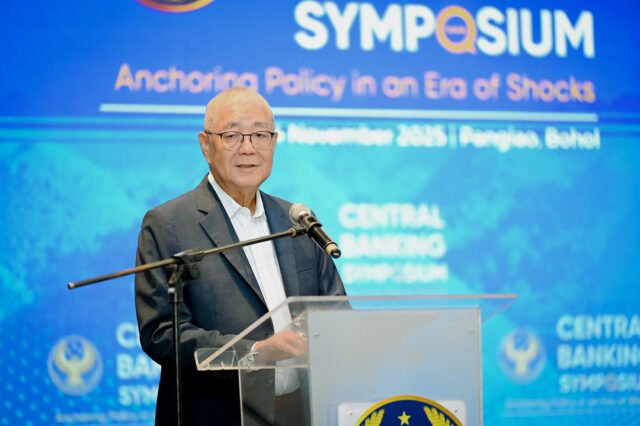
BANGKO SENTRAL ng Pilipinas Governor Eli M. Remolona, Jr. during the Central Banking Symposium in Panglao, Bohol on Nov. 24, 2025. -- Credit: Bangko Sentral ng Pilipinas
MANILA – Philippine central bank Governor Eli M. Remolona Jr. on Friday reiterated that policymakers face a “large element of uncertainty” which could complicate decision-making.
The Philippine central bank cut its key rate for a sixth straight time on Thursday to support growth.
Here are some key points from Remolona’s appearances on CNBC and One News.
  • Inflation is under control, giving the central bank “leeway to do something about growth”.
  • The central bank watches the Philippine peso, but it does not worry about day-to-day volatility.
  • There are risks to inflation, but the probability of risk factors materialising is low.
  • Uncertainty stems from how fast confidence in the economy will return.
  • “We are at the point where monetary policy cannot do much more, but things are very uncertain.”

— Reuters

ADVERTISEMENT
ADVERTISEMENT