The ships that move global trade are going electric
By David Fickling
IN JULES VERNE’s classic Twenty Thousand Leagues Under the Sea, Captain Nemo’s futuristic submarine, the Nautilus, is battery-powered. Electric shipping has remained science fiction ever since.
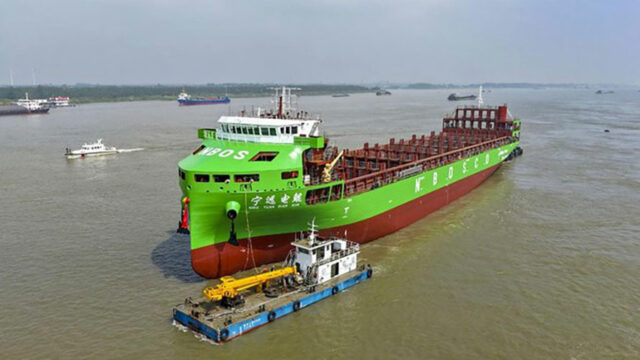
That might be about to change, though. The Ning Yuan Dian Kun, an electric container ship capable of carrying 740 20-foot-equivalent units or TEUs*, was delivered earlier this month. Its 10 containerized batteries hold as much charge as 380 Tesla Model 3s, and can either be swapped at port or charged from shore-based cables.
If you follow the shipping industry, 740 TEUs might seem pretty paltry. The size record is currently held by the MSC Irina, launched in 2023 and carrying 24,346 units, almost 33 times as many as the Ning Yuan Dian Kun. Until batteries compete on that scale, they can be safely ignored.
Well, not quite. While mega-container ships are the workhorses of global trade, essential for connecting major ports such as Shanghai, Rotterdam, Long Beach, and Singapore, they’re not for every harbor. Their sheer size excludes them from the thousands of smaller docks that still take container deliveries. Much of the work of the biggest freight hubs comes not from unloading metal boxes to roads and railways, but sorting them onto smaller feeder vessels for delivery to lesser ports.
Many of these feeders are a lot more diminutive than you’d think. Just over half the global container fleet is below 3,000 units, the generally accepted upper limit for this kind of vessel. The average size of all the ships that docked at ports during 2023 is 3,618, according to the United Nations trade and development agency, UNCTAD. As with small passenger jets like the Boeing Co. 737 and Airbus SE A320, their use on short, high-frequency routes means they’re arguably more important as the backbone of the global transport network compared to glitzier, larger vessels.
That means they’re also significant contributors to marine pollution. In a typical year, about half of emissions from container shipping come from vessels carrying less than 8,000 TEUs, with about a fifth below 3,000, according to Xeneta, an intelligence platform for the freight industry.
That’s a long way above the Ning Yuan Dian Kun’s 740 units. But other shipbuilders are moving in the same direction.
Norway’s Eitzen Group last year received $19 million from a government innovation fund to build two 850-box battery vessels. The 120 TEU Yara Birkeland, operated by Norwegian fertilizer company Yara International ASA, has been plying the waters between Herøya and Brevik since 2022. Cosco Shipping Holdings Co.’s Greenwater 01, working a river route from Shanghai to Nanjing, was launched in 2024 and can carry 700 units under electric power.
One 2024 study found that reductions in battery costs plus a carbon price would be sufficient to allow such battery vessels to start undercutting combustion engines on routes of less than 1,000 kilometers or even 2,500 kilometers. Beyond that, the weight of batteries still eats too deeply into cargo space to make the numbers work.
That doesn’t mean there’s no role for batteries. Any route to decarbonizing shipping will involve multiple innovations working side-by-side. As much as 30% of ship fuel is burned to provide energy in port. Work on avoiding that pollution by plugging moored vessels into the grid is already underway in Europe, North America, and China, where the Yangtze river, a major internal freight artery, has been working to electrify its docks for several years. LNG, methanol, and ammonia are starting to displace marine fuel oil and diesel, with about half of the industry’s order book capable of running on alternative fuels.
Such initiatives are worthwhile. Shipping accounts for about 3% of global emissions, similar to all the aircraft in the sky. Despite the US government’s aggressive efforts to block or delay a global carbon price at the United Nations shipping agency, the International Maritime Organization, the industry itself wants to cut its climate footprint. Fuel accounts for about half of voyage costs, so operators have a strong incentive to adopt any technologies that can reduce it.
So far, batteries are only playing a small part in that picture — but as with trucking, a segment of the freight industry that was long thought immune to electrification is now giving way. The modular, container-housed power plants currently being trialed in China and Norway offer the perfect opportunity for companies to learn how to make that work, and scale quickly if the economics make sense.
With each passing year, batteries get cheaper, lighter, and more powerful. You’d be wrong to underestimate their potential to change the world.
BLOOMBERG OPINION
*The TEU is the standard measure in freight shipping, equivalent to half the size of a conventional container box.