Home Blog Page 2640

Bill granting VAT refund for non-resident visitors approved in Senate on final reading

PHILSTAR FILE PHOTO

THE SENATE on Monday approved on third and final reading a bill that seeks to establish a value-added tax (VAT) refund mechanism for nonresident visitors.

Twenty senators voted in favor of Senate Bill No. 2415, allowing eligible tourists to avail of VAT refunds for local purchases of goods worth at least P3,000. The House of Representatives approved a counterpart bill on third and final reading in March 2022.

Senate Minority Leader Aquilino Martin Pimentel III voted against the bill, saying that the Philippines was better off improving the tourist experience and tax administration.

“We have already lost billions in revenue due to these inefficiencies, compounded by ghost receipts, fraud, and an exemption-plagued tax system,” he told the Senate floor after his vote.

“There are far more important matters pending before this august body that deserve our attention and prioritization.”

Citing a 2018 World Bank study, he said the Philippines has lost about P539 billion in potential revenue due to VAT leakages and exemptions.

Enrico P. Villanueva, a senior lecturer at the University of the Philippines Los Baños Economics Department, said the system could be used to promote the Philippines as a premier shopping destination in Southeast Asia, but added that the government should partner with the private sector to boost tourist transportation and infrastructure.

“It is really more of a bonus rather than a primary factor in enticing tourists,” he said in an X message. “There are more important factors that the Tourism department should look into to enhance the value proposition of the country as a destination.”

“By allowing foreign visitors to claim VAT refunds on goods they purchase in our country, we create an environment that not only attracts more tourists but also encourages them to spend more on our products, which will eventually be taken out of the country,” Senator Sherwin T. Gatchalian, who sponsored the measure, told the Senate floor following its approval. — John Victor D. Ordoñez

5 regions selected for 7-year agri climate resilience project

PHILIPPINE STAR/KRIZ JOHN ROSALES/PPA POOL

THE Department of Agriculture (DA) said that its $39.2-million climate resiliency program will operate in five vulnerable regions, benefiting 1.25 million farmers.

In a statement, the DA said the seven-year Adapting Philippine Agriculture to Climate Change (APA) project will promote “the adoption of climate-resilient farming practices, empowering farmers to establish sustainable enterprises.”

Within the five regions, which are the Cagayan Valley, the Cordillera Administrative Region, Bicol, Northern Mindanao, and Soccsksargen, the project will roll out across nine provinces and 100 municipalities.

The project is a partnership with the Food and Agriculture Organization (FAO) and the government weather service, known as PAGASA (Philippine Atmospheric, Geophysical and Astronomical Services Administration).

“Our combined efforts in implementing the APA Project will strengthen the foundation of progressive and resilient communities that we have begun through our various climate-resiliency-building initiatives,” Agriculture Secretary Francisco P. Tiu Laurel, Jr. said.

FAO Country Representative to the Philippines Lionel Henri Valentin Dabbadie said that the project will have long-term benefits for vulnerable farmers.

“It’s about creating opportunities for growth in the fields and through agricultural enterprises, ensuring that future generations continue to benefit from the rich agricultural heritage of the Philippines,” Mr. Dabbadie added.

The DA said that the program would expand on its Adaptation and Mitigation Initiative in Agriculture Program.

The project is financed under a Green Climate Fund grant amounting to $26.3 million with additional funding from the Philippine government of $12.9 million. — Adrian H. Halili

FinTech Alliance eyes opportunities provided by Konektadong Pinoy bill

THE passage of the Konektadong Pinoy (or Open Access in Data Transmission) bill will allow broadband infrastructure development in rural areas, thereby increasing access to transaction accounts, FinTech Alliance.PH said.

In a statement on Monday, FinTech Alliance.PH said the passage of the measure will help the Bangko Sentral ng Pilipinas (BSP) achieve its goal of bringing access to transaction accounts to 70% of adults.

“The Konektadong Pinoy bill is poised to be a crucial policy enabler, ensuring that every Filipino, regardless of their location, gains access to financial technology,” according to Angelito M. Villanueva, founding chairman of FinTech Alliance.PH.

The BSP’s recent financial inclusion survey indicates that 70% of salaries in the private sector are still paid in cash.

The central bank hopes to increase online payments to 60-70% of all retail transactions by volume by 2028, in line with the Philippine Development Plan.

In July, the BSP reported that digital payments made up 52.8% of retail transaction volume last year.

According to FinTech Alliance.PH, the bill will help provide access to affordable, reliable, and secure internet connections, which is vital to the adoption of digital payments.

“The Konektadong Pinoy bill seeks to bridge the digital divide by encouraging the entry of more internet service providers (ISP) to improve service quality,” it said.

“It also includes consumer protection provisions, such as ISP performance standards and enhanced cybersecurity safeguards, which are not present in current laws,” it added.

Identified among the priority bills of the Legislative-Executive Development Advisory Council, the Konektadong Pinoy bill aims to simplify the approval process for network operators, promote efficient management of the radio spectrum, and promote sharing of infrastructure.

The House of Representatives passed a version of the measure on third reading in December 2022, while its Senate counterpart, Senate Bill No. 2699, is currently set for floor debate. — Justine Irish D. Tabile

Safety monitoring at construction sites to undergo streamlining — Labor dep’t

PHILIPPINE STAR/RUSSELL PALMA

THE Department of Labor and Employment (DoLE) said it and other agencies hope to streamline safety monitoring at construction sites after setting the guidelines for a joint administrative order (JAO).

On Monday, DoLE, together with the departments of Public Works and Highways, Transportation, and Trade and Industry, through the Construction Industry Authority of the Philippines (CIAP), signed the guidelines for implementing JAO No. 1, Series of 2022.

The JAO promotes the welfare of construction workers. It updates JAO No. 01 Series of 2011 with additional provisions related to public health emergencies.

“The guidelines outlined in the JAO ensure that the construction industry remains compliant with the prevailing safety and health standards, protecting workers from undue risks and hazards,” according to the JAO.

“This is particularly essential in terms of crises when the health and safety of our workforce become even more vulnerable,” it added.

DoLE Bureau of Working Conditions Director Alvin B. Curada said that the JAO aims to ensure that all construction companies are compliant with labor law, especially on occupational safety and health standards.

In particular, he said that the JAO will help DoLE identify which projects to inspect first after evaluating data from the various partner agencies.

“This JAO will (help identify) the projects that we need to prioritize. Because we (the agencies) have lists of registered establishments and ongoing projects. From there you can easily target which are the vertical construction projects where many of the accidents happen,” Mr. Curada told BusinessWorld on the sidelines of the signing ceremony.

“Those will be the priorities. While we cannot cover everything due to limited resources, (the JAO) will help us focus on where, when, and who to inspect because of the sharing of information,” he added.

Liberito V. Espiritu, chairman of the CIAP-Philippine Domestic Construction Board, said the updated version of the JAO includes the implementing guidelines to be followed by each agency.

He added that the JAO will also help make the construction industry more competitive, bringing it in line with worker safety practices in other countries.

“In other countries, they prioritize safety … So we should also prioritize safety,” he said. — Justine Irish D. Tabile

PAGCOR revises distribution of bingo revenue

PHILIPPINE STAR/KRIZ JOHN ROSALES


PHILIPPINE AMUSEMENT and Gaming Corp. (PAGCOR) said it has increased its distribution of proceeds from its bingo games to 50% from 40% previously.

The old 40% payout level went to local government units and non-governmental organizations from ticket sales generated by its ‘Bingo for a Cause’ program, PAGCOR said in a statement.

“The revised bingo package will give our partners the option to sell tickets from as low as P100 to P1,000 each, depending on the package that they choose,” PAGCOR Assistant Vice-President Maria Teresa D. Ocampo said in the statement.

The proceeds may also increase depending on the volume of ticket sales, she said.

The ‘Bingo for a Cause’ program, formerly known as the Mobile Bingo Project, aims to crowd out illegal bingo games and promote PAGCOR as a supporter of community development.

It also seeks to establish a “mutually beneficial” relationship with socio-civic groups and empower the latter to be self-sustaining via state bingo revenues.

Ms. Ocampo said the government’s bingo program gives the public the opportunity to participate in “lawful” bingo games “while contributing to worthy causes.”

“Like any game of chance, only PAGCOR has the mandate to authorize bingo activities; hence bingo games without PAGCOR’s permission are illegal,” Ms. Ocampo added.

In the second quarter, PAGCOR reported a 19.83% year-on-year decline in revenue from bingo operations to P4.69 billion. Bingo revenue also fell 2.49% from the first quarter.

Gross gaming revenue in the three months to June rose 32.32% to P89.23 billion, led by electronic games. — Beatriz Marie D. Cruz

Unilever to offer grants to groups addressing plastic pollution

ANGELES CITY INFO OFFICE

UNILEVER said it and its partners have established an organization to issue grants to Philippine organizations engaged in plastic waste collection, processing, and recycling.

In partnership with the US Agency for International Aid, and Ernst and Young Global Ltd., Unilever-founded Catalyzing Inclusive, Resilient, and Circular Local Economies or the CIRCLE Alliance will fund qualified enterprises.

“CIRCLE’s collaborative model of enterprise acceleration — delivered through a mix of grant funding and bespoke business support — will help scale both new and existing solutions for packaging circularity, whether that’s driving collection and recycling, or reuse–refill models,” according to Rebecca Marmot, chief sustainability officer and member of the Unilever Leadership Council.

“Crucially, it will support small- to medium-sized enterprises (SMEs) and entrepreneurs that offer impactful, market-based solutions but are currently too small to work at the scale we need,” she added.

Aside from grants, Unilever also has the Misis Walastik (Wise on Plastic) program which aims to address plastic pollution in Metro Manila and nearby provinces.

“The momentum for solutions and collaborations to help fix the plastic waste issue is gaining even more speed,” CIRCLE Alliance Lead for Southeast Asia and Philippines Sustainability Lead Rondell Torres said.

“With the Circle Alliance across Southeast Asian countries like Indonesia, the Philippines, and Vietnam, Unilever is putting its expertise and networks to help build a fair and equitable circular economy for plastics in the Philippines and hopefully across Southeast Asia,” he added.

Aside from the Philippines, CIRCLE Alliance will also offer grants to enterprises in South and Southeast Asia.

“Unilever believes that the CIRCLE Alliance will make a meaningful impact and create value for emerging circular solutions and recognizes the socioeconomic impact of the plastics value chain,” the company said.

Enterprises planning to apply for CIRCLE Alliance grants can send in their applications until Oct. 4. — Justine Irish D. Tabile

Transfer pricing considerations in cash pooling arrangements

According to the Organisation for Economic Cooperation and Development (OECD), the use of a cash pool is popular among multinational enterprises as a way of achieving more efficient cash management by bringing together, either physically or notionally, the balances of a number of separate bank accounts. A cash pool can generally aid in improving liquidity management, reducing reliance on external borrowing or, where there is a cash surplus, enhancing returns on any aggregated cash balance. Financing or banking transaction costs may also be reduced.

WHAT IS CASH POOLING?
The OECD guidelines define cash pooling as the pooling of cash balances as part of a short-term liquidity management arrangement, with the purpose of optimizing the overall cash position of a group of companies. Depending on the arrangements, cash pooling is generally structured into physical pooling and notional pooling.

Physical pooling involves consolidating multiple cash accounts into a cash pool or a centralized account, wherein any cash deficits and surplus are managed through fund transfers to and from the centralized master account and the sub accounts. Notional pooling, on the other hand, does not involve any physical fund transfers between accounts. Rather, it involves the consolidation of credit and debit balances of separate bank accounts into a central account for the purpose of interest calculations.

In a typical cash pooling arrangement, there is a cash pool leader and its cash pool members. The cash pool leader owns and manages the centralized master account under physical pooling, as well as the central account for interest determination under notional pooling. The cash pool members are the subsidiaries or the business units of the group of companies, which can either function as cash pool borrowers or cash pool depositors.

To illustrate, a parent company sets a central cash account, with the parent  acting as the cash pool organizer or cash pool leader. In some cases, one of the subsidiaries functions as the cash pool leader, depending on the needs of the group of companies. Both the parent company and the subsidiaries can deposit or borrow funds within a specific period, wherein interest is generally charged.

WHAT ARE THE TRANSFER PRICING IMPLICATIONS OF CASH POOLING?
Cash pooling is a form of internal financing among related parties and, as such, can be subject to several potential transfer pricing challenges, particularly when it involves multiple tax jurisdictions. According to the OECD guidelines, the possible transfer pricing implications are as follows:

Accurate delineation or characterization of cash pooling transactions

The accurate characterization of the cash pooling transactions will depend on the particular facts and circumstances of each case as well as the wider context of the conditions of the pooling arrangement as a whole. For example, a cash pool is likely to differ from a straightforward overnight deposit with a bank or similar financial institution in that a cash pool member with a credit position is not depositing money as a transaction in isolation with a view to a simple depositor return. Pool participants deposit cash to the pool (or withdraw cash from the pool), and not to (or from) a particular cash pool member.

The absence of a formal agreement does not preclude the proper determination of the actual nature of the transaction. If the transaction is not aligned with the short-term deposit of excess capital and short-term borrowing, the cash pool arrangement would possibly be treated as a term loan, a longer-term deposit, a dividend distribution, or a mixture thereof.

In a case involving a company and the tax authority of Switzerland, the company entered into a physical cash pooling arrangement for short-term financing, with the company’s sister company a the cash pool leader. Due to its nature and terms, the Court ruled that the cash pooling agreement was a mix of long-term loan and short-term cash pooling arrangements, due to the nature and terms therein. As such, the interest rates should be recomputed to represent both transactions.

Considering the complexity of cash pooling, accurately identifying the circumstances surrounding the transaction is critical in determining whether it should be treated as a cash pool or another type of transaction.

• Rewarding the cash pool leader function

The appropriate renumeration for the cash pool leader depends on the facts and circumstances, functions performed, assets used, and the risks assumed in facilitating a cash pooling arrangement.

In general, a cash pool leader performs no more than a co-ordination or agency function, with the master account being a centralized point for a series of book entries to meet the pre-determined target balances for the pool members. Given such a low level of functionality, the cash pool leader’s remuneration as a service provider will generally be similarly limited.

In the case involving a group of companies and the tax authority of Denmark, two subsidiaries of the group entered into a physical cash pooling arrangement in which the Danish subsidiary was required to deposit surplus funds in the cash pool and was allowed to borrow funds when needed, while the Swiss subsidiary was appointed cash pool leader, handling the creation of the cash pool account, accounting and maintaining documentation of the intercompany accounts, computing the monthly interest rate, and overseeing liquidity and risk management. In the year under tax audit, the Danish subsidiary was in a lender position and the Swiss subsidiary was performing routine administrative functions. The tax authority of Denmark and its Court ruled that the Danish subsidiary should earn a higher return to reflect its risk as a lender, while the Swiss subsidiary should earn a lower return to reflect its routine administrative functions.

Rewarding the cash pool members

The remuneration of the cash pool members will be calculated through the determination of the arm’s length interest rates applicable to the debit and credit positions within the pool. This determination will allocate the synergy benefits arising from the cash pool arrangement among the pool members, and it will generally be done once the remuneration of the cash pool leader has been calculated. Eventually, the remuneration of the cash pool members will depend upon the specific facts and circumstances and the functions, assets, and risks of each of the pool members.

For instance, in the case involving a group of companies and the tax authority of Norway, two subsidiaries of the group entered into a physical cash pooling arrangement with the group’s treasury company, under which the cash pool members deposited surplus cash in multiple currencies to a third-party bank. The bank accounted the cash pool members’ deposits and withdrawals as one account per currency type and imposed different interest rates, depending on the net cash position. In the year under tax audit, both subsidiaries earned interest income under the same interest rate on deposits. The tax authority of Norway and its Court ruled that the interest rate earned by the two subsidiaries should be divided based on their respective actual contributions.

KEY CONSIDERATIONS IN AN ARM’S LENGTH CASH POOLING ARRANGEMENT
Factoring in the complexity of cash pooling and its possible transfer pricing implications, the following are key considerations in setting up an arm’s length cash pooling arrangement:

1. Analyze the characterization of the cash pooling arrangement to properly classify the transaction.

2. Map out the functions, risks, and other underlying factors of the cash pool leader and each of the cash pool members to identify the appropriate rewards.

3. Determine the appropriate transfer price (e.g., interest rate) of the cash pooling arrangement.

4. Document the cash pooling arrangement through a financing policy, cash pooling agreement, transfer pricing documentation, and other supporting documentation, to provide sufficient evidence during tax controversies.

Let’s Talk TP is an offshoot of Let’s Talk Tax, a weekly newspaper column of P&A Grant Thornton that aims to keep the public informed of various developments in taxation. This article is not intended to be a substitute for competent professional advice.


Sheena Marie Daño is a director of the Tax Advisory & Compliance Practice Area at the Davao office of P&A Grant Thornton. P&A Grant Thornton is one of the leading audits, tax, advisory, and outsourcing firms in the Philippines, with 29 Partners and more than 1000 staff members.

pagrantthornton@ph.gt.com

www.grantthornton.com.ph

Philippine women’s team finishes at 24th, captures gold in Group B

FILIPINAS enjoyed their Group B gold. medal.

Men’s group falls to 59th place

BUDAPEST, Hungary — At 49th place and grasping at straws with two rounds to go, the Philippines was praying for the stars to align.

It did.

Willing their way out of oblivion, the Filipinas bravely took out their last two foes including the Brazilians in a 4-0 victory in the 11th and final round on Sunday, and with everything falling into place, achieved so many milestones in the 45th FIDE Chess Olympiad that concluded at the BOK Sports Hall.

Shania Mendoza, Janelle Mae Frayna, Jodilyn Fronda and Ruelle Canino all prevailed across all four boards to power the Filipnas to a share of 22nd with 14 others with 14 match points apiece and eventually 24th overall after tiebreaks were computed.

It proved enough to snare the country, seeded 47th entering the 11-round tournament, the gold medal in Group B, confined to the 35th to the 70th ranked countries based on rating in this 181-nation field, ahead of Montenegro and Latvia.

The gold was first for the Philippines, which also has Bernadette Galas at last board, since the team of Sheerie Joy Lomibao, Catherine Pereña, Sherily Cua and Beverly Mendoza took the gold in Group C in the 2006 Turin edition.

It was also its best finish since the brave troika of Girme Fontanilla, Mila Emperado and Ma. Cristina Santos Fidaer performed magnificently at 22nd place in 1988 in Thessaloniki, Greece.

“It will be a legacy in Philippine chess that will be remembered for a long time,” said national women’s team coach Grandmaster Jayson Gonzales, who thanked the Philippine Sports Commission, the NCFP chief Butch Pichay, delegation head Atty. Ruel Canobas, women’s manager Atty. Nikki de Vega, Far Eastern University chair Aurelio Montinola III for their support.

It all came to fore after the heavens smiled on the Filipinas.

Sixth only in the Category B race entering the final round, Iran, the erstwhile leader, defaulted its game against Israel due to political reasons, and the other countries ahead of the Philippines, either fell and drew itself out of the hunt.

Then, with just four countries left to contend with, the Filipinas outpointed each and everyone in tiebreaks to hammer in the final nail in the coffin.

Interestingly, all five members earned rating points with Ms. Canino, the 16-year-old pint-sized spectacle from Cagayan de Oro and FEU, gaining the most with 102 whopping points after scoring six out of eight points right on his debut.

She will rise from 2004 to 2260, which will include the rating point (rps) she raked in following her impressive stints in several tournaments in Europe a couple of months before.

Also earning pluses were Mses. Mendoza (36.2 rps), Frayna (27.8 rps), Galas (8.8 rps) and Fronda (0.6 rp).

The jubilation somehow drowned the sorrows of the country’s stinging 59th place ending in the open section where it scored 12 points.

But it could have been better as the Filipinos were staring at replicating, if not eclipsing, the country’s record seventh-place effort in the 1988 staging in Thessaloniki, Greece after jumping to a share of 15th place with two rounds remaining.

The heavens, however, didn’t smile on them like it did to the Filipinas as they lost their last two including a painful 3-1 defeat to host Hungary B in the last round.

In all, India harvested the open and women’s gold medals as well as the Gaprindashvili Cup, awarded to the country with the highest total score of the men’s and women’s teams combined.

But that gold by the country shone as bright as the ones brandished by the mighty Indians and should reverberate back home for a country longing for Philippine chess glory. — Joey Villar

Mapua Cardinals gun for share of NCAA lead against LPU Pirates

MAPUA UNIVERSITY CARDINALS — FACEBOOK.COM/NCAA.ORG.PH

Games on Tuesday
(Filoil EcoOil Arena)
11 a.m. – UPHSD vs SSC-R
2:30 p.m. – LPU vs Mapua

RESURGENT Mapua University shoots for a share of the lead with College of St. Benilde as it clashes with Lyceum of the Philippines University on Tuesday in NCAA Season 100 at the Filoil EcoOil Arena.

The Cardinals were a completely different bunch after dropping their opening day assignment against the Blazers and have strung together three straight wins since then including an emphatic 77-62 rout of the Colegio de San Juan de Letran Knights Friday.

While focus is expected to be on reigning MVP Clint Escamis, expect bulky rookie big man Chris Hubilla to steal some of the attention again after he dropped a solid 18-point and 12-rebound effort off the bench in their last triumph.

But Mapua knows it will not be a walk in the park as it will face an LPU side that was also coming off a streak that sent the letter from the bottom to the middle of the pace with an even 2-2 slate.

Game time is at 2:30 p.m.

Also eyeing to bolster their campaign are University of the Perpetual Help and San Sebastian College-Recoletos, which collide at 11 a.m.

The Altas hurdled the Emilio Aguinaldo College Generals, 73-67, Saturday that catapulted the former in a three-team logjam at No. 3 with Letran and San Beda University on 3-2 cards.

The Stags, in contrast, have fallen into the ravine after dropping the last three assignments including an 87-73 setback at the hands of the Arellano University Chiefs Sunday.

SSC-R fell from a share of the lead to joint seventh with EAC with 2-3 marks. — Joey Villar

Alyssa Thomas’ triple-double carries Sun past Indiana Fever, 93-69, in playoff opener

ALYSSA THOMAS — JOHN MAC-FLICKR

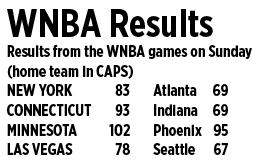
ALYSSA THOMAS recorded her WNBA-leading 15th career triple-double and fourth in the postseason as the Connecticut Sun overwhelmed the visiting Indiana Fever 93-69 in the opener of their best-of-three series on Sunday in Uncasville, Conn.

Thomas finished with 12 points, 13 assists and 10 rebounds, and Marina Mabrey led all scorers with a game-high 27 points off the Connecticut bench. Mabrey shot five of 12 from 3-point range, knocking down almost as many from beyond the arc as Indiana (six of 28) had as a team.

Indiana star Caitlin Clark, introduced as the unanimous 2024 WNBA Rookie of the Year, was  four of 17 from the floor, including two of 13 from 3-point range, and went to the foul line just twice (making one) for 11 total points. She also had a team-high eight assists.

Fever teammate Kelsey Mitchell had 21 points but was just two of 10 from distance, and center Aliyah Boston had a double-double with 17 points and 11 rebounds.

Connecticut’s DeWanna Bonner was seven-of-11 shooting from the floor for 22 points, grabbed six rebounds and dished five assists. DiJonai Carrington added 14 points and five rebounds.

After a closely contested first half, the Sun began to create some distance midway through the third quarter. After Clark knocked down a 3-pointer that pulled the Fever to within six points, Connecticut responded with a 13-4 run over the ensuing three minutes, building a double-digit-point lead that ballooned throughout the fourth quarter.

For the game, Connecticut shot nine of 18 from 3-point range and 36 of 73 overall (49.3%) from the floor. Indiana went 27-of-67 shooting (40.3%).

The loss spoiled Indiana’s first playoff game since 2016, when the coach was Stephanie White, now the Sun’s head coach.

The Fever surged in the second half of the regular season, but that includes losing the regular-season series against Connecticut three games to one. The Fever’s 69 points were their lowest total in five meetings with the Sun this season.

The Sun host the Fever on Wednesday, with Game 3, if necessary, on Friday in Indianapolis. — Reuters

Las Vegas Aces’ A’ja Wilson voted WNBA’s second unanimous MVP

LAS VEGAS ACES center A’ja Wilson on Sunday became the second player in WNBA history to be named unanimously as the league’s MVP.

Wilson, who also was awarded the MVP trophy in 2020 and 2022, received all 67 first-place votes, good for 670 points, from a media panel. She joined Cynthia Cooper as the lone players to be named the unanimous MVP, with the latter accomplishing the feat with the Houston Comets during the WNBA’s inaugural season of 1997.

Minnesota Lynx forward Napheesa Collier (467 points) finished second in the voting, followed by New York Liberty star Breanna Stewart (295 points), Indiana Fever rookie Caitlin Clark (130) and Connecticut Sun standout Alyssa Thomas (83).

Players were awarded 10 points for a first-place vote, seven for second, five for third, three for fourth and one for fifth.

Wilson joins Naismith Hall of Fame members Sheryl Swoopes (2000, 2002, 2005), Lisa Leslie (2001, 2004, 2006) and Lauren Jackson (2003, 2007, 2010) as the lone players to win the award on three occasions.

Wilson, 28, led the WNBA in scoring (26.9) and blocks (2.6) to go along with career-high season averages in rebounds (11.9) and steals (1.8). She was the first player in league history to record a 1,000-point season. — Reuters

Rams use frantic rally to slay 49ers

JOSHUA KARTY hit a 37-yard field goal with two seconds remaining and the Los Angeles Rams pulled off an improbable 27-24 victory over the visiting San Francisco 49ers on Sunday by scoring 13 points in the final six minutes, 15 seconds.

Matthew Stafford was 16-of-25 passing for 221 yards and a touchdown, while Kyren Williams ran for 89 yards and two scores on the ground, with one more receiving, as the Rams (1-2) ended a five-game home losing streak against the 49ers.

Tutu Atwell had four receptions for 93 yards as the Rams overcame two separate 14-point deficits.

Brock Purdy was 22-of-30 passing with 292 yards for the 49ers (1-2) and connected on three touchdown passes with Jauan Jennings, who had 11 receptions for 175 yards. Jordan Mason rushed for 77 yards for San Francisco.

After getting a 33-yard field goal from Karty with just over six minutes left to pull within 24-17, the Rams then went on a three-play 55-yard drive to score on a 3-yard run from Williams with 1:51 to play and tie the score at 24.

Los Angeles forced a San Francisco punt with under a minute to play and rookie Xavier Smith returned the kick 38 yards to the 50-yard line. A 49ers’ pass interference penalty moved the ball to the 19-yard line before Karty made the game-winner in his third NFL game.

Both teams were missing key offensive weapons. The 49ers were without running back Christian McCaffery (calf, Achillies), wide receiver Deebo Samuel (calf) and tight end George Kittle (hamstring). The Rams were without wide receivers Puka Nacua (knee) and Cooper Kupp (ankle).

The 49ers took the opening possession of the game and went 70 yards in eight plays, while taking a 7-0 lead on Purdy’s 13-yard TD pass to Jennings. After holding Los Angeles to a three-and-out, San Francisco got the ball back and went 77 yards in 13 plays, scoring on Purdy’s 4-yard strike to Jennings.

San Francisco went up 24-14 with 11:57 to play on a 26-yard field goal from Jake Moody. — Reuters

ADVERTISEMENT
ADVERTISEMENT