Home Blog Page 2627

Delays in landing imports also affecting shipments of meat
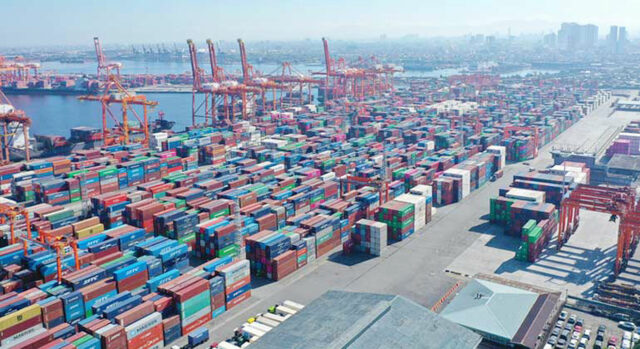
PHOTO COURTESY OF ICTSI

PORT CONGESTION is also delaying the unloading of frozen meat, an importers group said, potentially adding another imported commodity to the list of items that cannot be brought to market promptly to mitigate high prices.

“One of the reasons for port congestion is that the containers are not released and unloaded (immediately),” Meat Importers and Traders Association President Emeritus Jesus C. Cham said.

Last week, Agriculture Secretary Francisco P. Tiu Laurel, Jr. cited the need for more ports to fast-track the landing of imported farm goods.

Mr. Cham added that the requirement that shipments bear the seals of the National Meat Inspection Service, and the Bureau of Customs have also caused further delays.

“(Now) they are talking about pre-border inspection, cross-border electronic invoicing, and then you have the cold examination facilities in agriculture (CEFA), these are additional (requirements),” he said.

The CEFAs are intended to ensure that imports are disease-free, and to mitigate the risks from smuggled farm goods.

All imported agri-fishery products are to undergo a 100% examination by the various food regulators overseeing animal industry, plant industry, fisheries and aquatic resources, and meat.

Meat imports rose 9.64% by volume year on year in the first half, led by pork, chicken, and beef, the Bureau of Animal Industry (BAI) reported.

Shipments of imported meat amounted to 647.75 million kilograms during the first six months.

Mr. Laurel has cited the congested ports as delaying rice imports from reaching the market, blunting the intended impact of lower tariffs in containing rice prices.

Mr. Laurel had called for the Philippine Ports Authority to fast track the release of container vans stalled in Manila. About 888 shipping containers holding about 20,000 metric tons of rice have not yet been released.

“The delay in releasing the imported rice has raised concerns over food security, especially as the country faces ongoing inflation pressures,” the Department of Agriculture (DA) said in a statement.

In June, President Ferdinand R. Marcos, Jr. signed Executive Order No. 62 which lowered the tariff on imported rice to 15% from 35% until 2028, citing the need to stabilize rice prices. The order took effect in July.

“It is doubtful whether the 20 million kilos or 20,000 MT in the pier has any impact on prices. It is less than 4% of the 530,000 MT that arrived in the July-August at 15% tariff; 96% of the arrivals are already out in the market,” Federation of Free Farmers National Manager Raul Q. Montemayor said via Viber.

Rice imports have totaled 3.01 million MT as of Sept. 12, according to data from the Bureau of Plant Industry.

Leonardo A. Lanzona, an economics professor at the Ateneo de Manila, said that the delay in landing goods is due partly to importers waiting for more favorable prices.

“Importers seem to have contributed little to the price decreases as their goods are stuck in ports. If the government subsidizes the farmers, instead of lowering tariffs and improving port infrastructure, the rice producers and consumers are protected from these importers who wish to manipulate prices,” he said via Messenger chat.

Mr. Laurel has said that the DA is studying developing 17 ports with private partners that will specialize in handling agricultural shipments.

Mr. Montemayor added that prices could drop with the influx of palay (unmilled rice) during the dry season harvest.

 “It doesn’t make sense why they will hold on to these stocks when prices will foreseeably go down when new harvests come in,” Mr. Montemayor added.

“By January, we will have a lot of stocks because of the fresh harvests in September-November, plus imports at 15% (tariff).Prices will go down even without the tariff cut, not because of it,” he said.

The DA has said that the lower tariffs on rice would lead to a P5 to P7 per kilogram drop in imported rice prices. The impact on prices is expected to start showing up in mid-October, but more significant effects could be seen by January. — Adrian H. Halili 
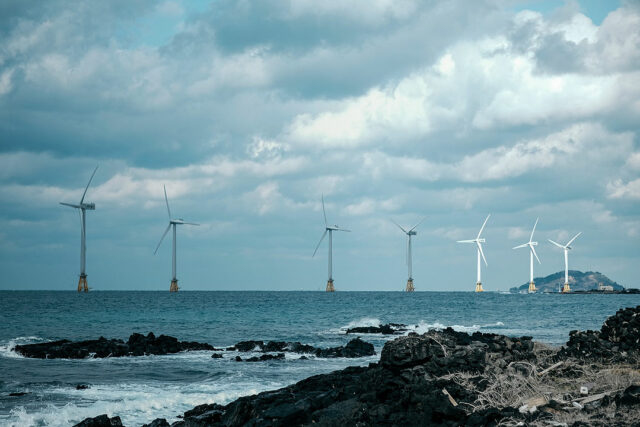
Initial work starts on preparing three ports to serve offshore wind farms

STOCK PHOTO | Image by Insung Yoon from Unsplash

THE Philippine Ports Authority (PPA) has kicked off the process of repurposing three ports to service the nascent offshore wind (OSW) industry, according to the Department of Energy (DoE).

“The PPA has formally expressed its full support to the DoE to initiate the detailed engineering designs and take immediate steps to repurpose three priority ports to ensure that they are fully equipped to handle the installation, commissioning, and operational requirements of OSW projects,” the DoE said in a statement on Sunday.

The DoE has identified the Port of Currimao in Ilocos Norte, Port of Batangas in Sta. Clara, Batangas City, and Port of Jose Panganiban in Camarines Norte as priority sites due to their proximity to high-potential offshore wind energy service contracts (OWESCs).

The Port of Currimao is located near 13 OWESCs with a potential capacity of 9,489 megawatts (MW). Of the total, three service contracts are in the “advanced pre-development stage.”

The port in Batangas is close to 29 OWESCs with a total capacity of 24,300 MW, with six contracts in the permitting, licensing, and data gathering stages.

Situated close to 14 OWESCs, the Port of Jose Panganiban is expected to service wind farms with estimated capacity of 8,150 MW. Two projects in the area are in the advanced pre-development phase.

“The modernization of port facilities will not only accelerate OSW projects but also play a critical role in securing the country’s clean energy future and promoting economic growth,” Energy Secretary Raphael P.M. Lotilla said.

Mr. Lotilla said that the ports will serve as “vital logistical hubs” throughout the lifecycle of the offshore wind projects — from installation to commissioning and decommissioning.

Upgrading these facilities will ensure that the Philippines is prepared to satisfy the increasing demands of OSW, which should yield “significant contributions to energy security and economic stability,” he said. 

“The PPA (is) committed to working closely with the DoE to ensure the completion of port infrastructure upgrades and to help usher in a cleaner, more sustainable energy future for the country,” PPA General Manager Jay Daniel R. Santiago said.

Mr. Santiago said that the PPA will be responsible for carrying out the feasibility study and infrastructure development at the three ports.

To date, the DoE has awarded 92 offshore wind energy service contracts to 38 renewable energy developers with a total potential capacity of 66.101 gigawatts (GW).

According to the Philippine Offshore Wind Roadmap, the Philippines has a potential capacity of about 63 GW if it taps offshore wind resources. — Sheldeen Joy Talavera

BCDA, S. Korean agency in Clark development tie-up

NEW CLARK CITY

THE Bases Conversion and Development Authority (BCDA) has entered a partnership agreement with South Korea’s National Agency for Administrative City Construction (NAACC) to develop New Clark City in Capas, Tarlac.

Under the partnership, BCDA and NAACC will collaborate in urban planning, smart city development, green energy, and smart administrative systems for the 9,450-hectare project.

“We at BCDA are very fortunate to have NAACC as our partner to facilitate knowledge exchange and link us with experts who can help us transform New Clark City as the Philippines’ alternative National Government hub,” BCDA President and Chief Executive Officer Joshua M. Bingcang said in a statement sent over the weekend. 

“Through this memorandum of understanding, we wish to replicate the successes and apply the lessons learned by Korea in relocating administrative agencies and national research and development (R&D) institutes to its administrative capital, Sejong City,” he added.

South Korea, through NAACC, set up satellite government administrative centers outside the capital to help ease congestion and overpopulation in metropolitan areas, which the BCDA hopes to emulate in New Clark City. 

“We hope that Korea’s experience in building the Administrative City will be helpful in transforming your former military base into a dynamic and vibrant new city,” NAACC Administrator Hyeong Ryeol Kim said.

Sejong is home to 40 central administrative agencies and 15 national research and development institutes.

The BCDA plans to host government agencies, housing projects, and sports facilities in its National Government Administrative Center (NGAC) in New Clark City.

In particular, the BCDA has engaged the Philippine Space Agency, the Bangko Sentral ng Pilipinas, the National Academy of Sports, and the Department of Science and Technology to put offices and key infrastructure in NGAC.

The signing of the agreement between BCDA and NAACC was conducted on the sidelines of the Global Infrastructure Cooperation Conference in Korea, in which the BCDA pitched investment opportunities in renewable energy, clean transportation, and smart city development. — Justine Irish D. Tabile

Harvard, MIT graduates with Filipino roots pioneer blockchain platform

Art Abal and Anna Kazlauskas

Data is the lifeblood of artificial intelligence (AI), enabling learning and decision-making. Yet, as AI advances, accessing data becomes increasingly challenging. The rise of AI has led to a future where our data is controlled by a few tech giants operating within their own controlled environments.

Two brilliant minds, Art Abal and Anna Kazlauskas, with their Filipino roots, are reshaping the future of data. Their vision is clear: create a system where no single entity holds control, ensuring data remains a tool for empowerment.

As graduates of Harvard and MIT, they co-founded VANA, a startup that will value each person’s digital footprint with the use of blockchain technology, and they are committed to overcoming every hurdle, establishing a new benchmark for future generations.

Mr. Abal was born in Iligan to native Cebuano parents, and his journey spans from the high-rise offices of a global law firm to the vibrant coffee farms of Colombia, merging technology with human connection and impact along the way. Now, as the COO of VANA, he is on a mission to reshape how technology and society influence each other in this age of AI.

Having started out as a corporate lawyer, Mr. Abal developed a keen insight into the complex ways in which law and data interact, along with the societal effects AI might have. Working at Appen, he managed impact sourcing-finding innovative ways to power AI, focusing on human-centric solutions. Moving to Harvard, his work at the Belfer Center has deepened his interest in the potential of AI to transform societal structures.

Key moments came when he started advising the Prime Minister of Timor-Leste on policy and legal matters, and when he helped Nespresso in Colombia rethink data’s role in measuring the impact of supply chain practices on local communities.

Through his career, Mr. Abal has confronted the real-world implications of governance, data rights, and technology’s impact on society. This is where Ms. Kazlauskas, whose mother is from Pampanga, steps in.

With her solid foundation in Computer Science and Economics from MIT, she has been raising the profile of Tarlac Province while always being at the forefront of pushing the boundaries in blockchain and AI.

Ms. Kazlauskas has always viewed the world through data since childhood, at one point, she even created a program that transformed US inflation data into a song.

She has a wide range of experiences. At Celo, Ms. Kazlauskas worked on blockchain solutions focused on financial inclusion, embodying a people-first tech philosophy. And when she interned at the World Bank, she was eager to model various data but noticed other interns spending their summer sorting documents. Seeing an opportunity, she automated the task, which led to the founding of her first company, Iambiq, eventually bringing her to the prestigious YCombinator.

Additionally, Ms. Kazlauskas’ experience in Ethereum crypto mining and her work with central banks and international organizations from 2014 to 2017 were dedicated to connecting technology with financial policy. This complements Mr. Abal’s insights into governance and data rights. Together, they leverage their diverse experiences to bring more people and data into a truly inclusive space, which led to the creation of VANA.

Founding VANA

The journey of both VANA founders began in a class at the MIT Media Lab focused on building technology for emerging markets. Driven by a shared mission to uplift communities often neglected by AI’s rapid growth, they launched TOCA, a project aimed at involving people in low-income areas by having them label data using their phones.

The success of TOCA’s launch in Cebu and Manila demonstrated the Philippines’ potential to bridge the AI divide. However, their studies at MIT took priority, putting TOCA on hold, but this pause allowed them to refine their vision.

After completing their studies, the founders launched VANA, a bold venture aimed at revolutionizing data ownership. This decentralized platform enables users to reclaim their data and carry it across applications.

Derived from ‘Nirvana,’ VANA seeks to be the premier digital playground for AI, creating relationships and economic activity free from Big Tech’s control. The business of decentralizing data certainly attracted the attention of some of the leading crypto VCs, with Paradigm and Polychain backing the pair right off the bat.

Rooted in the Filipino heritage of its founders, VANA is committed to empowering Filipinos with full control over their data, allowing them to benefit directly. As AI development faces constraints due to a lack of fresh, high-quality data, VANA presents a novel solution. The platform’s ethical data sourcing, with user consent, promotes fairness and embodies Filipino values of community and integrity.

Built on blockchain technology, VANA gives individuals control over their data, enhancing AI while preserving privacy. The platform has seen global success, with initiatives like the Reddit Data DAO drawing over 140,000 participants in a week, showing how people are fed up with platforms exploiting their data without permission.

In the Philippines, VANA’s technology allows AI to better understand local cultures and languages, creating more inclusive technologies that genuinely represent the community.

As the next chapter of AI unfolds, VANA is set to lead the charge, ensuring that individuals, rather than corporations, control their digital identities. For Mr. Abal and Ms. Kazlauskas, their drive is not just about building a tech company but about empowering Filipinos in a rapidly changing world.

“This is one direct way in which Filipinos can really participate in this emerging data economy,” Mr. Abal said.

Monde Nissin donates scholarship, research grant to UP Los Baños

Monde Nissin Corp. has partnered with the University of the Philippines Los Baños (UPLB) to offer a scholarship and research grant program aimed at developing future leaders in sustainability and food security.

The partnership was sealed through a Memorandum of Agreement (MoA) signing at UPLB’s BM Gonzalez Hall, with key officials from both parties present. Monde Nissin was represented by Corporate and Government Affairs Head Atty. Olive Misa, Public Affairs Head Marc Joseph Alejo, and Regulatory Affairs Head Charina May Tandas. UPLB’s delegation included Chancellor Dr. Jose V. Camacho, Jr.; Dr. Jennifer Amparo, dean of the College of Human Ecology; and Dr. Elpidio Agbisit, Jr., dean of the College of Agriculture and Food Science.

The Monde Nissin Sustainability and Food Security Scholarship will support six undergraduate students, three master’s students, and three PhD students per year from August 2024 to August 2027. The scholars will come from the College of Human Ecology and the College of Agriculture and Food Science, fields that are at the forefront of research on sustainability, food systems, and nutrition.

The program is part of Monde Nissin’s broader commitment to addressing critical food security challenges.

“As a leading food company in the Philippines, Monde Nissin hopes to leverage innovation and technology to tackle food security head-on. We believe that food security and nutrition are essential foundations for a sustainable future. This scholarship program is an investment in the future of our nation,” Atty. Misa said.

Dr. Camacho welcomed the partnership, emphasizing its importance to the university. “Napakalaking bagay na nagtutulungan po tayo upang makapagbigay ng suporta sa aming mga estudyante, hindi lamang po sa pagpopondo ng pag-aaral (It’s important that we work together to support our students, not only through funding their studies), but in addition to that, when you employ them as productive members of society,” he said.

The scholarship will provide students with a comprehensive package, including monthly living allowances and book stipends for undergraduates; and research grants, thesis support, and publication incentives for graduate students. Research funding will also be made available for projects related to food safety, sustainable food systems, and community nutrition, areas identified as key priorities.

Water companies to see ‘stable’ second half — analysts

BW FILE PHOTO

By Sheldeen Joy Talavera, Reporter

WATER companies are expected to perform steadily in the second half as industrial and commercial demand remains stable despite cooler weather, an analyst said.

“Despite the cooler weather during the ‘ber’ months, demand is likely to remain stable due to the consistent need for water in industrial and commercial sectors, which continue to operate at high capacity,” Jayniel Carl S. Manuel, an equity trader at Seedbox Securities, Inc., said in a social media message last week.

Mr. Manuel said that as the Philippines recovers from the pandemic, construction projects — including housing developments and infrastructure — are picking up, leading to a steady demand for water supply.

“Government support for public-private partnerships in the water sector, as well as improvements in distribution networks, will also drive performance,” he said.

Toby Allan C. Arce, head of sales trading at Globalinks Securities and Stocks, Inc., said that the outlook for water companies appears “promising.”

“Water companies may benefit from rising demand, as urbanization and industrialization continue to grow in the country,” he said in a Viber message.

Mr. Arce said that opportunities could arise from government infrastructure projects, especially those focused on improving water supply and sanitation.

“The sector could see growth if it capitalizes on smart water technology and improved water management solutions, addressing both supply inefficiencies and sustainability concerns,” he said.

Water firms serving customers in Metro Manila reported increases in their income for the first half, attributed to sustained volume and tariff adjustment during the period.

East zone concessionaire Manila Water Co., Inc. posted an attributable net income of P6.9 billion for the first half, up 36.8% driven by sustained growth in billed volume and tariff adjustments.

Maynilad Water Services, Inc., which serves the west zone network of Metro Manila, saw its first-half core net income climb by 29% to P5.6 billion amid the growth in billed volumes, tariff adjustment, and lower operating expenses.

Amid the stable outlook, analysts noted that water companies should be cautious of various risks posed by potential regulatory challenges.

“(Water) firms should remain cautious of potential regulatory hurdles, rising operational costs, and environmental challenges such as water shortages in certain regions, which could impact supply consistency,” Mr. Manuel said.

Mr. Arce said that climate change poses another threat as weather patterns, such as droughts or typhoons, could disrupt water supply or damage infrastructure.

“Careful risk management and strategic investment in technology and infrastructure will be crucial in maintaining growth during this period,” he said.

Geeks On A Beach tech startup conference happening in Cebu this November

GeeksPH, in partnership with the Department of Information and Communications Technology, announces the return of tech startup international conference Geeks On A Beach (GOAB), which is set to take place in Cebu this November at the JPark Island Resort and Waterpark in Mactan Island. A masterclass is slated on Nov. 13, followed by a two-day conference on Nov. 14-15.

“The return of Geeks On A Beach, the country’s premier tech startup international conference, to Cebu this year after a decade, is a testament to GOAB’s success as a catalyst for Cebu’s tech startup ecosystem,” said GOAB lead organizer Tina Amper.

Ms. Amper explained that Cebu’s strategic location in Central Visayas, which shaped its history as a trade entrepot, has allowed it to serve as a meeting point for startup enablers from different regions.

Central Visayas, whose core is Cebu, emerged as the “fastest-growing” economy among the 17 regions in the country, according to 2023 data from the Philippine Statistics Authority.

The region also maintained its position as the fourth-largest contributor to the Philippine economy’s growth and the top contributor outside Luzon, with a 6.6% share.

In addition, based on the global innovation research platform StartupBlink’s Global Startup Ecosystem Index, Cebu City maintained its position as the second leading startup ecosystem in the country and advanced one rank to tenth place in Southeast Asia this year.

“The growth of Cebu’s startup scene is rooted in a tradition of entrepreneurship that dates back to the ‘Ceboom’ era of the 1980s and 1990s and the subsequent take-off of its ICT sector beginning in the 2000s,” said Jojo Flores, founding advisor of GOAB and co-founder of Plug and Play Tech Center Philippines.

Cebu’s ICT industry began to take off at the onset of the 2000s decade as the national government strategy emphasized ICT-enabled services and business process outsourcing (BPO) as key economic drivers.

The rising BPO and ICT sectors leveraged a large pool of English-educated talent facilitated by numerous colleges and universities, private sector training, and government education programs.

Responding to these economic trends, the provincial government created the Cebu Provincial ICT Council in 2006 to attract ICT investments.

Establishing IT hubs like the Cebu IT Park, the first of its kind outside Manila, also marked this turn. By 2010, the Cebu IT Park became a hub for tech companies and startups, fostering collaboration and innovation.

“Bringing Geeks On A Beach (GOAB) in Cebu in 2015 for the first time helped nurture the province’s dynamic startup ecosystem, building on Cebu’s history as an ICT industry investment hub since the 2000s,” said Mr. Flores.

For Ms. Amper and Mr. Flores, the return of Geeks On A Beach to Cebu after a decade solidifies the province’s status as a rising tech hub and investment destination in Asia.

“We enjoin all interested geeks and budding entrepreneurs to join GOAB, where startups are celebrated, founders get funded, co-founders are found, geeks are hired, companies find talent, friends are discovered, partners are established, deals are secured, creativity is unlocked, connections are forged, community is strengthened, support is offered, and the inspiration is endless,” said Ms. Amper.

In addition, enspace Cebu, the Japan-based coworking and shared office space provider in the region, has officially partnered with GOAB as a community partner.

To join Geeks On A Beach, purchase tickets at https://geeksonabeach.com or email hello@geeksonabeach.com. Discounted tickets are available for a limited period.

Big wins for Philippine real estate

Dot Property Philippines Awards 2024 honored leading developers and their outstanding projects last Sept. 12 at Okada Manila.

Top developers, projects celebrated at Dot Property Philippines Awards 2024

By Angela Kiara S. Brillantes, Special Features and Content Writer

Celebrating another year of excellence in the country’s thriving real estate industry, the Dot Property Philippines Awards 2024 showcased this year’s key players in the industry and their outstanding projects, all of which have demonstrated the industry’s dedication to improving lifestyles and communities through the power of real estate development.

The prestigious event, which was held last Sept. 12 at Okada Manila in Parañaque City, brought a diverse range of real estate developments into the spotlight, particularly those notable for their design, innovation, luxury, to sustainability.

Dot Property Country Manager Tanya Peralta-Yu

“This year’s Dot Property Philippines Awards recognize the trailblazers who continue to raise the bar for the real estate industry. The winners have not only excelled in delivering top-tier projects but have also demonstrated a deep understanding of the evolving needs of property buyers and investors in the Philippines. Their innovation, commitment, and excellence inspire the entire sector,” Tanya Yu, country manager of Dot Property Philippines, said in her opening remarks.

Leading this year’s awardees, premier real estate developer RLC Residences, a division of Robinsons Land, holds the crown as the country’s Developer of the Year. The developer also garnered accolades for the following condominium developments: Mantawi Residences as Best Luxury Condominium Development, SYNC as the Best Smart Home Condominium Development, The Residences at Westin Manila as Best Condominium Architectural Design, and Le Point Residences for Best Sustainable Development. RLC Residences also received the Special Recognition Award for Innovation, achieving this for the second year in a row.

“What we try to do in RLC Residences is to put together something that addresses every customer’s unmet needs; and that’s very difficult, especially considering the quality of competition that we have in the industry nowadays. Everyone has stepped up their game. This is a speech of gratitude to everyone at RLC Residences, to the folks that are here, thank you for all the hard work, to our suppliers, partners, agencies, thank you for very much working with us as we try to raise, live, and connect the Filipino customers,” Chad Sotelo, senior vice-president and business unit general manager of RLC Residences, said in a statement.

Significant recognitions were also accorded to Grand Land, Inc., a top real estate developer specializing in creating vibrant communities in Cebu and Davao City. Grand Land was named the Best Developer in Visayas, while its very own The Piazza at The Grand Citygate Davao was recognized as the Best Investment Property in Davao and the People’s Choice Award for Project of the Year.

Solidifying its status as a leading full-range developer, Filinvest Land Corp. scored multiple accolades, including the Best Developer in Luzon and Mindanao. The developer also won the Special Recognition for its commitment to Corporate Social Responsibility. Meanwhile, Alveo Land has emerged as the Best Developer in Metro Manila. Its development, Park East Place also earned an award as the Best Lifestyle Condominium Development.

Recognitions were also given by Dot Property to the following developers this year: Golden Topper as Best Breakthrough Developer; PHirst Park Homes, Inc. as Best Townhome Developer; and Keyland Corp. as Best Boutique Developer. These developers are recognized because of their commitment to expanding their portfolio to improve urban living; delivering quality homes; and embracing innovative technology, ultimately setting new benchmarks for the industry.

Dot Property Philippines Awards also honored projects that have demonstrated impressive returns for investors in Luzon. Winning the Best Investment Property in Metro Manila is Enso Lofts by PH1 World Developers, who also won Best Innovative Housing Design; while Arcoe Residences by R Land Development was awarded the Best Investment Property in South Luzon.

The awards also recognized project developers across different segments. Excelling in residential development is Federal Land. Its Grand Hyatt Residences — South Tower was named Best High-End Lifestyle Condominium Development, Quantum Residences as Best Starter Home Condominium Development, and Riverpark as Best Integrated Township Development.

Other project winners for residential developments are I-Land Residences Sucat by I-Land, Inc., winning Best Affordable Condominium Development; 110 Benavidez by Keyland Corp., for Best Serviced Apartment Development; Bella Vista by Dolmar Land as Best Mid-Range Housing Development; and Primehomes Capitol Hills by Primehomes Real Estate Development, Inc., for Best Botanical Community Development.

In the office market, SM Offices by SM Prime snagged the Best Office Development for Mega Tower, and the Best LEED Development for their Three E-Com Center.


“This recognition is a testament to SM Prime’s commitment to continue to build convenient, innovative, and sustainable workspaces that meet the requirements of both traditional businesses and IT, BPO, KPO enterprises. We would also like to dedicate this award to our SM Prime team, business and design consultants, tenant partners whose passion, hard work, support, and trust continue to push us forward,” Alvin Briones, project and operations head of SM Prime, said in a statement.

In the industrial segment, Aboitiz InfraCapital Economic Estate received top accolades for developments such as TARI Estate for Best Industrial Development and LIMA Estate for Best Green Development.

Dot Property Philippines Awards also recognized agency winners, such as Luxe Realty and Development Corp., which earned the Agency Excellence Award; and Ayala Property Management Corp., which was awarded as Best Real Estate Property Management.

As a prominent media partner of this year’s Dot Property Philippines Awards, BusinessWorld shared its gratitude for being part of honoring the exceptional achievements of leading players and developers in transforming the real estate sector.

BusinessWorld Executive Vice-President Lucien C. Dy Tioco

“As we honor tonight’s awardees, we recognize not just their successes but also their resilience and capacity to innovate. From incorporating sustainable building practices to embracing digital solutions that enhance customer experiences, the real estate industry is at the forefront of shaping a better future. The sector’s adaptability in navigating economic challenges and leveraging new technologies ensures it remains a cornerstone of the Philippine economy,” Lucien C. Dy Tioco, executive vice-president of BusinessWorld, said in his remarks during the event.

Following the impressive achievements of Philippine real estate, Dot Property is set to celebrate top talents and achievements at a wider scale. This December, the Dot Property Southeast Asia Awards will highlight a wider array of property developments that’s been making a mark across the region.

Dot Property is a leading real estate platform in Southeast Asia, striving as a trusted partner for developers and real estate agents. Launched in 2013, it has then evolved as one the largest property portal across Southeast Asia, committed to connecting developers, ensuring seamless operation, and serving as hub of resource for property information.

The Dot Property Group annually holds the Dot Property Awards, utilizing its property portal network and user insights to showcase the best developments in the country across various segments.

PLDT, Smart to power 24 facilities with renewables

PLDT Inc. and Smart Communications, Inc. are transitioning more facilities to renewable energy (RE) to reduce energy costs and advance sustainability commitments, the company said.

“We continue to invest in more renewables to power up our facilities, particularly these key sites in Metro Manila. Recognizing the many benefits of RE, we are eyeing to switch more sites and further increase the share of renewables in our overall energy mix,” PLDT Vice-President and Sector Head for Property and Facilities Leo A. Gonzales said in a media release on Sunday.

PLDT said 24 of its and Smart’s facilities will be powered by ACEN Renewable Energy Solutions, the retail electricity arm of ACEN Corp.

The shift to renewables is expected to cut its energy consumption, generating an annual operating savings cost of P6 million, PLDT said, noting that the renewable energy switch will also cut its greenhouse gas emissions by almost 21,000 tons for the year.

The company said among the 24 sites shifting to renewables are its integrated operations center facility in Makati City, which is  round-the-clock command center managing the operations of PLDT and Smart’s wireless network operations; its facilities and business offices in Antipolo City; Cainta; Calamba City; Caloocan City; Las Piñas; Makati City; Manila City; Marikina City, Muntinlupa City; Parañaque City; Pasig City; Quezon City, Taguig City; and Valenzuela City.

PLDT is also powering its sites in Visayas and Mindanao with a diversified mix of renewable energy such as solar, geothermal, and wind energy sources, the company said.

“Going beyond our own roadmap and targets, we recognize how these operational choices help make our planet more livable for present and future generations,” said PLDT First Vice-President and Chief Sustainability Officer Melissa V. Vergel de Dios.

Ms. Vergel de Dios said the company will continue adopting emerging clean energy solutions to reduce its dependence on fossil fuels use while also integrating climate change offsetting measures in its operations.

At the stock exchange, shares in PLDT gained P12 or 0.83% to close at P1,450 apiece on Friday.

Hastings Holdings, Inc., a unit of PLDT Beneficial Trust Fund subsidiary MediaQuest Holdings, Inc., has a majority stake in BusinessWorld through the Philippine Star Group, which it controls. — Ashley Erika O. Jose

Goat, sheep flocks targeted for expansion by DA

BAR.GOV.PH

THE Department of Agriculture (DA) said is studying ways to expand the Philippines’ goat and sheep flocks, primarily by opening new farms and supporting established ones.

“The Goat and Sheep Expansion Project (GSEP) is aimed at promoting the growth of the small ruminant sector by introducing good genetics, strengthening livelihood of livestock farmers, and providing support to new and established goat and sheep farms and enterprises,” the DA said in a Memorandum Circular (MC).

Under MC 39, the DA plans to develop nucleus and multiplier farms for breeding stock to be introduced to production centers and farmer growers.

The project also includes the development of feed and forage components, training and capacity building, and animal health support. It will likewise establish a small ruminants registry system.

Eligible beneficiaries are established goat or sheep breeder farms led by farmer cooperatives and associations, local government units (LGUs), or the private sector.

The DA added that accredited civil service organizations and LGUs may be eligible for a nucleus farm grant aimed at producing the parent stock for the multiplier farms.

New and established goat or sheep farms are also qualified to receive production support, which includes seed for forage and planting materials, ruminant feed, and machinery for processing forage.

It added that veterinary drugs and biologics, vitamins, dewormers, and disinfectants will also be distributed to goat or sheep farmers.

Farmer training and capacity building will be offered by the Agricultural Training Institute.

“The project components involving external stakeholders such as farmers, FCAs (Farmers’ Cooperatives and Associations), LGUs, and State Universities and Colleges as beneficiaries, shall undergo an application process for availment,” the DA said.

It added that the project will be headed by the Undersecretary for Livestock, along with DA livestock agencies. — Adrian H. Halili

Philippine sovereign credit rating: An ‘A’ rating, how soon?

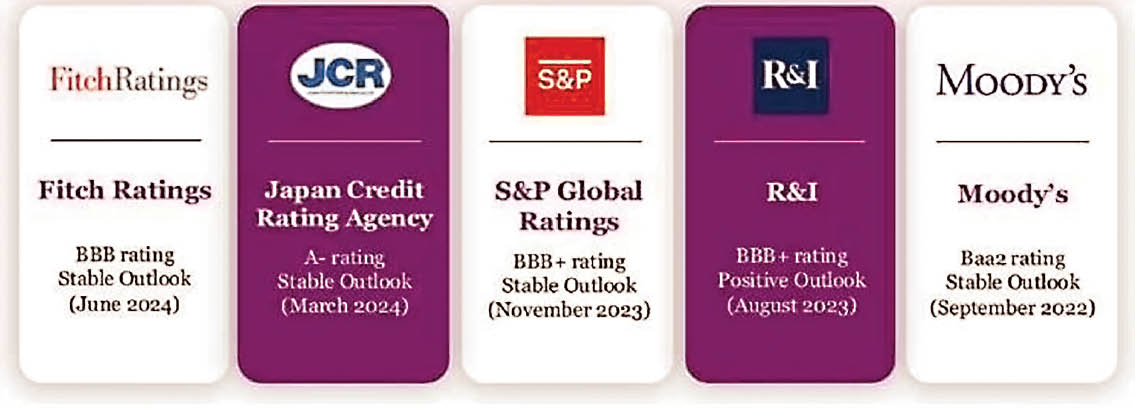
On Aug. 14, the Japanese credit rating agency R&I upgraded the Philippines Foreign Currency Issuer Rating to “A- with stable outlook,” one year after its last rating of “BBB, positive outlook.” Following a similar upgrade to “A-” by Japanese credit rating agency JRC, business media was abuzz with the expectation that similar rating upgrades are forthcoming from the better-known credit rating agencies (CRA) Moody’s, Fitch, and Standard & Poor.

R&I and JRC are not as well-known as the big three CRAs. They are known to be “quicker to the draw” so to say, in sovereign ratings. The media reports relied only on the press release from R&I, as the pdf file of the full report from the website cannot be downloaded. R&I and JRC apparently do not cover banks or corporates.

R&I gave the Philippines the same rating as Thailand (A-, stable) and one notch lower than that of Malaysia (A+, stable). Surprisingly, Vietnam’s rating — BBB — was lower than the Philippines’ despite it having a fiscal surplus of 5.8% of GDP vs the Philippines’ deficit of 4.5%. On the other hand, it was upgraded faster from BB+, stable in February 2024.

THE CREDIT RATING FRAMEWORK AND PROCESS
My previous corporate life involved dealing with CRAs starting in 1994 with Standard & Poor, later with Fitch Ratings, and eventually Moody’s — a period that included the CRAs’ controversial roles in 1997 Asian Financial Crisis and the 2008 Global Financial Crisis triggered by the collapse of Lehman Brothers and Bear Stearns. Capital Intelligence, a Cyprus-based CRA, covered Philippine banks in the 1990s and 2000s.

The experience gave me some familiarity with their methodologies, analytical framework, and the key metrics involved in arriving at their credit rating assessments. The bottom line of any credit rating is whether you can pay your debts when they fall due.

This column breaks down the key factors in a credit rating, mainly the macroeconomic indicators what constitute sustainable debt management. The key elements are the amount of debt, its composition (local vs foreign currency), its size relative to the size of the economy, its maturity structure, and market conditions.

HOW DEBT IS INCURRED
Every time the government spends more than it earns in revenues, it incurs a deficit. The gap is usually funded by borrowings. Continued fiscal deficit entails additional borrowing, adding to the stock of outstanding debt. For the period 2023-2028 under the five-year fiscal framework approved by the Development Budget Coordination Committee (DBCC), the country’s total outstanding debt is expected to grow by over P1.2 trillion a year corresponding to the amount of the fiscal deficit.

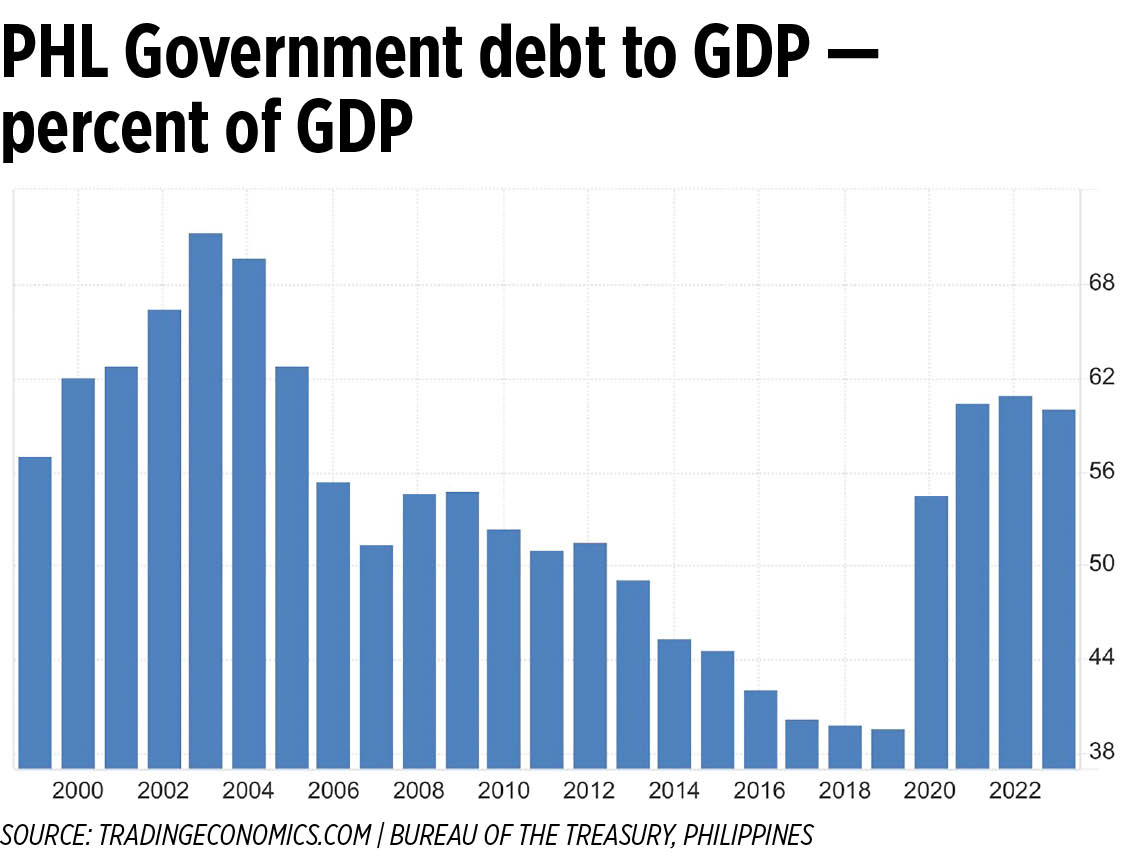
Key Point 1: Focusing the absolute amount of the outstanding debt alone is meaningless without the proper context. It is not the size of your debt, but all about the ability to pay your debt. The capacity to pay increases with a growing economy, hence declining debt to GDP means the economy is growing faster than the size of the debt, even if the absolute amount of the debt is also growing. Those who had housing loans can relate to the fact that the monthly installments are burdensome at the start but gets lighter as your income grows.

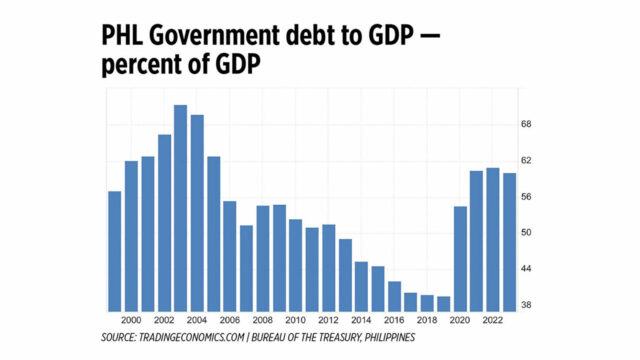
As historical context, the country’s debt to GDP ratio hit a high of 74% in 2004 when Gloria Macapagal Arroyo (GMA) was president, serving the remainder of Joseph “Erap” Estrada’s term. GMA was trailing actor Fernando Poe, Jr. or FPJ in the polls leading to the 2004 presidential elections, and she tried to gain votes by not allowing the National Power Corp. or Napocor to increase its power rates. The absorption of Napocor’s huge deficit into the consolidated public sector deficit (CPSD) pushed the fiscal deficit to 5% of GDP and the debt/GDP ratio to 74%. The resulting fiscal crisis triggered the release of a white paper from the professors of the University of the Philippines School of Economics on how to reverse the primary deficit into a surplus.

Once elected, GMA spent her political capital to support the increase in the value-added tax (VAT) from 10% to 12% (VAT Reform Act RA 9337, May 2005).  The debt/GDP ratio steadily improved thereafter through the rest of her term, through President Benigno “Noynoy” Aquino III’s term — during which the Philippines obtained the investment grade sovereign credit rating — and during Rodrigo Duterte’s term, to a low of 39% in 2019 just before the pandemic of 2020.

THE DEBT/GDP RATIO SHOULD NOT BE CONSIDERED ALONE
Singapore’s debt to GDP ratio is 168% but it has the highest rating of AAA, because its economy is so strong and its 2023 export/GDP ratio is 174% vs. 26.7% for the Philippines. The US ratio of 129% does not matter, since the US dollar is the global reserve currency it does not have to earn the dollars (exports of goods and services) to pay its debt. It only has to print the dollars (or, technically, create a credit entry with a US Fed account).

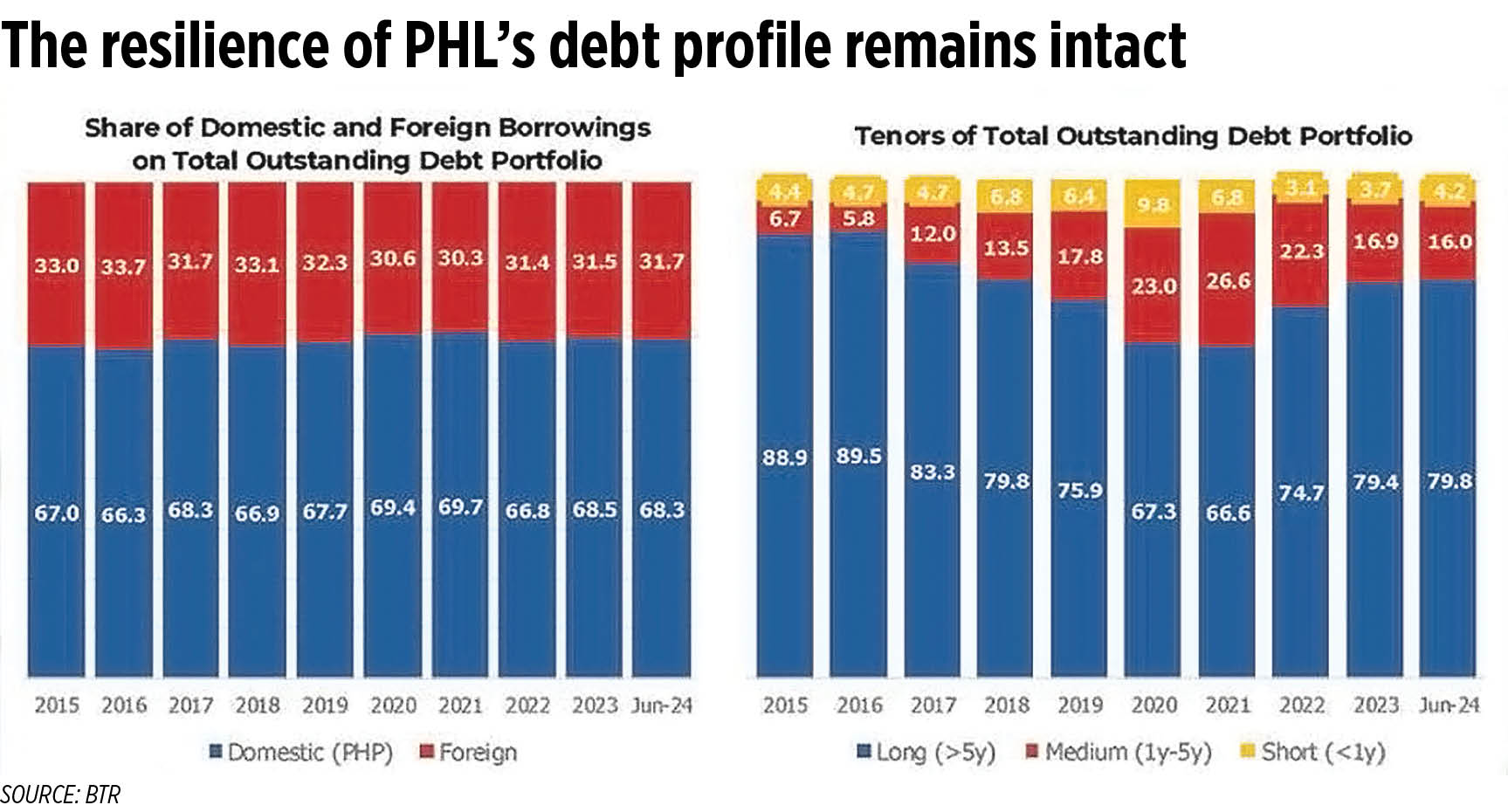
Key Point 2: The composition of the debt is important. The bulk or 80% of the debt is domestic, while only is 20% foreign — the portion of the debt subject to foreign exchange risk, or the risk that the government will not have enough dollars to pay the bonds.

The foreign exchange risk is even lower for ROP bonds, since at least half are held by local investors (mostly local banks and rich investors). The worst thing that could happen for these local holders of ROP bonds is to be paid in pesos (at current exchange rates).

Why the domestic share important: Japan’s debt to GDP ratio is 264%, but it is not considered a problem because all the debt is held by locals (43% of which is held by the Bank of Japan alone) and interest rates are very low (zero or negative) hence with practically zero cost of borrowing. This was highlighted during an extended period of negative interest rates, when banks had TO PAY the Bank of Japan to deposit instead of getting paid with interest.

Key Point 3: Maturity structure is critical. Even if your debt level is low, but the bulk of it is short term (falling due within one year), then you have a mismatch between your payments due and your cash flow. To use another consumer parallel, the amortizations for a housing loan is much lower if your maturity is 20 years vs. 10 years.

In this respect, the economic managers have managed our debt very well. The term structure management of Philippine debt has been very, very good, with 80% long term over five years, 16% medium term <1-5 years, 4% short term. The short-term ratio went up to 24% in 2020-2021 during the pandemic as sharp increase in borrowings had to make up for the fall in revenues but this has since “normalized” back to 4% of the total.

Key Point 4: International reserves as an indicator of ability to pay for imports and for foreign currency debt. Following painful lessons learned from the foreign exchange crisis in 1983-1985 (with foreign credit lines cut off, scarce foreign exchange was literally rationed every day to importers) and the Asian Financial Crisis of 1997, an important part of the monetary policy stance was to make sure there are sufficient international reserves.

How much of a buffer is enough? According to its method called Assessment of Reserve Adequacy (ARA), the IMF thinks that $100 billion in reserves is more than enough. However, Bangko Sentral ng Pilipinas Governor Eli Remolona noted that the IMF ARA methodology misses certain elements and is therefore not appropriate to the unique requirements of a developing country like the Philippines. He correctly asserted that maintaining our international reserves at the $100 billion level is the more prudent policy.

Key Point 5: A higher credit rating means a lower borrowing cost, but this is not necessarily true all the time. For example, Indonesia obtained an investment grade rating ahead of the Philippines but our ROP bonds were traded at lower interest rates than Indonesia.

The reason? The supply of ROP bonds was substantially more and the market for trading had high liquidity, coupled with competitive bids from local investors. The reduced liquidity risk of ROP bonds led to a lower rate.

The Challenge: How to maintain, even improve the Philippine sovereign credit rating to A during President Ferdinand Marcos, Jr.’s term while maintaining government spending to continue to spur the economy on — especially the 5-6% infrastructure spend to GDP ratio — while reducing the debt/GDP ratio to 50% by 2028 (a fiscal deficit of at least P1.2 trillion annually). The fiscal numbers in the DBCC fiscal framework 2023-2028 appear feasible.

Recap: After the Japanese rating agencies upgraded the Philippines to A, will the Big Three follow?

On Aug. 22, Moody’s affirmed the Philippine investment grade rating of Baa2, and its outlook of “stable.” Since it did not upgrade the outlook to “positive,” it will take another year before the outlook is upgraded to “positive,” which is a necessary prior step to the upgrade of the sovereign credit rating itself.

Similarly, on Sept. 17, S&P announced in a webinar that there is no change in its BBB+ rating with a “stable” outlook.

At this rate, it will take the Big Three CRAs at least two years to upgrade the Philippines to an A rating, or by 2026 at the earliest.


Alexander C. Escucha is president of the Institute for Development and Econometric Analysis, Inc., and chairman of the UP Visayas Foundation, Inc. He is a fellow of the Foundation for Economic Freedom and a past president of the Philippine Economic Society. He wrote the Handbook on the Overview of the Banking Industry for the Banking Association of the Philippines’ 60th anniversary in 2014. He is an international resource director of The Asian Banker (Singapore).

alex.escucha@gmail.com

Milan Fashion Week: ‘Optimism and joy’ at Versace, magical sunsets at Gucci, metallics at Prada, ties for Emporio Armani

EMPORIO ARMANI — OFFICIAL ARMANI YOUTUBE CHANNEL

MILAN — Presenting a playful and colorful collection of mismatched prints, Italian designer Donatella Versace said she had set out to bring “optimism and joy” to the catwalk with her show at Milan Fashion Week.

Friday evening’s Versace show, held at the medieval Castello Sforzesco, kicked off with models wearing clashing prints: zigzag tops and floral skirts, an aesthetic that dominated the spring/summer 2025 line for both womenswear and menswear. (See the show here: https://tinyurl.com/ycrwvzdy)

The mixed prints featured on silky dresses and skirts, shirts and knitwear which came in brown, blue, lilac and yellow, with hints of the Versace Medusa head print on some designs.

Outfits nodded to 1990s’ styles, with shirts sticking out from under short, unbuttoned cardigans, and there was also a selection of tailored suits and trousers in lemon.

“When there is so much darkness in the world — with this collection, I wanted to bring color, light, optimism and joy — we have never needed it more,” Versace, the design head at the Italian fashion house, said in a statement.

Some pieces were cut in shimmering gold — a corset, skirt, and strapless dress.

Models also wore colorful tights as well as slinky heels or platforms in bold hues, while menswear models wore suits with trainers or socks and sandals.

GUCCI
Gucci sought to recreate the magic of summer sunsets at Milan Fashion Week on Friday with a colorful line that at times nodded to the 1960s. (See the show here: https://tinyurl.com/573h6mn8 )

Creative director Sabato de Sarno began the show for his spring/summer 2025 collection, called “Casual grandeur,” with a tailored zipped jacket and floor-length trousers slit at the front bottom, opening up over sneakers.

Models wore draped or sleeveless dresses in various colors adorned with golden buckles as well as see-through lace frocks.

There were looks that mirrored 1960s styles with short A-line skirts, structured jackets, and shorts. Long coats were worn over tank tops and long denim trousers. Some coats were adorned with sparkling fringes.

Models walked down a red catwalk with lighting ranging from white to warmer shades, nodding to the “moment the sun dives into the sea at the end of an August day,” Mr. De Sarno said in show notes.

“It’s the moment we find ourselves. This collection is a tribute to those moments, and an invitation to stop, seek your own moment,” he said, as the show drew Oscar winner Jessica Chastain and Italian tennis star and world No. 1 Jannik Sinner among celebrity guests.

Accessories included large summer hats, an array of handbags, and footwear that varied from loafers and boots to platforms with transparent heels.

Mr. De Sarno’s color palette included grey, brown, different shades of green, white, orange, and red.

Mr. De Sarno, who presented his first Gucci show a year ago, has been resetting the Italian luxury brand with his sleek, pared-back creations since taking over from former designer Alessandro Michele, known for his eclectic, gender-neutral styles.

“A year later, this collection shows an accomplished journey of construction,” Mr. De Sarno said.

Gucci is the largest brand at Kering PRTP.PA where it accounts for half of the French luxury group’s sales.

In July, Kering reported a bigger-than-expected drop in second-quarter sales and forecast a weak second half, as the group works to re-energize Gucci while facing subdued demand from Chinese shoppers.

PRADA
Italian fashion house Prada played with distortion for its womenswear Spring-Summer 2025 collection at Milan Fashion Week on Thursday, presenting skirts suspended from belts, glasses with hugely oversized lenses and topless hats. (Watch the show here: https://tinyurl.com/yc879yue)

Designers Miuccia Prada and Raf Simons opened the show, called “Infinite Present” with a floral strappy frock followed by a black dress adorned with metallic rings, an embellishment seen on several outfits.

Models wore stiff shiny silver skirts, some bearing see-through decorative holes, colorful tights that morphed into trousers and tailored trousers as well as skirts that hung from belts.

The latter were prominent throughout the show, also appearing on handbags as a fastening or hanging low on one model’s hips.

There were fitted tops, hot pants, knotted blouses, and plenty of outerwear including macs and jackets in bright colors. One dark feathered dress was worn with an orange rain jacket. Some models wore sheer skirts over tight trousers.

Accessories included huge sunglasses and topless goggle-like bucket hats that covered faces.

Shoes varied from sandals to cowboy boots as well as plenty of colorful heels, some with stick out flaps on top.

EMPORIO ARMANI
Giorgio Armani offered soft fluid looks at Emporio Armani, the veteran designer’s second line. (See the show here: https://tinyurl.com/58vrpkzc )

He opened the show, called “Future Perfect,” with two models in suits and ties, an accessory that peppered the collection.

There were soft jackets, wide trousers, long skirts, light dresses and plenty of outerwear including trench coats and parkas. For the evening, models wore shimmering gowns or white shirts paired with shiny trousers and loose black ties.

Armani also presented menswear, offering loose trousers and blazers cinched with belts.

“The entire collection invites dressing with freedom and irony, quintessentially Armanian in its approach,” show notes said. “As always, the narrative is driven by the balance of masculine and feminine.”

Armani, 90, stuck to beige, grey, sage, and pink with bursts of blue and fuchsia.

At the end of the show, he greeted the audience with four design collaborators, including his niece, Silvana Armani.

He will present the latest collection for his main eponymous line in New York next month. — Reuters