Home Blog Page 253

Deutsche Bank sees last rate cut in June
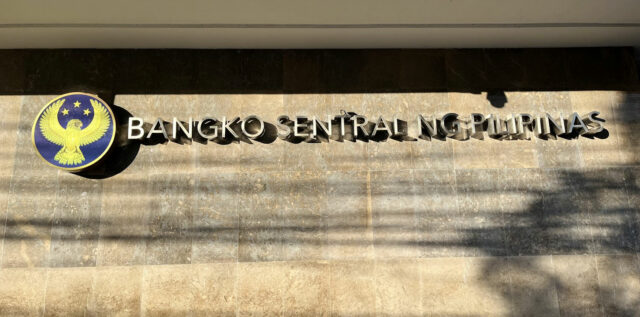
The main office of the Bangko Sentral ng Pilipinas in Manila. — BW FILE PHOTO

THE BANGKO SENTRAL ng Pilipinas (BSP) could stand pat at its next meeting before delivering its final rate cut for this easing cycle in June as economic growth is likely to stay sluggish this quarter, Deutsche Bank Research said.

“(The) Bangko Sentral ng Pilipinas lowered its policy rate by 25 bps (basis points) to 4.25%, in line with our forecast. We still expect another 25-bp rate cut by BSP’s June meeting, as first-quarter GDP growth data (to be released early May) is likely to remain weak,” it said in a report on Monday.

“Although BSP raised its inflation forecast to 3.6% in 2026, from 3.2% prior, it noted that it was ‘due mainly to supply-side pressures, which are likely to be temporary,’” Deutsche Bank Research said. “This supports our view for another rate cut as demand-pull pressures are likely to stay muted in line with subdued confidence and sentiment.”

For its part, Moody’s Analytics said the BSP may be approaching the end of its monetary easing cycle even as inflation remains subdued as the ongoing economic slowdown requires stronger reforms.

“Much of the recent softness reflects deteriorating business and consumer confidence amid a controversy over the misuse of government funds for flood control projects,” it said in a report dated Feb. 20.

“Rate cuts may contain the slowdown, but it will take greater transparency, stronger governance, and credible policy direction to restore confidence. For this reason, the easing cycle is likely nearing its limit.”

The Monetary Board’s next two policy meetings are scheduled for April 23 and June 18.

Last week, the BSP trimmed benchmark borrowing costs by 25 bps for a sixth straight meeting, bringing the policy rate to an over three-year low of 4.25% as it sought to support domestic demand, as governance concerns due to a corruption scandal involving flood control projects that unfolded last year have dented consumer and business confidence, causing economic growth to slow to a five-year low of 4.4% in 2025.

It has now cut rates by a total of 225 bps since it kicked off its current easing cycle in August 2024.

BSP Governor Eli M. Remolona, Jr. said future easing will largely hinge on how soon confidence will recover as weak sentiment has affected demand, making the output gap bigger.

“We’re now in a situation where it’s more conditional on what happens to confidence and growth,” he said at a briefing after Thursday’s meeting. “We support growth, and we do want growth. But at the same time, our main mandate is still inflation. So, to the extent we can support growth without causing inflation, we will support growth.”

He added that they are seeing “tentative” signs of improving confidence.

On Friday, the BSP chief said that with inflation under control, they have room to help stimulate domestic demand, although they face a “large element of uncertainty.”

“We are at the point where monetary policy cannot do much more, but things are very uncertain.”

The central bank raised its inflation forecasts for this year until 2027 to 3.6% and 3.2%, respectively, from 3.2% and 3% previously. Both are within its 2%-4% annual target.

Officials said they see upside risks coming from the supply side from electricity rate adjustments, higher oil prices, and the impact of the government’s flexible rice tariff scheme, although these are expected to be short-lived. — Katherine K. Chan


The new face of extremism among Asia’s youth

ONUR BINAY-UNSPLASH

By Karishma Vaswani

A DANGEROUS TREND is emerging in chatrooms and digital communities across Asia. Young people — mainly men and boys — are being exposed to a volatile mix of nationalist grievances, misogyny, and nihilistic violence. Governments are far from equipped to confront this rising threat; often they don’t even know what they’re looking for. Yet the longer this goes undetected, the greater the risk that it spills into real-world violence.

Online radicalization isn’t new. For years, groups like Islamic State have used social media platforms, slick digital propaganda magazines, and even artificial intelligence to recruit fighters and supporters. This globalized jihad had a clear aim: the establishment of a caliphate.

But today’s threat is different and more elusive. Singapore’s Internal Security Department has described it as “salad bar” extremism, a phenomenon where people cherry-pick from a range of hardline influences rather than subscribing to a single doctrine.

None of the recent cases point to a coordinated movement, nor do they supersede the threat of Islamist extremism, which remains the most prevalent organized menace in the region. Still, the emergence of this digital ecosystem is worrying because it is harder to detect and disrupt precisely because it lacks a formal structure.

These issues aren’t unique to Asia. This month’s mass shooting in Canada, which left several people dead and many more injured, previous school shootings in the US, and the Southport attack in the UK have also been potentially linked to nihilistic online movements. The pattern is global, but ignoring it locally would be a mistake.

Young men are particularly vulnerable. The reasons are complex and include social isolation, economic pessimism, and a perceived erosion of male status in rapidly modernizing societies. The incel subculture — involuntarily celibate men who resent their inability to find romantic or sexual partners — has become part of this troubling mix. These grievances are amplified online, spreading through digital forums, social media and even seeping into gaming communities.

Authorities are beginning to recognize this trend as an emerging concern, says Saddiq Basha, senior analyst at the Singapore-based S. Rajaratnam School of International Studies at Nanyang Technological University. “This is creating a fertile environment for a nihilistic worldview to take root,” he told me.

Singapore — a small but multiracial and multireligious society deeply conscious of the risk of terrorism and disharmony — has detained several youths over the past decade for plotting violence after being radicalized online. Among them were teens influenced by the ideology of Brenton Tarrant, the perpetrator of the 2019 Christchurch massacre who killed 51 people at two mosques. Singaporean officials say that some of those radicalized in recent years had consumed a mix of this extremist propaganda, racist conspiracy narratives, and violent manifestos.

Indonesia offers another warning. In November last year, the bombing of a high school in Jakarta was described by police as “memetic violence” — an attack shaped by the desire to imitate, rather than allegiance to an organization. The perpetrator also drew inspiration from Tarrant, as well as the 2017 Quebec City mosque attacker Alexandre Bissonnette and other school shooters, notes the Washington-based think tank Jamestown Foundation. Authorities also believe he was radicalized by the online “True Crime Community” forums that glorify mass killers, rather than following any specific ideology.

A related but distinct trend has emerged in South Korea. Online groups like New Men’s Solidarity have become a hub for anti-feminist rhetoric, attracting hundreds of thousands of views and subscribers on YouTube. Their messaging blames women’s progress for young men’s struggles, and describes feminism as a “social evil.” These platforms don’t necessarily advocate violence directly, but they normalize male victimhood and provide overly simple explanations for complex frustrations.

Prevention must start young. Given the nature of how these ideas are spread — online and through algorithm-driven feeds — governments may be tempted to follow Australia’s lead and impose nationwide curbs on social media for minors. This could reduce exposure at the margins.

But platform controls alone cannot address deeper drivers. Tackling this generation’s identity anxiety and social isolation requires a whole-of-society response — from governments and schools to families. Expanding digital literacy education from primary school, strengthening early intervention programs, and investing in youth mental health services are essential steps.

At the regional level, coordination must improve. Asian counterterror forces — such as Indonesia’s Densus-88 — have become adept at dismantling extremist networks. But this is a different kind of threat, so they need to adapt to track how these ideas spread and turn into digital ecosystems. 

The greatest challenge may lie closer to home. Conservative societies will need to confront narratives that frame female success as national decline. And where economic and educational gaps between men and women are widening, governments should address this directly by creating forums for open discussion while simultaneously regulating and monitoring sites where grievances can spread.

None of this will be easy. But failing to act now risks allowing a new generation to be shaped by insidious ideas, spreading quietly through feeds and forums — hiding in plain sight.

BLOOMBERG OPINION

FCC asks US networks to air ‘pro-America content’ to mark nation’s 250th birthday

WASHINGTON — The head of the Federal Communications Commission (FCC) urged US broadcasters on Friday to air “patriotic, pro-America content” to mark this year’s 250th anniversary of the United States’ founding.

FCC Chair Brendan Carr suggested broadcasters could voluntarily take part in the semiquincentennial celebrations by running nonpartisan public service announcements, short segments, or full specials promoting civic education and American history.

He said they could also choose to start each day’s broadcast with “The Star-Spangled Banner” or the Pledge of Allegiance, and could air music by major American composers.

The announcement comes as the Trump-led FCC has repeatedly clashed with broadcast networks.

NBC, Fox, CBS, and ABC did not immediately comment.

NO MORE NATIONAL ANTHEM
Until the 1980s, many local affiliates would play the national anthem when they signed off programming for the day, a practice made obsolete by round-the-clock broadcasting.

Mr. Carr, who was named FCC chair by President Donald J. Trump in January 2025, initiated a practice of saying the Pledge of Allegiance — a patriotic oath — before the FCC’s monthly meetings.

Mr. Carr said he hoped broadcasters would pledge to show civics programs to fulfill “their public interest mandate to serve the needs and interests of their local communities as America’s 250th birthday celebration marches on.”

COMPLAINTS AGAINST BROADCASTERS
Last week, Mr. Carr confirmed that the FCC is investigating ABC’s The View over whether it violated equal time rules when it aired an interview with Texas State Representative James Talarico, a Democrat running for the US Senate. CBS late-night talk show host Stephen Colbert said lawyers for CBS had barred him from airing an interview with Mr. Talarico.

The FCC said last month that daytime and late-night TV talk shows are no longer considered “bona fide” news programs that are exempt from requirements to give equal airtime to views of opposing candidates. For decades talk shows had been exempt from those rules.

Mr. Carr has repeatedly criticized the news media and suggested that broadcast networks need significant reforms.

In January, he reinstated complaints about a 60 Minutes interview with then-Vice-President Kamala Harris, how ABC News moderated the pre-election televised debate between then-President Joseph R. Biden and Donald J. Trump, and NBC for allowing Harris to appear on Saturday Night Live shortly before the election. — Reuters

Dissecting Philippine developers’ growing industrial footprint

By Julius Guevara and Joey Roi Bondoc

(First of two parts)

Amid global economic uncertainties, the Philippines continues to attract major industrial locators. Calls for improvement of business and regulatory environment to raise the country’s attractiveness as a manufacturing hub persist. Aside from ease of business registration, the government must ensure that sanctity of contracts is honored, infrastructure network is enhanced, and high power cost is addressed among others. The government should seriously address these issues if it wants to create more job-generating investments and foster inclusive economic growth across the Philippines.

Latest data from the Philippine Statistics Authority show that approved foreign investments dropped by 50% to P272.4 billion (USD4.7 billion) in 2025, the largest decline in five years. Analysts attributed the decline in pledges to the sluggish investor confidence in the Philippines amid global trade uncertainties, natural disasters and the flood control corruption scandal. In 2025, the Calabarzon (Cavite, Laguna, Batangas, Rizal, and Quezon) and Central Luzon regions accounted for nearly two-thirds of total foreign pledges, cornering around P171.2 billion (USD3 billion) worth of investments. By sector, the manufacturing segment covered nearly 30% (P81.4 billion or USD1.4 billion) of total approved foreign investments during the year, with both regions cornering bulk of the manufacturing pledges.

HIGH VALUE MANUFACTURERS LOCATING IN CENTRAL LUZON
Higher-value manufacturers are gravitating towards Central Luzon, taking advantage of the region’s industrial parks, skilled manpower, and improving connectivity to Metro Manila. Aside from big-ticket investments from Coca-Cola and Ajinomoto in Aboitiz InfraCapital’s TARI Estate in Tarlac, Clark Freeport Zone also continues to corner major manufacturing locators. Among the locators expanding in the industrial hub are UET Box Manufacturing, All Fashion Gloves, and DeviceDesign.

UET Box Manufacturing Corp. invested a total of P169.7 million (USD2.9 million) to expand by 10,000 square meters and produce high-quality knitted products (bags, socks, beanies) and custom shipping boxes. French firm All Fashion Gloves, a pioneer locator in Clark which is engaged in the manufacturing and exporting of premium leather gloves, will invest P18.27 million (USD315,000) for the construction of new facilities. DeviceDesign, a South Korean company specializing in wireless technology for the Internet of Things (IoT), invested P103 million (USD1.8 million) for a new factory inside Clark Freeport which will employ more than 500 individuals.

NEED FOR MORE PEZA-ACCREDITED FACILITIES
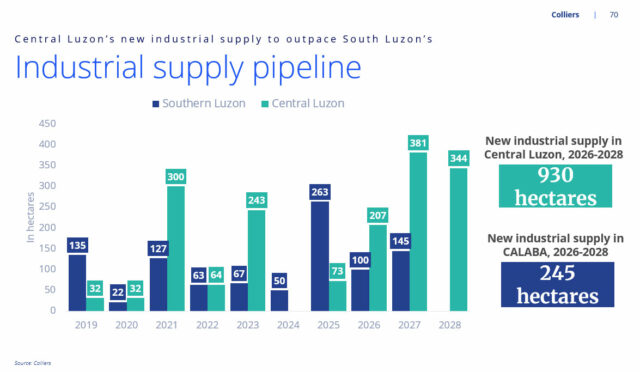
From 2026 to 2028, Colliers sees the delivery of 930 hectares of new industrial supply in Central Luzon, dwarfing the 245 hectares of expected new supply in Southern Luzon during the same period. With an improving business environment and bullish prospects for the region, we see more higher-value manufacturers locating in Central Luzon, especially in Pampanga, Tarlac, Bulacan, and Bataan.

In our view, the likes of Pampanga, Bulacan, Tarlac, and Bataan will likely remain as attractive industrial locations given their skilled manpower and improving infrastructure. Colliers Philippines believes that the completion of significant industrial supply in Central Luzon should provide opportunities for manufacturers and locators to haggle for more competitive lease rates. The improving quality of these industrial spaces and warehouses should also ensure that the region’s industrial facilities are ready to accommodate high-value manufacturers. The entry of major manufacturers should eventually develop the profile of locators in the region, enhance the industrial region’s supply chain system, and raise the volume and quality of commodity exports coming from the central Luzon corridor.

Meanwhile, some manufacturers continue to prefer locating in the Calaba (Cavite, Laguna, Batangas) corridor in Southern Luzon, the country’s major industrial hub. Among the profiles of locators which recently occupied industrial space in the region include those involved in the manufacturing of printers, air conditioners, air fresheners, and electronics.

This will be discussed next week.


Julius Guevara is senior director and head of Capital Markets and Investment Services, while Joey Roi Bondoc is director and head of Research at Colliers Philippines.

PhilWeb partners with FBM for online gaming across 30,000 machines

FBMGAMING.COM

PHILWEB CORP. has entered into a partnership with casino equipment provider FBM to develop and deploy an online gambling platform integrated into FBM’s nationwide network of electronic bingo machines and venues.

The agreement will allow PhilWeb to build and operate FBM Philippines’ online gaming platform, embedding digital functionality directly into thousands of physical machines in its initial phase, with potential expansion to as many as 30,000 machines across more than 500 locations.

Rather than launching a standalone online product, the companies will pursue an integrated online-to-offline model designed to connect digital content with brick-and-mortar gaming sites.

“By embedding online functionality directly into physical venues, we can support FBM in driving engagement and revitalizing offline operations at scale,” PhilWeb President Brian Ng said in a disclosure on Monday.

FBM has operated in the Philippines for more than two decades, supplying video bingo, slot machines and electronic gaming equipment. It holds a strong position in the country’s e-bingo segment through its extensive venue network.

Under the deal, PhilWeb will provide technology services, system integration and regulatory-compliant support to power the platform.

The companies said the integration is intended to enhance player engagement and create additional revenue streams for venue partners.

“This partnership enables us to extend our online presence in a way that directly benefits our offline business,” FBM Philippines Country Manager Pepe Costa said. “By deploying online-driven features across our machines and venues, we can offer a more engaging experience for players while creating stronger revenue opportunities for our partners nationwide.”

The move comes as physical gaming operators face mounting pressure from purely digital platforms that operate independently of land-based venues. By linking online features to existing machines and sites, the companies aim to help e-gaming outlets counter declining foot traffic and intensifying competition.

PhilWeb has been expanding its footprint in regulated online gaming. In January, it partnered with Hann Casino to support the expansion of Hann’s online gaming operations.

Shares of PhilWeb rose 6.45% to P10.90 each on the Philippine Stock Exchange. — Alexandria Grace C. Magno

Pre-need sector books higher premium income

PHILSTAR FILE PHOTO

PRE-NEED COMPANIES’ combined premium income rose by 5.73% year on year to P23.94 billion in 2025 despite a decrease in the number of licensed firms due to tighter regulatory oversight, the Insurance Commission (IC) said on Monday.

“The Philippine pre-need industry exhibited sustained growth and financial stability with improved performance in key indicators,” the regulator said in a statement.

The sector’s net income surged by 54.4% to P7.96 billion last year from P5.15 billion in 2024.

This came on the back of a 28.02% growth in the number of plans sold to 895,679 in 2025 from 699,621 in 2024, with life and memorial plans comprising 99.84% of total sales.

Meanwhile, the combined net worth of pre-need companies rose by 21.04% year on year to P33.87 billion,

Retained earnings, which accounted for 73.48% of their total net worth, increased by 39.57%.

The sector’s total assets grew by 8.19% to P178.2 billion last year from P164.71 billion in 2024.

This was mainly driven by a 9.64% increase in investments in trust funds that made up 85.92% of companies’ total assets.

Meanwhile, pre-need firms’ combined liabilities stood at P144.33 billion, with reserves making up 91.27% of the total.

The industry also recorded a 62.62% increase in surplus over required reserves to P16.03 billion, with investments in trust funds more than enough to cover all pre-need reserves, including benefits payable.

“Strengthened regulatory oversight has positively impacted the industry’s growth by restoring the trust and confidence of both consumers and investors, ensuring a more secure and transparent market environment. As the data show, the pre-need industry continues a solid upward path — strengthening its financial position, maintaining profitability, and enhancing its capacity to meet future obligations,” Insurance Commissioner Reynaldo A. Regalado said.

“The overall performance of the industry reflects a positive outlook and strong growth prospects in the market. This is a foundation we aim to build upon in 2026 and in the succeeding years.” — A.M.C. Sy

Political columnist Oscar Lagman writes 30

BW FILE PHOTO

JUNE 5, 1989 was the day Oscar Lagman’s column, “Musings,” was first published in BusinessWorld. It was a short, hard-hitting piece explaining why Filipinos were shocked by the conviction of Oliver North over the Iran-Contra scandal by listing a series of our own scandals which had failed to upset us. For the next 36 years he would muse mostly over the ins and outs, the scandals and the hopes of this country’s political life. On Feb. 3, 2026, Mr. Lagman’s final column for BW was published, a hard-hitting piece lamenting the Supreme Court’s decision on the impeachment of Vice-President Sara Duterte in which he urged the Catholic bishops to have their flock denounce the Court for not upholding the Constitution.

Mr. Lagman passed away on Feb. 16, 2026.

For years one would read a small note at the bottom of his columns: “Oscar P. Lagman, Jr.  has been a keen observer of Philippine politics since the late 1950s.”

Born on May 30, 1938, in the late 1950s he was a student at the College of De La Salle where he was a BSC major in Accounting and an AB major in Humanities, fields that stood him well in his subsequent careers as a corporate executive, an entrepreneur, a business consultant, and a management professor.

His keen mind was sharpened by further education: he received an MBA at the University of San Francisco, certificates in Population Administration from the University of North Carolina, in Environmental Management from the Centre d’Etudes Industrialles Geneva, and in Managed Care at the University of Missouri-Kansas City.

His work through the decades was wide ranging. Starting out as a research associate with a polling company (Robot Statistics Manila), he got into advertising (J. Walter Thompson Manila, J. Walter Thompson New York), accounting (John F. Forbes, CPA, San Francisco), health insurance (Blue Cross Health Insurance Manila), property development (Gateway Property Holdings Manila), and consulting (SGV Consulting Division Manila, Director; Head of Healthcare Consulting). All this while also being an entrepreneur, opening a chain of ice cream stores (Coney Island Ice Cream), a drugstore (Peerless Drugs), a healthcare venture (The Healthcare Alternative which serviced employee healthcare plans), and also got into communication skills training.

Still, he never lost his focus on education, teaching in the Asian Institute of Management, at the Ateneo Graduate School of Business and Ateneo Graduate School of Hospital Administration, at the Far Eastern University, Makati Graduate School of Business, and at his beloved alma mater, De La Salle, where he taught at the Graduate School of Business and at the College of St. Benilde Graduate School of Hospitality and Tourism.

As his daughter Maysie Lagman wrote on his Facebook page, “Dad was a passionate La Sallian who ‘remained on campus’ for decades after he graduated. He never really left La Salle.” Aside from teaching there, he would, in his senior years, “brave the crowds and steep bleacher steps of Araneta Coliseum” to cheer on his alma mater during UAAP games.

It is in a way not surprising that Mr. Lagman met “the love of his life,” his wife, Cecile, when he was a professor at the AIM and she was his travel agent. They married in 1974 and had three children. — AAH

Entertainment News (02/24/26)


Solo Mio in select Ayala Malls

THE film Solo Mio will be shown across all Ayala Malls Cinemas starting Feb. 25. Starring international comedy star Kevin James, it follows Matt, a groom left heartbroken by his fiancée on their wedding day. He turns his solo honeymoon in Italy into an unexpected escapade, filled with fun encounters, personal rediscovery, and a chance to start over.


SB19 releases new single

P-POP group SB19 has dropped their first official single of the year, “VISA.” The song tackles socially relevant themes, confronting the lived realities of Filipinos striving to shift culture and build a life of security and stability for their families. The song was an offshoot from a melody that SB19 songwriter Pablo imagined in one of their brand campaign shoots. “VISA” is out now on all digital music streaming platforms.


Silent Sanctuary goes on Japan tour, has new single

OPM “rockestra” band Silent Sanctuary is set to perform a three-date tour in Japan from March 27 to 29, at Mr. Back Saitama, Livehouse Shinjuku SAMURAI, and Heaven’s Door. The shows, which are now officially sold out, mark Silent Sanctuary bringing their signature blend of rock instrumentation and classical strings to new audiences. The tour will be followed by a Singapore show on April 5 at Timbre+ One North, with tickets still available via Peatix. Meanwhile, a new single, “UNA,” under Universal Records, is set to be released on Feb. 27.


Taiwan horror film opening in PHL cinemas in March

MUDBORN, a supernatural horror blockbuster in Taiwan, is coming to the Philippines on March 18 through Encore Films Philippines. The mystery-thriller tells the story of a virtual reality game developer (played by Yo Yang), who accidentally brings home a broken clay baby doll from a haunted house. His pregnant wife (played by Cecilia Choi) is an artifact conservator who becomes obsessed with the doll and continues restoring it, even as strange and terrifying events unfold in their family.


Pinoy crime drama to show on Prime Video

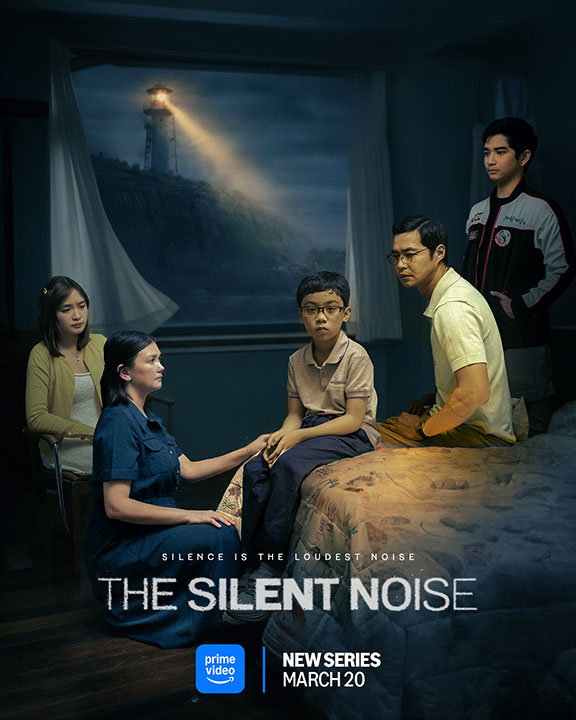
PRIME VIDEO has just released the first look at The Silent Noise, a Filipino crime drama produced by ABS-CBN Studios. Set to premiere on March 20, the series follows a young deaf man whose suppressed truth resurfaces when a body is discovered in their small town. Directed by Onat Diaz and starring Angelica Panganiban and Zanjoe Marudo, with KD Omalin introduced in a pivotal role, the show explores the delicate boundaries between truth and reputation, guilt and conscience, and the emotional cost of protecting family.


Hannah Montana 20th anniversary special out in March

DISNEY has announced that the Hannah Montana 20th Anniversary Special is coming to Disney+ on March 24, celebrating the iconic series that defined a generation. The special will be filmed in front of a live studio audience and will feature an exclusive, in-depth interview with Miley Cyrus (who played Hannah Montana), hosted by Alex Cooper. The conversation will offer a look at the creation of one of pop culture’s most iconic characters and the lasting impact the show and character have had on fans around the world. There will also be never-before-seen archival footage.


Nijel de Mesa to release romance film set in Japan

FILMMAKER Nijel de Mesa is back with a new original film, Hearts in Transit. Set against Tokyo’s neon glow and the serene stillness of rural Japan, the English language, full-length international feature will premiere in the second quarter of 2026 exclusively on the platform NDM PLUS. It follows three men whose paths cross into a love triangle: Ravi (played by Will Devaughn), an American logistics officer stationed in Japan; Gale (Sheridan Mortlock), a research fellow studying circular economy and sustainability in Japan; and Flynn (Nico Locco), an American drifter who hasn’t yet found himself. The film will be available to subscribers on www.ndmplus.com.

Robinsons Hotels and Resorts named largest Muslim-friendly hotel group in PHL

ROBINSONS HOTELS AND RESORTS (RHR) Senior Vice-President and Business Unit General Manager Barun Jolly (2nd from left) and Vice-President Annalyn Yap (Left) received the Muslim-friendly certification for all 22 of its properties from the Department of Tourism, led by Secretary Ma. Esperanza Christina G. Frasco (2nd from right).

THE Department of Tourism (DoT) certified Robinsons Hotels and Resorts (RHR) as the largest Muslim-friendly hotel group in the Philippines.

In a statement on Monday, the group said Tourism Secretary Ma. Esperanza Christina G. Frasco awarded the certification to all 22 RHR properties including Grand Summit Hotel, Summit Hotels and Resorts, Go Hotels Plus, Go Hotels, and its international brands, The Westin Manila and Crowne Plaza Manila Galleria.

From dedicated prayer rooms, which the DoT described as the best in the country, RHR has also implemented specialized staff training to ensure their services honored Muslim traditions and preferences.

“This certification is a testament to our deep respect for the Muslim community, which is an increasingly vital and vibrant part of our national tourism landscape,” Barun Jolly, senior vice-president and business unit general manager of RHR, was quoted as saying.

“By certifying 22 of our properties, we are ensuring our hospitality is world-class and inclusive.”

RHR was also recently named “Philippines’ Leading Hotel Group at the World Travel Awards Asia and “Best Hospitality Developer” at the Property Guru Asia Property Awards. — CAT

Century Properties’ PHirst launches P5.3-B housing project in GenSan

PHIRST’S GENSAN PROJECT — PHIRSTPARKHOMES.COM

CENTURY PROPERTIES Group, Inc. is expanding into Mindanao with a P5.3-billion affordable housing project in General Santos (GenSan) City, as the developer seeks to tap rising demand for homes outside Metro Manila.

Its affordable housing unit, PHirst Park Homes, Inc., launched PHirst Park Homes Gen San, a 23.7-hectare development in Barangay Baluan that will offer more than 2,400 units, it said in a stock exchange filing on Monday.

The project marks PHirst’s first venture in Mindanao and forms part of its push to widen its regional footprint amid sustained housing demand in growth areas.

PHirst has allocated P3 billion in capital expenditure for the project, signaling its confidence in long-term demand in General Santos and surrounding areas.

The site is located near commercial centers and major transport routes, positioning it to benefit from the city’s role as a trade and logistics hub in southern Philippines.

The development will offer two main house models: Amani, a 36-square-meter townhouse on 44- to 60-square-meter lots aimed at singles and starting families, and Dua, a 48-square-meter unit on 77-square-meter lots designed for larger households.

Units will be delivered fully finished and move-in ready, with kitchen cabinets, tiled flooring, pre-installed plumbing and electrical systems and perimeter fencing.

PHirst’s expansion into Mindanao comes as property developers step up launches in provincial markets, where land costs are lower and infrastructure spending has supported urban expansion.

Developers have been targeting end-user demand in regional cities, particularly for affordable and mid-market housing segments.

PHirst operates 32 projects nationwide, including developments in Cavite, Laguna, Batangas, Quezon Province, Bulacan, Pampanga, Bataan, Nueva Ecija, Bacolod City and South Cotabato. 

The brand focuses on turnkey homes with integrated community amenities and streamlined purchase processes.

Shares of Century Properties rose 2.67% to P0.77 each on the local bourse. — Alexandria Grace C. Magno

PHL, UAE central banks ink partnership on Islamic finance, cross-border transactions

REUTERS

CENTRAL BANKS of the Philippines and the United Arab Emirates (UAE) last week inked a memorandum of understanding (MoU) to advance Islamic banking and finance and modernize transactions between the two countries.

Bangko Sentral ng Pilipinas (BSP) Governor Eli M. Remolona, Jr. on Feb. 18 led the virtual signing of the MoU with Central Bank of the United Arab Emirates (CBUAE) Governor Khaled Mohamed Balama.

“This occasion reflects our shared goals in Islamic banking and finance, and in modernizing cross-border payment and messaging systems,” Mr. Remolona said in a speech at the ceremony.

“This partnership supports the BSP’s push to digitalize payments and make cross-border transactions more efficient.”

He said the agreement with the CBUAE will allow overseas Filipino workers and other migrant Filipinos in the UAE to have access to improved remittance platforms.

“For Filipinos in the UAE, especially our overseas Filipino workers (OFWs), this means better remittance channels, and more efficient financial services for their families back home,” Mr. Remolona said.

He added that the partnership also opens more avenues for both central banks to work together on initiatives for Islamic banking and finance.

“We also see strong opportunities for collaboration in Islamic banking and finance,” Mr. Remolona said. “By sharing knowledge and strengthening regulation, we can build a sound and inclusive ecosystem that supports financial innovation and inclusion.” — Katherine K. Chan

How PSEi member stocks performed — February 23, 2026

Here’s a quick glance at how PSEi stocks fared on Monday, February 23, 2026.


ADVERTISEMENT
ADVERTISEMENT