Home Blog Page 2463

Banks’ new trick could mean trouble for everyone

FREEPIK

IF YOU’RE UNFAMILIAR with synthetic risk transfers, there’s a chance you’ll hear all about them when the next financial crisis hits. They’re the latest way for big banks to game rules designed to safeguard the system, and they’re growing fast. So far, regulators seem all but oblivious.

Financial resilience depends largely on one line in banks’ balance sheets: equity. Also known as capital, it’s funding from shareholders who, unlike creditors, have agreed to absorb losses. The more equity banks have, the better they’re able to keep lending in difficult times. Bank managers, however, prefer to use more debt, because it comes with various government subsidies and boosts key profitability measures in good times.

The largest global banks have lately been very successful in minimizing equity. They’ve fended off plans for incremental increases in both the US and Europe. As a result, their capital typically amounts to about 5% to 6% of assets, far less than what experts and research indicate would be needed to weather a severe crisis.

Yet the banks think that’s still too much. They’ve revived a practice from before the 2008 subprime-mortgage crisis: Reduce capital requirements by repackaging loans into securities and buying protection against losses from other financial institutions. The banks keep the assets, the risk purportedly goes elsewhere. Hence, synthetic risk transfer.

It’s booming. The relevant pool of synthetically securitized assets amounted to €614 billion ($661 billion) at the end of 2023, up from just €5 billion seven years earlier. European corporate loans dominate, followed by auto and other retail loans in the US. Sellers of insurance, including private credit and pension funds, enjoy returns of 8% to 12%.

The insurance has legitimate uses, such as rebalancing banks’ exposures. But it entails its own risks. Unlike equity, it doesn’t absorb any and all losses. It applies only to the designated assets, and it could prove worthless in a crisis if the counterparty can’t pay. That’s what almost happened with insurer American International Group in 2008, necessitating one of the largest bailouts in US history.

Worse, there’s a twist. As Bloomberg News has reported, banks are lending to the same nonbank financial institutions that are providing the insurance — meaning that in aggregate, some of the risk isn’t leaving the banking system at all. While the magnitude of such “round tripping” is hard to know, overall bank credit to nonbanks has grown sharply in recent years. In the US, it amounted to more than $1.8 trillion in 2022.

One might expect regulators to be sounding the alarm. On the contrary, the European Central Bank is working to facilitate synthetic risk transfers, despite its own finding that banks don’t fully understand their exposures to the counterparties. Europe needs more securitization to boost investment, but it should involve transparent asset sales, not opaque contracts of uncertain value.

At the very least, as the International Monetary Fund urges, regulators should require the disclosure needed to assess the largely private transactions and their potential systemic risks. Ultimately, they should insist on equity, rather than settling for poor substitutes. There’s nothing like the real thing.

BLOOMBERG OPINION

Royal Canin unveils first pet care educational hub in Southeast Asia 

FILIPINOS have a long-standing relationship with myths, even when it comes to pet care — like feeding dogs and cats table food or giving them daily baths are good for them. While these practices may be common, they can sometimes do more harm than good according to experts. That’s why promoting responsible pet ownership is more crucial than ever. In response, Royal Canin has opened an educational hub in Cainta, Rizal — the first of its kind in Southeast Asia — aiming to elevate pet care standards in the Philippines and across the region.

“We are thrilled to launch our first Educational Hub in Southeast Asia. This facility is a testament to our mission of improving pet lives through education and innovation. By sharing our expertise, we hope to inspire our trade partners and pet owners to embrace responsible pet ownership and emphasize on health through nutrition for our furry companions,” Gerard Poa, market head at Royal Canin Philippines said.

Mr. Poa told BusinessWorld that the Philippines, with its large pet population, presents a strategic location for the global brand’s first educational hub in the region.

“We found that opportunity to say on how we level up in terms of what we want to do. What we stand for in terms of making the world ‘a better place for pets’,” Mr. Poa added.

The 850-square-meter facility is designed to be accessible to both pet owners and key stakeholders, including veterinary professionals and trade partners.

The educational hub will offer interactive workshops and exhibits that cover essential topics such as nutrition, health and well-being, grooming, and training. This initiative aims to emphasize the critical role of precise nutrition in promoting the overall well-being of pets, encouraging healthier lifestyles for both pets and their owners.

The facility will also function as a hub for veterinarians, providing opportunities for practitioners to enhance their expertise. Specialists from both domestic and international backgrounds will be invited to share their knowledge and insights.

“We want (to) help elevate the practice. So there a lot of general practitioners within the vets in the Philippines, but there are not a lot of specialists,” Mr. Poa said.

The Educational Hub, which was launched last Thursday, is set to open to the public in 2025.

THE FACILITY
Best known for its wide range of specialized pet food, Royal Canin underscores the importance of prioritizing a pet’s health and well-being at every life stage. To reinforce this message, the new educational hub features facilities designed for comprehensive pet care across all phases of a pet’s life.

The tour began at the facility dedicated to a pet’s “start of life,” where breeders will be educated on responsible breeding practices through proper nutrition.

As a brand renowned for its scientifically formulated food solutions, Royal Canin provides breeders with the option to nourish their pregnant dogs using its specialized “Queen Diet,” along with tailored diets for young puppies. This supports breeders in nurturing their animals during the earliest stages of life.

Guests at the launch were then guided through a facility designed for “Quick Consults,” where pets will receive health check-ups and tailored dietary recommendations. Guests had the unique opportunity to interact with a model designed to simulate a pet’s body, allowing them to feel the ribs beneath the skin and learn how to assess a pet’s weight effectively.

One of the program’s highlights was the introduction of the new Royal Canin Club, a loyalty rewards program designed to benefit both pets and their owners. Members can earn points through their purchases and online activities on their smartphones and tablets, which can be redeemed for an exclusive selection of rewards and vouchers from various partners.

Overall, the educational hub resembles a small town dedicated to pets and their owners, offering a range of facilities and resources to enhance pet care and well-being. This innovative space provides an environment where pets can thrive, and owners can access valuable information about responsible pet ownership.

Pet owners can access the Royal Canin Club at https://club.royalcanin.com.ph/. The center is located at 12 Suburban Drive, Cainta, Rizal. — Edg Adrian A. Eva

Finding a good manager

A new study by Ben Weidman of Harvard Kennedy School and his co-authors sought to identify the causal contribution of managers to team performance. The study was entitled “How do You Find a Good Manager?” The authors introduced a new experimental method that requires repeated random assignment of managers to multiple teams and careful controls for individual performance predictors. The premise is that good managers are expected to consistently cause their workers to exceed predicted performance.

Managers had several distinct roles in the experiment, delegation. monitoring and motivation. The first responsibility is deciding who did what. Managers were allowed to delegate in any way they saw fit provided everyone including the managers themselves had an allocation. Second, managers monitored progress throughout the task. Third, managers motivated their teams throughout the task and the reward structure excludes financial incentives.

The study makes the following conclusion, “Over multiple random assignments, some managers consistently cause their teams to exceed predicted performance. Good managers are roughly twice as valuable as good workers, consistent with studies of managerial performance in other settings. Good managers have higher fluid intelligence and score higher on a test of economic decision-making skill. There is no difference in average managerial performance by gender, age or ethnicity.”

“Self-promoted managers perform worse than managers who are randomly assigned to the role. This is likely due to overconfidence. Managers whose actual performance is worse than their self-reported performance have stronger preferences to be in charge. Self-promoted managers have higher reported social skills but do worse on a widely used skill-based test of emotional perceptiveness. Self-nomination is highly correlated with extraversion and self-reported people skills, especially among men. Finally, good managers increase group performance by monitoring workers to avoid wasting time, by allocating workers to tasks that maximize their comparative advantage, and by motivating them to exert effort.”

Finding a good manager is a crucial step in ensuring the success of any organization. Interestingly, the Weidman study cautions against self-promoting types. Attention to skills set rather than demographics or preferences for leadership could substantially increase organizational productivity.

Another study by Alan Benson, et.al. discussed “Promotions and the Peter Principle.” Evidence shows that many firms prioritize current job performance in promotion decisions at the expense of other observable characteristics that better predict managerial performance. This is the Peter Principle at work showing how individuals may be promoted to their “level of incompetence,” where they are no longer performing effectively.

Will an MBA help? Elon Musk was once quoted as saying MBA-trained leaders often focus too heavily on the financial side of the business, at the expense of understanding and improving the actual products and services a company provides.

An MBA equips individuals with theoretical knowledge, exposure to case studies, and analytical skills that can be beneficial in decision-making and problem solving. However, it does not inherently teach emotional intelligence, interpersonal skills, or the ability to motivate and manage people effectively. In many cases, experience is as valuable, if not more so, than formal education. Individuals who rise through the ranks within an organization often have a deep understanding of company culture, operational processes, and the specific challenges the team faces.

​Successful managers are distinguished by a set of core skills that enable them to lead teams effectively, drive results, and foster a healthy workplace culture. Below are some are key skills demonstrated by good managers.

Emotional intelligence (EQ) tops the list. A manager’s ability to understand and manage their own emotions, as well as empathize with the emotions of others, is vital for building strong relationships and maintaining team morale. This is followed by communication skills. Clear, concise, and transparent communication is essential for effective management. Managers must be able to articulate expectations, provide constructive feedback, and listen actively to team members’ concerns and ideas.

Managers must be relied on for their decision-making ability. Effective managers can weigh the pros and cons, consult relevant stakeholders, and make informed decisions that align with the company’s goals. As in the Weidman study, delegation and empowerment must be judicious. Effective managers know how to delegate tasks based on team members’ strengths and empower them to take ownership of their work.

In recognition of the constantly changing business environment, managers must demonstrate adaptability. Whether it’s responding to market shifts, managing a remote team, or implementing new technologies, adaptability allows managers to stay resilient and lead their teams through periods of uncertainty. Because disagreements are inevitable in the workplace, conflict resolution skill is a must. A good manager must be able to resolve conflicts in a fair and constructive manner, ensuring that issues are addressed promptly before they escalate.

In sum, self-promoting types usually will not make good managers and demographics (age, gender or ethnicity) are neutral.  The best workers also do not necessarily become good managers. Finding a good manager is balancing education, relevant experience and having the right economic decision-making skill set. Emotional intelligence, communication, decision making, delegation, adaptability and conflict solution are the core qualities needed to drive team success and organizational growth.

The views expressed herein are his own and do not necessarily reflect the opinion of his office as well as FINEX.


Benel Dela Paz Lagua was previously EVP and chief development officer at the Development Bank of the Philippines.  He is an active FINEX member and an advocate of risk-based lending for SMEs. Today, he is independent director in progressive banks and in some NGOs.

NTC mobilizes annual Undas assistance operations

PHILSTAR FILE PHOTO

THE National Telecommunications Commission (NTC) has directed all its regional directors to coordinate with government agencies that will render public assistance operations during the observance of “Undas” (All Saints’ Day).

“To ensure the safety and well-being of the general public during the observance of Undas 2024, the NTC has mobilized its annual Undas public assistance operations starting Oct. 23,” the agency said in a statement on Thursday.

In a memorandum, the NTC directed all its regional directors to coordinate with and extend assistance within their respective areas of jurisdiction to the National Disaster Risk Reduction and Management Council (NDRRMC), Civic Action Groups (CAGs) and Amateur Radio Groups (ARGs) that will also render Undas 2024 public assistance operations.

“This initiative includes any assistance that the commission may provide, such as issuance of temporary permits and licenses which are necessary to ensure the safety of our kababayans who will be traveling to various parts of the country,” the NTC said.

“The NTC Regional Offices were also directed to secure the assistance of radio, television, and cable TV stations/operators for the proper and timely dissemination of important public service information,” it added.

Likewise, the commission mandated the regional offices to monitor the operations of the CAGs and ARGs in their areas of jurisdiction, specifically the areas and routes covered, contact numbers of point persons and radio frequencies used, including locations of radio base stations for the entire duration of the public service operation.

“During this period, the NTC shall continue to accommodate any request for pertinent assistance from the general public, in order to uphold the meaningful observance of this important public occasion,” the agency said. — Aubrey Rose A. Inosante

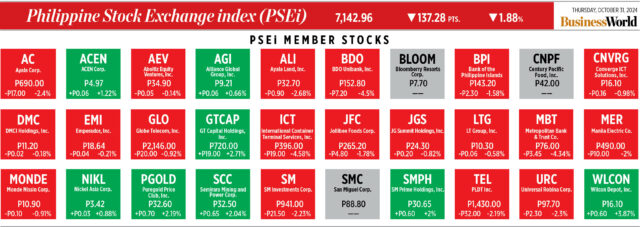
How PSEi member stocks performed — October 31, 2024

Here’s a quick glance at how PSEi stocks fared on Thursday, October 31, 2024.


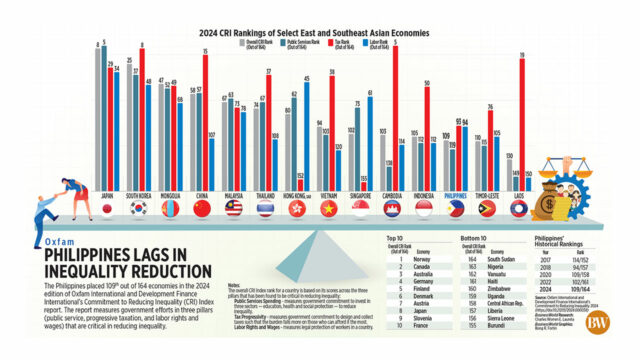
Oxfam: Philippines lags in inequality reduction

The Philippines placed 109th out of 164 economies in the 2024 edition of Oxfam International and Development Finance International’s Commitment to Reducing Inequality (CRI) Index report. The report measures government efforts in three pillars (public service, progressive taxation, and labor rights and wages) that are critical in reducing inequality.

Oxfam: Philippines lags in inequality reduction

Philippine Congress unlikely to invite ICC representatives to drug war probe

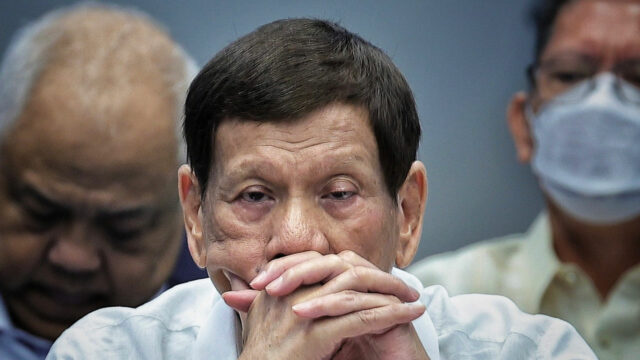
FORMER PRESIDENT Rodrigo R. Duterte — OFFICIAL FACEBOOK ACCOUNT OF THE SENATE OF THE PHILIPPINES

By John Victor D. Ordoñez, Reporter

PHILIPPINE lawmakers are unlikely to invite officials from the International Criminal Court (ICC) to congressional inquiries into ex-President Rodrigo R. Duterte’s deadly drug war since it could be a tacit admission of the country’s weak accountability mechanisms, according to political analysts and human rights lawyers.

“Given the reluctance of many senators to probe deeper into the issue, inviting ICC officials may actually be an added pressure to exact accountability,” Maria Ela L. Atienza, who teaches political science at the University of the Philippines, said in a Viber message on Thursday. “It also provides more opportunity on the part of families of drug war victims and human rights advocates to have allies in the process.”

The Hague-based tribunal is looking into alleged crimes against humanity committed during the drug war, where thousands of suspects died. Both Houses of Congress are conducting separate investigations of Mr. Duterte’s anti-narcotics campaign.

At a Senate hearing on Monday, the tough-talking leader told senators he offers “no apologies, no excuses” for his war on drugs.

“Considering the nature of the proceedings in the ICC which is akin to a judicial proceeding, I do not think they will discuss their ongoing investigations,” Ephraim B. Cortez, president of the National Union of Peoples’ Lawyers, said in a Viber message.

The Philippines under Mr. Duterte withdrew from the ICC in March 2018 amid criticisms that his government had systemically murdered drug suspects in police raids. It took effect a year later.

Senate Minority Leader Aquilino Martin L. Pimentel, who heads the Senate blue ribbon subcommittee looking into the previous government’s war on drugs, earlier said another committee would likely invite ICC officials to the country.

Michael Henry Ll. Yusingco, a fellow at the Ateneo de Manila University Policy Center, said ICC representatives could be invited as observers, but are unlikely to be resource persons at congressional probes.

“Unless a compelling reason emerges, such as the Marcos administration declaring they will cooperate with the ICC investigation, then it’s hard to see any ICC personnel being invited to be a resource person in the hearing on extrajudicial killings,” he said in a Facebook Messenger chat. “Allowing them now can be seen as undue foreign interference and will put lawmakers in a very bad light.”

Philippine President Ferdinand R. Marcos, Jr. has ruled out working with the ICC, citing the country’s working justice system.

The government estimates that at least 6,117 people died in Mr. Duterte’s drug war between July 1, 2016 and May 31, 2022, but human rights groups say the death toll could be as high as 30,000.

Mr. Duterte on Monday admitted to having ordered police officers in his hometown of Davao City when he was its mayor to goad criminals to fight back during anti-illegal drug raids so cops would have a reason to retaliate, adding that he had a hit-squad tasked to eradicate crimes.

He also said his former police chiefs were “commanders of death squads” since they took care of criminal syndicates, but denied ordering them to kill innocent people.

The Philippine Commission on Human Rights (CHR) on Wednesday urged full accountability for extrajudicial killings under the drug war. In a statement, the agency said it seeks to identify accountable officers and people as more key witnesses come forward to explain the events surrounding the campaign.

“In light of recent revelations, CHR expresses deep concern over the testimony of former President Rodrigo Duterte, who confessed that he would ‘rather have suspected drug dealers killed’ than allow them due process, and admitted to encouraging law enforcement in the past to taunt suspects to justify neutralizing them,” it added.

Referring to its April 2022 report, the CHR highlighted a troubling pattern among law enforcers claiming that victims had resisted arrest to justify deadly actions. The practice, it said, violates international agreements, including the International Covenant on Civil and Political Rights, and undermines the Philippine Constitution’s guarantee of due process and the right to life.

“Hopefully, lawmakers can get perspectives from the ICC prosecutor and the Judiciary separately, as they are strictly independent from each other,” Maria Kristina C. Conti, secretary general of the National Union of People’s Lawyers in Metro Manila and legal counsel for several victims of the drug war, said in a Viber message.

“The Senate could also do well in perusing through the records of the court and submissions of the Philippine government,” she added.

House panel to fast-track bill giving CHR power to prosecute rights offenders

PHILIPPINE STAR/ MIGUEL DE GUZMAN

By Kenneth Christiane L. Basilio, Reporter

A HOUSE of Representatives committee will expedite hearings on a bill that seeks to give the Commission on Human Rights (CHR) the power to prosecute human rights violators once Congress resumes sessions next week, according to its chairman, amid a Senate investigation of ex-President Rodrigo R. Duterte’s deadly war on drugs.

“We’ll fast-track it,” Manila Rep. Bienvenido M. Abante, Jr., who heads the House human rights committee, said in an interview on Tuesday. “With the House quad committee hearings, I think the bill will be appropriate. I’ll be talking to the [House] leadership about it.”

On Monday, CHR Chairman Richard P. Palpal-latoc told senators the Philippine National Police had sandbagged their investigation into alleged state-sponsored killings under Mr. Duterte’s anti-illegal drug campaign by denying their requests for documents on police raids.

The Philippine government estimates that more than 6,000 died under the campaign, according to a Facebook infographics posted published in June 2022 by RealNumbersPH, which is operated by the inter-agency Committee on Anti-Illegal Drugs. Human rights groups say the death toll could be as high as 30,000.

“The CHR can only investigate but cannot prosecute [human rights violators],” he told a news briefing in Filipino earlier this week. “That’s why I said we should give the CHR some teeth so they can do their mandate, even to prosecute those they believe are truly guilty.”

The late President Corazon C. Aquino created the CHR in 1987 through Executive Order No. 163. The CHR is limited to investigating human rights abuses and cannot file or hear charges, the Supreme Court ruled in 1991.

House Bill No. 9437, which Mr. Abante filed in 2023, seeks to empower the agency to file cases before the Ombudsman or any prosecutor’s office. The bill also expands the functions of the CHR by allowing it to compel witnesses to testify in its investigation and cite uncooperative witnesses in contempt.

Congress should look at strengthening the CHR’s investigative power by empowering its subpoena powers instead of giving it the ability to file cases, said Carlos H. Conde, a senior researcher at the Asia division of Human Rights Watch.

“Giving it prosecutorial powers would basically overhaul the CHR and I don’t think that is feasible,” he said in a WhatsApp message, adding that it would create “complications” because it is supposed to be an independent government body. “The CHR is about the only independent body that can do meaningful work to improve human rights. For that to happen, the government needs to make the CHR more independent, give it more resources and strengthen its mandate.”

Mr. Conde said giving the commission prosecutorial powers would unlikely change how government agencies engage with it. “Other parts of the government are not engaging with it, are hostile to it, and just don’t have any respect for it. I doubt giving it prosecutorial powers would change all that.”

Cristina E. Palabay, secretary-general of Karapatan, said giving the CHR prosecutorial powers would help human rights victims and their kin in pursuing lawsuits against state perpetrators.

Lawmakers should also review Philippine human rights laws to determine if the country still complies with international norms, she said in a Facebook Messenger chat. “They should conduct a comprehensive audit of current laws if these adhere to international human rights norms and instruments.”

Marcos says gov’t in control as typhoon deaths hit 150

PHILIPPINE STAR/EDD GUMBAN

By Kyle Aristophere T. Atienza, Reporter

PRESIDENT Ferdinand R. Marcos, Jr. on Thursday said his government remained in “full control” as deaths caused by Tropical Storm Trami and Super typhoon Kong-rey, which caused heavy rains in the northernmost province of Batanes, climbed to more than 100.

In a statement, he noted that while state resources and personnel “may be stretched due to the impact of typhoons on multiple fronts,” the government was “ably handling all disaster management efforts.” “We remain in full control.”

In an 8 a.m. report, the Philippines’ disaster agency said the reported death toll from Trami, locally named Kristine, and Super Typhoon Kong-rey (Leon) had hit 150. Fourteen deaths have been validated, while 29 people were still missing, it added.

The National Disaster Risk Reduction and Management Council said there were 115 reported injuries. More than 150,000 were damaged, more than 10,000 of which were totally destroyed. Trami and Kong-rey have caused P6.5 billion in damage to infrastructure.

“Nevertheless, we have sufficient assets to mitigate the worst impact, recover from the wreckage and rebuild stronger than before,” Mr. Marcos said. “Relief and recovery efforts continue in areas affected by Typhoon Kristine, while preparations are ramping up for Typhoon Leon.”

“All agencies and instrumentalities of government remain on full alert, and remain ready to deploy aid wherever it may be needed.”

Earlier in the day, the Presidential Communications Office in a statement said the government was on “high alert” as Leon hit Batanes province. The local government had launched evacuation efforts, it said, citing a report from Batanes Governor Marilou H. Cayco.

Food packs for the next three days had been distributed and healthcare and social welfare personnel were deployed to evacuation centers, it added.

The Department of Social Welfare and Development said it had prepared almost 2,000 family food packs for affected Batanes residents.

Social Welfare Undersecretary Diana Rose S. Cajipe said an additional 5,500 family food packs would be transported by a Philippine Coast Guard vessel from Pangasinan to Batanes.

Military spokesperson Colonel Francel Margareth Padilla-Taborlupa said they had deployed assets to areas affected by Kong-rey and was working with other government offices to transport essential supplies to affected residents.

The state weather bureau put Batanes under tropical cyclone wind signal No. 4 as the super typhoon started to move away from the province.

In a 2 p.m. report, the agency said the typhoon’s center was located 265 kilometers north-northwest of Itbayat, Batanes and was moving north-northwest at 25 kilometers per hour (kph). It was packing maximum sustained winds of 155 kph near the center and gustiness of up to 255 kph.

Leon sent heavy rains over the Philippines just as Kristine left the country and submerged parts of Bicol region in floodwaters.

Farm damage from Trami had reached P3.76 billion, the presidential palace said, citing the Department of Agriculture. The damage cost could increase as some areas remained inundated and isolated.

DA said it has a P1-billion quick response fund for the purchase of farm inputs. Farmers and fisherfolk may also avail themselves of a government loan worth P25,000, which could be paid in three years at zero interest, it said.

Meanwhile, Greenpeace Philippines urged the government to “step up and strongly champion” the call for increased climate funding, particularly through the Loss and Damage Fund, as world governments meet for the United Nations Climate talks on Nov. 11 to 22.

In a statement, it said climate finance would be a central topic of the talks. “As a start, the Philippine delegation should support the climate damages tax, so that there is a contribution from high emitting industries such as fossil fuel companies, not just states.”

Greenpeace earlier said Trami was the “third-most highly devastating weather event to batter the country this year.”

The Philippines in July was chosen to host the board of the Loss and Damage Fund (LDF), a UN financing mechanism that will benefit countries vulnerable to climate change, including the host-country.

“The Philippines lobbied to be the host of the Loss and Damage Fund Board, but what use is hosting the board if it doesn’t have money in the pot?” Greenpeace campaigner Khevin Yu asked.

“It’s more significant to the Filipino people if President Marcos followed through on his repeated calls for climate justice and resilience with action,” he said. “Filipinos are tired of the never-ending cycle of typhoon destruction.”

The Philippines lies along the typhoon belt in the Pacific and experiences about 20 storms each year. It also lies in the so-called Pacific Ring of Fire, a belt of volcanoes around the Pacific Ocean where most of the world’s earthquakes strike.

26 charges filed vs corporate officers using ‘ghost’ receipts

MICHAEL WALTER-UNSPLASH

TWENTY-SIX criminal informations have been filed before regional and municipal courts against corporate officers involved in “ghost” receipts, the Bureau of Internal Revenue (BIR) said, noting it will lead to their arrest.

“Twenty-six criminal informations were filed before the courts. Warrants of arrest will be issued against the responsible Corporate Officers,” BIR Commissioner Romeo D. Lumagui, Jr. said in a statement on Thursday.

“They will be arrested.”

This comes after the BIR reported winning two criminal cases against corporations and their corporate officers for using fake receipts after the Department of Justice (DoJ) found probable cause for the violation of the tax code.

The Justice department noted the corporate officers violated Sections 254, 255, 267 in relation 253 (d) and 256 of the National Internal Revenue Code.

When a tax case is filed, the government must prove the guilt of the accused by filing criminal information to formally pursue the case in court.

This forms part of the Bureau’s Run After Fake Transactions (RAFT) Program, which seeks to audit and prosecute individuals using fake receipts.

The RAFT program, led by Mr. Lumagui, was intended to address the sale and use of “ghost” receipts in the country. These are receipts that contain fictitious transactions, which are then bought and used by businesses to evade proper payment of taxes.  

The use of fake receipts is done to avoid paying the 12% value-added tax owed from the sale of goods and services. Individuals would set up “ghost” corporations that would fake a transaction and issue false receipts to escape tax payments.

In 2023, the BIR estimated up to P370 billion worth of revenue loss due to ghost receipts.

In February, the DoJ and BIR filed a total of 14 criminal complaints against 6 individuals associated with two companies using “ghost” receipts

In July, the BIR said it will maximize its partnership with the Securities Exchange Commission to run after large-scale tax fraud activities perpetrated by companies such as that of ghost receipts and corporate tax evasion.

In August 2024, the BIR partnered with Ateneo de Manila University-Department of Mathematics to develop an algorithm that will detect companies possibly using such receipts. — Beatriz Marie D. Cruz

Malacañang bares regular, special nonworking days for 2025

PRESIDENT Ferdinand R. Marcos, Jr.’s office on Thursday released a list of regular holidays and special nonworking days for 2025.

Under a proclamation signed by Executive Secretary Lucas P. Bersamin on Oct. 25, regular holidays include New Year’s Day on Jan. 1 (Wednesday) and Day of Valor on April 9 (Wednesday).

Catholic commemorations such as Maundy Thursday on April 17 and Good Friday on April 18 were also declared regular holidays.

They also include Labor Day on May 1 (Thursday), Independence Day on June 12 (Thursday), National Heroes Day on Aug. 25 (Monday) and Bonifacio Day on Nov. 30 (Sunday).

Christmas Day on Dec. 25 (Thursday) and Rizal Day on Dec. 30 (Tuesday) are also regular holidays.

Under the order, special nonworking days are Ninoy Aquino Day on Aug. 21 (Thursday), All Saints Day on Nov. 1 (Saturday), Feast of the Immaculate Conception of Mary on Dec. 8 (Monday) and the last day of the year on Dec. 31 (Wednesday).

Special nonworking days also include the Chinese New Year  on Jan. 29 (Wednesday), Black Saturday  on April 19, Christmas Eve on Dec.  24 (Wednesday) and All Saints’ Day Eve on Oct.  31 (Friday).

Meanwhile, the commemoration of the EDSA People Power revolution anniversary on Feb. 25 (Tuesday) will be a special working day.

“The proclamations declaring national holidays for the observance of Eidul Fitr and Eidul Adha will be issued after the approximate dates of the Islamic holidays have been determined in accordance with the Islamic calendar or the lunar calendar, or upon Islamic astronomical calculations, whichever is applicable,” according to the proclamation.

The proclamation tasked the Labor department to issue the rules that will enforce the presidential order — Kyle Aristophere T. Atienza

Water interruption to hit NAIA T3

NINOY AQUINO INTERNATIONAL AIRPORT (NAIA) Terminal 3 — PHILIPPINE STAR/MIGUEL DE GUZMAN

NEW NAIA Infra Corp. (NNIC), the private operator of the Ninoy Aquino International Airport (NAIA), is now preparing for a planned water service interruption by Maynilad Water Services, Inc. affecting the operations of Terminal 3 (T3).

In a media release on Thursday, NNIC said the scheduled water interruption will last for 16 hours starting 2 p.m. on Friday (Nov. 1) until 6 a.m. on Saturday (Nov. 2) due to maintenance and repair activities at Maynilad’s Putatan Treatment Plant.

NNIC said it has already prepared a contingency plan to ensure uninterrupted water supply at Terminal 3 throughout the duration of Maynilad’s maintenance and repair activities.

NNIC will utilize existing water reserves from the terminal’s water tanks which have a combined capacity of 3.2 million liters, the company said, adding that Maynilad is also on standby to provide water trucks for resupply if needed.

The airport operator said water containers will also be placed in washrooms throughout the terminal.

Last week, Terminal 1 of NAIA also experienced water service interruption after its main water pipe was damaged. NNIC also anticipates passenger influx for the All Souls’ Day and All Saints’ Day.

The Civil Aviation Authority of the Philippines said previously that it is expecting air travelers to increase by 10% from the 2.1 million passengers during this period.

Metro Pacific Investments Corp., which has a majority stake in Maynilad, is one of three Philippine units of Hong Kong-based First Pacific Co. Ltd., the others being Philex Mining Corp. and PLDT Inc.

Hastings Holdings, Inc., a unit of PLDT Beneficial Trust Fund subsidiary MediaQuest Holdings, Inc., has an interest in BusinessWorld through the Philippine Star Group, which it controls. — Ashley Erika O. Jose

ADVERTISEMENT
ADVERTISEMENT