Home Blog Page 2455

Striking Boeing union endorses 38% wage hike offer, vote set for Monday

REUTERS

 – Striking Boeing workers will vote on Monday on an improved contract offer that includes a 38% pay rise over four yearsa larger signing bonus and carries the endorsement of their union, which told members it had extracted all it could from the planemaker.

The latest offer, presented on Thursday, comes at a critical moment for Boeing, which this week announced it would raise up to $24.3 billion to shore up its battered finances as a seven-week strike by more than 33,000 U.S. West Coast factory workers worsens its cash burn.

In every negotiation and strike, there is a point where we have extracted everything that we can in bargaining and by withholding our labor. We are at that point now and risk a regressive or lesser offer in the future,” the International Association of Machinists and Aerospace Workers (IAM) said.

Members rejected two earlier offers from Boeing.

The planemaker’s shares rose 2.8% in after-hours trading after the offer was announced earlier in an exclusive report by Reuters. Shares had closed down 3.2% on Thursday.

Talks between the two sides were held this week with the assistance of Acting U.S. Secretary of Labor Julie Su, who praised the union and Boeing for their hard work in negotiating the deal.

The union vote will come the day before the U.S. presidential poll, which is a dead heat between Democrat Kamala Harris, who would be expected to continue the Biden administration’s pro-union policies, and Republican Donald Trump.

President Joe Biden congratulated the union and Boeing’s leadership on negotiating a new contract proposal, a White House spokesperson said, adding Biden “believes Machinists at Boeing have sacrificed over the years and deserve a strong contract.”

An approved deal would be a boost for new Boeing CEO Kelly Ortberg, who is pushing for a “fundamental culture change” at the company after a mid-air door panel blowout in January that put the spotlight on its safety and quality record.

The strike has halted production of its strongest-selling 737 MAX jet and its 767 and 777 widebodies.

Boeing said in a statement it encourages “all of our employees to learn more about the improved offer and vote on Monday, Nov. 4.”

An end to the strike would also benefit aerospace suppliers that have been furloughing workers and holding off on new capital investments, as well as airlines facing extended aircraft delivery delays.


APPROVAL NOT GUARANTEED

It is not yet clear how union members will vote. The negotiating team had been pushing for a 40% wage increase and the return of a defined-benefit pension that members lost a decade ago.

Last week, some 64% of workers rejected an offer of a 35% general wage increase over four years that was not endorsed by the union.

Boeing’s first offer of a 25% wage increase, which was endorsed by the union, was rejected by nearly 95% of workers in September.

James Mann, a 26-year-old 737 mechanic, said he planned to reject the offer proposed on Thursday, but he was prepared to return to work if it was approved by the majority.

I’m still voting no, because of the pension,” he said.

Boeing’s latest offer includes a $12,000 ratification bonus, the IAM said in a statement. It combines a previously offered $7,000 ratification bonus and a $5,000 lump sum into the members’ 401(k) retirement account.

This would allow workers to choose how the total amount is received, either as part of a paycheck, a contribution to the 401(k) or a combination of both.

The signing bonus and the higher pay raises are “basically what we asked for,” said Donovan Evans, 30, who works on the 767 final assembly line at Boeing’s Everett plant and voted to reject the first two offers.

I feel like it’s pretty fair for what we do,” he said. “I feel like I’m going to vote yes on Monday.” – Reuters

Chinese researchers develop AI model for military use on back of Meta’s Llama

REUTERS

Top Chinese research institutions linked to the People’s Liberation Army have used Meta’s publicly available Llama model to develop an AI tool for potential military applications, according to academic papers and analysts.

In a June paper reviewed by Reuters, six Chinese researchers from three institutions, including two under the People’s Liberation Army’s (PLA) leading research body, the Academy of Military Science (AMS), detailed how they had used an early version of Meta’s Llama as a base for what it calls “ChatBIT”.

The researchers used the Llama 2 13B large language model (LLM) that Meta META.O released in February 2023, incorporating their own parameters to construct a military-focused AI tool to gather and process intelligence, and offer accurate and reliable information for operational decision-making.

ChatBIT was fine-tuned and “optimized for dialogue and question-answering tasks in the military field”, the paper said. It was found to outperform some other AI models that were roughly 90% as capable as OpenAI’s powerful ChatGPT-4. The researchers didn’t elaborate on how they defined performance or specify whether the AI model had been put into service.

“It’s the first time there has been substantial evidence that PLA military experts in China have been systematically researching and trying to leverage the power of open-source LLMs, especially those of Meta, for military purposes,” said Sunny Cheung, associate fellow at the Jamestown Foundation who specializes in China’s emerging and dual use technologies including AI.

Meta has embraced the open release of many of its AI models, including Llama. It imposes restrictions on their use, including a requirement that services with more than 700 million users seek a license from the company.

Its terms also prohibit use of the models for “military, warfare, nuclear industries or applications, espionage” and other activities subject to U.S. defense export controls, as well as for the development of weapons and content intended to “incite and promote violence”.

However, because Meta’s models are public, the company has limited ways of enforcing those provisions.

In response to Reuters questions, Meta cited its acceptable use policy and said it took measures to prevent misuse.

“Any use of our models by the People’s Liberation Army is unauthorized and contrary to our acceptable use policy,” Molly Montgomery, Meta’s director of public policy, told Reuters in a phone interview.

The Chinese researchers include Geng Guotong and Li Weiwei with the AMS’s Military Science Information Research Center and the National Innovation Institute of Defense Technology, as well as researchers from the Beijing Institute of Technology and Minzu University.

“In the future, through technological refinement, ChatBIT will not only be applied to intelligence analysis, but also … strategic planning, simulation training and command decision-making will be explored,” the paper said.

China’s Defense Ministry didn’t reply to a request for comment, nor did any of the institutions or researchers.

Reuters could not confirm ChatBIT’s capabilities and computing power, though the researchers noted that its model incorporated only 100,000 military dialogue records, a relatively small number compared with other LLMs.

“That’s a drop in the ocean compared to most of these models (that) are trained with trillions of tokens so … it really makes me question what do they actually achieve here in terms of different capabilities,” said Joelle Pineau, a vice president of AI Research at Meta and a professor of computer science at McGill University in Canada.

The research comes amid a heated debate in U.S. national security and technology circles about whether firms such as Meta should make their models publicly available.

U.S. President Joe Biden in October 2023 signed an executive order seeking to manage AI developments, noting that although there can be substantial benefits to innovation,” there were also “substantial security risks, such as the removal of safeguards within the model”.

This week, Washington said it was finalizing rules to curb U.S. investment in artificial intelligence and other technology sectors in China that could threaten national security.

Pentagon spokesman John Supple said the Department of Defense recognized that open-source models had both benefits and drawbacks, and that “we will continue to closely monitor and assess competitors’ capabilities”.


‘COOKIE JAR’

Some observers say China’s strides in developing indigenous AI, including setting up scores of research labs, have already made it difficult to keep the country from narrowing the technology gap with the United States.

In a separate academic paper reviewed by Reuters, two researchers with the Aviation Industry Corporation of China (AVIC) – which the United States has designated a firm with ties to the PLA – described using Llama 2 for “the training of airborne electronic warfare interference strategies”.

China’s use of Western-developed AI has also extended into domestic security. A June paper described how Llama had been used for “intelligence policing” to process large amounts of data and enhance police decision-making.

The state-run PLA Daily published commentary in April on how AI could help “accelerate the research and development of weapons and equipment”, help develop combat simulation and improve military training efficiency”.

“Can you keep them (China) out of the cookie jar? No, I don’t see how you can,” William Hannas, lead analyst at Georgetown University’s Center for Security and Emerging Technology (CSET), told Reuters. A 2023 paper by CSET found 370 Chinese institutions whose researchers had published papers related to General Artificial Intelligence – helping drive China’s national strategy to lead the world in AI by 2030.

There is too much collaboration going on between China’s best scientists and the U.S.’ best AI scientists for them to be excluded from developments,” Mr. Hannas added. – Reuters

Poll: Inflation likely picked up in Oct.

Customers are seen buying goods at Quinta Market in Quiapo, Manila. — PHILIPPINE STAR/EDD GUMBAN

By Luisa Maria Jacinta C. Jocson, Reporter

HEADLINE INFLATION likely quickened in October amid higher prices of key commodities like food and fuel, analysts said.

A BusinessWorld poll of 11 analysts yielded a median estimate of 2.4% for the consumer price index (CPI) in October.

The Bangko Sentral ng Pilipinas gave a 2-2.8% inflation forecast for the month.

“Higher prices of food commodities such as vegetables, fruits, and fish as well as the increase in prices of domestic petroleum products and the peso depreciation are the primary sources of upward price pressures for the month,” the BSP said in a statement.

If realized, October inflation would have accelerated from the 1.9% print in September. However, it would still be slower than the 4.9% in the same month a year ago.

“Estimated October inflation is 2.4% year on year. Potential drivers include higher petroleum prices, lower electricity rates, moderate food inflation, and peso depreciation,” Security Bank Vice-President and Research Division Head Angelo B. Taningco said.

Bank of the Philippine Islands Lead Economist Emilio S. Neri, Jr. said that unfavorable weather conditions likely caused a spike in prices of food items, particularly vegetables and fruits.

Agricultural damage due to Severe Tropical Storm Kristine amounted to P3.76 billion, the latest bulletin from the Agriculture department showed.

Chinabank Research noted the possible pickup in food inflation. “Higher prices of vegetables fruits, fish, and eggs offset month-on-month declines in the prices of rice and meat.”

“Higher fuel prices for October also contributed along with the uptick of prices in various food items,” Ruben Carlo O. Asuncion, chief economist at Union Bank of the Philippines, Inc., said.

In October alone, pump price adjustments stood at a net increase of P2.80 per liter for gasoline, P4.60 per liter for diesel, and P3.25 per liter for kerosene.

Rizal Commercial Banking Corp. Chief Economist Michael L. Ricafort also noted the weaker peso exchange rate, which “could lead to some increase in importation costs and overall inflation.”

The peso closed at P58.10 per dollar at end-October, depreciating by P2.07 from its P56.030 finish at end-September.

On the other hand, the central bank said inflation would be offset by lower prices of rice and meat, as well as the reduction in electricity rates.

Manila Electric Co. (Meralco) lowered the overall rate by P0.3587 per kilowatt-hour (kWh) to P11.4295 per kWh in October from P11.7882 per kWh a month prior.

For residential customers consuming 200 kWh, this translated to a decrease of around P72 in their total electricity bills for the month.

Rice prices have also been on the decline after the executive order slashing tariffs on rice imports to 15% took effect in July.

The latest data from the Agriculture department showed the average price of well-milled rice ranged from P43 to P54 per kilogram at end-October, lower than the P47-to-P55 range at end-September.

Meanwhile, regular milled rice cost P40-P50 per kilogram from P45-P50 per kilogram a month ago.

DOWNTREND TO CONTINUE
For the coming months, analysts said that inflation would continue to settle within the BSP’s 2-4% target band.

“Inflation could still remain at the 2% levels for the rest of 2024, though some seasonal pickup in prices are expected towards the Christmas holiday season amid increased demand, but only to eventually ease upon crossing the holiday season,” Mr. Ricafort said.

Mr. Neri said inflation should remain “manageable” in the next 12 months, barring any shocks.

“Upside risks to this outlook include the possibility of La Niña and spread of African Swine Fever,” he said.

“It should also be noted that inflation remains sensitive to climate conditions and could go up easily. However, stable commodity prices amid China’s economic slowdown may offset these risks.”

Expectations of within-target inflation would allow the BSP to continue its easing cycle, Mr. Ricafort said.

“For monetary policy, I think it’s on autopilot and I see very little factors to interrupt a 25-bp cut in December,” Patrick M. Ella, economist at Sun Life Investment Management and Trust Corp. said.

BSP Governor Eli M. Remolona, Jr. earlier signaled a possible 25-bp cut at the Monetary Board’s Dec. 19 meeting, its last for the year.

The central bank has so far lowered borrowing costs by a total of 50 bps since it began its easing cycle in August.

“Furthermore, succeeding monthly inflation figures this quarter will likely stay below 3% due to lower rice tariffs and base effects,” Chinabank Research said.

Sarah Tan, an economist from Moody’s Analytics, said that despite the expected reacceleration, within-target inflation will “reaffirm BSP’s view that inflation expectations are well-anchored.”

“While this will give BSP the confidence to deliver another 25-bp rate cut in December, but a weakening peso could prompt them to hold off the loosening,” she added.

With inflation expected to remain manageable, Mr. Neri said a rate cut from the BSP could be on the table in December.  He cited risks that could derail the BSP’s rate-cutting cycle, such as further peso weakness and uncertainty in the US Federal Reserve’s own easing path.

“A stronger-than-expected US jobs report or a Republican sweep in the upcoming US elections could reinforce this sentiment, potentially weakening the peso further and adding upward pressure on inflation. The BSP may consider a pause in its rate cuts if the Fed doesn’t cut as anticipated,” Mr. Neri said.

“The recent volatility in the markets highlights the need for prudence when it comes to rate cuts. While inflation forecasts allow room for a cut, aggressive action may not be prudent in the current climate.”

The BSP has said that it will “continue to take a measured approach in ensuring price stability conducive to balanced and sustainable growth of the economy and employment.”

Hot money net inflows rise to $1B in September

Dollar and pound banknotes are seen in this picture illustration taken April 28, 2017. — REUTERS/DADO RUVIC/ILLUSTRATION

FOREIGN PORTFOLIO INVESTMENTS registered a net inflow in September, marking the third straight month that more foreign capital entered the country than left, the Bangko Sentral ng Pilipinas (BSP) said on Thursday.

Transactions on short-term foreign investments registered with the BSP through authorized agent banks posted a net inflow of $1.03 billion in September, a turnaround from the $698.01-million net outflows in the same month a year ago.

Hot money inflows also nearly doubled (92.1%) from $533.95 million posted in August.

Foreign portfolio investments are commonly referred to as “hot money” due to the ease with which these flows enter or leave the country.

Data from the central bank showed that gross inflows surged by 185.2% to $2.53 billion in September from $887.61 million in the same month a year ago. Month on month, inflows soared by 84.7% from $1.37 billion.

More than half (57.5%) of inflows was invested in peso government securities, while the remainder went to Philippine Stock Exchange-listed securities involved in banks, holding firms, property, transportation services, and food, beverage, and tobacco.

The majority or 88.4% of investments for the month came from the United Kingdom, Singapore, the United States, Luxembourg and Malaysia.

On the other hand, gross outflows declined by 5% to $1.51 billion during the month from $1.59 billion a year prior.  However, outflows surged by 80% in September from $836.78 million in August.

The central bank said that 51.1% of total outward remittances went to the United States, equivalent to $769.93 million.

For the first nine months of the year, BSP-registered foreign investments yielded a net inflow of $3.02 billion, significantly higher than the $387.24-million net inflow in the same period last year.

Rizal Commercial Banking Corp. Chief Economist Michael L. Ricafort said that the inflows were driven by the recent rate cuts by the central bank.

The central bank began its easing cycle in August with a 25-basis-point (bp) reduction, the first rate cut since November 2020.

It also delivered another 25-bp cut in October, which brought the target reverse repurchase (RRP) rate to 6%.

BSP Governor Eli M. Remolona, Jr. signaled the possibility of another 25-bp cut at the Monetary Board’s last meeting for the year on Dec. 19. If realized, this would bring the key rate to 5.75% by end-2024.

Mr. Ricafort also noted the positive impact of the recent reserve requirement ratio (RRR) reduction on markets.

“Policy rate cuts and RRR cuts are good for the financial markets especially for bond markets and stock markets; also good for the economy with lower borrowing costs that spur more demand for loans, investments and other business activities,” he said.

In September, the BSP announced its plans to reduce the RRR for universal and commercial banks and nonbank financial institutions with quasi-banking functions by 250 bps to 7% from 9.5%, effective on Oct. 25.

It also slashed the RRR for digital banks by 200 bps to 4%, while the ratio for thrift lenders was reduced by 100 bps to 1%. Rural and cooperative banks’ RRR was brought down by 100 bps to 0%.

The BSP expects foreign portfolio investments to yield a net inflow of $4.2 billion in 2024. — Luisa Maria Jacinta C. Jocson

Dimalanta reinstated at ERC 

Monalisa C. Dimalanta — ERC.GOV.PH

By Kyle Aristophere T. Atienza, Reporter

MALACAÑANG has reinstated Monalisa C. Dimalanta as chairperson and chief executive officer of the Energy Regulatory Commission (ERC), amid fears that a leadership vacuum at the agency could stall some power supply deals. 

This, as the Office of the Ombudsman already lifted the preventive suspension it issued against her arising from a consumer group’s administrative complaint, Executive Secretary Lucas P. Bersamin said in a memorandum dated Oct. 30.

The memo said Ms. Dimalanta should “immediately” be reinstated as ERC head since the Ombudsman already lifted her six-month preventive suspension following an administrative complaint filed by the National Association of Electricity Consumers for Reforms, Inc. (Nasecore).

In its complaint, Nasecore alleged that Ms. Dimalanta violated the Electric Power Industry Reform Act for allowing the Manila Electric Co. to purchase electricity from the Wholesale Electricity Spot Market and pass the charges on to consumers without obtaining the necessary approval from the ERC.

In its latest decision, the Ombudsman said that after a “thorough evaluation” of the case, it found that “the ground which justifies the continued imposition of preventive suspension no longer exists.”

“Therefore, the preventive suspension is no longer necessary.”

The ERC said in a statement that the lifting of Ms. Dimalanta’s suspension “would ensure the stability within the agency and the energy industry as a whole.”

Ms. Dimalanta earlier said the leadership vacuum at the ERC could delay power supply talks involving 23 electric cooperatives.

“With Chairperson Dimalanta’s return, the ERC continues its commitment to fulfilling its mandate as the country’s energy regulator,” the commission said.

The Philippine Chamber of Commerce and Industry (PCCI) and the Philippine Exporters Confederation, Inc. (Philexport) welcomed Ms. Dimalanta’s return to the ERC.

“Chairperson Dimalanta is capable, credible and transparent in performing her mandate at ERC,” PCCI Chairman George T. Barcelon said in a Viber message. “She also initiated the staggered payment to ease small establishments.”

Philexport President Sergio R. Ortiz-Luis, Jr. said Ms. Dimalanta’s action that gained the ire of Nasecore was “in the best interest of the country.”

“We’re very happy that she’s reinstated because we believe that she’s only acting for what is the best for the country,” he said in a phone call. “Most in the business sector agree with her.”

In a statement following Ms. Dimalanta’s suspension, the PCCI and Philexport said the ERC under her leadership had taken a proactive stance in rate and service regulation, which enabled a competitive environment in the electric power industry.

“Since (her) appointment, the ERC has become more active in addressing issues in the industry,” the groups said.

They cited the initial reset of the transmission and distribution rates of ERC’s regulated entities, the integration of processes into the Energy Virtual One Shared System, and the issuance of the revised rules and guidelines on Certificates of Compliance and Competitive Selection Process.

“We are pleased with the reinstatement and look forward to improved pace of ERC matters,” Management Association of the Philippines President Jose Rene D. Almendras said in a Viber message.

In a Viber message, PCCI President Enunina V. Mangio said Ms. Dimalanta can “now oversee the full implementation of the programs she initiated at the ERC,” citing “competitive operations” of the electric power industry and the education campaign for consumer protection under her leadership.

“We hope to see Atty. Dimalanta continue on with reforms at the ERC and her efforts to improve the country’s energy situation,” she added.

Climate change could cut PHL’s GDP by 18% by 2070

Resident are seen using a boat to navigate the floods in Bula, Camarines Sur. — PHILIPPINE STAR/NOEL B. PABALATE

THE PHILIPPINES could potentially lose 18.1% of its gross domestic product (GDP) by 2070 due to climate change under a high emissions scenario, the Asian Development Bank (ADB) said.

“In the Philippines, about half of losses come from sea level rise. And then, a larger share than at the regional average would come from natural resource-based sectors, so agriculture, fisheries, forestry,” David A. Raitzer, senior economist at the ADB’s Economic Research and Development Impact Department, said in a virtual briefing on Thursday.

In particular, the Philippines’ agriculture, forestry and fisheries sectors could suffer a combined 4.7% output loss by 2070 due to the impact of climate change, according to the ADB’s inaugural Asia-Pacific Climate Report.

The estimated loss in the Philippines’ natural resource-based sectors is higher than the 2.1% average loss across the Asia-Pacific, the ADB said.

The developing Asia-Pacific region could potentially suffer a 17% loss in its collective GDP by 2070 if high emissions continue. The losses could climb to as much as 41% of the region’s GDP by 2100.

Among Southeast Asian economies, Vietnam will experience the highest overall GDP loss due to climate change at 30.2% by 2070, followed by Indonesia (26.8%).

“These losses are far above prior model-based losses and are consistent with the upper bound of econometric estimates,” the ADB said in the report. “They also confirm that climate policy responses, including adaptation and mitigation, will be essential to the future welfare of the Asia and Pacific region.”

If climate change continues to worsen, the rising sea levels and storm surges will likely cause trillions of dollars’ worth of annual damage in the Asia-Pacific by 2070, ADB Principal Economist Yi Jiang said at a briefing.

Toru Kubo, senior director at the ADB’s Climate Change and Sustainable Development Department, said inhabited parts of the Asia-Pacific will be 4 to 8 degrees Celsius (°C) warmer within the century.

“Given that warmer air of 1°C can hold roughly 7% more water, that is approximately 30-50% more moisture in the atmosphere that comes crashing down when it hits cold air masses,” Mr. Kubo told the briefing.

“Our cities, the rivers, the drainage systems, the critical infrastructure for power, transport, water, food production systems, buildings and homes are not designed to cope with such extreme heat and sudden volumes of water.”

The Asia-Pacific region generates about half of the world’s greenhouse gas emissions. Many of its countries are signatories to the Paris Agreement, which seeks to limit the average global temperature to within 1.5°C.

“Climate change has supercharged the devastation from tropical storms, heat waves, and floods in the region, contributing to unprecedented economic challenges and human suffering,” ADB President Masatsugu Asakawa said in a statement.

“Urgent, well-coordinated climate action that addresses these impacts is needed before it is too late.”

Despite significant strides in reducing emissions intensity, and a 50% decrease across developing Asia since 2000, the region still produces nearly half of global greenhouse gas emissions.

Rapid production, rising energy demand and increased domestic consumption fueled the emissions rise over the past two decades, the ADB said, with China accounting for two-thirds of the increase. South Asia and Southeast Asia contributed 19.3% and 15.4%, respectively.

The energy sector is the region’s largest emitter, responsible for 77.6% of total emissions, driven by a heavy reliance on fossil fuels.

Left unchecked, these trends place developing Asia at the center of the climate crisis, both in terms of impacts from global warming and solutions, the ADB said.

“The window to stay within the 1.5°C target of the Paris Agreement is rapidly closing,” ADB said.

It urged countries to come up with more ambitious and large-scale mitigation action plans, accelerate the transition to net-zero emissions and scale up investments in advanced climate technologies and nature-based solutions.

Meanwhile, a majority of Filipinos identify climate change as a serious problem, according the ADB’s Climate Change Perception Survey mentioned in the report.

In a survey of 1,000 Filipino respondents, 90% believe climate change affects people now and in the next 10 years, while 86% of respondents said it affects their family now or within the next 10 years.

According to the survey, most Filipinos (71%) said they were most concerned about the impact of flooding, followed by heat waves (54%), unpredictable weather (46%), less productive agriculture/higher food prices/reduced food security (34%), and drought (21%).

More than half (59%) of Filipinos surveyed supported investments in low-emissions and resilient infrastructure, while 45% backed a carbon tax.

The survey was conducted online from July 8 to 31,. It surveyed 13,500 respondents across 14 Asian economies. — B.M.D.Cruz with Reuters

Looming debt spiral in emerging markets tests IMF and World Bank safety net

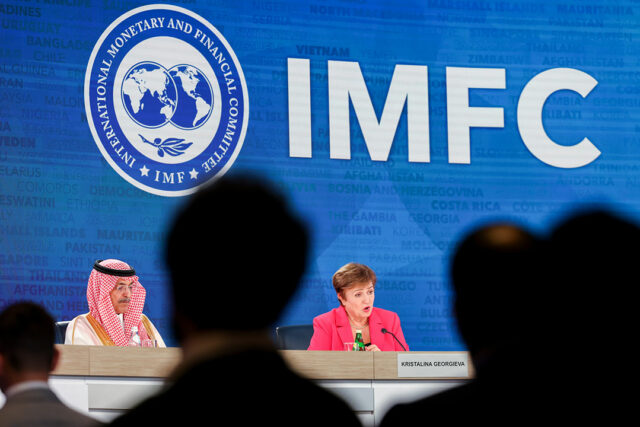
Mohammed Al-Jadaan and Kristalina Georgieva during the annual meetings of the IMF and World Bank in Washington on Oct. 25, 2024. — BLOOMBERG

A LIQUIDITY CRUNCH is brewing across the developing world, raising pressure on US-backed international financial institutions to help poor nations meet mounting debt repayments and drive much-needed investments.

The Washington-based International Monetary Fund (IMF) and World Bank last week unveiled a three-pronged approach to help countries deal with a wall of maturities due over the next three years. The poorest nations have to pay more than $290 billion in foreign debt in the coming years, and billions more to domestic lenders, according to World Bank data.

There’s growing concern that without short-term financing and longer-term fixes, the situation risks tipping into a new wave of sovereign defaults, which would paralyze governments, punish their citizens and deal losses to foreign investors.

“An ounce of prevention is worth a pound of cure,” said Samy Muaddi, head of emerging markets fixed income at T. Rowe Price. “For countries that are dealing with liquidity issues rather than insolvency, which we know is a big point, it’s best to get ahead of that.”

Analysts at S&P Global Ratings said this month that higher debt and borrowing costs will lead to an increase in defaults over the next decade compared to recent years.

The liquidity crunch means that governments are spending more to service debt, limiting what they can invest in infrastructure, education and health, as well as climate-change adaptation. The world’s poorest countries this year are spending an average of 50% of their revenue to service $185 billion owed to domestic and foreign creditors, according to World Bank data.

The joint IMF-World Bank proposal calls broadly for vulnerable countries to boost government revenues and improve public spending; bilateral creditors to provide more concessional funding; and for multilateral lenders to step in with new measures like credit guarantees to help bring down borrowing costs and ease debt burdens.

That plan, however, has been criticized by the US — the biggest shareholder of both the IMF and World Bank. While the Biden administration has welcomed the institutions’ involvement in confronting the liquidity issues, it has said their proposal isn’t aggressive and targeted enough, according to people with knowledge of talks between US Treasury Department and the two so-called Bretton Woods institutions.

Among other criticisms, the US has said the initiative isn’t structured or defined enough to make it clear which countries can and should engage. And while neither side wants to name specific countries with liquidity issues — which would likely spook investors and drive-up borrowing costs — Washington wants a more clearly defined eligibility framework, the people said.

The IMF so far has preferred bespoke solutions for any country in need of liquidity help, which should be designed and led by the countries themselves, rather than the IMF or other multilateral groups.

The last big effort from the IMF and World Bank to help debt-saddled countries — the Common Framework — was heavily criticized by both debtors and creditors as being too slow and politically fraught. Debt restructurings, in some cases, have dragged on for years.

The IMF plan is expected to be discussed by Group of 20 (G20) leaders meeting next month in Brazil. It’s unclear if they will endorse any specific program, as they did with the Common Framework.

An IMF spokesperson said in an e-mail that there’s consensus on the urgency for tackling liquidity challenges and “we remain closely engaged” with stakeholders, including the G20, “on the importance of continuing to strengthen our engagement around this pressing issue.”

The US Treasury declined to comment.

The US, along with France, drafted in September a seven-page informal document called “Pathway for Sustainable Growth” that called for “ambitious, integrated, multiyear reforms” for countries facing stress, according to the paper, which was reviewed by Bloomberg. It called on the IMF and World Bank to “propose a specific, actionable plan” to be discussed during the IMF and World Bank’s annual meetings last week in Washington.

Jay Shambaugh, US Treasury undersecretary for international affairs, hinted at the rift this month in a speech, which has been his usual medium for laying out Washington’s expectations for the institutions it helped found.

“In today’s complex sovereign debt landscape, the IMF plays the critical role of guide, and sometimes referee and air-traffic controller,” Mr. Shambaugh said at the Atlantic Council. He stressed it was key “for countries to have a better understanding of the tools that exist to help them through liquidity challenges.”

The Group of Seven — a group of rich, aligned countries that counts the US as its largest member — capped off the week with a statement that called on the IMF and World Bank to refine their approach.

“We support a country-owned, reform-oriented, multidimensional approach,” it said, “and encourage the IMF and the World Bank to further develop their proposal of a three-pillar approach.” — Bloomberg

SPNEC’s P200-B Terra Solar nears completion

THE PROJECT is expected to generate more than five billion kilowatt-hours of electricity annually. — PHILSTAR FILE PHOTO

SP NEW Energy Corp.’s (SPNEC) P200-billion Terra Solar project might be completed slightly ahead of schedule as it has already achieved a 73% progress rate, the company’s president said.

“In terms of completion, the Terra Solar Project achieved 73% overall development,” SPNEC President and Chief Executive Officer Emmanuel V. Rubio said during a briefing on Monday.

SPNEC, through its unit Terra Solar Philippines, Inc. (TSPI), is developing a project in Nueva Ecija and Bulacan, which consists of a 3,500-megawatt solar power plant and a 4,000-megawatt-hour energy storage system.

The project’s first phase is set to be completed by 2026, with the second phase targeted for 2027.

“Just slightly ahead of schedule. We still have a number of transmission lands to secure. We’re close to actually finalizing and acquiring all the lots for Phase 1. Phase 2 is still ongoing,” Mr. Rubio said.

The project is expected to generate more than five billion kilowatt-hours of electricity annually.

Key progress areas include land control, which is 62% complete, and transmission line right-of-way, which is also 62% complete, according to Mr. Rubio.

The company has secured permits at 61%. Solar farm development has already attained a 96% progress rate, procurement of major equipment is at 95%, interconnecting development is at 90%, and photovoltaic site clearing is about 23% complete.

“We continue to make significant strides in our low-carbon energy transition journey, highlighted by the progress made in our flagship project, Terra Solar,” Mr. Rubio said.

In September, SPNEC and its parent company, Manila Electric Co. (Meralco), formed a strategic partnership with global investment firm Actis, which includes a $600-million investment for a 40% equity stake in Terra Solar.

TSPI has partnered with Meralco Industrial Engineering Services Corp. to build the infrastructure needed to connect the Terra Solar project to the grid.

The Terra Solar project was certified by the Energy department as an “energy project of national significance” and secured “green lane certification” from the Board of Investments, enabling it to benefit from streamlined and expedited permit processing.

SPNEC is controlled by the Pangilinan group through MGen Renewable Energy, Inc., the renewable energy development arm of Meralco Power Gen Corp. The latter is a unit of Meralco.

Meralco’s controlling stakeholder, Beacon Electric Asset Holdings, Inc., is partly owned by PLDT, Inc.

Hastings Holdings, Inc., a unit of PLDT Beneficial Trust Fund subsidiary MediaQuest Holdings, Inc., has an interest in BusinessWorld through the Philippine Star Group, which it controls. — Sheldeen Joy Talavera

Topline’s P3.2-B IPO gets PSE nod, listing set for Dec. 12

BW FILE PHOTO

CEBU-BASED fuel retailer Top Line Business Development Corp. (Topline) has secured the approval of the Philippine Stock Exchange (PSE) for its planned initial public offering (IPO) worth up to P3.16 billion.

Top Line’s maiden offering will consist of 3.68 billion primary shares and an overallotment option of up to 368.31 million shares priced at up to 78 centavos apiece, the PSE said in an e-mailed statement on Thursday.

Based on a prospectus dated Oct. 31, the offer period will be from Nov. 27 to Dec. 3, while the tentative listing date is on Dec. 12. The final price will be determined on Nov. 18.

Top Line will be listed on the PSE’s main board and will be traded via the ticker symbol “TOP.”

At the maximum offer price of 78 centavos, Top Line aims to generate P2.75 billion in net proceeds. The company will not receive any proceeds from the overallotment option.

The company will use the proceeds to build fuel depots in Mactan, Cebu, and in Bohol that will have a combined storage capacity of 30 million liters.

A portion of the proceeds will also be allocated for the acquisition of fuel tankers and tank trucks, as well as the construction of ten Light Fuels service stations.

Investment & Capital Corp. of the Philippines and PNB Capital and Investment Corp. were appointed as the joint lead underwriters and joint bookrunners for the offer.

“Doing an IPO is a big step for companies aiming for growth and expansion. We are pleased that the equities market can support Top Line’s business strategy by providing access to capital it needs to accelerate its development, which is crucial in solidifying its position in the industry,” PSE President and Chief Executive Officer Ramon S. Monzon said.

Top Line started commercial fuel trading operations in 2017, mainly in Central Visayas. The company operates a retail distribution network via fuel station chain Light Fuels.

The company is slated to be the fourth IPO this year, joining gold and copper mining company OceanaGold (Philippines), Inc., and renewable energy companies Citicore Renewable Energy Corp. and NexGen Energy Corp. — Revin Mikhael D. Ochave

Cebu Pacific adds three more aircraft

THE ARRIVAL of two A321 NEOs and one A320ceo brings Cebu Pacific to 83.3% of its 18 expected aircraft deliveries for the year. — AIRBUS.COM

CEBU PACIFIC (CEB) is close to completing its expected aircraft deliveries for the year following the arrival of three new aircraft this month, the budget carrier said on Thursday.

“We’re excited to expand our fleet with these additional aircraft ahead of the peak travel season in December,” Cebu Pacific President and Chief Commercial Officer Alexander G. Lao said in a media release on Thursday.

The arrival of two A321 NEOs and one A320ceo brings Cebu Pacific to 83.3% of its 18 expected aircraft deliveries for the year.

“These deliveries are a key part of our continuous efforts to expand routes and enhance our service, allowing us to better serve the increasing number of travelers,” Mr. Lao added.

Cebu Pacific said these new aircraft deliveries are meant to support the growing travel demand and its network expansion goals.

Airbus’ NEO aircraft also align with the budget carrier’s goal of integrating green fuel across its network. All Airbus aircraft are certified to operate with up to a 50% SAF blend, aligning with Cebu Pacific’s goal of integrating green fuel across its network.

In October, the company also finalized its aircraft order with Airbus SE, touted as the largest aircraft order in Philippine history, valued at P1.4 trillion ($24 billion), covering 102 A321neos and 50 A320neo family.

Currently, Cebu Pacific operates a diversified fleet with nine Airbus 330s, 40 Airbus 320s, 24 Airbus 321s, and 15 ATR turboprops.

The airline operates in 35 domestic and 26 international destinations spread across Asia, Australia, and the Middle East. — Ashley Erika O. Jose

Aboitiz InfraCapital eyes MCIA upgrades

MEGAWIDE.COM.PH

ABOITIZ InfraCapital, Inc. (AIC) is eyeing upgrades to Mactan-Cebu International Airport (MCIA) after acquiring Megawide Construction Corp.’s remaining equity stake, the company said on Thursday.

“With full ownership of AGMCAC (Aboitiz GMR Megawide Cebu Airport Corp.), we are committed to taking the airport to new heights, delivering exceptional passenger experience, and cementing its status as a world-class gateway,” AIC President and Chief Executive Officer Cosette V. Canilao said in a statement.

On Wednesday, Megawide announced that it had completed the divestment of its remaining equity stake in MCIA to AIC for P7.76 billion, allowing it to fully exit from the airport’s operations.

MCIA is considered the second-largest airport in the country after Ninoy Aquino International Airport.

It serves as the main gateway to Central Visayas, serving more than 11 million passengers per year.

“MCIA is more than just an airport; it’s a vital gateway to Cebu and the Philippines. Given the airport’s expansive growth, with international and domestic traffic growing by 35% and 8%, respectively, year on year, we will continue to elevate the airport and, thus, Filipino aviation by setting new standards for what it means to be a Filipino brand of airport management and operations,” said AIC Vice-President and Head of Airports Business Rafael M. Aboitiz.

According to AIC, MCIA continued to elevate passenger experience, citing the transition of MCIA into a silent airport and the introduction of “Cebu Connect,” which allows efficient and seamless passenger transfers.

The company’s acquisition of Megawide’s remaining stake in AGMCAC is part of its goal to bolster its presence in the aviation industry, AIC said, adding that it also aligns with the company’s plan to help accelerate the country’s economic recovery through infrastructure projects.

AIC is also set to take over the operations and maintenance of the Laguindingan International Airport in Misamis Oriental in April 2025.

It also holds the original proponent status for the P4.5-billion New Bohol-Panglao International Airport, which is currently undergoing a Swiss Challenge. — Ashley Erika O. Jose

Death: The Imperial way

THE Tomb of Empress Maria Theresa (background), and her son Joseph II (front). — JOSEPH L. GARCIA

By Joseph L. Garcia, Senior Reporter

DURING a trip BusinessWorld took to Vienna in October, the Austrian capital felt like the setting of a fairy tale. Across our hotel at the Neuer Markt square (the new market, but it had been so since the Middle Ages) stood the shop of A.E. Köchert, jewelers to the Habsburgs, the former Imperial dynasty of Austria (and once, the Holy Roman Empire). Their windows displayed diamond tiaras, while street performers nearby sang arias, and waltzed with their audience. Bells from St. Stephen’s Cathedral woke the square, populated by old-world shops filled with only one specialty: fur, or silver, or stationery.

Every fairy tale has an end, however, and for the rulers of the House of Habsburg, they were reminded of this by the Kapuzinergruft, the Imperial crypt. Located in the same Neuer Markt square (it was a two-minute walk from our hotel), this is where members of the Habsburg family were laid to rest. Oddly enough, it’s a mere seven-minute stroll from their once-seat of power, the Hofburg Palace (aside from being a museum, it also houses the offices of the Austrian president, now Alexander Van der Bellen). The Hofburg Palace complex also holds their treasures at the Schatzkammer (the Imperial Treasury), for all to gawk at and see — at least one thing is true: you really can’t take it to your grave.

The Habsburg dynasty once ruled over several territories beyond their capital in Vienna, which now constitute a large chunk of continental Europe: most of Germany, the modern Czech Republic, Spain, Italy, Belgium, Luxembourg, Switzerland, and so much more — all united under the Habsburg crown. A succession of wars broke up the empire over the years, concluding in the Napoleonic Wars, which ended the Holy Roman Empire and gave birth to the Austro-Hungarian Empire — later to be dissolved, along with Habsburg rule, in the ashes of World War I. No matter — while pieces of the empire were lost in war, the Habsburgs maintained their influence over most of Europe through strategic marriages, hence the family motto: Bella gerant alii, tu felix Austria nube (“May others go to war, you happy Austria, marry”).

The Kapuzinergruft, maintained in perpetuity by the Capuchin friars, was founded in 1618 by Anna of Tyrol, wife of the Habsburg emperor Matthias. Their coffins, made of lead, are among the first you see once you enter the crypt — but then there are so many tombs (about 150), it really depends on where your eyes rest first. To see the tombs of the Habsburgs, one pays about €8.50. Since the crypt is still a working church and monastery, guests are told by a sign to keep their voices down, not to take videos or photos with flash, and not to touch anything. During our visit on Oct. 12, there was just one other hushed tour group, wearing headsets, while a priest guided them through the tour, speaking in low tones into his own headset.

We skipped over some Habsburgs (sorry), and went to the tomb holding Empress Maria Theresa and her husband, Franz Stefan I, Holy Roman Emperor. Empress Maria Theresa (who died in 1780) and her offspring changed much of the world: she introduced education reform across her dominions, and united them all under one code of laws in her name. Her son, Joseph II, expanded upon these reforms and introduced legal freedom to the serfs in 1782, ending serfdom in most of Europe (and in a way, nudging in the Industrial Revolution). His successor, younger brother Leopold II, fought against the French for his sister, Marie Antoinette, trapped in the French Revolution. His son, Francis, continued this battle into the French Revolutionary Wars (he failed to save his aunt from the guillotine, and wasn’t very much interested in doing so, according to accounts), later evolving into the Napoleonic Wars. The resulting Congress of Vienna helped shape Europe as we know it today.

Maria Theresa and her husband’s tomb stands in the center of a vault: impressive, large as a small ship, beneath a dome where sunlight streams in. Veiled spirits guard her baroque tomb, and amidst all this splendor, a skull: a reminder of what we all turn into after death, no matter how great the life led (it is, however, still a skull wearing an imperial crown). Her successor, Joseph, lies in front of his parents, in humbler style, as per his own wishes: the inscription on his plain tomb is almost faded, reading: Hier liegt ein Fürst, der trotz der besten Meinung keiner seiner Pläne durchsetzen konnte (“Here lies a ruler who, despite his best intentions, was unsuccessful in all of his endeavors”).

His wife Isabella’s tomb, by a corner, changed the world in its own way, affecting the Habsburg matchmaking game. Archduchess Josepha was forced by her mother Maria Theresa to pray for her sister-in-law in the crypt. According to accounts, Isabella’s tomb was improperly sealed, and her body infected her sister-in-law with smallpox, which later killed her. With the death of Archduchess Josepha, earmarked as a bride for Naples, her sister Maria Carolina, intended as a bride for France, took her place, and in turn, younger sister Marie Antoinette was sent to France. No smallpox, no Marie Antoinette, no Napoleon, no Congress of Vienna, no Austro-Hungarian Empire, no World War I — and perhaps, little of the conflicts we see today.

We saw other Habsburg tombs: there’s Marie Christine, Maria Theresa’s favorite daughter, and everyone’s least favorite sibling (Marie Antoinette did not invite her to the Petit Trianon during a state visit), whose art collection forms the backbone of the Albertina Museum, also close by; Maria Carolina, Marie Antoinette’s favorite sister, also ousted from her throne in Italy. After seeking familiar names from that chapter of history, we went to the tomb of Empress Elisabeth, another Habsburg celebrity.

Her tomb shares raised space with her husband, Franz Joseph, and her son, Crown Prince Rudolf, though her husband the Emperor’s tomb is raised in the center a few feet above his wife and child. Elisabeth, affectionately known throughout the world as Sisi, captivated the Belle Epoque world then with her beauty, her style, and her melancholic life. Stylishly thin because of an eating disorder caused by the impact of imperial and family life on her mental health, she moved across Europe to avoid staying in the imperial capital of Vienna. Assassinated in 1898, her life and death are the subject of numerous movies, musicals, even a cartoon. The most recent showcase of her tragic life and its influence in pop culture was most recently seen in 2022, with The Empress streaming on Netflix.

Her tomb is not lonely. Again, she spares space with her husband and son (who died in a mysterious suicide in Mayerling) — but to this day, offerings are laid at her tomb. We saw flowers, a framed photograph of her, and drawings by children telling her they loved her.

Other Habsburgs of her own age are also strangely honored: her brother-in-law, Maximillian, is buried in the Kapuzinergruft as well. Mexican flags and other souvenirs from the country are laid at his tomb, despite failing to successfully rule the weak, newly established Mexican Empire. For this, he was executed in 1867 by forces led by Benito Juarez (which led to the modern state of Mexico). His wife, Charlotte of Belgium, mourned him to the point of insanity — she died a recluse in 1927, outliving the empires that shaped her world.

There are tombs of a relatively new make, still retaining their bronzed sheen. They are conspicuous in their newness: the tombs of the family of Karl, the last Emperor of Austria, who died in 1922. His wife, Zita of Bourbon-Parma, died in 1989, and was laid there to rest. After the dissolution of the Empire, the Habsburgs were exiled from Austria and banned from returning until fairly recently. The ex-Empress was allowed entry only in 1982. After her death, she was declared a Servant of God by Pope Benedict XVI, putting her on the path to sainthood (which probably explains the floral offerings at her tomb). The most recent entombment was just last year, in 2023, for Princess Yolande de Ligne, the widow of Archduke Carl Ludwig of Austria, a son of the last emperor.

We take some comfort when we are told that in death, we are all the same. Judging by the resting place of the Habsburgs, are we sure that’s true? Some graves lie forgotten, while some are cared for by priests, centuries on; flowers laid at their tombs, their names still whispered with reverence. There will be no souvenir shops with skull keychains and books about me when I die, that’s for sure. But the map to the Kapuzinergruft argues: “Those who believe that the wealthy and powerful have erected a final monument of their vanity stand corrected: beauty and splendor are strongly contrasted by bare bones and toothless skulls. Above all there is a reminder that death can strike everyone — regardless of age or rank — at any time.”


ADVERTISEMENT
ADVERTISEMENT