Home Blog Page 2448

BusinessWorld is looking for the Philippines Best Places to Work. Is your organization one of them? 

BusinessWorld has partnered with WorkL, a leading employee experience platform that helps companies like yours to measure, track, and improve staff engagement.

Together with WorkL, we’re on a journey to find and celebrate the very best organizations with consistently high levels of positive employee experience in the Philippines.

About WorkL

WorkL, founded by Mark Price, former Managing Director of Waitrose and Deputy Chair of the John Lewis Partnership, is the leading global employee experience platform.

WorkL’s benchmarking data from more than 100,000 organizations demonstrates that workplaces with happy and highly engaged employees typically experience higher productivity, reduced staff turnover and sick absence, and higher profits. These workplaces also find it easier to retain employees and recruit new staff.

Hence why, WorkL’s mission is to help individuals work happier and enable organizations to boost commercial performance by prioritizing employee well-being.

With flexible surveys, advanced data insights, and predictive analytics, WorkL empowers businesses to measure, track, and enhance workplace satisfaction.

WorkL proudly powers the prestigious Best Places to Work Awards in partnership with leading publications across the globe — The Times (UK & Ireland), The Australian, Khaleej Times, and Sunday Times South Africa.

About the Best Places to Work Awards, powered by WorkL

The Best Places to Work Awards are a global initiative to put a spotlight on the companies that take employee engagement and well-being seriously.

At the heart of the Awards is the proven methodology based on six key drivers of workplace engagement:

  1. Reward and Recognition
  2. Information Sharing
  3. Empowerment
  4. Well-Being
  5. Instilling Pride
  6. Job Satisfaction

You can find out more about the methodology in Mark’s latest book — Happy Economics.

The Awards are based on real employee feedback, so the recognition you receive is a true reflection of the positive culture you’ve built.

Awards categories:

  • Best Places to Work: Small Organization (10-49 Employees)
  • Best Places to Work: Medium Organization (50-249 Employees)
  • Best Places to Work: Big Organization (250-1,999 Employees)
  • Best Places to Work: Very Big Organization (2,000+ Employees)
  • Best Places to Work for Women
  • Best Places to Work for Disabled Employees
  • Best Places to Work for Ethnic Minority Employees
  • Best Places to Work for LGBTQA+ Employees
  • Best Places to Work for 16-34 Year Olds
  • Best Places to Work for 55+ Year Olds
  • Best Places to Work for Employee Well-Being

How we identify the best workplaces

To identify the best workplaces, WorkL’s employee engagement survey — developed by behavioral scientists, data analysts, and psychologists — focuses on the above-mentioned six key areas essential to workplace engagement.

These six areas form a comprehensive framework to measure how employees feel about their workplace. A highly engaged workplace will perform well across all these dimensions, and your company has already proven it excels here.

How the Awards Survey works

  • The survey includes 31 questions that measure employee engagement on a 0-10 scale.
  • Each company’s overall engagement score is calculated by combining responses and presenting them as a percentage.
  • To qualify for the awards, organizations must achieve a minimum 70% overall engagement score.

To achieve a high overall engagement score, a company must consistently perform well across its six-step framework, encompassing Reward and Recognition, Instilling Pride, Information Sharing, Empowerment, Well-Being and Job Satisfaction.

It’s not possible to trade off one dimension against another — in a highly engaged workplace, all six steps will be seen positively by employees, albeit to varying degrees. An organization’s overall engagement score is the sum of all question responses, divided by the maximum possible value as a percentage.

WorkL’s banding threshold is based on both independent and WorkL-commissioned research on employee engagement initiatives, and is reinforced by WorkL’s benchmarking data of more than 100,000 organizations.

For an accurate representation of employee sentiment, organizations are required to send the survey to as many current employees as possible.

The survey takes five minutes to complete and the platform is fully mobile-optimized.

Organizations are required to complete a supplementary information survey which is analyzed in conjunction with their survey score to help support their entry.

Those participating have to also reach minimum average response rates to qualify across their organization: Very big — 25%, Big — 35%; Medium — 45%; Small — 50%.

Why enter?

This is an extraordinary opportunity to:

  1. Achieve national recognition as a top employer in the Philippines
  2. Elevate your employer brand and attract top talent
  3. Gain exclusive insights into enhancing employee engagement and workplace culture
  4. Benchmark your organization against industry leaders and outperform competitors
  5. Boost employee morale by publicly celebrating their contributions to your company’s success
  6. Receive a free subscription to BWorldX

In addition to the opportunity to be recognized as one of the best places to work in the Philippines, you will receive a comprehensive management dashboard upon completing the survey, which provides valuable insights into your organization:

  • Overall Engagement Score
  • Confidence In Management Indicator
  • Flight Risk Indicator
  • Well-Being Risk indicator
  • Diversity & Inclusion Indicator
  • Net Promoter Score
  • Six Steps to Workplace Engagement Scores
  • Your data benchmarked against global and industry scores

As mentioned above, the WorkL platform allows you to benchmark your organization against all other businesses in the country and globally.

How to enter

    1. Select your organization size. Select if you are a small, medium, big or very big organization based on your number of employees.
    2. Set up your survey. Select when you’d like your survey to start, end and how many employees you have.
    3. Purchase your Awards package. Pay by card or generate an invoice to purchase your package and be able to send your survey out.
    4. You’re entered!

Once your survey results have been collected and the entry period closes, our panel of experts will evaluate your results and determine the final lists, based on organization size.

The process will only take no more than 10 minutes and you will need your company card or relevant details to generate an invoice.

Click here to enter now.


Spotlight is BusinessWorld’s sponsored section that allows advertisers to amplify their brand and connect with BusinessWorld’s audience by publishing their stories on the BusinessWorld Web site. For more information, send an email to online@bworldonline.com.

Join us on Viber at https://bit.ly/3hv6bLA to get more updates and subscribe to BusinessWorld’s titles and get exclusive content through www.bworld-x.com.
Indonesia’s Laki-laki volcano on Flores Island erupts, killing 9 people

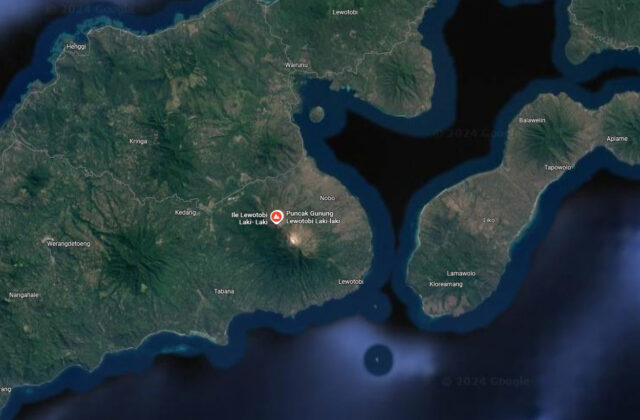
Mount Lewotobi Laki-laki, located on Flores Island in East Nusa Tenggara province, Indonesia. Screenshot from Google Maps

 – At least nine people died after Mount Lewotobi Laki-laki in eastern Indonesia erupted on Sunday, spewing explosive plumes of lava and forcing authorities to evacuate several nearby villages, officials said on Monday.

Mount Lewotobi Laki-laki, located on Flores Island in East Nusa Tenggara province, erupted on Sunday at 23.57 local time (15:57 GMT), belching a fiery-red column of lava, volcanic ash and incandescent rocks, Hadi Wijaya, a spokesperson for The Center of Volcanology and Geological Hazard Mitigation (PVMBG), said on Monday.

“After the eruption, there was power outage and then it was raining and big lightning which caused panic among residents,” he told Reuters, adding that the authority had raised the status of the volcano to level IV or the highest.

The agency has recommended a seven-kilometer (4.35 miles)radius must be cleared.

Fiery lava and rocks hit the nearest settlements around four kms (two miles) from the crater, burning and damaging residents’ houses, Hadi said.

As of Monday morning at least nine people had died, said Heronimus Lamawuran, a local official at East Flores area, adding the eruption had affected seven villages.

“We have started evacuating residents since this morning to other villages located around 20 kms (13 miles) from the crater,” he said.

The nearest villages were covered by thick volcanic ash on Monday morning, Heronimus added.

The authorities are still gathering data on the number of evacuees and damaged buildings.

Indonesia sits on the “Pacific Ring of Fire”, an area of high seismic activity atop multiple tectonic plates.

This eruption follows a series of eruptions of different volcanoes in Indonesia. In May, a volcano on the remote island of Halmahera, Mount Ibu, caused evacuation of people from seven villages.

North Sulawesi’s Ruang volcano has also erupted in May and prompted authorities to evacuate more than 12,000 people.

Flash floods and cold lava flow from Mount Marapi in West Sumatra province, covered several nearby districts following torrential rain on May 11, killing more than 60 people. – Reuters

Harris appeals to Christians and Arab Americans, Trump embraces violent rhetoric

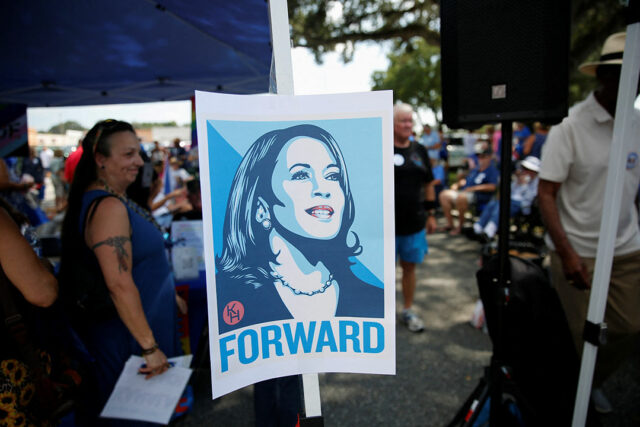
A POSTER of Democratic presidential candidate and US Vice President Kamala Harris is displayed in Florida, US, Aug. 18, 2024. — REUTERS

 – Democrat Kamala Harris made her closing pitch for the U.S. presidency at a historically Black church and to Arab Americans in battleground Michigan on Sunday, while her Republican rival Donald Trump embraced violent rhetoric at a rally in Pennsylvania.

Opinion polls show the pair locked in a tight race, with Vice President Harris, 60, bolstered by strong support among female voters while former President Trump, 78, gains ground with Hispanic voters, especially men.

Voters overall view both candidates unfavorably, according to Reuters/Ipsos polling, but that has not dissuaded them from casting ballots.

More than 78 million Americans have already done so ahead of Tuesday’s Election Day, according to the University of Florida’s Election Lab, approaching half the total 160 million votes cast in 2020, in which U.S. voter turnout was the highest in more than a century.

Control of Congress is also up for grabs on Tuesday, with Republicans favored to capture a majority in the Senate while Democrats are seen as having an even chance of flipping Republicans’ narrow majority in the House of Representatives. Presidents whose parties fail to control both chambers have struggled to pass major legislation.

“In just two days we have the power to decide the fate of our nation for generations to come,” Ms. Harris told parishioners at Greater Emmanuel Institutional Church of God in Christ in Detroit. “We must act. It’s not enough to only pray; not enough to just talk.

Later in a rally in East Lansing, Michigan, she addressed the state’s 200,000 Arab Americans, starting her speech with a nod to civilian victims of Israel’s wars in Gaza and Lebanon.

“This year has been difficult, given the scale of death and destruction in Gaza and given the civilian casualties and displacement in Lebanon, it is devastating. And as president, I will do everything in my power to end the war in Gaza,” Ms. Harris said to applause.

Many Arab and Muslim Americans as well as anti-war activist groups have condemned U.S. support for Israel amid the tens of thousands of civilian deaths in Gaza and Lebanon, and the displacement of millions. Israel says it is targeting militant groups Hamas and Hezbollah.

Mr. Trump visited Dearborn, Michigan, the heart of the Arab American community, on Friday and vowed to end the conflict in the Middle East without saying how.

Instead of mentioning Mr. Trump by name, Ms. Harris chose to highlight her opponent’s record during her last Sunday on the campaign trail.


TRUMP GOES OFF SCRIPT

Mr. Trump, at his first of three rallies on Sunday, frequently abandoned his teleprompter with off-the-cuff remarks in which he denounced opinion polls showing movement for Harris. He called Democrats a “demonic party,” ridiculed Democratic President Joe Biden and talked about the high price of apples.

Mr. Trump, who survived an assassination attempt in July when a gunman’s bullet grazed his ear in Butler, Pennsylvania, on Sunday complained to supporters about gaps in the bulletproof glass surrounding him as he spoke and mused that an assassin would have to shoot through the news media to get him.

“To get me, somebody would have to shoot through the fake news and I don’t mind that so much,” said Mr. Trump, who has long criticized the media and sought to rile public sentiment against them.

Last week he suggested prominent Republican critic, former congresswoman Liz Cheney, should face gunfire in combat over her hawkish foreign policy, leading an Arizona prosecutor to open an investigation.

Campaign spokesperson Steven Cheung issued a statement saying Mr. Trump’s comment was not directed toward the media but rather, “It was about threats against him that were spurred on by dangerous rhetoric from Democrats.”

Mr. Trump later spoke in Kinston, North Carolina, and in Macon, Georgia, where he seized on last week’s jobs report that showed the U.S. economy only produced 12,000 jobs last month.

He told a large crowd gathered in an amphitheater that the report showed that the United States was a “nation in decline” and he warned darkly without evidence of a potentially looming repeat of the 1929 Great Depression with “people jumping off buildings.”

Senior Harris campaign officials have said her closing argument is designed to reach a narrow slice of undecided voters. That stood in contrast to Mr. Trump, who varied little from his standard speech aimed at inspiring his loyal supporters.

“Kamala’s campaign is run on hate and demonization,” Mr. Trump said.

Near the end of his Pennsylvania speech, Mr. Trump – whose false claims that his 2020 loss was the result of fraud inspired his supporters’ Jan. 6, 2021, assault on the U.S. Capitol – mused that he would have preferred not to have handed over power.

“We had the safest border in the history of our country the day that I left. I shouldn’t have left. I mean, honestly, because we did so, we did so well,” Mr. Trump said.

Mr. Trump said during his remarks that election results should be announced on Election Night, despite warnings by officials in multiple states that it could take days to ascertain the final outcome.

Democrats say they have plans in place should Mr. Trump try to prematurely claim victory this time. – Reuters

China urges France to get EU to arrive at palatable EV trade solution

MICHAEL FOUSERT-UNSPLASH

 – China has urged France to take on “an active role” to push the European Commission towards a solution acceptable to both the European and Chinese electric vehicle industries, Beijing’s commerce ministry said on Monday, citing its minister.

Wang Wentao, in a meeting with French junior trade minister Sophie Primas in Shanghai on Sunday, reiterated the European Union’s investigation into China’s EVs is a major concern and has “seriously hindered” China-EU auto industry cooperation.

The EU launched an anti-subsidy investigation into imports of Chinese-made battery EVs last year and in October voted for tariffs on those vehicles. China in the past year has launched its own investigations into European pork and dairy, and imposed temporary anti-dumping measures on imports of brandy from the EU early this month.

Primas is on a three-day visit to challenge China over its import duties on brandy, which Paris calls political and unjustified, Reuters reported last week.

Mr. Wang told Primas China’s trade remedy investigations on EU brandy, pork and dairy products were in accordance with the domestic industry’s applications and complied with the World Trade Organization rules, “unlike the EU” which was “rash” in launching its EV probe.

“China will continue to conduct investigations in strict accordance with the law, safeguard the legitimate rights of enterprises of EU member states, including France, and make rulings based on facts and evidence,” the ministry statement cited Wang as saying.

But he said China is willing to work with the European Commission towards a “proper solution” as well, without elaborating.

China opened an anti-subsidy probe into imported EU dairy products in August and an investigation focusing on pork intended for human consumption in June. – Reuters

Public funding for nature conservation stalls at COP16, eyes on private investment

BETH MACDONALD -UNSPLASH

 – Wealthy nations appeared to hit a limit with how much they are willing to pay to conserve nature around the world, instead shifting their focus at the two-week U.N. biodiversity summit toward discussions of private money filling the funding gap.

At the COP16 negotiations in Cali, Colombia, countries failed to figure out how they would mobilize $200 billion annually in conservation funding by 2030, including $30 billion that would come directly from rich nations.

That money, pledged two years ago as part of the landmark Kunming-Montreal Global Biodiversity Framework agreement, is meant to finance activities that boost nature, such as sustainable farming or patrolling wildlife reserves.

But there was no consensus as talks dragged on beyond the summit’s scheduled end on Friday, during which dozens of delegations departed. By Saturday morning’s roll call, there was no longer a quorum among the nearly 200 nations for an agreement to pass, forcing organizers to abruptly suspend the meeting.

“I am both saddened and enraged by the non-outcome of COP16,” said Shilps Gautam, chief executive of project finance firm Opna.

“The wild thing about the nature financing discussions is that the numbers discussed are already a pittance.”

Human activities such as farming, mining, and urban development are increasingly pushing nature into crisis, with 1 million or so plant and animal species thought to be at risk of extinction.

Climate change, a result of fossil fuel burning, is also adding to nature’s woes by raising temperatures and disrupting weather cycles.

Countries will meet again in Azerbaijan next week for the U.N.’s COP29 climate summit, which again will be focused on the steep need for funding from wealthy nations to their poorer counterparts to help shoulder climate costs.


LITTLE MONEY FROM RICH NATIONS

Even before the talks broke down, developed nations had signaled an unwillingness to offer large amounts of cash.

European governments including Germany and the Netherlands have slashed their foreign aid budgets over the last year, while France and the U.K. are also cutting back.

Government development money specifically targeted at nature conservation abroad fell to $3.8 billion in 2022 compared with $4.6 billion in 2015, according to the Organization for Economic Co-operation and Development.

At COP16, U.N. Secretary General Antonio Guterres demanded that countries make significant new contributions to the Global Biodiversity Framework Fund.

The response was muted. Nations at COP16 pledged $163 million in contributions to the fund, bringing total contributions to roughly $400 million – far from a major contribution to the $30 billion target from nations by 2030.

The United States, which is not a party to U.N. Convention on Biological Diversity, has not contributed.

“The public money is already leveraged as much as we can,” Florika Fink-Hooijer, the European Union’s director general of environment, told reporters at the summit.

“We now have to look at other sources of funding.”


PRIVATE CASH

When it came to going after private capital, delegates at the COP16 summit agreed to a plan to charge pharmaceutical and other companies for their use of genetic information in the research and development of new commercial products.

Pharmaceutical companies Pfizer PFE.N, Merck MRK.NAstraZeneca AZN.Land Sanofi SASY.PA did not respond to request for comment on the deal.

Experts estimate the plan could generate about $1 billion annually.

That still doesn’t cover the billions needed to halt the collapse of ecosystems, like the Amazon rainforest or coral reefs. The world will need to devise ways for enticing private investment in nature-friendly projects, said Marcos Neto, director of global policy at the U.N. Development Program.

Some tools include green bonds or debt-for-nature swaps, whereby countries refinance their debt at lower interest rates in order to spend the savings on conservation. The World Economic Forum estimates that debt-for-nature swaps could generate $100 billion in nature funding. – Reuters

Chinese solar firms, ever-nimble, go further afield where US tariffs don’t reach

EVGENIY ALYOSHIN-UNSPLASH

Some of the biggest Chinese-owned solar factories in Vietnam are cutting production and laying off workers, spurred on by the expansion of U.S. trade tariffs targeting it and three other Southeast Asian countries.

Meanwhile, in nearby Indonesia and Laos, a slew of new Chinese-owned solar plants are popping up, out of the reach of Washington’s trade protections. Their planned capacity is enough to supply about half the panels installed in the U.S. last year, Reuters reporting shows.

Chinese solar firms have repeatedly shrunk output in existing hubs while building new factories in other countries, allowing them to sidestep tariffs and dominate the U.S. and global markets despite successive waves of U.S. tariffs over more than a decade designed to rein them in.

While Chinese firms have been moving their solar manufacturing for years, the scope of the shift to Indonesia and Laos in this latest phase has not previously been reported. More than a dozen people in five countries, including employees at Chinese plants, officials at non-Chinese solar companies and lawyers were interviewed for this article.

“It’s a huge cat and mouse game,” said William A. Reinsch, a former trade official in the Clinton administration and senior adviser at the Center for Strategic and International Studies.

“It’s not that hard to move. You set up and you play the game again. The design of the rules is such that the U.S. is usually one step behind.”

China accounts for about 80% of the world’s solar shipments, while its export hubs elsewhere in Asia make up much of the rest, according to SPV Market Research. That’s a sharp contrast to two decades ago when the U.S. was a global leader in the industry.

America’s imports of solar supplies, meanwhile, have tripled since Washington began imposing its tariffs in 2012, hitting a record $15 billion last year, according to federal data. While almost none came directly from China in 2023, some 80% came from Vietnam, Thailand, Malaysia and Cambodia – home to factories owned by Chinese firms.

Washington slapped tariffs on solar exports from those four Southeast Asia nations last year and expanded them in October following complaints from manufacturers in the United States.

Over the last 18 months, at least four Chinese or China-linked projects have begun operations in Indonesia and Laos, and another two have been announced. Together, the projects total 22.9 gigawatts (GW) in solar cell or panel capacity.

Much of that production will be sold in the United States, the world’s second-biggest solar market after China and one of the most lucrative. U.S. prices have on average been 40% higher than those in China over the past four years, according to data from PVinsights.

U.S. solar producers have repeatedly stated in trade complaints lodged with the U.S. government that they can’t compete with cheap Chinese products that they say are unfairly supported by subsidies from the Chinese government and the Asian countries they export from.

Chinese solar firms have countered that their mastery of the technology makes them more competitive on price.

Tariffs are a key theme in the U.S. election, with Republican former President Donald Trump proposing levies on all U.S. imports to stimulate U.S. manufacturing, including a 60% rate on any goods from China. His rival, Democrat Vice President Kamala Harris has said Trump’s plan would raise costs for U.S. consumers.

Lawmakers on both sides of the aisle, however, have shown support for tougher tariffs on China’s solar shipments to nurture a domestic supply chain.

“Going forward, the American public should demand much stricter enforcement of tariffs, especially around (China’s) use of third countries to break U.S. trade law,” Republican Congressman John Moolenaar, Chairman of the House Select Committee on China, told Reuters.

The U.S. Department of Commerce, the White House and China’s commerce ministry did not respond to Reuters requests for comment.


PAIN IN VIETNAM

The most immediate visible impact of the latest U.S. tariffs, which have brought total duties to more than 300% for some producers, has been in Vietnam’s solar sector.

In August, Reuters visited industrial parks in northern Vietnam owned by Chinese-owned companies including Longi and Trina Solar, and spoke with workers.

In Bac Giang province, hundreds of workers at a large factory complex owned by Longi Green Energy Technology’s 601012.SS Vinasolar unit lost their jobs this year, two employees with knowledge of the matter said.

The company was using just one of nine production lines in the industrial park, one of them said.

In Thai Nguyen, another province, Trina Solar 688599.SS has idled one of its two factories making solar cells and panels, two employees there said.

The employees at both companies declined to be identified due to the sensitivity of the issue.

Longi did not respond to Reuters requests for comment. It said in June it had suspended output at a Vietnamese solar cell plant but did not provide details. Trina declined to comment. It said in June that some facilities in Vietnam and Thailand would be shut down for maintenance without elaborating.

While U.S. solar import data shows shipments from Vietnam up almost 74% through August, industry analysts have attributed the jump to the frontloading of exports to get ahead of this year’s U.S. tariffs.

Vietnam’s government did not respond to requests for comment.


NEW EXPORT BASES, US PLANTS

Chinese solar companies are flocking to Indonesia motivated by the tariffs on Vietnam, according to Indonesian industry ministry official Beny Adi Purwanto who cited Thornova Solar as an example. Thornova says on its website its Indonesian plant has annual capacity to build 2.5 GW of solar modules and 2.5 GW of solar cells for the North American market.

A new 1 GW Trina module and cell plant will be fully operational by end 2024 and will expand capacity, according to Beny. He noted China Lesso Group’s solar module plant which has 2.4 GW in production capacity.

China-linked New East Solar also announced a 3.5 GW panel and cell plant in Indonesia last year.

The Chinese companies did not respond to Reuters requests for comment.

The shift to Indonesian production has been sharp and swift, according to one manager at a U.S. solar firm who was told by their Chinese supplier in Indonesia that they’re inundated with big orders from major Chinese firms looking to export to the United States.

“The scale is totally different,” said the manager who declined to be identified.

Solar exports from Indonesia to the U.S. nearly doubled to $246 million through August of 2024, according to federal data.

Solar companies seeking greener pastures in Laos include Imperial Star Solar. The firm, which has Chinese roots but most of its production in Cambodia, opened a Laos wafer plant in March slated to eventually have 4 GW in capacity.

The move, it said in a statement at the time, helped it sidestep U.S. tariffs.

SolarSpace also opened a 5 GW solar cell plant in Laos in September 2023. The primary purpose of transferring production capacity to Laos was not related to U.S. tariffs, the company said in a statement to Reuters but did not elaborate.

Solar exports from Laos to the U.S. were non-existent in the first eight months of last year but were worth some $48 million through August of 2024.

Others are going further afield.

JinkoSolar said in July it had signed an almost $1 billion deal with partners in Saudi Arabia to build a new 10 GW solar cell and module plant in the kingdom.

Construction of U.S. solar-manufacturing plants by Chinese companies is also surging as they too seek to take advantage of U.S. incentives.

Chinese companies will have at least 20 GW worth of annual solar panel production capacity on U.S. soil within the next year, enough to serve about half the U.S. market, according to a Reuters analysis. – Reuters

[B-SIDE Podcast] Amplifying brands: leveraging podcasts for business growth

Follow us on Spotify BusinessWorld B-Side

How can podcasting help businesses in terms of brand management, community building, and thought leadership? In this episode, BusinessWorld speaks with Ron Baetiong, the founder and CEO of Podcast Network Asia, about the impact podcasting can have for businesses who get into this digital medium.

Interview by Patricia Mirasol
Audio editing by Jayson Mariñas

Follow us on Spotify BusinessWorld B-Side

Key Alcohol sectors launch Philippine Standards Coalition to combat harmful alcohol use

UNSPLASH

by Edg Adrian A. Eva, Reporter

The Philippine Standards Coalition (PSC), comprising leading alcohol producers, e-commerce platforms, and related industry associations, launched on Friday to commit to reducing harmful alcohol consumption in the country. 

During the launch event, the coalition signed a pledge to promote responsible marketing and sales practices, bringing together members including Diageo, Pernod Ricard, Moët Hennessy, Brown-Forman, Bacardi, and the Philippine Association of Stores and Carinderia Owners (PASCO). Other members include Sugbo, Wine, Winery, Singlemalt, Booze Shop, and Flasked. 

PSC is also supported by the Asia Pacific International Spirits and Wines Alliance (APISWA) and the Alcoholic Beverage Alliance of the Philippines (ABAPI).  

“The Launch of the Philippines Standards Coalition demonstrates our industry’s commitment to addressing an important area of alcohol-related harm, which is the access to and consumption of alcohol by minors (below 18-years old),” Siau Xi Goh, APISWA representative said in a statement.  

This campaign reinforces the Philippines’ commitment to reducing harmful alcohol use to 20% by 2030, in line with WHO’s Global Alcohol Action Plan 2022-2030. 

For Philippine Senator Sherwin T. Gatchalian, the launch of the PSC is a major step in uniting stakeholders, the alcoholic beverage industry, sari-sari stores, and other key related industries to promote responsible retailing practices. 

“Tackling harmful alcohol consumption requires collective action,” Mr. Gatchalian said in a video message.  

Recognizing the key role played by sari-sari stores in alcohol distribution, the campaign focuses on educating store owners by training them on their legal and social responsibilities in preventing the sale of alcohol to vulnerable individuals, primarily minors, pregnant women, among others.  

At the heart of the training, sari-sari store owners will learn about various legal requirements, including proper age verification, permits, and licensing for their stores, as well as the consequences of non-compliance. They will also learn about the effects of alcohol on health and the risks associated with its misuse. 

As of October 25, over 200 sari-sari store owners from 13 cities in Metro Manila have successfully trained through this campaign. The 7,000 sari-sari store owner-members of PASCO are expected to follow suit in the training rollout.


Responsible selling of alcohol

Sari-sari stores, positioned at the final point of sale in the alcohol distribution chain, should promote responsible micro-retailing to prevent alcohol consumption among minors, PASCO said.  

“Sari-sari stores are in the best position to implement responsible retailing practices… They can initiate immediate and continuous changes in drinking culture,” Joan Hipolito, Vice President of PASCO said during the launch event.  

As of June, it was reported that over 27,400 deaths in the Philippines are associated with alcohol and its effects, including around 248 fatalities among individuals aged 15 to 19, according to a statement from the Sin Tax Coalition.  

Given that sari-sari stores are deeply embedded within communities and significantly shape the local drinking culture as a go-to source for alcohol purchases, Ms. Hipolito emphasized that targeting these stores is essential for effectively controlling alcohol consumption among minors.  

Responsible micro-retailing involves the “ethical sale of alcoholic beverages, ensuring compliance with regulations, and prioritizing community safety,” Ms. Hipolito said.  

She also emphasized that sari-sari store owners are aware of their responsibilities as micro-retailers of alcohol; they simply need a catalyst to rekindle their motivation and take a more proactive stance in safeguarding their communities. 

Empower Filipinos of all ages and levels to maximize AI use – DOST

FREEPIK

by Patricia B. Mirasol, Producer

In order to maximize artificial intelligence (AI) as a tool, Filipinos from every age and every level of society will need to be capacitated on its use, experts say. 

Franz A. de Leon, director of the Department of Science and Technology (DoST)’s Advanced Science and Technology Institute, said that it is best to start capacity building at an early age. 

“The interest in science, math, etc… if it’s just at the university level, it might be too late,” he said at the second day of the AI Horizons PH 2024 conference. “We want to engage the youth.” 

“The more we diffuse this technology to the very least of our citizens, the more they can gain from it,” also said Enrico C. Paringit, executive director of the DoST-Philippine Council for Industry, Energy and Emerging Technology Research and Development. 

“The reason why ChatGPT [an AI model that’s designed to generate human-like text based on the input it receives] is so ubiquitous is because it’s so accessible,” he told the audience of the same October 25 event.  

“It must have that type of accessibility,” he added, “to achieve the type of impact that you want.” 

With 189 scientists per million people, the Philippines has lower than the UNESCO recommendation of 380 per million. 

The DoST has been creating 21st century learning environment models (CLEM) since 2018 to help meet the demand for such professionals. 

The 21st century CLEM is a school-based classroom setup equipped with technologies such as robotics, three-dimensional modelling and printing, and virtual and augmented reality. It aims to promote teaching and learning skills and is intended as a support system to the education department’s K-12 curriculum. 

The 16th and latest one was launched on October 14 in Cavite’s Angelo L. Loyola Senior High School. 

The bulk of the investment is from the local government unit, which situates the facility in schools that are managed by the Department of Education, explained Albert G. Mariño, director III of DoST’s Science Education Institute (SEI). 

Parati namin inu-update yung mga resources dito (We update the resources in these classrooms),” he said at the October 14 launch. “Kung anong ma-develop naming bago, nilalagay po namin dito (We always incorporate whatever new technology we develop).” 

Students who qualify for SEI’s undergraduate scholarship program can join the roster of the country’s scientists, researchers, and engineers, he said. 

Yan kailangan ng ating bansa dahil sila yung nagiisip ng new knowledge at nagde-develop ng new technologies (This is what the country needs, because it’s the scientists, researchers, and engineers that discover new knowledge and develop new technologies),” he added.  

Children nowadays have an “easy grasp of technology,” Mr. De Leon said at AI Horizons PH 2024. “If we can do some intervention and engage them from the start, that would be good.” 

Interoperability a key component in digital health

STOCK PHOTO | Image by vjohns1580 from Pixabay

by Patricia B. Mirasol, Producer

Data integration and systems interoperability are key components in the digital transformation of healthcare, according to experts speaking at an international symposium by The Association of Academies and Societies of Sciences in Asia (AASSA) and the National Academy of Science and Technology Philippines (NAST PHL). 

Electronic health records (EHRs) exist in the Philippines, but “EHR data is not collected and curated in a way that is optimized for learning health systems (LHS),” said Dr. Iris Isip-Tan, a professor at the University of the Philippines Manila’s College of Medicine. 

An LHS creates a feedback loop of ongoing improvement in healthcare by using data from healthcare encounters. A 2021 BMC Health Services Research publication notes that EHRs are important to an LHS because they provide the data needed to drive this improvement. 

“There’s acceptance among clinicians in digital systems,” Dr. Tan said at the symposium on October 30. “The barrier is infrastructure in terms of data connectivity in our islands.” 

Good outputs need good data, according to Carmencita D. Padilla, a national scientist and a member of the health sciences division of NAST PHL. 

“The issue of interoperability is very important if you want to fast-track the issue of integration of data,” she said. 

“You have to strategically plan and include budget for it [the digitalization of the healthcare process] in your system,” she added. “The primary source of funding should be the government, with the assistance of the private sector.” 

“The cost of digital transformation should of course be done by the government,” also said Dr. Ertugrul Kilic, a member of the Turkish Academy of Sciences. 

Turkey’s entire healthcare process has been digitalized, Dr. Kilic shared in the same event. 

The e-Nabiz Personal Health System, for one, has enabled the country’s citizens to access their digital health records since 2015. It draws information from – among others – over 1500 hospitals and 9000 medical centers. 

Turkey’s digital transformation roadmap – which began in 2004 with its Health Information Systems Action Plan – includes the centralization of health data in 2008, as well as the launch of a communications center in 2016 that provides video translation for those with hearing impairment. 

Younger generations need to be aware of the world’s pressing health problems, advised Narinder Mehra, a professor and the vice president of international affairs of India’s National Academy of Sciences. 

Among these global issues are air pollution and antimicrobial resistance, of which climate change can act as a catalyst.  

“We need to change the narrative: from the threat of climate change, [let’s shift the focus] to a healthier future through climate action,” Mr. Mehra said. 

BingoPlus Foundation stands strong for seniors, breast cancer warriors, and LGBTQIA+ community this October

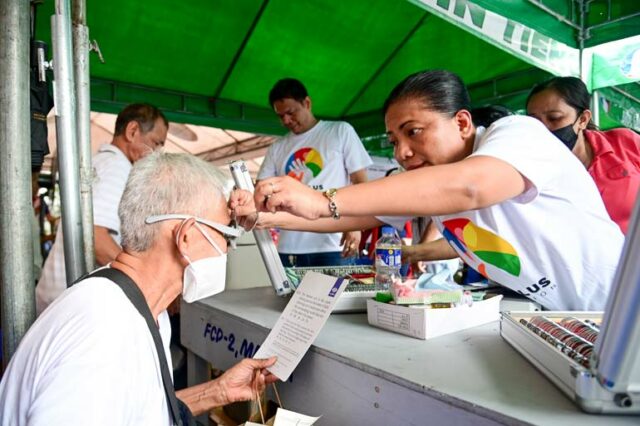
BingoPlus Foundation and the National Commission on Senior Citizens collaborate to provide lolos and lolas with eye checks and glasses during Elderly Filipino Week.

As part of its ongoing commitment to improving community welfare, BingoPlus Foundation, the social development arm of DigiPlus Interactive, dedicated the month of October to three critical health initiatives supporting senior citizens, breast cancer survivors, and the LGBTQIA community.

By partnering with leading organizations in healthcare and social advocacy, BingoPlus Foundation helped bring life-changing support to communities in need.

Celebrating Elderly Filipino Week: Clearer Vision, Brighter Tomorrows

To honor Elderly Filipino Week, BingoPlus Foundation joined forces with the National Commission on Senior Citizens to host a medical mission for over 500 senior citizens in BASECO Compound, Tondo, Manila.

The Foundation provided vision screenings and glasses, giving “lolos” and “lolas” the gift of clearer sight and a renewed sense of independence.

The initiative also included medicines, dental checks and other services from the Department of Health (DoH), Philippine Amusement and Gaming Corp. (PAGCOR), the Philippine Charity Sweepstakes Office (PCSO), among others.

Pink Ribbon Month: Empowering Breast Cancer Warriors with Livelihood Opportunities

A new PLUS e-Center will be established for the benefit of Kasuso Foundation to bridge remote work opportunities for breast cancer warriors and survivors, and sustain financial independence throughout their journey to recovery.

In celebration of Pink Ribbon Month, BingoPlus Foundation partnered with the Philippine Foundation for Breast Care (Kasuso Foundation) to launch a PLUS e-Center to bridge remote work opportunities for breast cancer survivors and their families.

With access to roles as online tutors and virtual assistants, “Pink Warriors” — many of whom are immunocompromised — will have sustainable ways to earn and cover medical expenses, ensuring they remain financially independent while staying safe. The grant was announced during a benefit ballet by SM Cares.

LGBT History Month: Making Healthcare Accessible for LGBTQIA+ Communities

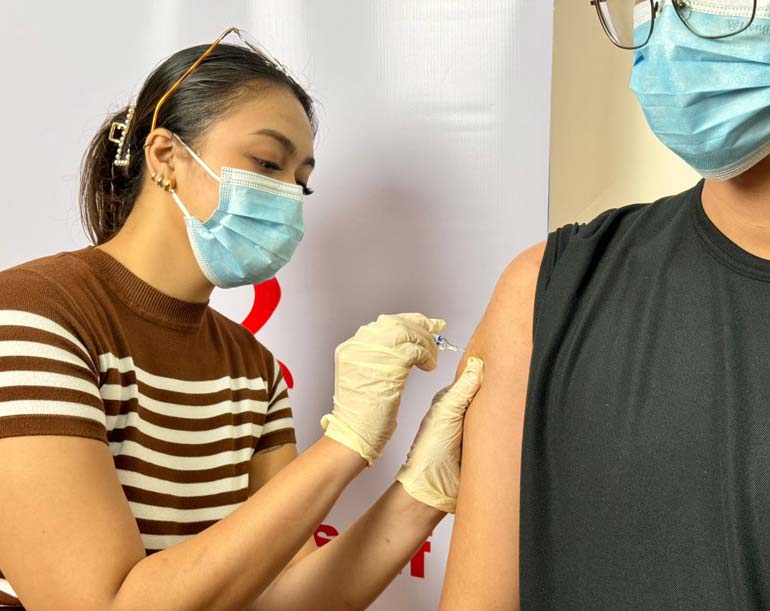
BingoPlus Foundation turned over flu vaccines to boost the immunity of HIV+ clients of Love Yourself PH, represented by Head of Operations Mark Ryan Costales and Head for External Partnerships Calvin June Sintoy.

BingoPlus Foundation also observed LGBT History Month by continuing its collaboration with Love Yourself PH, an organization devoted to providing healthcare services and fostering acceptance for the LGBTQIA community.

In solidarity, the Foundation sponsored a vaccination drive for 600 HIV-positive clients, addressing the critical healthcare needs of this community while promoting health and wellness.

As LGBT History Month celebrates the history and achievements of the lesbian, gay, bisexual, and transgender community, this drive highlights the Foundation’s commitment to reducing stigma and increasing access to healthcare for vulnerable populations.

BingoPlus Foundation remains steadfast in its mission to support the healthcare needs of various communities across the Philippines.

By addressing health disparities and fostering resilience through strategic partnerships, the Foundation is making a lasting impact on the lives of those most in need.


Spotlight is BusinessWorld’s sponsored section that allows advertisers to amplify their brand and connect with BusinessWorld’s audience by publishing their stories on the BusinessWorld Web site. For more information, send an email to online@bworldonline.com.

Join us on Viber at https://bit.ly/3hv6bLA to get more updates and subscribe to BusinessWorld’s titles and get exclusive content through www.bworld-x.com.
Poll: GDP growth likely cooled in Q3

PHILIPPINE STAR/MIGUEL DE GUZMAN

THE PHILIPPINE ECONOMY likely slowed in the third quarter as household spending remained muted after the central bank cut interest rates in August.

A BusinessWorld poll of 12 economists and analysts conducted last week yielded a median gross domestic product (GDP) annual growth estimate of 5.7% for the July-to-September period.

If realized, it would mark a slowdown from the 6.3% growth in the previous quarter and the 6% expansion in the third quarter of 2023.

Q3 2024 GDP growth forecast

This would also bring the year-to-date growth to 5.9%, just below the 6-7% target for the year.

The Philippine Statistics Authority (PSA) is scheduled to release third-quarter GDP data on Thursday (Nov. 7). 

Most economists polled by BusinessWorld said GDP growth likely slowed as elevated inflation may have tempered household spending in the third quarter.

“On the demand side, household consumption was still the primary driver of growth, though it may have remained subdued due to persisting price pressures,” said Chinabank Research, which projected a 5.7% GDP growth in the third quarter.

Inflation quickened to a nine-month high of 4.4% in July but slowed to 3.3% in August. Inflation further eased to a four-year low of 1.9% in September, settling below the 2-4% target. In the first nine months, consumer price growth averaged 3.4%, which is also the central bank’s forecast for the year.

“We expect growth in 3Q 2024 to have cooled to 5.7% year on year as public spending, both in consumption and investment, moderated. Though the central bank did begin its easing cycle during the quarter, we don’t think the change in the monetary stance had affected [the third-quarter] growth,” HSBC ASEAN (Association of Southeast Asian Nations) economist Aris D. Dacanay said in an e-mail.

The Bangko Sentral ng Pilipinas (BSP) began its easing cycle with a 25-basis-point (bp) cut at its Aug. 15 meeting, followed by another 25-bp reduction at its Oct. 16 meeting. This brought the target reverse repurchase rate to 6%.

“Private consumption will stay muted as it will take time for the recent rate cuts to filter through the economy,” said Sarah Tan, an economist at Moody’s Analytics.

Patrick M. Ella, economist at Sun Life Investment Management and Trust Corp., said third-quarter GDP likely expanded by 6%. This, as he expects household spending to have grown by 5%-5.5% in the period ending September from 4.6% seen in the second quarter.

He noted the rate cut’s effect could be seen in “both improved liquidity and a firmer expectation of lower forward inflation.”

Angelo B. Taningco, vice-president and Research Division head at Security Bank Corp., said third-quarter growth may have also been driven by “healthy” government spending, “resilient” capital formation, and a wider trade deficit.

Government spending jumped by more than a tenth to P4.26 trillion in the first nine months, breaching the P4.22-trillion program for the period.

So far, the government has already disbursed almost three-fourths of its P5.8-trillion revised spending program this year.

“Continued public and private construction activities continued to support growth in capital formation,” said Chinabank Research.

Ser Percival K. Peña-Reyes, director of the Ateneo Center for Economic Research and Development, said in an e-mail that construction, transport and storage, and accommodation and food service activities also likely drove GDP expansion to 6.5% in the third quarter.

However, some economists noted adverse weather conditions in the July-to-September period may have hurt agricultural output, which accounts for around 10% of GDP.

“With farm output challenged by recent typhoons and strong monsoon rains, the nonfarm GDP driven by private sector spending, would probably do much of the heavy lifting for 3Q24 GDP to rise by 6.2% year on year,” Ruben Carlo O. Asuncion, chief economist of Union Bank of the Philippines, said.

Chinabank Research said agriculture likely remained “a drag” on third-quarter growth as output declined due to bad weather.

For instance, the effect of Super Typhoon Carina and the enhanced southwest monsoon left around P4.73 billion worth of agricultural damage, affecting farmers and fisherfolk mostly in Luzon.

Third-quarter agricultural output data will be released on Wednesday.

“On the supply side, services continued to power the economy but may have moderated amid lackluster consumption,” Chinabank Research said.

Mr. Asuncion also noted that recent disinflation, strong employment generation by the services sector in August, and robust manufacturing are “clear signals of positive macro catalysts during the quarter.”

OUTLOOK
“Overall, we expect the Philippine economy to grow 5.9% in 2024,” Moody’s Analytics’ Ms. Tan said. “That will be just shy of the government’s 6% to 7% target for the year but will again outperform many of its regional peers in terms of growth.”

Harumi Taguchi, principal economist at S&P Global Market Intelligence, said they expect “lower borrowing costs and softer financial conditions to lift household and business sentiment and lift credit growth in 2025.”

“Overall economic performance is expected to remain on an uptick even though the impact from previous policy rate hikes suppress investment in the private sector. While robust infrastructure spending will drive economic activity, a steady increase in remittance will support private consumption,” Ms. Taguchi said.

John Paolo R. Rivera, senior research fellow at Philippine Institute for Development Studies, said he maintains an optimistic outlook for the rest of the year as a rise in remittances ahead of the holidays is expected to boost consumer spending.

HSBC’s Mr. Dacanay said he expects growth in household consumption to “finally change direction for the better as inflation significantly eased over the quarter.”

“Services exports also likely remained unperturbed with the BPO (business process outsourcing) sector leading the charge while goods exports likely held its ground,” he said. Pierce Oel A. Montalvo

ADVERTISEMENT
ADVERTISEMENT