Home Blog Page 2431

Fixing education

PHILIPPINE STAR/JOHN RYAN BALDEMOR

The Philippine government is preparing to borrow $150 million (roughly P8.5 billion) from the World Bank (WB) to finance a series of projects aimed at improving public education. According to reports, these initiatives will run from 2025 to 2030, potentially benefiting over 21 million students from kindergarten to Grade 10. While any investment in education is welcome, a critical look at the numbers raises questions about the adequacy of this funding.

If we break down the P8.5 billion, this equates to approximately P425 per student over the five-year period. Considering the enormous challenges facing the education sector, this amount appears almost negligible. Yet, as modest as it may be, it is still better than nothing. The question, however, remains: can such a limited budget make a meaningful impact?

The most pressing challenge, as highlighted by the World Bank, is “learning poverty.” An alarming 91% of 10-year-olds in the Philippines cannot read and understand age-appropriate text. The country ranks near the bottom — 77 out of 81 countries — in math, reading, and science. These dire statistics point to a nationwide crisis, with overcrowded classrooms, poor teacher quality, and a lack of essential learning materials identified as primary causes.

It is crucial to acknowledge the systemic issues that have plagued Philippine education for decades. One of the most glaring problems is chronic underfunding. Despite constitutional mandates, public investment in education has been consistently insufficient. In 2019, education spending accounted for just 2.8% of the Gross National Product, far below the recommended 4% benchmark. This chronic underinvestment has created a ripple effect, impacting infrastructure, teacher salaries, and the availability of learning materials.

Many public schools, especially those in rural and remote areas, lack basic facilities like classrooms, libraries, and laboratories. Overcrowded classrooms are the norm, with one teacher often having to manage 40 or more students. This environment is hardly conducive to effective learning, and it is a reality that has persisted for at least half a century.

Another critical factor is the quality of teaching. Teacher education and professional development are areas in desperate need of attention. Higher passing rates in the Licensure Examination for Teachers, coupled with more opportunities for skill enhancement, can help address subpar teaching standards. We also need to ensure that our educators are well-trained, motivated, and equipped to adopt modern teaching methods.

Moreover, the curriculum itself may need a complete overhaul. The current system seems to place emphasis on rote memorization, rather than developing critical thinking, problem-solving, and creativity. This is evident in our students’ poor performance in international assessments in reading, mathematics, and science. Many students know mathematical formulas but struggle to apply them in real-world scenarios or word problems.

Education inequality is another formidable challenge. In a country where poverty is pervasive, children from economically disadvantaged families often find themselves left behind. Geographic isolation further compounds the problem, limiting access to quality education, particularly in rural and conflict-affected areas. The urban poor face similar hurdles, with many parents unable to prioritize education when daily survival is a struggle.

It is easy to prescribe solutions like increasing the national budget for education or reforming the curriculum. However, these are far easier said than done. A large portion of the national budget is already tied up in debt servicing, limiting the government’s ability to allocate more resources to education. Nonetheless, a strategic increase in investment is crucial. Funds must be channeled effectively to improve infrastructure, provide adequate learning materials, and enhance teacher training.

Curriculum reform should be more than just an academic exercise. The new curriculum must prepare students for both local and global demands. As the Philippines is a major exporter of labor, our education system must equip students with skills that are relevant in a rapidly evolving global economy. Critical thinking, creativity, and practical problem-solving must be prioritized to prepare students for the future.

Improving teacher quality is equally important. The Department of Education (DepEd) must collaborate with the private sector to develop comprehensive professional development programs. These should not be one-off workshops but continuous learning initiatives that keep teachers updated on best practices. However, resistance to change is a real challenge. Many educators are reluctant to acknowledge the need for self-improvement, and breaking down this resistance will require concerted effort, possibly through mandatory continuing education.

No education reform will be complete without addressing the socioeconomic barriers that keep children out of school. The government must invest in targeted support for disadvantaged students. This could include scholarships, meal programs, and transportation subsidies. However, financial assistance should not be a blanket approach. It needs to be carefully targeted to maximize impact, ensuring that students with the potential to benefit most are prioritized.

And last but not least, while the government and educators play significant roles, parents are also key players in this equation. A holistic approach to education reform must involve parents as active partners in their children’s learning journey. Parental involvement can make a significant difference, especially in instilling the value of education and encouraging children to stay in school and strive for academic excellence. Simple acts, such as reading with children at home or reinforcing what they learn in school, can have a profound impact.

In countries like Singapore and Japan, the importance of parental involvement is well recognized. These nations have robust education systems, but they also have cultures that place a high value on education and parental engagement. While we cannot replicate their models wholesale, there are valuable lessons to be learned. For instance, promoting a culture that emphasizes education as a pathway to improving one’s quality of life can inspire students to aim higher and do better in school.

Obviously, we need more funding, better infrastructure, and highly skilled teachers. But we also need a curriculum that prepares students for real-world challenges. And perhaps most important, we need parents to step up and be active participants in their children’s education. Education is a shared responsibility, and everyone — government, teachers, parents, and society at large — has a role to play.


Marvin Tort is a former managing editor of BusinessWorld, and a former chairman of the Philippine Press Council

matort@yahoo.com

Ovialand eyes P2.2B in initial sales from new Laguna project

Sentro Properties is a 9.7-hectare development in San Pablo, Laguna.

REAL ESTATE developer Ovialand, Inc. launched a 9.7-hectare development in San Pablo, Laguna, marking the second project under its joint venture with Japan-based Takara Leben Co. Ltd.

The project, called Sentro, will have 746 housing units priced at P3 million to P5 million, Ovialand President and Chief Executive Officer Pammy Olivares-Vital said during the launch event in Makati City late Tuesday.

She added that Ovialand expects about P2.2 billion in sales for the initial phase of the development.

“The launch of Sentro builds on our ongoing fruitful partnership with Takara Leben. This involves us tapping their expertise as we work towards our goal of having a nationwide presence by 2033,” Ms. Vital said.

The turnover of the units will start by late 2025. The property is located near the city center and has a 20-meter frontage.

The sizes of the housing units range from townhouse, duplex, and single-detached units. Each unit is built using pre-cast technology, allowing homebuyers to move into the homes within three to six months.

“We want our homebuyers to avail their dream homes with ease and convenience as they are assisted in every step of the home-buying process — from securing their loan applications up until the completion of administrative-related work,” Ms. Vital said.

Some of the amenities of Sentro include a planned commercial center, wider roads, bike lanes, and open spaces.

“The commercial space we’re allocating is around 10% of the area. Our goal is to supplement the community,” Ms. Vital said.

The first project of the Ovialand and Takara Leben joint venture is the 6.5-hectare Savana South in Laguna, which has 657 house and lot units.

To date, Ovialand has completed close to 3,000 housing units in San Pablo, Laguna, which are fully moved into by homebuyers.

Other Ovialand projects in San Pablo include Santevi, Sannera, and Savana.

Takara Leben is a Japan-based company involved in the development and sale of condominiums, leasing of real estate, and distribution of real estate. It is a subsidiary of Japan-listed Mirarth Holdings, Inc.

Ovialand is a real estate developer that has a presence in Laguna, Batangas, Quezon, and Bulacan. It caters to the premium and affordable segments of the real estate market. — Revin Mikhael D. Ochave

Philippine Merchandise Trade Performance (September 2024)

THE PHILIPPINES’ trade-in-goods deficit ballooned to $5.09 billion in September, the biggest trade gap in 20 months, the Philippine Statistics Authority (PSA) said on Wednesday. Read the full story.

Philippine Merchandise Trade Performance (September 2024)

Nintendo Switch software to be playable on successor device

REUTERS

TOKYO — Nintendo President Shuntaro Furukawa said on Wednesday that software for the company’s Switch console would be playable on the successor device.

The Kyoto-based gaming company has said it plans to make an announcement about a successor device during the financial year ending March 2025 but has not provided further details.

“Nintendo Switch is currently being played with by many customers so we decided it would be optimal for them to be able to play their Switch software on the successor model,” Mr. Furukawa said.

“Customers will be able to enjoy the games they own and choose their next title from the lineup of games already on the market,” Mr. Furukawa told a management policy briefing.

Offering backwards compatibility could help encourage consumers to transition to the new device and boost the appeal of existing software.

“It’s not a big surprise but might be another hint the next device will be similar to the current one,” said Serkan Toto, founder of the Kantan Games consultancy.

Nintendo has sold more than 1.3 billion software units for the Switch, which is in its eighth year on the market and has an install base of more than 145 million units.

The Kyoto-based gaming company has had success in extending the life cycle of the hybrid home-portable Switch with hit games and a series of hardware refreshes.

Hardware sales are losing steam, with Nintendo on Tuesday cutting its full-year sales Switch forecast by 7% to 12.5 million units ahead of the key year-end shopping season.

“We are not surprised by the miss on the (hardware) side, given that Nintendo’s target markets appear fairly saturated in most geographies,” Jefferies analyst Atul Goyal wrote in a client note.

“Software sales picked up in 2Q and are expected to continue in 3Q,” Mr. Goyal wrote.

Nintendo sold 39.6 million software units in the second quarter ended September, a 29% increase compared to three months earlier.

The company’s shares climbed 6% in Tokyo, compared to a 3% rise in the benchmark index. Reuters

BSP to collaborate with French central bank on currency management

BW FILE PHOTO

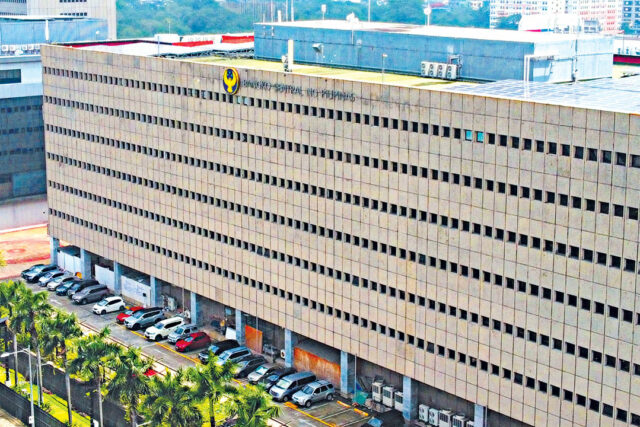
THE BANGKO SENTRAL ng Pilipinas (BSP) has partnered with the French central bank to improve currency management.

The central bank signed a memorandum of understanding (MoU) with Banque de France to share best practices and provide technical and capacity-building assistance to improve currency operations, it said in a statement on Wednesday.

“Because we take this seriously, the BSP is proud to partner with Banque de France to enhance the quality of our currency. We look forward to tapping over a century of its experience in paper-money production and many patented security features,” BSP Governor Eli M. Remolona, Jr. said.

He said issuing banknotes and coins “remains an important part of a central bank’s responsibilities” despite the shift to digital.

“Under the five-year MoU, BSP and Banque de France will collaborate on strengthening currency and security management and production; currency demand forecasting; digital payments governance; and research and development on digital payments, banknote substrates, and high durability solutions,” the BSP said.

The two central banks will also work on “improving technology exchange; information-sharing on legal aspects of central banking cooperation; staff exchange and training; and counterfeit banknote analysis and evaluation of the counterfeit resilience of new banknotes and security features,” it added. — Luisa Maria Jacinta C. Jocson

How to dine like a banker at Hong Kong’s Nobu, according to Nobu himself

NOBURESTAURANTS.COM

By Kristine Servando

FOLKS who went to Nobu at the Regent Hotel in Kowloon last week were in for a treat as celebrity chef Nobu Matsuhisa was in the city to celebrate the first anniversary of the reopening of his namesake restaurant in Hong Kong.

To mark the event, he hosted special omakase meals for two days. Though some dishes weren’t featured on the regular menu, they still evoked the Peruvian-Japanese flavors that made his sushi restaurants — now numbering 56 worldwide — a hive for the rich, famous, gluttonous, and now me.

With their boss in the room, one could sense the servers were extra spiffy. It was also nearly a full house, a rarity on a weekday night these days, I’m told.

Among the highlights of the HK$1,888 ($243) set meal included the melt-in-your-mouth A5 wagyu with mushrooms, the lobster with cream sauce, and his signature parade of sushi and sashimi. My favorite was the seaweed taco filled with hamachi (yellowtail tuna) and sea urchin — the perfect umami bomb. A handful of dishes were slightly imbalanced, like the mackerel pico de gallo with harsh red onions, but otherwise it was all tasty.

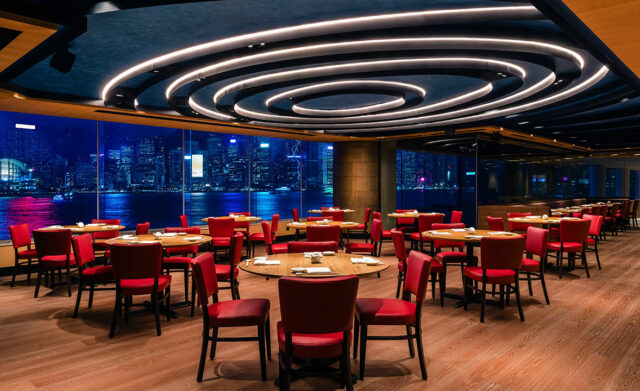
As to the decor, it resembled a wood-paneled, low-lit wing of a luxury ryokan (a traditional Japanese inn), with lovely wraparound views of Victoria Harbour. Yes, it’s good for business meetings, with enough space between tables, including semi-private circular booths, plus a 15-seat private room.

I asked Chef Nobu what bankers should order to impress clients and he recommended the classics: black cod miso (HK$380), yellowtail and jalapeño sushi maki (HK$130) and his miso salad with lobster and pear (HK$320). I would add the wagyu flambé (HK$480 per 75 grams) if you really want fireworks.

I also took the occasion to briefly interview Chef Nobu about the restaurant industry and his next steps. His comments have been lightly edited for brevity and clarity.

What brings you back to Hong Kong?

It’s a world-renowned dining destination and we are very excited to be a part of it. You cannot beat the stunning panoramic view of Victoria Harbor!

Where do you eat when you’re here?

When I visit Hong Kong, I like to spend almost all of my time at my restaurant, with my team. It’s the best way for me to pass on my teachings and connect.

How are you dealing with Hong Kong’s economic slowdown?

Yes, economic challenges have affected the way people dine out, but guests still seek out meaningful, memorable experiences. Nobu Hong Kong, like everyone, has been affected, but our focus remains on quality ingredients, exceptional service, and inspired cuisine. To position for growth, we’re focusing on unique experiences, like our omakase dinners and special collaborations.

You run hotels too. Any plans for Hong Kong?

No plans to expand into Hong Kong property right now. But in the future, anything is possible.

Your best investment ever?

The expansion into hotels was very important. One day I was talking to Bob [co-founder Robert De Niro] and he said, “Nobu, instead of opening restaurants in everyone else’s hotels, why don’t we open restaurants in our own hotels?” This has allowed Nobu to grow into a true lifestyle brand. We are able to connect with our guests in a deeper way. My dream now is to continue to grow Nobu into a global lifestyle brand and pass on my philosophies and learnings to the next generation of our team. Bloomberg

Nobu Hong Kong is located on the second floor of Regent Hong Kong hotel (formerly the InterContinental Hong Kong) at 18 Salisbury Road in Kowloon. It’s open all week from 6 to 11 p.m., and on Saturday for brunch from 11:30 a.m. to 2:30 p.m. Bookings can be made online or by phone at +852 2313-2313.

Money can buy you happiness

FREEPIK

THE IDEA that money can’t buy you happiness is one of the world’s most persistent tropes. King Midas is granted his wish that everything he touches will turn to gold only to starve to death. Jay Gatsby finds that money can’t buy him Daisy’s love. Succession proved to be so popular not just because it is so cleverly written but also because it dwells on the misery of the super-rich. The Roy children may live in a world of private planes, luxury yachts, and subdued designer clothing, but their personal lives are marinated in toxicity. Better to be a happy peasant than Kendall Roy.

But is there any real evidence for this? Or is it just a story we tell ourselves out of either resentment of the rich or a sense of social justice? We can all produce examples of rich people whose lives were ruined by horrible divorces or poor people who spend their lives doing what they love. But anecdotes are not data — and vague sentiments about just desserts are not arguments.

Over recent decades both economists and psychologists have embarked on a rigorous study of happiness (or “well-being,” as they tend to put it). Their work not only explodes the myth of happy peasants and miserable millionaires. It also suggests, more tantalizingly, that there may be no upper limit to the happiness that wealth can bring.

There is overwhelming evidence that up to a certain point greater average wealth produces greater average wellbeing. In 2007 the Nobel Prize-winning economist Angus Deaton analyzed the data on life satisfaction supplied by a Gallup Organization poll of well-being in 132 countries and discovered that average life satisfaction is strongly related to per capita national income. Each doubling of income was associated with a nearly one-point increase in life satisfaction on a scale of one to ten.

Skeptics about the wealth-happiness equation have now retreated to a different argument: that there is a plateau in the relationship between wealth and happiness. People in rich countries may well be happier than people in poorer ones because their basic needs are more likely to be met, the argument goes, but a point comes when the money effect diminishes and the real causes of happiness (a happy marriage or a compelling hobby) assert themselves.

Deaton conceded at least some of this point in subsequent work that he did with his Princeton University colleague and fellow Nobel Prize-winner, the psychologist Daniel Kahneman. In this work the Nobel duo distinguished between two sorts of well-being — evaluative well-being (how you evaluate your life in retrospect) and moment-to-moment well-being (how you evaluate your life in real time).

They discovered that while evaluative well-being continues to rise with income, experienced well-being reaches a plateau at about $75,000 a year. One possible interpretation of this discrepancy is that, after a certain point, money is just a way of keeping score. You can’t buy any more day-to-day satisfaction (indeed the pursuit of money may even prevent you from enjoying your gains) but you can at least gloat that you’re doing better than Mr. Jones.

But the latest academic work chips away at the idea that there is a plateau, just as previous academic work chipped away at the idea of happy peasants and miserable bourgeois. Matthew Killingsworth, of the University of Pennsylvania’s Wharton Business School, has amassed a sample of more than one million real-time reports of experienced well-being in the US (compiled by getting people to report their day-to-day well-being on their smartphones). In a 2021 paper he studied 33,000 people who provided such real-time evidence and discovered three things: that there is no evidence of a divergence between evaluative and real-time well-being; that real-time well-being rises linearly with income and, third, that the slope is just as steep above $80,000 a year as below. The idea of a happiness plateau is for the birds: Higher incomes are clearly associated with both feeling better on a day-to-day basis and being more satisfied with your life overall.

What about people who earn well above $80,000? In a new paper Killingsworth compares the reported life-satisfaction of his sample of 33,000 Americans with a wide variety of incomes with the reported life-satisfaction of two groups of ultra-wealthy individuals: millionaires from around the world and members of the Forbes 400 list of the richest Americans. His conclusions are well-summarized in the title of his study: “Money and Happiness: Extended Evidence against Satiation.” Truly wealthy people are significantly happier than the highest earners in the ordinary income group if you take “life satisfaction” as a meaningful measure of happiness. Moreover, the happiness gap between truly wealthy people and middle-income earners is three times as large as the happiness gap between middle and low-income groups. We not only get happier as we move from the middle-income herd to the Succession crowd, but we get a lot happier.

Killingsworth’s study is not perfect: There is such a shortage of evidence about the well-being of the truly wealthy that one of the studies he relies on, of the Forbes 400, dates from 1985 (the other is from 2018). But never has the phrase “more research is required” sounded more attractive. I’m afraid that my manager has rejected my request for an expanded expense account to explore the question of whether there is, in fact, an upper limit to the relationship between money and happiness. “Satiation” research sounds like my sort of thing. But my few experiences of life among the super-rich suggest strongly that there is no upper limit. I used to think that no happiness is greater than being upgraded from economy class to business class, given the vileness of life in the former. But in fact, First Class is significantly better than business, happiness-wise, a lift on a private jet is significantly better still, and a spell on a yacht is better than both.

The growing consensus among happiness researchers is more than an idle curiosity. It has important implications for both social policy and individual choices. The world suffers from a growing plague of anti-growth activists who argue that growth doesn’t really bring happiness. Commencement speakers routinely tell students to follow their passions rather than going for the money. In terms of personal happiness, the science suggests that this is nonsense. Anti-growth activists should take a hike. Commencement speakers should adopt a more realistic template. Don’t bother to follow your adolescent passions: You will end up as an unemployed musician or an itinerant professor moving from one miserable gig to another. Go for the money instead: That way lies not only long-term freedom but happiness as well.

BLOOMBERG OPINION

Banking, IT sectors drive ManageEngine’s Philippine revenues

PIXABAY

THE PHILIPPINES is the third largest source of revenues for information technology (IT) management provider ManageEngine in the Southeast Asian region, driven by the banking and IT sectors, its regional director said.

ManageEngine Regional Director Arun Kumar told a media briefing on Wednesday that the Philippines contributes 15% of its revenues in the Association of Southeast Asian Nations, only behind Singapore and Indonesia, which together account for 50% of revenues.

In the Philippines, sectors that drive revenues for ManageEngine include IT, IT-enabled services, business process outsourcing, government, healthcare, and education.

Philippine firms have been beefing up their digitalization efforts to protect themselves against cyberattacks.

A 2022 report by independent risk advisory firm Kroll said that three in four Philippine firms have dealt with a cyberattack.

ManageEngine’s revenues in the Philippines have been growing by around 20% to 25% in the last three to four years, Mr. Kumar said.

“We are very confident we will even grow on the higher side in the coming years,” he told BusinessWorld after the briefing.

The expected increase in ManageEngine’s revenues from the Philippine market is driven by unified product offerings for enterprises on IT management and IT security, Mr. Kumar said.

The company expects to gain more customers from mid and large enterprises.

“Our local investments in terms of hiring people locally in the Philippines will definitely add more value to us,” Mr. Kumar said. — Beatriz Marie D. Cruz

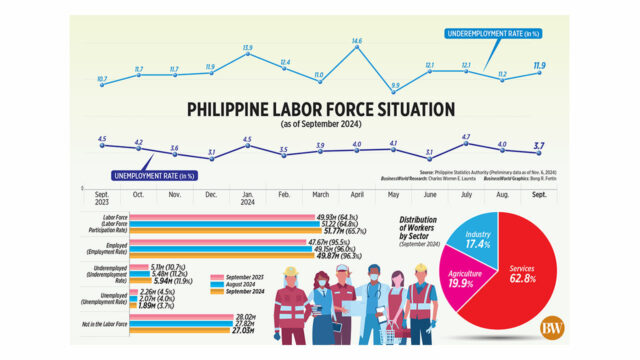
Philippine Labor Force Situation

THE PHILIPPINES’ unemployment rate fell to 3.7% in September, driven in part by a growing number of female workers joining the labor force ahead of the holiday season, the statistics agency said on Wednesday. Read the full story.

Philippine Labor Force Situation

Apple set to face fine under EU’s landmark Digital Markets Act, sources say

The Apple logo hangs in a glass enclosure above the 5th Ave Apple Store in New York, Sept. 20, 2012. — REUTERS

APPLE is set to be fined by the European Union’s (EU) antitrust regulators under the bloc’s landmark rules aimed at reining in the power of Big Tech, making it the first company to be sanctioned, sources with direct knowledge of the matter said on Tuesday.

The regulators charged in June that the iPhone maker had breached the bloc’s tech rules. The charge against Apple was the first by the Commission under its Digital Markets Act (DMA).

The fine is likely to come this month although the timing could still change, the sources said.

The fine would add to Apple’s mounting antitrust troubles, as EU regulators attempt to level the playing field for smaller firms.

This comes just months after Brussels fined Apple €1.84 billion ($2.01 billion) in March for thwarting competition from music streaming rivals via restrictions on its App Store — Apple’s first ever penalty for breaching EU rules.

Apple also faces an investigation into new fees imposed on app developers. DMA violations could result in a fine of as much as 10% of a company’s global annual turnover.

The Digital Markets Act, which came into force earlier this year, requires Apple to allow users to set the default web browser of their choice on iPads, permit alternative app stores on its operating system and allow headphones and smart pens to access iPad OS features.

Apple declined to comment. The European Commission did not immediately respond to a Reuters request for comment.

Apple also lost a long-running court battle with the EU in September, resulting in the company being forced to pay €13 billion in back taxes to Ireland.

Bloomberg first reported on Apple’s imminent EU fine earlier on Tuesday.

Watchdogs are readying the penalty after Apple failed to allow app developers to steer users to cheaper deals and offers outside of the App Store, Bloomberg reported, citing people familiar with the case. Reuters

Dominion Holdings books lower Q3 earnings

DOMINION HOLDINGS, Inc. (DHI) saw its net income decline by 54.57% year on year in the third quarter due to lower interest earnings.

The company’s net income stood at P36.53 million in the three months through September, down from P80.4 million in the same period last year, its financial statement showed.

In the first nine months, the company’s net profit stood at P171.01 million, down by 16.86% from P205.69 million a year ago.

“The company paid P3.2 billion in cash dividends in May 2024, which reduced the funds available for investment, and consequently, resulted in lower income from investments,” DHI said.

The company’s interest income was at P49.24 million in the third quarter, down by 44.61% from P88.9 million a year ago

Meanwhile, its expenses stood at P2.87 million in the period.

Total assets were at P3.297 billion at end-September, down from P6.31 billion a year prior.

DHI shares inched down by one centavo or 0.61% to end at P1.64 each on Wednesday. — AMCS

Dining In/Out (11/07/24)


Dining at home with Kultura

KULTURA, inside SM Store and SM Malls, carries a full range of tablescaping accessories that are under the Green Finds label. They are made of responsibly sourced raw materials such as acacia, nito, and rattan. For example, there is an acacia plates and ramen bowl set, as well as chopsticks and a single sauce container. The line of acacia/mango wood products includes the Kuksa Mug. The rattan line has multipurpose trays that come in different sizes, a stained coaster set, a bread tray with handle, and placemats. There are also placemats in sets of six, in different colors. Another material to consider is nito, with a line of placemats in round and oval shapes, bread trays, as well as a utility holder.


McDonald’s releases reusable holiday cups

MCDONALD’S is launching its first-ever reusable cups with its Holiday Christmas Collection line. The cups are available until Nov. 15 via the McDo App, McDonald’s stores nationwide, and McDelivery. Every reusable cup is designed with McDonald’s iconography featuring bright and fun graphics. Meant for both hot or cold drinks, each reusable cup design comes with a yellow or white lid, giving customers flexibility to mix and match. McDonald’s Reusable Cups are available for P79 each with any Extra Value Meal purchase in all stores nationwide.


Dylan Patisserie and Gourmet Café’s holiday hampers

DYLAN PATISSERIE and Gourmet Café is now offering a selection of luxury gift hampers. Dylan’s Gift Hampers come packaged in themed baskets, filled with a selection of flavors that cater to every palate. These include cookies, chocolates, premium nuts, and pastries. The hamper themes include “Yuletide,” “Festive,” “Holiday,” “Holly,” “Merry,” “Season,” “Party,” “Festival,” “Prosperity,” and “Jolly.” For more information visit the website www.dylanpatisserie.com or contact 0917-877-2999.


Magnolia Chicken Timplados aims for convenience

Magnolia Chicken Timplados products come in a variety of marinades and flavors so they’re instantly and conveniently ready-to-cook and flavorful. Magnolia’s Chicken Inasal has the classic deep and smoky inasal (barbecue) flavor, marinated in a mixture of vinegar, calamansi, garlic, and spices. Cheesy Chicken Fingers are a flavorful twist on a classic favorite, and can be served with the diner’s favorite dips. Magnolia’s Oriental Wings has a blend of sweet, savory, and a touch of spice. Magnolia Chicken Timplados products are available in leading supermarkets.

ADVERTISEMENT
ADVERTISEMENT