Home Blog Page 2407

Ex-Philippine President Duterte says ICC should ‘hurry up’ on drug war investigation

FORMER President Rodrigo R. Duterte on Monday told a Senate blue ribbon committee hearing his anti-illegal drug campaign was meant to “protect the country and the Filipino people.” — PHILIPPINE STAR/JESSE BUSTOS

MANILA – Former Philippine President Rodrigo Duterte said the International Criminal Court (ICC) should ‘hurry up’ with its probe of his war on drugs, remaining firm in his defence of the brutal campaign as he said the investigation should start immediately.”I’m asking the ICC to hurry up, and if possible, they can come here and start the investigation tomorrow,” Duterte said in a congressional inquiry on his war on drugs.

“If I am found guilty, I will go to prison.”

According to police data, more than 6,200 people died in anti-drug operations under Duterte’s presidency, during which police typically said they had killed suspects in self-defence.

Human rights groups believe the real toll to be far greater, with thousands more users and small-time peddlers killed in mysterious circumstances by unknown assailants.

“I assume full responsibility for whatever happened in the actions taken by law enforcement agencies of this country to… stop the serious problem of drugs affecting our people,” Duterte said.

The ICC last year cleared the way for an investigation to into the thousands of deaths and other suspected rights abuses.

The Philippines withdrew from the ICC in March 2019, when Duterte was president. Appeals judges at the ICC subsequently ruled prosecutors still had jurisdiction over the alleged crimes because they occurred when the Philippines was an ICC member. — Reuters

Get to Know Ray Manigsaca: The AppleOne Group Leader whose Love of God and Family, Commitment to Community Propelled the Company to Success

AppleOne Group CEO and President Ray Go Manigsaca

AppleOne Group CEO and President Ray Manigsaca has an easy-going aura that drives people to warm up to him easily. But it is his no-nonsense and calculated approach to business that ultimately convinces business partners to trust his sharpness and vision. The biggest proof of which is the continuous growth of AppleOne Group which he built from the ground up with his wife Venus.

Manigsaca has successfully cultivated his business that has residential, hotel and resort, commercial and healthcare branches. He made it his primary mission to make AppleOne anchored on wanting to serve his community and the VisMin region, and in creating a ripple effect to help sections of the communities grow their own business, have access to better medical assistance, and secure stable jobs. He believes in making these spaces and opportunities available that will elevate the quality of living in many aspects.

AppleOne Group credits much of its steady growth and enduring impact to the transformative leadership of President and CEO Ray Manigsaca. Having dedicated fifteen years growing the Cebu-based business, Manigsaca has pushed AppleOne to the forefront of the industry on a national level, which helped pave the way for VisMin region to take centerstage after Metro Manila.

One of Manigsaca’s strongest traits is his spiritual grounding which serves as the north star in his business endeavors. He fondly remembers having started the AppleOne Medical Group after a church pastor talked to him about the need for accessible quality medical services within the community. For Manigsaca, each decision has to be made with a balanced and reflective mindset, ensuring that they align with ethical principles and long-term community welfare.

“I am intentional in every move I make as a businessman, and I always want to bring the focus in the VisMin because I believe there is so much potential and this is something that we really can achieve, while ensuring we are able to contribute to the tourism industry and the economy as a whole, as we have always strived to be a government partner in our operations,” Manigsaca said.

Family also plays a major role in how Manigsaca operates as a business leader. He effectively inspired his kids, Sam and Patrick, to appreciate his vision and in what AppleOne does. Both of them are passionate about their business as they hold key roles in the company operations and strategic planning. His approach to business can be seen as familial in nature — he views his employees not just as staff but as extensions of a broader company family, where there is mutual trust and respect, and plenty of avenues for growth.

The Manigsaca family (from L-R): Patrick, Samantha, Venus, and Ray

“I am blessed to have my family’s support that is rooted from their love. My kids voluntarily wanted to help out in the business because they saw me and my wife’s hard work while they were growing up. They appreciate the work that we do and we fully trust in what they can bring to the table as second-generation leaders of the company. It gives them a sense of pride and fulfillment knowing that their contributions are valued.”

Community engagement is another pillar in Manigsaca’s business philosophy. AppleOne actively endeavors to cultivate developments that benefit the different sectors of the community and uplift the tourism of the VisMin region, reinforcing the idea that there is so much potential in the region that can be explored and developed. This mindset not only fuels regional development but also instills a sense of pride and purpose within AppleOne.

The Manigsaca family during a groundbreaking event

Manigsaca’s unique leadership style has propelled AppleOne to expand its portfolio of award-winning projects that continue to elevate Cebu’s real estate landscape and make an impact on a global scale. True enough, AppleOne has achieved numerous milestones, not only through strategic partnerships but also through a deep commitment to the VisMin community and culture. His dedication has fostered AppleOne’s continuous expansion, ensuring that every project enhances the region’s tourism, strengthens the local economy, and improves the lives of individuals affected by it.

“I make sure that each decision is carefully planned, and that these decisions are connected to one another so they serve a bigger purpose. For AppleOne, I envisioned it to be a holistic business approach. In the end they all lead to the same goal of uplifting the living and industry standards in the VisMin region,” he said.

Manigsaca’s strong leadership traits have created a positive domino effect within the Manigsaca family and the AppleOne company. Being one of the fastest-growing development companies in the country, Manigsaca’s hard work and virtues are paying off, one location and one development at a time.


Spotlight is BusinessWorld’s sponsored section that allows advertisers to amplify their brand and connect with BusinessWorld’s audience by publishing their stories on the BusinessWorld Web site. For more information, send an email to online@bworldonline.com.

Join us on Viber at https://bit.ly/3hv6bLA to get more updates and subscribe to BusinessWorld’s titles and get exclusive content through www.bworld-x.com.

Trump’s cabinet: who’s been picked, who’s in the running?

REUTERS

Donald Trump has begun the process of choosing a cabinet and selecting other high-ranking administration officials following his presidential election victory.

Here are the early picks and top contenders for some of the key posts overseeing defense, intelligence, diplomacy, trade, immigration and economic policymaking. Some are in contention for a range of posts.

SUSIE WILES, chief of staff
Trump announced last week that Wiles, one of his two campaign managers, will be his White House chief of staff.

While the specifics of her political views are somewhat unclear, Wiles, 67, is credited with running a successful and efficient campaign. Supporters hope she will instill a sense of order and discipline that was often lacking during Trump’s first four-year term, when he cycled through a number of chiefs of staff.

TOM HOMAN, ‘border czar’
Trump announced on Sunday night that Homan, the acting director of Immigration and Customs Enforcement during Trump’s first administration, will be in charge of the country’s borders.

Trump made cracking down on people illegally in the country a central element of his campaign, promising mass deportations.

Homan, 62, said on Monday he would prioritize deporting immigrants illegally in the U.S. who posed safety and security threats as well as those working at job sites.

ELISE STEFANIK, U.N. ambassador
Trump announced on Monday that Stefanik, a Republican congresswoman and staunch Trump supporter, would be his ambassador to the United Nations.

Stefanik, 40, a U.S. representative from New York state and House Republican conference chair, took a leadership position in the House of Representatives in 2021 when she was elected to replace then-Representative Liz Cheney, who was ousted for criticizing Trump’s false claims of election fraud.

“Elise is an incredibly strong, tough, and smart America First fighter,” Trump said in a statement.

Stefanik will arrive at the U.N. after bold promises by Trump to end the Russia-Ukraine war and Israel’s war in Gaza.

LEE ZELDIN, EPA administrator
Trump announced on Monday he had appointed former congressman Lee Zeldin of New York state as administrator of the Environmental Protection Agency, and Zeldin said he had accepted the role.

Zeldin, 44, a staunch Trump ally, served in Congress from 2015 to 2023. In 2022, he lost the New York governor’s race to Democratic incumbent Kathy Hochul.

Trump has promised to overhaul U.S. energy policy, with the aim of maximizing the country’s already record-high oil and gas production by rolling back regulations and speeding up permitting.

MARCO RUBIO, secretary of state
Trump is expected to tap U.S. Senator Marco Rubio to be his secretary of state, sources said on Monday, putting the Florida-born politician on track to be the first Latino to serve as the United States’ top diplomat.

Rubio, 53, was arguably the most hawkish option on Trump’s shortlist for secretary of state. The senator has in past years advocated for a muscular foreign policy with respect to U.S. geopolitical foes, including China, Iran and Cuba.

Over the last several years he has softened some of his stances to align more closely with Trump’s views. The president-elect accuses past U.S. presidents of leading the U.S. into costly and futile wars and has pushed for a less interventionist foreign policy.

PETE HEGSETH, defense secretary
Trump said on Tuesday he has picked Pete Hegseth as his secretary of defense. Hegseth is a Fox News commentator and veteran who has expressed disdain for the so-called “woke” policies of Pentagon leaders including its top military officer.

Hegseth, if confirmed by the U.S. Senate, could make good on Trump’s campaign promises to rid the U.S. military of generals who he accuses of pursuing progressive policies on diversity in the ranks that conservatives have rallied against.

It could also set up a collision course between Hegseth and the chairman of the Joint Chiefs of Staff, Air Force General C.Q. Brown who Hegseth accused of “pursuing the radical positions of left-wing politicians.”

MIKE WALTZ, national security adviser
Trump said on Tuesday he had picked Republican U.S. Representative Mike Waltz to be national security adviser. Waltz is a retired Army Green Beret who has been a leading critic of China.

Waltz, a 50-year-old Trump loyalist who also served in the National Guard as a colonel, has criticized Chinese activity in the Asia-Pacific and has voiced the need for the U.S. to be ready for a potential conflict in the region.

The national security adviser is a powerful role, which does not require Senate confirmation. Waltz will be responsible for briefing Trump on key national security issues and coordinating with different agencies.

While slamming the Biden administration for a disastrous withdrawal from Afghanistan in 2021, Waltz has publicly praised Trump’s foreign policy views.

ELON MUSK AND VIVEK RAMASWAMY, heads of Department of Government Efficiency
Trump on Tuesday named Elon Musk and former Republican presidential candidate Vivek Ramaswamy to lead a newly created Department of Government Efficiency, rewarding two of his well known supporters from the private sector.

Musk and Ramaswamy “will pave the way for my Administration to dismantle Government Bureaucracy, slash excess regulations, cut wasteful expenditures, and restructure Federal Agencies,” Trump said in a statement.

Trump said the new department “will provide advice and guidance from outside of Government” and work with the White House and Office of Management & Budget to “drive large scale structural reform, and create an entrepreneurial approach”.

KRISTI NOEM, Homeland Security secretary
South Dakota Governor Kristi Noem has been picked to serve as the next homeland security secretary, Trump said on Tuesday.

Noem, 52, once seen as a possible running mate for Trump, is currently serving her second four-year term as South Dakota’s governor. She rose to national prominence after refusing to impose a statewide mask mandate during the COVID-19 pandemic.

The Department of Homeland Security is responsible for everything from border protection and immigration to disaster response and the U.S. Secret Service.

“Kristi has been very strong on Border Security. She was the first Governor to send National Guard Soldiers to help Texas fight the Biden Border Crisis, and they were sent a total of eight times,” Trump said in a statement.

He said Noem would work closely with his “border czar,” Tom Homan. In an X post, Noem said she looked forward to working with Homan to “make America SAFE again.”

JOHN RATCLIFFE, CIA director
Trump said on Tuesday he had picked former Director of National Intelligence John Ratcliffe to serve as director of the Central Intelligence Agency.

A former congressman and prosecutor who served as director of national intelligence during Trump’s last year in office, Ratcliffe, 59, is seen as a hardcore Trump loyalist who could likely win Senate confirmation. Still, during his time as director of national intelligence, Ratcliffe often contradicted the assessments of career civil servants, drawing criticism from Democrats who said he politicized the role.

SCOTT BESSENT, potential treasury secretary
Bessent, a key economic adviser to Trump, is widely seen as a top candidate for treasury secretary. A longtime hedge fund investor who taught at Yale University for several years, Bessent has a warm relationship with the president-elect.

While Bessent has long favored the laissez-faire policies that were popular in the pre-Trump Republican Party, he has also spoken highly of Trump’s use of tariffs as a negotiating tool. He has praised the president-elect’s economic philosophy, which rests on a skepticism of both regulations and international trade.

ROBERT LIGHTHIZER, trade czar, potential treasury secretary
A loyalist who served as Trump’s U.S. trade representative for essentially the then-president’s entire term, Lighthizer will almost certainly be invited back.

Though Bessent likely has a better shot at becoming treasury secretary, Lighthizer has an outside chance, and he might be able to reprise his old role if he’s interested.

The Wall Street Journal has reported Trump wanted Lighthizer as his trade czar.

Like Trump, Lighthizer, 77, is a trade skeptic and a firm believer in tariffs. He was one of the leading figures in Trump’s trade war with China and the renegotiation of the North American Free Trade Agreement, or NAFTA, with Mexico and Canada during Trump’s first term.

HOWARD LUTNICK, potential treasury secretary
The co-chair of Trump’s transition effort and the longtime chief executive of financial services firm Cantor Fitzgerald, Lutnick is in the running for treasury secretary.

A bombastic New Yorker like Trump, Lutnick, 63, has uniformly praised the president-elect’s economic policies, including his use of tariffs.

He has at times given elaborate, unvarnished opinions about what policies will be enacted in Trump’s second term. Some Trump allies had privately complained that he too often presented himself as speaking on behalf of the campaign.

LINDA McMAHON, potential commerce secretary
Professional wrestling magnate and former Small Business Administration director Linda McMahon is seen as the frontrunner to lead Trump’s Department of Commerce, three sources briefed on the plans said.

McMahon, 76, is a major donor and was an early supporter of the Republican president-elect when he first ran for the White House almost a decade ago. This time, Trump tapped her to co-lead a transition team formed to help vet personnel and draft policy ahead of the Nov. 5 election.

McMahon is the co-founder and former CEO of the professional wrestling franchise WWE. She later served as director of the Small Business Administration, resigning in 2019, and went on to lead a pro-Trump political action committee that supported his 2020 reelection bid.

MIKE LEE, potential attorney general
A U.S. senator from Utah, Lee is widely seen as a top candidate for attorney general. Though the former prosecutor declined to vote for Trump during the 2016 election, he later became an unwavering ally, and he has become something of an intellectual hero among some factions of Trumpworld.

Lee, 53, was a key figure in attempts by Trump and his allies to overturn his 2020 election loss to Democrat Joe Biden, and has spread unfounded conspiracy theories about the Jan. 6, 2021, attack on the Capitol.

KASH PATEL, potential candidate for national security posts
A former Republican House staffer who served in various high-ranking staff roles in the defense and intelligence communities during Trump’s first term, Patel frequently appeared on the campaign trail to rally support for the candidate.

Any position requiring Senate confirmation may be a challenge, however.

Patel, 44, has leaned into controversy throughout his career. In an interview with Trump ally Steve Bannon last year, he promised to “come after” politicians and journalists perceived to be enemies of Trump.

During Trump’s first term, Patel, seen as the ultimate Trump loyalist, drew animosity from some more experienced national security officials, who saw him as volatile and too eager to please the then-president. — Reuters


Argentine consumers feel squeezed even as inflation dips below 200%

AN ARGENTINIAN FLAG waves at the Presidential Palace Casa Rosada in Buenos Aires, Argentina, Oct. 29, 2019. — REUTERS

BUENOS AIRES – Argentine inflation has dipped to 193%, landing below the 200% threshold for the first time in close to a year, data from statistics agency INDEC showed on Tuesday, as President Javier Milei’s dramatic austerity agenda bears fruit.

Slowing inflation, pulled back in part by the government’s dramatic public spending adjustments, has however come at the cost of consumption in a battered economy where more than half of the country has fallen into poverty.

Data from INDEC showed that monthly inflation slowed to 2.7% in October from 3.5% the previous month, its lowest since November 2021. The annual rate dipped below 200% for the first time since November last year.

While rent and utility costs drove monthly price rises, up 5.4%, prices in transport, food and non-alcoholic drinks rose just 1.2% from the previous month.

But the good news can be hard to grasp for Argentines who have had to tighten their belts to make it to the end of the month.

The government has slashed subsidies on public services, and increased public sector layoffs. Inflation is still very high by global standards and has contributed to a deep fall in purchasing power.

“Sales have been dropping a lot, perhaps people come more to buy on a daily basis, small quantities, and you can see the difference,” said Maria Sunilda Correa, who works in a poultry store.

Consumers are buying less beef in the famously steak-loving country after Milei ended the previous government’s freeze on beef prices. Beef consumption fell in the first six months of the year to its lowest level in 13 years, according to a report by industry group Ciccra.

“The price of meat has not gone up these months because there is very little consumption. As consumption goes down, sales also go down. And well, it is a bit complicated,” said Gabriel Segovia, a 52-year-old butcher in Buenos Aires. — Reuters

OPEC again cuts 2024, 2025 oil demand growth forecasts

Crude oil is dispensed into a bottle in this illustration photo. — REUTERS

LONDON – OPEC cut its forecast for global oil demand growth this year and next on Tuesday, highlighting weakness in China, India and other regions, marking the producer group’s fourth consecutive downward revision in the 2024 outlook.

The weaker outlook highlights the challenge facing OPEC+, which comprises the Organization of the Petroleum Exporting Countries and allies such as Russia, which earlier this month postponed a plan to start raising output in December against a backdrop of falling prices.

In a monthly report on Tuesday, OPEC said world oil demand would rise by 1.82 million barrels per day in 2024, down from growth of 1.93 million bpd forecast last month. Until August, OPEC had kept the outlook unchanged since its first forecast in July 2023.

In the report, OPEC also cut its 2025 global demand growth estimate to 1.54 million bpd from 1.64 million bpd.

China accounted for the bulk of the 2024 downgrade. OPEC trimmed its Chinese growth forecast to 450,000 bpd from 580,000 bpd and said diesel use in September fell year-on-year for a seventh consecutive month.

“Diesel has been under pressure from a slowdown in construction amid weak manufacturing activity, combined with the ongoing deployment of LNG-fuelled trucks,” OPEC said with reference to China.

Oil pared gains after the report was issued, with Brent crude trading below $73 a barrel.

Forecasts on the strength of demand growth in 2024 vary widely, partly due to differences over demand from China and the pace of the world’s switch to cleaner fuels.

OPEC is still at the top of industry estimates and has a long way to go to match the International Energy Agency’s far lower view.

The IEA, which represents industrialised countries, sees demand growth of 860,000 bpd in 2024. The agency is scheduled to update its figures on Thursday.

OUTPUT RISES
OPEC+ has implemented a series of output cuts since late 2022 to support prices, most of which are in place until the end of 2025.

The group was to start unwinding the most recent layer of cuts of 2.2 million bpd from December but said on Nov. 3 it will delay the plan for a month, as weak demand and rising supply outside the group maintain downward pressure on the market.

OPEC’s output is also rising, the report showed, with Libyan production rebounding after being cut by unrest. OPEC+ pumped 40.34 million bpd in October, up 215,000 bpd from September. Iraq cut output to 4.07 million bpd, closer to its 4 million bpd quota.

As well as Iraq, OPEC has named Russia and Kazakhstan as among the OPEC+ countries which pumped above quotas.

Russia’s output edged up in October by 9,000 bpd to about 9.01 million bpd, OPEC said, slightly above its quota. — Reuters

JBL transforms your home theater into an unforgettable experience

The JBL Modern Audio AV Receivers and Stage 2 Loudspeakers are high-performance audio products designed for the next generation of music and movie enthusiasts: stylish, intuitive, scalable, and attainable

JBL introduces the JBL Modern Audio (MA) AV Receivers and Stage 2 Loudspeakers, revolutionizing home theaters for the next generation of music and movie lovers. Crafted to integrate effortlessly into modern homes, these systems are refreshingly easy to install, connect, and upgrade. They empower consumers with a unified system that embodies simplicity, elegance, quality, and scalability, all at an accessible price, inspiring a new era of audio excellence.

Designed and engineered to work in harmony, these solutions offer the ultimate experience for every home entertainment enthusiast. Whether you’re upgrading your current system or dreaming of high-performance immersive audio, these products promise to elevate your entertainment.

Drawing on JBL’s legendary cinema sound expertise, including digital amplification and patented loudspeaker technology, they simplify the home cinema experience, making extraordinary sound accessible to all. Let your passion for sound take flight and transform your space into a personal theater with JBL.

A Home Theater Solution Without the Complexity

Transform your home entertainment experience with ease using JBL MA AV Receivers and Stage 2 Loudspeakers. Designed as a straightforward, turnkey system, these components eliminate the intimidation and complexity often associated with home theater purchases. By choosing a single branded solution, engineered for seamless unity, you gain peace of mind and confidence in knowing everything you need is included. Simplified setup and upgrades mean you can quickly transition from installation to enjoying immersive sound experiences.

Redefining Simplicity

Unleash the power of simplicity with the JBL MA AV Receivers and Stage 2 Loudspeakers. Designed with intuitive functionality and seamless integration, these devices make technology effortlessly accessible. Through the EZ Set EQ mobile app, transform any space by perfectly calibrating your sound system in minutes. Experience the future of connectivity with Wi-Fi-enabled AVRs that integrate with SmartThings, empowering you to automate your world with a single button press. Dive into the limitless world of music with compatibility across various audio platforms. Whether streaming via Apple AirPlay, Chromecast, Bluetooth, or Spotify, embark on a journey of smooth and seamless audio experiences. Embrace innovation and elevate your environment.

Design That Stands Out

Experience the perfect harmony of style and function with JBL MA AV Receivers and Stage 2 Loudspeakers. Their slim, sleek design and contemporary flair complement modern interiors, available in the elegant shades of Latte and Espresso. Transform your living space into a symphony of beauty and sound.

JBL: The Gold Standard in Sound

For over 75 years, JBL has been the leading audio provider for movie theaters, recording studios, and luxury home theaters worldwide. Their engineers, celebrated with Academy Awards for groundbreaking innovations, continue to push the boundaries of sound technology. At the JBL Center of Acoustics Excellence in Northridge, California, they craft systems with advanced acoustics, featuring next-generation patented HDI waveguides for immersive sound and anodized tweeters for crystal-clear highs. These are the same visionary engineers who design the most advanced high-performance audio systems available today.

Scalable to User’s Need

Whether users are just starting out with a basic two-channel system, upgrading from a soundbar or simple home audio system, or looking to build a high-end home theater setup featuring 8K HDMI video, Dolby Atmos® immersive sound and DTS:X, this product range can be scaled accordingly. Moreover, the performance of each model has been optimized both individually and as a system, giving users the freedom to create the setup they want without ever having to sacrifice on sound quality.

“JBL is recognized as the leader in high-performance cinematic experiences, so it should come as no surprise that our new line of home cinema products punches above its weight class,” said Dave Tovissi, Vice-President & General Manager, Luxury Audio at HARMAN International. “Solving modern consumer behaviors and concerns was front and center when we developed these products. We designed the systems to blend perfectly into today’s lifestyle, giving users the sound quality, and simplicity of use they always wanted from a home theater system but never found — until now.”

Meet the JBL Home Theater Lineup

The JBL MA AV Receivers are available in a variety of models, including:

  • The 60W JBL MA310 5.2-channel 4K AV Receiver
  • The 75W JBL MA510 5.2-channel 8K AV Receiver
  • The 110W / 125W MA710 / MA710HP 7.2-channel 8K (High Performance) AV Receiver
  • The 140W JBL MA9100HP, with either 5.1, 7.1, or 9.1 channels, Dolby Audio® and DTS® or Dolby Atmos and DTS:X support, low noise Class D amplification, and broad compatibility

JBL Stage 2 Loudspeakers also offer a wide array of models and options, including:

  • The 260F and 280F Floor-standing models
  • The 240B and 250B Bookshelf models with separate floor stands
  • The 245C Center Channel speaker
  • The 240H Dolby Atmos enabled Height Module
  • The 200P and 220P Subwoofers

The JBL MA Series AV Receivers and JBL Stage 2 Series Loudspeakers has been available starting from August 2024 with distributor suggested retail prices from P30,999 to P106,999 for the JBL MA AV Receivers, and P15,999 to P39,999 per pair for the JBL Stage 2 Loudspeakers.


Spotlight is BusinessWorld’s sponsored section that allows advertisers to amplify their brand and connect with BusinessWorld’s audience by publishing their stories on the BusinessWorld Web site. For more information, send an email to online@bworldonline.com.

Join us on Viber at https://bit.ly/3hv6bLA to get more updates and subscribe to BusinessWorld’s titles and get exclusive content through www.bworld-x.com.

Meralco shines globally, bags awards for sustainability and corporate leadership

Illuminating the international stage: Meralco bags multiple accolades at the 2024 International Business Awards. Seen in the photo are (L-R) Meralco First Vice-President and Head of Customer Retail Services Charina P. Padua, One Meralco Foundation President and Chief Corporate Social Responsibility Officer Jeffrey O. Tarayao, Executive Vice-President and Chief Operating Officer Ronnie L. Aperocho, First Vice-President and Chief Sustainability Officer Raymond B. Ravelo and Senior Vice-President and Chief Human Resources Officer Edgardo V. Carasig.

Manuel V. Pangilinan-led Manila Electric Company (Meralco) reaffirmed its leadership in sustainability, innovation, employee engagement and social responsibility as it took home eight (8) Stevies at the prestigious 2024 International Business Awards (IBAs).

For the second consecutive year, Meralco First Vice-President and Chief Sustainability Officer Raymond B. Ravelo took home the Gold Stevie Award for Sustainability Hero of the Year in Asia, Australia, and New Zealand.

“This recognition brings great pride and honor to all of us in Meralco. It signifies that we are on the right track and have set the bar for excellence that puts us at par, if not better, than the global best. It truly inspires us as we continue powering the good life for our customers, communities, constituents, and the country,” Mr. Ravelo said.

Meralco also garnered three Silver Stevie Awards for its sustainability and corporate social responsibility efforts.

Meralco’s sustainability campaign, “Powering the Good Life,” anchored on the United Nations’ Sustainable Development Goals (SDGs) and focused on the pillars of Power, Planet, People, and Prosperity, was recognized with the Sustainability Leadership Award in Asia, Australia, and New Zealand.

In addition, One Meralco Foundation’s (OMF) “Leading Energy for Productivity in Underprivileged Communities in the Philippines,” which showcased the foundation’s strategic program for inclusive development in geographically isolated and disadvantaged communities in the Philippines, was recognized under the Organizations of the Year — Non-Profit or Government, while OMF President Jeffrey O. Tarayao was recognized under the Thought Leader of the Year for Non-Profit or Government Category.

“These recognitions for Meralco’s CSR programs further strengthen our resolve to implement more initiatives that will enable marginalized communities to become more self-reliant,” Mr. Tarayao, who also serves as Meralco Chief Corporate Social Responsibility Officer, said.

Meralco’s human resource and stakeholder management strategies, along with its digital transformation efforts, earned four Bronze Stevie Awards.

“Nurturing a Vibrant Workforce: Meralco’s Approach to Engagement and Retention” was recognized for highlighting Meralco’s initiatives to build a strong culture and boost employee engagement; while “Mbrace: Meralco’s Diversity and Inclusion Program” was awarded for its success in fostering gender balance and increasing female representation in the workplace.

“The 9th Meralco Luminaries: Brighter New World” won for honoring external stakeholders who align with Meralco’s vision for a more progressive Philippines.

“Lighting the Way: Meralco’s Customer Experience Dashboard for Sales Analysis” was acknowledged for its innovative use of competitive intelligence to address evolving customer needs. Meralco remains committed to global excellence in powering better, more sustainable, and inclusive lives for all, driving progress through cutting-edge energy solutions and meaningful programs.

Since its inception in 2002, the International Business Awards have been one of the most coveted global recognitions for companies and professionals, celebrating their achievements and positive contributions to the world. Known as the “International Stevies” and often referred to as the “Olympics for the workplace,” this year’s competition attracted over 3,600 nominations from 62 countries, with winners selected by more than 300 executives worldwide.


Spotlight is BusinessWorld’s sponsored section that allows advertisers to amplify their brand and connect with BusinessWorld’s audience by publishing their stories on the BusinessWorld Web site. For more information, send an email to online@bworldonline.com.

Join us on Viber at https://bit.ly/3hv6bLA to get more updates and subscribe to BusinessWorld’s titles and get exclusive content through www.bworld-x.com.

PHL credit growth outlook improves

PHILSTAR FILE PHOTO

By Luisa Maria Jacinta C. Jocson, Reporter

THE PHILIPPINES is seen having the most optimistic outlook for credit growth among Southeast Asian countries, Bank of America (BofA) Global Research said.

“The Philippines is the only country within ASEAN (Association of Southeast Asian Nations) showing an ‘improving’ trend and has seen a faster recovery in credit growth to 9-10%… The latest reading of the indicator implies slight improvement from current levels,” it said in a report.

Under its ASEAN Credit Growth Indicators index, BofA assesses the “directional trends and key turning points” for credit growth in the ASEAN-5. It gauges how banks’ loan growth is likely to shape up over the next one to two quarters.

Compared with its neighbors, the Philippines was the only country to have an “improving” outlook. This was driven by “an increase in import growth and net sales index, partially offset by lower auto sales.”

Meanwhile, Malaysia and Indonesia are seen to have a “declining” outlook, while credit growth in Singapore and Malaysia is expected to be “flat.”

BofA said its overall outlook for credit growth in ASEAN is likely to remain “tepid and mixed.”

“Our ASEAN economist team highlights an underwhelming growth picture for Indonesia in 2024, driven by soft manufacturing data and a weak textile industry, but believes growth will likely be firmer in 2025, with scope for further gains from the down-streaming sector,” it said.

It also noted the “constructive growth outlook in the near term for Malaysia, boosted by recovery in external demand, healthy labor market conditions and a lift from tourism.”

Latest data from the Bangko Sentral ng Pilipinas (BSP) showed bank lending jumped by 11% year on year to P12.4 trillion in September. This was the fastest loan growth since 13.7% posted in December 2022.

Credit growth is seen to expand further amid an improving interest rate environment, Juan Paolo E. Colet, managing director at Chinabank Capital Corp., said.

“We expect healthy credit growth to continue in view of looser monetary policy, stable employment, and sustained economic expansion,” he said in a Viber message.

The central bank began its easing cycle in August with a 25-basis-point (bp) rate cut, its first reduction since November 2020. Since then, the BSP has cut borrowing costs by a total of 50 bps, bringing the key rate to 6%.

The Monetary Board’s last meeting this year is scheduled for Dec. 19. BSP Governor Eli M. Remolona, Jr. has signaled the possibility of another 25-bp cut before the year ends.

“The lending outlook remains positive as companies have been largely optimistic about business prospects and we see a resilient borrowing appetite from consumers. There is also a good pipeline of projects that will require a lot of debt financing,” Mr. Colet said.

Increasing credit activity is seen to continue amid strong demand and resilient macroeconomic fundamentals, the BSP earlier said in its latest report on the Philippine financial system.

Data from the report showed that gross total loans had jumped by 12.4% annually to P14.3 trillion as of June. Banks’ credit-to-gross domestic product (GDP) ratio stood at 56.4%, improving from 54.9% a year earlier.

On the other hand, Mr. Colet noted risks such as the incoming Trump administration and its restrictive trade policies.

“The year ahead could pose some challenges given the potential impact of Trump 2.0, but we are hopeful that the Philippines can navigate the potential complexities in view of our strong economic fundamentals and special relationship with the US,” he added.

New taxes eyed by DoF likely to face opposition

Taxpayers file their tax returns at the Bureau of Internal Revenue office. — PHILIPPINE STAR/EDD GUMBAN

By Kyle Aristophere T. Atienza, Reporter

THE MARCOS government will have a difficult time convincing Congress to pass new tax measures amid high living costs, analysts said, after the Department of Finance (DoF) chief hinted at pushing new taxes.

Philip Arnold “Randy” P. Tuaño, dean of the Ateneo School of Government, said lawmakers are unlikely to approve new tax measures that would affect the general public after the Corporate Recovery and Tax Incentives for Enterprises to Maximize Opportunities for Reinvigorating the Economy (CREATE MORE) Act was signed into law.

“This may create an unfavorable impression that the administration is aligning themselves to large businesses and foreign investors to the detriment of the middle and lower income classes,” he said in a Facebook Messenger chat.

President Ferdinand R. Marcos, Jr. on Monday signed into law CREATE MORE, which lowers the corporate income tax (CIT) rate and provides more incentives for businesses registered with investment promotion agencies.

Mr. Tuaño noted there was public backlash over the Tax Reform for Acceleration and Inclusion (TRAIN) Act, the first part of the Duterte administration’s comprehensive tax reform package.

It restructured and reduced the rates of personal income tax but imposed higher taxes on tobacco products, petroleum products, automobiles, several nonessential services, sweetened beverages and mineral products.

“In the previous tax reforms under TRAIN, the perception was that by reducing personal and corporate income taxation but increasing excise and value-added taxes, the government was favoring enterprises and higher income groups, and this could also happen again,” Mr. Tuaño said.

“Historically, reforms like the expanded value-added tax law faced backlash due to perceived burdens on everyday consumers, fueling public resistance to any additional tax increases.”

The implementation of CREATE MORE is expected to lead to about P5.9 billion in revenue losses from 2025 to 2028, the Palace said.

Asked how the government could offset these losses, Finance Secretary Ralph G. Recto said: “We have other revenue measures which we’re pursuing. I just discussed also with the Speaker and the Senate President some financial taxes that we are reconsidering.”

“We just plan accordingly. If there’s a revenue loss here, then we look for another bill that will gain the revenue,” he said  on the sidelines of the signing ceremony for CREATE MORE on Monday.

Jonathan L. Ravelas, senior adviser at professional service firm Reyes Tacandong & Co., said Mr. Recto’s response was to ensure that “whatever erosion in revenue due to CREATE MORE, there is a source to plug it.”

“They have a potential tax in mind to pass. These could have been some of the measures that were not implemented by the previous administration,” he added in a Viber message.

Mr. Ravelas also cited the proposed tax on junk food and sweetened beverages, which then Finance Secretary Benjamin E. Diokno said could add about P70 billion to state coffers while addressing diseases related to poor diet.

The proposed excise tax on single-use plastics, which was already approved on third and final reading at the House of Representatives, is a priority legislation of the Legislative-Executive Development Advisory Council.

But Environment Secretary Maria Antonia Yulo-Loyzaga last month told BusinessWorld on the sidelines of a Palace briefing that the bill could only advance in Congress if the country comes up with cheaper alternatives to plastic.

Another fiscal measure on the LEDAC’s priority list is the proposed rationalization of the mining fiscal regime.

The proposed motor vehicle road user’s charge has not been included in the list, which was last updated in June.

Meanwhile, Mr. Recto’s latest remark on pursuing new “financial taxes” — a shift from his previous statements that the government would not introduce new taxes — could mean that the government was struggling to find new revenue sources.

“The fact they are looking for alternatives indicates there is a shortcoming that needs to be filled,” John Paolo R. Rivera, a senior research fellow at the Philippine Institute for Development Studies, said in a Facebook Messenger chat.

In the face of inequalities, the government should consider taxes on wealth or certain luxury items, which would not affect lower-income households, he said. The government may also consider higher taxes on high-emission industries to incentivize “cleaner business practices while generating new revenues.”

Mr. Rivera said the government should also boost non-tax revenues by improving tax compliance, streamlining collections and expanding public-private partnerships for infrastructure and development projects.

Hansley A. Juliano, who teaches politics at the Ateneo, said the absence of a strong opposition would enable the Marcos administration to push new tax proposals in Congress.

“Considering there’s really no opposition figure reaching the Senate Magic 12 at the moment, administration allies clearly find it easy to get ahead with these kinds of possibly unpopular policies,” he said in a Facebook Messenger chat.

The Philippines will hold midterm elections next year, with 55 people vying for 12 Senate seats. Filipinos will also elect district representatives and other local officials in an election seen to be a referendum of the administration’s performance in the previous years.

As the midterm elections approach, fiscal difficulties will “present opportunities for candidates to project themselves against a variety of scapegoats and in support of alternatives,” Anthony Lawrence Borja, a political science professor at the De La Salle University, said.

Jose Enrique A. Africa, executive director of think tank IBON Foundation, said the government “desperately needs new taxes to expand urgent social and economic services as well to contain bloated government debt.”

“The government needs to take the long view of what is needed for strategic economic development and transformation and then plan major revenue measures accordingly,” he added.

Leonardo A. Lanzona, who teaches economics at the Ateneo, said the government will “continue to rely on indirect taxes which corporations will only pass to their consumers,” amid fears higher taxes will discourage investments.

“In the end, fiscal consolidation is not achieved, and an economic crisis ensues,” he said.

PHL tourist arrivals to hit 9.7 million by 2028

Local tourists take photos in front of the Taal Basilica in Taal, Batangas, Aug. 31, 2024. — PHILIPPINE STAR/MIGUEL DE GUZMAN

TOURIST ARRIVALS in the Philippines are projected to hit 9.7 million by 2028, Fitch Solutions unit BMI said.

In a report, BMI said the Philippines’ tourist arrival growth is expected to average 14.8% annually to reach 9.7 million in 2028.

This year, it noted the Philippine tourism sector remains in a post-pandemic recovery phase.

Department of Tourism (DoT) data showed tourist arrivals in the January-to-October period jumped by 10% to 4.5 million from 4.1 million a year ago. BMI said this figure represents just 66.5% of tourist arrivals in the comparable period in 2019.

“With 10 months of tourist arrival data published for 2024, we maintain our view that arrivals over the year will fall short of a full pandemic recovery,” it said.

BMI projects tourist arrivals to go up by an annual 19.5% to six million this year, but still representing only 73% of the 8.2 million arrivals in 2019.

The DoT is targeting 7.7 million tourist arrivals this year.

“Our 2025 forecast for the Philippines’ tourist arrivals is growth of 38.4% year on year to 8.3 million arrivals which will mark a full recovery as they reach 101.1% of the 2019 arrivals,” BMI said.

Tourism Congress of the Philippines President James M. Montenegro said it is crucial to open up the country to more Chinese and Indian tourists to drive the tourism sector’s recovery.

“If we’re able to issue more Chinese visas, then we will hit the seven million arrivals easily. If we open up our borders to the Indian market, then we can even hit maybe 10 million,” he said in a phone call with BusinessWorld.

He also noted that the lack of Chinese tourist arrivals was the main issue for the tourism sector’s struggles this year.

In 2019, China was the second-biggest source of foreign tourists for the Philippines, accounting for 1.74 million out of the total arrivals of 8.26 million.

“For 2025, if we don’t fix our restrictions on China and to India, it will still be Korea, Japan, and the US. Australia is an upcoming market and there are the European markets,” Mr. Montenegro said.

The Philippines has failed to capitalize on the rebound in Chinese tourists to Southeast Asia, unlike Thailand, Singapore and Malaysia, which offer visa-free entry to Chinese tourists. Thailand is targeting 36.7 million foreign arrivals this year, with Chinese tourists accounting for nearly six million.

The Philippine government has tightened visa requirements for Chinese tourists amid heightened tensions in disputed territories in the South China Sea. Airlines have also reduced direct flights to China amid weak tourist demand.

Philippine Institute for Development Studies Senior Research Fellow John Paolo R. Rivera said the Philippines has faced challenges such as limited flight capacity and infrastructure bottlenecks in key tourism areas.

“Global economic uncertainties, dampened revenge travel, high oil prices and higher airfares have affected discretionary travel budgets, which may also have impacted international arrivals,” he said.

Mr. Rivera said South Korea, the US and Japan are expected to remain major source markets due to their “strong historic ties” to the country.

“The Chinese market, while slower to recover due to recent travel patterns and their domestic economic factors, could rebound by 2025 as consumer confidence grows and visa restrictions are relaxed to some extent,” he said.

Mr. Rivera also said Southeast Asian neighbors like Thailand, Indonesia and Vietnam have seen faster tourism recovery from the pandemic due to more aggressive marketing campaigns and more established tourism products, services and infrastructure. — Aubrey Rose A. Inosante

Meralco rates go up in November on higher gen charge

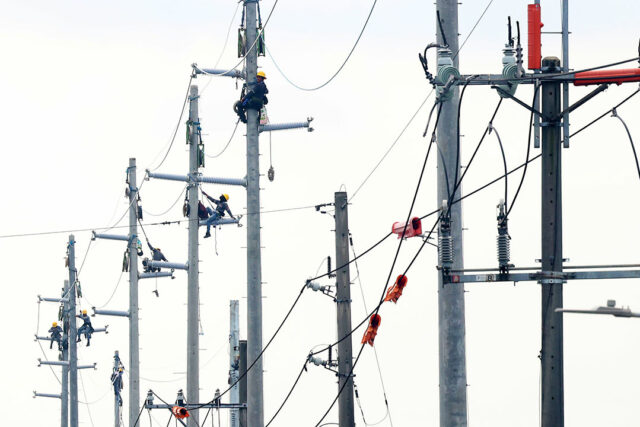
Linemen are seen working on electric posts along Commonwealth Avenue in Quezon City, Oct. 19, 2024. — PHILIPPINE STAR/MIGUEL DE GUZMAN

TYPICAL HOUSEHOLDS served by Manila Electric Co. (Meralco) will see higher electricity bills this month due to the increase in the cost of power from suppliers.

The overall rate will climb by P0.4274 per kilowatt-hour (kWh) to P11.8569 per kWh in November from P11.4295 per kWh in October, Meralco said in a statement on Tuesday.

Households consuming 200 kWh will have to pay around P85 more this month. Those consuming 300 kWh, 400 kWh, and 500 kWh will see their monthly electricity bills go up by P128, P171, and P213, respectively.

“Driving this month’s overall rate increase is the P0.2884 per kWh increase in the generation charge (gen charge),” the power distributor said.

Charges from independent power producers (IPP) and power supply agreements (PSA) increased by P0.9392 and P0.4295 per kWh, respectively, mainly due to the peso’s decline. About 98% of IPPs’ costs and 49% of PSA costs were dollar-denominated.

The peso closed at P58.10 a dollar on Oct. 31, weakening by P2.07 from its P56.03 finish on Sept. 30.

At a briefing on Tuesday, Joe R. Zaldarriaga, Meralco vice-president and head of corporate communications, attributed the higher IPP charges to the payments for liquefied natural gas terminal fees of First Gas Sta. Rita and San Lorenzo plants.

Charges from the Wholesale Electricity Spot Market (WESM) climbed by P0.015 per kWh, as average demand in the Luzon grid and average capacity on outage increased.

IPPs, PSAs and WESM accounted for 24%, 47%, and 29%, respectively, of the company’s total energy requirement for the period.

Meanwhile, transmission charges likewise rose by P0.0724 per kWh due to higher ancillary service charges from the WESM reserve market.

The reserve market allows the system operator to procure power from the WESM to meet the reserve requirements of the power system.

“Pass-through charges for generation and transmission are paid to the power suppliers and the grid operator, respectively, while taxes, universal charges, and feed-in tariff allowance (FIT-All) are all remitted to the government,” Meralco said.

The distribution charge has been unchanged at P0.036 per kWh since August 2022. 

Meanwhile, Meralco said that it provided relief to some of its customers affected by the onslaught of Severe Tropical Storm Kristine.

Meralco customers in areas under a state of calamity with a monthly consumption of less than 200 kWh will not face disconnection until December 2024, in compliance with a presidential directive.

Affected customers may also avail of installment payment schemes for six months for their electricity bills from October to December 2024.

“Meralco has always been considerate of its customers especially during challenging times. We join the government in efforts to help those severely affected by the storm to recover as soon as possible. Qualified customers for the staggered payment arrangement can go to Meralco Business Centers and our personnel will assist them accordingly,” Mr. Zaldarriaga said in a statement.

Meralco’s controlling stakeholder, Beacon Electric Asset Holdings, Inc., is partly owned by PLDT Inc.

Hastings Holdings, Inc., a unit of PLDT Beneficial Trust Fund subsidiary MediaQuest Holdings, Inc., has an interest in BusinessWorld through the Philippine Star Group, which it controls. — Sheldeen Joy Talavera

Gov’t to award P4.53-B Bohol airport contract to Aboitiz group

THE CONTRACT involves upgrades, expansion, and maintenance of the airport within a 30-year period from the start of the turnover. — ABOITIZINFRACAPITAL.COM

By Ashley Erika O. Jose, Reporter

THE Department of Transportation (DoTr) will award Aboitiz InfraCapital, Inc. the P4.53-billion contract for the operations and maintenance of the New Bohol-Panglao International Airport after no bids were received by the Nov. 11 deadline, an official said.

“No challenge has been submitted by any challenger during the comparative challenge period for this project,” Transportation Undersecretary Timothy John R. Batan, who chairs the pre-qualification bids and awards committee, announced on Monday.

He said the bids and awards committee has recommended issuing the notice of award to the project’s original proponent.

As per the DoTr’s schedule, the notice of award to the winning bidder will be issued on Nov. 28, and the official handover of the airport’s operations and maintenance to the private operator will take place on June 22, 2025.

“Considering that we have not received a comparative proposal for this project, we hereby recommend that we proceed with the next step which is submission of the recommendation to the heads of agencies for the issuance of notice of award to the original proponent,” the bids and awards committee said.

The concession agreement for the New Bohol-Panglao International Airport covers a 30-year period, according to the Public-Private Partnership (PPP) Center.

The contract involves upgrades, expansion, and maintenance of the airport within a 30-year period from the start of the turnover.

The project is among the government’s flagship infrastructure initiatives for 2024.

“If there’s no challenger, yes [we will be awarded] the contract. We will be taking a foreign partner. It is part of the requirements of the government to have a technical service provider,” Aboitiz InfraCapital President and Chief Executive Officer Cosette V. Canilao told BusinessWorld last week.

“This was expected and further reinforced my position that huge and complex infrastructure projects, when done through PPP should better be procured through the solicited mode rather than wait for unsolicited proposals,” Nigel Paul C. Villarete, senior adviser on public-private partnerships at the technical advisory group Libra Konsult, Inc., said in a Viber message.

He said that while unsolicited PPP projects are acceptable, it would be more beneficial for the government to handle large infrastructure projects with complex operations, such as airports, through a solicited process due to the specialized expertise required.

“This will attract interest from many possible proponents since they will come from an equal and balanced position in the bidding,” he added.

“The government should present a study whether proceeding with this unsolicited proposal will ultimately be beneficial to government and the public, given the success of solicited bidding for the NAIA rehabilitation in reducing the total cost of the project,” said Terry L. Ridon, a public investment analyst and convenor of InfraWatch PH.

More airports are expected to be privatized next year, including the Iloilo, Puerto Princesa, and Kalibo airports.

The infrastructure arm of the Aboitiz group is also set to take over the operations and maintenance of the P12.75-billion Laguindingan International Airport in Misamis Oriental next year.

The group is partnering with Ireland-based daa International for the upgrade and operations of the Laguindingan International Airport in Northern Mindanao.

The DoTr said previously that it expects to launch the competitive tender for the Davao International Airport under a PPP program.

“We are going to look at the terms. Definitely, we will review the scope of the term,” the Aboitiz group’s Ms. Canilao said in response to a question about the company’s interest in bidding for the Davao airport.

Villar-led Prime Asset Ventures, Inc. holds the original proponent status for both P14.7-billion Iloilo International Airport and P10.24-billion Puerto Princesa International Airport, according to the PPP Center website.

Meanwhile, Mega7 Construction Corp. has submitted an unsolicited proposal to operate, upgrade and maintain the P3.62-billion Kalibo International Airport.

ADVERTISEMENT
ADVERTISEMENT