Home Blog Page 239

Megaworld moves forward with Ilocandia Coastown development

Beach Village in Laoag City, Ilocos Norte — MEGAWORLD CORP

MEGAWORLD CORP. is moving forward with land clearing and infrastructure at its 84-hectare (ha) Ilocandia Coastown, a beachfront township launched in 2024.

The work includes building roads, utilities, and the first residential project in the area.

“We envision Ilocandia Beach Village transforming the landscape of the city by offering a unique and vibrant lifestyle that celebrates the beauty of Ilocandia’s stunning coastline,” Ilocandia Coastown Head of Sales and Marketing May Santos said in a statement on Wednesday.

Ilocandia Beach Village will cover 19.4 ha of coastal land with direct beach access. It will include 446 lots sized 230 to 406 square meters (sq.m.).

The project features a two-story clubhouse with modern tropical design, including a fitness center, movement studio, and function hall for up to 160 guests.

Outdoor areas include a swimming pool with jacuzzi, pool deck with cabanas, and alfresco dining. The clubhouse connects to a central park with jogging paths, picnic grove, and multi-play court.

“In terms of infrastructure, Ilocandia Beach Village will also become the first village in Laoag City to feature an underground cabling system for all electrical and telecom utilities, in order to preserve the pristine, panoramic beauty of the beachside development,” the company said.

Other features include linear parks with fitness trails, a kids’ sand play area, a pet park with hydration stations, and an urban agri park with an edible garden.

Ilocandia Coastown is located 15 minutes from Laoag International Airport and 30 minutes from the Paoay Church, one of only four Baroque Churches in the Philippines recognized as a UNESCO World Heritage Site.

The turnover of lots is scheduled for 2031, with expected sales of P2 billion.

At the local bourse on Wednesday, Megaworld shares rose 1.78% to close at P2.29 apiece. — Alexandria Grace C. Magno

Tax gamble

PHILIPPINE STAR/RYAN BALDEMOR

For a government that’s cash-strapped, I cannot understand why Congress is abolishing the travel tax as well as reducing the tax on nicotine juice for vaping products. Both actions will erode revenue collections. Worse, in the case of nicotine juice, a lower tax can make vaping more accessible to the youth.

This is a tax gamble. In the case of nicotine juice, a lower tax is an attempt to beat smuggling and boost tax compliance. As for the travel tax, removing it aims to encourage travel and tourism. In both cases, Congress is attempting to provide a fiscal incentive to grow consumption.

The siren song of “tax rationalization” is always enchanting. But sirens, in ancient folklore, were not exactly charming, beautiful creatures but terrifying monsters. This dual attempt by Congress to win points with the public may prove just as terrifying in its unintended consequences.

Vaping products make use of “vape juice” derived from either freebase nicotine in liquid form, or nicotine salts in powder form, mixed with acid. Vape juice from nicotine salts is taxed about P60 per mL, while freebase nicotine is taxed around P7 per mL. This discrepancy is pushing importers to “smuggle” the more expensive nicotine salts as cheaper freebase nicotine.

To curb illicit trade and encourage tax compliance, Congress is proposing a unitary rate of P10 per mL for both freebase nicotine and nicotine salts.

At the same time, it wants to abolish the travel tax, currently P1,620 for economy tickets and P2,700 for first and business class.

We should be honest about what we are risking. Travel tax collections reached about P8 billion in 2024 and almost P9 billion in 2025. Of the total, 50% goes to Tourism Infrastructure and Enterprise Zone Authority for tourism facilities and infrastructure, 40% to the Commission on Higher Education for education programs, and 10% to the National Commission for Culture and the Arts for culture and heritage work.

On the vape side, Finance data presented to the House show excise collections from freebase vape juices rising to almost P900 million in 2024 and to almost P2 billion in 2025. Excise taxes on nicotine products were designed not only to deter use but also to help fund health programs that will eventually carry the burden of addiction.

If Congress weakens or removes these revenue streams without a credible replacement, scholarships, tourism projects, and health financing stop being self-funded and become annual budget fights, where delay, dilution, or quiet non-funding becomes the default outcome.

Proponents of the tax cuts cite them as necessary to administrative efficiency, and, as a way to kill smuggling and stimulate the economy in one fell swoop. But this is a dangerous fiscal gamble. By favoring “administrative ease” over “social deterrence,” the government is effectively abdicating its police power to protect the public.

I am quite open about my call for a ban on vaping, and more curbs against cigarette smoking. But by cutting the tax on vape juice, I believe Congress is trading the health of our youth for a theoretical boost in compliance that may never materialize.

I believe the choice should not be binary between a broken high-tax system and a reckless low-tax surrender. Tax policy should not be driven by the path of least resistance when there is a middle way: a two-year, data-driven trial period that treats these measures as experiments rather than permanent surrenders.

The Bureau of Internal Revenue (BIR) is currently fighting a losing battle against misdeclaration. Because nicotine salt is taxed at roughly P60 per mL while freebase nicotine sits at just around P7 per mL, importers have found a massive arbitrage opportunity. They label the former as the latter to save 90% in duties. And physically, it is difficult to tell the two products apart. So, for the sake of tax compliance, Congress’s solution is to unify the rate at P10 per mL.

From where I sit, that is not tax policy but a white flag. We should view vaping as a significant public health threat. I truly believe it warrants a total ban to protect the youth, in particular, from a new generation of nicotine dependency. But barring a total ban, higher taxes can be a deterrent.

But reducing the tax from P60 to P10 is a step in the opposite direction. This is a massive tax cut on a product with a negative impact on the youth. Data from the Department of Health (DoH) shows a staggering 1,100% spike in youth vaping over the last five years, reaching nearly 40% among nicotine users aged 10 to 19 years of age.

Unlike adult smokers, whose demand is relatively inelastic, teenagers are highly price-sensitive. By slashing the tax to P10, the government is effectively subsidizing an addiction and inviting more of our youth to take up the habit. The argument that we must lower the tax to P10 to ensure compliance is a false dilemma that rewards the vaping industry for its own evasion.

If the objective is truly to curb the negative externality of addiction, a unified tax of, say, P25 per mL serves as a far more logical compliance threshold. Why drop it all the way to P10? At P25, the profit from lying is narrowed enough to make large-scale smuggling less attractive for importers, yet the retail price of vaping products remains high enough to limit youth access.

Parallel to the vape tax debate is the push to abolish the travel tax, a move championed by those who argue it will stimulate P22 billion in new economic activity. Proponents suggest that removing the P1,620 fee will trigger a surge in passenger volume so massive that the resulting corporate income taxes from airlines and hotels will more than replace the lost revenue.

While this multiplier effect makes for an interesting narrative, fact is, the travel tax generated about P8.7 billion in 2025, up from P7.8 billion in 2024. And this tax is a critical source of funding for higher education, tourism infrastructure, and the promotion of culture and the arts.

Abolishing it immediately puts the scholarships of over 5.4 million students at the mercy of the annual national budget process. In a country where education funding is already a perennial battleground, removing a dedicated, self-sustaining revenue stream for a theoretical economic boost is reckless.

Furthermore, the stimulus argument fails the test of price elasticity. For an average international flight costing P25,000, the P1,620 travel tax represents only about 6.5% of the total cost. Some studies suggest that leisure travelers only react significantly to price changes of 10% to 15%. A 6% reduction is easily swallowed by seasonal airline fare hikes or fluctuating fuel surcharges, meaning the traveler barely feels the savings, while the state loses billions in guaranteed revenue.

A middle way, a two-year data-driven trial of calibrated taxes, is an option, to avoid these fiscal and social pitfalls. Congress can propose a tiered trial framework so that we do not permanently erode revenues or public health without empirical proof of success.

For the vape juice tax, instead of a deep cut to P10, we can try a unified P25 per mL for a mandatory two-year trial period. A further reduction to P10 should be done only if, after 24 months, BIR vape tax collections increase significantly, proving that the industry has chosen honesty over technical smuggling.

More importantly, any further reduction should be blocked if DoH data shows that youth vaping rates have increased over the same period. If usage spikes, then the tax should automatically go back to the higher tier of P60 per mL. This treats the tax code as a dynamic feedback loop for public safety.

As for the travel tax, rather than full abolition, the government should implement a pilot reduction for two years to test the elasticity of the travel market. Reduce the travel tax for Economy Class passengers to P800 while maintaining the current rate of P2,700 for First and Business Class. This provides relief to the price-sensitive middle class while preserving a revenue base from luxury travelers.

At the same time, legislate that the collection must be earmarked for education as well as tourism infrastructure. We must ensure that even if the stimulus fails to attract more flyers, our students and our tourism facilities aren’t the ones paying the price. Meantime, over the two-year trial period for calibrated taxes, the government can gather real-world Philippine data.

Bottom line, we shouldn’t be quick to trade away the state’s power to curb negative externalities in exchange for the convenience of tax collectors. Even travel has negative externalities: more jet fuel use, higher aircraft emissions, and a larger carbon footprint from air travel.

Let the data justify the tax cut, not the promise of it. The health of the next generation and the education of our students, and the improvement of our tourism infrastructure, should not be put at risk. It is time to test, verify, and govern based on results, backed by data, and not just rhetoric.


Marvin Tort is a former managing editor of BusinessWorld, and a former chairman of the Philippine Press Council.

matort@yahoo.com

HP reckons memory chip crunch will linger next year, warns of PC sales slump

Semiconductor chips are seen on a circuit board of a computer in this illustration picture taken on Feb. 25, 2022. — REUTERS

HP, Inc. said on Tuesday it expected volatility in memory chips to persist even into next year and forecast a slump in its PC shipments, sending its shares down around 6% in extended trading.

The personal devices maker said it expects adjusted profit for fiscal 2026 ending Oct. 31 to be at the low end of its previously issued forecast of $2.90 to $3.20 per share. It anticipates PC unit shipments to decline in the double digits, in line with industry trends.

HP, like its rivals such as Dell, is dealing with increased costs as a shortage of memory chips has gripped the tech industry, fueled by massive AI data center buildouts that are sucking up capacity. The company said on Tuesday it has taken steps to mitigate this, including adjusting its supply chain and raising prices to offset the impact of US President Donald Trump’s sweeping tariffs.

“With just one quarter behind us in a dynamic environment marked by increasing memory costs, we are holding our outlook for the year, yet currently anticipate results to be closer to the low end of our range,” HP finance chief Karen Parkhill said in a statement.

The company, however, struck a positive note on demand from Europe and Asia, driven by the ongoing Windows 11 upgrade cycle, and said its average selling prices got a boost from a shift towards commercial and consumer premium devices. HP also observed a “moderate amount of customer demand pull-in” in the first quarter, especially in its consumer business, which grew 16%.

This, and a growing adoption of AI-powered PCs, helped it beat analysts’ estimates for first-quarter revenue and profit.

AI PCs constituted more than 35% of the company’s total PC shipments in the first quarter, up from 30% in the previous quarter, the company said.

HP said it was evaluating Mr. Trump’s new tariff announcements, but did not expect these levies to immediately hurt its business. It will continue “engaging the administration on these matters and others,” interim CEO Bruce Broussard said on a conference call with analysts.

The US began collecting a temporary new 10% global import tariff on Tuesday, but the Trump administration was working to increase it to 15%, a White House official said, sowing confusion over the tariff policies after last week’s Supreme Court defeat.

The company’s first-quarter revenue rose 6.9% to $14.44 billion, beating estimates of $13.94 billion, according to data compiled by LSEG. Its adjusted profit per share of 81 cents for the quarter ended Jan. 31 exceeded estimates of 76 cents.

Revenue for the personal systems unit, which houses both consumer and commercial PCs, grew 11% to $10.25 billion in the quarter. Revenue in its printing segment, which includes office-oriented printers and service offerings, fell 2% to $4.19 billion.

It forecast second-quarter adjusted profit per share between 70 cents and 76 cents, compared with estimates of 74 cents. — Reuters

Sun Life Philippines, Pioneer Insurance top 2025 industry rankings for premiums

SUN LIFE of Canada (Philippines), Inc. (Sun Life Philippines) and Pioneer Insurance and Surety Corp. were the top life and nonlife insurers in the country last year in premium income terms, data from the Insurance Commission (IC) showed.

Sun Life Philippines booked the highest premium income among life insurers in 2025 at P61.81 billion, while Pioneer Insurance recorded P6.903 billion in net premiums written (NPW) to top the nonlife sector, IC rankings based on firms’ submissions of unaudited enhanced quarterly reports on selected financial statistics showed.

Sun Life Philippines said in a statement that this marks its 15th year as the leader of the country’s life insurance industry.

It added that it was also the top performer in terms of net income, net worth, invested assets, and total assets.

LIFE INSURERS
Based on premium income, Pru Life Insurance Corp. of UK (Pru Life UK) ranked second among life insurers with P52.84 billion, followed by FWD Life Insurance Corp. (FWD Life Philippines) with P52.47 billion, Allianz PNB Life Insurance, Inc. with P37.66 billion, and AXA Philippines Life and General Insurance Corp. with P31.498 billion.

The Insular Life Assurance Co., Ltd., (Insular Life) was in sixth place with P24.56 billion, followed by BDO Life Assurance Co., Inc. with P22.78 billion, BPI-AIA Life Assurance Corp. with P20.12 billion, Sun Life Grepa Financial, Inc. with P18.59 billion, while Manulife Chinabank Life Assurance Corp. rounded out the top 10 with a premium income of P14.44 billion.

Meanwhile, in terms of net income, Sun Life Philippines also topped life insurers with P10.22 billion, followed by Pru Life UK at P7.103 billion, BPI-AIA Life at P5.698 billion, the life unit of AIA Philippines Life and General Insurance Co., Inc. at P5.67 billion, and BDO life at P5.04 billion.

For new business annual premium equivalent or NBAPE, Pru Life UK was the top life insurer with P10.05 billion, followed by Sun Life Philippines with P9.19 billion, FWD Life Philippines at P9.03 billion, BDO Life at P5.31 billion, and BPI-AIA Life with P4.96 billion.

Meanwhile, Sun Life Philippines had the highest net worth among life insurers last year at P60.12 billion, followed by AIA Philippines’ life unit at P57.87 billion, Insular Life at P42.046 billion, BDO Life with P30.459 billion, and BPI-AIA Life at P18.05 billion.

Sun Life Philippines was also the largest life insurer in terms of assets with P344.49 billion, followed by AIA Philippines’ life unit with P251.49 billion, AXA Philippines with P185.68 billion, Insular Life with P169.07 billion, and Allianz PNB Life with P168.459 billion.

The life insurance sector’s combined premium income grew by 14.54% to P403.21 billion in 2025 from P352.02 billion in the prior year, according to IC data based on submissions of 33 out of 34 licensed companies.

NONLIFE INSURERS
For nonlife insurers, in NPW terms, Prudential Guarantee and Assurance, Inc. (PGA) was in second place with P5.38 billion, followed by Malayan Insurance Co., Inc. with P5.309 billion, Stronghold Insurance Co., Inc. at P4.99 billion, while BPI/MS Insurance Corp. rounded out the top five with P3.92 billion.

Standard Insurance Co. Inc. was ranked sixth with P3.42 billion, followed by Pacific Cross Insurance, Inc. with P3.18 billion, The Mercantile Insurance Co., Inc. with P3.005 billion. The nonlife unit of AXA Philippines was at ninth place with P2.94 billion and Alpha Insurance & Surety Company, Inc. was tenth with P2.71 billion.

Based on net income, Pioneer Insurance also topped the list with P697.41 million. This was followed by Petrogen Insurance Corp. with P677.02 million, Standard Insurance with P652.72 million, Insurance Company of North America with P589.8 million, and BPI/MS Insurance with P528.39 million.

Pioneer Insurance likewise had the highest net worth in the nonlife industry in 2025 at P19.365 billion, followed by Malayan Insurance at P7.696 billion, Standard Insurance at P5.695 billion, Petrogen Insurance with P4.596 billion, and Stronghold Insurance with P4.099 billion.

In asset terms, Pioneer Insurance was the largest nonlife insurer with P57.91 billion. Malayan Insurance was in second place with P33.52 billion, followed by PGA with P24.89 billion, BPI/MS Insurance with P18.84 billion, and Standard Insurance with P12.64 billion.

The combined net premiums written of nonlife insurers grew by 14.6% year on year to P82.49 billion in 2025, according to IC data based on submissions of 57 out of 59 licensed companies. — BVR

Culture Current: Asma Khan on cooking with conscience

ASMA KHAN broke the mold in 2017 when she opened one of the world’s only all-female kitchens staffed by home cooks rather than professionally trained chefs. Nearly a decade on, the Indian-born British restaurateur continues to eschew convention, prioritizing locally sourced over out-of-season produce and pushing back against culinary fads that she says wreak havoc on the environment.

Considered one of Britain’s most influential food voices, Ms. Khan’s work has been recognized by the Michelin Guide, the Gourmand World Cookbook Awards, and the Johannes van Dam Prize, a lifetime-achievement award for contributions to gastronomy that she won in 2024. Since 2022, she has served as a UN World Food Program chef advocate for her work raising awareness of global hunger crises.

Speaking with Reuters from Kolkata, she makes her case for seasonal cooking and why she thinks following culinary hype can do more harm than good.

This conversation has been edited and condensed for clarity.

Q: You recently completed your first culinary tour of India. How did that project come about?

A: I’ve always felt that India has so many layers. A lot of people don’t even understand that there is nothing called an Indian cuisine. It’s like saying I’m having “American food” or “European food.”

India is divided into wheat-growing areas and rice-growing areas. It’s not just that the staple is different; the food is different. With rice, we eat with our hands. The dal is watery. Whereas if you look at the dal makhani (a dish made of black lentils and kidney beans), it’s so thick because it’s being eaten with bread. You don’t want it to be soggy. I’ve never heard a chef explaining these things.

I come from an area where there’s a lot of fish, and that completely changes what you do because it also depends on where you are, how hot the chilies are. In Gujarat and Bengal, we don’t have a lot of chilies because they’re damp. The drier areas, the chili is stronger. So I wanted to do a culinary trip (that’s) not like a encyclopedia, taking them around and blinding them with science. I wanted them to taste the difference.

Q: Your third and latest cookbook, Monsoon, focuses on seasonal cooking. Should home cooks be thinking about seasonality more — and how practical is it in a place like Britain?

A: Absolutely. I don’t think that the customer is always right. Very often we have customers asking us, “Why don’t you have jackfruit?” or “I would love to have okra.” I don’t want a jet-lagged okra on my menu. I don’t want the air miles and the carbon footprint. So I gracefully say no, we go by the seasons in Britain. The most classic aloo gobi matar (a dish made of cauliflower, potatoes, and peas), which is an all-time favorite of Indian vegetarian food, it’s all British — the potatoes and the cauliflower. We make beetroot chop with smoked chilies and fennel, and the beetroot comes from the Fens, (marshy lands drained for agriculture) near Cambridge.

The reason why the Earth has this ingredient for you is because your body needs it. When you look at what happens in a place like Rajasthan, where there is this wind which is called “The Loo,” it’s so hot — it’s like fire on your skin. But that same (hot wind) that goes over the watermelon sweetens it, and when everything else has died in the heat, there is that fruit for you. We are being compensated by nature and by the universe. Let us embrace it.

Q: To your point on the carbon footprint of jet-lagged okra, it sounds like there’s an environmental argument for eating more seasonally too.

A: When I moved to England 35 years ago, you never saw strawberries year-round. Now you do, and no one is surprised. And when you look at where the strawberries have come from, (they’re) from Argentina, Peru. We have become so arrogant in our power and our sense of being invincible when you can eat whatever you want to eat when you want to eat (it).

Q: You’ll be delivering the SOAS Food Studies Center Annual Distinguished Lecture next month on food and heritage. Can you give us a preview of what it will entail?

A: I’m using that SOAS lecture to really talk about the power politics of food — from the way that farmers are treated, the fact that everybody feels they’re being extremely pious when they have jackfruit because they’re not killing an animal. But the farmer who is growing that jackfruit is borrowing money to use fertilizers. Jackfruit is a huge fruit; it takes a long time to grow. They are growing for the Western market. The farmer is going to go into debt growing jackfruit for this person who thinks they’re being very noble by eating pulled jackfruit instead of pulled meat.

I think we should do everything within reason, in moderation. You know, like what’s happening with matcha. I mean, why are we so driven by trends and obsessions (to the extent) that, in Japan, they’re running out of matcha?

I want to use the SOAS lecture to talk about honor and respect, the politics of food, but also the fact that food should always be interwoven with justice. We need to know this fruit, this vegetable, whose water was (used to grow) it, whose land was it grown on? These are very important things. We need to also make choices. If it is out-of-season strawberries, or when you know that the water came from a source that was not (ethical), choose not to buy it. I think that’s really important.

Q: Darjeeling Express is known for its all-female, immigrant-led kitchen. How radical was this concept when you first pitched it?

A: I still remember when I spoke about opening my restaurant in 2017 with an all-female kitchen. Everybody, including well-meaning women in the industry, came and told me I would fail. They said you need professionals — i.e. men — who’ve been to culinary school, who’ve trained under the Taj and Oberoi’s and five-star hotels in India. One of the things everyone was concerned about was that we didn’t have the professional skills that you needed to run a restaurant. Everyone said, “You don’t have culinary experience. Maybe you should go to culinary school.”

I have life experience. I have failed more times than anyone can imagine. But I thought, if I succeed, every woman who’s going through this dark phase in life can look at Darjeeling Express and see we are victorious.

Q: What tips do you have for other women aspiring to break into the industry?

A: I think the main important thing is you believe in yourself. You’re the boss. Respect yourself and honor yourself. Then everybody else will.

The other thing is build your tribe. And your tribe doesn’t have to be women. Your tribe doesn’t have to look like you. Your tribe can be just empathetic men and women. Yes, I have an all-female kitchen, but I have incredible men who support me. Never think you can make it on your own. You don’t become weak because you’re asking for help. I still ask people for help. I don’t think it makes me less successful or powerful.

Q: London’s food scene is constantly evolving. Which chefs or trends are exciting you right now?

A: I’m watching, from the Indian perspective, a lot of regional dishes coming in. Thank God people no longer feel that they need to have butter chicken and Kali Dal, which is only eaten by a microscopic number of people in India.

I also am very optimistic that you will see more African food coming in. I’m seeing it still on the street level and some in restaurants. Because we have so many opportunities to start from the street (in London) — I started from my house (hosting) supper clubs — it allows you to build a following. I’m enjoying seeing a lot of dishes whose names I’ve never (heard before).

Q: Finally, Ramadan begins this week. How are you preparing for it this year, and what does cooking during the month mean to you?

A: It’s very hard to explain how, unless you go through this, it’s a month where suddenly everything shuts off. Even though the whole world around you isn’t fasting, somehow you’re in this zone of huge humility to understand that I have chosen not to eat and drink because of my faith. But so many people of every faith and none live this life of food insecurity. And the fact that I’m going through this, I feel that this is so sacred and so important for me, especially as a restaurateur. We have people who come and break their fast with us. And I’m grateful. I serve them personally if I’m there because I want them to feel that I respect them. — Reuters

Gov’t hopes to secure full RoW for LRT-1 Cavite extension by yearend

LRMC.PH

THE LIGHT RAIL Transit Authority (LRTA) said the government is hoping to complete the acquisition of right-of-way (RoW) for segments 2 and 3 of the Light Rail Transit Line 1 (LRT-1) Cavite extension within the year.

“Our target is to deliver the RoW for segments 2 and 3 this year or early next year,” LRTA Executive Hernando T. Cabrera told reporters last week.

Light Rail Manila Corp. (LRMC), operator of LRT-1, opened Phase 1 of the Cavite extension in 2024, adding five new stations to the rail line.

The first phase extended the line by 6.2 kilometers, connecting Baclaran Station in Pasay City to Dr. Santos Station in Parañaque City.

Phases 2 and 3, covering mostly Cavite stations, will include Las Piñas, Zapote, and Niog stations.

The government is working to secure the RoW to begin construction of the Cavite extension, Mr. Cabrera said, noting that full RoW has already been acquired for Segment 3, while acquisition for Segment 2 is now nearly 70% complete.

Mr. Cabrera pointed to a flyover constructed along the rail line’s alignment as a main challenge in completing the acquisition of RoW.

“For now, the most important is to deliver the RoW, so that they can start the (construction),” he said, adding that LRMC does not need to redesign the alignment despite the flyover.

“They do not have to redesign because they have not submitted the design yet. Our task is to complete the RoW right now,” he said.

The Department of Transportation last year requested an additional P3 billion in funding to build an extra station in Bacoor City for the LRT-1 Cavite extension.

“That will be a future station, because right now, we cannot change it; if we add a new station, we have to change the concession agreement. Yes, we can accommodate one or two more new stations but that will happen in the future,” Mr. Cabrera said.

LRMC is a joint venture of Ayala Corp., Metro Pacific Light Rail Corp., and Macquarie Infrastructure Holdings (Philippines) Pte. Ltd. Metro Pacific Light Rail is a unit of Metro Pacific Investments Corp., which is one of three Philippine subsidiaries of Hong Kong’s First Pacific Co. Ltd., the others being PLDT Inc. and Philex Mining Corp.

Hastings Holdings, Inc., a unit of PLDT Beneficial Trust Fund subsidiary MediaQuest Holdings, Inc., maintains an interest in BusinessWorld through the Philippine Star Group, which it controls. — Ashley Erika O. Jose

Anthropic should stand its ground against the Pentagon

WIKIMEDIA.ORG

By Dave Lee

THEY SAY your values aren’t truly values until they cost you something. For Anthropic co-founder and Chief Executive Officer Dario Amodei, that cost might come as soon as Tuesday when he visits the Pentagon for what’s been billed as a showdown meeting with Secretary of Defense Pete Hegseth.

“This is not a friendly meeting,” a senior defense official told Axios. The AI company, best known for its chatbot Claude, took a more diplomatic tone: “We are having productive conversations, in good faith,” a spokesperson said.

The topic of discussion could not be more serious. To date, Claude has been the only AI model permitted to be used on the Pentagon’s classified networks, a valuable seal of approval that likely wins Anthropic enterprise contracts across many sectors but has also put it in a lonely position when pushing back against what it thinks might be some of the Pentagon’s intended use cases.

Hegseth is insisting Anthropic agree to sign on to allowing Claude to be used for “all lawful purposes,” threatening severe sanctions if it does not. That could mean not only the cancellation of a $200-million contract awarded last July but also being designated a “supply chain risk,” a move that would force companies with military contracts to no longer use Anthropic’s AI for that work. The restriction would make Anthropic a less appealing partner for regular AI use cases, too.

Tensions between Anthropic and the Pentagon increased after the operation to capture Venezuelan President Nicolás Maduro, after which it was reported that Anthropic had objected to how its technology was used. The company has since said those reports were “inaccurate” and that no discussions were held nor complaints made. Even so, the Trump administration has branded Anthropic as the “woke” AI company for months. Amodei is “ideological,” Axios’ Pentagon source added. It’s important to look at the company’s concerns and consider whether these labels are justified.

The first issue Anthropic has is about mass surveillance. AI can be used to monitor masses of data and match up previously siloed datasets in ways that were previously impossible. The company worries that Fourth Amendment protections against unlawful surveillance don’t directly address what is possible with AI — leaving scope for actions it isn’t comfortable with from an administration that has demonstrated a willingness to test constitutional limits.

The second concern is about a technical practicality rather than an ethical red line. Anthropic has said it does not want its AI models to be used for control of autonomous weapons because it doesn’t believe its technology is reliable enough yet to make life-or-death decisions without human supervision.

If the Pentagon is unhappy with those apparently “woke” conditions, then, sure, it is well within its rights to cancel the contract. But to take the additional step of declaring Anthropic a “supply chain risk” appears unreasonably punitive while unnecessarily burdening other companies that have adopted Claude because of its superiority to other competing models.

Indeed, the quality of Anthropic’s product gives Amodei a stronger bargaining position than it might first appear. It would take a significant effort from the Pentagon to disentangle Claude within its systems and, even if it did, it would then need to find a willing and equally capable partner to fill the gap. Maybe that would be OpenAI or Google, but both would surely hesitate to lead their companies — and their employees — into the ethical quagmire Amodei is trying to avoid. Both companies are said to have been in talks with the Pentagon, but neither has reached a deal yet. The New York Times reported on Monday evening that Elon Musk had agreed to make his Grok chatbot available for use on classified material without the safeguards Anthropic was pushing for — though it is questionable whether Musk’s model will be as capable as Anthropic’s. 

From several angles, pressure is being applied on Anthropic to fall in line. In Tuesday’s meeting, Amodei must state it plainly: It is not “woke” to want to avoid accidentally killing innocent people. This isn’t a case of an arms maker dictating how the Pentagon must use a weapon it has purchased or against which target. No, this is a responsible company making sure a tool bought for one purpose won’t be recklessly used for another.

BLOOMBERG OPINION

Anthropic touts new AI tools weeks after legal plug-in spurred market rout

SAN FRANCISCO — Artificial intelligence (AI) lab Anthropic on Tuesday unveiled 10 new ways for business customers to plug in its technology to key areas of their work, weeks after other releases sparked an aggressive selloff in traditional software company shares.

The San Francisco-based startup said its plug-ins could now help with investment banking tasks like reviewing deals, wealth-management tasks such as portfolio analysis and human resource-related tasks such as making new-hire materials reflect a brand’s tone and policies.

Other items that Anthropic touted included plug-ins for private equity, engineering and design.

Anthropic said its new plug-ins were developed with partners, including LSEG, FactSet, Salesforce’s Slack, and DocuSign.

Companies including Thomson Reuters, which owns Reuters news agency, and RBC Wealth Management were using AI agents powered by Anthropic, it said.

The announcement lifted the shares of Anthropic’s partner companies — Salesforce rose 4%, FactSet 5% and DocuSign nearly 6%.

Backed by Alphabet’s Google and Amazon.com, the lab said it was releasing ways to connect its Claude AI to some commonly used business tools like Google Calendar and Gmail.

The rapid-fire releases this year show how Anthropic is seeking to get ahead of the pack in selling autonomous AI to the lucrative enterprise market ahead of a widely expected public offering.

Anthropic faces competition from Google itself, OpenAI and Elon Musk’s xAI, among others. The startup has said it has not decided about going public.

Last month, Anthropic’s release of a legal plug-in ignited an $830-billion global selloff in software and services stocks, including some of the startup’s partners, over six trading days as investors worried that AI-powered automation could undercut a revenue streams of these companies.

Scott White, Anthropic’s head of product for enterprise, said the goal was for Claude to deliver better outcomes for customers, not replace them.

“It’s not a product that’s trying to own every workflow,” he said in an interview. “We’re providing infrastructure and intelligence so our partners or our customers can bring their business knowledge, their expertise, their trusted relationships and their customers to the equation.”

Companies can build and manage their own plug-ins as well, Anthropic said. Reuters

Peso rises to new five-month high as tariff jitters drag dollar

BW FILE PHOTO

THE PESO appreciated to a new five-month high against the dollar on Wednesday as renewed tariff uncertainty dragged the dollar.

The local unit surged by 24.5 centavos to close at P57.51 against the greenback from its P57.755 finish on Tuesday, data from the Bankers Association of the Philippines showed.

This was the peso’s best close in 22 weeks or since it finished at P57.461 on Sept. 24, 2025.

The currency opened Wednesday’s trading session slightly weaker at P57.80 per dollar, which was already its worst showing for the day. Its intraday high was at P57.43 versus the greenback.

Dollars traded increased to $1.768 billion from $1.358 billion on Tuesday.

“The dollar-peso closed lower on broad dollar weakness following President Trump’s state of the nation speech where he reiterated he will reimpose tariffs via other means following the Supreme Court ruling,” a trader said by phone.

On Wednesday, the US dollar index was down 0.1% at 97.78, Reuters reported.

US President Donald J. Trump said little to allay concerns about the future of his tariffs and global trade policy in his State of the Union speech on Tuesday.

The Trump administration is working to increase the rate on Mr. Trump’s new, temporary global tariff to 15% from the 10% rate published by the US Customs and Border Protection (CBP) agency, a White House official said on Tuesday.

The official said Mr. Trump has had “no change of heart” on his desire for a 15% tariff rate, which he had announced on Saturday after issuing a formal order on Friday for a 10% rate on the new duties that will last 150 days. The temporary tariff imposed under Section 122 of the Trade Act of 1974 are meant to replace Mr. Trump’s global emergency tariffs struck down by the US Supreme Court on Friday.

The White House official said there was no further detail on the timing of the tariff rate increase. CBP can only collect tariffs based on information published in formal presidential executive orders or proclamations.

The peso was also supported by market optimism on the Philippines’ re-inclusion in JPMorgan Chase & Co.’s Government Bond Index-Emerging Markets (GBI-EM), Rizal Commercial Banking Corp. Chief Economist Michael L. Ricafort said in a Viber message.

National Treasurer Sharon P. Almanza said last week she is positive about the country’s re-inclusion in the index amid government efforts to improve bond pricing standards and progress in addressing liquidity and taxation issues.

JPMorgan’s GBI-EM tracks the performance of sovereign and quasi-sovereign bonds issued by emerging market countries. The country’s inclusion will need to be approved by a certain percentage of investors reviewing the index.

In September last year, JPMorgan tagged Philippine peso-denominated government bonds (RPGB) as “Index Watch Positive,” which is the final review phase for the’ country’s potential inclusion in the GBI-EM.

The global bank earlier said it will conduct its Index Watch assessment and provide updates within this quarter.

The Philippines’ global peso notes were removed from the GBI-EM in January 2024 due to illiquidity. For potential inclusion in the index are RPGBs issued from 2023 with tenors up to 20 years.

For Thursday, the trader sees the peso moving between P57.30 and P57.60 versus the dollar, while Mr. Ricafort expects it to range from P57.40 to P57.60. — Aaron Michael C. Sy with Reuters

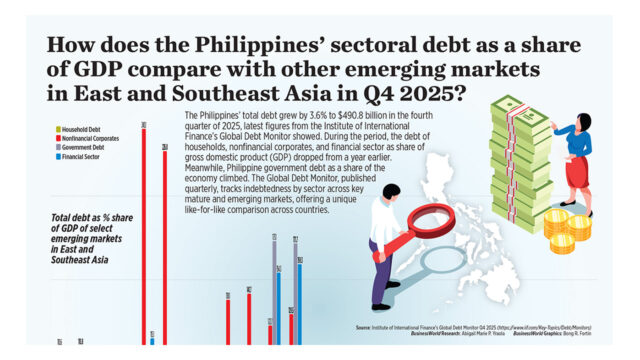
How does the Philippines’ sectoral debt as a share of GDP compare with other emerging markets in East and Southeast Asia in Q4 2025?

The Philippines’ total debt grew by 3.6% to $490.8 billion in the fourth quarter of 2025, latest figures from the Institute of International Finance’s Global Debt Monitor showed. During the period, the debt of households, nonfinancial corporates, and financial sector as share of gross domestic product (GDP) dropped from a year earlier. Meanwhile, Philippine government debt as a share of the economy climbed. The Global Debt Monitor, published quarterly, tracks indebtedness by sector across key mature and emerging markets, offering a unique like-for-like comparison across countries.

Dining In/Out (02/26/26)


Carmen’s Best milk now available at 7-Eleven

CARMEN’S BEST, the Filipino brand celebrated for its 100% fresh milk gourmet ice cream, is moving beyond the pint and is making premium, fresh milk more accessible through an exclusive partnership with 7-Eleven. Since the brand’s milk is 100% fresh with no additives or preservatives, it is best consumed immediately. Currently, the single-serve 300 ml line is available in select 7-Eleven stores, including key locations like Metro Manila and Rizal. The product will soon be available in Pampanga and Batangas, as well as cities in Visayas and Mindanao, particularly Cebu, Davao, and Cagayan de Oro, with future plans to roll out in more areas nationwide in the coming months. “Our goal has always been to elevate the Filipino dairy experience. This journey began with a commitment to 100% real milk, but our mission has grown to ensure that fresh, local dairy is accessible to every Filipino,” Toby Gatchalian, Chief Commercial Officer of Metro Pacific Agro Ventures and Carmen’s Best, said in a statement. “To make this possible, we’ve aggressively expanded our operations, growing our herd to 400 cows across farms in Luzon and Vismin, while increasing our yield from 11 liters to an impressive 28 liters per cow, per day. By partnering with 7-Eleven, we are completing that farm-to-table circle, ensuring that pure, locally produced milk is finally within reach for everyone.” The Carmen’s Best Milk 300 ml range offers a variety of options: Whole Milk (P60), Low-Fat Milk (P60), Low-Fat Chocolate Milk (P65), and Salted Caramel Milk (P70). In addition to the new Salted Caramel milk flavor, the brand is also introducing more products: the Milk Bar (now available in carmensbest.com and major supermarkets in Luzon, and soon to be available nationwide), Barista Fresh Milk (with a standardized fat content that produces a long-lasting, more defined foam), Ube Halaya and Tiramisu Ice Cream flavors (created in collaboration with HOPE, and every pint purchased helps build classrooms), and Kesong Puti. Carmen’s Best is also heading south, opening its first scooping stations outside Luzon, in Cebu, at The Mall at Nustar and SM City J Mall.


GH Mall offers multi-restaurant lunch promo

THE Power Lunch promo returns with weekday lunch deals at GH Mall from 11 a.m. to 2 p.m. until March 31. The participating restaurants are: Alba, Banh Mi Kitchen, CIBO, Chinese Beef Noodles House, Ebi10, Genki Sushi, Iroha, Kettle, Lucky Boba Milk Tea, Mango Tree, Pizza Planet, Sen-ryo, Sibyullee, Stoned Steaks, Supreme Beef Hotpot, Three Dots, and Tittos.


Lunar New Year celebration continues at Solaire

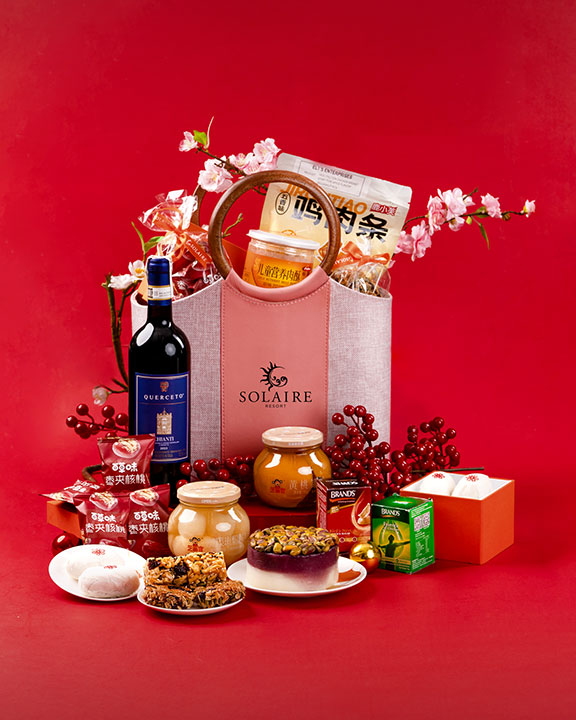
WHILE the main celebrations for the Lunar New Year have passed, they continue at some of Solaire Resort Entertainment City’s restaurants. Red Lantern offers a special Lunar New Year set menu until March 3 which journeys through the symbols and stories of the season and includes the Prosperity “Yu Sheng” with fresh salmon. Dim sum lovers are treated to an “Eat-All-You-Can” experience. For those seeking variety and abundance, Fresh offers a festive buffet until March 3. Guests can explore dedicated Chinese roasted and dim sum sections. Indulge in the treasure pot, roasted duck, Shanghai-style deep-fried fish fillet in soya sauce, deep-fried blue swimmer crabs salted egg yolk, deep fried tikoy, and more. The celebration is complemented by free-flowing beverages. Meanwhile, Oasis Garden Café offers an elegant afternoon tea experience with a Lunar New Year twist until Feb. 28. Guests can enjoy a selection of dainty tea sandwiches, including Chun bing, Peking duck with hoisin, Szechuan pork baguette, and Rou jia mou with pulled beef and shaoxing wine. These savory items are complemented by pastries such as Chinese Five spice chocolate tart, red bean eclairs, egg custard tart, black sesame macaron, Jasmine tea crème brûlée, and more.


Tanduay shines at PR%F Awards

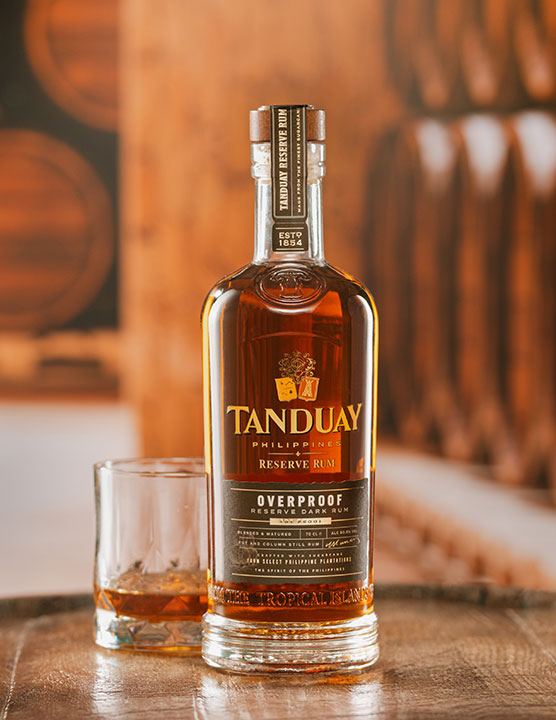
AT THE recent PR%F Awards 2025, Tanduay Overproof earned a Gold Medal with a score of 93 at the Tasting Competition and a Double Gold at the Design Competition. Tanduay Reserve Rum 10 Years, meanwhile, was awarded a Silver Medal with a score of 89 at the Tasting Competition and a Gold at the Design Competition. The Tasting Competition is a double blind-tasting process where spirits, wines, and beverages are judged in 100-point rating system. In the Design Competition, judges inspect the bottles or cans of the product, read its story and ingredients, and evaluate its packaging and overall look and feel. The PR%F Awards’ judging panel is comprised of top-tier buyers and decision-makers from hotel groups, airlines, restaurants, nightclubs, dispensaries, and liquor stores from the United States and Canada. Tanduay Overproof has an interplay of fruity nuances and woody spice notes from bourbon oak barrels. It is a blend of pot and column still dark rums and has 40% alcohol by volume. This elegantly packaged premium rum comes in 700 ml and 750 ml bottles and is available in select international wines and spirits stores. Tanduay Reserve Rum 10 Years, meanwhile, is a smooth rounded rum perfect for sipping neat or in cocktails. Bottled at 40% alcohol by volume, it comes in a deep amber color. Tanduay Reserve Rum 10 Years is aged for at least 10 years in former bourbon barrels. It comes in a 750 ml bottle and can also be purchased in select international wines and spirits stores.


Jollibee has glowed up the Yumburger

THE Yumburger now has a bigger beef patty and more dressing while still priced at P45. The new-ish burger was launched in transport hubs and shopping centers across the Philippines. Jollibee gave away 2,000 free Yumburgers at One Ayala in Makati, The Infinity in Pampanga, Paseo de Santa Rosa in Laguna, Parkmall in Cebu, and Rizal Park in Davao as, plus 4,000 vouchers to try an exclusive combo in stores. For updates visit www.jollibee.com.ph, to order go to https://order.jollibee.com.


11,000 chain resto locations serve cage-free eggs

CAGE-FREE eggs are fast becoming the new standard for the Philippines’ restaurant industry, with some of the country’s biggest chains now committed to phasing out caged eggs, according to the 2025 Philippines Restaurant Industry Cage-Free Egg Scorecard, released by Lever Foundation. Of 67 leading restaurant brands evaluated, 47 chains operating 11,277 locations have pledged to fully transition to cage-free eggs. This represents 78% of all chain restaurant locations nationwide — the highest concentration in Asia. This includes brands that have already completed their transition, such as Nanyang and Peri-Peri, along with many of the industry’s biggest names, which have set timelines to implement 100% cage-free sourcing in the years ahead. Three major restaurant groups set cage-free egg policies for a combined 2,140 locations: 333 Foods (operating BreadTalk, Nanyang, and Banana Leaf), Max’s Group (operating Pancake House and Yellow Cab), and Century Pacific Food, Inc. (operating Shakey’s, Potato Corner, and Peri-Peri). Filipino favorites, including Jollibee, Chowking, Mang Inasal, Red Ribbon, and Greenwich have made pledges, alongside international giants such as KFC, Dunkin’, Pizza Hut, Subway, and Burger King. “With 70% of major restaurant brands — representing 78% of chain restaurant locations across the country — already committed to cage-free egg sourcing, we’re witnessing the sector’s recognition that animal welfare, food safety, and sustainability are essential business priorities,” said Robyn Del Rosario, sustainability program lead at Lever Foundation, in a statement. Lever Foundation is an international NGO that collaborated with all of the domestic restaurant groups and a number of international groups in developing their policies. Cage-free systems allow hens to move freely and engage in natural behaviors such as nesting, perching, dust-bathing, and short flights in indoor barn environments — behaviors completely restricted in conventional battery cage systems. The Bureau of Agriculture and Fisheries Standards developed comprehensive animal welfare guidelines for cage-free eggs in 2020.


Pinoy finishes in Top 10 of international culinary tilt

THE Philippines’ sole delegate to the 12th International Young Chef Olympiad (YCO) landed among the Top 10 finalists in the world’s largest culinary competition for student-chefs, held in various cities in India. Jomari Bernardo, a recent graduate with a Culinary Arts Management degree from the De La Salle-College of Saint Benilde (DLS-CSB) School of Hotel, Restaurant, and Institution Management (SHRIM), brought home two special awards: Best Hygiene and Kitchen Practice and Tourism Ambassador. During the grand finals in Kolkata, Mr. Bernardo competed alongside Enri Cuedari of Albania, Dominic Grundy of England, and Vidanagamage Rumira Reshan Piyasiri of Sri Lanka, who eventually won the gold, silver, and bronze medals respectively. After his performance in YCO and the completion of his degree from Benilde, Mr. Bernardo plans to further polish his craft in other countries and gain more culinary experience.

NNIC to implement new terminal assignments at NAIA

PHILIPPINE STAR/MIGUEL DE GUZMAN

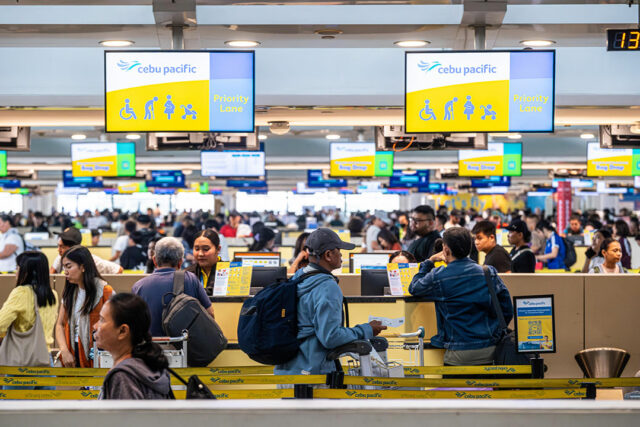
NEW NAIA INFRA CORP. (NNIC), the private operator of the country’s main gateway, is set to implement new terminal assignments at the Ninoy Aquino International Airport (NAIA) beginning March 29.

In an advisory, NNIC said foreign carriers such as Air China, China Eastern, Vietnam Airlines, Royal Brunei, and Shenzhen Airlines will be reassigned from Terminal 1 to Terminal 3.

The international flights of Philippines AirAsia, Inc., operator of low-cost carrier AirAsia Philippines, will be moved from Terminal 3 to Terminal 1.

Japan Airlines will be shifted to Terminal 3 from Terminal 1 starting April 1, NNIC said, noting that passengers are advised to verify their terminal assignments prior to travel.

NNIC previously said the reshuffling of airline terminal assignments is part of its overall plan to allow seamless airport operations while improving passenger experience.

The move also follows a 2025 resolution issued by the Department of Transportation’s (DoTr) Manila Slot Coordination Committee directing the relocation of turboprop operations outside Metro Manila.

The transfer of turboprops from NAIA aims to help decongest the airport and improve air traffic flow.

AirAsia Philippines said on Wednesday that all domestic flights will continue to operate from Terminal 2, with no changes to its domestic operations.

Previously, NNIC said terminal reassignments at the main gateway were expected by July, coinciding with the planned opening of Terminal 4.

Under the plan, Terminals 1 and 3 will continue serving international passengers, with low-cost carriers assigned to Terminal 1 and full-service airlines to Terminal 3. Terminals 2, 4, and the proposed Terminal 5 will be reserved for domestic operations, which account for the majority of NAIA’s passenger traffic. — Ashley Erika O. Jose

ADVERTISEMENT
ADVERTISEMENT