Home Blog Page 2314

SMC defends 7,000-ha Bugsuk Island titles

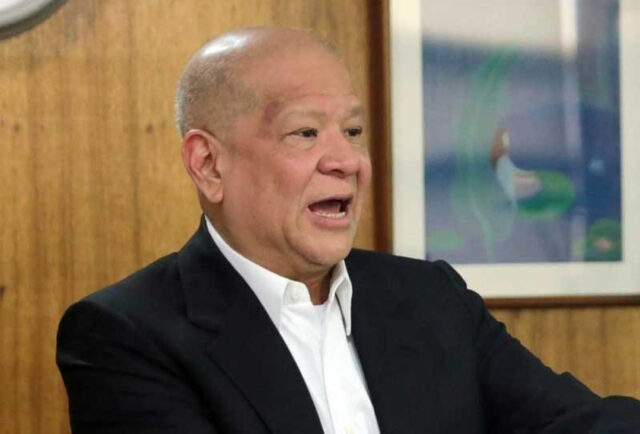
SAN MIGUEL CORP. (SMC) confirmed its acquisition of 7,000 hectares on Bugsuk Island in Balabac, Palawan, noting that the titles predate the 1997 Indigenous Peoples Rights Act and no certificate of ancestral domain title exists for the properties.

SMC acquired the properties “through the purchase of companies that have held the titles since their original issuance in 1974 as part of a government program involving the redistribution of agricultural lands to farmers under the Land Reform Program,” the Ramon S. Ang-led conglomerate said in an e-mailed statement on Monday.

“The Department of Agrarian Reform (DAR) has upheld in its orders dated Aug. 15 and Sept. 20, 2023, that the Bugsuk properties are not subject to Agrarian Reform distribution,” the company said. An indigenous peoples (IP) group called Sambilog-Balik Bugsuk Movement questioned this decision.

“While no certificate of ancestral domain title exists for Bugsuk Island, and existing property titles predate the 1997 Indigenous Peoples Rights Act, SMC is committed to engaging in constructive dialogue with all stakeholders, including the true representatives of the Molbog people, to address any concerns,” it added.

BusinessWorld still awaits comment from Agrarian Reform Secretary Conrado M. Estrella III.

“Any reacquisition by the government would violate the just compensation already provided and infringe upon the Constitutional rights of the lawful owners,” SMC said.

“Still, SMC acknowledges the historical complexities of land ownership in the Philippines and recognizes the importance of respecting the rights of legitimate indigenous communities,” it added. — Ashley Erika O. Jose

A grand Colosseum spectacle that falls flat

Paul Mescal plays Lucius in Gladiator II from Paramount Pictures.

By Brontë H. Lacsamana, Reporter

MOVIE REVIEW
Gladiator II
Directed by Ridley Scott
MTRCB Rating: R-16

RIDLEY SCOTT’S Gladiator II is a grand, entertaining spectacle. The opening credits scene is a thing of beauty, the animated sketches and score serving as a breathtaking introduction to the Roman Empire as depicted in the film. The rest of it delivers as a blockbuster — it’s the type of experience that works best when the elaborate costumes and set pieces placed in well-staged gigantic battles and sweeping scenes of the Colosseum are projected 10 to 30 feet high in a large movie theater.

An epic historical action film set 16 years after the events in the original Gladiator (2000), it follows Marcus Aurelius’s grandson Lucius, who is living under an alias as a warrior in Africa until the Roman army invades and enslaves him. He then pursues the path of a gladiator, inspired by the legendary gladiator Maximus, protagonist of the first Gladiator movie. Unfortunately, despite awesome visuals befitting a big-screen popcorn movie, the film sways in-consistently between criticizing and glorifying the Roman Empire, thanks to the poor writing of the lead character.

A valiant effort was made by indie darling Paul Mescal (Normal People, Aftersun, All of Us Strangers) to bring Lucius to life. As a newcomer to blockbusters, Mescal was given no favors by the messy script and pacing that ren-dered his character unrelatable. The film keeps insisting that he is a man driven by unbridled rage, but Mescal’s effective chemistry with his fellow gladiators and with his doctor friend Ravi show otherwise, that he is instead a man with a good heart.

If only we were outright shown these softer moments, similar to how the first Gladiator gave Russell Crowe’s Maximus plenty scenes as a family man and everyday man of honor. Instead, this movie’s protagonist is given unreal-istic character development, as he goes from vowing to kill General Acacius (played by Pedro Pascal) who enslaved him and despising all of Rome, to suddenly reversing his hate and deciding to take up his mantle as its prince. Per-haps in a more polished version of Ridley Scott’s messy sequel, with scenes delving into Lucius’ gradual evolution, this problem might be solved.

Undoubtedly, the stand-out performance in the film is given by Denzel Washington as the conniving Macrinus, who keeps a stable of gladiators. He is an ex-slave who was playing the long game in pursuit of a free Rome, but emerges as a corrupted manipulator now in pursuit of power. Washington plays this character compellingly, as a morally gray character finally ascending to the level of his oppressors. When Mescal’s Lucius puts a stop to it, the ending resorting to the generic “hero saves the day” trope, the promise of a complex, nuanced game of politics ends, and the film falls flat.

Gladiator II falls apart — its plot holes, historical inaccuracies, and character inconsistencies glaringly distracting — if you think about it too much. For sure, Roman history nerds will leave the theater with a migraine after seeing all the terrible anachronisms, from a printed newspaper (invented 1,200 years too early!) to the brother emperors Geta and Caracalla (not twins in real life, and more ruthless rather than insane as depicted here). For movie fans, comparing this sequel to the original shows it full of faults, too, because this echoes Gladiator way too closely to be its own triumph.

Even the evil twin emperors Geta and Caracalla (played with surprising pathos by Joseph Quinn and Fred Hechinger) are an echo of the cruelty of Joaquin Phoenix’s Commodus in the first film, albeit more unhinged. But while the lone monarch was clearly motivated by a lack of love and recognition, a frustration he redirected towards gladiators in the arena, the twins’ supposed insanity is a more symbolic one, representing the chaos of Rome as the two wreak havoc on their subjects and eventually tear each other apart, the audience left to speculate on their motivations given their limited screentime.

Of course, their underdeveloped subplot is but one part of the film, with Denzel Washington’s Macrinus doing much of the heavy lifting as the main antagonist. If not for anything else, this film is worth watching for his memora-ble Shakespearean performance alone, proving Washington’s sheer star power. It reaches the point where, as other scenes unfold, one wonders where Macrinus is and hopes to see him onscreen once more.

Pedro Pascal as Acacius and Paul Mescal as Lucius play action heroes well enough, even serving as eye candy for those who want to see men all roughed up in battle, but their characters are simply not as compelling as Macrinus.

The CGI baboons and the naval battle recreated in the flooded Colosseum (filled with sharks, somehow) are a symptom of the movie industry’s illness of neglecting original ideas just to fill the screen with spectacle and rehash what’s been successful before. Its ending is the most damning piece of evidence — playing Hans Zimmer’s iconic theme, “Now We Are Free,” over footage of Maximus brushing his hand through stalks of grain. While it may symbol-ize Lucius following in the grand gladiator’s footsteps to fulfil his legacy, it comes off as forced. It only makes one want to watch the original film again.

Gladiator II did not need to be a disorganized nostalgia fest that only retreads its predecessor, overdressed with visual stimuli to keep audiences entertained. Perhaps audiences will be entertained regardless (admittedly this writer was, despite my criticism), but it is still a waste of the potential for a decent story.

Gladiator II opens in Philippine cinemas on Dec. 4.

Has Sara’s diversionary tactic turned the tide?

Vice-President Sara Z. Duterte-Carpio — PHILIPPINE STAR/RYAN BALDEMOR

Vice-President Sara Duterte went ballistic, launching her biggest missile at President Bongbong Marcos (BBM), First Lady Lisa Marcos, and Speaker Martin Romualdez. In a pre-dawn online news conference the other Sat-urday, she said, “I have spoken to someone. I said, ‘If I am killed, go and kill BBM, Liza Araneta, and Martin Romualdez.’ No joke. No joke. I said, ‘Do not stop until they are dead,’ and the person said ‘yes.’”

The salvo was in response to advice from her political allies that she stay safe while she was in the House of Representatives because Romualdez supposedly wants her dead, alleging that she is the biggest threat to his political ambitions.

BBM and Romualdez returned fire. In the afternoon of the Monday following Duterte’s blast, BBM vowed, “I will fight back.” He found the Vice-President’s pronouncements “alarming.” “If it’s that easy to plan the assassination of a president, how much more for ordinary citizens? Such criminal attempts should not be ignored,” said he.

He said the whole “drama” would not have escalated to this point if the Vice-President had faced the House of Representatives’ investigation into the alleged misuse of confidential funds in the Office of the Vice-President and the De-partment of Education. “The truth should not be killed. This issue would have been over if only the sworn oath to be a public servant had been fulfilled, to tell the truth and not to obstruct.”

Marcos then declared that the rule of law must be upheld in a democratic country. “The law must be upheld whatever the situation may be, to whoever it may apply,” he added.

A few hours later, Speaker Romualdez addressed the members of the House of Representatives. In agitated tone, he declared:

“Let me be clear: This is no longer a joke; this is not a normal manner of speaking. This is a direct threat to our democracy, to our government, and the security of the country.

“Such a statement is not just reckless — it is dangerous. It sends a chilling message to our people, a message that violence can be contemplated by those in positions of power. This is not just an affront to the individuals targeted; it is an attack on the very foundation of our government. It is an insult to every Filipino who believes in the rule of law and the sanctity of life. Violence has no place in our society. It is irreconcilable with the values that have taught and guided us for years — values of respect, and amicable peaceful conflict resolution.

“We cannot let this pass as mere rhetoric. The gravity of such a confession demands accountability. It demands answers. It demands that we, as the representatives of the Filipino people, take a stand to protect our democ-racy from any and all forms of threats.

“My colleagues, I call on you to stand with me in defending this institution. Let us fight for the dignity of Congress. Let us fight for the truth. Let us fight for democracy. To the Filipino people, I assure you that this House will not waver in its commitment to transparency, accountability, and service. We should not allow individuals to ruin this great nation with their manipulative tactics, their troll armies, or their few blind followers.”

Enemies of Sara Duterte joined the fray. That same Monday, the Makabayan bloc in the House of Representatives held a protest rally in front of the Batasan building calling for the impeachment of VP Duterte. Like the President, the Vice-President may be impeached for graft and corruption, other high crimes, or betrayal of public trust.

BBM’s foot soldiers fired shots at Sara. On Tuesday, the National Bureau of Investigation (NBI) issued a subpoena to Sara Duterte regarding her threat against BBM. The subpoena, dated Nov. 25, ordered Duterte to appear before the NBI Main Office in Pasay City at 9 a.m. on Friday, Nov. 29, “to shed light on the investigation for alleged grave threats against President Ferdinand Marcos, First Lady Liza Araneta-Marcos, and Speaker Martin Romualdez and possible viola-tion of the Anti-Terrorism Act.”

Section 4 of RA 11479 states that terrorism is committed by any person who, regardless of the stage of execution, engages in acts intended to cause death or serious bodily injury to any person, or endangers a person’s life.

On Wednesday, Presidential Adviser for Poverty Alleviation Secretary Larry Gadon filed a complaint before the Supreme Court for the disbarment of Duterte, a lawyer, from the legal profession. He asked the Court to initiate a motu pro-prio proceeding of disbarment against Duterte following her threat to have the President and Speaker killed.

On microblogging platform X, former senator Leila de Lima called Sara Duterte’s pronouncements as part of a “political drama staged by the Office of the Vice-President to divert the issue from its plunder of confidential funds.”

Diversionary tactics are common in warfare. They have been employed in major and crucial offensives. In World War II, the Allied Forces deceived the German High Command into expecting them to launch the liberation of France from German occupation at Pas-de-Calais instead of Normandy.

The same tactic was used during the Persian Gulf War. The Central Command of the UN coalition forces tricked Sadam Hussein into believing they would begin the freeing of Kuwait from his stranglehold with an amphibious assault on the Kuwaiti coast instead of a ground offensive into Iraqi territory.

Diversionary tactics are also used in a defensive way. One such tactic is shock action. It is intended to disrupt the offensive of the adversary. In the liberation of the Philippines, the landing of American forces was delayed by the waves of kamikaze attacks on the US Naval fleet in Leyte Gulf in October 1944. A kamikaze was a bomber airplane that dove into an enemy warship to cause it heavy damage.

That is what beleaguered Sara Duterte used to disrupt the relentless offensive of her numerous adversaries — pre-dawn shock action. Her adversaries’ leaders, President Bongbong Marcos and Speaker Martin Romualdez, were jolted.

But by Thursday last week, it looked like Sara’s diversionary tactic was a monumental blunder as she had fired her biggest shell and she was surrounded by her enemies. She seemed bound to meet the same fate of the ka-mikaze squadrons that attacked the US Navy fleet in Leyte Gulf in October 1944 — self-destruction.

Came the fateful day, Friday, Nov. 29, the day she was to appear before the NBI Main Office “to shed light on the investigation for alleged grave threats against President Ferdinand Marcos, First Lady Liza Araneta-Marcos, and Speaker Martin Romualdez and possible violation of the Anti-Terrorism Act.” She was a no show.

NBI Director Jaime Santiago explained that Duterte had requested resetting of her appearance having “learned late that her appearance before the House committee hearing was cancelled.” Santiago accepted the excuse and granted the request and reset Duterte’s appearance for Dec. 11.

It is strange that Santiago accepted the lame excuse. The cancellation of her appearance before the House committee was announced through a televised press conference in the early afternoon of Thursday. Several chan-nels announced it in their evening newscast that Thursday. The major dailies reported the cancellation in their Nov. 29 issues.

Strange too is Santiago resetting the appearance when he had said the day before that if Duterte didn’t show up, he would submit to the Department of Justice prosecutors the evidence he has regarding her threat against the President. He also said he might accommodate Duterte’s request for the questions she would be asked, “given her position as the country’s second highest official.”

After Justice Undersecretary Jesse Andres remarked that the Ombudsman had the authority to discipline and investigate government officials, Ombudsman Manuel Martires said his office could take over the investigations by the NBI and the House committee. Martires was appointed to the Supreme Court and subsequently as Ombudsman by President Rodrigo Duterte. They were contemporaries at San Beda Law and are Lex Talionis Fraternitas brothers.

That same day, BBM said he did not support calls for the impeachment of Sara Duterte. “It will tie down the House, it will tie down the Senate. It will just take up all our time and for what? For nothing, for nothing. None of this will help improve a single Filipino life,” he explained.

Impeachment is a power vested by the Constitution on the House of Representatives alone. The Speaker of the House, not the President, has the prerogative to oppose calls for impeachment. By expressing his objection to the impeachment of Sara, he is prompting Speaker Romualdez, also a target of Sara’s sinister plan, to dissuade the congressmen from impeaching Sara.

Why the softening of the BBM offensive? Has Sara Duterte’s diversionary tactic exposed BBM’s vulnerability — the military, the Senate, the Supreme Court, even the Office of the Ombudsman? Asked if, like Sara, he has al-ready reached “a point of no return,” he answered, “Never say never.” Is a truce in the offing?

Has Sara Duterte’s diversionary tactic of shock action turned the tide?


Oscar P. Lagman, Jr. has been a keen observer of Philippine politics since the late 1950s.

PHL monetary policy transmission remains ‘weak,’ AMRO says

MONETARY POLICY transmission in the Philippines remains “weak,” as seen in the muted movements in actual bank lending rates compared to the changes to the Bangko Sentral ng Pilipinas’ (BSP) policy rate, the ASEAN+3 Macro-economic Research Office (AMRO) said.

AMRO said in a special chapter of its annual consultation report for the Philippines released on Monday that the “weak pass-through” of BSP actions could reduce the impact of its monetary policy on the economy.

“In 2022-2023, Bangko Sentral ng Pilipinas tightened monetary policy forcefully by raising the policy interest rate by 450 basis points (bps) to fight off inflation. The magnitude of the increase was large compared with peer coun-tries such as Indonesia, Malaysia and Thailand. However, only half of the total change was reflected in the actual bank lending rate. Such a weak pass-through may hinder monetary policy effectiveness, given the bank-based nature of the Philippine financial system,” AMRO said.

“Effective monetary policy implementation requires a robust transmission of the policy rate to the interest rates in the broader economy.”

BSP Governor Eli M. Remolona, Jr. has said that the Philippines’ monetary transmission mechanism has long lags.

AMRO attributed the limited pass-through to “an abundance of low-cost funding and the lack of consumer credit data.”

“In the Philippines, since bank funding is the largest formal financing source for the private sector, the sensitivity of bank lending rates to the policy rate is central to monetary policy effectiveness,” AMRO said.

It noted that there are disconnects in several key policy transmission links.

“When the BSP adjusts its policy rate, known as the target reverse repurchase (RRP) rate, it should lead to corresponding changes in the short-term market interest rates at which banks lend or borrow funds from one another. These market interest rates influence asset prices, such as stock indices, bond yields and exchange rates. They also feed into bank funding costs, which are the basis for the pricing of bank deposit and lending rates. The bank rates and asset prices that consumers and firms face affect their demand for goods and services, and ultimately, domestic prices,” it said.

The first transmission link, which is from the policy rate to short-term market rates, has “worked well in some markets,” it noted.

“Movements of the interbank call loan rate (IBCL), which is the overnight unsecured borrowing rate, and the short-term government bond yields have been well anchored to the policy rate since the establishment of the In-terest Rate Corridor (IRC) in 2016.”

The BSP adopted the interest rate corridor system in 2016 to help bring short-term market rates closer to its policy rate for better policy transmission.

“Before the IRC, insufficient liquidity absorption led the IBCL and one-year yields to trade significantly below the policy rate,” AMRO said. “However, after the IRC was put in place, the BSP introduced new liquidity ab-sorption tools such as the term deposit facility and the issuance of BSP securities, and these short-term market rates began moving more in line with the policy rate.”

However, the “interest rate in the foreign exchange swap market is more volatile and often trades below the policy rate,” it noted.

The Philippine Interbank Reference Rate (PHIREF), the implied peso interest rate derived from foreign currency (FX) swaps, depends “not only on domestic interest rate conditions but also US dollar funding conditions.”

“The PHIREF volatilities and deviations from the policy rate can dilute monetary policy signals, given that FX swaps remain the most active interbank market in the Philippines due to higher liquidity and more familiarity among participants compared with the repo market.”

AMRO added that there is also a disconnect between market rates and bank funding costs.

“Short-term market rates are only partially reflected in bank funding costs. Following the 450 bps increase in the policy rate and the comparable changes in many short-term market rates, the average funding costs of the banking system rose by less than 30% of that amount,” it said.

“The muted changes in bank funding costs are a result of the large low-cost deposit funding in the banking system,” it added, noting that in the BSP’s last tightening cycle, where the policy rate was hiked to a 17-year high, deposit rates only moved marginally.

“To be sure, from a bank’s perspective, a high NOW (negotiable order of withdrawal) and savings ratio supports profitability. However, from a monetary policy perspective, it limits the degree of policy transmission to bank rates and then to the economy overall,” AMRO said.

“The large surplus liquidity in the banking system also limits the rise in bank funding costs. The Philippine banking system has ample liquidity… Excess liquidity is also reflected by the loan-to-deposit (L/D) ratio, which is markedly lower than in ASEAN-4 peers The low L/D ratio shows that most banks have a sizable buffer of idle liquidity, and hence have no need to compete for deposits by using more attractive rates,” it added.

AMRO also noted the “constrained” linkage from bank funding costs to lending rates, with the pass-through differing depending on the loan type.

“After the policy rate was raised by 450 bps, the average effective lending rate rose by 224 bps, a pass-through of 50%. However, behind this average number, the degree of pass-through varies across loan types,” it said.

It noted that the degree of pass-through was strongest for corporate loans (64%), followed by small- and medium-sized enterprise loans (32%) and household loans (20%).

“Household loan rates are less sensitive to the policy rate because they are dominated by credit risk premiums. In simple terms, bank loan rates comprise bank funding costs plus the risk premium of the borrowers and the bank’s profit margins,” it said. “Based on AMRO’s interviews with banks, the credit risk component in household loan rates tends to be large, dwarfing any changes in funding costs that can be influenced by the policy rate.”

IMPROVING LINKAGES
Moving forward, to strengthen the link between the BSP’s policy rate and bank lending rates, AMRO said the central bank should “continue to develop a liquid repo (repurchase) market to serve as the core interbank funding mar-ket with a stronger link to the domestic policy rate.”

The BSP and the Bankers Association of the Philippines have announced their plans to enhance the government securities repo market to boost the capital markets and improve asset pricing.

“Second, although stable bank funding is important for banking system resilience, the deposit market has room for more competition to enhance sensitivity to the policy rate,” AMRO said.

Increasing consumer awareness regarding alternative and higher-yielding savings and investment products would help monetary policy transmission, boost household savings and deepen the capital markets, it said.

Lastly, the quality and availability of household credit data should be improved to allow lenders to better assess credit risks and price loans, AMRO said.

“First, the data should be more complete, encompassing all financial footprints at bank and nonbank lenders. Second, the accuracy of the data must be improved. Third, alternative data such as payments to utility com-panies or online shopping platforms can be added to the credit profile, subject to appropriate data privacy and protection standards,” it said.

“Such improvements in the credit data will not only benefit policy rate transmission, but also provide opportunities to households with a good credit history to access finance at more reasonable costs.” — Luisa Maria Jacinta C. Jocson

Power China tapped to construct MTerra Solar

STOCK PHOTO | Image by Michael Wilson from Unsplash

TERRA SOLAR Philippines, Inc. (TSPI), a subsidiary of SP New Energy Corp. (SPNEC), has tapped Power Construction Corp. of China Ltd. (Power China) for the construction of a portion of the P200-billion solar and battery energy storage project.

TSPI signed an engineering, procurement, and construction (EPC) contract with Power China along with its affiliates to build the east-side development of the MTerra Solar Project, the company said in a statement on Monday.

“MTerra Solar serves as our bold step towards ensuring a sustainable energy future for the Philippines — and with Power China as our partner, we are well on our way to achieving our vision of a cleaner energy future for the Philippines,” TSPI President and Executive Director Dennis B. Jordan said.

TSPI is constructing a 3,500-megawatt-peak (MWp) solar power plant and a 4,500-megawatt-hour (MWh) battery energy storage system in Central Luzon.

The project will be located in five towns — Gapan, General Tinio, Peñaranda, and San Leonardo, all in Nueva Ecija, and San Miguel, Bulacan.

Slated for completion by 2027, MTerra Solar is expected to provide clean energy to more than two million households.

Under the agreement, Power China will handle the development of the project’s east section, spanning approximately 1,505 hectares.

The section accounts for 1,050 MWp of the project’s total capacity.

SPNEC said that the agreement covers warranty, defect resolution, and the implementation of operational and maintenance protocols “to ensure long-term reliability and success” of the project.

MGen Renewable Energy, Inc., the renewable energy arm of Meralco PowerGen Corp. (MGen), holds a controlling stake in SPNEC. MGen is a subsidiary of power distributor Manila Electric Co. (Meralco).

“We sign this EPC agreement with Power China recognizing their expertise, exceptional track record, and unwavering commitment to excellence — we know that they will help us realize our bold ambition,” MGen President and Chief Executive Officer Emmanuel V. Rubio said.

Power China, a state-owned enterprise, focuses on the planning, design, and construction of electric power infrastructure with a presence across Africa, Asia, and Europe.

For the west side, TSPI recently inked an EPC contract with China Energy Engineering Group Co., Ltd. (Energy China) for the construction of the project’s section accounting for 1,400 MWp for solar and 3,300 MWh for energy storage.

Last month, the companies officially broke ground for the MTerra Solar Project, marking the full swing of its construction.

The project is set to deliver solar energy under a 20-year, 850 MW mid-merit power supply agreement to Meralco.

Meralco’s controlling stakeholder, Beacon Electric Asset Holdings, Inc., is partly owned by PLDT Inc.

Hastings Holdings, Inc., a unit of PLDT Beneficial Trust Fund subsidiary MediaQuest Holdings, Inc., has an interest in BusinessWorld through the Philippine Star Group, which it controls. — Sheldeen Joy Talavera

Moana 2 and Wicked lift US box office to Thanksgiving weekend record

LOS ANGELES — Walt Disney’s animated musical Moana 2 debuted with an estimated $368 million in global ticket sales through Sunday and combined with Wicked and Gladiator II to deliver the biggest Thanksgiving weekend in US and Canadian box office history.

A sequel to the 2016 animated film, Moana 2 reunites Auli’i Cravalho as the wayfinding title character with demigod Maui, voiced by Dwayne Johnson, on a voyage to break a curse and reunite the people of the ocean.

Initially envisioned as a series for the Disney+ streaming service, Moana 2 racked up a record $221 million from domestic ticket sales over the Thanksgiving period from Wednesday through Sunday. That surpassed Frozen 2’s holiday haul of $125 million in 2019.

For all movies in theaters this weekend, the domestic total hit $420 million, smashing the 2018 Thanksgiving record of $315.6 million led by Ralph Breaks the Internet and Creed II.

The results provided Hollywood studios and cinemas a reason to celebrate after prolonged closures during the COVID-19 pandemic and concerns that audiences might abandon theaters in favor of staying home to watch streaming TV.

“If you make the right movie, a movie with heart and humor that appeals to audiences, they will come to the theater,” Disney Entertainment Co-Chairman Alan Bergman said at a recent Moana 2 screening in Los Angeles.

The figures also showed Hollywood had rebounded from disruptions caused by strikes by writers and actors last year. Chains such as AMC Entertainment and Cineworld were left with a thin schedule for moviegoers in the first half of 2024.

Wicked, the adaptation of a beloved Broadway musical that is a prequel to The Wizard of Oz, brought in $117.5 million over Thanksgiving. Its global total after two weekends in theaters reached $359.2 million, distributor Uni-versal Pictures said.

Paramount Pictures’ action epic Gladiator II, the sequel to a best picture winner two decades ago, hauled in $44 million domestically over the holiday and brought its global total to $320 million.

Before the weekend, year-to-date domestic ticket sales had hovered nearly 11% behind the same point in 2023, according to data from Comscore. The Thanksgiving tally narrowed the deficit to 6.4%.

Still, the receipts remained significantly below pre-pandemic levels. Through Sunday, domestic ticket sales for 2024 were roughly 24% lower than the pace of 2019.

Paul Dergarabedian, senior media analyst at Comscore, said the frenzy at theaters this weekend would likely fuel strong sales in the coming weeks. He cited a number of potential hits reaching theaters in December to “help the industry take the year out on a high note.”

They include Kraven the Hunter, the animated Lord of the Rings: the War of the Rohirrim, Sonic the Hedgehog 3, and Mufasa: The Lion King, he said. — Reuters

PhilHealth budget tied to tobacco tax money, credit ratings upgrade

There are three phrases that I regularly read used in the continuing opposition by health activists and lobbyists over the excess PhilHealth (Philippine Health Insurance Corp.) funds.

One is “defunding PhilHealth.” “Defunding” means that a budget is slashed from xx billions to zero. This is not happening so the term is plain emotional and dishonest.

In 2023, PhilHealth had a budget of P100 billion, largely sourced from tobacco excise tax collections, which peaked at P176 billion in 2021. Under RA 11346 of 2018 which raised sin tax rates, 50% of excise tax revenues from tobacco, alcohol, sugar-sweetened beverages (SSB) should go to PhilHealth and the Department of Health (DoH).

When the tobacco tax rate increased from P50/pack in 2021 to P55/pack in 2022, tobacco smuggling and illicit trade exacerbated and tobacco tax revenues declined for the first time, down to P160 billion in 2022. The PhilHealth budget declined to P61 billion in 2024.

Then in 2023, the tobacco tax rate further increased to P60/pack and tobacco smuggling got even worse and government tobacco tax revenues further declined to only P135 billion, or P41 billion less than 2021’s level. In 2024, the tax rate further increased to P63/pack, the illicit tobacco trade worsened again, and the projected tobacco tax revenues will further decline to only about P122 billion.

The health lobbyists demanded an even higher PhilHealth budget for 2025 of up to P172 billion, even if they knew that their beloved tobacco tax money keeps declining. They did not get what they wished so now they blame the departments of Budget and Finance. This instead of blaming the high incidence of illicit trade in tobacco and the shift of smokers from legal to illegal tobacco, plus the shift to vapes from tobacco.

Anyway, PhilHealth will still get funding despite the declining tobacco tax money. PhilHealth will not be “defunded” in 2025 but it will receive fewer funds — P47.5 billion based on the Senate budget bill for 2025 (see Table 1).

The second phrase I see is “PhilHealth indirect contributors.” The indirect contribution to PhilHealth is the 50% share from excise tax revenues from tobacco and sugar-sweetened beverages. So, are the health lobbyists implying that the non-direct contributors to PhilHealth are the smokers, vapers, and sweet beverage drinkers? It does not sound logical because most patients are prohibited by their attending doctors from smoking and eating sweets.

The third phrase I read is “Insurance contract liabilities (ICL)… amounted to P1.128 billion.” As discussed last month in this column, “On the PEB in London, the PhilHealth funds, and the US elections” (Nov. 5), I ex-plained that “ICL is Present Value of Future Outflows minus Present Value of Future Inflows… So ICL are just estimates, not backed up by actual claims or contracts with hospitals and health professionals.”

Since ICL are just estimates based on certain assumptions, when the assumptions change, the ICL also changes significantly. See the fluctuation and variability of ICL estimates: P1 trillion in 2020, P0.34 trillion in 2021, P0.27 trillion in 2022, P1.15 trillion in 2023. Even that P1 trillion ICL is just hypothetical and not actual claims made by healthcare providers like hospitals.

One mistake that was made by the health lobbyists and activists was when they moved for the earmarking of tobacco tax revenues for PhilHealth and the DoH. They are happy when there are more smokers and drinkers of legal products because then the tax revenues increase. When smokers shifted to illegal or illicit products because of the high tobacco tax rate, the revenues declined, and funding for PhilHealth declined.

CREDIT RATINGS
Last week, on Nov. 26, S&P raised the Philippines’ credit rating from “BBB+ stable” (given in April 2019) to “BBB+ positive.” So, the next ratings upgrade for the Philippines would be “A-,” and will hopefully be given within the next 12 to 24 months. This is good news for us.

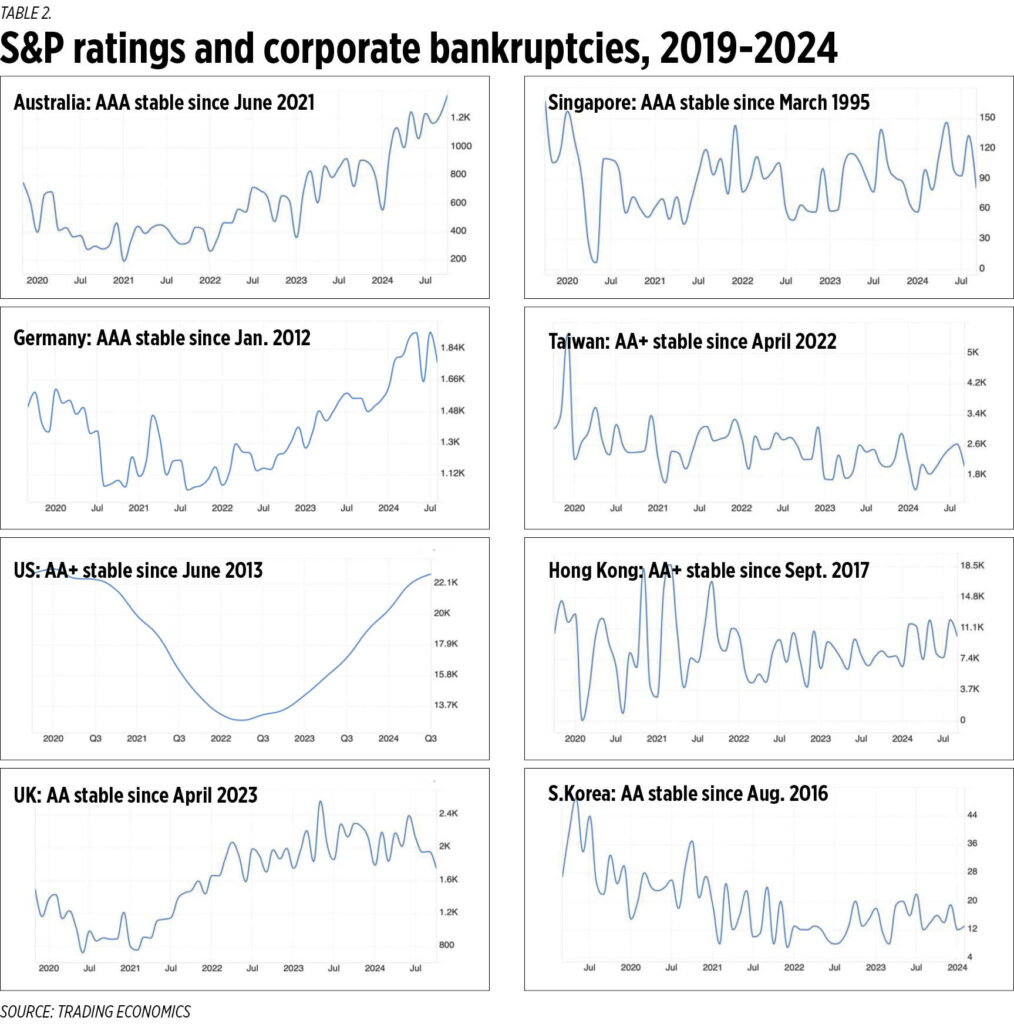
I noticed that several developed countries have very high ratings of AA to AAA yet have had a high level of corporate bankruptcies recently, like Australia and Germany. In contrast, a number of East Asian economies also have high credit ratings but are seeing flat or a declining number of bankruptcies, like Singapore, Taiwan, Hong Kong, and South Korea (see Table 2).

The challenge for us, especially the government economic team, is to attract those failing and migrating companies to move from North America, Australia, and Europe to the Philippines. We have third fastest GDP growth in Asia next to India and Vietnam, have improving credit ratings, declining inflation and unemployment rates, and other positive factors.


Bienvenido S. Oplas, Jr. is the president of Bienvenido S. Oplas, Jr. Research Consultancy Services, and Minimal Government Thinkers. He is an international fellow of the Tholos Foundation.

minimalgovernment@gmail.com

DMCI Homes eyes up to 3 new projects

THE VALERON TOWER -- DMCIPROJECTS.NET

By Almira Louise S. Martinez, Reporter

CONSUNJI-LED developer DMCI Homes, Inc. is eyeing to launch two to three more projects in 2025, according to its president.

“If sales are very good, we will launch maybe two or three more projects,” DMCI Homes President Alfredo R. Austria told reporters on Friday last week.

However, this may not happen in the first half of 2025 “due to recent project launches,” he noted.

He cited new projects in Quezon City, One Delta Terraces, and Kalea Heights, the company’s first four-tower project in Cebu.

DMCI Homes is targeting P37 billion in sales and reservations for 2025.

According to Mr. Austria, Baguio, Quezon City, Taguig, and Laguna are some of the possible areas for the DMCI Homes’ next launches in the second half of 2025.

He said the company aims to focus on the sales of its existing projects before venturing into new ones.

“We also want our sales team to focus on our ready-for-occupancy projects.”

The Cresmont, a single-tower condominium in Quezon City by DMCI Homes, will have its unit turnover this month, remaining on track with its original schedule.

“We saw that many projects around us are not finished on time,” Mr. Austria said. “Despite the difficulties of the environment, especially brought by the pandemic, our delivery is still on time.”

Reflecting on the company’s challenges during the lockdown, Mr. Austria said that the majority of Cresmont units had been sold before the pandemic.

“It was actually almost sold out in 2019 before the pandemic. It was selling fast,” he said. “After the pandemic, Chinese buyers, one after the other, backed out.”

He noted that even Filipino buyers canceled their payments because of the public health crisis.

At present, around 190 units have become available again in the project.

DMCI Vice-President for Project Development Dennis O. Yap said that the lower interest rate will help the company increase its ready-for-occupancy sales.

“Before, maybe the market was discouraged from buying ready-for-occupancy units because of the interest rate,” he told BusinessWorld.

“Our main target end-users want to be able to occupy the units right away,” he said. “So, we feel like the situation of our ready-for-occupancy units will definitely improve.”

Cemex Holdings completes sale of reinsurance unit

CEMEX PHILIPPINES FACEBOOK ACCOUNT

CEMEX Holdings Philippines, Inc. (CHP) has completed the sale of its shares in a foreign subsidiary.

The payment for the sale of all CHP shares in Falcon Re Ltd. to Torino Re Ltd. was completed on Nov. 29, the cement producer said in a stock exchange disclosure.

The deal was valued at $3 million. The share purchase agreement between CHP and Torino was signed on Nov. 14.

Falcon is a CHP subsidiary established in Barbados which reinsures third-party insurers of CHP covering risks associated with property insurance coverage, with political violence and non-damage business interruption pro-grams, professional liability program and cyber risks.

Torino is an affiliate of Cemex, S.A.B. de C.V.

CHP recently sold its entire stake in Swiss-based Cemex Asia Research AG (CAR) to Cemex Innovation Holding AG for $900,459 (P53 million) to streamline its business.

Meanwhile, CHP said in a separate disclosure that its indirect parent company, Cemex Asia B.V., has signed an amendment agreement with DMCI Holdings, Inc., Semirara Mining and Power Corp. (SMPC) and Dacon Corp. on Dec. 1.

The agreement amends the sale and purchase of shares in CHP’s principal stockholder, Cemex Asian South East Corp. (CASEC), to waive the condition precedent in relation to the solid expansion.

CASEC owns about 89.86% of CHP’s outstanding capital stock.

“The parties agreed to conduct certain standard confirmatory testing related to the solid expansion after closing, and the same is expected to be completed within the first quarter of 2025 or soon thereafter,” CHP said.

In April, DMCI, SMPC, and Dacon announced the acquisition of CHP for $305.6 million under a share purchase agreement.

DMCI acquired the entire share of Cemex Asia B.V. in CASEC. Under the deal, DMCI will acquire a 56.75% stake in CASEC, Dacon will secure 32.12%, and SMPC will purchase the remaining 11.13%.

On Monday, CHP stocks rose by 5.59% or 10 centavos to P1.89 per share while DMCI stocks improved by 1.13% or 12 centavos to P10.78 apiece. — Revin Mikhael D. Ochave

Peso may hit P60 early next year — DBS

THE PHILIPPINE PESO could hit the P60-per-dollar level in the first half of 2025, DBS Bank said.

In a recent report, DBS said the local unit could settle at P60 against the greenback from the first quarter to the second quarter of 2025.

It then expects the peso to rebound to P58.90 by the third quarter and to P57.30 by end-2025.

DBS said it adjusted its currency forecasts to “reflect a bias towards a stronger US dollar at the onset of Trump’s second term.”

“Although markets viewed Trump’s tariffs as a transactional policy approach to extract leverage in negotiations, not all countries would be willing or able to meet his demand, resulting in retaliatory measures, straining US rela-tions with key allies and trading partners,” it said.

“Apart from undermining business confidence and investments, tit-for-tat trade wars would also hamper or halt the Fed’s ability to lower interest rates. Overall, Trump’s policy agenda is a complex mix of initiatives that sparked much debate seeking coherence. Their impact remains as uncertain as its implementation and global responses.”

US President-elect Donald J. Trump has promised to impose restrictive tariffs on Chinese imports as well as a universal tariff. Markets are anticipating the inflationary pressures that could come from these duties.

This year, DBS expects the peso to average P59.10 against the dollar.

The peso closed at its all-time low of P59 per dollar on Nov. 21 and 26.

FED EASING CYCLE
In a separate report, the ASEAN+3 Macroeconomic Research Office (AMRO) noted several shocks that could cause the peso to weaken further versus the greenback.

“The peso may continue to experience high volatility amid uncertainties over monetary policy decisions both at home and abroad, the global growth outlook, and geopolitical concerns,” it said.

“Against this backdrop, the peso should continue to be determined by the market and serve as a shock absorber for the economy. Judicious foreign exchange interventions should be employed from time to time to address ex-cessive volatility.”

AMRO said possible delays in the US central bank’s easing cycle could affect the local currency.

“A slower-than-expected monetary policy easing in the US compared to market expectations can trigger a peso depreciation and an increase in Philippine government bond yields,” it said.

“Even though the Federal Reserve already started cutting the federal funds rate in September, there remain uncertainties in the pace of further easing for the rest of this year and into 2025. As a result, the pace of US monetary policy easing still warrants close monitoring, as a slower-than-expected pace can trigger renewed peso depreciations.”

AMRO said that while a weaker peso would benefit overseas Filipino workers and exporters, this would place the country at risk as “large depreciations can exert upward pressures on the prices of imported goods.”

“Higher import prices can cause significant burdens on importers and manufacturers, and potentially consumers if the higher prices are passed on,” it said.

“Moreover, slower US monetary policy easing can contribute to an increase in the Philippine government bond yields, which are highly correlated with US Treasury yields. This will raise the government’s funding costs.” — Luisa Maria Jacinta C. Jocson

Taylor Swift fans turn out on Black Friday for vinyl album, new Swift book

LOS ANGELES/CHICAGO/NORTH BERGEN, N.J. — Young Taylor Swift fans and their parents lined up outside some of Target’s nearly 2,000 US stores early on Black Friday to buy copies of her new Eras Tour book and vinyl album. Hoping to buck a long stretch of slowing sales at Target stores — with penny-pinched shoppers making purchases at rival retailers — the big-box chain teamed up with Ms. Swift to build on the fan momentum she experienced following her Eras Tour concerts.

Several customers queued up outside Target stores as early as 5 a.m. in freezing temperatures, with most of them there to snap up Swift merchandise.

“Yeah, it’s really cold, but we’re here to get Taylor Swift’s tour book and her latest vinyl drop,” Carlos Miracle, a 31-year-old Swift fan, said while waiting outside a Chicago store.

Parents of teenage daughters and youngsters in their late 20s were up and about to buy Ms. Swift’s Eras Tour book priced at $39.99 at Target. The retailer is also making available a vinyl and CD version of The Tortured Poets Department: The Anthology for the first time, containing 35 tracks including four acoustic bonus songs.

The vinyl version is being sold for $59.99 and CDs for $17.99, according to Target’s website.

In Los Angeles, Landon McCall, a 31-year-old accountant, said “I originally came for the vinyl, and I saw the book there, too.”

A Target store employee “was like, ‘Hey, this is going to go by fast. It’s what everyone’s wanting. I already sold 30 this morning within the first 30 minutes,’” Mr. McCall said. “So, I was like, I might as well just get both … My daughter likes Taylor Swift, too, so I thought it’d be something for her and her mom to kind of, like, go through the book and look at it together.”

Ms. Swift, 34, has been setting music industry milestones and boosting local economies with The Eras Tour, with the last leg of the concert happening in Canada currently, a phenomenon that some economists have termed “Swiftflation.”

Ms. Swift had released her latest Tortured Poets album in May during Target’s first quarter, boosting its sales in its entertainment category by a high-single-digit percentage.

On Friday, Julia Corrin, a 39-year-old from Pittsburgh bought the Era Tour book. The tour was a “really special moment … and it’ll be great to have something to remember it by,” she said.

In New Jersey, 28-year-old Amy Webb was in line to get her hands on the new Eras Tour book. “I usually don’t buy anything during the holiday season, but wanted to get my hands on this before it sells out,” she said.

On X, formerly known as Twitter, users shared images of long queues to grab Swift merchandise, while some noted that a few Target stores saw nearly empty shelves for the Eras Tour book and were out of Tortured Poets vinyl by 9:30 a.m.

To boost sales during the holiday season, which is shorter than in previous years with only 26 days between Thanksgiving and Christmas, Target will offer the Eras Tour items on its app and website beginning Saturday.

“That’s the only reason I am here, we don’t want to go online and see that it is sold (out),” said a 35-year-old Marriott Hotel employee Adrian Antuna, who was waiting to get his hands on the Eras Tour book and a couple vinyl albums. — Reuters

IDC Prime, Dusit to develop 2 upscale hotels in Mindanao

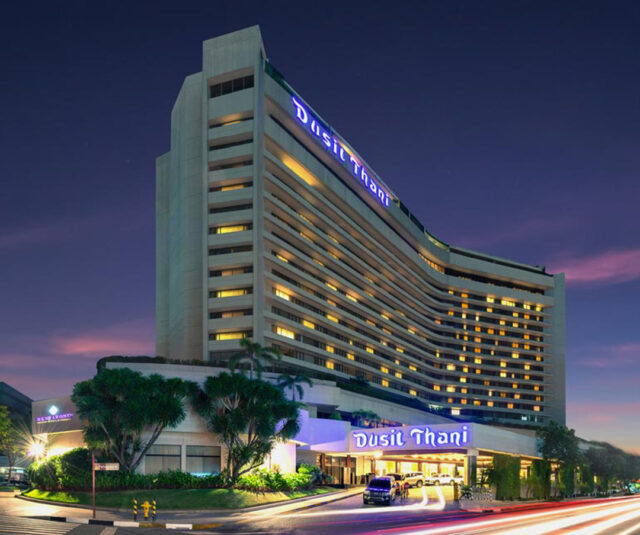
Dusit Thani Manila

IDC Prime, Inc., a subsidiary of real estate developer Italpinas Development Corp., has partnered with Thai hospitality group Dusit International to develop two new upscale hotels in Northern Mindanao.

IDC Prime signed agreements with Dusit Thani Public Co. Ltd. and Dusit Thani Philippines, Inc. on Monday to establish Dusit Princess Moena in Bukidnon and Dusit Princess Firenze in Cagayan de Oro.

Under the partnership, IDC Prime will be the developer and owner of the projects, while Dusit will provide its brand and expertise in guest experience.

“We are delighted to strengthen our presence in the Philippines with these two remarkable projects,” Dusit International Chief Operating Officer Gilles Cretallaz said in a statement.

“As one of Asia’s fastest-growing economies, the Philippines presents tremendous opportunities, and we look forward to introducing our unique brand of Thai-inspired gracious hospitality to these dynamic and promising desti-nations, delivering lasting value for all stakeholders,” he added.

Expected to open by the last quarter of 2029, the 1.5-hectare Dusit Princess Moena is a mixed-use development that will have an eight-storey green building as well as a grouping of luxury villas.

The property is located at a hilltop site within IDC’s Moena Mountain Estate in Manolo Fortich town and will complement attractions such as Dahilayan Adventure Park and the Del Monte Pineapple plantations.

Also set to open by the last quarter of 2029, the 14-storey Dusit Princess Firenze mixed-use green building will be located within IDC’s Firenze Green Tower project in the Limketkai area.

The property will have commercial, residential, and hotel areas, as well as first-class amenities and parking.

IDC Prime said that both Firenze Green Tower and Moena Mountain Estate are pre-existing joint ventures between IDC as the property developer and the Go family as the original owners of the two sites.

“IDC was founded on our belief in the Philippines’ growth story, particularly in areas such as these, which are already full of energy and have great potential for game-changing growth. Apart from being recognized for their ar-chitecture and sustainability, our projects have all been located in places where they are ahead of the curve and deliver a ‘level-up’ in elegance and quality of experience,” IDC Chief Executive Officer and Chairman Romolo V. Nati said.

“To us, partnering with Dusit for new hotels in Cagayan de Oro and Bukidnon is an extension of this, and we look forward to having these world-class hotel experiences in our new locations,” he added.

Dusit has 301 properties across 18 countries. Dusit-branded hotels in the Philippines include Dusit Thani Manila, Dusit Thani Mactan Cebu Resort, Dusit Thani Residence Davao, dusitD2 Davao, and Dusit Thani Lubi Plantation Re-sort.

On Monday, IDC shares were unchanged at P1.35 per share. — Revin Mikhael D. Ochave

ADVERTISEMENT
ADVERTISEMENT