Home Blog Page 226

South Luzon remains key to industrial expansion — Colliers
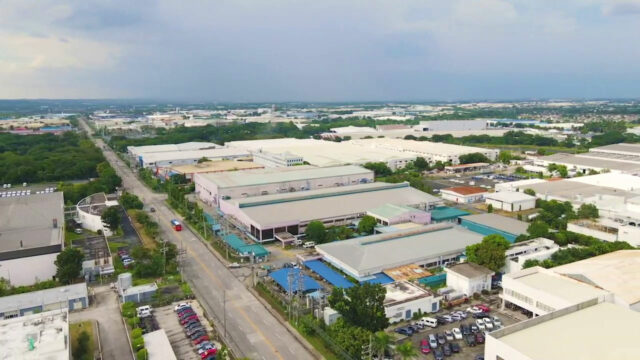
LAGUNA TECHNOPARK — TECHNOPARKS.COM.PH

(Conclusion)

Last week, we discussed the rising competitiveness of Central Luzon as an industrial hub, particularly Pampanga, Bulacan, and Tarlac. This piece now highlights South Luzon’s prominence as the most competitive industrial hub in the Philippines.

Southern Luzon has long been a major growth driver of the Philippine economy. The region is among the largest contributors to the country’s annual economic output, accounting for about 15% of gross domestic product (GDP) in 2024.

Improving infrastructure connectivity has led to an influx of large multinational exporters and manufacturers, further strengthening Southern Luzon’s viability as a major industrial and manufacturing corridor.

STABLE INDUSTRIAL VACANCY
Industrial vacancy in the Calaba (Cavite-Laguna-Batangas) corridor fell to 11.4% in H2 2025 from 16.9% in H1 2025 due to stable demand. Over the past 12 months, firms that took up industrial space included manufacturers of equipment, electronics, air conditioners, air fresheners, as well as printing and packaging solutions.

The region also hosts several modernized and PEZA-accredited facilities, which remain key considerations for some high-value manufacturers and e-commerce firms. Shopee Xpress (SPX) leased its second warehouse facility with Robinsons Logistix (RLX) in Calamba, Laguna.

The Grade A warehouse features flexible layouts and state-of-the-art specifications designed to support high-volume and time-sensitive operations. We believe the continued growth of the country’s digital economy, alongside the influx of high-value manufacturing investments, should sustain demand for these facilities in Southern Luzon.

MORE MANUFACTURING INVESTMENTS ON THE HORIZON
Data from the Philippine Statistics Authority (PSA) showed that Region IV-A, or Calabarzon, received the largest foreign investment allocation of P100.4 billion ($1.7 billion) in 2025, equivalent to 37% of total approved pledges during the period. We believe these pledges should support industrial land and warehouse space take-up in the Calaba corridor once projects materialize.

Fujifilm will establish a 500-square-meter (sq.m.) Circular Manufacturing Center (CMC) within Carmelray International Business Park in Laguna, which will produce remanufactured multifunction printers (MFPs). Other major manufacturing investments in Laguna include Samsung Electronics’ $1-billion expansion project in Calamba Premiere International Park, which is expected to generate at least 3,000 high-technology jobs. Panasonic has also begun construction of a P3-billion ($52 million) factory in Ayala Land’s Laguna Technopark. The 37,000-sq.m. facility will produce refrigerators and washing machines.

In Batangas, Taiwan’s Aromate Industries is investing $4.3 million to construct a 15,300-sq.m. facility in Aboitiz InfraCapital’s LIMA Estate. Singapore-based MNEX will set up a P180-million ($3 million) plant in Science Park of the Philippines’ (SPPI) Light Industry and Science Park 3 (LISP 3), which will manufacture molded parts for various industries.

In Cavite, ASE Co. Ltd. plans to expand by 26,000 sq.m. in Gateway Business Park. The company manufactures electronic and semiconductor products. Several firms are also expanding within the Cavite Economic Zone, including Acuvex Corp., which specializes in jigs and fixtures; CIXIN Precision, which will produce heatsink products, CNC components, electroplating, and surface treatments; and Philippine Newly Ever Rise, which will manufacture and assemble transformers, power supplies, batteries, robotics products, solar systems, and electric vehicle parts.

The Calaba hub continues to attract global manufacturing players due to its highly skilled workforce, improving infrastructure, and the availability of master-planned communities developed by national property firms that offer expansive industrial spaces.

In our view, further improvements in business registration systems and the consistent implementation of business policies could further enhance the region’s attractiveness to high-value manufacturers.


Julius Guevara is senior director and head of Capital Markets and Investment Services, while Joey Roi Bondoc is director and head of Research at Colliers Philippines.

A crisis lurks as Asians bring money back home

A person shows US dollars at a currency exchange stall in Manila, Philippines, Oct. 21, 2022. — REUTERS

By Shuli Ren

LAST MAY, the Taiwan dollar led historic rallies in Asia amid speculation that President Donald Trump would ask exporting nations to lift the value of their currencies as part of trade deals with the US.

The daily moves were so sharp that some investors said they had the feel of the late 1990s Asian Financial Crisis, when capital flight sank currencies from Thailand to South Korea. The big difference in 2025, though, was that the traffic was the other way around — waves of one-sided selling sank the greenback.

And it may get even weaker yet. This year, the threat of a disorderly depreciation of the dollar remains, even after the Supreme Court diminished Trump’s ability to use tariffs as trade negotiation tools. The catalyst may be different, but the outcome will likely be the same: North Asia’s dollar earnings are coming home.

South Korea’s exchange rate, for one, should be a lot stronger. Historically, the Kospi stock index and the won were largely in sync, simultaneously selling off during previous crises. But lately, that relationship has broken down — the Kospi’s blistering rally has been met with a won depreciation.

One explanation is capital outflows. Even though the country’s exports are at a record high, retail investors have been wading into the Nasdaq. Last year, they bought $32 billion in US stocks on a net basis, also a historical peak.

But will this outflow continue? Koreans, who for many years stayed away from domestic blue-chip stocks because of the Kospi’s chronic underperformance, are starting to purchase homegrown tech companies. If they offload their US holdings to fund local investments, the repatriation might cause a sharp appreciation of the won.

In the last two years, global trade imbalances have been on the rise, led by China, South Korea, and Taiwan. US Big Tech’s AI infrastructure built-out underpinned rising demand for chips from Samsung Electronics Co. to SK Hynix, Inc. and Taiwan Semiconductor Manufacturing Co. Meanwhile, a weak deflationary economy prompted Chinese exporters to seek better customers abroad. As a result, the region’s current account surplus as a percentage of their economy is ticking up again.

Until recently, the money that North Asia’s exporters earned was recycled into US assets. For instance, as China’s trade surplus ballooned, rising from roughly $820 billion in 2023 to $1.2 trillion last year, a vast pool of companies’ overseas sales were parked in Hong Kong, where dollar deposits grew by about $320 billion. Dollar-denominated money-market accounts earned higher interest.

But now that the S&P 500 has stopped delivering handsome returns and the greenback is languishing, some treasurers are converting their dollar holdings, betting on a strengthening of their home currencies instead. China’s exporters, for instance, are already doing this.

Last week, the yuan notched its longest winning streak against the greenback since 2010. It’s a sign that Beijing is warming up to the idea of a stronger renminbi. The government may have realized the glaring imbalance of its own books: A record trade surplus only increases vulnerability to US capital markets and the dollar.

During the Asian Financial Crisis, a sudden stop in capital inflows exposed how unsustainable some of the current account deficits were. Now, the tables have turned. The US has become the deficit nation. According to Goldman Sachs, just to stabilize its net international investment position — a measure of a country’s liabilities to the rest of the world — Washington has to halve its current account deficit to 2% of gross domestic product.

Going forward, repatriation, or the Sell America narrative, will be a key theme. For currency traders, the question is whether it might result in an avalanche. Buckle your seatbelt when that happens.

BLOOMBERG OPINION

Security Bank net profit rises to P11.63B

BW FILE PHOTO

SECURITY BANK Corp. posted a net income of P11.63 billion in 2025 as saw double-digit revenue growth.

This was 3% higher than its 2024 profit of P11.24 billion “as the bank balanced revenue growth with higher credit provisioning to reinforce balance-sheet resilience amid a challenging macroeconomic environment,” it said in a disclosure to the stock exchange on Monday.

Return on assets was at 1%, down from 1.12% in 2024. Return on equity also declined to 7.87% from 8.11%.

“We are seeing the benefits of the strong foundations we have built. Following a period of intentional investment and operating in a more challenging macro environment, we are refocusing on disciplined growth, delivering strong revenue momentum, improving asset quality, and maintaining a resilient balance sheet. This reflects our BetterBanking approach, focused on long-term value and serving our customers and all stakeholders responsibly,” Security Bank President and Chief Executive Officer Victor Lee Meng Teck said.

The bank’s revenues grew by 22% year on year to P66.9 billion in 2025, backed by its core banking businesses and diversified income streams.

Net interest income rose by 15.4% year on year to P50.457 billion from P43.722 billion, “supported by healthy asset yields and disciplined funding.”

This came as interest income went up by 23.44% to P77.528 billion, while interest expense increased by 41.9% to P27.071 billion.

“Full-year net interest margin stood at 4.66%, reflecting sustained margin resilience despite market volatility,” Security Bank said.

Meanwhile, non-interest income surged by 46.9% year on year to P16.5 billion as it saw better foreign exchange, trading, and securities gains.

“Service charges, fees, and commissions totaled P8.9 billion, slightly lower than the previous year due to the one-off bancassurance milestone fee recognized in the first quarter of 2024. Excluding this milestone fee, fee income increased 18% year on year, led by credit cards, bancassurance, payment services, and capital markets activities,” it said.

The bank’s operating expenses went up by 18.9% year on year to P39.325 billion.

Its cost-to-income ratio improved to 58.75% from 60.23%.

“In line with its disciplined risk management approach, the bank increased its provisions for credit and impairment losses and set aside P12.8 billion compared with P6.6 billion a year earlier,” Security Bank said.

Its gross nonperforming loan (NPL) ratio was at 2.89% last year from 2.85% in 2024. NPL reserve coverage stood at 85.61%.

Net loans grew by 3% year on year to P696.638 billion at end-2025. The bank said this came amid continued growth in its retail lending segment.

“Retail loans expanded 14% year on year, with auto loans up 24%, credit cards 16%, and home loans 9%. Retail loans now account for 32% of total loans, up from 29% a year ago,” it said.

On the funding side, deposits climbed by 16% to P930.503 billion, low-cost current account, savings account deposits rising by 9% year on year and making up 49% of the total.

Security Bank’s assets stood at P1.19 trillion at end-2025, up 6% from P1.13 trillion in the prior year.

Total equity grew 9% to P154.23 billion.

“Capital ratios remained resilient, with a common equity Tier 1 ratio of 12.33% and total capital adequacy ratio of 13.21%,” the bank said.

Security Bank’s shares went down by P2.85 or 3.86% to P71 apiece on Monday. — BVR

SMIC weighing exit from Atlas Mining

ATLASMINING.COM.PH

SM INVESTMENTS Corp. (SMIC) said it is considering exiting its stake in Atlas Consolidated Mining and Development Corp. to prioritize investments in renewable energy.

SMIC President and Chief Executive Officer (CEO) Frederic C. DyBuncio said the company is evaluating whether to divest from the listed miner to focus on businesses that align more closely with the group’s core operations.

“That’s something which will be discussed at the board level, whether we want to take out Atlas from the portfolio or not. But that’s something which could happen in the near future,” he said during a briefing on Monday.

The SM Group currently holds a 34.05% stake in Atlas Mining, while 42.14% is controlled by the Ramos Group, according to the mining company’s website.

Mr. DyBuncio added that SMIC is moving toward a mining-free portfolio while accelerating growth in renewable energy.

“Mining is actually an outlier because all the other businesses have synergy with the entire group. It’s the mining that is more or less outside the area,” he said.

Last year, SMIC announced plans to expand its renewable energy portfolio through new geothermal projects and potential ventures in wind energy.

“We are focused on geothermal energy production, which is baseload and runs 24/7. Production has been doing well, and with a new rig in place, we are building capacity to develop more sites,” Mr. DyBuncio said in an earlier statement. — Vonn Andrei E. Villamiel

Singer Olivia Dean wins big at BRIT Awards

MANCHESTER, England — Singer Olivia Dean was the big winner at Saturday’s BRIT Awards, picking up four prizes at Britain’s pop music honors.

Ms. Dean, who alongside singer Lola Young led nominations with five nods each, triumphed in the first award of the night, song of the year, for “Rein Me In,” a collaboration with rocker Sam Fender.

The 26-year-old, known for her soulful voice and music that blends R&B, pop and neo-soul, won pop act, artist of the year and album of the year for her second studio album, The Art of Loving.

“Making this album has changed my life,” said Ms. Dean, who earlier this month won best new artist at the Grammys. “This album is just about love and loving each other in a world that feels lovelessness right now.”

Mr. Fender also won alternative/rock act, while “Messy” singer Ms. Young won breakthrough artist.

WOLF ALICE SINGER THANKS PUBS, CLUBS
Rock band Wolf Alice won group of the year. In her acceptance speech, singer Ellie Rowsell thanked “all the pubs, clubs and grassroots venues across the country where we quite literally learned to play our instruments and write our songs.”

Organizers announced several winners ahead of Saturday’s ceremony, with Noel Gallagher named songwriter of the year and PinkPantheress crowned producer of the year. At 24, she is the youngest ever and the first woman recipient of the prize.

Ozzy Osbourne, the late frontman of heavy metal band Black Sabbath, was honored with a lifetime achievement award. Known to fans as “The Prince of Darkness,” Mr. Osbourne died in July aged 76, around two weeks after Black Sabbath’s emotional farewell gig.

“Ozzy was authentic, he was gifted, totally unpredictable, a wild man, he was a true artist,” Mr. Osbourne’s wife, Sharon Osbourne, said before singer Robbie Williams performed a musical tribute.

Among the international category winners was singer Rosalia, who won international artist of the year.

“I would love to share this with all my peers who also make music in Spanish,” Rosalia said. “Let’s keep celebrating the otherness, let’s keep celebrating different music, different cultures, different languages.”

This year’s BRITs took place in the northern English city of Manchester, the first time the awards ceremony was held outside of London. — Reuters

Palafox pushes smart cities plan, partners with Elsal Ventures

STOCK PHOTO | Image from Freepik

ARCHITECTURE and urban planning firm Palafox Associates said it remains optimistic about advancing its smart cities initiative despite governance and economic challenges.

“We’re busier this year than before the pandemic at the Palafox Associates and Palafox Architecture, which is a very pleasant surprise, despite all this negative news about our country,” Palafox Associates Founder and Managing Partner Felino A. Palafox, Jr. said in an interview with BusinessWorld.

“To me, if we address corruption in our economy, climate change, inequality, investments, and infrastructure incompetence, we should be in the top 10 economies of the world,” he added.

In an earlier statement, Mr. Palafox stressed the need to address inefficient land use, strengthen urban planning, and establish smart cities in the countryside as part of a long-term vision for national development by 2050.

He cited a previous projection by Goldman Sachs that the Philippines could become the world’s 16th largest economy by 2050.

The outlook aligns with Palafox Associates’ “Philippines 2050: A First-World Country, A First-World Economy” campaign, which envisions the country attaining first-world status by mid-century.

“Despite all our challenges, we have three foreign investors, and then maybe without the challenges, we can probably have more,” he said, adding that foreign investors are increasingly selective in choosing Filipino partners they consider trustworthy.

Details of the agreements with the three foreign investors were not disclosed due to non-disclosure arrangements.

Mr. Palafox said one project is advancing, while the other two are in the master planning stage.

Palafox Associates and real estate and land investment facilitation firm Elsal Ventures signed a memorandum of agreement on Feb. 2 to collaborate on integrated development projects across the Philippines.

Under the partnership, Palafox Associates will contribute its expertise in master planning, sustainable design, and resilient urban development, while Elsal Ventures will provide support in land aggregation, investment facilitation, and real estate sourcing.

The companies said the collaboration aims to advance responsible and future-ready projects.

Mr. Palafox highlighted the role of strategic collaboration in city-building initiatives.

“Partnerships like this allow us to align design excellence with smart land development, ensuring projects are not only profitable, but sustainable, inclusive, and resilient,” he said.

Elsal Ventures Chairman and Chief Executive Officer Ernesto L. Salas also expressed optimism about the agreement.

“This will be the first formal partnership, because it is a perfect fit. He can provide the land, design the land, and provide investors from the Middle East or even locals. Then, we can provide the land on the scale he wants,” Mr. Salas told BusinessWorld. — Alexandria Grace C. Magno

On the Iran war, energy, and economic implications

The US-Israel joint bombings of Iran are US President Donald Trump’s second regime change project this year. Venezuela’s President Nicolas Maduro was removed in early January, and now Iran’s supreme leader, Ayatollah Ali Khamenei, has been killed.

The US has military bases, facilities, and naval support in Middle East countries with huge oil-gas reserves — Saudi Arabia, Kuwait, Qatar, the United Arab Emirates (UAE), and Bahrain.

The US has been involved in several invasions and regime change projects in Middle East countries that have plenty of oil-gas reserves. There was the Iraq invasion in 2003, the airstrikes then partial occupation of Syria in 2014, and the bombing of Iran in 2025 and 2026.

In North Africa near the Middle East, the US bombing of Libya in 2011 also led to regime change. Last December, the US bombed Islamic militants in Nigeria.

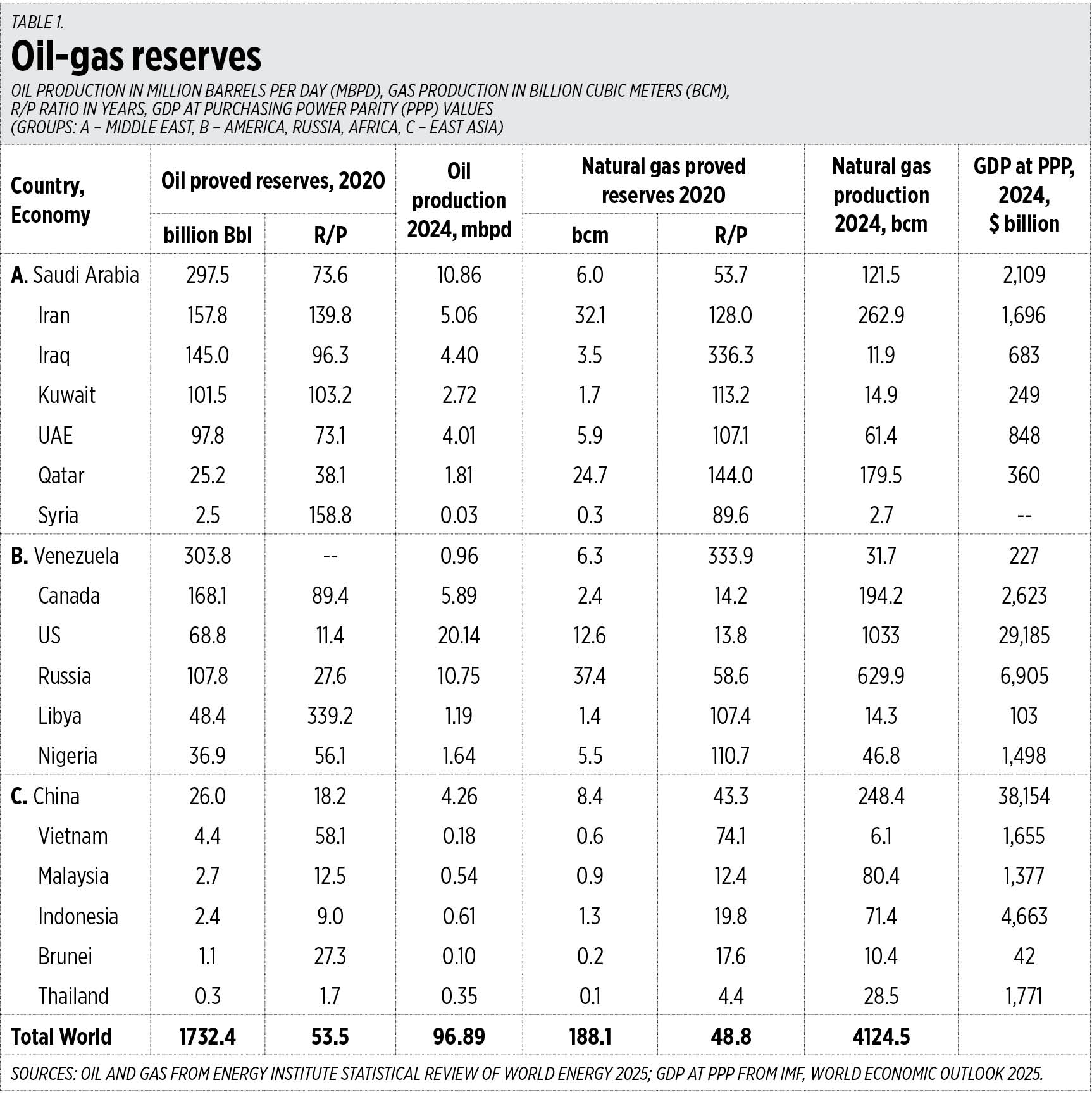
When it comes to oil reserves, Iran has second largest in the Middle East and fourth largest in the world with 158 billion barrels. When it comes to gas reserves, Iran has the largest in the Middle East and second largest in the world with 32 billion cubic meters (bcm), trailing Russia.

Looking at the oil reserves/production (R/P) ratio, or the number of years before the reserves are depleted if current rates of production both for domestic use and exports (if any) continues, Iran is fourth in the world with 140 years, behind Libya, Venezuela, and Syria — the US’ R/P ratio is only 11 years.

Then there is the gas R/P ratio, where Iran is third in the world with 128 years, behind Iraq and Venezuela with 330+ years each. The US only has 14 years.

Looking at East Asia’s R/P ratios, China has only 18 years for oil and 43 years for gas. Of our neighbors, Vietnam has 58 years in oil and 74 years in gas, Malaysia has 12 years for both oil and gas, and Indonesia has nine years for oil and 20 years for gas (see Table 1).

The US continues its military involvement in the Middle East to pursue its oil-gas security interests. Regime change in Iran is part of this long-term goal.

The Philippines gets its oil mainly from Saudi Arabia and the UAE, two countries that also host many Overseas Filipino Workers (OFWs) especially in Riyadh and Dubai. But the oil coming from both those countries passes through the Strait of Hormuz and now the Strait is technically closed as cargo ships are avoiding it for fear of Iranian missiles.

THE US, CHINA, AND PHL
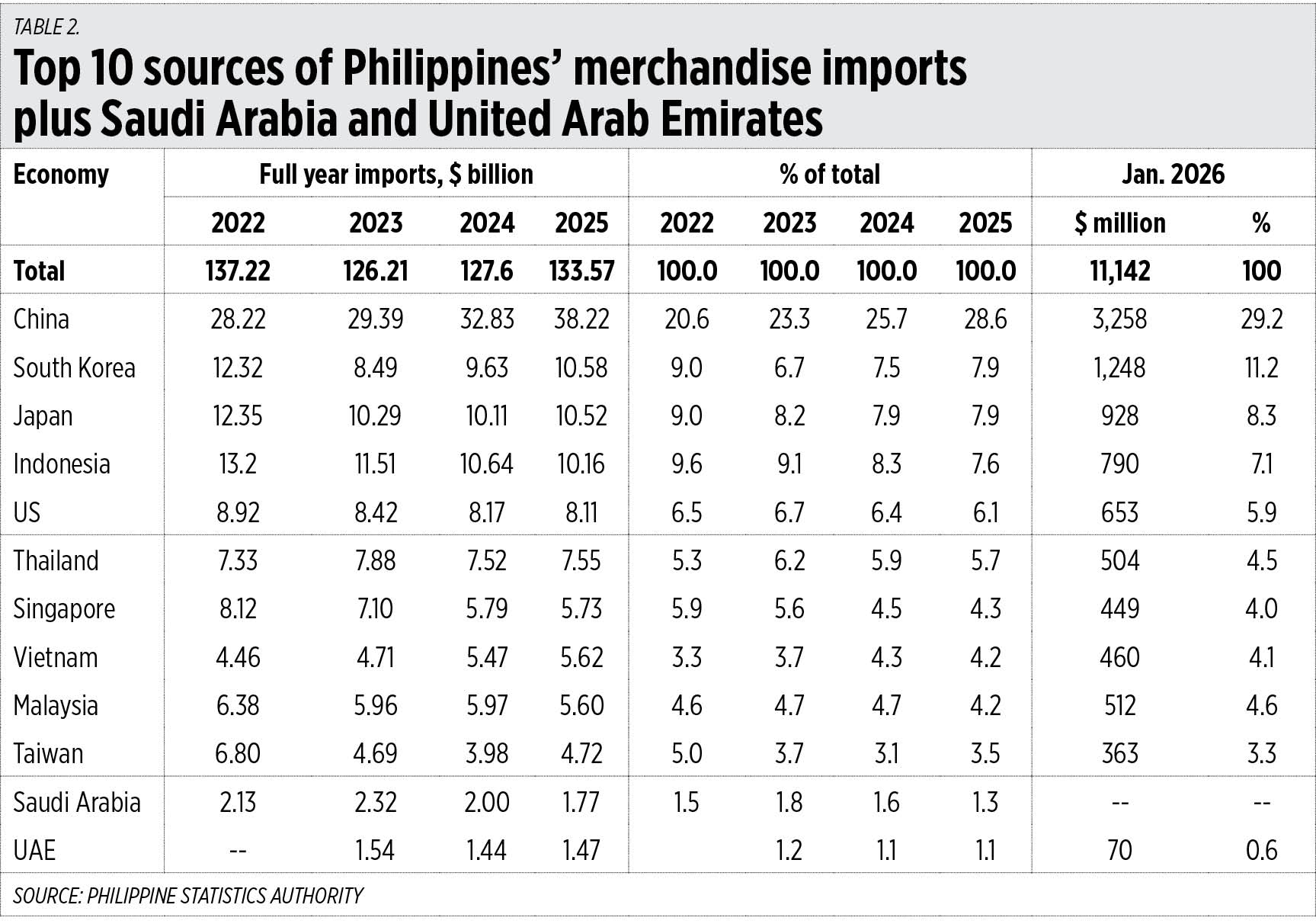
Now let’s consider the continuing economic and military rivalry between the US and China. Looking at the Philippines’ merchandise trade, especially imports, we see that China is gaining while the US is losing market share in the Philippines. The share of our total imports from China keeps rising, from 21% in 2022 to nearly 29% in 2025, and 29.2% in January 2026. In contrast, the US share decreased from 6.5% in 2022 to 6.1% in 2025, and down to 5.9% in January 2026 (see Table 2).

The overall impact of the ongoing US-Iran war will be negative economically. World prices for oil, gas, and petrochemical products (plastic, paint, fertilizer…) will increase, leading to higher overall inflation. Which will then adversely affect GDP performance as people tend to spend less when inflation is high.

I can think of two (among many) things that the Philippines can do, especially in the short-term.

One, do a partial reduction of the oil excise tax, to be compensated by a reduction of government spending like the subsidies and freebies that were created during the 2020 lockdown, and which continue until today. The budget deficit and annual borrowings should not increase when there is a partial tax cut.

Two, we should source more oil and gas from our neighbors in Asia no matter how small initially. After all, Brunei, Malaysia, Indonesia, Vietnam are fellow ASEAN members.


Bienvenido S. Oplas, Jr. is the president of Bienvenido S. Oplas, Jr. Research Consultancy Services, and Minimal Government Thinkers. He is an internationa fellow of the Tholos Foundation.

minimalgovernment@gmail.com

UnionBank nets P9.94 billion in 2025

BW FILE PHOTO

UNION BANK of the Philippines (UnionBank) saw its net income drop by 16.67% in 2025 due to one-time costs at the subsidiary level that were partly offset strong revenues from the parent.

The bank’s attributable net income went down to P9.94 billion last year from P11.93 billion in 2024, it said in a disclosure to the stock exchange on Monday.

This translated to a return on average capital funds of 5% and a return on average resources of 0.9%.

UnionBank noted that its earnings for the second half surged by 108% from the first semester.

“Performance was driven primarily by the parent bank, including the acquired Citi consumer business, which continued to gain momentum during the year. Record topline revenues at the parent bank helped offset one-time costs, largely booked at the subsidiary level, as the bank took decisive actions to clean up and strengthen its balance sheet and position it for future growth,” it said.

“In 2025, we took deliberate steps to strengthen our balance sheet and lay the foundation for profitable, sustainable growth. Building on the strength of our core franchise, we are doubling down on our key competitive advantages in 2026. We expect continued improvement in topline growth and NIM (net interest margin), supported by an expanding customer base and a growing stream of recurring revenues,” UnionBank President and Chief Executive Officer Ana Maria Aboitiz-Delgado said. “As we move into 2026, our focus remains on disciplined growth, customer‑centric innovation, and delivering long‑term value for our shareholders.”

The bank’s net revenues stood at P83.2 billion in 2025.

“This growth was supported by an expanding customer franchise, with total customers rising to 18.6 million — up 9.7% year on year.”

UnionBank net interest income increased by 10.72% to P64.25 billion in 2025 from P58.03 billion the prior year, as interest income inched up by 0.74% to P84.36 billion while interest expense dropped by 21.78% to P20.11 billion from P25.71 billion.

As a result, net interest margin was at 6.4%, up from 6% in 2024.

Meanwhile, other income dropped by 4.28% to P18.98 billion from P19.83 billion amid lower trading gains and miscellaneous income. But fee income remained strong, with its fee income-to-assets ratio at 1.3%, more than twice the industry average, UnionBank said.

“Fee growth was driven by higher digital transaction volumes, including bills payments, funds transfers, interchange, and other card-related fees across the bank’s larger and more engaged customer base.”

Total operating income was at P62.07 billion, up from P59.95 billion in the prior year.

Meanwhile, the bank’s other expenses increased by 8.15% to P47.87 billion from P44.27 billion.

“Excluding one-time items, total cost growth would have been at 5%. This reflects the bank’s disciplined efforts to drive cost efficiency and realize the benefits of the bank’s digitization initiatives,” UnionBank said.

The bank set aside credit loss provisions amounting to P21.16 billion in 2025, up by 18.14% from P17.91 billion in 2024.

UnionBank’s net loans and receivables stood at P537.68 billion last year, rising from P522.66 billion in 2024.

“The parent bank’s unsecured consumer loans grew by 18% to P150.8 billion, driven by digital acquisition and cross-selling initiatives. Consumer loans accounted for 61% of the bank’s total loan portfolio, well-diversified across credit cards, mortgage loans, personal and salary loans, and vehicle loans.”

Its nonperforming loan ratio declined by 37 basis points to 6.8%, with provision coverage increasing to 70.8% from 58.2%. It said that its unsecured loans are “more than fully covered.”

“Credit costs rose by 18% year on year to P21.2 billion; however, asset quality indicators improved over the course of the year,” UnionBank said.

“Transaction banking volumes also increased during the year, contributing to a 12% year-on-year growth in low-cost CASA (current account, savings account) deposits. This improvement in funding mix helped reduce overall funding costs and supported margin expansion.”

Total deposits increased by 15.4% to P267.019 billion at end-2025 from P231.378 billion in the prior year.

UnionBank’s resources expanded to P1.16 trillion in 2025 from P1.145 trillion in 2024.

Total capital was at P202.06 billion, up from P195.21 billion in the prior year.

“Capital ratios remain well above regulatory limits, providing sufficient buffer to support future growth, with common equity Tier 1 ratio at 15.03% and capital adequacy ratio at 15.86%.”

UnionBank’s shares gained five centavos or 0.19% to close at P26.70 each on Monday. — A.M.C. Sy

Maxicare opens 1,100-sq.m. clinic at Filinvest Three

FILINVEST.COM

FILINVEST REIT Corp. (FILRT) has added Maxicare Health Services, Inc. as a new tenant in Filinvest Three, opening a nearly 1,100-square-meter (sq.m.) outpatient clinic on the ground floor, one of the largest in the Philippines.

“Maxicare’s choice to open one of their largest clinics in the country at Filinvest Three aligns with FILRT’s mission to not only deliver high-quality, strategically located office spaces but also to support businesses that drive innovation and growth across various sectors,” FILRT President and Chief Executive Officer Maricel Brion-Lirio said in a statement on Monday.

Josephine Lopez, Maxicare Health Services, Inc. president and chief executive officer, said the new, larger clinic at Filinvest Three marks a key expansion in providing accessible healthcare to more communities.

“By establishing our Primary Care Clinic here, we are significantly expanding our reach and reinforcing our mission to empower more Filipinos to lead healthier lives,” she added.

Filinvest Three, a Grade A office building in FILRT’s Northgate Cyberzone portfolio, is located in Filinvest City, Alabang. 

It connects to major roads such as South Luzon Expressway, Skyway, Alabang-Zapote Road, Daang Hari, and West Service Road, linking it to Metro Manila, nearby provinces, transport networks, business centers, and residential areas.

At the local bourse on Monday, FILRT shares rose 0.33% to P3.03 apiece. — Alexandria Grace C. Magno

Rock band Radiohead urges US ICE to take down video using its song

WASHINGTON — British rock band Radiohead said on Friday it wanted a promotional video for the US Immigration and Customs Enforcement (ICE) agency that used their song to be taken down.

ICE, whose immigration enforcement tactics have been widely condemned by human rights advocates during President Donald J. Trump’s hardline immigration crackdown, posted a video last week that used a version of Radiohead’s song “Let Down.”

“We demand that the amateurs in control of the ICE social media account take it down. It ain’t funny, this song means a lot to us and other people, and you don’t get to appropriate it without a fight,” Radiohead said in a statement to media outlets.

ICE did not immediately respond to a request for comment outside of business hours.

The song’s version appeared as a soundtrack to the video that showed a montage of victims of violence that ICE attributed to immigrants who are in the US illegally.

Radiohead said the song was used without the band’s permission.

The Trump administration has used ICE in an immigration crackdown and deportation drive that has been condemned by human rights advocates, especially after the January fatal shootings of two US citizens by federal agents in Minnesota. Many celebrities have also previously condemned ICE.

Rights groups say the crackdown has created a fearful environment for both citizens and immigrants, especially for minority groups.

Around the country, at least eight people have died in ICE detention centers since the start of 2026, following at least 31 deaths last year.

Rights advocates have also raised free speech and due process concerns in ICE’s detention and attempted deportations of pro-Palestinian foreign protesters who opposed US ally Israel’s assault on Gaza.

Mr. Trump has cast his crackdown as aiming to curb illegal immigration and improve domestic security. — Reuters

RLX to build Shopwise ‘big-box’ in Rizal; RRHI sets up to P7-billion capex

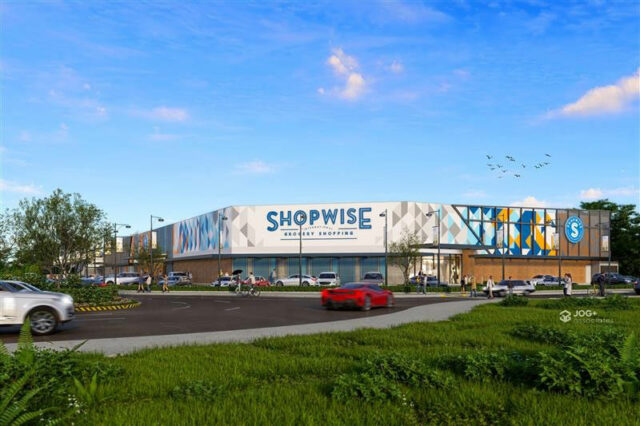
Robinsons Logistix and Industrials, Inc. has recently formed a partnership with Robinsons Retail Holdings, Inc. with the unveiling of a “big box” facility for Shopwise, Robinsons Retail’s value-driven supermarket brand. — ROBINSONS LAND CORP.

ROBINSONS LOGISTIX & Industrials, Inc. (RLX) said it has partnered with Robinsons Retail Holdings, Inc. to launch a “big box” facility for Shopwise at Sierra Valley Destination Estate in Cainta, Rizal.

“Designed to serve both the growing local community and visitors to the estate on Ortigas Avenue Extension, this project reinforces RLX’s role as a builder of scalable, high-impact retail infrastructure,” Robinsons Land Corp. (RLC) Senior Vice-President and RLX Business Unit General Manager Cora Ang Ley said in a statement on Monday.

Shopwise’s big-box facility, which will span more than 7,000 square meters (sq.m.) of land with 5,000 sq.m. of leasable space, is targeted for construction completion in the first half of 2027, with store opening scheduled in the third quarter of the same year.

RLX, known for its Grade A logistics facilities, will lead the development and construction of the new retail format as part of efforts to drive organic growth and improve integration within Robinsons Land’s operations.

The company said Shopwise Sierra Valley will adopt a big-box retail format similar to Walmart or Costco, designed for efficient, high-volume sales and bulk purchasing, making it “especially relevant” to middle-class families and small business owners.

“This development will serve real needs, strengthen communities and create more opportunities for growth for years to come,” Ms. Ang Ley said.

Sierra Valley integrates retail, residential, office, and logistics components. Key anchors include Robinsons Sierra Valley Mall and The Shops at Sierra Valley, alongside Sierra Valley Gardens residential developments and RLX’s Grade A logistics facilities.

According to the company, the project aligns with Robinsons Land’s Vision 5-25-50 plan, which aims to scale standardized developments in growth areas. The plan is anchored on five growth levers to achieve P25 billion in net income by 2030, the company’s 50th anniversary.

RLX, the industrial and logistics arm of RLC, operates 13 facilities across Calamba, Laguna; Sucat and Muntinlupa City; Pampanga; and Rizal. Its warehouses feature modern specifications and flexible layouts.

CAPEX FOR 2026
Meanwhile, in a disclosure on Monday, Robinsons Retail Holdings, Inc. (RRHI) said it has earmarked about P5 billion to P7 billion in capital expenditures (capex) for 2026, primarily for store construction and renovations.

“The company also confirms the expected store openings and renovations for its supermarket business,” the company added.

On Friday, Robinsons Supermarket reopened its third revamped branch at Robinsons Magnolia in Quezon City, with nine more renovations planned nationwide this year.

At the event, Robinsons Retail Holdings, Inc. President and Chief Executive Officer Stanley C. Co said about P200 million has been allocated for supermarket renovations.

In December, Robinsons Supermarket relaunched its branches at Robinsons Nuvali and Robinsons Galleria, the latter being its largest branch, according to Robinsons Supermarket Group General Manager Kerwin L. Legarde.

Another branch in Bacolod is scheduled for completion within two weeks.

Robinsons Supermarket currently operates 157 branches nationwide, with about 10% to 15% selected for renovation based on location, according to Mr. Co.

At the local bourse on Monday, RRHI shares fell by 2.23% to close at P37.30 apiece, while RLC shares rose by 0.76% to P18.64 each. — Alexandria Grace C. Magno

Thrift banks’ loans grow 26%

BW FILE PHOTO

THE THRIFT banking industry’s loans grew last year as they continue to extend financing to their core markets.

“Core lending expanded by 26%, reaching P977.32 billion, reflecting sustained credit support to micro, small, and medium enterprises (MSMEs) and households across the country,” Chamber of Thrift Banks (CTB) President and Citystate Savings Bank, Inc. President Jaime Valentin L. Araneta said in a speech on Monday.

Meanwhile, the sector’s nonperforming loan ratio remained manageable at 6%, which he said reflects “disciplined” risk management despite strong loan growth.

On the funding side, total deposits rose by 26% to P1.03 trillion.

The industry’s total assets also expanded by 25% to P1.38 trillion at end-2025.

“These are not incremental gains. They are structural signals of strength. They show that first banks are not only stable; we are expanding responsibly and competitively,” Mr. Araneta said.

Meanwhile, total capital increased by 21% to P209.63 billion.

Bangko Sentral ng Pilipinas (BSP) Deputy Governor Mamerto E. Tangonan said thrift banks played a significant role in the country’s digital payments ecosystem last year.

The sector facilitated nearly 70 million in InstaPay transactions as of December 2025, increasing from just 10 million in January 2025, he said in a speech at the same event.

“At the peak in September, thrift banks accounted for 31% of total InstaPay value across the entire system. But participation is uneven.”

He said thrift banks accounted for just 13% of QR Ph virtual payments last year, which is the channel most directly relevant to MSMEs.

“Given that thrift banks are among the primary financiers and deposit takers of small businesses in this country, we bank on your support to help close that gap and invite more MSME clients to enjoy the benefits of digital payments. If not on the issuing side, definitely on the accepting side. I would even say mostly on the accepting side because that’s where you get the sales transactions of the bank,” Mr. Tangonan added. — A.M.C. Sy

ADVERTISEMENT
ADVERTISEMENT