Home Blog Page 2237

TUMI celebrates grand opening of its first Manifest Concept Design store in the Philippines at Greenbelt 5
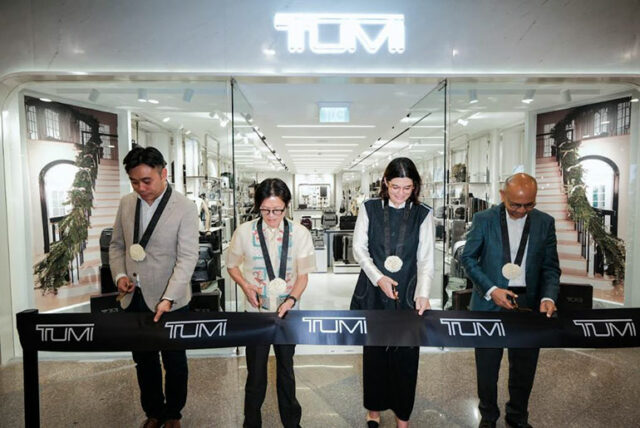
From left to right: Randy Wong, General Manager for Southeast Asia; Jimmy Thai, President and CEO of the Primer Group of Companies; Mariana Zobel de Ayala, President of Ayala Malls; and Subrata Dutta, President of Samsonite Group at the ribbon-cutting ceremony

Today, renowned international travel and lifestyle brand TUMI opened its new store at Greenbelt 5, Makati with a sophisticated celebration of style, innovation, and craftsmanship.

The grand opening event for TUMI’s largest store in the Philippines and the first to showcase its Manifest Concept Design attracted a prominent guest list that included Congressman Franz Pumaren, Director Carlos Alvarez, business woman Charmaine Lagman, designer Maureen Disini, and celebrity couples Cristalle Belo and Justin Pitt, and Nikki Gil and BJ Albert. Representing TUMI at the event were Subrata Dutta, President of Samsonite Group; Randy Wong, General Manager for Southeast Asia; and Mariana Zobel de Ayala, President of Ayala Malls. Also present from the Primer Group of Companies were Jimmy Thai, CEO and President; Board of Directors Susan Thai, Johnny Thai (represented by Jamille Thai), Jerry Sy; Dinah Yau-Lim, COO; Sofia Borromeo-Alvarez, Business Unit Head; Dane Marie Lacap, Brand Manager; and Ella Martinez from Marketing.
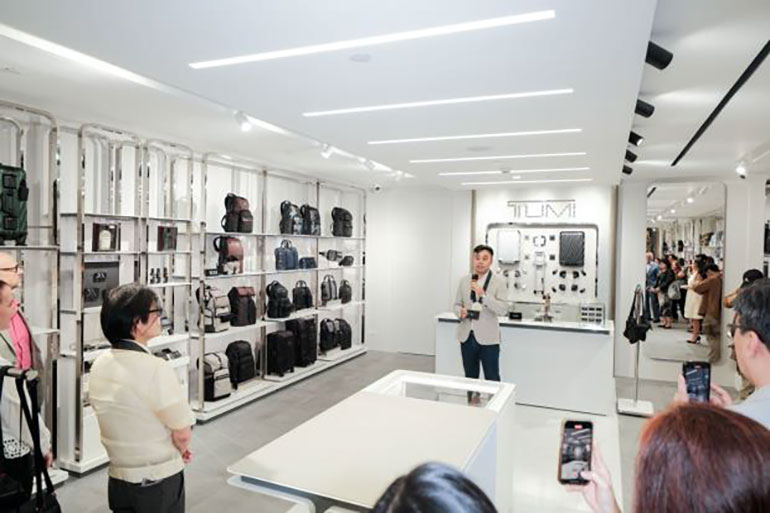
​Randy Wong delivering his welcoming speech at the grand opening of TUMI’s new store at Greenbelt 5, Makati

Following a ribbon-cutting ceremony performed by Subrata Dutta, President of Samsonite Group; Randy Wong, General Manager for Southeast Asia; Jimmy Thai, President and CEO of the Primer Group of Companies; and Mariana Zobel de Ayala, President of Ayala Malls, more than 70 guests enjoyed on-site product demonstrations inside the spacious new store.

Throughout the evening, guests were also treated to an exclusive first look at standout pieces from TUMI’s Fall 2024 and Holiday 2024 collections. Highlights included the women’s Voyageur collection, celebrated for its timeless elegance and adaptability, as well as the all-new Turin collection, meticulously crafted from premium Italian leather and accented with elevated metal details, making it a perfect fit for the modern, multifaceted man.
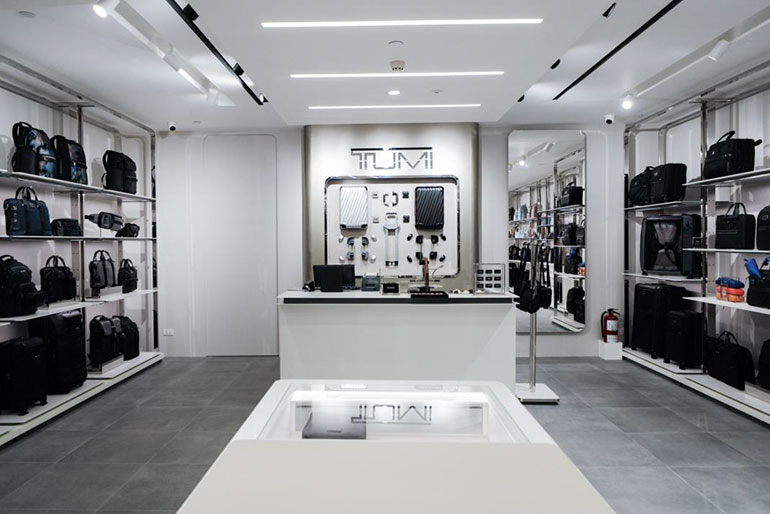
​A sleek, titanium-colored magnetic wall stands as the centerpiece of TUMI Greenbelt 5 store, highlighting the cutting-edge innovation in luggage design and construction.

The grand opening of TUMI Greenbelt 5 was a tribute to the brand’s commitment to excellence, innovation, and design that enhances every journey.

Monogramming Service and Accessories Tower Enhance the Shopping Experience

​Congressman Franz Pumaren, Randy Wong, Jimmy Thai, Mariana Zobel de Ayala, Subrata Dutta, Charmaine Lagman, and Stephanie Zubiri at the grand opening of TUMI’s new store at Greenbelt 5, Makati

The newly opened store at Greenbelt 5, Makati, spans an impressive 123 square meters (1,325 square feet), offering a spacious layout for TUMI’s global customers. As the first TUMI Manifest Concept Design store in the Philippines, it introduces a unique and modern aesthetic defined by a sleek white and grey color palette partnered with mirrored elements and generous lighting. The contemporary and inviting ambience is marked by a curved arch portal shopfront. White natural marble pattern finishes and flooring exemplify the brand’s premium identity, while a striking titanium-colored magnetic wall serves as the focal point showcasing TUMI’s innovative approach to luggage construction.

​BJ Albert, Nikki Gil in Asra, Stephanie Zubiri in Voyageur Lex Train Case, Jimmy Thai, Charmaine Lagman in Voyageur Leather, Dane Marie Lacap ​at the grand opening of TUMI’s new store at Greenbelt 5, Makati

Other design highlights include angled entrance walls, along with a dedicated accessories tower and demonstration table that are unique to the Manifest Concept Design. The store’s fixtures are thoughtfully designed with soft, curved edges, while a premium seating area adds to the inviting ambience.

​BJ Albert, Maureen Disini, Sofia Borromeo-Alvarez, Nikki Gil, and Cristalle Belo at the grand opening of TUMI’s new store at Greenbelt 5, Makati

TUMI Greenbelt 5
P2-2-25-2L Second Floor Ayala Greenbelt 5, Legaspi St., Brgy San Lorenzo, Makati City, Philippines

About TUMI
Since 1975, TUMI has been creating world-class business, travel and performance luxury essentials, designed to upgrade, uncomplicate and beautify all aspects of life on the move. Blending flawless functionality with a spirit of ingenuity, we’re committed to empowering journeys as a lifelong partner to movers and makers in pursuit of their passions.

Discover more at TUMI.com. TUMI and TUMI logo are registered trademarks of Tumi, Inc. ©
2024 Tumi, Inc.


Spotlight is BusinessWorld’s sponsored section that allows advertisers to amplify their brand and connect with BusinessWorld’s audience by publishing their stories on the BusinessWorld Web site. For more information, send an email to online@bworldonline.com.

Join us on Viber at https://bit.ly/3hv6bLA to get more updates and subscribe to BusinessWorld’s titles and get exclusive content through www.bworld-x.com.

Unveiling the impact of evolving LLMs with a Google expert

What should software look like when you have a language model “at the center of everything?” How can play explore the edges of what technology can do? BusinessWorld discusses these topics with Steven Johnson, co-creator of Google’s NotebookLM, an AI-powered research assistant.

Interview by Patricia Mirasol
Video editing by Jayson Mariñas

Trump bump? Fed officials prepare projections into new presidential term

A sign for the Federal Reserve Board of Governors is seen at the entrance to the William McChesney Martin Jr. building in Washington, D.C. — REUTERS

WASHINGTON – Since Donald Trump’s election to a second term last month, Federal Reserve policymakers including Chair Jerome Powell have said it is too soon to factor in the U.S. president-elect’s yet-to-be-detailed policies into forecasts.

But eight years ago Powell as a Fed governor joined the majority of his colleagues in doing just that, meeting records show, bumping up estimates for economic momentum and interest rates to reflect the expected effect of Trumpís tax cuts and other policies.

So it may not be all that surprising that a growth upgrade for next year may be back in the cards again this week when Fed policymakers gather to deliver what is expected to be a third interest rate cut and to update their forecasts for growth, unemployment and inflation.

In September, officials estimated growth at 2% next year. The Philadelphia Fed’s survey of professional forecasters, for one, has since lifted its 2025 estimate to 2.2% from 1.9% previously.

Fed officials are also likely to dial back projections of just how much more they’ll cut interest rates next year. To be sure, they are likely to be reluctant to lay it at Trump’s feet – instead pointing to a run of recent data showing solid momentum into next year that is likely to propel growth, hold down unemployment and keep them on their toes about inflation.

But it may still stand as a preliminary judgment of sorts for what’s to come from Trump as he promises more by way of tax cuts, deregulation and tariffs.

“We are taking Chair Powell and the committee at their word when they say they will make monetary policy based on actual changes to fiscal, trade, and immigration policies and not in advance,” wrote economists at Morgan Stanley. Even so, they said, Fed policymaker projections will likely feature stronger growth in 2024, slower disinflation this year and next, “and fewer rate cuts in the appropriate policy path.”

TAKING STOCK
Since the last time they met, in November, several U.S. central bankers have indicated they are open to a more cautious pace of rate cuts, especially with the labor market looking less fragile than it did in September when they started cutting rates, and with inflation more sticky.

Their new best guesses for where the economy and interest rates are headed for the next three years will appear on Wednesday in fresh quarterly projections published at the close of their Dec. 17-18 meeting.

Even without taking the still-uncertain effects of Trump’s plans into account, there is plenty of reason to believe policymakers will see a shallower rate-cut path as appropriate next year, simply because they will be taking stock of the generally stronger economic data since their last projections.

Inflation by the Fed’s targeted metric – the 12-month change in the personal consumption expenditures price index – was 2.3% in October, exactly where policymakers had previously forecast it would be in the final quarter of the year.

But data published so far suggests that core PCE inflation, which Fed policymakers use to gauge underlying price pressures, is on track to end the year around 2.8%, according to several Wall Street analysts who see that inflationary impulse carrying forward into 2025 as well. Fed policymakers in September had projected core PCE inflation at 2.6% in fourth-quarter 2024, and 2.2% in the last quarter of 2025, estimates that look optimistic given recent trends.

The unemployment rate, by contrast, has been running lower than Fed policymakers had forecast. It was 4.1% in October and 4.2% in November. Only a massive deterioration this month could result in a rise in the fourth-quarter average to the 4.4% Fed policymakers had penciled in at September’s meeting, and analysts generally expect the new projections to be a couple tenths of a percentage point lower.

Firmer labor markets and stickier inflation will likely move some policymakers to dial down their rate-cut expectations. Most analysts expect the median projection to be for three quarter-point rate cuts next year, from the four projected in September, though a few see a more hawkish two-cut projection as possible. Financial markets are priced for an end-2025 policy rate in the 3.75%-4.00% range.

Policymakers are also expected to write down a further couple of rate cuts in 2026, bringing the policy rate down to 3.4% or 3.1%, versus the 2.9% penciled in as of September.

That 2.9% is equivalent to what policymakers have been nodding to as the ‘longer-run’ or stopping point for the federal funds rate.

Dallas Fed President Lorie Logan has argued that as the Fed’s policy rate approaches its eventual stopping point it should reduce speed, as a ship’s captain maneuvering into harbor must do. Some analysts are looking for the ‘longer-run’ estimate to rise to 3% or potentially higher, further bolstering the case for a go-slower approach. — Reuters

Vietnam seeks to boost domestic defense industry as it hosts arms fair

MATT W NEWMAN-UNSPLASH

 – Vietnam will showcase locally made weapons at an international arms fair in Hanoi on Thursday, as it seeks to boost its domestic industry and possibly export military equipment.

Among the nearly 250 exhibitors will be top defense companies, including from the United States, Europe, Turkey and countries at war with each other, such as Israel, Iran, Russia and Ukraine.

The Southeast Asian nation is a major importer of weapons, especially from Russia, having invested for years in its defense capabilities in an unstable region where it has clashed with China over boundaries in the South China Sea.

But recently it has also bolstered its domestic defense industry and promoting exports of military products is now a priority, defense ministry officials have repeatedly said.

State-owned defense firm Viettel and other local companies will showcase missile defense systems, drones, air defense radars, armored vehicles and artillery, according to defense ministry media.

Some of these weapons will be displayed for the first time, said Nguyen The Phuong, an expert on Vietnam security at Australia’s University of New South Wales.

He noted a key strategy to strengthen the local industry had been the signing of deals with foreign arms exporters to have some of their components produced in Vietnam.

Talks with South Korean companies were underway for possible new deals under those conditions, especially for artillery and aviation, he said.

Similar talks had also been held with companies from other countries, including the Czech Republic, officials said.


RIVALS’ GEAR ON DISPLAY

At the expo, Iran’s defense ministry will have an entire pavilion, not far from the booths of Israel’s defense firms Israel Aerospace Industries ISRAI.UL and Rafael Advanced Defense Systems.

The fair will also host a dozen booths of Russian firms and one for Ukraine’s Motor Sich, an aircraft engine manufacturer.

A dozen Turkish defense companies, including Aselsan, Turkish Aerospace Industries and Roketsan, are among listed participants, making Turkey’s one of the largest delegations.

China’s Norinco will be one of two Chinese exhibitors, in a first for a Vietnamese defense fair.

U.S. defense giants Lockheed Martin, Boeing and Textron Aviation Defense TXT.N will also have their booths at the fair.

They have all been involved in talks with Vietnamese authorities for the sale of helicopters. Lockheed is also discussing a possible deal on C-130 Hercules military transport planes, sources had told Reuters.

Brazil’s Embraer said it will exhibit its C-390 Millennium plane – a rival to the C-130.

Top European defense firms will also attend, including aerospace giant Airbus, Britain’s BAE Systems, Germany’s Rheinmetall, Italy’s Leonardo and France’s Thales Group. – Reuters

Congress to vote on new restrictions on US investment in China

STOCK PHOTO | Image by David Mark from Pixabay

 – Congress is set to vote in the coming days on legislation restricting U.S. investments in China as part of a bill to fund government operations through mid-March, lawmakers said late on Tuesday.

In October, the Treasury finalized rules effective Jan. 2 that will limit U.S. investments in artificial intelligence and other technology sectors in China that could threaten U.S. national security.

The bill expands on those restrictions and also includes other provisions aimed at concerns about China, including a requirement to study national security risks posed by Chinese-made consumer routers and modems and mandate reviews of Chinese real estate purchases near additional national security sensitive sites.

The Chinese Embassy in Washington did not immediately comment.

The bill will also require the Federal Communications Commission to publish a list of every entity that both holds an FCC license or authorization and has any ownership by foreign adversarial governments, including China to ensure the commission “knows when telecommunications and technology companies have a connection and foreign adversary.”

Lawmakers have criticized major American index providers for directing billions of dollars from U.S. investors into stocks of Chinese companies that the U.S. believes are facilitating the development of China’s military.

The Treasury rules and legislation cover semiconductors and microelectronics, quantum information technologies and certain AI systems aimed at preventing investments in Chinese technologies like cutting-edge code-breaking computer systems or next-generation fighter jets.

Representative Rosa DeLauro, the top Democrat on the House Appropriations Committee, said “for years I have watched American dollars and intellectual property fuel the Chinese Community Party’s technology and capabilities… This legislation builds on the regulations put into place this year by the Biden Administration, and sets the stage for continued bipartisan efforts to protect and rebuild our critical national capabilities.”

The outbound legislation covers technologies listed in the Treasury order and adds additional AI models that use some semiconductors, AI systems designed for exclusive military or government surveillance end use, hypersonic systems and additional export-controlled technologies. – Reuters

Honda, Nissan move to closer tie-up as competition intensifies, source says

 – Honda and Nissan are moving towards a closer tie-up with talks of setting up a holding company, a source said, in the clearest sign yet of reorganization in Japan’s auto industry in response to immense challenges posed by Tesla and Chinese rivals.

The discussions, first reported by the Nikkei newspaper, would allow the manufacturers to cooperate more closely on technology and help Japan’s No. 2 and No. 3 automakers to create a more formidable domestic rival to Toyota 7203.T.

The talks between Honda and Nissan are aimed at setting up a holding company, said the source, who declined to be identified because the information had not been made public.

It was not immediately clear whether a new holding company was aimed at eventually establishing a full union between the two companies, although Nikkei said they were beginning merger talks.

Shares of Nissan surged more than 21% in Tokyo trade, while shares of Honda were down 1.6%.

Honda’s market capitalization is about $44 billion, while Nissan’s is about $10 billion after price surge on Wednesday, meaning a full merger would be bigger than the giant $52 billion deal between Fiat Chrysler and PSA in 2021 to create Stellantis.

Honda and Nissan are also looking to bring in Mitsubishi Motors, in which Nissan is the top shareholder with a 24% stake, under the holding company, the Nikkei report said.

Honda and Nissan have increased ties in recent months as they wrestle with the changing electric vehicle landscape. As well as heavy competition, automakers also face stalling demand in Europe and the U.S., intensifying the pressures on them.

Honda and Nissan on Tuesday issued identical statements saying no merger had been announced by either company.

“As announced in March of this year, Honda and Nissan are exploring various possibilities for future collaboration, leveraging each other’s strengths,” the companies said in their separate statements, adding they will inform stakeholders of any updates at an appropriate time.

French automaker Renault, a major Nissan shareholder, said it had no information and declined to comment.

Over the past year, an EV price war launched by Tesla and Chinese automaker BYD has intensified pressure on any companies losing money on the next-generation vehicles. That has put pressure on companies like Honda and Nissan to seek ways to cut costs and speed vehicle development, and mergers are a major step in that direction. – Reuters

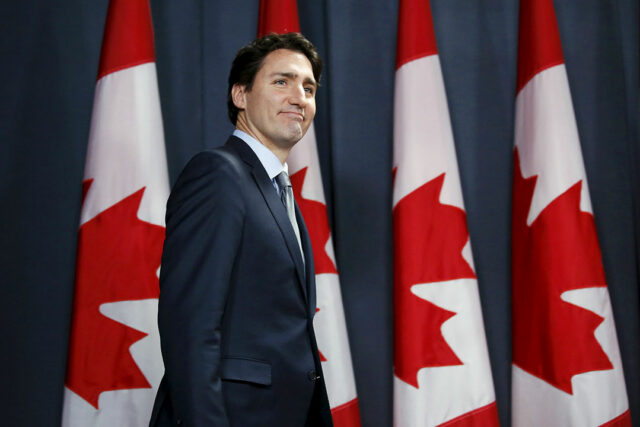
Canada PM Trudeau reflecting on criticism amid leadership crisis, says ally

PRIME MINISTER JUSTIN TRUDEAU — REUTERS

 – Canadian Prime Minister Justin Trudeau is reflecting on complaints about his leadership by legislators from the ruling Liberal Party who are unhappy that Finance Minister Chrystia Freeland quit, a close ally said on Tuesday.

Another Liberal parliamentarian said separately that Mr. Trudeau was “delusional” if he thought he could fight the next election, which is due by Oct. 20 next year. Polls show the Liberals would be crushed by the official opposition Conservatives.

Freeland resigned on Monday amid a policy clash and released a letter savaging Trudeau’s leadership, prompting one of the worst crises since he took office in 2015.

Mr. Trudeau later held a special meeting with his parliamentary caucus, which is already unhappy over the party’s poor performance in the polls.

“He did say to caucus that he had heard very clearly, and listened carefully, to their concerns and he would reflect on it,” new Finance Minister Dominic LeBlanc told the Canadian Broadcasting Corporation.

Mr. LeBlanc, one of Trudeau’s closest friends, was named finance minister later on Monday.

Mr. LeBlanc is also temporarily keeping his previous role as public safety minister and a number of other ministers have more than one job as a result of colleagues’ resignations. CBC said Trudeau would reshuffle his cabinet soon, possibly on Wednesday.

“A number of my caucus colleagues have said publicly that the prime minister is reflecting on Minister Freeland’s decision and the feedback he heard yesterday. I respect that he is taking time to reflect,” Natural Resources Minister Jonathan Wilkinson told Reuters.

Mr. Trudeau alluded to the turmoil on Tuesday night, telling a Liberal Party event to mark the end of the parliamentary session that the last couple of days had not been easy.

“We really are a big family. Now like most families, sometimes we have fights around the holidays, but of course, like most families, we find our way through it,” he said to some cheers from the audience.

The Globe and Mail newspaper, citing two Liberal sources, said Mr. Trudeau told Freeland on Friday she would be replaced by former central banker Mark Carney, who is already advising the prime minister on economic affairs.

Mr. Carney, long courted by the Liberals, has stayed out of federal politics. No one in the offices of Freeland or Trudeau was immediately available for comment.

If Mr. Trudeau does resign, it will set off a Liberal leadership race that Freeland could join.

She sent an email to party volunteers on Tuesday saying “this will not be the end of the road” but gave no details. The email was posted on X by journalist Stephen Maher.


LIBERALS LOSE SPECIAL ELECTION

To underline the party’s woes, it badly lost a special election in the western province of British Columbia.

While Mr. Trudeau cannot be forced out by his caucus, he may find it harder to stay if enough parliamentarians openly call on him to go. Only a handful have done so publicly but that number is growing.

Veteran Liberal legislator John McKay, who has remained loyal to Mr. Trudeau, told CBC the prime minister needed to make a decision about his future sooner rather than later.

Mr. Trudeau is safe for now, since the only way he can be toppled is if all opposition parties unite against him on a vote of non-confidence. Such a vote could not happen until after the House of Commons elected chamber returns on Jan. 27.

Liberal legislator Wayne Long, who had previously called on Mr. Trudeau to quit, told reporters the prime minister was “delusional if he thinks we can continue like this … We’re not just taking on water, we’re underwater”.

The opposition Bloc Quebecois demanded an immediate election, saying Canada needed a properly functioning government to deal with the incoming U.S. administration and its threats to impose 25% tariffs on Canadian imports.

A Nanos Research poll released on Tuesday showed the Conservatives have 43% public support, the Liberals have 23% and the smaller left-leaning New Democrats are attracting 20% support. Such a result on Election Day would produce a massive Conservative majority. – Reuters

New Zealand sports get $93.69 mln in govt funding ahead of LA 2028

STOCK PHOTO | Image by Kerin Gedge from Unsplash

High Performance Sport New Zealand on Wednesday announced NZ$162.8 million ($93.69 million) in government funding for Olympic and Paralympic sports in the run-up to the 2028 Summer Games in Los Angeles.

New Zealand enjoyed its best ever Olympics in Paris earlier this year and most sports that helped towards its tally of 10 golds, seven silver and three bronze medals have been rewarded with consistent or extra funding.

Some sports, such as diving, surfing, golf and badminton, will get no funding, while others, such as swimming and hockey, will receive reduced investments.

Among those receiving lower funding is the men’s All Blacks Rugby Sevens team, which lost to South Africa in the quarter-finals in Paris and finished fifth.

“We understand that some sports will be disappointed with these decisions,” said HPSNZ’s director of high performance Steve Tew, a former chief executive of New Zealand Rugby.

“This was a robust process with a focus on winning medals at the LA 2028 Olympics and Paralympics and other pinnacle events during the cycle.”

Although the funding models are not identical, Britain this week announced an investment of 330 million pounds ($419.43 million) in Olympic and Paralympic sports over the same period.

Australia in November said A$385 million ($243.90 million)would be granted to Summer and Winter Olympic and Paralympic sports over the next 18 months. – Reuters

Australia’s government spends its way to bigger budget deficits

STOCK PHOTO | Image by beasternchen from Pixabay

 – Australia’s government on Wednesday trimmed its likely budget deficit for the current fiscal year, but flagged bigger shortfalls ahead due to “unavoidable spending” on health, cost-of-living relief and veterans care.

Facing a tough election next year, the center-left Labor government said the economy had slowed under the weight of high interest rates and elevated inflation, but insisted public spending would help ensure a soft landing.

Recent data for the third quarter showed that without public investment in infrastructure and rebates on electricity costs, the economy would have been in recession.

In its Mid-Year Economic and Fiscal Outlook (MYEFO), the government still had to trim its forecast for economic growth in the current fiscal year to end June 2025 to 1.75%, down from 2.0% in its main Budget last May.

Wage growth was also marked down to 3.0% in a blow to government claims it would deliver faster pay gains than the Liberal National opposition.

The economic slowdown was enough for the Reserve Bank of Australia (RBA) last week to open the door to policy easing, having held interest rates at 4.35% for all of this year.

Treasurer Jim Chalmers on Wednesday suggested more cost of living relief could be on the way, on top of the tax cuts, electricity rebates, cheaper medicines and other policies the government has already delivered to date.

“From budget to budget, if we can afford to do more and there is a case to do more to help people with the cost of living, of course then we will consider that,” Chalmers said in a press briefing.

All this government spending meant its budget was back in deficit after two years of rare surpluses, though the shortfall this year was not as large as first feared.

The Treasury projected a deficit of A$26.9 billion ($17.04 billion) for the current 2024/25 year. That compared with a forecast of A$28.3 billion in its main Budget last May.

From there, the red ink only gets worse due to A$25 billion in extra payments. The projected deficit for the three years to 2027/28 is now A$117 billion, or A$23 billion more than expected in May.

“The slippage in subsequent years is largely because of urgent, unavoidable or automatic increases in spending in areas like pensions, Medicare and medicines,” Treasury said in a statement.

Expected tax revenues from companies have also been downgraded as subdued demand in China weighs on prices for some of Australia’s main commodity exports, notably iron ore. It retained the long-term iron ore price assumption at $60 per ton by the third quarter 2025, compared with $104 per ton currently.

The government’s net debt was now seen expanding to A$1.16 trillion by 2027/28, from an expected A$940 billion this year. At 36.7% of gross domestic product, net debt would still be low by international standards.

Estimated overseas migration has been revised up to 340,000 for the 2024/25, from 260,000, as the government struggled to bring migration to more sustainable levels. – Reuters

Filipina death-row prisoner in Indonesia arrives home

MARY JANE F. VELOSO — PHILSTAR FILE PHOTO

MANILA – Mary Jane Veloso, who received a last-minute reprieve from execution by firing squad for drug trafficking in Indonesia in 2015, arrived in Manila in the early hours of Wednesday after years of negotiations between the two Southeast Asian countries.

Ms. Veloso, a 39-year-old former domestic helper and mother of two, told reporters in Jakarta she was ready to start a new life in the Philippines.

Ms. Veloso was arrested in Yogyakarta in 2010 after being found with 2.6 kg (5.73 lb) of heroin concealed in a suitcase. She said she was an unwitting drug mule, but she was convicted and sentenced to death.

Her release came days after the five remaining members of the “Bali Nine” drug ring were repatriated to Australia from Indonesia.

Ms. Veloso was flanked by heavy security upon her arrival at Manila’s airport and was transported straight to a prison facility for women. Her family and dozens of supporters who were waiting outside the terminal failed to greet Veloso on her arrival.

“They made my daughter a criminal even if she is innocent. They did not allow us to see her. We wanted to hug her,” her father Cesar Veloso told reporters at the airport as he broke down in tears.

Her mother Celia Veloso was more upbeat, saying: “What’s important is she’s here already”.

Edre Olalia, Ms. Veloso’s lawyer in the Philippines, said authorities had given her family private time with her at the prison facility.

The two governments agreed this month to transfer Veloso back to Manila in a deal that includes the Philippines respecting the court’s sentencing of Veloso and her status as prisoner.

Any decision on her clemency will depend on Philippine President Ferdinand Marcos Jr.

Philippine executive secretary Lucas Bersamin said on Tuesday it’s “premature to speculate” what Mr. Marcos will do.

Indonesia said it would respect any decision made by the Philippines, including if Ms. Veloso was given clemency.

Philippine Foreign Minister Enrique Manalo thanked the Indonesian government for its “sincere and decisive action” to allow Ms. Veloso to return home in time for the Christmas holidays.

“Their generosity has made possible this momentous day of Ms. Veloso’s return to the Philippines,” Mr. Manalo said in a statement. – Reuters

NEDA Board OKs P63-billion projects

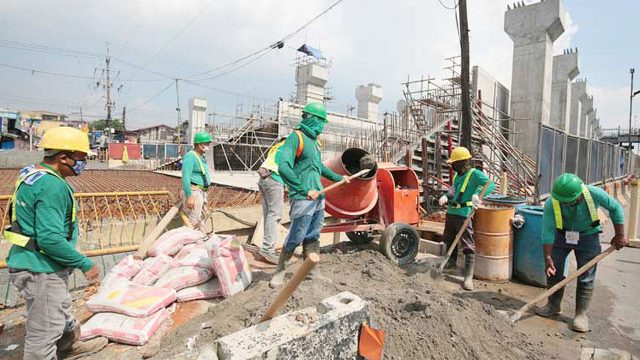
Workers are seen mixing cement at a construction site in Quezon City, May 19, 2020. — PHILIPPINE STAR/ MICHAEL VARCAS

THE NATIONAL Economic and Development Authority (NEDA) Board on Tuesday approved two projects worth P63.2 billion, as well as the release of an executive order (EO) that will implement the tariff commitments under the Philippines-South Korea free trade deal.

The EO will cover Manila’s tariff commitments under the Philippines-South Korea Free Trade Agreement (FTA), which was sealed in September last year, NEDA Secretary Arsenio M. Balisacan said in a statement.

South Korea is the Philippines’ third-largest import source, accounting for $989.72 million or 8.3% of Philippine imports in October this year, the Philippine Statistics Authority reported earlier this month.

Seoul is also the sixth-largest destination of Philippine exports.

Total trade between the two countries hit $12 billion last year.

Mr. Balisacan said upon the FTA’s implementation, South Korea will grant preferential duty-free entry on 11,164 Philippine products worth $3.18 billion.

These products account for 87.4% of total South Korean imports from the Philippines, he added.

Mr. Balisacan said the Philippines-South Korea FTA will help Manila address its lagging trade competitiveness in the region and “secure more preferential concessions” than those currently available under the ASEAN-Korea FTA and the Regional Comprehensive Economic Partnership Agreement, which is touted as the world’s largest FTA.

The FTA was signed by the two countries on the sidelines of the 43rd ASEAN Summit in Jakarta, Indonesia in September 2023. The Philippine Senate ratified the deal in September this year, while South Korea’s National Assembly gave the greenlight last month.

Meanwhile, the NEDA Board, chaired by President Ferdinand R. Marcos, Jr., also greenlit the National Irrigation Administration’s P37.5-billion Ilocos Norte-Ilocos Sur-Abra Irrigation Project, which is “set to improve agricultural output and water management across the three provinces,” according to Mr. Balisacan.

The project, which will irrigate agricultural lands up to 14,672 hectares during the wet season and 13,256 hectares during the dry season, includes the construction of an earth and rockfill dam across the Palsiguan River in Abra, an afterbay dam in Nueva Era in Ilocos Norte, and various linked irrigation canals serving as major irrigation systems.

“Additionally, the project plans to incorporate renewable energy components, such as hydroelectric power plants and a solar power farm, through a public-private partnership,” the NEDA said. 

The Board also approved the Department of Public Works and Highways’ (DPWH) P25.7-billion Accelerated Bridge Construction Project for Greater Economic Mobility and Calamity Response, which aims to improve connectivity and disaster resilience by constructing 29 bridges nationwide. 

The project, which is funded by official development assistance loan from the French government, is divided into two components, with the first one comprising seven long bridges and scheduled for implementation from January 2025 to December 2029.

The second component, which consists of 22 calamity response bridges, will be implemented from January 2025 to December 2027.

Meanwhile, the NEDA Board approved adjustments to various parameters of five ongoing projects, namely:

• Value Chain Innovation for Sustainable Transformation in Agrarian Reform Communities of the Department of Agrarian Reform; 

• Health System Enhancement to Address and Limit COVID-19 Project of the Department of Health;

• Panglao-Tagbilaran City Offshore Bridge Connector Project of the DPWH; 

• Metro Manila Interchange Construction Project, Phase VI of the DPWH; and 

• North-South Commuter Railway System Project – Malolos-Clark Railway Project, Tranche 1 of the Department of Transportation.

The projects saw changes in project scope, cost, partial loan cancellation, and extensions of the implementation period and loan validity.

Also, the NEDA reported the completion of the Arterial Road Bypass Project Phase III (Plaridel Bypass) and the Panguil Bay Bridge. 

“Through these investment and infrastructure initiatives, we are advancing connectivity to enhance economic opportunities and ensure that progress reaches all regions of the country,” Mr. Balisacan said. — Kyle Aristophere T. Atienza

Banks’ real estate exposure sinks to 5-year low

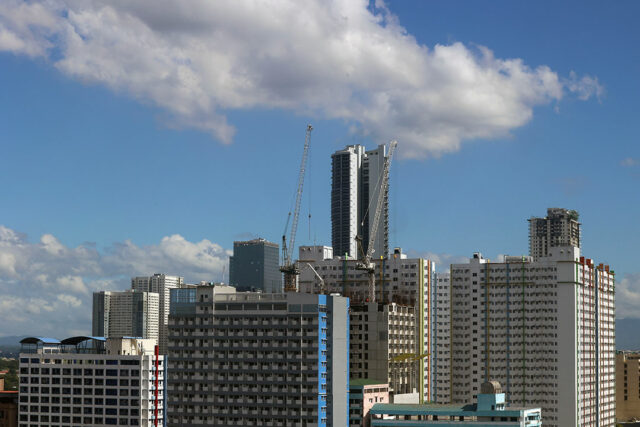
Construction continues on a building in Quezon City, Nov. 20, 2024. — PHILIPPINE STAR/MIGUEL DE GUZMAN

By Luisa Maria Jacinta C. Jocson, Reporter

THE EXPOSURE of Philippine banks and trust entities to the property sector continued to decline at the end of September, hitting a five-year low, data from the Bangko Sentral ng Pilipinas (BSP) showed.

Banks’ real estate exposure ratio dropped to 19.55% at end-September from 19.92% at end-June and from 20.55% at the end of September in 2023.

This was also the lowest real estate exposure ratio recorded in five years or since the 19.5% as of September 2019.

The BSP monitors lenders’ exposure to the real estate industry as part of its mandate to maintain financial stability.

Investments and loans extended by Philippine banks and trust departments to the real estate sector inched up by 2% to P3.22 trillion as of September from P3.16 trillion a year ago.

BSP data showed real estate loans rose by 7.9% to P2.84 trillion as of end-September from P2.64 trillion a year ago.

Residential real estate loans jumped by an annual 8.1% to P1.07 trillion, while commercial real estate loans climbed by 7.8% to P1.78 trillion.

Past due real estate loans stood at P148.157 billion, higher by 10% from P134.828 billion a year prior.

Broken down, past due residential real estate loans rose by 10.1% to P104.967 billion, while past due commercial real estate loans went up by 9.4% to P43.189 billion.

Meanwhile, gross nonperforming real estate loans went up by 7.1% to P111.554 billion as of the third quarter from P104.138 billion a year ago.

This brought the gross nonperforming real estate loan ratio to 3.92% at end-September, slightly lower than 3.95% a year earlier.

On the other hand, real estate investments fell by 15.5% to P376.406 billion as of end-September from P445.666 billion in the same period a year ago.

This, as debt securities dropped by 14.6% year on year to P246.041 billion, while equity securities fell by 17.2% to P130.365 billion.

Joey Roi H. Bondoc, director and head of research at Colliers Philippines, said the slowing real estate exposure seen at end-September is due to the developers’ “lukewarm appetite” for new projects.

“They’re not launching a lot of new projects. Whether it’s for office or for residential, there’s really a tepid appetite at this point for new developments,” he said via phone call.

Over the next three years, Colliers expects about 400,000 to 450,000 square meters (sq.m.) of new office space to be added to the Philippine market.

“That is much smaller, in fact, less than half of 1 million square meters of new office space from 2017 to 2019,” Mr. Bondoc said.

“If you look at launches in the first nine months of this year, they are down by about 50-60% compared to the same period in 2023,” he added.

Mr. Bondoc said developers are opting to prioritize their existing inventory.

“We don’t see a lot of expansion because they are waiting for their remaining current inventory to be taken up, to be absorbed.”

For example, he noted there is 2.6 million sq.m. of vacant office space that will take five years to be absorbed by the market.

“In the residential market in Metro Manila, it will take more than five years. Meaning, that’s about 70 months that you need for the remaining unsold condominium inventory which covers pre-selling and ready for occupancy to be absorbed by the market.”

“It’s really ranging between that period, five to about six years, whether you look at office or residential. They’re waiting for this remaining inventory to be taken up or absorbed by the market.”

Rizal Commercial Banking Corp. Chief Economist Michael L. Ricafort also noted the higher vacancy rates amid the ban on Philippine Offshore Gaming Operators (POGOs).

During his State of the Nation Address in July, President Ferdinand R. Marcos, Jr. ordered a complete ban on all offshore gaming operations, citing links to illegal activities such as money laundering and human trafficking.

The Philippine Amusement and Gaming Corp. earlier this month said that only 17 POGOs remain in operation from a total of 298 licensed POGOs in 2019.

“Right now, why are we seeing a lot of vacated office space and unabsorbed condominiums in Metro Manila? POGO exodus,” Mr. Bondoc said, adding that POGOs had previously driven demand for office and condominiums.

Moving forward, Mr. Bondoc said that banks’ real estate exposure is seen to ease further in the next three to five years.

“We will likely see less completion resulting from these less launches that we’re seeing in the market right now, especially in Metro Manila,” he said.

On the other hand, the central bank’s rate-cutting cycle could offset this outlook.

“Hopefully, further cuts from the central bank up to this month spill over to next year and result in lower mortgage rates. Hopefully that provides a much-needed impetus,” Mr. Bondoc said.

“Although, will it substantially stoke the market? I don’t think so. We’ve yet to see as to how big the impact will be on mortgage rates by these interest rate cuts,” he added.

The Monetary Board is expected to reduce the benchmark rate by 25 basis points (bps) at its meeting on Thursday, according to 13 out of 16 analysts surveyed for a BusinessWorld poll.

The central bank began its easing cycle in August this year with a 25-bp cut and again delivered another 25-bp reduction in October.

BSP Governor Eli M. Remolona, Jr. has also signaled further rate cuts next year in the 100-bp ballpark.

“Further cuts in local policy rates would be a positive offsetting factor for the real estate sector that could lead to some pickup in demand for real estate loans by both developers and buyers, but with some lag effects,” Mr. Ricafort added.

In 2020, the central bank raised the real estate loan limit of banks to 25% of their total loan portfolio from 20% previously to help free up additional liquidity as a relief measure during the coronavirus pandemic.