Home Blog Page 215

From handwashed underwear to fake Adidas, stranded travelers wait out travel chaos
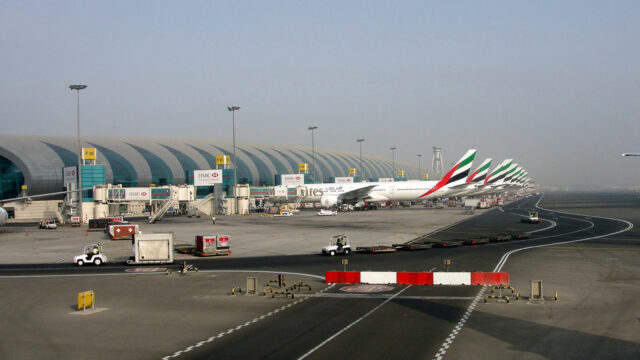
DUBAI INTERNATIONAL AIRPORT — COMMONS.WIKIMEDIA.ORG

DUBAI/DOHA — In the lobby of a tired hotel near Doha airport, stranded travellers wear identical fake Adidas T-shirts bought from a nearby store and swap tips on where to buy underwear.

“It’s our uniform,” said Erika Macikova.

The 49-year-old Slovak winemaker was returning from an ayurvedic retreat in Sri Lanka when she became stranded in the Qatari capital. Her luggage remains at the airport, but she was evacuated to a hotel alongside hundreds of other passengers.

With no spare clothes, Ms. Macikova tracked down open shops and began sharing their names with fellow globetrotters.

Tens of thousands of travelers across the Middle East were entering a third day of limbo after escalating conflict between the US, Israel, and Iran disrupted flights worldwide and forced the closure of major airports including Dubai, the world’s busiest international hub.

BIGGEST UPHEAVAL TO GLOBAL AIR TRAVEL SINCE COVID-19
Many of those stuck in the region, like Macikova, were simply changing planes. Dubai, which handles more than 1,000 flights a day, and nearby Doha and Abu Dhabi sit at the crossroads of east‑west air travel, funneling long‑haul traffic between Europe and Asia through tightly scheduled connecting flights.

The upheaval is rippling far beyond the Middle East, with tens of thousands of passengers stranded in places including Bali, Kathmandu, and Frankfurt.

The United Arab Emirates’ civil aviation authority said it assisted about 20,200 travelers on Saturday. Data show at least 4,000 flights were canceled in the space of three days.

In Dubai, James Gaskin spent Monday morning washing his underwear and a collection of novelty socks in his bathroom sink.

After a week in India for work, the 53-year-old procurement manager from northern England was already short of clean clothes when his connecting flight back to Britain was canceled. He was taken to a local hotel with hundreds of other passengers.

Like many of them, Mr. Gaskin said he had little idea what was unfolding when he landed at Dubai airport.

“A lady came to the gate and just stood on a chair and made an announcement that everyone’s got to leave the airport. All very calm and orderly,” he said. “In a British way, I did six hours of queuing without any real drama.”

But the baggage hall descended into chaos, he said, as passengers pulled bags off carousels, seeking their own. “Even though it was pandemonium, I was pretty relaxed,” he said. But then “there were quite a few bangs, the airport got hit,” he said. “That brought it home.”

“The general feeling is, the longer it goes on, the more edgy people are getting.”

PASSENGERS WHATSAPP TO SHARE COPING TIPS
Across hotels in the region, strangers trade information on where to find washing machines, how to navigate airline helplines or retrieve luggage, and whether it makes sense to pool resources and try to leave by car.

They gather in hotel lobbies to play games or watch sports, or head to shopping malls to buy snacks. WhatsApp groups have sprung up.

Many are trying not to dwell on their situation, even as loud bangs overhead remind them why they are stuck.

Ms. Macikova was spending as much time as possible inside the hotel because she felt most secure there.

She was immersed in a romantic novel, but Mr. Gaskin was bored. His wife had sent him logins to various streaming services but he had not felt like watching them.

British friends Julie Hardy and Francis McKay, who had been on a two-week tour of southern India, were staying at the same low-rise hotel near the airport.

On Sunday, they took a taxi to a nearby mall to buy medication, cheese and crackers, and to have lunch.

It was fun, they said. The nights are harder.

On Saturday night, two alarms went off on Ms. Hardy’s phone and she rushed to the hotel lobby in her nightie, which no one seemed to find surprising.

“I’m very reluctant to go to bed up here,” she said. “I would rather be downstairs for as long as possible… I can’t relax, because I think something’s going to happen in the night and I’m going to have to get up quickly and evacuate.”

Ms. McKay was anxious too and, while it sounded dramatic, worried whether she would see her family again:

“It’s the unknown, and I’ve never been in a war zone.” — Reuters

DoLE’s new procedural guidelines on voluntary arbitration

FREEPIK/MACROVECTOR

Under the Labor Code, voluntary arbitration is a mode of settling labor disputes involving unresolved grievances arising from the interpretation or implementation of the Collective Bargaining Agreement (CBA) and those arising from the interpretation or enforcement of company personnel policies.

On Aug. 15, 2025, the Department of Labor and Employment (DoLE) issued Department Order No. 255, series of 2025, or the Revised Procedural Guidelines in the Conduct of Voluntary Arbitration Proceedings.

The guidelines introduced major amendments to the processes involved in voluntary arbitration. These guidelines clarified the acquisition of jurisdiction by the Voluntary Arbitrator (or the Panel of Voluntary Arbitrators, as the case may be), introduced new modes of submission to voluntary arbitration, provided for the digitization of the arbitration proceedings, and implemented a framework for walk-in settlements.

JURISDICTION
Under the 2021 Revised Procedural Guidelines in the Conduct of Voluntary Arbitration Proceedings, jurisdiction is acquired upon receipt of a Submission Agreement signed by both parties, or by the acceptance by the Voluntary Arbitrator/Panel of Voluntary Arbitrators of the Notice of Selection through raffle should there be no Submission Agreement. The 2025 Voluntary Arbitration Guidelines now provide that jurisdiction can also be acquired by the receipt and acceptance of any of the following:

1. Submission Agreement duly signed by both parties;

2. Notice to Arbitrate (when a Voluntary Arbitrator/Panel of Voluntary Arbitrators is named in the CBA, in the grievance machinery, or any similar mechanism); and,

3. Notice of Selection (should parties fail to select an arbitrator, or if there is no named arbitrator and the party upon whom the Notice to Arbitrate is served does not favorably reply within seven calendar days from receipt of such notice).

MODES OF SUBMISSION
Previously, the only mode of submission to voluntary arbitration under the 2021 Voluntary Arbitration Guidelines was the submission of a Notice to Arbitrate. With the 2025 Voluntary Arbitration Guidelines, the following modes were added:

1. Direct Submission: involves the automatic submission of unresolved grievances to voluntary arbitration, through the agreed selection procedure of the parties;

2. Referral from NCMB (National Conciliation and Mediation Board) after conciliation-mediation: referral of unresolved issues raised in an actual strike or lockout, notice of strike or lockout, preventive mediation, or request for assistance, upon agreement of the parties;

3. Referral from NLRC (National Labor Relations Commission) or DoLE: referral of cases initially filed with the Regional Arbitration Branches of the NLRC or the DoLE Regional Offices that fall within the exclusive and original jurisdiction of the Voluntary Arbitrator or Panel of Voluntary Arbitrators; and,

4. Referral of Request for Assistance: involves the pre-termination of the conciliation-mediation proceedings by either or both parties to a labor dispute and the referral of the unresolved issues to voluntary arbitration, upon agreement of the parties.

DIGITIZATION OF VOLUNTARY ARBITRATION PROCEEDINGS
Voluntary arbitration proceedings can now be digitally held, with the 2025 Voluntary Arbitration Guidelines allowing for the service of the notice of conference through electronic mail and the conduct of conferences through online platforms as may be agreed by the parties.

WALK-IN SETTLEMENTS
The 2025 Voluntary Arbitration Guidelines now allow for the parties in the submitted labor dispute to submit for confirmation the validity and finality of their settlement. In such cases, the Voluntary Arbitrator/Panel of Voluntary Arbitrators is mandated to perform due diligence to ensure the understanding by both parties of the settlement (particularly the worker) and its details and thereafter issue an Order adopting the terms of the settlement. This Order serves as a waiver of both parties to file an appeal.

The issuance of the 2025 Voluntary Arbitration Guidelines underscores the preference for settlement as an ideal outcome in labor disputes. Accordingly, employers and employees or unions should take note of the significant procedural changes in voluntary arbitration and evaluate their compliance with these updated requirements.

The views and opinions expressed in this article are those of the author. This article is for general informational and educational purposes only and not offered as and does not constitute legal advice or legal opinion.


Dominique S. Cadiz is an associate of the Labor and Employment department of the Angara Abello Concepcion Regala & Cruz Law Offices (ACCRALAW)

dcadiz@accralaw.com

8830-8000

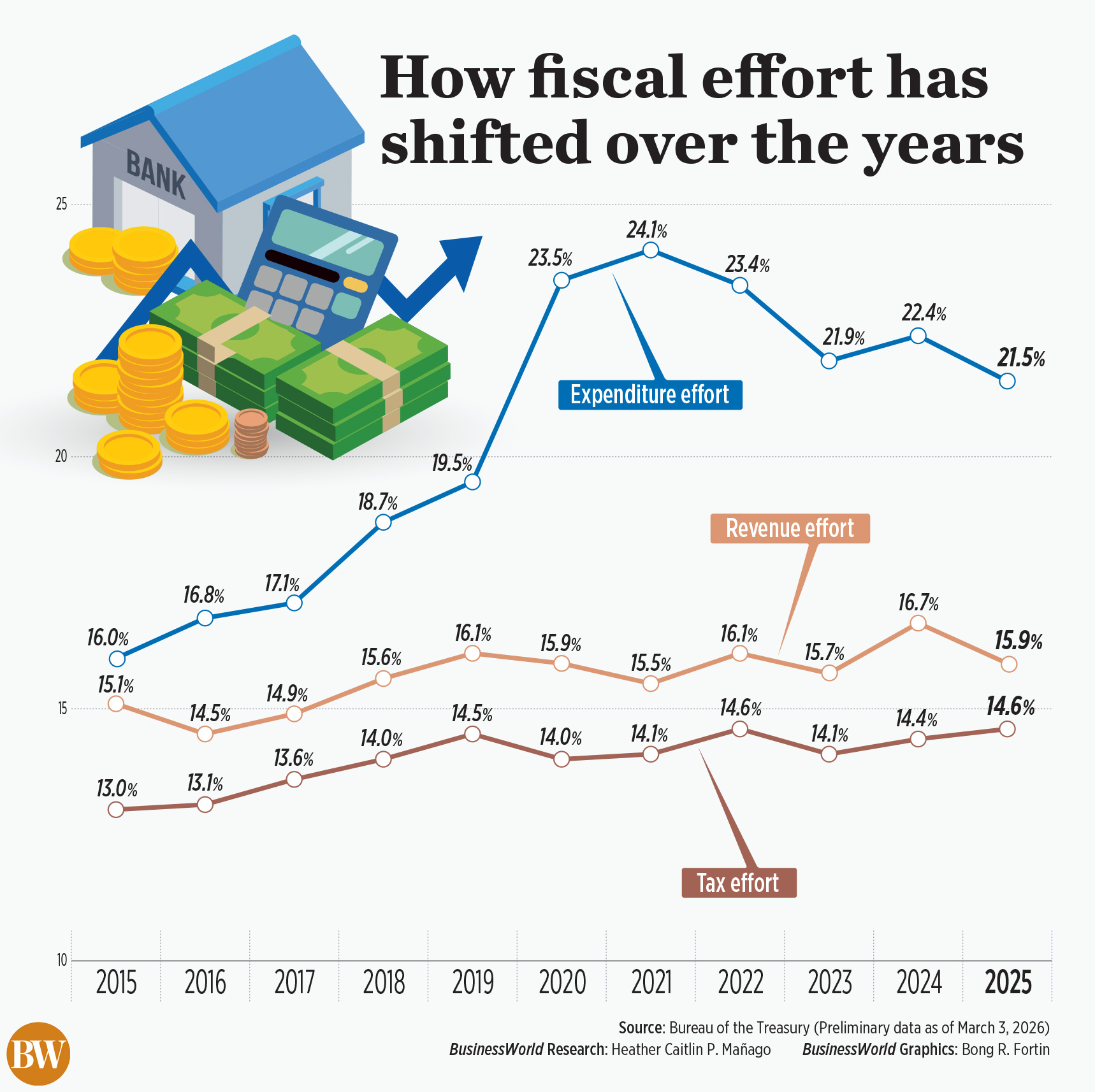
How fiscal effort has shifted over the years

THE NATIONAL Government’s (NG) budget deficit breached its 2025 ceiling after the main tax agencies missed their collection targets and state spending slowed amid a corruption scandal, the Bureau of the Treasury (BTr) said. Read the full story.

Filipiniana dress code memo boosts Sassy’s Creation sales

FACEBOOK.COM/SASSYSCREATIONPH

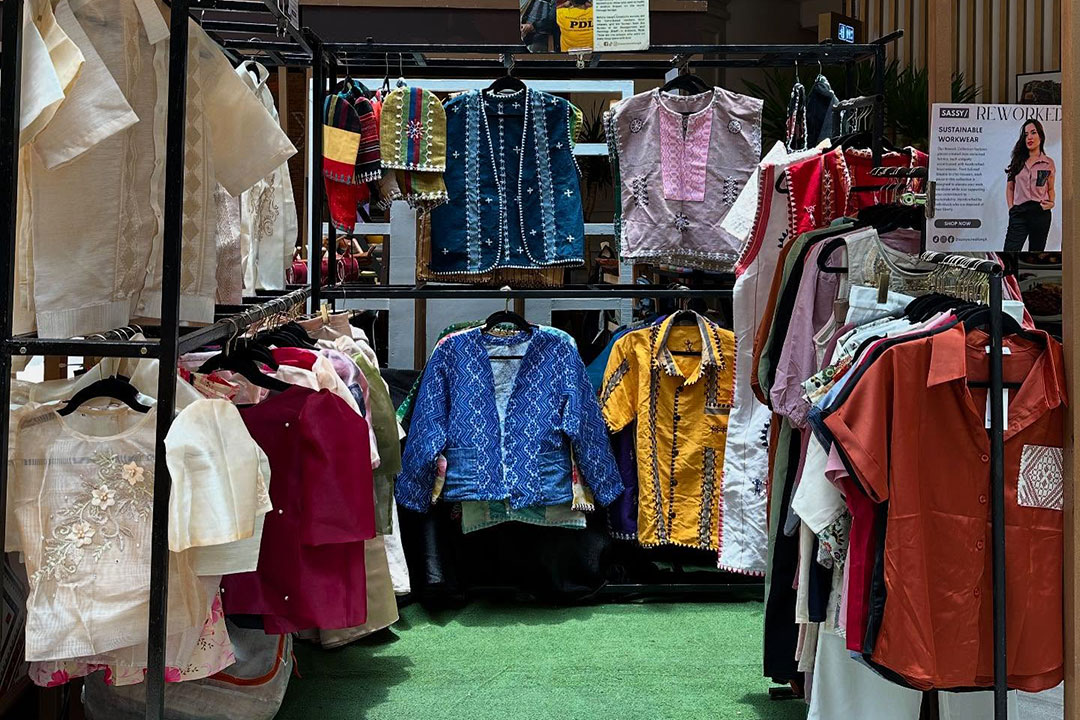
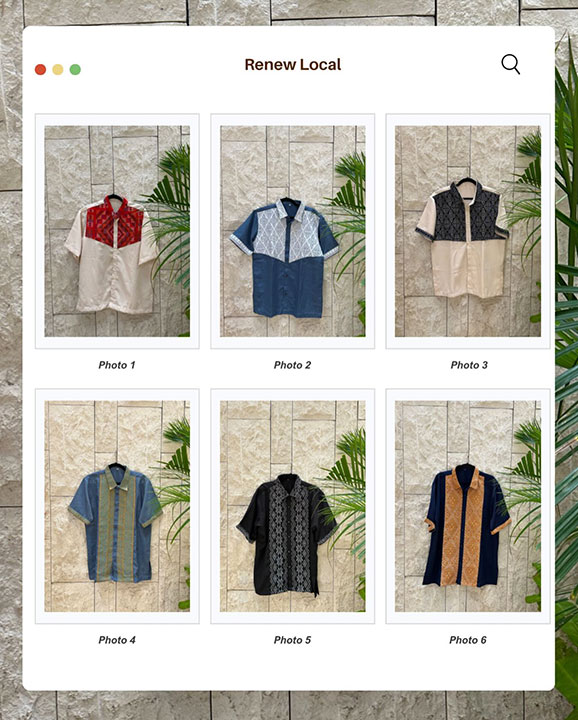
SASSY’S CREATION, a Philippine startup, has experienced a surge in demand for its Filipiniana tops since a 2024 Civil Service Commission memo that requires government employees to wear Filipiniana-inspired attire on Mondays.

“It was a good thing for us local MSMEs because it’s hard to market piña tops,” Joy L. Rapsing, owner of Sassy’s Creation, told BusinessWorld in Filipino. “Back then, it was only for special occasions, but now that the government mandated showcasing cultural heritage, it really helped us.”

The brand’s sales have more than doubled because of the dress code. “The only downside is the competition from online shops offering low-quality materials,” Ms. Rapsing added.

Sassy’s Creation uses indigenous handloom fabrics such as  pineapple, jusi and cocoon for its tops, while upcycled scrap fabrics are transformed into boleros as part of its sustainable fashion advocacy.

Each piece, priced at P3,500 and above, is crafted by stay-at-home women, local weavers and 10 prisoners from the Bureau of Jail Management and Penology in Antipolo City.

“We support cooperative communities,” Ms. Rapsing said. “We source many of our materials directly from manufacturers and ensure fair practices in workers’ salaries.”

The handcrafted textile used in these garments is also seeing growing international demand. The US accounted for 49% of Philippine textile exports last year, according to DHL Express.

The Foreign Buyers Association of the Philippines expects exports of garments, textiles and apparel to grow 2-5% this year from a projected $1 billion in 2025. — Almira Louise S. Martinez

EEI secures P1.6-billion real estate contracts

EEI.COM.PH

EEI CORP. has secured P1.6 billion worth of real estate contracts in the first two months of 2026, bringing the listed construction company closer to its order book target.

“This is a positive development to start in 2026. With these residential and hospitality projects, we push our diversified portfolio further to regional markets and expand our capabilities to build sustainable communities throughout the country,” EEI President and Chief Executive Officer Henry D. Antonio said in a statement on Tuesday.

The company said it was recently awarded real estate construction projects that expand its presence in the high-growth residential and hospitality segment.

It said it received the contract for the construction of Torre Lorenzo Development Corp.’s Crown Residences, a 21-storey residential tower, and Crest Suites, a 21-storey mixed-use development in Tierra Davao.

With these projects, the company expects steady financial results this year, driven by its pipeline.

“Propelled by a growing pipeline of projects, EEI expects to see a year of steady financial performance and successful partnerships with companies in various sectors,” it said.

Crown Residences will feature expansive wellness facilities and 322 residential units, while Crest Suites, a hospitality investment property, will have 16 floors of condominium-hotel units and three floors of residential condominium units.

In the third quarter of 2025, EEI said its project pipeline reached P19.1 billion for the quarter alone. Its total backlog as of August 2025 stood at P39.24 billion.

At the local bourse, shares in EEI fell by one centavo, or 0.43%, to close at P2.34 each. — Ashley Erika O. Jose

Top Philippine fund eyes more stocks as latest sell-off offers bargains

GSIS FACEBOOK PAGE

THE SELL-OFF in stocks fueled by the Middle East conflict provides a buying opportunity for the Philippines’ top pension fund as it weighs expanding its equities portfolio.

“I always believe that you buy when markets are not at their best,” Wick Veloso, president of the Government Service Insurance System (GSIS), said in an interview in his Manila office on Monday. There “are opportunities for you to find the diamond in the rough,” he added.

The fund, which manages about P2 trillion ($34.4 billion) in assets, 21% of which are in equities, may increase its stock holdings by another 1% if opportunities present themselves, said Mr. Veloso, who was chief executive officer of HSBC Holdings Plc’s Philippine unit from 2012 to 2018.

“When there’s fear in the market it’s the time for you to have the ability to discern the good, the bad and the ugly and take a look at what you will be able to take advantage of,” he said.

Mr. Veloso said he sees support for the Philippine stock market’s benchmark index at around 6,100 points. It closed at 6,426.83 points on Monday, down 2.78% that was its sharpest slide since last April.

Global stocks tumbled as Iran retaliated against US-Israeli strikes that killed the Islamic Republic’s supreme leader. President Donald J. Trump said the bombing campaign against Iran could last for weeks and called on the nation’s leaders to capitulate.

GSIS is the pension fund for nearly three million workers in the Southeast Asian nation’s public sector.

Mr. Veloso, who worked at HSBC for more than two decades before leading local lender Philippine National Bank, said telecoms, infrastructure and consumer companies are good bets in the Philippine equity market during times of volatility. The fund is also looking at investing in preferred shares of top local firms, given the dividends they provide.

“I want us to have predictable sources of revenue instead of quantifiable,” he said. GSIS pours about 72% of its assets in risk-free investments, of which 40% are allocated in government securities, according to Mr. Veloso. 

The company posted P344.5 billion in profit last year, up 6.4% from 2024 with assets rising 8.2% to P1.96 trillion. — Bloomberg

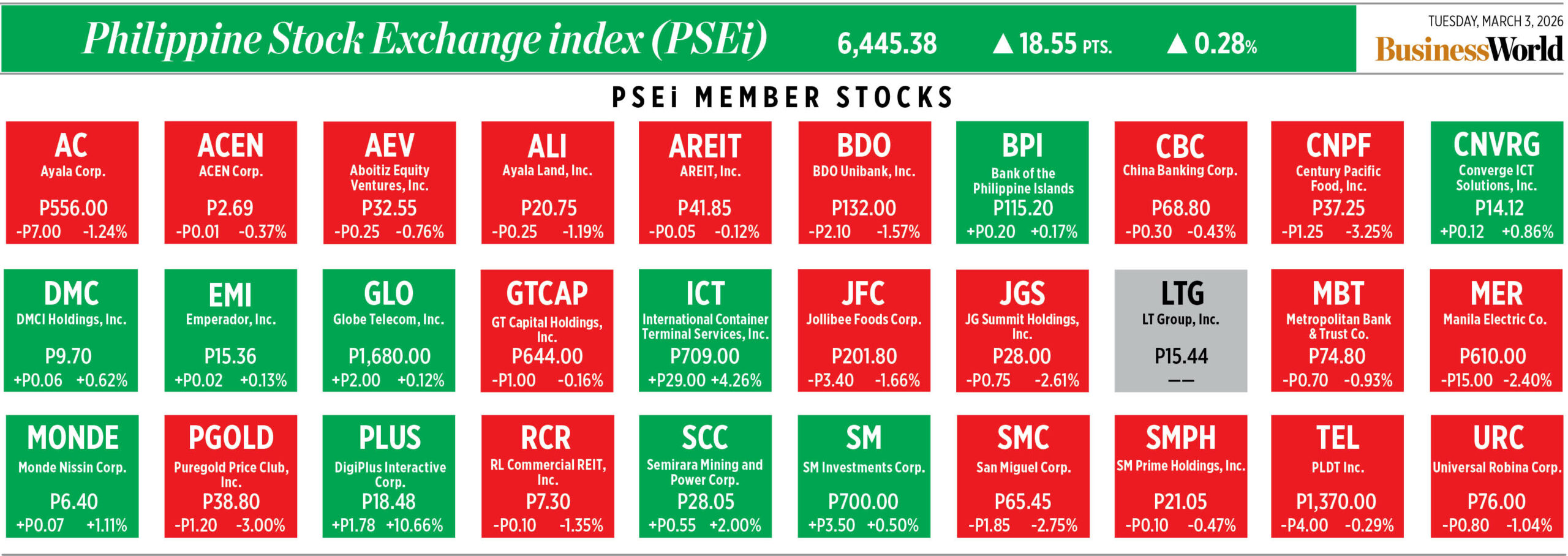
How PSEi member stocks performed — March 3, 2026

Here’s a quick glance at how PSEi stocks fared on Tuesday, March 3, 2026.


DoE’s Garin sees many other possible suppliers of energy

POWERPHILIPPINES.COM

THE GOVERNMENT is considering alternative sources of energy in the event of a “worst-case scenario” for Middle East suppliers, Energy Secretary Sharon S. Garin said.

Marami tayong pwedeng pagkukunan (There are many sources we can draw from). 20% lang ang dumadaan sa Strait of Hormuz (only 20% of the world’s energy transits the Strait of Hormuz,)” she said, referring to the narrows that restrict access to the Persian Gulf, which is at risk of being blocked by military action in the area.

“There are many countries that are producing oil and are willing to sell oil also to the Philippines,” Ms. Garin said at a briefing on Tuesday. 

Reuters reported on Monday that Iran will fire on any ship trying to pass the Strait.

Users of the Strait include Saudi Arabia, the United Arab Emirates, Iraq, Kuwait and Iran.

Ms. Garin said 98% of Philippine crude imports comes from the Middle East. The remaining 2% is sourced from Brunei and Malaysia.

“Looking globally, significant shifts in global conditions may therefore be reflected in broader market prices,” she said.

Rino E. Abad, director of the Department of Energy (DoE)-Oil Industry Management Bureau, said alternative suppliers not affected by disruptions to the Persian Gulf include the US, Canada, South America, and Africa.

Yun ang importante na pina-prioritize ng department ay yung masigurado yung continuous supply ng fuel at yung mga big-time price increases ay hindi ma-implement on a one-time basis. (The department’s priorities are to ensure continuous supply of fuel and to ensure that severe prices increases do not take effect in one blow).” The combination of these measures will actually mitigate the impact on consumers,” he said.

Ms. Garin said oil companies have sufficient inventory to meet fuel demand.

“We would like to assure the Filipino households, motorists and businesses that the country’s fuel supply remains sufficient and stable,” Ms. Garin said.

Oil companies are required to maintain at least a 30-day inventory of crude oil and a 15-day inventory of finished petroleum products.

Ms. Garin said that ordering takes about a week, noting that maintaining an inventory of a year will be expensive and require more storage.

“We are instructing all oil companies to submit to us this week, by tomorrow, if possible, all the contingency measures that they are currently taking as a situation as is today or if it prolongs or escalates,” Ms. Garin said.

She also directed the Philippine National Oil Co. to pursue alternative sources in the event that oil companies require assistance.

Energy Undersecretary Alessandro O. Sales said the supply is less of a concern than price.

“There will be petroleum products that can be bought. The main risk… is how high the price will go. And therefore, (the DoE is focusing on) how to mitigate the price impact,” he said, adding that the possible suspension of the excise tax on petroleum products is on the table.

President Ferdinand R. Marcos, Jr. said in a Palace briefing earlier on Tuesday that he is considering seeking congressional authority to temporarily reduce excise taxes on petroleum products should global oil prices surge further.

The Tax Reform for Acceleration and Inclusion law imposed excise taxes hikes on petroleum products in three tranches between Jan. 1, 2018 and Jan. 1, 2020.

The biggest excise tax increases were applied to diesel, liquefied petroleum gas and bunker, with rates rising from P2.50 to P6 per liter.

“We are willing to give assistance in whatever form is needed,” Ms. Garin said.

On Monday, oil firms announced an increase in gasoline prices by P1.90 per liter, diesel by P1.20 per liter, and kerosene by P1.50 per liter.

The upward adjustments marked the 10th consecutive week of increases for diesel and kerosene, and eight straight weeks for gasoline. Since January, per-liter prices of gasoline, diesel, and kerosene have risen by P6.70, P9.40, and P7.70, respectively.

Ms. Garin said the government is looking to encourage oil companies to implement a staggered approach should there be a major price movement next week. — Sheldeen Joy Talavera

Fertilizer, freight costs seen as main areas of concern due to Iran crisis 

ATLASFERTILIZER.COM

THE Department of Agriculture (DA) said the impact of the Iran crisis is expected to manifest in the cost of synthetic fertilizer, much of which is petroleum-based fuel, which farmers and fisherfolk depend on, and the cost of freight, which will rise due to the risk premiums attached to shipments from the Persian Gulf.

In a statement on Tuesday, the DA said: “We are concerned about the intensifying conflict between the US and Iran as it might increase oil prices over an extended period, affecting petroleum-based fertilizers, freight costs, and the fuel that powers the machinery our farmers use and the boats our fishermen rely on,” Agriculture Secretary Francisco P. Tiu Laurel, Jr. was quoted as saying.

The DA said increased fuel prices can drive up the cost of agricultural inputs, particularly nitrogen-based fertilizer products derived from natural gas.

The DA added that higher bunker fuel costs can raise shipping rates, increasing the landed cost of imported commodities such as wheat and animal feed, with knock-on effects on the prices of bread, poultry, and pork.

“We have seen this during past oil shocks, and we are now looking at ways to manage the impact on our food systems and on the country’s food security,” Mr. Laurel said.

Mr. Laurel earlier told BusinessWorld that the DA is currently assessing possible interventions for farmers and fisherfolk who may be affected by the Iran crisis.

“We are studying now what we can assist them with. I hope this conflict in the Middle East does not last long,” he said. — Vonn Andrei E. Villamiel

OTC drug registration going online this year

Illustration photo shows various medicine pills in their original packaging in Brussels, Belgium, Aug. 9, 2019. — REUTERS/YVES HERMAN/ILLUSTRATION

THE Food and Drug Administration (FDA) said it hopes to roll out an online portal for registering over-the-counter (OTC) medicines within the year.

“We will soon launch the online application portal for the registration of OTC medicines. This is (currently) undergoing public consultation,” FDA Director General Paolo S. Teston said at the European Chamber of Commerce of the Philippines Luncheon Meeting on Tuesday.

The portal is expected to speed up the application process and shorten turnaround times for OTC medicine, he said.

“Over-the-counter medicines are the most commonly consumed, in particular for non-communicable diseases,” Mr. Teston told reporters on the sidelines of the event.

Mr. Teston added that having more market authorizations for pharmaceutical products would ensure competitive pricing.

“This will ultimately improve our patients’ access to quality, safe, effective, and affordable medicine,” Mr. Teston added.

Meanwhile, the FDA is also seeking the help of law enforcement agencies, including the Bureau of Customs, to contain the proliferation of counterfeit vaccines.

Mr. Teston said: “We really need the help of the Bureau of Customs to really catch the big sellers of counterfeit vaccines,” adding that previous operations have netted only smaller players.

The FDA has seized P56.8 million worth of unregistered and counterfeit medicine in the last eight months, Mr. Teston told the Senate in January.

It has also taken down 1,531 online listings for unregistered and counterfeit products between November and January, he said. — Beatriz Marie D. Cruz

Rice imports top 700,000 MT as of late February

PHILSTAR FILE PHOTO

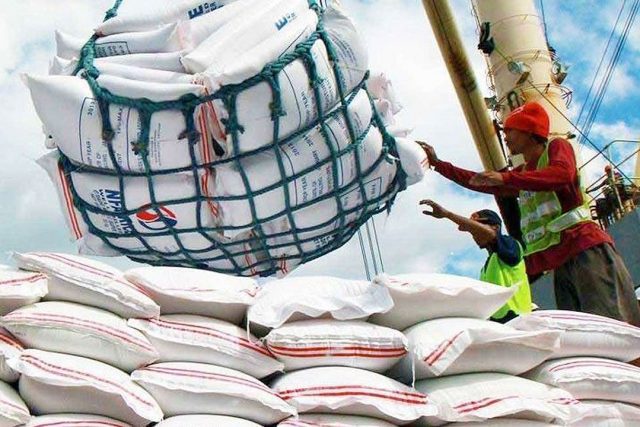
RICE IMPORTS in 2026 amounted to 707,711 metric tons (MT) as of Feb. 26, up 28.5% from a year earlier, the Bureau of Plant Industry (BPI) said.

The year-to-date volume has exceeded the Department of Agriculture’s (DA) projection of about 600,000 MT for the first two months. The DA had urged traders and importers to keep shipments to around 300,000 MT per month.

The BPI said inbound rice shipments rose 33.87% to 374,768 MT in January, while shipments from Feb. 1 to 26 totaled 332,944 MT, 22.9% higher than the full-month figure of 270,796 MT a year earlier.

The BPI said inbound shipments as of Feb. 26 are equivalent to 74.95% of the 944,290 MT expected volume based on approved import clearances.

Of the total arrivals, 87.96% originated in Vietnam, 6.17% Thailand, and 5.04% Myanmar.

Regular rice accounted for the bulk of imports at 686,957.68 MT or 97.1% of the total, while special rice amounted to 20,753.78 MT or 2.9%.

The DA has said it expects rice import volumes to amount to 150,000 MT per month in March and April, following consultations with rice traders and importers.

Agriculture Secretary Francisco P. Tiu Laurel, Jr. said the projected shipments are lower than the usual monthly average of about 400,000 MT, after importers agreed to scale back inbound shipments for the domestic harvest.

If realized, the combined 300,000-MT import volume for March and April would be equivalent to a 65.5% decline from the year-earlier 869,321 MT. — Vonn Andrei E. Villamiel

Recruitment firm officials ruled personally liable in OFW claims

WIKIMEDIA/PATRICKROQUE01

CORPORATE OFFICERS of recruitment and manning agencies are jointly and severally liable with their companies for the money claims and disability benefits of overseas Filipino workers (OFWs), the Supreme Court (SC) has ruled.

In a resolution promulgated on Oct. 13, 2025 and made public on Tuesday, the High Court clarified that individual officers, such as Sorwin Joy G. Rivera of Magsaysay Maritime Corp., cannot hide behind the company’s separate legal identity to avoid paying a worker’s claims.

The SC noted that protecting migrant workers under specific labor laws requires these officers to be personally responsible for ensuring payment, particularly if they signed the employment contract on the company’s behalf.

“If the recruitment/placement agency is a juridical being, the corporate officers and directors and partners as the case may be, shall themselves be jointly and solidarily liable with the corporation or partnership for the aforesaid claims and damages,” the SC special first division said in its 10-page ruling, written by Associate Justice Jhosep Y. Lopez.

The case involved seafarer Ruthgar T. Parce, who suffered a shoulder injury while working as a senior electrical fitter. Although the company’s doctors initially claimed he was fit to return to work, the SC found their medical assessment incomplete and indefinite.

As a result, the tribunal upheld an award of $60,000 for total and permanent disability, plus 10% in attorney’s fees and legal interest.

The court further noted that officers of manning agencies are already required by the Philippine Overseas Employment Administration to sign a formal promise — a “verified undertaking” — stating they will be personally liable for claims arising from the employment relationship. This policy, according to SC, is intended to ensure that Filipino workers abroad receive the “immediate and sufficient payment” they are rightfully owed. — Erika Mae P. Sinaking

ADVERTISEMENT
ADVERTISEMENT