Home Blog Page 2006

Perfect at home, Cleveland Cavaliers invite Atlanta Hawks into pick-your-poison test

THE Cleveland Cavaliers open a home-and-home series against the visiting Atlanta Hawks on Wednesday trying to extend their perfect start in Ohio.

The Cavaliers, who visit the Hawks on Friday, rebounded from their lone loss of the season last week with decisive victories over the New Orleans Pelicans and Toronto Raptors.

Cleveland improved to a sterling 17-1 overall and 10-0 at home following its 122-108 victory over the Raptors on Sunday.

“I’m surprised by the (record), but I’m not surprised by the play style,” Cavaliers center Jarrett Allen said, per The Cleveland Plain Dealer. “I’ve expected us to come out and play like we do, play at a high level. Still, 17-1 is incredible.”

Ty Jerome followed up his 29-point performance in the Cavaliers’ 128-100 victory over the Pelicans on Wednesday with 26 points off the bench against Toronto. He is 19-for-33 from the field and 11-for-20 from 3-point range in the last two games.

“He’s just in a state of grace right now. It’s beautiful to watch,” Cleveland coach Kenny Atkinson said.

Jerome has scored at least 24 points in three of his last four games.

“I just keep doing my job, and that’s just reading the game,” he said. “And if I have space I’m going to shoot it. I think just think the more guys you have on court that are aggressive, it gives Donovan (Mitchell) space, it gives Darius (Garland) space, it gives Evan (Mobley) space. We’re putting four or five guys out there that are all aggressive, and it’s like, what’s the defense going to do?”

Mitchell, who averages a team-best 24.4 points per game, pumped in 26 points versus the Raptors. He averaged 26.7 points, 8.7 assists and 7.3 rebounds in three games against Atlanta last season.

Jarrett Allen added 23 points and 13 rebounds to record his sixth straight double-double.

While the Cavaliers have raced to the top of the standings, the Hawks have fallen a few notches down the ladder after dropping their third straight game on Monday.

Jalen Johnson collected 28 points and 11 rebounds and Trae Young added 18 points and 16 assists in a 129-119 setback to the Dallas Mavericks. Young has recorded a double-digit assist total in four straight games and in seven of his last nine.

That said, Young admitted to being flustered by a basic defense employed by Dallas.

“It’s tough,” Young said, per the Atlanta Journal-Constitution. “We’re taking a lot of twos; we’re taking a lot of mid-range shots. I hate that they played a lot of a high-school defense — zone — and it worked. That should never work: going into the zone and being able to stop us.”

Bogdan Bogdanovic followed up a 16-point performance in a 136-122 setback to the Chicago Bulls on Friday by scoring a season-high 18 points versus the Mavericks. He made 14 of 26 shots from the floor in those two games after going 4-for-21 in his previous two contests. — Reuters

Rockets advance in NBA Cup with overtime win over Timberwolves

HOUSTON ROCKETS guard Jalen Green (4) drives against Minnesota Timberwolves guard Anthony Edwards (5) in the first quarter at Target Center. — REUTERS/BRUCE KLUCKHOHN-IMAGN IMAGES

ALPEREN SENGUN tallied a triple-double and the Houston Rockets outlasted the Minnesota Timberwolves for a 117-111 overtime win in an NBA in-season tournament matchup Tuesday night in Minneapolis.

Sengun amassed 22 points, 11 assists and 10 rebounds while Fred VanVleet finished with 27 points and 11 assists for Houston, which clinched the West Group A title with a 3-0 mark and will advance to the quarterfinals. Dillon Brooks scored 22 points, and Jabari Smith, Jr. finished with 19 points on 8-for-9 shooting.

Minnesota’s Anthony Edwards produced 29 points and 10 rebounds, but his last-second shot attempt to win the game in regulation rimmed in and out of the basket. Julius Randle scored 21 points and Naz Reid contributed 19 points off the bench for the Timberwolves, who fell to 1-2 in West Group A.

An 11-0 run in overtime fueled the Rockets’ victory. Houston trailed 105-102 before the surge, which started with a 3-pointer by Amen Thompson and ended with a basket by Sengun to give Houston a 113-105 advantage with 54 seconds left in the extra session.

The score was tied at 102-all at the end of regulation.

Randle made a driving layup to give the Timberwolves a 102-97 lead with 3:12 to go.

Houston finished the fourth quarter with five straight points on a 3-pointer by VanVleet and a basket by Thompson with 38 seconds to go.

At the end of the third quarter, the Rockets held on to an 84-78 edge. Minnesota finished the period on an 11-0 run. Edwards scored six points during that span, including a three-point play on a layup and free throw with 49.8 seconds left.

Houston led 57-47 at the half.

The Rockets jumped to a 22-11 lead in the first 6 1/2 minutes. Brooks made a basket off an assist from Sengun to finish the early scoring binge.

Minnesota pulled within 47-46 on a layup by Randle with 2:53 left in the first half.

Houston responded with a 10-0 run to regain a double-digit lead. Smith logged eight straight points on back-to-back 3-pointers and a 2-point basket, and VanVleet finished the run with a driving layup with 26 seconds to go in the half. — Reuters

Man City gives up three-goal lead in 3-3 draw with Feyenoord

MANCHESTER, England — Manchester City squandered a three-goal lead to draw 3-3 with Feyenoord in the Champions League on Tuesday after another calamitous performance from Pep Guardiola’s stuttering side who have suffered an alarming slump in form.

Erling Haaland scored either side of an Ilkay Gundogan strike for the hosts, who looked poised for victory aftera five-game losing streak in all competitions.

But defensive blunders in the dying minutes allowed Anis Hadj Moussa, Santiago Gimenez and David Hancko to score as City dropped to 15th in the Champions League table on eight points.

“We lost a lot of games lately, we’re fragile and of course we needed a victory,” Guardiola said as his side threw away the lead, with the English champions having been trounced 4-0 at home by Tottenham Hotspur in the Premier League on Saturday.

“I don’t know if it’s mental. The first goal cannot happen and the second as well. After that we forget what happened, we were desperate to win and do well, we do well but don’t win games.”

City has conceded two or more goals in six successive matches in all competitions for the first time since 1963 – a season that saw them relegated from the English top flight.

They are also the first team in Champions League history to lead by three goals as late as the 75th minute but fail to win.

“Difficult,” said City defender Nathan Ake. “We played quite well, all under control, then things changed. We have to stay strong mentally, believe in ourselves, and stay together… and make sure we get out of it.

“The only thing we can do is fight back and stay strong… When you’re three-nil up, it feels like a defeat when you give up three goals at home.”

City parked in the visitors’ end for much of the night and following several near misses in the first half, Haaland got the hosts on the scoresheet in the 45th by striking a blistering penalty kick past Timon Wellenreuther after he was fouled.

TURNAROUND
Gundogan doubled the lead in the 50th minute with a deflected low long-range shot before Haaland scored again three minutes later when he slid in to stab home a Matheus Nunes cross for his 46th goal in Europe’s elite club competition.

At that stage, it was all smiles among the Etihad crowd.

Yet astonishingly, Feyenoord replied with three goals inside 15 minutes, first from Hadj Moussa, who pounced on a careless ball back from Josko Gvardiol in the 75th minute.

Then Gimenez struck seven minutes later when he chested in Jordan Lotomba’s cross, created from another wayward Gvardiol pass that had a furious Guardiola with his head in his hands for several minutes and Gvardiol tugging his shirt over his face.

Hancko equalized in the 89th when keeper Ederson was beaten by Igor Paixao who sent over a cross for Hancko to head in.

“It was an unbelievable evening,” said Feyenoord boss Brian Priske. “To be 3-0 down around 75 minutes away from home and against the best team in the world and then to be able to pick up a really important point for us — an unbelievable result.”

City’s Jack Grealish narrowly missed scoring a late winner but his deflected strike grazed the crossbar.

The home fans booed their side after the final whistle.

What could have been a massive confidence boost for Guardiola’s struggling team now raises more questions ahead of their toughest test of the season yet, a clash with Premier League-leading Liverpool at Anfield on Sunday.

Defeat would leave City 11 points adrift of the Reds.

Feyenoord, who are fourth in the Eredivisie, are 20th in the Champions League standings with seven points and among the playoff places with three games remaining in the first phase. — Reuters

Israel-Hezbollah ceasefire takes effect

TOY SOLDIERS, Hezbollah and Israel flags are seen in this illustration taken on Oct. 15, 2023. — REUTERS

WASHINGTON/BEIRUT/JERUSALEM  — A ceasefire between Israel and Iran-backed group Hezbollah came into effect at 0200 GMT on Wednesday after US President Joseph R. Biden said both sides accepted an agreement brokered by the United States and France.

Bursts of gunfire could be heard across Beirut after the ceasefire took effect. It was not immediately clear if the shooting was celebratory, as gunfire had also been used to alert residents who may have missed evacuation warnings issued by Israel’s military.

Streams of cars carrying people displaced from southern Lebanon by Israeli strikes in recent months began heading back to the area after the ceasefire, according to Reuters witnesses.

The ceasefire promises to end a conflict across the Israeli-Lebanese border that has killed thousands of people since it was ignited by the Gaza war last year.

Mr. Biden spoke at the White House on Tuesday shortly after Israel’s security cabinet approved the agreement in a 10-1 vote. He said he had spoken to Israeli Prime Minister Benjamin Netanyahu and Lebanon’s caretaker Prime Minister Najib Mikati, and that fighting would end at 4 a.m. local time (0200 GMT).

“This is designed to be a permanent cessation of hostilities,” Mr. Biden said. “What is left of Hezbollah and other terrorist organizations will not be allowed to threaten the security of Israel again.”

Israel will gradually withdraw its forces over 60 days as Lebanon’s army takes control of territory near its border with Israel to ensure that Hezbollah does not rebuild its infrastructure there, Biden said.

“Civilians on both sides will soon be able to safely return to their communities,” he said.

Hezbollah has not formally commented on the ceasefire but senior official Hassan Fadlallah told Lebanon’s Al Jadeed TV that while it supported the extension of the Lebanese state’s authority, the group would emerge from the war stronger.

“Thousands will join the resistance … Disarming the resistance was an Israeli proposal that fell through,” said Fadlallah, who is also a member of Lebanon’s parliament.

Iran, which backs Hezbollah, the Palestinian group Hamas as well as the Houthi rebels that have attacked Israel from Yemen, said it welcomed the ceasefire.

French President Emmanuel Macron said on social media platform X the deal was “the culmination of efforts undertaken for many months with the Israeli and Lebanese authorities, in close collaboration with the United States.”

Lebanon’s Mr. Mikati issued a statement welcoming the deal. Foreign Minister Abdallah Bou Habib said the Lebanese army would have at least 5,000 troops deployed in southern Lebanon as Israeli troops withdrew.

Mr. Netanyahu said he was ready to implement a ceasefire but would respond forcefully to any violation by Hezbollah.

He said the ceasefire would allow Israel to focus on the threat from Iran, give the army an opportunity to rest and replenish supplies, and isolate Hamas, the Islamist militant group that triggered war in the region when it attacked Israel from Gaza last year.

‘SET IT BACK DECADES’
“In full coordination with the United States, we retain complete military freedom of action. Should Hezbollah violate the agreement or attempt to rearm, we will strike decisively,” Netanyahu said.

Hezbollah, which is allied to Hamas, was considerably weaker than it had been at the start of the conflict, he added.

“We have set it back decades, eliminated… its top leaders, destroyed most of its rockets and missiles, neutralized thousands of fighters, and obliterated years of terror infrastructure near our border,” he said.

A senior US official, briefing reporters on condition of anonymity, said the US and France would join a mechanism with the UNIFIL peacekeeping force that would work with Lebanon’s army to deter potential violations of the ceasefire. US combat forces would not be deployed, the official said.

Jon Finer, deputy national security adviser in the Biden administration, told CNN that Washington would be watching for any violations of the deal.

“Implementation of this agreement will be key and we will be very vigilant to any attempts to disrupt what the two parties have committed to as part of this process today,” he said.

Mr. Biden, who leaves office in January, said his administration would continue to push for an elusive ceasefire and hostage-release deal in Gaza, as well as for a deal to normalize relations between Israel and Saudi Arabia.

In the hours leading up to the ceasefire, hostilities raged as Israel ramped up its campaign of airstrikes in Beirut and other parts of Lebanon, with health authorities reporting at least 18 killed.

The Israeli military said it struck “components of Hezbollah’s financial management and systems” including a money-exchange office.

Hezbollah also kept up rocket fire into Israel.

Israel’s air force intercepted three launches from Lebanese territory, the military said, in an extensive missile barrage on Tuesday night that led to warning alarms in about 115 settlements.

Alia Ibrahim, a mother of twin girls from the southern village of Qaaqaiyat al-Snawbar, who had fled nearly three months ago to Beirut, said she hoped Israeli officials, who have expressed contradictory views on a ceasefire, would be faithful to the deal.

“Our village — they destroyed half of it. In these few seconds before they announced the ceasefire, they destroyed half our village,” she said. “God willing, we can go back to our homes and our land.”

A poll conducted by Israel’s Channel 12 TV found that 37% of Israelis were in favor of the ceasefire, compared with 32% against.

Opponents to the deal in Israel include opposition leaders and heads of towns near Israel’s border with Lebanon, who want a depopulated buffer zone on Lebanon’s side of the frontier.

Both the Lebanese government and Hezbollah have insisted that a return of displaced civilians to southern Lebanon is a key tenet of the truce.

Israeli Security Minister Itamar Ben-Gvir, a right-wing member of Netanyahu’s government, said on X the agreement did not ensure the return of Israelis to their homes in the country’s north and that the Lebanese army did not have the ability to overcome Hezbollah.

“In order to leave Lebanon, we must have our own security belt,” Ben-Gvir said. — Reuters

Malaysia drops 1MDB-linked charges against ex-PM Najib

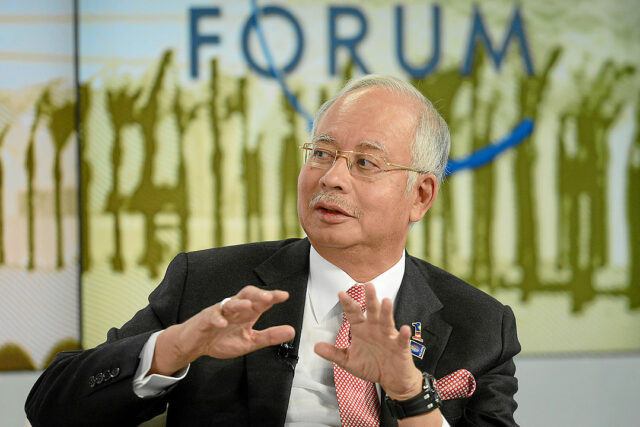
Najib Razak — WORLD ECONOMIC FORUM/WIKIPEDIA

KUALA LUMPUR — A Malaysian court on Wednesday allowed corruption charges linked to the multibillion-dollar 1MDB scandal filed against jailed former Prime Minister (PM) Najib Razak and the former treasury chief to be dropped, their lawyers said.

Najib faces several trials linked to the scandal at state fund 1Malaysia Development Berhad (1MDB), from which Malaysian and U.S. authorities say about $4.5 billion was stolen in a complex, globe-spanning scheme between 2009 and 2014.

Najib, who helped found 1MDB when he was premier in 2009, was found guilty of corruption and money laundering in a case linked to the scandal and sentenced to 12 years in prison in 2022, though the term was later halved by a pardon’s board chaired by Malaysia’s king.

He last month apologized for his role in mishandling the 1MDB scandal, though he maintained he had no knowledge of any illegal transfers from the state fund.

Najib and former treasury secretary-general Irwan Serigar Abdullah had been charged in 2018 with six counts of criminal breach of trust involving government funds worth 6.6 billion ringgit ($1.48 billion), which officials have said were related to a settlement agreement between 1MDB and Abu Dhabi state fund International Petroleum Investment Company.

The pair consistently denied wrongdoing.

The Kuala Lumpur High Court granted their bid for a discharge not amounting to an acquittal, due to procedural delays and the failure of the prosecution to disclose key documents, their lawyers said.

“The court correctly exercised its jurisdiction to discharge our client of the charges, consonant with the law,” Najib’s lawyer Muhammad Farhan Muhammad Shafee said in a text message.

The decision is likely to prompt further questions over the remaining cases against Najib, after prosecutors last year did not appeal his acquittal in a separate 1MDB-related case.

That came amid accusations that current Prime Minister Anwar Ibrahim, who was voted in two years ago on an anti-corruption platform, is backsliding on promised reforms. Anwar has said he remains committed to tackling graft but does not interfere in court cases.

Najib has also been pushing to serve the remainder of his sentence under house arrest, and has filed a case to compel the government to confirm the existence of a royal order that he says would allow him to do so.

Anwar’s government said last month it would introduce a law allowing house arrest for some offences next year, though it denied that was aimed at getting Najib or other politicians accused of corruption out of jail. — Reuters

Top importer Vietnam struggles to recycle plastic waste

A GENERAL VIEW of plastic waste at a recycling facility in Minh Khai Craft Village, Hung Yen province, Vietnam, Feb. 26, 2024. — REUTERS

MINH KHAI, Vietnam — Countless discarded bags float on the canal running through Minh Khai village, whose narrow streets are clogged with tall heaps of plastic waste spilling out from villagers’ front yards and stacked near furnaces where non-recyclable scrap is burned.

This so-called plastic recycling “craft village,” an hour’s drive from Vietnam’s capital Hanoi, is where some of the plastic sorted for recycling in Japan, America and Europe ends up for final treatment.

Delegates at a United Nations (UN) summit in South Korea this week are discussing new global rules that could limit that trade, which UN data show were worth $3.8 billion last year. Stricter domestic requirements on waste imports will also be applicable in Vietnam from next year.

The Southeast Asian nation has emerged as a major importer of plastic scrap in recent years after China, once the top player in the industry, banned imports in 2018. Vietnam was the world’s fourth-largest importer in 2022, according to the Organisation for Economic Co-operation and Development.

But that surge in imports has taken place as the country is struggling to recycle even its own plastic waste.

Additional restrictions could reduce the trade but the large size of the domestic informal industry may make it hard to monitor commercial flows and recycling rates, experts and officials said.

FROM SORTING TO LANDFILLS
More than one quarter of Vietnam’s plastic recycling capacity is concentrated in craft villages like Minh Khai, the World Bank said in a 2021 report, noting that spare capacity to process imported plastic amounted to 300,000 metric tons.

That was well short of the 420,000 tons of plastic scrap Vietnam imported last year, which was up 11% from 2022, according to UN data, which does not capture the entire volume.

Vietnam’s environment ministry did not reply to requests for updated figures.

Researchers have found that recycling is being hampered by the inability to properly sort plastic waste, both offshore and in Vietnam. Only 30% of plastic waste generated in Vietnam is sorted, said a government-backed WWF report in 2023.

As a result, in spite of shipment costs, Vietnam’s recyclers rely on higher-quality foreign plastic scrap, according to FiinGroup, a research firm.

But estimates suggest Vietnam recycles only up to one-third of the imported plastic waste, said a research paper published in January.

That is partly because some imported plastic is often mixed with organic waste that makes it hard or impossible to treat, said one of the paper’s authors, Kaustubh Thapa, from the Netherlands’ Utrecht University.

A recycler at Minh Khai village was more upbeat. “The amount of imported waste that can’t be recycled is often about 5% of the volume, but at times it goes up to 25%,” said Chi, who declined to give his full name.

Most people contacted in the village in person or by phone declined to talk to media for fear of repercussions on their activities.

Much of the unrecycled plastic is dumped in “unsanitary” landfills, and about 15% of that is directly released into the environment and the oceans, the WWF report said.

“Exporting waste for recycling to destinations without sound recycling capacity raises questions of fairness and sustainability,” concluded the research paper by Thapa and co-authors. — Reuters

Australia moves closer to ban social media for children

Social media logos are seen in this illustration taken on May 25, 2021. — REUTERS/DADO RUVIC/ILLUSTRATION

SYDNEY — Australia on Wednesday moved closer to banning social media for children under 16 after the parliament’s lower house passed the bill even as Alphabet’s Google and Facebook-owner Meta pressed the government to delay the legislation.

Australia’s House of Representatives passed the bill 102 votes to 13 after Prime Minister Anthony Albanese’s center-left Labor government secured bipartisan support for the ban.

The Senate is expected to debate the bill later on Wednesday, with the government keen to ensure it is passed by the end of the parliamentary year on Thursday.

Mr. Albanese, trying to lift his approval ratings ahead of an election expected in May, has argued that excessive use of social media poses risks to the physical and mental health of children and is looking for support from parents.

Media outlets, including News Corp, have backed the ban.

Some youth advocates including Australia’s human rights commission raised concerns the law would hurt children’s rights to self-expression, but a YouGov survey released on Tuesday showed 77% of Australians backed the ban, up from 61% in an August survey.

The planned law would force social media platforms to take reasonable steps to ensure age-verification protections are in place. Companies could be fined up to A$49.5 million ($32 million) for systemic breaches.

Australia plans to trial an age-verification system that may include biometrics or government identification to enforce the ban, some of the toughest social media controls imposed by any country to date.

A Senate committee late on Tuesday backed the bill but inserted a condition that social media platforms should not force users to submit personal data such as passport and other digital identification to prove their age.

In its report, the Senate’s environment and communications legislation committee said social media platforms “must set out alternative methods for assuring age as reasonable steps with consideration given to the age assurance trial.”

A progress report on the age assurance trial must be submitted by the communications minister to parliament by Sept. 30, 2025, the committee said as it urged the government to “meaningfully engage” with youth when framing the law.

“Young people, and in particular diverse cohorts, must be at the centre of the conversation as an age restriction is implemented to ensure there are constructive pathways for connection,” committee Chair Senator Karen Grogan said.

In separate submissions to parliament, Google and Meta said the social media ban should be delayed until the age-verification trial finishes. Bytedance’s TikTok said the bill needed more consultation, while Elon Musk’s X said the proposed law might hurt children’s human rights.

Some opposition and independent lawmakers have criticized the government for trying to pass the legislation in a week. The bill was introduced last Thursday, submissions on it closed the following day, and a brief public hearing was held on Monday. — Reuters

China could launch military drills near Taiwan over president’s Pacific visit

A NAVY miniature is seen in front of displayed Chinese and Taiwanese flags in this illustration taken April 11, 2023. — REUTERS

TAIPEI — China is likely to launch military drills in the coming days near Taiwan, using President Lai Ching-te’s upcoming trip to the Pacific and scheduled US transit as a pretext, according to assessments by Taiwan and regional security officials.

Mr. Lai will start a visit to Taipei’s three diplomatic allies in the Pacific on Saturday, and sources told Reuters he was planning stops in Hawaii and possibly the US territory of Guam in a sensitive trip coming shortly after the US election.

China, which views democratically governed Taiwan as its own territory and the most important issue in its relations with Washington, has a strong dislike of Mr. Lai whom Beijing calls a “separatist.”

Mr. Lai’s office has yet to confirm details of what are officially stop-overs in the United States, but is expected to do so shortly before he departs, sources familiar with the trip have previously said.

Beijing could conduct military maneuvers around or shortly after Mr. Lai’s trip which ends on Dec. 6, said four officials in the region briefed on the matter, who declined to be identified due to the sensitivity of the matter.

Neither China’s defense ministry nor its Taiwan Affairs Office responded to requests for comment, though the government has urged the United States not to permit Lai to transit.

Taiwan’s defense ministry and the White House did not respond to a request for comment.

China has already staged two rounds of major exercises around Taiwan this year to pressure Taipei, one in May and one in October, dubbed “Joint Sword – 2024A” and B, respectively.

China could “repackage” ongoing regular military activities in the South China Sea or the East China Sea, moving them closer to Taiwan and rebranding them “Joint Sword – 2024C,” according to a Taiwan security official.

Beijing could expand the size of its regular “joint combat readiness patrol” that typically involves naval and air force drills near Taiwan during Mr. Lai’s visit and launch a “targeted” exercise towards the end of the trip, the source said.

Between 20 and 30 Chinese naval vessels are involved in the ongoing military maneuvers this week in the South China Sea, the source added.

‘RED LINE’
Beijing wants to show the incoming U.S. administration of President-elect Donald Trump that the first island chain is “China’s sphere of influence” and Mr. Lai’s trip could become a “pretext,” the official said, referring to an area that runs from Japan through Taiwan, the Philippines and on to Borneo, enclosing China’s coastal seas.

“Beijing hopes to draw a red line and establish its power” during the US government transition and extend its sphere of influence, the official said, adding the military drills were meant for the United States and its allies.

A second source, a Taiwan-based regional security official, said the drills would probably be more limited in scope than the two earlier rounds this year given unstable winter weather conditions in the Taiwan Strait.

A third source, familiar with security assessments around Taiwan, said China could use exercises in the coming weeks to test the bottom line of the Trump administration.

Two of the sources said more favorable weather conditions may prompt an earlier or delayed display of force in the days around Mr. Lai’s trip.

Taiwan presidents typically take advantage of stopovers in the United States going to and from far-flung allies to give speeches and meet with friendly politicians. Mr. Lai will be visiting the Marshall Islands, Tuvalu and Palau, three of the 12 remaining countries maintaining official diplomatic ties with Taipei.

It would not be unprecedented for China to respond militarily to this trip. It did so in August of last year when then-Vice President Lai returned from the United States, and in April of last year upon then-President Tsai Ing-wen’s return from California.

Mr. Lai and his ruling Democratic Progressive Party reject Beijing’s sovereignty claims, saying only Taiwan’s people can decide their future. — Reuters

Canada hints at fast-tracking refugee refusals

PRAVEEN KUMAR NANDAGIRI-UNSPLASH

TORONTO — Canada’s immigration minister says he plans to propose measures to reform the country’s refugee system, potentially fast-tracking refusals of cases deemed to have little chance of succeeding.

Experts and advocates warned that could violate asylum-seekers’ right to due process and could be challenged in court.

“I plan to put forward more measures. I want to reform the system. It’s not working in the way it should,” Immigration Minister Marc Miller told a parliamentary committee on Monday.

Prime Minister Justin Trudeau has been changing his government’s welcoming stance on migrants, pledging to cut immigration and reduce Canada’s population over the next two years as his party trails in polls and Canadians surveyed profess dwindling support for new arrivals.

Canada’s Immigration and Refugee Board, an independent adjudicator of refugee claims, is seeing claims from “people having increasingly fewer hopes to stay in Canada and being counseled to file, I think unjustly, asylum claims where they shouldn’t have the ability to do so,” Mr. Miller added.

Canada has seen its highest number of refugee claims ever in recent months. Although the monthly total has dropped to about 17,400 in October from about 20,000 in July, the number of claims pending is the highest ever — at more than 260,000 last month.

More than 265,000 non-permanent residents came to Canada in the second quarter of 2024, according to Statistics Canada.

Thousands of the refugee claims are from international students filing refugee claims, whose veracity Mr. Miller has questioned.

The reforms would be aimed in part at preventing people who planned to use their international study as a path to permanence in Canada from filing refugee claims as a last-ditch effort to stay now that new rules have closed off that path. Refugee claims were rising prior to the new rules.

“There are an increasing number of international students making asylum claims, I think with very little hope, given their conditions,” Mr. Miller said.

“Are there things we can do to make sure that’s more streamlined? I would encourage you to follow the next few weeks as we propose more amendments to the immigration system and the asylum system.”

Mr. Miller did not say what those changes will be. He is “exploring options related to asylum reforms,” spokesperson Renee LeBlanc Proctor wrote in an e-mail Tuesday.

But fast-tracking refugee refusals would likely meet legal challenges on the grounds that it “short-circuits” procedural fairness, said University of Toronto law professor and Human Rights Chair Audrey Macklin.

“You can’t say (in effect) ‘We think this is a ‘bogus’ claim so we won’t bother with a hearing,’” she wrote in an e-mail Tuesday.

Advocates for migrants have argued for better resourcing of the Immigration and Refugee Board so it can process more claims faster, and potentially fast-tracking claims from countries with high acceptance rates because they are more likely to succeed. — Reuters

Reinventing Insurance Services with Digital Solutions

Traditional insurance sales have long relied on personal relationships, referrals, and face-to-face interactions. However, customers often face challenges like difficulty accessing product information, scheduling appointments, and tracking policies.

While these methods have successfully served policyholders for decades, they are increasingly being challenged by evolving consumer expectations and digital transformation trends. As a result, the insurance sector needs to update its methods and service delivery to stay competitive and meet the needs of today’s customers as technology advances across industries.

Cocolife, a leading insurance provider in the Philippines, has developed the myCOCOLIFE App to enhance the customer and agent experience. Designed to simplify the insurance process, the application offers a seamless digital platform for users to manage their policies and access various insurance-related services in real time.

Through the myCOCOLIFE App, customers receive timely notifications and quick access to important information, including detailed guides about various insurance products. These features make obtaining insurance more accessible and instill confidence, knowing they can easily find the information they need.

The integration of e-commerce feature allows users to explore and purchase new insurance products directly from their mobile devices. They can get quotes and purchase policies across various types, including life and non-life, with car, home, health, and business insurance coming soon.

Users may also enjoy the convenience of making payments and filing claims through the app application.

In addition, the myCOCOLIFE App allows users to book appointments with agents for personalized consultations. This function ensures that customers are well-informed about their insurance options and can make educated decisions that fit their needs.


Melanio De Vicente, Vice President and Head of Digital Innovation for Sales and Growth Department at Cocolife

“There’s a definite need to keep up with the rapid changes in the industry and this includes the turn towards digitalization,” said Melanio De Vicente, Vice President and Head of Digital Innovation for Sales and Growth Department at Cocolife. “Cocolife wants to make sure that customer experience is at its absolute best and convenience. All the services that [customers] used to do, which required [them] to travel to a service center, can now be done on [their] mobile phones with this app.”

Leading innovation in the insurance sector

Cocolife has continued to enhance the app’s capabilities, with the second phase already introducing key upgrades such as a marketplace for products, an EKYC (electronic know-your-customer) process for faster applications, e-policies, and comprehensive payment options. 

The insurance provider also plans to introduce more dynamic features over the next few years to meet growing customer demands. The upcoming third phase will include agent assistance tools, the ability to submit claims through the app, and biometric login for added security. The app will also offer a renewal option for policies, including riders, and provide a dividends ledger for customers to track their financial benefits.  

According to Cocolife, all features are designed based on the company’s deep understanding of customer needs, ensuring that it offers the ease of use and functionality that today’s digital-savvy clients expect. 

“myCOCOLIFE App aims to provide accessibility through the digital delivery of most, if not all, of our services. We hope that by providing the best possible customer journey, we will be able to gain solid customer trust while expanding our network,” Mr. De Vicente said.

Beyond customer satisfaction

One of the primary issues with traditional insurance is the time-consuming paperwork and manual processes involved. These often result in inaccuracies, limited access to product information, and slow turnaround times. Customers struggle with scheduling appointments and managing leads, leading to frustration and dissatisfaction, which can eventually cause lost sales.

In response, the myCOCOLIFE App resolves these challenges by automating many tedious tasks, enabling users to complete transactions digitally without the burden of physical paperwork. 

The application also increases the productivity of insurance agents. By integrating built-in tools for managing workloads, it allows users to stay organized and reach more potential customers, regardless of location. With instant access to product information, quotes, and policy details, agents can connect with their clients anytime and anywhere.  

“The products and services offered by Cocolife speak volumes in itself. These are high-quality insurance products that are tailored to the specific needs of our clients,” said Cocolife President and Chief Executive Office Atty. Jose Martin A. Loon. “For Cocolife, it is our duty to serve our clients with the best insurance products, together with the highest standards of customer servicing especially during these most trying times.” 


Furthermore, digital services like myCOCOLIFE are crucial for reaching more customers, especially in remote areas where physical access to service centers is limited. 

“Cocolife will continue to make sure that our customer’s needs are met with the right service and timely development,” said Mr. De Vicente. “This new app should help make each interaction easier and accessible. We all know that Cocolife prides itself in ‘Believing in the Filipino’ and this new technology should empower them as they strive towards a better future.” 


Spotlight is BusinessWorld’s sponsored section that allows advertisers to amplify their brand and connect with BusinessWorld’s audience by publishing their stories on the BusinessWorld Web site. For more information, send an email to online@bworldonline.com.

Join us on Viber at https://bit.ly/3hv6bLA to get more updates and subscribe to BusinessWorld’s titles and get exclusive content through www.bworld-x.com.

Fed cites volatility, uncertainty as reasons to go slow on rate cuts

A sign for the Federal Reserve Board of Governors is seen at the entrance to the William McChesney Martin Jr. building in Washington, D.C. — REUTERS

WASHINGTON — Federal Reserve officials appeared divided at their meeting earlier this month over how much farther they may need to cut interest rates, but as a group agreed to avoid giving much guidance from here on about how U.S. monetary policy is likely to evolve.

There was uncertainty about the direction of the economy, Fed officials noted, according to the minutes of the Nov. 6-7 meeting, uncertainty about just how much the current level of interest rates was doing to restrict the economy – a key issue in deciding how much further rates should fall – and a developing case to step carefully.

“Many participants observed that uncertainties concerning the level of the neutral rate of interest complicated the assessment of the degree of restrictiveness of monetary policy and, in their view, made it appropriate to reduce policy restraint gradually,” said the minutes, which were released on Tuesday.

The neutral interest rate is the level at which economic activity is neither stimulated nor restrained.

“Participants noted that monetary policy decisions were not on a pre-set course and were conditional on the evolution of the economy and the implications for the economic outlook … They stressed that it would be important for the (Federal Open Market) Committee to make this clear as it adjusted its policy stance,” the minutes stated, referring to the central bank’s policy-setting committee.

The Fed cut its benchmark policy rate by a quarter of a percentage point to the 4.50%-4.75% range at the meeting three weeks ago, a session that followed Republican candidate Donald Trump’s victory in the Nov. 5 U.S. presidential election.

Though the implication of the election outcome was not mentioned in the minutes, “many” participants noted the complications of making policy at a time when economic data was volatile due to storms, strikes and other factors, and geopolitical tensions were high.

Fed officials generally agree that inflation is all but controlled, and the risk of a sharp rise in unemployment has diminished.

Still “some participants noted that the Committee could pause its easing of the policy rate and hold it at a restrictive level” if inflation remained too high, and some saidrate cuts could be accelerated “if the labor market turned down or economic activity faltered.”

After the release of the minutes, financial markets added slightly to bets on a rate cut at the Fed’s Dec. 17-18 meeting, and kept intact prior bets on a slower pace of reductions next year, with just one cut priced in by the middle of the year.

STRONG ECONOMY
“We continue to think that the FOMC will reduce the funds rate by a further 25 bp (basis points) in December,” wrote Samuel Tombs, chief U.S. economist for Pantheon Macroeconomics, but then scale back next year to navigate a potentially complicated set of policy developments once Trump takes office.

The president-elect this week, for example, said he planned on his first day in office to impose import tariffs of 25% on Mexico and Canada alongside demands for tougher border control.

“Our base case is that the Fed will have to ease cautiously, most likely at alternate meetings next year, trading off labor market and inflation risks,” Tombs wrote. “Huge uncertainty over the scale, timing and likelihood of President Trump’s economic proposals, however, creates considerable risk to both sides of our funds rate forecast.”

The Fed’s November meeting also followed a run of stronger-than-expected economic data – “remarkable” is how Fed Chair Jerome Powell referred to it – that stoked concern monetary policy may not be restricting the economy as much as thought.

Officials since thatsession have said ongoing economic strength meant the central bank’s benchmark policy rate might already be close to the “neutral” level, an argument for fewer rate cuts approved at a slower pace in order to avoid easing policy too much and possibly rekindling inflation.

Others argue the economy was likely to slow and the job market continue to weaken, which would be a reason to continue easing financial conditions to encourage spending and investment. — Reuters

The beauty disruptor: One Earth Organics founder Tyff Short on leading the all-natural movement

One Earth Organics Founder Tyff Short

The industry icon discusses how she helped change the narrative on clean beauty, Filipino skincare products, and more

It wasn’t too long ago when most Filipinas depended their choice of beauty products on a single qualifier: Is it imported? Today, as consumers evolved and learned to consider everything from the item’s ingredients to its environmental impact, inspiring mompreneur Tyff Short of proudly local beauty brand One Earth Organics looks back with pride on how much the market’s mindset has changed — a transformation shaped by her significant influence.

Short admits that she, too, used to solely base her beauty product purchases on whether it’s manufactured outside the country. After all, this led her to learn firsthand about the harmful effects of chemical-based products, and why she established One Earth Organics more than a decade ago as a healthier alternative. The brand offers safe, clean, and best-quality skincare products as organic as they can get, designed to enhance and sustain natural beauty.

More than that, One Earth Organics has always stood for beauty that runs not just skin-deep, but self-deep, rooted in principles that today have become staples in the industry. Without a doubt, Short is a visionary, a bona fide disruptor in the Philippine beauty industry.

“From the beginning, our goal was to educate people about the benefits of organic skincare in a way that wasn’t just a trend, but as a lifestyle,” the One Earth Organics founder says. “We were able to prove that the quality of One Earth Organics as a local brand is as good or even better than imported products; and that we can also compete with the premium brands.”

Ahead of the curve

Short founded One Earth Organics in 2013 with her little life savings as a single mother making ends meet. Her goal was to present the market with organic beauty solutions and to give her son a brighter future.

Through innovative offerings that resonated with the market, One Earth Organics proved to be the answer for many. A member of PETA, the brand champions all-natural materials, combining cutting-edge plant-based solutions with the potent synergy of  organic and natural components. The goal was to nurture a positive impact on both health and the environment. That means One Earth Organics has always trumpeted concepts like “sustainability,” “niacinamide,” and “paraben-free,” among others, even before they became the beauty buzzwords that they are now.

“One Earth Organics paved the way for local consumers to be more aware of the dangers of using highly toxic chemicals, and for women to talk about and act on their beauty problems and insecurities,” Short says.

One of the brand’s hero products from the get-go is the multi-awarded, game-changing One Earth Organics Under Arm Therapy Set, comprised of antibacterial whitening deo-spray, healthy glow booster serum, and underarm deep whitening cream. To go with the product’s popularity, the brand sparked the “kili-kili selfie” trend that became a revolutionary online phenomenon, empowering women to be more open about their underarm insecurities.

“I always believe that the underarm is as important as the face because it plays that confidence factor,” Short says. “All the products we produce stem from addressing a specific beauty problem or insecurity of women. We get to solve it without using harmful chemicals and by boosting confidence to allow them to focus on their goals.”

More to be done

Short and One Earth Organics have been through quite the ride over the past 11-plus years.

The brand evolved from its humble beginnings as a constant participant in bazaars, to changing countless lives with its distributorship/reseller program, to breaking ground with milestone partnerships with national wellness chains Watson’s and Beauty Bar. One Earth Organics also takes pride in overcoming the trials of the global pandemic.

According to Short, the key to the brand’s recovery was setting its priorities straight, which started with fixing everything internally. One Earth Organics began its rebuilding efforts in the last quarter of 2022, following two years of losses and system collapse. Short took care of the brand’s employee welfare across all departments, from human resources to operations, then proceeded to create a new roadmap for the brand.

“I fought for it,” she says. “I wanted to stay true to myself and my advocacies, which meant fixing everything from the inside first before producing and marketing our products. Also, I did not want to compromise the quality of our offerings, which is why we had to make sure that we got everything right.”

Today, One Earth Organics is back on its feet with bigger goals than ever, including a global expansion that’s already in motion. The brand went live on its export partner’s trade website this year, bringing One Earth Organics one step closer to being available in the US, Europe, Middle East, and Indonesia.

Short admits that the journey has exceeded her expectations. What began as a business to help those like her and to give her son a better shot at life has evolved into a full-blown revolution on women empowerment. She receives messages from female entrepreneurs, thanking her for inspiring them to take control of their lives. Some even ventured into beauty and wellness as well, but Short does not view them as competition.

“At the end of the day, it’s all about women empowerment and supporting other women,” she says. “I am happy and also inspired by their story.”

Check out One Earth Organics on Watsons and Beauty Bar, as well as on LazMall and Shopee Mall. For more information about One Earth Organics, go to www.oeorganics.com. Follow the brand on Facebook at https://www.facebook.com/oneeearthorganicsbeauty and Instagram at https://www.instagram.com/oneearthorganicsbeauty/.


Spotlight is BusinessWorld’s sponsored section that allows advertisers to amplify their brand and connect with BusinessWorld’s audience by publishing their stories on the BusinessWorld Web site. For more information, send an email to online@bworldonline.com.

Join us on Viber at https://bit.ly/3hv6bLA to get more updates and subscribe to BusinessWorld’s titles and get exclusive content through www.bworld-x.com.