Home Blog Page 2005

On gas power, Pacific Light, and coal

SINGAPORE — This small but very rich country is known for its bright lights at night, and huge indoor gardens and tall waterfalls featuring 24/7 lights and aircon like those at the Gardens by the Bay and the Jewell Changi airport, among others. The city-state has huge power generation per capita, about 10 times that of the Philippines.

Singapore is the most natural gas-intensive country in the world, with about 90% of its total power generated in liquified natural gas (LNG) plants, and another 10% generated from diesel. It has no coal or nuclear plants, no solar or wind farms. It is pure 100% fossil fuel power generation with competitive prices. It does not suffer from blackouts or power fluctuations.

Some Middle East Asia and North Africa countries — like Iran, Egypt, and the United Arab Emirates (UAE) — have gas to total generation shares of above 70%. In Asia, Thailand, and Taiwan follow Singapore in having high gas/total generation ratios (see Table 1).

Pacific Light Power (PLP) is one of the six generation companies (gencos) in Singapore that contribute to the country’s bright lights. It is the smallest among the six, with only about an 8% share of installed capacity, but it has a 10% consumer market share, meaning it is efficient and has competitive prices. It is jointly owned by Meralco Power Gen Corp. (MGen) with 58% share and First Pacific Co. Ltd. with 42%.

Singapore has no mandatory competitive selection process (CSP) — long-term supply contracts between gencos and consumers. Singapore’s retail competition and open access (RCOA) style service goes down to the household level, so households can choose their gencos for a contract of at least one year. With consumers’ ability to switch from one genco to another, each genco must be as price competitive as possible. And PLP is exactly doing that.

THE PHILIPPINE SITUATION
The Philippines has five gas plants that use either indigenous Malampaya natural gas or imported LNG. These gas plants supply between 14% to 16% of the total power generation yearly.

MGen is a potentially big player in the Philippines’ gas development, not only for its knowledge about gas power through PLP, but also through Chromite Holdings that will (hopefully) own two huge gas plants — Ilijan and Excellent Energy (EERI) — in a partnership between San Miguel Corp., Aboitiz Power, and MGen. The partnership is still subject to approval by the Philippine Competition Commission though.

Coal plants are the workhorses of the Philippines, they contribute between 60-62% of total power generation yearly. This ratio is similar to that of China, Indonesia, and Vietnam but lower than India’s 75%.

The average marginal increase in the Philippines’ power generation from 2019 to 2023 was about six terawatt-hours (TWh) a year. If the Philippines is to sustain an annual GDP growth of 6%, compounded, and avoid the frequent yellow-red alerts (low power) that we experienced until early this year, I estimate that we will need about seven to eight TWh/year from 2024-2026, then eight to 10 TWh/year from 2027-2032.

To achieve this, we will need new conventional power plants with a combined dependable capacity of 1,000 megawatts (MW) yearly. Since these are new, their projected capacity is up to 90%. To compute the potential output of a 1,000 MW conventional plant, we use this formula: (1,000 MW) x (0.90) x (24 hours/day) x (365 days/year) = 7.88 TWH/year

And to achieve this, gas, coal, or nuclear plants must be commissioned every year from 2028 onwards, and construction should start this year, not two or three years from now.

In the experience of many countries, those that shifted away from using coal experienced higher or flat inflation rates — Australia, Canada, Germany, the UK, and the US. Meanwhile, countries that increased their coal use experienced lower inflation rates — Taiwan, China, South Korea, Japan, India, Indonesia, Malaysia, the Philippines, Vietnam, Russia, and Turkey (see Table 2).
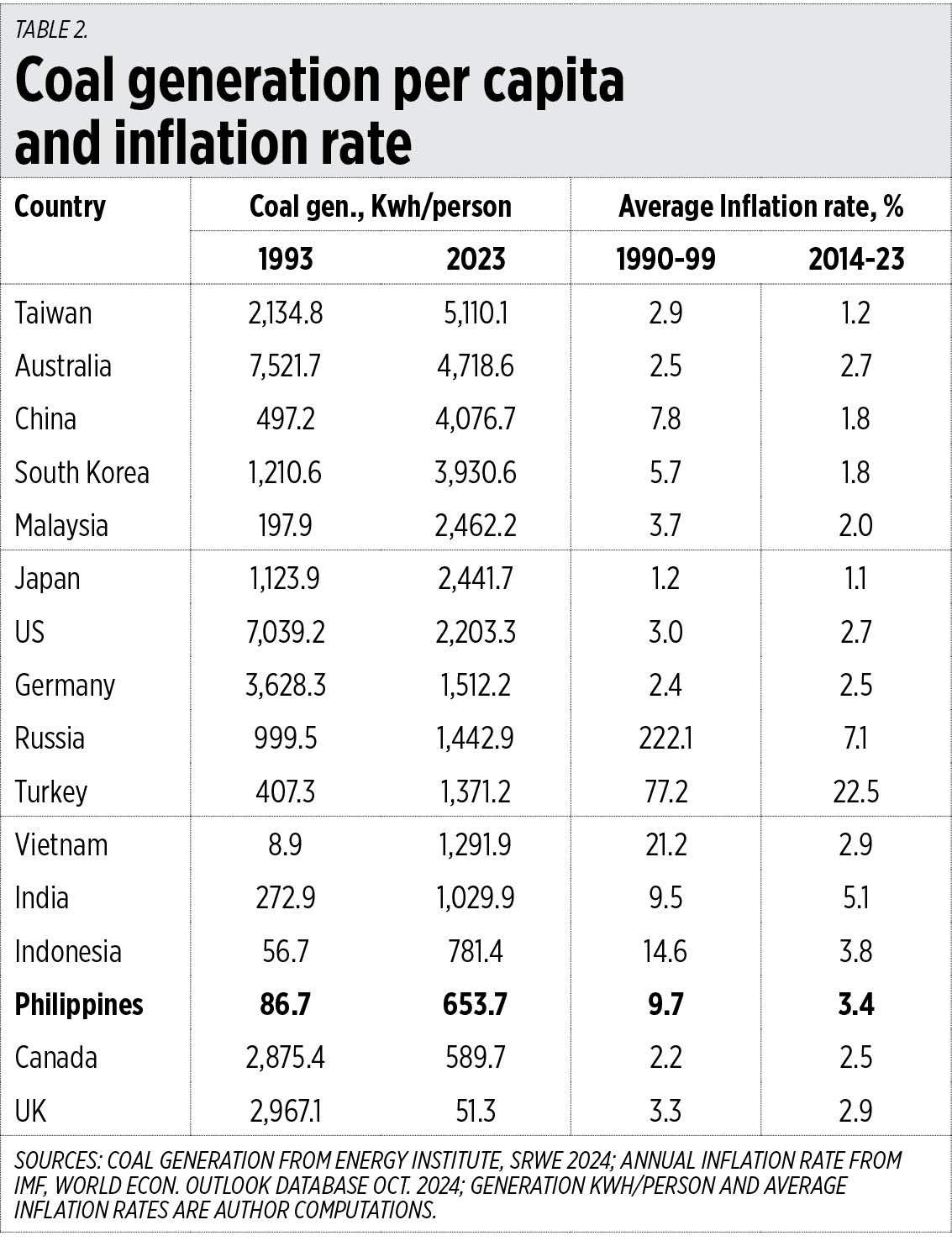
The numbers on total coal generation, population, and derivation of coal generation per capita were shown in this column’s previous article, “The Atimonan coal project, energy transition, and the ERC” (Sept. 19).

Despite the increase in the Philippines’ coal power capacity, our per capita coal generation remains the lowest in our neighborhood — it is, for instance, only one-half of Vietnam’s and only one-fourth of that of Malaysia.

We should not accede to the lobbying for the early shutdown of our coal plants unless there are huge gas or nuclear plants ready. If we do, we should be prepared for daily blackouts again like in 1990 and 1991. 


Bienvenido S. Oplas, Jr. is the president of Bienvenido S. Oplas, Jr. Research Consultancy Services, and Minimal Government Thinkers. He is an international fellow of the Tholos Foundation.

minimalgovernment@gmail.com

MPH partners with Intellicare and Avega to expand healthcare access

SIX METRO PACIFIC Health Corp. hospitals will participate in a preferred partnership program with Intellicare and Avega to offer healthcare services.

PANGILINAN-led Metro Pacific Health Corp. (MPH) has partnered with health maintenance organization Asalus Corp. (Intellicare) and Avega Managed Care, Inc., a provider of managed healthcare services, to expand healthcare access for Filipinos.

Under the partnership, six MPH hospitals will participate in a preferred partnership program with Intellicare and Avega to offer healthcare services, the company said in an e-mailed statement on Wednesday.

The participating hospitals include Asian Hospital and Medical Center in Muntinlupa; Calamba Medical Center in Laguna; Our Lady of Lourdes Hospital in Sta. Mesa, Manila; Riverside Medical Center, Inc. in Bacolod; De Los Santos Medical Center and Commonwealth Hospital and Medical Center in Quezon City.

“This strategic alliance combines MPH’s extensive network of top-tier hospitals nationwide, committed to high-quality, compassionate healthcare, Intellicare’s established expertise in managed healthcare, and Avega’s deep commitment to quality care to collectively offer Intellicare members a seamless, efficient, and affordable healthcare experience across the country,” MPH said.

Earlier in the month, MPH grew its portfolio to 27 hospitals with the acquisition of the City of General Trias Doctors Medical Center, Inc. in Cavite.

MPH is the healthcare arm of the Pangilinan-led conglomerate Metro Pacific Investments Corp. (MPIC).

Aside from its hospital network, MPH also has 33 outpatient care centers, two allied health colleges, and a centralized laboratory.

MPIC is one of three key Philippine units of First Pacific, the others being Philex Mining Corp. and PLDT Inc.

Hastings Holdings Inc., a unit of the PLDT Beneficial Trust Fund subsidiary MediaQuest Holdings, Inc., has a majority stake in BusinessWorld through the Philippine Star Group, which it controls. — Revin Mikhael D. Ochave

In Zimbabwe, Starlink’s fast internet gives telehealth a boost

STARLINK.COM

NHEDZIWA, Zimbabwe — In early November, Precious Chinonzura went to a telehealth, or e-health, booth in the local shopping center in her village in Zimbabwe to see if she could get relief from bladder pains that had been bothering her for a month.

The 30-year-old consulted a doctor online and by evening the medication he prescribed had been delivered to her village of Nhedziwa from a telehealth booth in Chakohwa, some 22 km (14 miles) away.

“The doctor told me I had a bladder infection and needed treatment. I had privacy and I spoke freely to the doctor,” Ms. Chinonzura, who runs a small business at the shopping center, told the Thomson Reuters Foundation.

Telehealth — the use of technology to provide and access healthcare services remotely — has been growing around the world but is relatively new in Zimbabwe, where internet services are generally slow, unreliable and among Africa’s most expensive.

This could change after Elon Musk’s Starlink, the satellite unit of SpaceX, received the telecom regulator’s green light in May to operate its internet services in the country.

Starlink first launched in Africa last year as satellite-internet becomes an increasingly popular connectivity solution in the continent, but it has faced teething problems — from complaints about speed to regulatory challenges.

ZimSmart Villages, which has been setting up telehealth services in Zimbabwe since February, has already connected two of its 16 e-health centers to Starlink and plans to connect five more by the end of November, said ZimSmart Villages cofounder and chief operations officer Tawanda Njerere.

There is no countrywide data on how many companies offer telehealth services in Zimbabwe.

Mr. Njerere said Starlink enabled ZimSmart Villages to allow access to its online health platform BatsiHealth, especially in underserved regions where connectivity can be a problem.

“Starlink provides the fast, low-latency connectivity that virtual consultations need for real-time telepresence on BatsiHealth,” he said, adding it is cost-effective.

“Our doctors can conduct video consultations with near in-person clarity, seeing fine visual details essential for accurate diagnoses.”

Zimbabwe’s health sector has been deteriorating for years as the ailing economy has been hit by chronic corruption, mismanagement, economic sanctions, and southern Africa’s worst drought in decades.

There are shortages of basic drugs like paracetamol, public hospitals are struggling and there is a lack of doctors and nurses, forcing people to turn to private health facilities.

As of 2022, Zimbabwe had 1.7 doctors per 10,000 people, according to the World Health Organization, compared to Africa’s average of 2.6 per 10,000 people.

STARLINK KIT TOO COSTLY FOR MOST
After first launching in Nigeria last year, Starlink is now operating in 15 countries in the continent, with Chad becoming the latest to approve the technology.

Starlink’s expansion across Africa has not been without problems — from complaints about cost and speed to regulatory challenges and resistance from local mobile operators.

Admire Mare, head of the communication and media studies department at the University of Johannesburg, said Starlink kits were too expensive despite its services being more reliable and faster than those of local providers.

Starlink’s basic internet package consists of an $170 kit and $30 monthly subscription, while at the high-end, the kit costs $350 and the subscription $50 a month. That is very costly for many in a country like Zimbabwe where a teacher, for example, earns about $350 a month.

By comparison, local provider Liquid Intelligent Technologies sells an equivalent high-end kit for $225, while its monthly subscription costs about $173.

Mr. Mare said there was a risk that the high cost of innovation would reproduce existing inequalities, since only the wealthy would be able to afford the cost of the Starlink kit and therefore be able to benefit from the cheaper internet services it provides compared to local operators.

“The rest of us are unfortunately going to remain locked up in using expensive broadband internet,” he said.

“When we talk about making sure that we bridge the digital divide some of these technologies are often presented as saviors (but they) are not going to save us.”

Some Starlink users in Zimbabwe’s capital city Harare and second-largest city Bulawayo have complained about slow speeds, with some returning to their traditional providers. The kits have also sold out in these cities, meaning new users cannot sign up for now.

Starlink has also faced regulatory challenges and resistance from state monopolies in some countries.

Cameroon ordered the seizure of Starlink equipment at ports earlier this year as Starlink was not licensed to operate in the country.

In Kenya, the country’s biggest telecoms firm Safaricom has urged regulators to consider requiring satellite internet providers such as Starlink to partner with local mobile network operators.

TRANSFORMING LIVES
Starlink’s presence in Zimbabwe already appeared to be helping consumers by connecting remote areas that are not covered by traditional internet service and by pushing local providers to reduce prices, said Dr. Danford Zirugo, assistant professor of journalism at the University of Alabama.

In August, Zimbabwe’s largest mobile operator Econet slashed prices of its SmartBiz package, which offers internet via a portable MiFi or small router, by 25%. It cut the price of its five megabytes per second unlimited package to $45 per month from $70.

Willard Shoko, a Starlink researcher and consultant, said Starlink’s presence in Zimbabwe could revolutionize its health sector though more ground stations were needed to boost services.

“When you connect hospitals and clinics to high-speed internet, it means that doctors from anywhere in the world can collaborate. This can be the difference between a life being saved and a life being lost,” he told the Thomson Reuters Foundation.

Back in Nhedziwa, Chinonzura said the benefits of telehealth centers were already proving to be immense.

If she hadn’t had access to an online doctor, she would have had to close her business and travel to the city of Mutare, 83 km (51.5 miles) away, or to Harare, nearly 350 km (217 miles) away.

“I could not believe it. I did not know that it was possible,” said the mother-of-two. “I will come here whenever I feel sick for consultation and checkups.” — Thomson Reuters Foundation

London’s pie and mash makers say Cockney favorite needs special status

MANZE.CO.UK

LONDON — Rick Poole grew up in his family’s pie and mash shop in London, the oldest of its kind still in operation today. Now a campaign to give the traditional dish protected status is giving him hope his business will continue to flourish for years to come.

Pie with mashed potato and parsley liquor has been enjoyed by the Cockney natives of east London since the first shops appeared there in the 19th century.

Back then, the pies were filled with eels as they were cheap and plentiful in the River Thames.

The eels have long been replaced with minced beef but jellied eels are still available on the side.

“It gives you a good feeling knowing that you are keeping this tradition alive for over 120 years,” said 61-year-old Mr. Poole, director of M. Manze, who owns several shops including the flagship in Tower Bridge which retains its original green tiles and furniture. The family took it over in 1902.

Mr. Poole said protected status would give businesses like his some security as it would stop others from falsely claiming they were making the dish in the traditional way.

Britain, like the European Union, grants protected status to food and drink that come from a defined area or follow a specific recipe as a guarantee of authenticity. Cornish pasties, Melton Mowbray pork pies, and Blue Stilton cheese are well known examples.

Campaigners, including from the Modern Cockney Festival, are calling on the government to grant Traditional Speciality Guaranteed (TSG) status to the London meal.

Rather than being a geographic label, TSG means products must use traditional methods of production or follow a traditional recipe.

All pie shops have their own unique recipes. But environment minister Daniel Zeichner has said that all producers would need to agree on a common recipe in order to receive the status.

Andy Green, founder of the Modern Cockney Festival, said the label would not only give shop-owners a “sense of belief that they are guardians of a culture” but may also boost the dish’s global recognition.

He said he hoped a decision would be made next year.

Mr. Poole’s daughter Emma Harrington, who is also a company director, said generations of Londoners had been brought up on pie and mash. “It’s in their blood and their heritage,” she said. — Reuters

Ateneo mathematicians develop AI tools to forecast money market rates

MATHEMATICIANS from the Ateneo de Manila University have developed artificial intelligence (AI) deep learning tools for predicting secondary market interest rates.

The AI learning models can be used by both the government and businesses to help manage risks and reduce borrowing costs, Ateneo’s Office of the Assistant Vice-President for Research, Creative Work, Innovation said in a statement.

The research paper titled “Deep Learning Approaches in Interest Rate Forecasting” and authored by Ateneo’s Halle Megan L. Bata, Mark Jayson A. Victoria, Wyonna Chezska B. Alvarez, Elvira P. de Lara-Tuprio, and Armin Paul D. Allado was published in the journal AIP Conference Proceedings on Nov. 15.

“Interest rates are among the most important macroeconomic factors considered by both government and private entities when making investment and policy decisions. A reliable forecast is a requisite to sound management of exposure to different types of risk,” the Ateneo researchers were quoted as saying.

The researchers tested two deep learning models for rate forecasting: the Multi-layer Perceptrons (MLP) and Vanilla Generative Adversarial Networks (VGAN).

The MLP model is a type of artificial neural network that passes the data through a series of cells to find complex patterns in data.

Meanwhile, the VGAN is made up of two networks — a synthetic data generator and a discriminator that determines data authenticity — that work opposite each other for analysis.

“Both successfully anticipated changes in Philippine Benchmark Valuation (BVAL) rates before and during the pandemic, showcasing the models’ robust capability to potentially foresee economic fluctuations and market disruptions… The researchers found that both models produced reliable forecasts of one-, three-, six-month, and one-year BVAL rates within the limits of the datasets used. They successfully predicted key trends by incorporating as many as 16 domestic and global economic indicators, including inflation, exchange rates, and credit default swaps,” Ateneo said.

Based on the research, the MLP model performed well with fewer variables and simpler structures, while the VGAN model excelled in analyzing complex scenarios and working with larger datasets.

“The practical implications of these AI deep learning models are substantial, according to the researchers: financial institutions could potentially deploy them to manage market, credit, liquidity, and other risks; and governments could also potentially use these models to optimize debt issuance strategies by reducing borrowing costs,” Ateneo said.

“The study highlights the growing role of AI in financial decision-making and suggests exploring more advanced neural network designs to further enhance forecasting accuracy. It is hoped that businesses and policy makers will come to embrace these technologies in order to gain a competitive advantage in a rapidly evolving data-driven landscape.” — Aaron Michael C. Sy

Losing gracefully

FREEPIK

WHEN JOINING any contest, the objective is to win, no matter how the odds are stacked against you. All the effort and competitive skills are brought to bear towards success. The participant may not deem it necessary to craft a victory speech ahead of time, since this may bring bad luck, but does he even bother to think of a concession speech in case he loses? (Is he even going to be interviewed for his comments?) Still, the contestant must always consider the possibility, sometimes a big one, of losing.

Political contests are classic examples of the need to prepare for defeat.

A concession speech, after a loss, should contain the following — Gracious thanks to the supporters for the sacrifices made (including being with the defeated candidate rather than switching too quickly to the victor on the other side  — that will come a week later), a reminder of the public service already rendered, an expression of the willingness to offer one’s talent to the people (who already rejected it), and the gratitude for having met so many from different walks of life understanding their dreams and aspirations, and maybe congratulating the winner and hoping for his future success in the new position. (This last one can be skipped.)

A public congratulation to the winner (He won’t have time to chat with the loser, anyway) and an offer, no matter how insincere, to help without asking for any concession or position in return may be seen as a desperate attempt to share in the media limelight.

Unless the contest is just between two candidates, the attendance at a concession speech is expected to be thin, especially in terms of media attention. The bigger crowd is in another place, more crowded and jubilant.

Seldom is any graciousness and acceptance expected from defeat.

Too often, the loser lashes out at the process that put him in the dark side of the stage, away from the lights of the television cameras which are in another part of the building  — with the winner. There may even be hints of cheating.

There may be a protest march, a prayer rally, or, nowadays just as effective as a platform for whining, filing a case in court, or an invitation for an international investigation from election watchers, maybe a combination of these to give vent to the frustrations of losing.

And yet, losers may in fact have been truly robbed of their mandate, as is the case in a country in Latin America. International organizations may even be supporting this claim.

Chasing a big prize requires energy and monetary as well as emotional investment. The contest changes the contestants. Rules can be set aside, previously stated beliefs tweaked to conform to the prevailing sentiment from focus groups. Those formerly held in contempt may have been sought for alliances. And old friendships may need to be abandoned.

All losers carry the burden of humiliation. Will analysts of what went wrong be far behind?

Those who lose contests seldom concede. They prefer to fade away and lick their wounds in private. Their point of view is no longer objective. Bad procedures, unfair advantages, terrible officiating, uneven application of the rules are offered as explanations for defeat. Seldom does the loser grant or even allude to the superior ability and execution of the winner.

Even in a contest like sports which is attended by crowds, the interpretation of the outcome can vary depending on affiliation and team support. A close game that could have gone either way is seen as a lost opportunity by the loser  — if only he made those foul shots.

The art of losing has seldom been perfected. Why should it be? The focus of attention is on the winner. The loser is a sideshow undeserving of any public reaction. After all, one does not want to be too good at giving concession speeches. All the effort and practice go into trying to compete fiercely, and winning, and then preparing a victory speech before a big crowd.

But it is a fact of life that there are fewer winners than losers. It is the singular gold medalist that attracts cash prizes along with celebrity status. Brave efforts that almost got an athlete to the podium may be warmly extolled in private. A concession speech becomes unnecessary — even embarrassing.


Tony Samson is chairman and CEO of TOUCH xda.

ar.samson@yahoo.com

Huawei launches Mate 70 smartphone as new US chip curbs loom

REUTERS

SHENZHEN, China — Chinese tech giant Huawei Technologies unveiled its Mate 70 smartphone series on Tuesday, marking a significant step in its premium smartphone comeback while showcasing its own operating system in a clean break away from US technology.

The phone marks the “the most powerful Mate phone ever,” Richard Yu, chairman of Huawei’s Consumer Business Group, said at an event in the company’s hometown of Shenzhen.

The Mate 70 is the first mainstream smartphone to include a satellite paging system, has an improved processor and runs on Huawei’s own HarmonyOS Next operating system, which together boost performance by 40% compared to previous models, Mr. Yu said.

The launch comes as the US is expected to announce new export controls that could add up to 200 Chinese chip companies to a trade blacklist as soon as this week, restricting their access to US suppliers, Reuters reported on Saturday.

Huawei does not typically discuss its chip advancements at product launch events, with improvements usually discovered by teardown firms later.

The Mate 70 series is the first major commercial rollout of the HarmonyOS NEXT, a significant step in Huawei’s push for software independence since US curbs cut off its access to Google services in 2019.

While Huawei’s earlier versions of Harmony OS maintained Android compatibility, the HarmonyOS NEXT, which began public testing this year, represents a complete break from Android.

Last week, Huawei said it had secured more than 15,000 applications for its HarmonyOS ecosystem, with plans to expand to 100,000 apps in the coming months.

The patriotic sentiment surrounding Huawei’s technological breakthrough has helped fuel its market recovery and intensified competition with other players, including iPhone maker Apple, in China — the world’s largest smartphone market.

Huawei was ranked as China’s No.2 smartphone vendor in the third quarter of 2024, with deliveries exceeding 10 million units for the fourth straight quarter, according to research firm Canalys. This is a significant rebound from the second quarter of 2022 when it shipped just 4.1 million units.

The Mate 70 is the successor to the Mate 60 series released in August last year, widely seen as marking Huawei’s comeback to high-end smartphones.

Teardown analyzes revealed both the Mate 60 and the Pura 70 series — launched in April — feature advanced chips manufactured by China’s SMIC, underscoring the country’s growing semiconductor capabilities despite Western export controls. — Reuters

PLDT introduces ‘Always On’ service

BW FILE PHOTO

PANGILINAN-LED PLDT Inc. has introduced the country’s first-ever “uninterrupted” broadband service connectivity.

“Seamless broadband connectivity is no longer a convenience but rather a necessity. It is actually similar already to our utilities of water and electricity, which we need always on, always available,” Roy Victor E. Añonuevo, vice-president and head of PLDT Home Broadband Product Management, said during a briefing on Wednesday.

PLDT Home’s “Always On” broadband service is said to be the first of its kind in the country.

Mr. Añonuevo said the add-on service for PLDT Home Fiber will cost around P299 per month.

The service provides a hybrid modem that automatically switches a customer’s connection from fiber to LTE in case of service interruption, similar to a generator set for electricity.

The service also sends automatic triggers to PLDT, notifying it of a line problem in the event of an interruption, while also giving its subscribers priority service for repairs.

“We call this ‘Always On.’ In the event of a service interruption, you don’t need to worry about losing access to the internet. Even with a severed cable, you will stay connected and pursue your online activities with minimal interruption,” said Senior Vice-President and Head of Home Business Group Jeremiah M. de la Cruz.

PLDT has allocated P75 billion to P78 billion for capital expenditures this year for mobile, port rollout, data centers, and submarine cables.

At the stock exchange on Wednesday, shares in the company closed P34, or 2.57% lower, to end at P1,290 each.

Hastings Holdings, Inc., a unit of PLDT Beneficial Trust Fund subsidiary MediaQuest Holdings, Inc., has a majority stake in BusinessWorld through the Philippine Star Group, which it controls. — Ashley Erika O. Jose

Tips for holiday travelers as new US consumer protections kick in

CLAUDIO SCHWARZ-UNSPLASH

NEW YORK — If you thought last year’s holiday travel was insane, well, buckle your seatbelt.

American Automobile Association projects 79.9 million Americans will travel 50 miles or more from their home over Thanksgiving, an increase of 1.7 million over last year. Transportation Secretary Pete Buttigieg says this could make for some of the busiest travel days in American history.

At airports, the crowds will put a lot of stress on the system: Security lines, staffing shortages, equipment snafus, potential delays and cancellations.

But there is good news for consumers: New rules and regulations are designed to make it easier for travelers to get compensated when things go wrong.

Here are tips from the experts.

1. ENJOY NO-HASSLE REFUNDS

Previously, if your flight was screwed up and you wanted a refund, you may have been out of luck.

But now this entitlement has been codified into law.

“If there is a snowstorm in Chicago and you can’t get to Thanksgiving dinner, airlines should now offer a refund automatically without making you jump through hoops,” says John Breyault, travel expert for the National Consumers League.

A caveat: This only applies if you want a refund rather than being rebooked to your destination. If you file for a refund and then have to book a new last-minute ticket, it could end up costing you through the nose.

Other factors to know: The new rules only apply to flights booked after Oct. 28. And the rules only kick in when there is a “significant delay” of at least three hours for a domestic flight and six hours for an international one.

2. PAY ATTENTION TO YOUR NOTIFICATIONS

Turning your phone off or leaving it on silent mode? Big mistake.

“Make sure the airline can text and e-mail you, and install their app on your phone,” says Teresa Murray, consumer watchdog director for the advocacy group US Public Interest Research Group.

“Because if something is going on, you need to know about it quickly — and if you don’t respond to them, it’s on you.”

3. CHECK THE DASHBOARD

When it comes to meal or hotel vouchers for disrupted flights, the airlines all have different commitments that they have made to the Department of Transportation.

“It is up to the airlines to decide their own policies, but they do have to say what they will do for passengers in case of delays,” says Mr. Breyault. “And that is enforceable by law.”

Find that information on the consumer dashboard FlightRights.gov, which lists exactly what you can expect from the nation’s top 10 carriers. Ideally, do your research long before you go to the airport, so you are prepared if chaos hits.

Keep in mind that there is a difference between “controllable” events and those that are not. Staffing or maintenance problems are considered controllable, for instance. But a hurricane obviously isn’t. So in that case the airline would not have the same obligations to the traveler.

4. ASK — NICELY

Customer service responses from airlines are rarely uniform: How smooth your experience is after a problem may depend on the individual you are dealing with.

Remember that the airline representative is a person doing their job and likely is as stressed out as you are. So be polite, Ms. Murray says.

“That person you are talking to didn’t cause your travel problem — so don’t be nasty,” Ms. Murray says. — Reuters

Tala looks to expand customer base to 10M in next three years

TALA PHILIPPINES is eyeing to grow its customer base to 10 million within the next three years as it also seeks to widen its reach to other Southeast Asian markets.

“Where we are at the moment globally, we would like to be in the Philippines in three years from now, so at around 10 million customers,” Tala Philippines General Manager Moritz Gastl said at a briefing on Wednesday.

The financial technology company currently has over three million customers in the Philippines and over 10 million worldwide.

“We still believe that it’s about improving and increasing reach — so, reaching more customers in the Philippines with our existing product, because we do feel that it provides a lot of value and that means really going deeper into certain market segments,” he added.

Tala has disbursed over P100 billion worth of loans in the Philippines, with 500,000 loans granted globally on a monthly basis.

Apart from the Philippines, Tala is also looking to expand its presence in other markets in the region.

“We are actually expanding to other markets in Southeast Asia in the next year or so,” Tala Philippines Senior Marketing Manager Missy de Rivera-Santos said.

“We have proven in several markets now that our model works, that its a very successful product, our customers like the product and therefore we are slowly looking at expanding this to other countries,” Mr. Gastl added.

He said they are closely looking at Vietnam as their next potential destination.

“But we have no rush. We still feel like there is a large opportunity in the Philippines. You think there’s so many players, but in reality, there are still massive gaps in the market,” Mr. Gastl added.

Tala is also working on expanding its product line in the next few years to cater to segments such as micro, small and medium enterprises (MSMEs), he said.

“We look at specific segments and potentially structure new products around these segments. These MSMEs, they’re currently using the Tala loan to buy inventory. Luckily, our product is flexible enough to allow for that, but an inventory loan is a different loan product from the product that we have at the moment.”

Roughly 38% of Tala’s borrowers are informal MSMEs, he said, but noted that it is difficult to estimate the exact number given how broad the sector is.

“Over time, we really hope, in the next one or two years, we hope to actually have a dedicated product for larger product segments,” Mr. Gastl added.

Tala currently offers a flexible credit line capped at P25,000, but they are looking at raising this limit in the future.

“We will certainly increase that further, but we are focusing a lot on giving customers access in the first place,” Mr. Gastl said.

“We are aware that sometimes P1,000 may not be enough, but at least it’s a way in the door.”

Over time, Tala is planning to upgrade its credit limit to ideally P50,000, he said.

“At some point, maybe even P100,000 at cheaper rates than what we’re offering at the moment, but this is really something more like a three-year plan because over time we need to learn more about the customer and give them better loans,” he added.

Tala will also continue to focus on credit alone, Mr. Gastl said.

“We’re not positioning ourselves to be like the next super app that has a lot of other features. The focus is really on there’s a massive need for credit. Customers are underserved. We want to make sure that we give a good credit product at a good price to the right customers,” he added.

Tala is also working on offering QR payments, which will soon be available to clients.

“We still have a lot of work to do in terms of our industry in general. People don’t always have a positive relationship to credit in the Philippines, and that’s really something that we’re trying to overturn,” Mr. Gastl said.

FINANCIAL LITERACY
To improve credit perception, Tala offers various initiatives on financial literacy to educate Filipinos on credit use and financial management.

It is also currently working with the Atlantic Council Geoeconomics Center for a research partnership on the “global majority.” The global majority mainly refers to women, children, MSMEs and individuals that make up the largest percent of the population, but are more likely to be unbanked and underserved, according to Tala.

“It doesn’t just end with a bunch of data and numbers, but really it sets the groundwork as a reference to influence policy,” Ms. de Rivera-Santos said.

This would also ensure that “investors and stakeholders can actually use this information to create a more inclusive, financially inclusive industry here in the Philippines,” she added.

Tala Philippines External Affairs Director Arianne Ferrer noted the gaps in knowledge on the state of finance in the Philippines.

“That’s what we’re working with this entity to study more about. What are the metrics? How do we make sure these standards of measurement are consistent throughout countries and throughout regions? Because there’s so much data that’s not adequately captured by existing mechanisms.”

The research could help the industry develop frameworks that can be used in the future, she added.

“It’s really the beginning of a conversation, and we’ll try to get various stakeholders in the public sector and the private sector. It’s really getting everybody on the same page and collaborating research, active engagement with the community,” Ms. Ferrer said. — Luisa Maria Jacinta C. Jocson

National Government fiscal performance

THE NATIONAL Government’s (NG) fiscal position swung to a surplus in October, driven by a 23% jump in revenues, the Bureau of the Treasury (BTr) said on Wednesday. Read the full story.

National Government fiscal performance

How PSEi member stocks performed — November 27, 2024

Here’s a quick glance at how PSEi stocks fared on Wednesday, November 27, 2024.