Home Blog Page 199

Philippine central bank warns oil at $100 may trigger rate hike

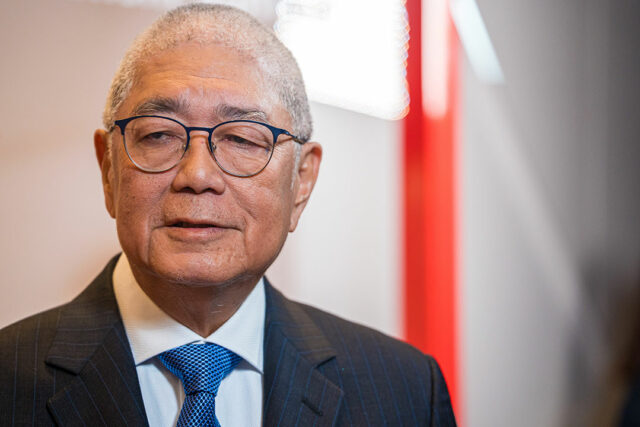
BANGKO SENTRAL ng Pilipinas Governor Eli M. Remolona, Jr. — LAM YIK/BLOOMBERG

BANGKO SENTRAL ng Pilipinas (BSP) Governor Eli M. Remolona, Jr. said oil reaching $100 per barrel could force monetary policy tightening as inflation could breach the central bank’s target range.

The Philippine central bank, which just cut its policy rate in February, now faces new risks from rising oil prices and a strengthening dollar. Mr. Remolona said that while the 10% increase in oil prices since the start of the Middle East conflict remains “manageable,” a 50% surge would require stronger intervention.

“It’s possible that at $100 a barrel, we will begin to breach what we call our tolerance range” of 4% inflation as it could also push up the costs of other commodities, Mr. Remolona said in an interview with Bloomberg Television’s Haslinda Amin in Bangkok.

“If oil prices rise sharply, persistently, then we have work to do,” he said on Friday.

Inflation in the Philippines accelerated to 2.4% in February, the fastest pace in over a year and puts the economy in a delicate position ahead of the expected surge in prices of goods amid the war in Iran.

The governor indicated the central bank has limited room to support economic growth, which he described as “lackluster” at 3% in the fourth quarter, falling short of the Philippines’ 5.5%-6% potential.

The economy is in what he called a “vicious circle” where “a lack of confidence affects growth and low growth affects confidence.”

“We’re hoping we don’t have to tighten in the face of higher inflation,” Mr. Remolona said. He added that if current risks don’t materialize, the central bank would likely maintain its current policy stance.

The BSP, which aims to keep inflation within the 2%-4% range, has reduced its key rate by 225 basis points so far and signaled it could be nearing the end of the easing cycle that began in August 2024.

Price increases are expected to quicken in coming months as the heightened conflict in the Middle East risks a sustained disruption in global oil supply. The concerns have already driven lower the Philippine peso, which has fallen by over 2% against the dollar since the US-Israel attacks began.

Even so, Mr. Remolona said the central bank’s appetite to intervene in the local currency market is “not a lot,” adding that it usually steps in if it’s worried about the pass-through effects of the peso’s fall on inflation.

The Philippines relies heavily on fuel and food imports and is widely seen by economists as one of the most vulnerable in the region to inflation and growth risks triggered by the conflict.

Despite these challenges, Mr. Remolona expressed confidence in the Philippine banking system, describing it as “very strong” with ample liquidity and capital buffers. — Bloomberg

GCash empowers MSMEs, drives financial literacy and digital inclusion through Wais Tindera Caravan

Sari-sari stores, local carinderias, and other micro, small, and medium enterprises (MSMEs) are the driving force behind the Philippines’ nearly P30-trillion economy.  Often referred to as its backbone, MSMEs represent 99.6% of all business establishments and generate 67% of total employment.

However, these establishments face persistent challenges that limit growth and resilience. Most sari-sari stores and carinderias still rely heavily on cash-only transactions, manual record-keeping, and informal credit systems (colloquially known as lista). While these traditional practices have sustained them for decades, they also expose MSMEs to inefficiencies, cash-handling risks, and even missed opportunities.

Recognizing this demand for digitalization, finance super app GCash recently conducted its latest financial literacy program, the Wais Tindera Caravan, which kicked off at Tunasan, Muntinlupa, on Dec. 5. The initiative aims to empower MSMEs with practical knowledge on finance and business while seeking to drive digital adoption through GCash’s Pera Outlet rollout and use of its Visa cards.

“MSMEs are the backbone of our economy, yet many close within five years because running a business in the Philippines remains challenging. Through our Wais Tindera financial literacy programs, we equip nano- and micro-entrepreneurs with practical skills to start, manage, and grow their businesses; and we introduce digital tools like GCash to help them run operations more efficiently and safely. This strengthens financial inclusion and supports a more resilient digital economy,”  GCash Assistant Vice-President for Sustainability CJ Alegre said in an interview.

As part of the initiative, the program featured a series of talks by the Muntinlupa Entrepreneurship Financing Division (MEFD), headed by Kate Ax’l T. Estojero, discussing the basics of managing a store, handling inventory, building a network of loyal customers, and utilizing digital tools for operations.

The event was also graced by Muntinlupa City Vice-Mayor Stephanie “Phanie” G. Teves, who highlighted the importance of supporting local entrepreneurs on the ground and the challenges their “muntipreneurs” face.

“The usual challenges that our micro-entrepreneurs or “muntipreneurs”, as we call them here in Muntinlupa, are the literacy on investment and capital direction. So, it’s challenging for them if their business is right in their capital direction and if the locations where they are building their business are correct,” she said.

“These gaps can be addressed through different digital platforms where, even in their houses, they can start their own business, and even their transactions are much more accessible and easier through digital platforms like GCash. So, the transactions are easier,” the vice-mayor added.

She further emphasized that as digital adoption accelerates among small businesses, strengthening their awareness of online risks has become just as important as providing them with new tools.

“Because our world is becoming digital, all transactions are becoming digital and online. It also comes with challenges where fraud or scamming becomes rampant. So, it’s very important for micro-entrepreneurs that we support them so that they can identify fraudulent or scam transactions,” Ms. Teves concluded.

Aside from the discussions, several booths kept participants entertained as they learned about various concepts in financial literacy. The interactive stations included areas focused on budgeting basics, responsible borrowing, smart saving habits, and digital security. Each booth featured engaging activities and simple explanations designed to help MSMEs understand essential money concepts, such as managing daily expenses and protecting themselves from scams.

Building on these learning activities, Mr. Alegre noted that GCash is also expanding and rolling out practical solutions that can help nano- and micro-entrepreneurs boost their income and strengthen their businesses.

“Most nano- and micro-entrepreneurs want to thrive, but many are still in survival mode. With GCash Pera Outlet Plus, sari-sari stores, salons, and small cafés can earn additional income by serving as cash-in and cash-out hubs, while gaining access to digital services like business loans. This transforms a regular tindera into a tech-enabled community partner, strengthening both their livelihood and the local economy,” he said.

Mr. Alegre explained that, other than providing new income streams, GCash is also focused on simplifying the digital shift for informal enterprises to make sure that even the smallest community businesses can participate in the modern economy.

“We make it easy for informal small businesses to go digital through simple online onboarding and fast approval, allowing sari-sari stores and micro-enterprises to offer cash-in, cash-out, and bills payment services. With GCash Pera Outlet and GCash for Business, they gain digital tools that track sales, manage transactions, and organize daily operations. This helps them transition into the formal digital economy and contributes to a more cash-lite and inclusive marketplace,” he said.

The caravan is aligned with the Bangko Sentral ng Pilipinas’ (BSP) commitment to broadening and enhancing financial participation following a report showing a slight decline in financial account ownership among Filipino adults between 2021 and 2024.

The World Bank’s The Global Findex Database 2025 report showed that only 50.2% of approximately 82 million Filipinos aged 15 years old and above had financial accounts in 2024, a decrease from the 51.4% recorded in 2021.

By providing MSMEs with practical financial knowledge and accessible digital tools, GCash helps businesses grow while promoting a safer and more efficient way to manage money. In this way, the finance super app gives back to the community it serves, down to even the smallest enterprises, empowering them to participate fully in the country’s digital economy.


Spotlight is BusinessWorld’s sponsored section that allows advertisers to amplify their brand and connect with BusinessWorld’s audience by publishing their stories on the BusinessWorld Web site. For more information, send an email to online@bworldonline.com.

Join us on Viber at https://bit.ly/3hv6bLA to get more updates and subscribe to BusinessWorld’s titles and get exclusive content through www.bworld-x.com.

DOST-PAGASA upgrades key weather facilities in Iloilo

The Iloilo S-Band Radar Facility will enhance weather monitoring capabilities in Western Visayas.—DOST-PAGASA
The Department of Science and Technology–Philippine Atmospheric, Geophysical and Astronomical Services Administration (DOST-PAGASA) on Friday marked a major step in the country’s weather modernization program with the launch of two key infrastructure projects in Iloilo.

The agency inaugurated the Iloilo S-Band Radar Facility and held the groundbreaking of a new synoptic station.

The radar facility, which is equipped with a state-of-the-art dual-polarimetric Doppler system, will improve weather monitoring across Western Visayas, PAGASA said.

It will provide high-resolution, real-time data essential for tracking heavy rainfall, severe storms, and tropical cyclones.

Operating at lower frequencies and longer wavelengths, the radar can detect atmospheric conditions to support reliable large-scale weather observations.

DOST Secretary Renato U. Solidum, Jr. said during his keynote address that the radar is a vital safeguard for the country against meteorological hazards.

“It is the combination of technology, skilled scientists, proactive leaders, and a well-informed public that truly builds resilience. This is why we continue to invest in modernizing PAGASA’s equipment, enhancing forecasting capabilities, and bringing science closer to communities,” Mr. Solidum said.

Meanwhile, the new synoptic station will serve as a vital weather observation facility in the province once completed.

Dr. Nathaniel T. Servando, administrator of DOST-PAGASA, highlighted the role of the synoptic station in the broader monitoring network, noting that accurate measurements are the foundation of every forecast.

He said the facility will deliver continuous and reliable observations of key atmospheric parameters.

“Without reliable observations, there can be no accurate forecasts, and without accurate forecasts, preparedness becomes a challenge,” he said.

DOST-PAGASA said the completion of these facilities underscores the agency’s commitment to modernizing its nationwide monitoring network and improving the delivery of reliable public weather services.

Through upgraded infrastructure and coordination with local governments and partner agencies, the agency aims to strengthen disaster preparedness and community resilience in the region. — Edg Adrian A. Eva

DepEd eyes new performance rating framework for teachers

DEPED.GOV.PH

The Department of Education (DepEd) said on Thursday that it is currently developing an improved framework to assess the performance of public school teachers, following concerns about the current classroom observation policy.

“The Department is currently working on a policy that focuses on teachers’ growth and performance,” it said in a statement.

The agency noted that the meeting between Education Secretary Juan Edgardo “Sonny” M. Angara and DepEd’s National Management Committee members discussed ways to eliminate “unnecessary stress” among educators during classroom teaching observations.

DepEd said classroom observation is a “uniform measure to assess teacher performance, identify needs, and provide support for professional development.” It is also one of the significant factors considered for teachers’ promotion.

In January, the death of a public school teacher during the scheduled classroom observation caused groups to raise their concerns about the pressure teachers face during the evaluation process.

The Alliance of Concerned Teachers (ACT) said that the Results-based Performance Management System (RPMS) is a “burdensome” process for teachers, causing additional stress.

Meanwhile, for the Teachers’ Dignity Coalition (TDC), reinstating the Performance Appraisal System for Teachers (PAST) is a “simpler and more developmental alternative” to the evaluation process.

To enhance the assessment procedure, the key components of the proposed policy are Learner Evidence, Professional Artifacts, Collaboration and Professional Engagement, and a Single Classroom Observation.

Each category has a 25% weight in the overall evaluation to ensure a proportionate rating system for teachers’ performance.

The framework of the policy also aims to promote professional growth, effective workload management, and improved learning outcomes.

“Muli, patuloy tayong magsusulong ng mga polisiya at programa para sa ikabubuti ng ating mga kaguruan [Again, we will continue to push for policies and programs that will benefit our teachers],” Mr. Angara said in a news release.

“President Bongbong Marcos has emphasized time and again the need to protect the welfare of our teachers—and we remain steadfast in carrying out this directive,” he added. — Almira Louise S. Martinez

PHL wholesale price growth slows down in January

psa.gov.ph

Price growth of wholesale goods eased to an over six-year low of 1.6% in January dragged by slower annual increase in chemicals including animal and vegetable oils and fats, the Philippine Statistics Authority (PSA) reported on Friday.

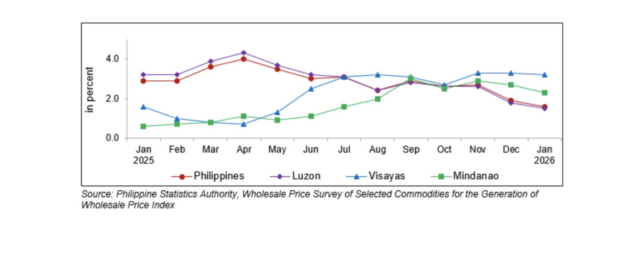
Preliminary data from the PSA showed the general wholesale price index (GWPI) at the national level slowed down to 1.6% year on year in January from 2.9% a year earlier and 1.9% in December 2025.

This was the slowest growth in over six-years or since the 1.5% growth posted in July 2019.

The PSA attributed the slowdown in bulk price to the index of chemicals including animal and vegetable oils and fats at 2.5% in January from 5.1% in December 2025. The index accounts for 10.1% of the wholesale basket of goods.

The PSA also noted slower growths in beverages and tobacco (2.1% in January from 3.2% in December), crude materials, inedible except fuels (3.1% from 13.3%), and machinery and transport equipment (0.3% from 0.8%).

The mineral fuels, lubricants and related materials index saw a year-on-year decline of 0.4% from a 2.8% growth in December 2025.

Faster annual growths were recorded in food (2.7% in January from 2.2% in December), manufactured goods classified chiefly by materials (0.3% from 0.2%), and miscellaneous manufactured articles (0.6% from 0.4%).

GWPI by major island group were mixed in January.

The GWPI of Luzon eased to 1.5% in January from 3.2% a year earlier and 1.8% last December. This was also the slowest in over six years or since the 1.4% in July 2019.

In the Visayas, GWPI grew by 3.2% year on year from 1.6% in January 2025. However, it was slower than the 3.3% in December 2025.

Meanwhile, GWPI in Mindanao grew 2.3%, accelerating from 0.6% in January 2025 but easing from 2.7% in December last year. This was the slowest in five months or since the 2% in August 2025.– Isa Jane D. Acabal

Australia complains to China after encounter between military helicopters

STOCK PHOTO | Image by Rebecca Lintz from Pixabay

SYDNEY – Australia has raised concerns with China following an “unsafe and unprofessional” encounter between two military helicopters, the defense department said on Friday.

An Australian military helicopter was flying over international waters in the Yellow Sea when it was intercepted by a Chinese helicopter on Wednesday, a statement said.

The Chinese helicopter matched the Australian aircraft’s altitude before “closing in to an unsafe distance”, increasing speed and then rolling towards it, requiring the Australian crew to take “evasive action”.

“This was an unsafe and unprofessional maneuver that posed a risk to our aircraft and its personnel,” the statement said.

Australia was undertaking a routine patrol in the Yellow Sea as part of the international effort to enforce United Nations Security Council sanctions against North Korea, it said.

No injuries were reported in the encounter between the People’s Liberation Army-Navy helicopter and the aircraft of the Australian Defense Force.

The incident is the latest in a series of military encounters involving China that Australia has called out publicly in similar terms.

In October, it also criticized as “unsafe and unprofessional” the actions of a Chinese fighter jet that dropped flares near one of its maritime patrol planes.

The Chinese embassy did not immediately respond to a request for comment. — Reuters

Romania will not host nuclear components on its territory for deterrence, says president

Romanian and European Union flags flutter, with a rainbow in the background, outside the Parliament in Bucharest, Romania, May 18, 2025. — REUTERS

BUCHAREST – Romania will not host nuclear components on its territory in the medium term, centrist President Nicusor Dan said late on Thursday, in response to French plans to expand nuclear deterrence and collaborate with European partners.

Earlier this week, President Emmanuel Macron said France would expand its nuclear arsenal and potentially allow European partners to host French warplanes on nuclear deterrence missions.

France and Germany have established a nuclear steering group to discuss deterrence issues and will start concrete cooperation this year. Greece, Poland, the Netherlands, Belgium, Denmark, and Sweden could take part in French nuclear wargames, Mr. Macron said, while on Tuesday Romania said it too had been invited to talks.

“As a NATO state, Romania is under the NATO nuclear umbrella provided by the United States,” Mr. Dan told reporters after an official visit to Warsaw.

“Being protected by the NATO umbrella does not imply the presence of nuclear elements on Romanian territory, and in the medium term, hosting nuclear components is out of the question.”

Though France and Britain are both nuclear powers, most European countries have relied primarily on the United States for deterring any potential adversaries — a decades-old pillar of transatlantic security.

Mr. Macron’s initiative comes amid criticism from the Trump administration of Europe’s willingness and ability to defend itself and also amid concerns about growing global geopolitical instability as the United States and Israel strike Iran. — Reuters

Nepal’s vote count puts ex-rapper’s party ahead in two-thirds of seats

A demonstrator holding Nepal’s flag celebrates at the Singha Durbar office complex that houses the Prime Minister’s office and other ministries after storming it during a protest against Monday’s killing of 19 people after anti-corruption protests that were triggered by a social media ban, which was later lifted, during a curfew in Kathmandu, Nepal, Sept. 9, 2025. — REUTERS/NAVESH CHITRAKAR

KATHMANDU – The party of Nepali rapper-turned-politician Balendra Shah was ahead on Friday in more than two-thirds of seats where leads were available in general elections, outpacing rivals, including the former prime minister ousted in last year’s uprising.

Mr. Shah, 35, the former mayor of Kathmandu, the capital, has dominated the race to become prime minister during the campaign, gaining near-rockstar like fame on social media across the Himalayan nation in the wake of the youth-led uprising.

“I voted for Rastriya Swatantra Party because Balen is there,” said Deepak Adhikari, 33, after voting for Mr. Shah’s party in Kathmandu on Thursday, referring to the youthful leader by his popular name.

“I believe he will become prime minister and make the country prosperous.”

By noon on Friday his centrist Rastriya Swatantra Party, founded three years ago, was leading in 52 of the 65 seats for which leads were available.

Vote counting was underway for 165 seats filled by direct election from a total of 275 in Nepal’s lower house of parliament, while the rest are to be decided by a system of proportional representation.

Trends showed former Prime Minister K P Sharma Oli’s Communist Party of Nepal (Unified Marxist-Leninist-UML) was leading in four, and the Nepal Congress, the country’s oldest party, was ahead in six.

Mr. Shah, who drew huge crowds during his election campaign, was leading over Mr. Oli in the latter’s home constituency of Jhapa 5 near the Indian border.

Results for the direct elections are likely to be clear by Friday evening or Saturday, officials said.

If Mr. Shah is able to take power, it would cap a dramatic rise for a man who entered the public spotlight with rap music critical of the establishment and seeks to ride his popularity to high political office.

Political instability has plagued the nation of 30 million perched between China and India for decades, crippling a largely agrarian economy battling worsening unemployment and rampant corruption.

The long-festering malaise erupted into street protests last September, triggered by a social media ban that brought thousands on the streets, causing clashes and deaths that led to the resignation of Mr. Oli.– Reuters

Factory output slows in January

Workers are seen inside a manufacturing facility in Sto. Tomas, Batangas in this file photo taken on March 1, 2023 — PHILIPPINE STAR/KJ ROSALES

Manufacturing output eased to a two-month low in January dragged by contractions in food and transport equipment as well as sluggish growth in other non-metallic mineral products, the Philippine Statistics Authority (PSA) reported on Friday.

Preliminary results of the PSA’s latest Monthly Integrated Survey of Selected Industries (MISSI) showed factory output, as measured by the volume of production index, slowed by 1.2% year on year in January.

This was slower than the 3.2% growth in January 2025 and the revised 2% increase recorded last December.

It was also the weakest growth in two months or since the 0.6% uptick in November last year.

The sector’s output has been in positive territory for nine straight months.

Month on month, January’s output grew by 4.7%, from a 3.6% decline in December. Stripping out seasonal factors, it inched up by 2.8% from 1.1%.

In comparison, the Philippines in S&P Global Manufacturing Purchasing Managers’ Index (PMI) expanded 52.9 in January from 50.2 in December. It was the fastest pace in nine months or since the 53 expansion logged in April 2025.

PMIs are a leading indicator for factory activity, reflecting the volume of materials purchased in advance of manufacturing operations weeks or months down the line. A reading above 50 separates expansion from contraction.

Marco Antonio C. Agonia, an economist at the University of Asia and the Pacific, said that the slip in manufacturing activity points to the “muddling through” narrative of 2026.

“While we expect economic activity to slightly recover this year, the absence of concerted efforts to restore business confidence and improve business operations appears to continue weighing on industrial activity,” he said in an e-mail.

Data from the Bangko Sentral ng Pilipinas’ inaugural monthly business expectations survey (BES) showed that businesses had a current-month confidence index (CI) of 0.9% in January.

While the positive value indicated business optimism, the figure was a crash from the quarterly CI of 29.7% seen in the fourth quarter of 2025.

Rizal Commercial Banking Corp. Chief Economist Michael L. Ricafort said that the industrial production slowdown in January is largely attributed to political scandal last year that curbed infrastructure spending, with anti-corruption reforms dampening demand across supply chains and weighing down on manufacturers.

“Higher tariffs could have weighed on global trade, adversely affecting manufacturers that are part of the global supply chains of exporters,” Mr. Ricafort said in an e-mail.

In a phone interview, Philippine Chamber of Commerce and Industry Honorary Chairman Sergio R. Ortiz-Luis, Jr. said that business uncertainty caused by further potential US tariffs contributed to the slip.

According to the PSA, the slowdown in factory output in January was due to the sharp annual declines in the heavily weighted food index.

Food manufacturing’s VoPI dipped by 0.5% in January from the 14.9% growth in December and a reversal from the revised 15.5% growth a year earlier.

The food products index accounted for 18.7% of manufacturing activity.

Meanwhile, slowdowns were recorded in other non-metallic mineral products (6.8% in January from 32.4%in December), and transport equipment (-1.9% from 5.8%).

Eight other divisions logged declines while the remaining 11 posted expansion.

Additionally, the PSA said that the top three industry divisions that contributed to the overall year-on-year growth in the VoPI were computer, electronic and optical products (23.6% from 14.1%), beverages (21.1% from 4.8%), and electrical equipment (16.7% from 11.4%).

Mr. Agonia said that the sudden plunge in food manufacturing growth may be attributed to seasonal adjustments and manufacturing conditions.

“Food manufacturers likely scaled down production after the holiday season, while cost pressures continue to build. We note that growth in the Producer Price Index (PPI) has been accelerating since November last year, largely driven by the food products segment,” he said.

Year on year, the PPI grew by 1.5% in January 2026, from the 0.9% posted in the same period last year, and the 0.8% in December, PSA data showed.

Its food subindex grew by 1.3%, higher than the 0.4% in January 2025 and reversing the 0.1% contraction last December.

For the following months, Mr. Agonia said that people are monitoring movements in global oil prices following conflict escalation in the Middle East.

“These higher oil prices are expected to raise production costs for most economic sectors, leading to deterioration in manufacturing conditions and higher retail prices.”

Mr. Ortiz-Luis said that that continued discussions with the US is necessary to improve factory outputs.

“It’s like we have no leverage with them. And [we’re pushing them to] define what exactly the applicable tariffs are,” he said.

Average capacity utilization — the extent industry resources are used in producing goods — averaged 77.8% in January, slightly higher from the 77.6% in December and 76.2% in January 2025.

All industry divisions reported capacity utilization rates above 60%, with coke and refined petroleum products reporting the highest rate at 84.5%. — Pierce Oel A. Montalvo

BFAR cites success of annual fishing ban in increasing galunggong stocks

The annual closed fishing season for roundscad (galunggong) has been instrumental in ensuring sustainable yield and enhanced volume production, the Bureau of Fisheries and Aquatic Resources (BFAR) said, citing the success of the science-based approach in Palawan.

BFAR National Director Elizer Salilig said this fishing cycle, which has been enforced for over 10 years, allows the galunggong to thrive in Palawan waters, ensuring ecological balance and economic success for the local fishing industry.

Galunggong is a dining staple among Filipino families, known to be relatively more affordable than other options. In Palawan, it sells for between P150 and P200 per kilo.

“The success of the annual roundscad fishing cycle in Palawan shows what we can do together through science and discipline. It proves that science-based conservation is not a hindrance to the fishing industry, but its greatest ally,” said Mr. Salilig.

The National Stock Assessment Program has confirmed the positive impact of the annual fishing hiatus, said Salilig.

The annual fishing ban contributed to improved volume of roundscad production at 3,363.75 MT in the third quarter of 2024, a sequential increase of 55.1%. It was the top contributor to the total commercial fisheries production in MIMAROPA, accounting for 27.1% of the total fish catch.

Enforcement of the fishing cycle has also led to a decrease in fishing mortality and the amount of immature galunggong in the catch. The roundscad also showed an increase in average length from 16.8 cm in 2015 to 17.6 cm in 2024, suggesting “improved growth and a healthier, more mature population.”

The closed season for commercial fishing of roundscad in Northern Palawan takes effect every Nov. 1 to Jan. 31 and is lifted between Feb. 1 and Oct. 31. This fishing cycle, implemented via a 2015 administrative order, covers the West Philippine Sea and the Northern Sulu Sea.

This policy leaves the galunggong breeding ground largely undisturbed during the closed season, protecting the species during its peak spawning period.

Mr. Salilig thanked the Palawan fishing community for continuing to comply with the annual fishing cycle.

“By respecting the natural spawning cycles of the galunggong, we are not just protecting an ecosystem; we are securing the food supply and the livelihoods of thousands of Filipino fishers for years to come,” he said.


Spotlight is BusinessWorld’s sponsored section that allows advertisers to amplify their brand and connect with BusinessWorld’s audience by publishing their stories on the BusinessWorld Web site. For more information, send an email to online@bworldonline.com.

Join us on Viber at https://bit.ly/3hv6bLA to get more updates and subscribe to BusinessWorld’s titles and get exclusive content through www.bworld-x.com.

Greenfield to continue township developments amid cautious economic outlook

Mark Dantes at the Fit Crawl 2026 event in Greenfield District, Mandaluyong City. — EDG ADRIAN A. EVA

Greenfield Development Corp. (GDC) said it will continue developing its townships and future projects, including wellness-focused initiatives, despite a “cautious” outlook for the country’s real estate sector.

Mark Dantes, vice president–strategic landbanking division head at GDC, told BusinessWorld that although the sector has been challenging for the past few years, the company has done very well in landbanking for future developments.

“So now that we’re in that stage where we want to activate all these different properties,” Mr. Dantes said during the sidelines of Fit Crawl 2026 on Wednesday.

“In terms of outlook, of course, there’s still a bit of, you know, you don’t want to go too all out,” he added.

Mr. Dantes said the real estate sector is still expected to post growth this year, despite weaker economic performance in 2025. Analysts said the slowdown was partly due to plunged infrastructure spending following issues with flood control projects.

One of GDC’s upcoming projects is Greenfield City Biñan, a 110-hectare development near the Greenfield City–Unilab Interchange in Laguna.

GDC said the development will be designed with plenty of open spaces and greenery, with a strong focus on education.

“It will get started soon and it’s definitely in the timeline,” Mr. Dantes said.

Meanwhile, phase one of Greenfield Hillsborough, a 20-hectare neighborhood a few meters from Alabang, is ongoing, he noted.

GDC is also rolling out projects that promote overall wellness, including Diagonal Park, a mixed-use public space soon to rise in its Greenfield District township in Mandaluyong City.

In its 400-hectare township in Sta. Rosa, Laguna, Mr. Dantes said GDC is about to announce a park-inspired project modeled after Boston’s Emerald Necklace, set to launch in the second quarter of this year.

GDC has a total of two main townships, he said.

Mr. Dantes also said that wellness-focused projects such as parks and open spaces are a deliberate pursuit and part of GDC’s guiding philosophy, “Wellness Belongs Here. We Belong Here,” which places people’s well-being and community connection at the core of its masterplan.

“So most developers turn parks into parking lots, right? We’re actually a developer that turns parking lots into parks,” he said.

In the coming years, GDC will continue integrating this philosophy into its future developments by creating parks and open spaces that foster community interaction and designing walkable townships that encourage residents to move around on foot, Mr. Dantes said.

Underscoring this guiding philosophy, GDC also held its experiential and multi-sport wellness event, Fit Crawl 2026, in the 15-hectare Greenfield District. The event gathered influencers, media, and community members.

Now in its second year, Mr. Dantes said the event showcases the Greenfield District’s activity hubs where people can begin their wellness journeys.

“The difference between the first Fit Crawl and the second Fit Crawl is that this year actually involves people from the community. These are the people who live, work, and dine here,” he said.

BusinessWorld had the chance to participate in and experience several activity hubs in the township, including indoor rock climbing, padel, yoga, dancing, and other wellness activities.

As a first-timer in some of these activities, the hubs proved to be beginner-friendly, with dedicated instructors available at each area to guide participants.

The activity hubs are also easily accessible, as they are located close to one another within the township.

Mr. Dantes said that the activity hubs at Greenfield District are open to anyone who wants to try them.

“Whatever skill level you are, whether you’re an expert or just starting, you’re welcome to join us. We have a community here to help teach you,” he said. — Edg Adrian A. Eva

EU trade head says US has given assurance it will honor trade deal

REUTERS

TORONTO — European Union Commissioner for Trade and Economic Security Maros Sefcovic said on Thursday he believed the US would respect the terms of the trade deal signed with the EU last year after receiving assurances from his American counterparts.

“I believe that the United States will honor the deal because this was the reassurance I got from my American partners,” he said.

President Donald Trump’s executive order from last month, after the Supreme Court struck down most of his global tariffs, imposed a 10% tariff on imports. But US Treasury Secretary Scott Bessent said Wednesday that those rates would likely rise to 15% later this week.

Mr. Trump and European Commission President Ursula von der Leyen concluded a deal at Mr. Trump’s Turnberry golf course in Scotland last July which set a broad 15% US tariff for most EU exports.

However, unlike the tariff terms of the EU-US trade deal, the new surcharge applies in addition to the most-favored-nation rate, meaning some EU exports could face higher tariffs than before.

Mr. Sefcovic’s remarks came in Toronto, Canada where he signed an agreement with Canada’s Trade Minister Maninder Sidhu to expand trade ties and ease trade rules under their existing pact as countries across the world strive to increase non-US trade.

The agreement set new rules for settling investment disputes and also launched talks on a digital trade deal that would support data sharing, digital services, cybersecurity cooperation, and emerging technologies.

Canada and Europe are both seeking to diversify away from the United States. The US is Canada’s biggest trading partner and consumes almost 70% of its exports, making it particularly vulnerable to changes in US trade policy.

The agreements aim to modernize and strengthen the Comprehensive Economic and Trade Agreement (CETA), a free trade deal signed in 2017, that gives companies easier access in both regions for doing business and exporting goods and services.

Prime Minister Mark Carney has set a goal to double Canada’s non-US trade within a decade.

“This is not just an economic target, it is a strategy to reduce vulnerability, protect Canadian workers from shocks beyond our control, and build long term resilience. And Europe is an important partner to build on this ambitious goal,” Mr. Sidhu said.

The negotiations on digital trade, which will be Canada’s first such agreement, will be concluded within this year, he said. — Reuters

ADVERTISEMENT
ADVERTISEMENT