Home Blog Page 1988

Long shadows between DC and Manila

RAWPIXEL.COM

This column comes out almost a week after the 2024 United States Elections on Nov. 5. The world seems to have settled to the globally upsetting news of the return of Donald J. Trump and the Republican Party to the White House and Capitol Hill. Both have been elected with unquestionable majorities (at least compared to the previous 2016 and 2020 cycles). A Republican victory, bolstered by the mainstreaming of far-right, white supremacist, and fascist efforts, is an ominous portent for the world.

For those whose politics and values spring from global and liberal norms, there is much to grieve and grit our teeth for. For many like me who have been led by these values to global solidarity, political activism, and development work, it is another indictment of the weakness, if not strategic poverty, of our position. The concurrent rise of countries whose hostility to universal human rights (of which China and Russia are only the largest) continue to belie prospects towards global peace, addressing global climate change, and ending inequality across nations.

It is not my intent to cast a further pall of gloom on a disappointing week. However, steeling ourselves for the next four years (nay, the next decade) requires us to answer hard questions not only on the impact of America’s politics on the world. What genuine questions must the Philippines contend with moving forward? For now, I offer three.

First: Why was Trump’s return even possible? What might it mean for other democratic countries like us?

The possible answers are as myriad, overlapping, and impossible to reconcile as there are opinion-makers. Some will chalk it up to the unabated outpouring of money from billionaire lobbyists, campaign finance laws be damned. Some would blame the haphazard, latecomer and inward-looking campaign run by Kamala Harris and Tim Walz, despite its forward-looking ethos. Others see it an indictment not of Harris’ character, but of the Democratic Party’s failure under outgoing President Joe Biden to address the lingering causes of post-COVID socio-economic insecurity. Let’s not even get to the “culture wars” that entrenched Americans’ intransigence against each other.

These invite relevant, and lamentable, comparison to the tragedies of former Vice-President Leni Robredo’s campaign against current President Ferdinand “Bongbong” Marcos, Jr. back in 2022. Even now, liberal institutions, policies, and political leaders continue to prove themselves lacking strategic innovation and in denial about the destruction of the EDSA Revolution’s symbolic capital. With these unaddressed, all the genuine enthusiasm, innovations, and heroic efforts of grassroots movements and mobilized citizens to bolster and prop up institutional liberal projects are doomed to disappointment, if not disillusion.

Second: Is a second Trump presidency heralding the irreversible decline of America’s role in global affairs?

This is usually asked despairingly, with an uncritical acceptance of American hegemony in global governance. Since the end of the Cold War in 1989, the aftermath of the War on Terror, and the 2008 financial crisis, America’s role in global affairs is much contested. Critiques come across the spectrum, from competing powers like Russia and China who actively undermine global institutions, to global solidarity movements whose advocacies have been much injured by America’s adventurist, techno-muscular, and unabashedly neoliberal foreign policy. America’s countenancing of war crimes and atrocities from preferred governments, plus its abating of corporate excess even at the expense of climate regulation, invite rightful opprobrium.

For both, American decline is perhaps long in coming. But it is only to the global solidarity movements that we should listen in good faith. The loss of credible American participation in multilateral affairs presages the weakening of international institutions dependent on American-led blocs’ funding. This also leads to the loss of global norms which served as the foundation of universal human rights, development policy and investment, as well as the expansion of global civil society space.

Crucially, contraction of American intervention may mean the evaporation of development and military aid to those long reliant on it. This ranges from the unconscionable (like Israel’s genocide in Gaza) to those also at the forefront of battling Russian and Chinese aggression (such as Ukraine, Taiwan, and our fight in the West Philippine Sea).

The Philippine security sector’s optimism that America will not retreat from us, even with the Republican Party’s hostility to internationalism, is perhaps informed by previous experience. Yet it is at this very moment that the old certainties are weakest and being upended. Prudence requires us to look to ourselves, to newer allies, and to friends closer to home.

Third: What should Filipino democratic advocates take away from the US election?

The continuing degeneration of American politics need not despair us more than it already has. As Philippine politics continues to be under the grip of unabated clientelism, vulnerabilities to disinformation (thanks in part to American social media conglomerates), and the continuing isolation of our civil society under changing demographics, we must now confront the elephants in our own living rooms. America has no monopoly on a “perfect democratic model.” Democratic potential starts in acknowledging our people have been much abused, denied their opportunities, and made overdependent on the munificence of the elites holding them economic hostage. The challenge of “saving democracy” must start by asking: Have our people taken ownership of the democratic society we supposedly live under? To what extent are the people we “fight for” already developing skewed values, drifting away from democratic norms? To what extent, then, must we first talk and listen to the people instead of mounting our kneejerk actions, reactions, and mobilizations? This last point, ironically, is where we keep falling short.

Our own clock is ticking. The 2025 midterm elections do not offer much optimism. These will pile up greater hurdles for the 2028 succession. We can no longer say with a straight face that we were not warned.

“The death of the contemporary forms of social order ought to gladden rather than trouble the soul. But what is frightening is that the departing world leaves behind it not an heir, but a pregnant widow.” — Alexander Herzen, 1849


Hansley A. Juliano serves as instructor with the Department of Political Science, School of Social Sciences, Ateneo de Manila University. He is finishing his doctoral research at the Graduate School of International Development, Nagoya University. He also serves as a radio show producer for Radyo Katipunan 87.9, Jesuit Communications Foundation.


DFNN, PCSO partner for expanded tech services

PHILSTAR FILE PHOTO

LISTED DFNN, Inc. has signed an agreement to provide expanded technology services to the Philippine Charity Sweepstakes Office (PCSO) in a bid to boost the latter’s lotto operations.

On Nov. 8, the company signed an agreement with PCSO as a corporate business level two agent, DFNN said in a regulatory filing on Monday.

The agreement is aimed at “increasing sales and thus enhancing the charitable contributions of (PCSO’s) lotto operations,” the company said.

“The services have soft launched over the weekend and are now live,” it added.

DFNN is an information technology provider and systems integrator.

The company has competencies in high volume and secure financial transactions, software or middleware development, IT support services, secure platform development, and turnkey implementations.

It also holds licenses for electronic gaming machines, a sports betting exchange, and digital and pari-mutuel games.

On Monday, DFNN shares dropped by 9.09% or 30 centavos to P3 per share. — Revin Mikhael D. Ochave

Maya revolutionizes banking with high engagement strategy, driving deposit and lending growth

Maya, the No. 1 Digital Bank in the Philippines, is revolutionizing banking with high engagement banking (HEB) strategy, leading to a 52% year-on-year growth in deposit balances to P36 billion as of September 2024.

With 52% of Filipinos still keeping savings at home according to the 2021 survey by the Bangko Sentral ng Pilipinas, Maya offers an attractive alternative via HEB by providing up to 15% per annum interest—far higher than the 0.0625% to 1% typical of traditional banks. The interest rate increases the more customers use Maya for everyday transactions like paying bills or purchases through QR or card – making it even more exciting for customers to save and transact with Maya.

Additionally, customers earn interest daily, which makes the benefits of saving more tangible compared to the traditional monthly accrual. This experience is further enhanced by an intuitive interest-earning tracker, which empowers customers to actively manage and visualize their growing savings in real-time.

“We’re redefining how Filipinos master and grow their money,” said Shailesh Baidwan, Maya Group President and Maya Bank Co-Founder. “We’re not only helping people save but also giving them tools to grow their financial health and access opportunities previously out of reach.”

A New Era for Financial Inclusion

Maya’s strategy goes beyond deposits. It leverages transaction data from the program to enhance credit access through its AI-powered scoring system.

By analyzing customer transaction data, Maya has disbursed P67 billion in cumulative loans to over 1.4 million borrowers as of September 2024. About 50% of these borrowers are receiving their first formal bank loan through the platform.

High-engagement users—those making regular transactions and earning higher interest—make up 72% of Maya’s lending customers. They have better borrowing profiles, ensuring more sustainable and profitable lending.

Changing Consumer Behavior and Financial Habits

Users are increasingly seeing the value of Maya’s all-in-one banking app for saving, spending, borrowing, and investing, leading them to deposit more over time. On average, balances double within 12 months and triple by the 23rd month, reflecting strong financial discipline and deeper engagement.

“At Maya, we’re creating a financial ecosystem where savings, credit, and investments all grow together for our users,” said Angelo Madrid, Maya Bank President. “We’re revolutionizing how Filipinos bank by combining convenience, innovation, and value all in one experience.”

Maya’s HEB strategy is leading the transformation of banking in the Philippines, promoting smart financial habits and addressing gaps in financial inclusion.

Maya is the #1 Fintech Ecosystem in the Philippines, integrating Maya, the #1 Digital Bank, and Maya Business, the leading Omni-Channel Payment Processor. Maya Bank is regulated by the Bangko Sentral ng Pilipinas (BSP), and deposits are insured by the Philippine Deposit Insurance Corporation (PDIC) for up to P500,000 per depositor. For more information, visit maya.ph and mayabank.ph. Follow Maya on social media at @mayaiseverything on Facebook, Instagram, YouTube, TikTok, and @mayaofficialph on Twitter.


Spotlight is BusinessWorld’s sponsored section that allows advertisers to amplify their brand and connect with BusinessWorld’s audience by publishing their stories on the BusinessWorld Web site. For more information, send an email to online@bworldonline.com.

Join us on Viber at https://bit.ly/3hv6bLA to get more updates and subscribe to BusinessWorld’s titles and get exclusive content through www.bworld-x.com

Reytech targets to finish Landers in Vermosa estate before yearend

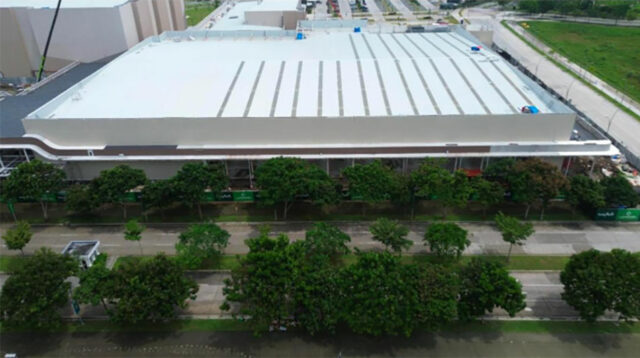
LANDERS VERMOSA comes months after Reytech turned over Landers Naga, the first in the Bicol region, which opened in July 2024.

REYTECH CONSTRUCTION & Development Corp. (Reytech) targets to turn over the new Landers branch in Vermosa estate in Cavite before the end of the year, the retail builder said on Monday.

“Reytech is scheduled to finish construction and turn over the site in Q4 (fourth quarter) of 2024, marking Landers Vermosa as the first branch of the fastest-growing exclusive membership shopping store in the province of Cavite,” the company said in an e-mailed statement.

The Vermosa estate branch is set to be the largest Landers branch in the country, with a store footprint of 1.3 hectares, it added.

Vermosa estate, developed by Ayala Land, Inc., is a 700-hectare growth center in Cavite.

This is also the retail builder’s second branch constructed for the exclusive membership shopping store within an Ayala Land township, the first being Landers Nuvali in August 2023. It is the fourth branch completed by Reytech as a general contractor.

In July, Reytech handed over Landers Naga, the first branch in the Bicol region.

“The construction of both developments supports the retail chain’s drive to bolster its presence across the country and serve more Filipino consumers with Landers’ global product offerings and best-in-class membership shopping experience,” it said.

For Landers Vermosa, Reytech employed off-site fabrication of both structural and architectural requirements to support faster implementation and reduced cost, the company said.

“For future Landers projects, we plan to use more streamlined and higher end wall paneling systems and introduce the use of pre-engineered building (PEB) materials for the structural requirements of the project coming from Reytech’s partnership with Kirby Systems, a leading global PEB system provider,” said Jay Pantangco, commercial director at Reytech.

“Both will enable us to decrease the duration of the project by more than 75 days and reduce the cost of structural scope of the project by at least 10%,” he added. — Beatriz Marie D. Cruz

Manulife, MCBL launch new insurance product with yearly payouts

THE MANUFACTURERS Life Insurance Co. (Phils.), Inc. (Manulife Philippines) and Manulife China Bank Life Assurance Corp. (MCBL) have launched a single-payment insurance product with a seven-year wealth growth savings plan.

“Through Wealth Guarantee, we are giving Filipinos an investment plan option that offers competitive guaranteed returns and valuable life insurance protection, enabling them to diversify their portfolio and gain financial security,” Manulife Philippines President and Chief Executive Officer Rahul Hora said in a statement on Monday.

Wealth Guarantee policyholders will get yearly payouts of up to 4.5% over six years with 100% capital return.

The medium-term wealth management product also provides 125% life protection coverage throughout the plan’s term.

“Wealth Guarantee is suited for investors interested in a medium-term savings plan, and for those looking to build their legacies for future generations,” Manulife Philippines said.

The plan will be available for a limited time through Manulife’s financial advisors or its financial sales associates based in China Banking Corp. branches nationwide.

“At Manulife, we are dedicated to continuously providing our customers with products and services that fit their unique financial needs and goals. We recognize the hard work that Filipinos put in to secure their envisioned future, and we aim to be their trusted partner in achieving financial freedom. Our latest offering — Wealth Guarantee — is designed to bring customers one step closer to that dream,” Mr. Hora said.

Manulife Philippines’ premium income stood at P15.54 billion in 2023, based on latest Insurance Commission data. Its net income was at P1.899 billion last year.

Meanwhile, MCBL’s premium income was at P8.33 billion and its net profit stood at P943.2 million in 2023. — A.M.C. Sy

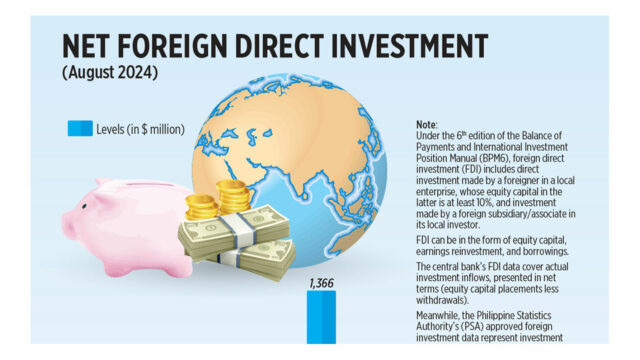
Net Foreign Direct Investment

NET INFLOWS of foreign direct investment (FDI) into the Philippines slid in August mainly due to a sharp decline in investments in debt instruments, data from the central bank showed. Read the full story.

Net Foreign Direct Investment

Entertainment News (11/12/24)


Ely Buendia drops sophomore album

OPM icon Ely Buendia has marked another chapter in his solo career with the release of his sophomore album Method Adaptor, via Offshore Music and Sony Music Entertainment. The collection of 10 new tracks examines memories, experiences, and social issues through both cultural and personal narratives. “I think all the songs have something to do with rebelling — be it from the disappointments and hardships of life or from the control that people want to have on your mind,” Mr. Buendia said in a statement. The album is produced by Jerome Velasco, Audry Dionisio, and Erwin Romulo. Method Adaptor is out now on all digital music streaming platforms.


Denise Julia releases new EP

AN up-and-coming female voice in Filipino R&B, Denise Julia aims to build on her traction with the new EP, Sweet Nothings (Chapter 2), distributed by Sony Music Entertainment. The nine-track release is done in her confessional R&B/soul style. Sweet Nothings (Chapter 2) is out now on all digital music streaming platforms.


Philippine Dance Cup celebrates Filipino talents

THE Philippine Dance Cup, the only national ensemble and solo dance championship in the country, has once again tapped the De La Salle-College of Saint Benilde (DLS-CSB) to provide a platform for outstanding Filipino contemporary and classical dancers. For the 2024 iteration, scholarships to professional schools in Manila, Melbourne, and London are at stake. All participants, from the junior and senior solos to the ensembles, will engage in a highly professional program to display their skills in contemporary dance and ballet. The competition will run from Nov. 13 to 15 at the 5th floor theater of the Design + Arts Campus. Tickets are priced at P300 and may be secured through forms.gle/8n6QtEMJTTd7HsiL7.


TikTok Shop, SM Supermalls spotlight female CEOs

TIKTOK Shop and SM Supermalls have launched “She Leads: Fun Beyond Shopping,” a mall pop-up in the Philippines running from Nov. 15 to 17 at the SM Mall of Asia Main Atrium. The pop-up aims to recognize and empower female-owned and -led businesses in the Philippines, particularly those that have found success both offline and on TikTok Shop. The featured creator-CEOs are Rosenda Casaje of Gorgeous Glow Philippines, Rei Germar of Tapies, and Ashley Yap of Sip2Glow. They will have a talk in the She Leads segment of the mall pop-up (schedule to be announced), where they will share their success stories and have a special meet and greet.


Kapuso Mo, Jessica Soho turns 20 years old

FOR the GMA Network Public Affairs show, Kapuso Mo, Jessica Soho, hitting 20 years of bringing real stories to the screen is an achievement. In line with the milestone, it recently announced that it is the most followed Filipino show on Facebook, with 30 million followers and 1.4 billion views. Its has 1.2 billion views on TikTok, and over 1 billion on YouTube.

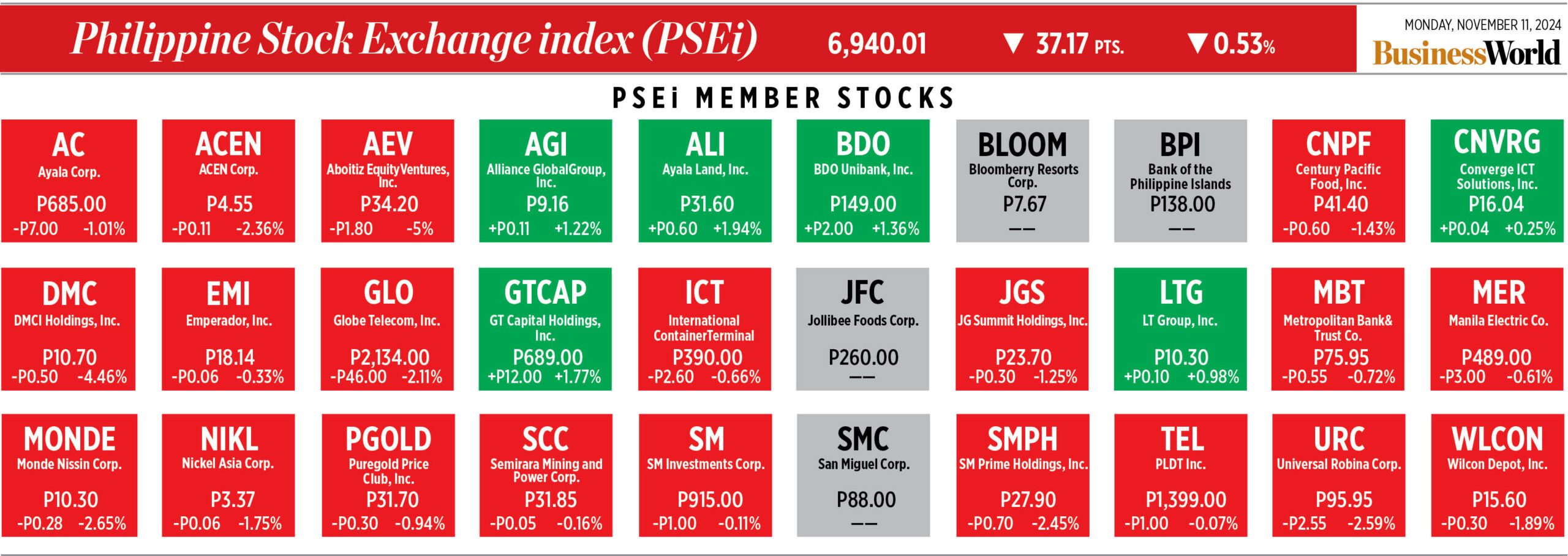
How PSEi member stocks performed — November 11, 2024

Here’s a quick glance at how PSEi stocks fared on Monday, November 11, 2024.


BoC beats collection goal for first 10 months with P784.54B

BW FILE PHOTO

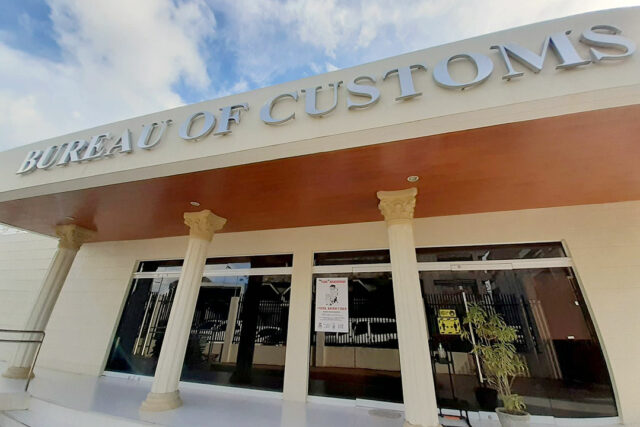
THE Bureau of Customs (BoC) said on Monday that it surpassed its 10-month collection target with a preliminary estimate of P784.54 billion in the January to October period.

This exceeded the P779.99-billion target set for it by the Development Budget Coordination Committee. The full-year target is P939.69 billion.

“This amount marks a robust 6% increase compared to the same period last year, resulting in an additional P44.445 billion over the P740.095 billion collected in 2023,” the BoC said in a statement.

In October, the BoC collected P89.50 billion, also exceeding its P86.10 billion target for the month.

Commissioner Bienvenido Y. Rubio said the bureau is “resolute” in strengthening its collection capabilities and supporting the expansion of fiscal space.

The BoC said the collection numbers reflect contributions from the value-added tax refund program and the fuel marking initiative, adding that P3.35 billion was collected from tax credit certificates. — Aubrey Rose A. Inosante

Norway pitched on LNG tech, sustainable fuel partnerships

REUTERS

THE Department of Energy (DoE) said it will propose potential partnerships with Norway in sustainable fuels and natural gas technology.

“Norway, which has a huge interest in shipping, is a natural ally of the Philippines for biofuels,” Energy Secretary Raphael P.M. Lotilla said at the Norway-Philippines LNG Summit on Monday.

Mr. Lotilla cited the strong interest in sustainable aviation fuel (SAF) and “cleaner fuels” for shipping.

“That is an important area where Norway and the Philippines can do business and research together,” he said.

According to the DoE, SAF is an “environmentally sustainable and chemically identical alternative to fossil fuel-based aviation fuel.” SAF can be manufactured from forestry and agricultural waste and used oils.

Mr. Lotilla said that the Philippines has much to learn from Norway on the use and management of natural resources, noting Norway’s North Sea energy projects and the revenue they produce.

Norway can provide insights “that will be useful for the Philippines, especially in relation to our indigenous gas resources,” Mr. Lotilla said.

He said that Norway has shown that “the responsible management of natural resources requires clear regulation, prudent fiscal policy, and a commitment to continuously upgrading the skills of our workforce.”

Meanwhile, he touted the role of liquefied natural gas (LNG) as transition fuel, not only for power generation but also for complementing renewable energy sources like solar and wind.

“Today, LNG is stepping in to play a crucial role in our energy value chain. With two LNG terminals in Batangas Bay nearing full commercial operations, we are preparing to ensure the reliability of our gas-fired power plants,” Mr. Lotilla said.

Currently, the Philippines is expected to have a combined capacity of eight million tons per annum once the LNG terminals become fully operational.

The DoE said that the facilities may also serve as a redundancy mechanism by offering an alternative fuel source for over 4,500 megawatts of generation capacity by 2025.

Norwegian Ambassador to the Philippines Christian Halaas Lyster said Norway has developed “world-class technology” within the LNG industry and can support the Philippines in its energy transition.

Compared to oil and coal, LNG offers opportunities to significantly reduce carbon emissions, he said.

“We can support the Philippines in the decarbonizing agenda and energy transition by proven LNG technology for years to come,” he said.

The Philippines is aiming to increase the share of renewable energy in the power mix to 35% by 2030 and 50% by 2040. — Sheldeen Joy Talavera

Senate passes natural gas industry development bill on final reading

MALAMPAYA GAS FIELD — PHILSTAR FILE PHOTO

THE SENATE approved on third and final reading on Monday a bill seeking to develop the indigenous natural gas industry, which the government views as transition fuel en route to broader adoption of renewable energy.

With a 14-3 vote, senators approved Senate Bill No. 2793 or the Philippine Natural Gas Industry Development Act, with the Department of Energy tasked with overseeing the development of the downstream natural gas industry.

“This legislation supports our own and also international commitments to cleaner and more efficient energy production,” Senator Pilar Juliana S. Cayetano, who sponsored the measure, told the plenary after the bill’s approval.

“We have to remember that natural gas is a transition fuel and our goal is to move to renewables.”

Senator Sherwin T. Gatchalian voted against the measure, saying that it lacked mechanisms to govern competitive bidding as well as protections for consumers against high power costs.

Citing a provision of the bill giving “indigenous natural gas… priority over conventional energy sources,” he said that even if power from conventional sources is cheaper to procure and bid for, indigenous natural gas will still have an advantage despite being more expensive.

“This will push up spot prices, thereby placing the burden of higher prices on consumers,” the senator told the floor.

Minority Floor Leader Aquilino L. Pimentel III and Deputy Minority Leader Ana Theresia N. Hontiveros-Baraquel also opposed the bill, citing similar concerns over consumer safeguards.

Ms. Hontiveros-Baraquel said in her speech explaining her no vote that “This abandonment of the ‘least cost’ principle may even affect without categorically saying, the greatest potential of renewable energy to drive down electricity costs.”

The Philippines is under pressure to find other sources of indigenous energy with the imminent depletion of the Malampaya gas field, which supplies power plants accounting for a fifth of all power generated in the Philippines. The gas field is expected to run out of easily recoverable gas by 2027.

The government is aiming to raise the share of renewable energy in the country’s energy mix to 35% by 2030 and to 50% by 2040 from 22% now.

Under the bill, the Energy Regulatory Commission (ERC) is tasked with keeping track of the government’s share of revenue related to the production of indigenous natural gas sold to power plants.

Downstream natural gas industry projects, as certified by the Department of Energy, will also be entitled to a value-added tax exemption on the purchase and sale of indigenous gas attributed to aggregated fuel, as authorized by the ERC. — John Victor D. Ordoñez

Philippines urged to build more sustainable roads

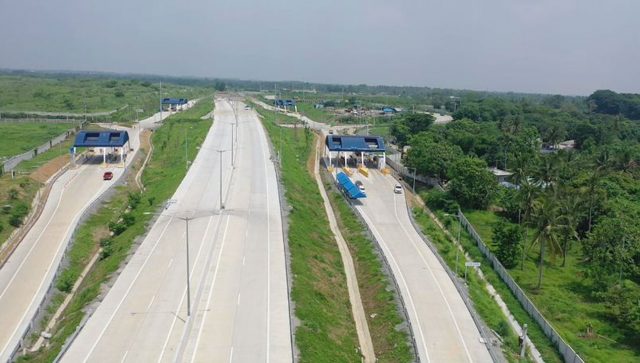
THE PHILIPPINES should prioritize resilient transport infrastructure planning and operation to improve road quality, reduce travel time, and lower emissions, an official with the United Nations Economic and Social Commission for Asia and the Pacific (ESCAP) said.

Weimin Ren, director of the ESCAP Transport Division, said the Philippines needs to “take a very active role in the regional cooperation on sustainable transport connectivity,” and added three highways to the Asian Highway Network last year.

The Philippines added three highways to the Asian Highway Network last year. The network is a regional transport cooperation platform aimed at enhancing the efficiency and development of road infrastructure.

“Integrated transport and land use planning will also help improve the sustainability of transport systems, through the reduction of distance traveled, enhance the efficiency of last-mile solutions and vehicular emissions,” Mr. Ren added.

He said the technological advancements, along with new pavement materials and the design, construction, maintenance, and upgrade needs of Asian highways, provide various opportunities to transition toward a more environmentally sustainable infrastructure design.

In comparison to “low-quality road transport infrastructure” that is more vulnerable to extreme weather.

Mr. Ren also noted that road safety should also be considered, citing that the Philippines road fatality increased to 11,062 in 2021, according to Global Status Reports for Road Safety by the World Health Organization.

“Ultimately, strategic investments in sustainable transport infrastructure would need to be prioritized to decrease transport externalities, while maintaining or improving transport accessibility,” he said. 

He said such investments will improve the overall efficiency of the transport system, reduce environmental and social impacts of transport activities, and support the growth of sustainable transport options.

“To balance rapid motorization with sustainable practices, the Philippines can adopt the ‘Avoid-Shift-Improve’ (ASI) framework,” he said.

The “avoid” approach advocates reducing the need for travel through better urban planning, limiting car dependence by developing mixed-use communities.

“This would mean creating neighborhoods where work leisure, and essential services are within walking or cycling distance, reducing the demand for motorized transport,” Mr. Ren said.

Meanwhile the “shift” component refers to transitioning from private vehicles to more sustainable modes of transport, including public transport and active mobility, with greater system integration.

The “improve” portion of the framework targets increasing efficiency and reducing emissions of current transport modes.

This means promoting electric vehicles, enhancing fuel standards, and improving the operational efficiency of public transit, he said. — Aubrey Rose A. Inosante