Home Blog Page 1925

Taiwan is not just Taipei (though it is not a bad place to start a visit)
by Almira Louise S, Martinez, Reporter

Source: https://eng.taiwan.net.tw/

For the record, there is more to Taiwan than Taipei.

The Taiwan Tourism Administration (TTA) wants international visitors, including Filipinos, to explore cities beyond Taipei to experience the country’s culture, history, nature, and cuisine in a showcase of Taiwan’s charm.

“We want to see more Filipino visitors to Taiwan in addition to a higher percentage of repeat visitors,” the TTA said in an email interview.

Taiwan’s tourism brand, Waves of Wonder, was launched in May 2024 to promote the scenic spots around the country. Its logo mimics the contours of mountains, ocean waves, winding roads, and historical railways, highlighting that the self-ruled island has plenty to offer aside from the bustling city of Taipei.

With this branding, the TTA aims to invite visitors to their country to “enjoy the mountains, embrace the sea, and explore the island.”

BusinessWorld, together with six representatives of the Philippine media, visited Taiwan from February 11 to 16 at the behest of the TTA for a familiarization trip around Taoyuan City, Miaoli County, and Hsinchu County to see and experience the “Waves of Wonder” the country has to offer.


Historical and cultural spots

The Lost Army Story House | Photo by Almira Louise S. Martinez, BusinessWorld

The Filipino press group went to the “Lost Army” museum in Zhongzheng New Village, Taoyuan City, opened in 2022 by Simon Wang, one of the soldiers who fought in the Chinese Civil War.

“They don’t know about these people, these soldiers that died in the battle, they sacrificed their lives, and no one [remembers],” Mr. Wang told reporters.

Historical materials such as old documents, fake guns, uniforms, grenades, and even “mission cards” that reveal a message once heated are displayed inside.

The Lost Army Story House | Photo by Almira Louise S. Martinez, BusinessWorld

Along with the war memorabilia, the museum has different areas narrating the trauma experienced by soldiers, how soldiers used opium during the war, and other traditional clothing.

Mr. Wang said that he wanted to establish a story house to commemorate, remember, and let the people know about his fellow soldiers in the Lost Army.

Almost an hour from Taoyuan City lies Jinliangxing Brick Factory, another valuable place in Miaoli County that holds a significant part in the history and culture of Taiwan, particularly in its architecture and construction.

Jinliangxing Brick Factory | Photo by Almira Louise S. Martinez

Before concrete became widely used globally, Taiwan built houses and structures with red bricks. The bricks manufactured by Jinliangxing have made 100-year-old churches and other establishments, Sem Yie, owner of the brick factory, said.

Jinliangxing Brick Factory | Photo by Almira Louise S. Martinez

With the lowering demands as time passed, the factory opened a small museum showcasing the history of bricks and carved artworks. Mr. Yie said by doing so, he hopes to preserve the history and culture of traditional Taiwanese architecture.

Tours exploring the interior and exterior of an old kiln are also open to visitors.

“I am trying to introduce this bricks culture to the new generation,” Mr. Yie said.

Longteng Bridge is one of the notable structures made from Jinliangxing bricks. Although it got damaged by the deadly 1935 Shinchiku-Taichū earthquake, its foundation stood still and is now a tourist spot in Miaoli County.

Old Mountain Rail Bike | Photo by Almira Louise S. Martinez

Through Taiwan’s first mountain-town rail biking system, the Old Mountain Line Rail Bike, tourists can see the remains of the historical bridge while driving an electric bike on a century-old railway.

Visual displays and colorful lights lit up the tunnels the electric bike will pass through, making the experience more unique.


Connecting with nature

For vacationers seeking nature trips, Taiwan is one of the best places to visit. Surrounded by waters and mountainous terrain, breathtaking nature-filled spots are endless.

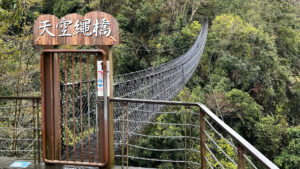
Located in Fuxing District in Taoyuan City, Xiaowulai Skywalk offers fresh air and scenic views of the mountains, forest, and falls.
Xiaowulai Skywalk | Photo by Almira Louise S. Martinez

Although it was raining when the media group visited the area, the beauty and serenity of the place still shined through. A glass platform view deck overlooking Xiao Wulai waterfall allows visitors to feel like they are “walking on clouds”, hence the name skywalk.

Apart from the skywalk, vibrant cherry blossom trees can be spotted around the area from late January to mid-April. This enhances its visual appeal, making it look like a mini-Japan.

photo by Almira Louise S. Martinez
Leofoo Resort | photo by Almira Louise S. Martinez

Animals are also well-loved in Taiwan. In fact, Leofoo Resort Guanshi in Hsinchu County is Asia’s first resort with herbivorous animals and natural ecology incorporated into its design inspirations.

Capybaras, flamingos, and meerkats can be seen through the big windows inside the 161 rooms available in the hotel, allowing vacationers to have a close-up look at the adorable animals.

If this is not enough, Leofoo Village Theme Park also offers an African safari experience where visitors can ride a bus driving around different habitats of wild animals such as white tigers and lions.


Flavors of Taiwan

Visiting places is not the only way to learn more about a country. A traveler’s stomach must be full, together with his eyes and mind.

photo by Almira Louise S. Martinez

After exploring the countryside, the media group had the opportunity to indulge in one of the staples in Taiwanese cuisine – authentic beef rice noodles, from different local restaurants like Jin Bang Noodles Shop in Sanyi Township, Bebu Chun Jiao Noodles near Beipu Old Street, and Duan Chunzhen Beef Noodles in Hsinchu County.

photo by Almira Louise S. Martinez

A distinct flavor evident in their staples, like beef noodle soup, is the five-spice powder. The five-spice powder is composed of star anise, cloves, Chinese cinnamon, Sichuan pepper, and fennel seeds.

Unlike the typical Filipino cuisine bursting with bold and rich flavors, beef rice noodles in Taiwan tasted light yet filling. The thick rice noodles complement the subtle flavors of the soup paired with the tender beef.

If one wants to be more adventurous, exploring Beipu Old Street is an easy fix for anyone who likes to expand their taste palette. Ranging from dried fruits to the popular stinky tofu, this street in Hsinchu County is the answer to all the foodie travelers.

While exploring the island, it further highlighted a few similarities with the Filipino culture and history – from closely knit families and being colonized to ‘Popiah’ or Lumpia, it is like a “home” away from home.

Last year, the Philippines became Taiwan’s fifth largest source of inbound tourists. The once-known ‘Heart of Asia’ has exceeded far beyond just a neighbor; it has captured and found a place close to the hearts of Filipinos.


China will not apologize for military drills off Australia’s east, ambassador says

ALEJANDRO LUENGO-UNSPLASH

– China’s ambassador to Australia said on Friday his country had no reason to apologize for the military drills it conducted in international waters between Australia and New Zealand that forced at least 49 flights to change path.

Both Australia and New Zealand have raised concerns with Beijing on the rare live-fire drills in the Tasman Sea last week, saying they did not receive adequate notice from China’s navy.

Ambassador Xiao Qian said China’s navy conducted drills that complied with international law and gave advance notice following international practices.

“I don’t see there is any reason why the Chinese side should feel sorry about that, or even to think about to apologize for that,” Xiao told national broadcaster ABC News in an interview.

“Different countries have different practice and based on the nature of the drill, size of the drill, and the scope of the drill, my view is that the Chinese naval certification advice was appropriate.”

Xiao said the drills did not pose any threat to Australia, one of its largest trading partners, and suggested Canberra should expect more Chinese ships sailing in the region in the future.

“As a major power in this region, as a country that has so many things to look after, it is normal for China to send their vessels to different parts of the region to conduct various kinds of activities,” Xiao told ABC News.

A frigate, cruiser and replenishment vessel that formed the Chinese navy task group has continued west on Friday, across the Great Australian Bight, the New Zealand Defense Force said.

Australian air traffic control agency officials this week told a parliamentary committee that a Virgin Australia pilot alerted them first about the live-fire drill after a message from the Chinese task group was broadcast on an emergency radio channel monitored mostly by pilots.

David Johnston, Australia’s defense chief, told the committee on Thursday it was likely the Defense Department came to know about the drill more than 30 minutes after it started.

Prime Minister Anthony Albanese, trailing in polls ahead of a national election due by May, has downplayed the incident, saying the drills occurred in international waters and that China did not break any maritime laws.

But the opposition Liberal-National coalition said it would be a major incident if the Australian Defense force became aware of the drills late and had to be alerted by a commercial pilot. – Reuters

Air safety reporting under scrutiny as crashes lie unresolved

STOCK PHOTO | Image from Pixabay

 – Next month marks three years since a China Eastern jet plunged into a hillside killing 132 people, with relatives still waiting to learn what caused China’s deadliest air disaster in three decades.

It is one of dozens of accidents worldwide in which investigators have yet to issue a final report designed to help prevent new accidents, despite a target of one year.

While recent deadly crashes in KazakhstanSouth Korea and the United States and the non-fatal flip of a crash-landed jet in Canada have thrust safety into the spotlight, the industry is worried that too many past accidents remain unresolved.

According to airlines, almost half of 268 accidents involving fatalities or major damage between 2018 and the end of 2023 lacked a final report.

“That’s a really big concern,” said Mark Searle, head of safety at the International Air Transport Association (IATA).

“The lessons that we learn from accident reports are absolutely critical to avoid future events.”

Aviation safety has improved markedly over decades based on open sharing of information, with investigations intended to draw lessons rather than assign blame.

The “brace position” for emergency landings, for example, was refined over years thanks to such investigations. By pure chance, the least injured person in a fatal 1976 crash in New Jersey had his head between his knees due to air sickness.

Technology to avoid collisions, the importance of not inflating life jackets inside planes and improved seat design are all lessons learned from past crashes.

Coordinated by the U.N.’s International Civil Aviation Organization (ICAO), global guidelines call for an initial report in 30 days and a final one ideally within a year. Failing that, investigators should issue statements on each anniversary.

But in a recent paper, IATA and six other aviation bodies raised the alarm over delayed or non-existent final reports.

“I think a number are being held up at the political government level because they are narratives that perhaps they are not too keen to hit the public eye,” Searle said.

Others blame judicial interference or a shortage of resources for independent investigations in many countries.

The warning comes as social media has transformed how the public interact with air disasters.

Fuelled by statements from U.S. President Donald Trump that January’s mid-air collision in Washington stemmed from diversity policies and a helicopter flying too high, a flurry of rumours circulated online about pilot identities and accident causes.

It is often only when publicity fades that forensic work can unlock the multiple factors in an accident, experts say.

The resulting final reports carry particular weight because they are based on validated data.

Three years on, however, the China Eastern crash remains shrouded in speculation and no final report has been published – only a preliminary one and two anniversary updates.

At three and seven paragraphs long, these contain scant data compared to other major accidents, such as the 150-page interim statement Japan published on a fatal collision in January 2024.

Following the China Eastern crash, investigators examined crew actions after finding no malfunctions, two people briefed on the matter said at the time.

In May 2022, the Wall Street Journal reported that black box data indicated someone had intentionally crashed the Boeing 737, citing a preliminary assessment from U.S. officials.

China’s regulator CAAC has said speculation “gravely misled the public” and interfered with accident investigation work.

Chinese lawmakers will now consider significant changes to the country’s civil aviation law, including measures against spreading rumors about aviation safety, CAAC said this week.

CAAC did not respond when asked if it would issue a final report for the March 21 anniversary, or if the proposed law revisions were linked to the China Eastern crash.

ICAO, without commenting on any specific probe, said there can be challenges in releasing reports “particularly in cases involving security sensitivities or political considerations”.

The guidelines have recently been amended to allow more information to be published earlier to curb speculation.


UNEVEN REPORTING

Even when reports are published, recommendations are sometimes ignored or findings disputed, experts say.

A pair of hotly debated Egyptian accidents almost a decade ago illustrates the uneven reporting practices.

In 2016, EgyptAir 804 plunged into the Mediterranean, killing 66 people. After eight years, a final report identified explosives as the probable cause.

But France’s BEA agency said the report’s accuracy was “questionable” and a cockpit fire likely initiated events.

Even so, the eventual publication of the report – which allowed those dissenting comments to be published – was seen as a victory for the diplomatic machinery behind safety reporting.

By contrast the Sinai crash of an Airbus operated by Russian airline Metrojet in 2015, which Moscow blamed on a bomb while Egypt doubted a terrorist link, has not produced a final report but suspicions of a criminal act were reported to prosecutors.

The International Society of Air Safety Investigators is worried that cases of “unlawful interference” are not always investigated from a safety perspective.

Even when a crime is suspected, civil investigations have a place alongside police probes, it said in a recent paper.

French investigators issued a report urging better mental health checks following the pilot-suicide crash of a Germanwings jet, whose 10-year anniversary also falls next month.

Despite the gaps, investigators argue the reporting system remains robust with tangible gains in safety.

ICAO data indicates reporting rates for fatal accidents rose to 76% between 1990 and 2022 from 41% between 1990 and 2016.

But the issue remains a “significant focus area,” it said. – Reuters

Trump dodges plea from Britain’s Starmer for Ukraine security guarantee

REUTERS

 – President Donald Trump said on Thursday that a minerals deal with Ukraine is the security guarantee Kyiv needs against Russia, brushing aside a plea from British Prime Minister Keir Starmer for a commitment of U.S. military support.

Mr. Starmer, who was meeting Trump at the White House for the first time since the U.S. leader took office, turned on the charm, saying peace in Ukraine had only become possible because of Trump.

Mr. Starmer also delivered an invitation from King Charles for a future state visit, which Mr. Trump accepted.

But underlying differences between the allies remained, including transatlantic frictions over U.S.-Russia talks aimed at ending the Ukraine war and Trump’s tariff threats.

Before the meeting, Mr. Starmer had said there could be no long-term peace in Ukraine without firm U.S. security guarantees – an argument Trump all but dismissed.

“We are a backstop because we’ll be over there, we’ll be working,” as a result of the economic partnership, Mr. Trump said. “We’re going to have a lot of people over there.”

Asked whether he could trust Russian President Vladimir Putin, Trump said, “trust and verify,” echoing former U.S. President Ronald Reagan’s views on negotiations with the Soviet Union.

He said he did not think Putin, who organized invasions of Ukraine in 2014 and 2022, would do so again after a deal. Talks toward such a compact were moving briskly, he said.

“It will either be fairly soon, or it won’t be at all,” Trump said.

Mr. Starmer said not just any deal would do, underscoring the concern among European nations that a rushed peace deal with Russia might lead to further instability in Europe.

“We have to get it right,” he said at a joint press conference with Mr. Trump. “It can’t be peace that rewards the aggressor.”


SHOCKING ALLIES

Mr. Starmer is the latest European leader to meet Trump after French President Emmanuel Macron came to the White House on Monday for a friendly encounter that also displayed stark differences about Russia’s war with Ukraine.

Mr. Trump, who entered office on January 20, has shocked traditional U.S. allies in Europe by drawing closer to Putin, calling Ukrainian President Volodymyr Zelenskiy a “dictator,” and demanding payback for U.S. financial support for Kyiv. On Thursday, Mr. Trump distanced himself from the dictator comment and said he gets along with the Ukrainian leader.

Mr. Zelenskiy is expected to be in Washington on Friday to sign a deal with Mr. Trump on rare earth minerals. Trump portrays the deal as a way to recoup American money that has been spent to support Ukraine. It includes no security guarantees for Kyiv.

Mr. Starmer has signaled that Britain will increase defense spending and tried to reassure the U.S. president that Europe will provide support and security guarantees to Kyiv if peace talks with Russia are successful.

On Thursday, Trump reaffirmed the United States’ long commitments to the mutual defense of NATO nations even if European peacekeepers end up in Ukraine, saying “I support it. I don’t think we’re going to have any reason for it.”

Mr. Putin on Thursday warned “Western elites” against trying to sabotage rapprochement between Russia and the U.S., saying Moscow would use its diplomats and intelligence services to thwart such efforts. The remarks were an apparent reference to the European Union and Britain.

Mr. Starmer has said he is open to British troops providing security guarantees to Ukraine but only alongside other European nations and with “the right conditions in place.”

European countries are concerned about the high level of conflict in Ukraine now, the U.S. official said, while a ceasefire based on a strong political settlement would give them more comfort that their role is more about peacekeeping than deterring active conflict.


TRADE TALKS

Mr. Trump has shattered policy norms since the start of his second term, rattling allies by advocating for U.S. ownership of the Gaza Strip and promising trade tariffs on U.S. friends and foes alike.

During the joint press conference, Mr. Trump said the U.S. and Britain were negotiating a bilateral trade agreement.

A wide-ranging free trade deal has eluded the countries since Trump’s 2017-2021 term in office, but the U.S. president said the two countries could reach a deal “very shortly.”

Asked by a reporter whether Mr. Starmer had convinced him to abandon threats to impose tariffs on Britain, Mr. Trump said, “He tried. He was working hard, I’ll tell you that.”

“We could very well end up with a real trade deal where the tariffs wouldn’t be necessary,” Mr. Trump said. “We’ll see.”

At the start of the visit, U.S. Vice President JD Vance said the leaders also were discussing what he described as “infringements on free speech” in Britain that have affected U.S. technology companies.

“We’ve had free speech for a very, very long time in the United Kingdom,” Mr. Starmer responded.

The British leader took care not to be drawn into any criticism of Mr. Trump. The U.S. president also dished out compliments.

“You’re a very tough negotiator,”Mr. Trump said, drawing laughter from Mr. Starmer. “I’m not sure I like that.” – Reuters

How to succeed in the bakery business

To succeed in business, love and enjoy what you do, advised Wilson Lee Flores, owner of Kamuning Bakery Café.

Interview by Edg Adrian Eva
Video editing by Arjale Queral

Budget gap exceeds full-year ceiling

BW FILE PHOTO

THE NATIONAL GOVERNMENT’S (NG) budget deficit narrowed year on year in 2024, but overshot the target by 1.48%, the Bureau of the Treasury (BTr) said.

Data from the Treasury released on Thursday showed that the budget deficit shrank by 0.38% or P5.7 billion to P1.506 trillion in 2024 from P1.512 trillion in 2023.

However, it exceeded the P1.48-trillion deficit ceiling set by the Development Budget Coordination Committee.

Philippine budget deficit reaches P1.506 trillion in 2024

“The slight variance versus the P1.484-trillion deficit program was primarily due to a higher outturn in government spending including those charged to unprogrammed appropriation, as well as defrayment of accounts payables,” the Treasury said.

As of end-2024, the deficit as a share of gross domestic product (GDP) settled at 5.7%, lower than 6.2% at end-2023 but slightly higher than the target of 5.6%.

BTr data showed revenue collection jumped by 15.56% to P4.42 trillion and exceeded its P4.27-trillion target due to better-than-expected nontax revenue collections.

“This is equivalent to 16.72% of GDP, the highest revenue effort in the last 27 years, since 1997,” the Treasury said.

Tax revenues rose by an annual 10.83% to P3.8 trillion in 2024 but fell short of the P3.82-trillion target by 0.51%.

Collections by the Bureau of the Internal Revenue (BIR) increased by 13.29% year on year to P2.852 trillion, driven by increased value-added tax (VAT) collections. It surpassed the P2.849-trillion target by 0.09%.

On the other hand, the Bureau of Customs’ (BoC) revenues went up by 3.79% to P916.7 billion in 2024 but fell short of the P939.7-billion target by 2.45%

The BTr attributed the lower Customs collections to the reduced tariff on rice and selected electric vehicles, as well as the extension of lower tariffs on meat products.

“The increase is attributable to the growth across duties, VAT, and excise collections, which is among the effects of the bureau’s strengthened digitization, inspection, and border protection efforts implemented during the year,” the BTr said.

Meanwhile, nontax revenues surged by 56.61% to P618.3 billion in 2024, exceeding the full-year target P449.6 billion by 37.53%.

“The better-than-expected outturn was primarily due to strengthened efforts to generate windfall collections such as that from the Public-Private Partnership (PPP) concession fee (P30 billion) and the P167.2-billion fund balance transfers from the Philippine Health Insurance Corp. (PHIC) and Philippine Deposit Insurance Corp. (PDIC),” the Treasury said.

“Deducting the fund balance transfers, total nontax collections of P451.1 billion still exceeded the adjusted full-year program by 0.33% (P1.5 billion).”

The Treasury’s income grew by 24.48% to P283.4 billion last year and surpassed the P187-billion target by 51.52%. This was due to “higher dividend remittances, interest advances from government-owned and -controlled corporations, guarantee fees, and NG share from the Philippine Amusement and Gaming Corp. profits.”

Revenue from other offices more than doubled to P335 billion from P167.2 billion in 2023. It also exceeded its P262.6-billion program by 27.56%.

At the same time, government expenditures rose by an annual 11.04% to P5.925 trillion in 2024. This was 2.97% higher than its P5.754-trillion annual program.

“The strong disbursement performance was largely driven by infrastructure and other capital outlays of the Department of Public Works and Highways (DPWH),” the BTr said.

It also cited the “maintenance and other operating expenses for various health and social protection programs, and personnel services expenditures due to the implementation of the first tranche of salary adjustments of qualified civilian government employees.”

Primary spending — which refers to total expenditures minus interest payments — increased by 9.65% to P5.16 trillion last year. It was 3.43% higher than the programmed P4.999 trillion.

Interest payments (IP) jumped by 21.48% to P763.3 billion due to the “higher interest rates and less favorable foreign exchange rate conditions.” However, it was 0.02% lower than the revised program of P763.4 billion.

DECEMBER DEFICIT
In December alone, the NG’s budget deficit also sharply narrowed by 17.82% to P329.5 billion from P401 billion in the same month in 2023.

Revenue collection rose by 20.99% to P314.7 billion in December, as tax revenues inched up by 2.01% to P251.6 billion.

Broken down, BIR collection went up by 5.48% to P183.8 billion, while Customs collection slipped by 6.38% to P66.7 billion.

Meanwhile, nontax revenues surged by 369% to P63.1 billion, as Treasury revenues climbed by 348% to P50.7 billion.

On the other hand, government spending fell by 2.55% to P644.2 billion in December.

Primary spending slid by 2.36% to P586.2 billion while interest payments dropped by 4.45% to P58 billion.

Rizal Commercial Banking Corp. Chief Economist Michael L. Ricafort said the slightly lower deficit in 2024 largely reflected higher government expenditures.

“Higher prices and election-related spending could have partly led to the increase in government expenditures in 2024,” he said.

SM Investments Corp. Group Economist Robert Dan J. Roces said in a Viber message that the fiscal performance “demonstrates a delicate balancing act between revenue mobilization and expenditure management amid macroeconomic headwinds.”

“While the deficit narrowed slightly to P1.506 trillion, the achievement is noteworthy given the substantial 21.48% surge in interest payments that created significant expenditure pressure,” he said.

“The narrowing deficit trajectory, despite missing the precise target, still represents significant fiscal consolidation progress, with the deficit-to-GDP ratio improving from 6.2% to 5.7%, continuing the favorable trend since the post-pandemic high of 8.6% in 2021,” Mr. Roces added. — A.R.A. Inosante

Thailand’s planned casinos ‘a big threat’ to PHL, says PAGCOR 

A worker walks past the casino at Okada Manila in Parañaque City, Philippines, July 11, 2022. — REUTERS

By Aubrey Rose A. Inosante, Reporter

THE THAI government’s plan to legalize casinos poses a “big threat” to the Philippine gaming industry, according to Philippine Amusement and Gaming Corp. (PAGCOR) Chairman and Chief Executive Officer Alejandro H. Tengco.

At a briefing on Wednesday, Mr. Tengco said Thailand has an advantage as its tourist arrivals are bigger than the Philippines.

“It is a big threat. Why? Thailand had 35 million tourists, and the Philippines had less than six million,” he said, referring to the international tourist arrival numbers in 2024.

The Thai Cabinet last month approved a draft law to legalize casinos in “entertainment complexes” to boost economic growth. With this plan, the Thai government is looking to attract at least 100 billion baht ($3 billion) in new investments, and to boost foreign tourist arrivals by as much as 10%.

“Instead of coming to the Philippines to gamble, people might just go to Thailand,” Mr. Tengco said.

Mr. Tengco also flagged possible competition from Japan’s first casino-resort that is expected to open in Osaka by 2030.

“They might go to Osaka, Japan instead. That’s why I’m saying we need to prepare well because competition is coming, and it’s better if we get ahead of it,” he said.

The Philippines’ Las Vegas-style Entertainment City has been attracting local and foreign tourists. Several integrated resorts operate in the area, such as Solaire Resort & Casino, City of Dreams Manila and Okada Manila.

Mr. Tengco said PAGCOR must tighten rules and regulations to build its reputation, and push license holders to renovate their “very old looking casinos.” 

Mr. Tengco said PAGCOR is also determined to split its dual role of regulator and operator by 2026. “By decoupling, we will be able to show the world that we are fair, that there is no conflict of interest,” he said.

Mr. Tengco remained optimistic about the gaming outlook in the Philippines. He noted the Philippines would easily reach a fresh high of P480-billion gross gaming revenue (GGR) in 2025, which would be mostly driven by the e-gaming segment.

If realized, this would be 16.94% higher than the record-high P410.48 billion in 2024.

The Philippines’ GGR of P410.48 billion ($7.09 billion) was the second highest in Asia last year, after Macau’s GGR which stood at 226.78 billion Macanese pataca ($28.32 billion).

A Citi report in November projected Thailand’s GGR could hit as much as $9.1 billion once it is fully developed. This would make it the second biggest in Asia, after Macau.

Philippine Institute for Development Studies Senior Research Fellow John Paolo R. Rivera said that with Thailand’s strategic location, well-developed tourism industry, and global connectivity, would make it more attractive for gaming operators and tourists.

“Investors may reconsider Philippines as a long-term gaming hub if Thailand and Japan offer more stable regulations, tax incentives, and high-quality infrastructure,” he said.

To maintain its regional advantage, Mr. Rivera said the country should position its integrated resorts as entertainment and tourism destinations, not just gaming hubs by adding theme parks and concert venues.

“(They should also) boost marketing efforts for Japanese, Korean, and Chinese high rollers, while also diversifying into new markets like the Middle East, India, and Association of Southeast Asian Nations, Regional Comprehensive Economic Partnership,” he said.

Mr. Tengco said most of the casino goers in the country are from South Korea. Most of these Korean tourists patronize casinos located in Clark, Pampanga.

Meanwhile, Michael Henry Ll. Yusingco, a fellow at the Ateneo de Manila University Policy Center, said Thailand and Japan have a big edge as a tourist destination and are equipped with the necessary infrastructure and services.

“But the Philippines still has ways to differentiate itself in order to get a significant chunk of the gambling market. We may have a lower cost of doing business. And our service industry is robust as well,” he said.

Mr. Yusingco also said elevating the status of our international airports, improving power stability and traffic mobility, will boost competitiveness of the Philippine gaming industry.

Pag-IBIG Fund declares record-high dividends

PAG-IBIG FUND Chairman and Department of Human Settlements and Urban Development Secretary Jose Rizalino Acuzar and Pag-IBIG Fund Chief Executive Officer Marilene Acosta announce the dividend rates for its savings program.

THE HOME Development Mutual Fund or Pag-IBIG Fund has declared a record-high P55.65 billion in total dividends for its members’ savings in 2024.

In a statement, Pag-IBIG Fund said this brought the dividend rate for its regular savings to 6.6%, while the rate for its modified Pag-IBIG 2 (MP2) savings went up to 7.1%.

The regular savings account is available to Pag-IBIG members who are currently employed or self-employed. The MP2 savings account is a voluntary savings program that offers higher dividend rates and has a five-year maturity period.

The Pag-IBIG Fund’s board of trustees approved that 82% of net income or P55.643 billion be declared as dividends for its members. This was higher than 70% of net income usually mandated to be declared as dividends.

The Pag-IBIG Fund’s net income reached a record P67.52 billion in 2024, up by 36% from P49.79 billion last year driven by higher loans, collections, and investment returns.

“Pag-IBIG Fund has once again marked 2024 as one of its best-performing years, achieving record highs in both total assets and net income,” Department of Human Settlements and Urban Development Secretary Jose Rizalino Acuzar was quoted as saying.

“With our strong performance, sound investments and robust finances, we are well-equipped to continue providing our members with responsive benefits and advance our efforts under the Pambansang Pabahay para sa Pilipino Program (4PH), ensuring that more Filipino workers can access affordable homes,” he added.

Pag-IBIG Fund Chief Executive Officer Marilene C. Acosta said in a speech on Thursday that the fund released P129.73 billion in home loans to 90,640 members last year.

The agency also collected P132.81 billion in membership savings, of which P73.74 billion were voluntarily saved under Upgraded and MP2 savings accounts.

Around P70.33 billion in cash loans or short-term loans were also disbursed to more than 3.21 million members.

The agency also extended P20 billion in approved developmental loans for 18,000 under the 4PH Program. It was able to onboard 54 partners under the program and grow the housing fund to about P5 billion from P3 billion.

“We also aim to empower at least 110,000 more families to achieve their dream of home ownership through our Pag-IBIG housing loan and almost 10,000 of our members to enjoy the comfort of their own home under the 4PH program,” Ms. Acosta said.

The agency’s total assets increased by about P75 billion to a record high of P1.069 trillion as of end-2024.

“By the end of this year, we expect total assets to reach P1.18 trillion,” Ms. Acosta said.

She added that Pag-IBIG Fund aims to add at least 1.5 million new members this year. The fund ended 2024 with 17 million members. — AMCS

BSP seen to bring down RRR to zero by 2028

BW FILE PHOTO

BIG BANKS’ reserve requirements are seen to be slashed further to zero in the near term, Security Bank said.

“Our forecast is that even in the next couple of years, there will still be cuts,” Security Bank Corp. Vice-President and Research Division Head Angelo B. Taningco said in mixed English and Filipino.

Mr. Taningco said they expect the central bank to reduce the reserve requirement ratio (RRR) by 200 basis points (bps) next year, 150 bps in 2027 and another 150 bps in 2028.

This would bring the current 5% reserve requirement for big banks to zero by 2028.

Bangko Sentral ng Pilipinas (BSP) Governor Eli M. Remolona, Jr. earlier said the central bank is eyeing to bring down banks’ reserve requirements to zero before his term ends in 2029.

The BSP last week announced it will cut the RRR of universal and commercial banks and nonbank financial institutions with quasi-banking functions by 200 bps to 5% from 7%, effective March 28.

It will also reduce the RRR for digital banks by 150 bps to 2.5%, while the ratio for thrift lenders will be lowered by 100 bps to 0%.

Rural and cooperative banks’ RRR has been at zero since October, the last time the BSP cut reserve requirements.

From a high of 20% in 2018, the central bank has since brought down the RRR to single-digit levels.

Further lowering reserve requirements could lead to further financial intermediation and make the usage of capital more efficient, Mr. Taningco said.

“It would lead to more growth prospects because you have additional funds,” he added.

The RRR is the portion of reserves that banks must hold onto rather than lending out. When a bank is required to hold a lower reserve ratio, it has more funds to lend to borrowers.

Several economists estimated that the RRR cut will release P300 billion to nearly P400 billion of additional liquidity in the economy.

For this round, Security Bank estimated that P325 billion will be injected into the financial system.

“This was part of the plan, gradual (reduction) every year until it reaches zero. The timing was just what we didn’t expect, it came a bit early.”

Mr. Taningco said there is a need to make sure the reductions are implemented at a gradual pace as the central bank is juggling inflation, growth and exchange rate stability.

“More liquidity is inflationary. So, it’s a balance. That’s why it’s gradual and not one time, big time. In theory, we could bring the 5% down to zero, but that would be inflationary.”

The central bank has said the risks to the inflation outlook have become “broadly balanced” for this year and the next.

It expects inflation to average 3.5% this year and 3.7% in 2026, both within the 2-4% target range.

“If we go from 5% to zero, how many billions is that? That’s already about a trillion. If it’s done all at once, the peso may weaken significantly. So, we are trying to avoid that excessive volatility,” Mr. Taningco added.

For the past months, the peso has been under pressure amid the dollar surge. The local unit fell to the record-low P59-per-dollar level thrice last year, twice in November and once in December.

The RRR cut would also boost bank lending, Mr. Taningco said, though this may not necessarily be “substantive” growth.

The latest BSP data showed bank lending jumped by 12.2% year on year to P13.1 trillion in December, its fastest growth in two years. — Luisa Maria Jacinta C. Jocson

TP bolsters sustainable operations in PH

60% energy use sourced from renewables

Teleperformance (TP) in the Philippines, an industry leader in sustainable business, affirms its unwavering commitment to the United Nations Sustainable Development Goals as it announced a significant achievement in its sustainability efforts: over 60% of its nationwide energy consumption now comes from renewable energy sources.

Celebrating a major milestone just in time for Energy Savings Week, the achievement positions TP as a leader in corporate sustainability and underscores its commitment to a greener and cleaner future.

Catalyst for Positive Change

As of September 2024, TP in the Philippines has saved 35.8 million kilowatt-hours of energy. This reduction is equivalent to the emissions generated by 5,598 gasoline-powered vehicles driven for a year or approximately 2.7 million gallons of gasoline consumed. It also matches the carbon absorption capacity of 396,806 tree seedlings grown for over 10 years and represents the annual carbon budget of 18,460 people.

“Shifting to renewable energy is a major step toward our goal of reducing our environmental impact and building a sustainable future. We’re committed to expanding our renewable energy initiatives, and we believe that by working together, we can create a healthier planet for generations to come,” shares Rahul Jolly, Chief Executive Officer, TP in the Philippines.

TP Group has adopted ambitious emission reduction targets, fully aligned with the Science Based Targets initiative or SBTi’s rigorous framework, aiming to keep global warming within a critical 1.5°C limit. TP was also among the first 100 to join the Climate Pledge, a global coalition of businesses committed to achieving carbon neutrality by 2040, 10 years ahead of the Paris Agreement.

Driving Global and Local Impact

Another impactful collaboration is with the non-profit organization, One Tree Planted. This partnership donates one tree for every dollar raised and has resulted in over USD 500,000 being contributed to global reforestation efforts.

The Philippine project brought the spotlight on restoring 400 hectares in Aurora province to provide a safe habitat for the endangered Philippine Eagle while supporting local communities. Globally, One Tree Planted has planted over 91 million trees across 78 countries, demonstrating the tangible impact of such partnerships.

TP’s site in Sucat became the company’s first clean energy-powered site, setting the stage for a broader transition to renewable energy sources. Meanwhile, a survey conducted in 2023 analyzing the employees’ commuting habits underscores TP’s holistic approach to carbon emissions.

“At TP, sustainability isn’t just a corporate goal — it’s a personal responsibility for each of us. Efforts like these, highlight how TP integrates sustainability into every aspect of our operations, reinforcing our role as a catalyst for positive change,” said Jolly.

TP’s Climate Action

Throughout the year, TP implemented climate actions across its 27 sites in the Philippines. Its sites in Sucat and Bacolod achieved a reduction of 2,033 and 2,729 Metric tons of CO₂, respectively. In addition, TP’s sites in Davao and Cebu are also actively involved when it comes to beach cleanups, relief operations, and volunteerism for school repairs, alongside TP’s Cloud Campus Hubs in General Santos and Laoag.

In 2024, TP in the Philippines also achieved a reduction of 1,495 metric tons of carbon emissions through the Uninterruptible Power Supply (UPS) Upgrade Activity. These sustainability efforts contributed to TP receiving ISO certification for Green Operations, specifically ISO 14001 for Environmental Management System and ISO 4500 for Occupational Health and Safety Management Systems, from Société Générale de Surveillance (SGS).

Furthermore, TP also observes an hour of lights-off in support of its pledge for Net Zero in 2040. Through this participation in Earth Hour, TP has saved 27,123 kWh in energy consumption, resulting in a reduction of 19.2 metric tons of CO₂ emissions in just one year.

“Our commitment has always been to be a Force for Good for people, communities, and the environment. We work with the principle that being intentional in our sustainability efforts is not only good for business, but it is the right thing to do. We will continue to invest and advocate for a greener, safer, and healthier world for everyone,” said Jeffrey Johnson, Chief People Officer and President – Citizen of the World (COTW) Foundation of TP in the Philippines.

TP’s sustainability efforts continue to extend beyond its workplaces, actively engaging with local communities through partnerships with environmental organizations and government agencies to create meaningful and impactful changes in the environment.


Spotlight is BusinessWorld’s sponsored section that allows advertisers to amplify their brand and connect with BusinessWorld’s audience by publishing their stories on the BusinessWorld Web site. For more information, send an email to online@bworldonline.com.

Join us on Viber at https://bit.ly/3hv6bLA to get more updates and subscribe to BusinessWorld’s titles and get exclusive content through www.bworld-x.com.

Toyota Motor Philippines recognizes excellent 2024 performance of dealer network

Toyota Motor Philippines (TMP) recently celebrated its top-performing dealers for 2024 at the annual Toyota Dealer Awards held during the 2025 Dealer Conference. Outstanding marketing professionals and service advisers were also acknowledged during the Toyota Outstanding Performers in Sales and Service (TOPS) Awards.

The prestigious President’s Award of Excellence was given to Toyota Marilao, Bulacan, Inc. (TMR) for the large business division; Toyota Nueva Ecija, Inc. (TNI) for the medium business division; and Toyota Tarlac City (TTA) for the small business division. This award goes to the dealers who have achieved overall excellence in all aspects of dealer operations and have the highest rating among all dealers in their respective divisions.

1st and 2nd runner ups within this award include Toyota San Fernando, Pampanga, Inc. and Toyota Pasig, respectively, under the large business division; Toyota Silang, Cavite, Inc. and Toyota North EDSA under the medium business division; and Toyota Subic, Inc. and Toyota Plaridel under the Bulacan small business division.

Toyota Marilao, Bulacan, Inc. also received the President’s Value Chain Award, while Toyota Nueva Ecija, Inc. was presented with the President’s Customer Satisfaction (CS) Cup of Excellence Award.

During his speech, TMP Chairman Alfred V. Ty shared, “I would like to remind Team Toyota Philippines of our mission of making ever-better products and creating happiness. Let us unite our efforts as one Toyota to remain number one in the hearts of every Filipino.”

TMP also acknowledged awardees for the Toyota Dealer Achievement Award — Overall Operations, Toyota Award of Excellence — Operations Performance, and various Special Awards.

“2024 was indeed a year of challenges and we overcame it all through your hard work and dedication. As we step into 2025, we do so with gratitude for our continuous partnership, and we are very excited for the road ahead,” shared TMP President Masando Hashimoto in his address to the Toyota dealer network.

Marketing professionals and service advisers were also recognized during the Toyota Outstanding Performers in Sales and Service (TOPS) Awards.

Awarded as TOPS Club Elite Members are Richard Taqueban Amanse of Toyota Quezon Avenue, Inc.; Janine Eugenio Mendoza of Toyota North EDSA; Aldrin Hernandez Garcia of Toyota Marilao, Bulacan, Inc.; Ivy Marie Torres Latosquin of Toyota Marilao, Bulacan, Inc.; and Marvin Balason Aloria of Toyota Batangas City, Inc.

Ramil Angelo de Guzman Tantay of Toyota Marilao, Bulacan, Inc. is recognized as TOPS Finest Marketing Professional of the Year.

TOPS Finest General Job Service Advisor of the Year is awarded to Vladimir John Pangilinan Yutuc of Toyota Tarlac City; while TOPS Finest Body and Paint Service Advisor of the Year is accorded to Ma. Precious Claire Perez Castro of Toyota Isabela, Inc.


Spotlight is BusinessWorld’s sponsored section that allows advertisers to amplify their brand and connect with BusinessWorld’s audience by publishing their stories on the BusinessWorld Web site. For more information, send an email to online@bworldonline.com.

Join us on Viber at https://bit.ly/3hv6bLA to get more updates and subscribe to BusinessWorld’s titles and get exclusive content through www.bworld-x.com.

Taking initiative for a sustainable planet

Freepik

By Angela Kiara S. Brillantes, Special Features and Content Writer

As the planet faces the harsh realities of climate change, climate action needs to further accelerate. According to the World Meteorological Organization (WMO), 2024 was marked as the hottest year in history, with extreme temperatures on land and ocean, as well as rising sea levels and greenhouse gas levels.

Recognizing the urgency of the climate crisis, global chief executive officers (CEOs) are increasingly driven by the need to reinvent their companies in response to climate change. To ensure long-term success, business leaders are transitioning toward net zero emissions and investing in climate-friendly technologies.

In a PwC report, about 33% of global CEOs anticipate that climate change will significantly influence how their companies operate over the next three years. This is echoed by another study, which showed that 37% of employees expect their jobs to be affected by climate change within the same time frame.

Since then, companies have been taking charge of managing climate impacts. Many have seen tangible benefits from their climate-friendly investments and sustainable initiatives, among them higher revenue from their climate investments over the past five years.

Within the country’s real estate sector, Filinvest REIT Corp. (FILRT), the country’s first sustainability-focused real estate investment trust company, has taken significant initiatives in climate action, exemplifying the power of clean and sustainable energy in business operations.

Established in 2015, FILRT is setting an example in the sustainable real estate movement by utilizing cleaner and more energy-efficient power across its buildings.

“FILRT recognized early on that efficiency and environmental responsibility are closely linked. This understanding shaped its approach, integrating sustainability into its strategy and property portfolio,” FILRT President Maricel Brion-Lirio told BusinessWorld in an email.

With sustainability having been a key driver of its growth in recent years, FILRT has enhanced its operational efficiency and dramatically reduced utility consumption through clean, energy-efficient solutions.

“FILRT contributes to sustainable development by integrating energy-efficient solutions and clean technologies across its properties, reducing environmental impact and supporting climate change mitigation,” Ms. Brion-Lirio added.

For instance, its Axis Tower One and Vector Three, 25- and 22-storey office buildings, respectively, are designed with sustainable features, including energy recover ventilators (ERVs), low consumption lighting and plumbing fixtures, and strategic building orientation. Both buildings are among the country’s LEED (Leadership in Energy and Environmental Design) Gold-certified developments.

Another remarkable example is the District Cooling System (DCS), which is designed to reduce electricity consumption by 40%. The cooling system produces and distributes cooling energy, primarily chilled water, through a network of underground pipes, reaching various buildings within a district.

In the Northgate Cyberzone, a hub for technology-based businesses in Filinvest City in Alabang, 81% of FILRT’s buildings utilize the DCS, making it the first and largest cooling system in the country. It provides various benefits such as reduced greenhouse gas emissions, improved energy efficiency, and enhanced cost-effectiveness. Its focus on clean and sustainable energy has perfectly aligned with global sustainability standards and reduced reliance for non-renewable energy sources.

Currently powered by 100% renewable energy, the Northgate Cyberzone tops the 94% of FILRT’s office portfolio that are fully powered by renewable energy as of last year. It has also been the starting point of the company’s renewable shift. As per its 2021 Annual and Sustainability Report, the company started its renewable energy initiative in 2020, which resulted in six buildings in the Cyberzone being powered by renewable energy sources since 2021, accounting for 26.5% of FILRT’s total energy consumption.

By 2024, all buildings in the Cyberzone have fully transitioned to renewable energy, reflecting the company’s commitment to sustainability and minimizing its environmental impact.

“FILRT’s Northgate Cyberzone distinguishes itself as a forward-thinking business hub, incorporating advanced energy-efficient and clean technologies that prioritize sustainability, operational efficiency, and tenant well-being,” Ms. Brion-Lirio said.

“By incorporating renewable energy, efficient cooling systems, and eco-friendly transportation, Northgate Cyberzone is prepared for future demands. It offers businesses a sustainable, adaptable space that not only meets today’s environmental and operational needs but also positions itself to thrive in the evolving landscape of the future,” she added.

In the digital services sector, Teleperformance (TP) addresses climate action as both a business strategy and a collective responsibility to the planet and future generations.

In 2008, the company embarked its sustainability journey with the Citizen of the World (COTW) program, positioning itself as a global pioneer in sustainability. The program focuses on humanitarian initiatives, addressing environmental issues, and promoting environmentally friendly and responsible business management.

“TP remains resolute in achieving its commitment to Net Zero by 2040. Our operations in the Philippines, as one of our global group’s largest operations worldwide, catering to over a hundred markets, plays a crucial role in achieving this feat,” Jeffrey Johnson, chief people officer of TP in the Philippines and president of Citizen of the World (COTW) Foundation Philippines, said.

“We plan to continue pioneering the use of renewables in the majority of our operations. We plan to continue monitoring, evaluating, and iterating our sustainability goals, as well as mobilizing people to march towards our envisioned future.”

Green infrastructure

FILRT goes beyond meeting sustainability standards; it elevates them. With the right green infrastructure in place, the company empowers operational efficiency and helps tenants achieve their ESG goals.

For instance, FILRT’s infrastructure includes 100% renewable electricity sourcing, generating electricity by harnessing energy from various sustainable sources; and electric vehicle (EV) charging stations, providing safe and efficient way to charge EVs.

In the Northgate Cyberzone, adoption of EVs is evident as Ecoloop offers a more convenient, eco-friendly, and hassle-free transportation service to get around the district. These electric-powered vehicles help enhance air quality, lower carbon emissions, reinforcing their clear focus on sustainable practices within the area.

This approach not only attracts multinational companies, keeping occupancy rates high, but also solidifies FILRT’s commitment to “creating an ecosystem where businesses can thrive in future-proofed, sustainable environments.”

“By integrating these sustainability initiatives — along with energy-efficient building designs, responsible resource management, and green certifications — FILRT continues to provide workspaces that not only meet business needs but also support environmental goals, fostering a more sustainable built environment,” Ms. Brion-Lirio said.

Concurrently, TP is optimizing renewable energy efficiency and sustainability through the COTW program. This program is aimed at minimizing environmental impact, promoting eco-friendly business practices, and accelerating the adoption of renewable energy.

COTW has also been instrumental in renewable energy adoption and related initiatives. Currently, 60% of its energy consumption is sourced from renewables, including hydro, solar, and geothermal energy sources.

On another note, the company uses Science Based Targets Initiative (SBTi) goals, a framework that helps them achieve global targets of Net Zero emissions by 2040. This framework enables the company to track and minimize its carbon footprint worldwide.

Substantial returns

Integrating energy-efficient and clean technologies brings many benefits, from reduced operational costs to enabling a healthier environment for occupants.

One key benefit of energy-efficient and clean technologies is the noticeable decrease in energy consumption. For example, FILRT’s EDGE-certified buildings have reduced energy use by at least 20%. On top of that, their LEED and WELL-core certifications have not only ensured that their buildings are energy-efficient, but also provide high standards of air quality, natural lighting, and thermal comfort — all of which are key aspects of a healthier and more sustainable spaces.

Energy-efficient and clean technologies also promote carbon neutrality. By utilizing renewable energy, it reduces the use of external power and accelerates the path to net-zero emissions. Currently, the Northgate Cyberzone’s zero carbon rating exemplifies this progress.

For its part, TP’s shift to renewables has significantly reduced energy consumption by 35.8 million kilowatt-hours (kWh). By utilizing uninterruptable power supply (UPS), a backup power system used during power outages, TP achieved a reduction of 1,495 metric tons of carbon emissions last year. The company’s implementation of Earth Hour, where it observes a monthly lights-off event, has saved at least 27,123 kWh in consumption, equivalent to 19.2 metric tonnes of CO2 over the same period.

Sustainability has become a fundamental pillar of business growth and strategies. Through sustainable investments and practices, businesses are helping the planet advance steadily toward greater climate resilience. And in a more tangible scale, they enable individuals and communities to thrive in healthier and more efficient environments.

ADVERTISEMENT
ADVERTISEMENT