Home Blog Page 1921

First Gen to supply Cebu’s Oakridge Business Park with renewable energy 

THE agreement for the solar facility was signed by (from left) Mark Malabanan, Pi Energy customer progress partner; Carlo Vega, chief engagement officer of First Gen; Anne Liu, president, Oakridge Realty Development Corp.; and Reina Tano-Bello, ORDC business development director.

OAKRIDGE Realty Development Corp. (ORDC), the developer of Oakridge Business Park in Cebu, has renewed its partnership with Lopez-led First Gen Corp. for the construction of a rooftop solar system in the premier development.

Under the deal, First Gen will install solar panels totaling 638 kilowatts atop Oakridge Business Park, the company said in a media release over the weekend.

Situated in Mandaue City, Cebu, the 4-hectare Oakridge Business Park is the first mixed-use property in Cebu to be 100% powered by renewable energy and to install charging stations for electric vehicles, as well as solar-powered charging stations for mobile devices.

“Since we started Oakridge Business Park in 2009, we have gradually made it part of our mission to push for sustainable solutions to help the environment,” said ORDC President Anne Liu.

“We would like to believe that the impact of our initiatives has not only led to an improved carbon footprint but has also significantly influenced lifestyles and, more importantly, instilled a more conscious mindset in the communities we serve,” she added.

The two companies initially entered into an agreement in 2021 to directly supply the business park with electricity from a natural gas-fired power plant. In 2023, ORDC signed another contract with First Gen to shift its energy source to geothermal power as part of its sustainability program.

Under their renewed power supply deal, First Gen and its sister company, Pi Energy, Inc., will also provide the business park with a remote energy monitoring system that allows for real-time electricity usage tracking.

The system will also generate regular energy audit reports, which include an analysis of the business park’s energy consumption and costs to identify the need for additional intervention measures and efficiency projects.

ORDC is the real estate development arm of Cebu-based LH Paragon Group, Inc., a diversified holding company with domestic and overseas business operations, including the fashion retail powerhouse Golden ABC, Inc. The group also has businesses in wood distribution, healthcare and diagnostic services, and food retailing.

Meanwhile, First Gen holds a total of 3,668 megawatts (MW) of combined capacity, with 1,651 MW coming from its renewable energy portfolio and 2,017 MW from its natural gas-fired plants. — Sheldeen Joy Talavera

Gamaba awardee Magdalena Gamayo weaves Philippine cotton again

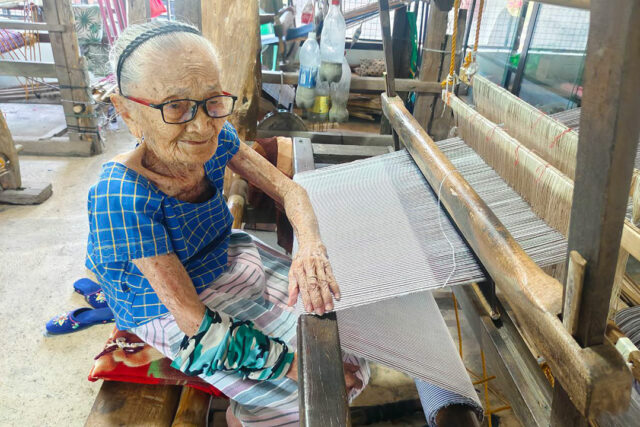
IN PINILI, Ilocos Norte, National Living Treasure Magdalena Gamayo is once more weaving with Philippine cotton. At the age of 100, her hands remain steady, creating swathes of inabel, a traditional Ilocano textile.

This return to Philippine cotton — after a long period when weavers had to make do with imported cotton or synthetic thread — marks a blend of heritage and innovation.

On Feb. 12, in celebration of National Arts Month, the Department of Science and Technology-Philippine Textile Research Institute (DOST-PTRI), provided nine kilos of brown and six kilos of white ring-spun Philippine cotton yarns to the Gamaba Weavers Association, an association of weavers who have been awarded the Gawad sa Manlilikha ng Bayan (Gamaba) or National Living Treasures Award. This initiative is meant to revive Philippine cotton in order to boost local textiles, cut imports, and promote sustainability, providing weavers with quality, sustainable yarns.

The Gamaba Weaving Association, based at the Gamaba Cultural Center, is one of the first communities selected for DOST-PTRI’s yarn deployment. The field trials allow weavers to assess the yarn’s quality, ensuring alignment with traditional techniques before commercialization.

For generations, inabel weaving has featured patterns like binakol, inuritan, kusikos, and Inubon a Sabong. Using the DOST-PTRI-developed cotton yarn, Ms. Gamayo is now weaving inunsoy, a stripe-patterned weave.

“This is a weaving movement in which we ask communities to validate with us whether cotton can be used for weaving. We seek feedback as it allows us to adjust the specifications of the cotton yarns,” DOST-PTRI Director Julius L. Leaño, Jr., was quoted as saying in a press release.

The weavers will help refine the DOST-PTRI-developed yarns, ensuring that they align with traditional weaving standards. By actively weaving with these new yarns and providing feedback, they contribute to R&D, bridging innovation and heritage.

Preventing and confronting liver cancer together

FREEPIK

Liver cancer in the Philippines holds a staggering mortality rate of 11.6 out of 100,000 individuals, compared to the global death rate of 7.8/100,000. This reflects the significant impact of liver cancer on the public health of our country, highlighting the need for a multi-faceted approach that encompasses patient education, screening and diagnosis initiatives, and access to appropriate medicine.

Liver cancer also ranks as the 4th most common type of cancer diagnosed in the Philippines next to breast, lung, and colon, and the 3rd most common cause of death. Statistics from the Global Cancer Observatory show that as of 2022, the Philippines had 12,544 new cases of liver cancer and 11,653 deaths annually.

With these, one of the diseases that deserves our attention is liver cancer and its most common variant, hepatocellular carcinoma (HCC). This, as the country commemorates World Cancer Day and the National Cancer Awareness Month every February.

As Hepatitis B infection is a major risk factor for developing HCC, increasing vaccination coverage among the population is important. This is more crucial for high-risk populations such as healthcare workers, people with chronic liver disease, individuals with multiple sexual partners, and immunocompromised patients. While the government has implemented national vaccination programs to reduce the incidence of hepatitis B, this remains to be the most common cause for hepatocellular carcinoma.

The US Centers for Disease Prevention and Control (CDC) noted that in its early stages, liver cancer may not have symptoms that can be seen or felt. On the other hand, people may notice one or more of the common symptoms as the cancer grows larger.

The CDC said that liver cancer symptoms may include discomfort in the upper abdomen on the right side; a swollen abdomen; a hard lump on the right side just below the rib cage; and pain near the right shoulder blade or in the back. Also among the symptoms are jaundice (yellowing of the skin and whites of the eyes); easy bruising or bleeding; unusual tiredness; nausea and vomiting; loss of appetite; and weight loss for no known reason.

The CDC added that a person may reduce the risk of getting liver cancer by keeping a healthy weight and getting enough physical activity. Also, one is encouraged to get tested for hepatitis C and get medical care if one has it. Finally, quit smoking and avoid drinking too much alcohol.

As with most cancers, detecting liver cancer in its early stages gives patients the best chance for successful treatment. Early diagnosis means more treatment options, better outcomes, and higher chances for survival.

The Philippine Clinical Practice Guidelines (CPG) for the Diagnosis and Management of Hepatocellular Carcinoma in 2021 recommend the semi-annual screening of patients identified to be at higher risk to develop HCC. Screening would benefit patients who are diagnosed to have late-stage liver damage or cirrhosis, and patients with hepatitis B who have a family history of HCC. For this patient group, tools like ultrasound and alpha-fetoprotein (AFP) testing can help in early detection of liver cancer.

Access to effective treatment is an important factor in cancer care, as the availability of medications directly impacts patient outcomes. In the Philippines, there is a comprehensive range of treatment options for liver cancer. Localized therapies such as interventional radiology and transarterial chemoembolization procedures are available for earlier stage disease. These allow for targeted treatment of liver tumors while minimizing damage to surrounding healthy tissue.

Beyond localized treatments, systemic medications like immunotherapy and targeted therapy are also available for more advanced diseases. These therapies work by either disrupting cancer growth at the molecular level or by enhancing the immune system’s ability to fight cancer, leading not just to prolonged survival, but also a better side effect profile.

By integrating these innovative treatments into clinical practice, physicians can now tailor HCC management to each patient’s disease stage and overall health status, ultimately leading to better disease control, extended survival, and an improved quality of life. It is important for liver cancer patients to speak with their physicians for the most appropriate treatment plan for them.

Despite these advancements, however, there is a need for healthcare programs to be in place to provide financial support for these life-saving medicines. With funding mechanisms, more Filipino patients will be able to access the therapies they need, increasing their chances of receiving optimal cancer care.

Co-creation of strategies from the government, medical experts, and the biopharmaceutical industry is crucial to pivot the condition of HCC in the country. This starts with the swift inclusion of necessary medicines into the Philippine National Formulary, followed by the development of health programs such as PhilHealth’s Z Benefits packages to ensure that medicines get into the hands of patients who need them the most.

Finally, public awareness of liver cancer and HCC is important. Increasing awareness about liver health and the signs and symptoms of liver cancer is crucial to encourage people to seek medical advice promptly.


Teodoro B. Padilla is the executive director of Pharmaceutical and Healthcare Association of the Philippines which PHAP represents the biopharmaceutical medicines and vaccines industry in the country. Its members are in the forefront of research and development efforts for COVID-19 and other diseases that affect Filipinos.

Limited Mazda MX-5 35th Anniversary Edition now available

Limited to just 15 units in the country, the Mazda MX-5 35th Anniversary Edition is priced at P2.49 million. — PHOTO FROM MAZDA PHILIPPINES

THE MAZDA MX-5 35th Anniversary Edition recently made its Asian debut outside Japan in the Philippines at the Sports Cars for a Cause (SCFC) charity event in Bonifacio Global City. First shown at the Mazda Fan Festa last November in Fuji Speedway, the iteration was produced to celebrate the roadster’s 35th year since its introduction at the 1989 Chicago Auto Show.

The SCFC featured more than 200 sports cars, along with the Mazda MX-5 35th Anniversary Edition, that converged along 4th Avenue and 27th Street in Bonifacio Global City last Feb. 23.

“Mazda Philippines is one with the BGC Car Club and Neo in supporting this wonderful event,” said Mazda Philippines President Steven Tan. “The strong sense of charity and compassion among the sports car community in Manila made it the perfect venue to show the MX-5 35th Anniversary Edition. Like the people behind Sports Cars for a Cause, the MX-5 is a car that has enjoyed a strong, dedicated following that has made it the world’s best-selling sportscar since its inception in 1989.”

Limited to just 15 units in the country and priced at P2.49 million, the Mazda MX-5 35th Anniversary Edition features upscale touches such as Artisan RedPremium Metallic paintwork, which is Mazda’s fourth Takuminuri special color. A three-layer finish produces a deep, dark red hue that complements the tan soft top and bright-silver 17-inch aluminum alloy wheels. A serialized badge on the driver’s rear fender completes the exterior highlights.

Inside, the upper door panels and AC vents are color-matched to the exterior so that customers can appreciate the rich, color-shift properties of Artisan Red Premium Metallic. The roadster gets a classic sports car interior with its heated tan Nappa leather seats embossed with exclusive “35th Anniversary” logos, and matching tan carpeting and floor mats.

Mirroring the high level of equipment found in other Mazda MX-5 soft-top models, the MX-5 35th Anniversary Edition comes standard with an 8.8-inch infotainment screen powered by the latest-generation Mazda Connect with wireless Apple CarPlay and Android Auto, dual USB Type-C ports, automatic climate control, rain-sensing wipers, and a nine-speaker Bose sound system.

Powering the Mazda MX-5 35th Anniversary Edition is a high-revving 2.0-liter Skyactiv-G engine delivering 184ps at 7,000rpm and 205Nm at 4,000rpm. This is paired exclusively to a six-speed manual. Like other 2025 MX-5 MT variants, the MX-5 35th Anniversary Edition amplifies Mazda’s “Jinbai-Ittai” philosophy of “horse and rider as one” with two new circuit-developed technologies: DSC-Track mode and Asymmetric Limited Slip Differential. This is on top of sport-tuned Bilstein dampers.

Philippine Merchandise Trade Performance (January 2025)

The Philippines’ trade-in-goods deficit widened to a three-month high in January as both exports and imports picked up, the Philippine Statistics Authority (PSA) reported on Friday. Read the full story.

Philippine Merchandise Trade Performance (January 2025)

Gov’t debt yields track US Treasuries’ decline

By Abigail Marie P. Yraola, Deputy Research Head

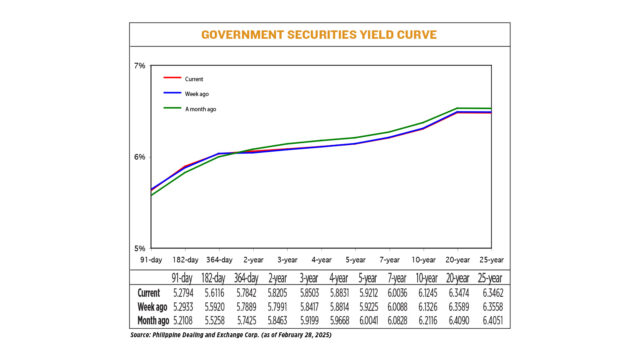
YIELDS on government securities (GS) traded in the secondary market were mixed last week amid the decline in US Treasuries and as weak data and tariff issues raised concerns about the outlook for the world’s largest economy.

GS yields, which move opposite to prices, inched down by an average of 0.03 basis point (bp) week on week, according to the PHP Bloomberg Valuation Service (BVAL) Reference Rates as of Feb. 28 published on the Philippine Dealing System’s website.

Rates at the short end of the curve were mixed, with the 91- and 364-day Treasury bills (T-bills) declining by 1.39 bps (to 5.2794%), and 0.47 bp (5.7842%) week on week, respectively. Meanwhile, the 182-day T-bill went up 1.96 bps to fetch 5.6116%.

At the belly, the two-, three-, four-year Treasury bonds (T-bonds) saw their rates increase by 2.14 bps (to 5.8205%), 0.86 bp (5.8503%), and 0.17 bp (5.8831%), respectively. On the other hand, the five- and seven-year bonds inched down 0.13 bp (to 5.9212%) and 0.52 bp (6.0036%), respectively.

At the long end of the curve, yields fell across all tenors. The rates of the 10-, 20- and 25-year T-bonds went down by 0.81 bp, 1.15 bps and 0.96 bp to 6.1245%, 6.3474% and 6.3462%, respectively.

GS volume traded amounted to P24.79 billion on Friday, lower than the P39.83 billion recorded a week earlier.

“BVAL yields broadly tracked the movement in US Treasury yields, which dropped significantly over the week after a series of disappointing economic data on consumer sentiment and inflation expectations raised market fears of a likely wavering US economic performance from anticipated untoward effects of tariffs on consumption and future business prospects,” a bond trader said in an e-mail.

“Market participants have shifted their focus on the future viability of the United States to remain the trailblazer of global economic growth. Meanwhile, other developed economies have started strategizing their economic blueprints farther away from any trade policy pronouncements by US President Donald J. Trump,” the trader said.

ATRAM Trust Corp. Vice-President and Head of Fixed Income Strategies Lodevico M. Ulpo, Jr. said the lack of local catalysts led market participants to look to the US for drivers.

“For the week, local bond yields were slightly higher by 4-8 basis points across the curve. The yield curve saw a steepening move as investors positioned ahead of key economic data releases,” Mr. Ulpo said in a Viber message.

“Offshore, news regarding PMI (purchasing managers’ index) data, consumer sentiment, and tariff concerns affected US Treasury yields to dive lower. In particular, US President Donald J. Trump’s proposed tariffs introduced fresh uncertainties in the global trade outlook, causing a risk-off sentiment. This forced global investors to flee to safe haven assets as economic concerns continue to grow.”

Mr. Ulpo added that overseas uncertainties have affected interest in bonds.

“Domestic jitters from US policy uncertainties have likewise driven local demand strongly towards bond issuances as investors seek to secure relatively stable returns while waiting for greater clarity on future market opportunities,” the trader also said.

“Market participants have turned cautious in their approach to the bond market this year, primarily due to marked volatility in a rather less-risky market than equities.”

On Friday, the yield on benchmark US 10-year notes fell 6 bps to 4.227% from 4.287% late on Thursday, Reuters reported.

The 2-year note yield, which typically moves in step with interest rate expectations for the Federal Reserve, fell 8.9 bps to 3.991% from 4.08% on Thursday.

The prospect of higher US tariffs sent jitters through markets and revived concerns about an escalating global trade war.

Mr. Trump said on Thursday that 25% duties on imports from Canada and Mexico will come into effect on March 4 — not April 2 as he had suggested a day earlier — and said goods from China will be subject to an additional 10% duty. Last week, he also floated 25% tariffs on shipments from the European Union.

For this week, GS yield movements could be driven by the release of February Philippine consumer price index (CPI) data, which could affect the Bangko Sentral ng Pilipinas’ (BSP) policy easing path, Mr. Ulpo said.

The government will release CPI data on March 5 (Wednesday). The BSP said February headline inflation may have settled within 2.3%–3.0%.

“A reading at the lower end of this range could further reinforce expectations of a rate cut, potentially driving demand for government securities,” Mr. Ulpo said.

He added that the market will continue to monitor global developments, including the Trump administration’s trade policy and the movements of major central banks.

“On the global front, US labor market data will be a key factor in shaping expectations for the Federal Reserve’s next policy move, adding another layer of policy cue to market sentiment.”

“Domestic yields are seen to continue broadly declining next week from the compounded effect of lingering BSP policy rate cuts, anticipation ahead of the lower reserve requirement by end-March and brewing concerns on the global economic growth likely to exert downward pressures across the different portions of the yield curve,” the bond trader added.

The result of the Bureau of the Treasury’s bond auction this week could also affect GS yield movements, Mr. Ulpo said.

“The Bureau of the Treasury is set to offer a five-year bond at the primary auction, with yields expected to clear within the 5.95%–6.05% range. Market participants will closely watch the auction results to gauge demand for mid-tenor bonds ahead of the BSP’s anticipated rate cut in April.” — with Reuters


S. Korea-PHL consortium to build Clark low-cost housing complex

NEW CLARK CITY

A CONSORTIUM consisting of South Korean and Filipino companies is investing P4.8 billion for an affordable housing complex in New Clark City, the Bases Conversion and Development Authority (BCDA) said.

“The BCDA is seeking to partner with a consortium of South Korean and local companies to develop a 6.1-hectare affordable housing complex in New Clark City, aiming to address the housing shortage and foster sustainable urban growth,” it said on Saturday.

The consortium includes Sta. Clara International Corp., Saekyung Realty Corp., and Korea Overseas Infrastructure and Urban Development Corp.

The project is expected to feature 12 high-density residential buildings with 3,320 units. Some 2,600 units will go on the open market, while the remaining 720 units will be offered under the Pambansang Pabahay Para sa Pilipino (4PH) Program.

“Beyond addressing housing needs, this project, if realized, will generate jobs, attract investment, and drive economic growth in Central Luzon,” BCDA President and Chief Executive Officer Joshua M. Bingcang said in a statement.

The project is also expected to incorporate green spaces and parks, road networks and stormwater drainage systems, fire protection measures and disaster-ready structures, retail and commercial spaces, and sports and leisure facilities.

In 2023, BCDA entered a memorandum of understanding with the Department of Human Settlements and Urban Development (DHSUD) to develop the initial housing units for the 4PH Program inside New Clark City.

CAMP JOHN HAY
In a separate statement, the BCDA said that investments in Camp John Hay have hit P1 billion in the two months since it regained full control of the property in January.

“This reflects the business sector’s trust and confidence in the BCDA’s track record and its plans of transforming the iconic destination into a premier ecotourism and investment hub,” it said.

To date, the BCDA has signed 75 residential and commercial lease agreements in Camp John Hay, totaling P1 billion in investments.

Of the contracts signed, 70 were residential lease agreements signed with Filipino and foreign nationals, including Koreans, while the remainder were commercial lease agreements.

“Numbers don’t lie. Breaching a billion mark in just two months is proof that Camp John Hay is thriving as more and more investors are seeing its potential of becoming the country’s next ecotourism and investment hub under the management of BCDA,” Mr. Bingcang said.

“More exciting things will be announced soon, as we are set to close more contracts and deals in the next weeks,” he added.

The BCDA said some of the investments have come in, including those from Metro Pacific Investments Corp. subsidiary Landco Pacific Corp., Stern Real Estate Development Corp., Amare La Cucina, Golfplus Management, Inc. (GMI), DuckWorld Philippines, and Top Taste Trading, Inc.

The BCDA is also conducting a review of the comprehensive master plan of the John Hay Special Economic Zone.

In January, the BCDA projected that investments in Camp John Hay will hit P10 billion under its management. — Justine Irish D. Tabile

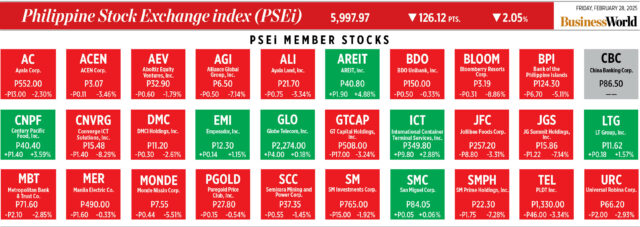
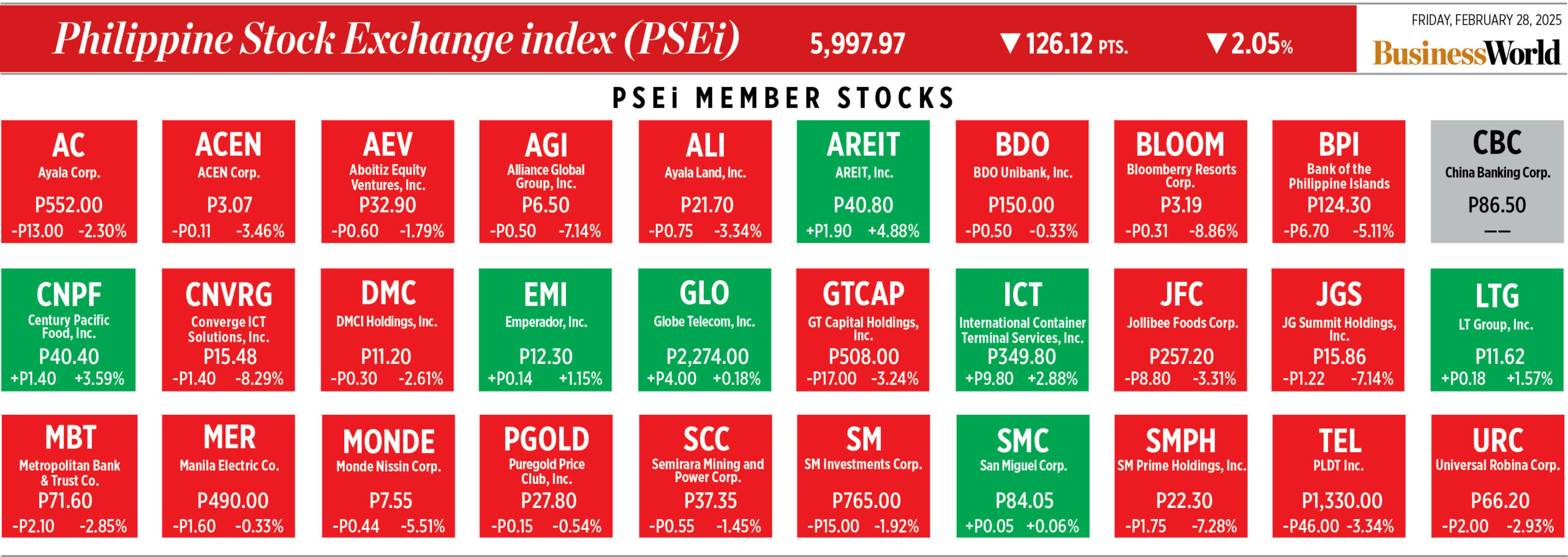
How PSEi member stocks performed — February 28, 2025

Here’s a quick glance at how PSEi stocks fared on Friday, February 28, 2025.


Peso may move sideways as markets digest key US economic data, tariffs

BW FILE PHOTO

THE PESO could continue to move sideways against the dollar this week as the market digests key US economic data released over the weekend, which could affect the US Federal Reserve’s policy path moving forward.

On Friday, the local unit closed at P57.995 per dollar, weakening by 8.5 centavos from its P57.91 finish on Thursday, Bankers Association of the Philippines data showed.

Week on week, the peso also declined by three centavos from its P57.94-per-dollar finish on Feb. 21.

“The dollar-peso traded lower after US President Donald J. Trump said the tariffs on Canada and Mexico will take effect next week, and an additional 10% tariffs on China,” a trader said in a phone interview on Friday.

Rizal Commercial Banking Corp. Chief Economist Michael L. Ricafort said in a Viber message that Mr. Trump’s comments caused safe-haven demand for the greenback on Friday.

Investors unnerved by the prospect of Mr. Trump’s impending tariffs drove a wave of selling on Friday that hit risk-sensitive currencies such as the Australian dollar and sent bitcoin tumbling, thereby boosting the dollar in the Asian session, Reuters reported.

On Thursday, Mr. Trump said his proposed tariffs of 25% on Mexican and Canadian goods would take effect on March 4, along with an extra 10% duty on Chinese imports, defying expectations of those who hoped for a further delay in the levies.

For this week, the trader said the peso’s movement would depend on US core personal consumption expenditures (PCE), personal income, and consumer spending data, which were released after the Asian trading session on Friday.

The trader sees the peso moving between P57.70 and P58.20 per dollar this week, while Mr. Ricafort expects it to range from P57.75 to P58.15.

In the US session, the US dollar edged lower on Friday following two straight days of gains, after a reading on inflation was largely as anticipated by investors while consumer spending unexpectedly fell, Reuters reported.

The PCE price index increased 0.3% in January, in line with expectations of economists polled by Reuters, after advancing by an unrevised 0.3% in December. In the 12 months through January, prices rose 2.5% after increasing 2.6% in December.

The Fed tracks the PCE price measures for its 2% inflation target. The US central bank paused rate cuts in January, leaving its benchmark overnight interest rate in the 4.25%-4.5% range, having reduced it by 100 basis points since September, when it started its easing cycle.

But consumer spending, which accounts for more than two-thirds of US economic activity, dropped 0.2% in January after an upwardly revised 0.8% increase in December.

The dollar index, which measures the greenback against a basket of currencies including the yen and the euro, fell 0.1% to 107.25, with the euro up 0.18% at $1.0416.

For the week, the dollar was up about 0.5% but down more than 1% for February, poised for its largest monthly decline since August.

Expectations the Federal Reserve will cut rates by at least 25 basis points (bps) at its June meeting edged up after the data, with markets pricing in a 71.4% chance of a cut, up from nearly 70% in the prior sessions, according to CME’s FedWatch Tool.

Fed officials have recently indicated they expect the central bank to hold rates steady until there is more clarity surrounding the impact of tariffs on inflation and a slowing economy.

Minutes of the US central bank’s Jan. 28-29 policy meeting showed officials were worried about higher inflation from Mr. Trump’s initial policy proposals. The policy rate was hiked by 5.25 percentage points in 2022 and 2023 to quell inflation.

The greenback had fallen earlier last week by nearly 4% from a more than two-year high in January on renewed worries about US economic growth and inflation as Mr. Trump shifted tariff deadlines on Canada and Mexico.

Investors are also bracing for the labor market impact from actions by the Department of Government Efficiency under Elon Musk.

Against the Japanese yen, the dollar strengthened 0.65% to 150.77 but has fallen nearly 3% for February as investors largely expect the Bank of Japan to hike interest rates this year. — AMCS with Reuters

Stocks may rebound before PHL inflation report

REUTERS

PHILIPPINE SHARES may rebound this week on increased flows amid fresh catalysts, including inflation and factory activity data, and with the market awaiting developments regarding the Trump administration’s trade policy.

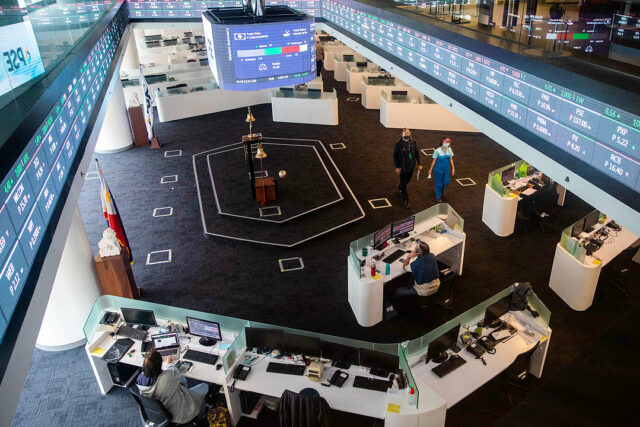
On Friday, the Philippine Stock Exchange index (PSEi) slumped by 2.06% or 126.12 points to close at 5,997.97, while the broader all shares index declined by 1.83% or 67.07 points to end at 3,588.12.

Week on week, the PSEi went down by 1.64% or 100.07 points from its 6,098.04 finish on Feb. 21.

“The benchmark index failed to hold above the 6,000 psychological support level, impacted by the latest MSCI (Morgan Stanley Capital International) rebalancing,” online brokerage 2TradeAsia.com said in a market note.

For this week, 2TradeAsia.com said the release of February Philippine headline inflation data on March 5 (Wednesday) will take center stage. The consumer price index may have settled within 2.3%–3% last month, the Bangko Sentral ng Pilipinas said on Friday.

Anticipation for the report may cause the PSEi to rise on Monday, Rastine Mackie D. Mercado, research director at China Bank Securities Corp., said in an e-mail.

“We think that the PSEi could bounce back at Monday’s open given the MSCI-flows related forced downward closure on Friday. If this expectation materializes, we see the PSEi continuing to traverse the 6,000-6,150 range for most part of the week,” he said. “Upcoming data releases, such as the domestic February manufacturing PMI (purchasing managers’ index) and inflation could also spur reactive moves.”

“If the PSEi is able to find its footing atop 6,000 in the coming week, then prospects of a retest of the 6,150 level remain in play in the short term.”

Meanwhile, tariff announcements from US President Donald J. Trump could continue to weigh down market sentiment, said Toby Allan C. Arce, head of sales at Globalinks Securities and Stocks, Inc.

“The international community is increasingly wary of Trump’s hardline stance, which targets countries accused of unfair trade practices, drug trafficking, and immigration challenges… Investors, who had become less reactive to trade headlines, are now recalibrating their outlook as these measures threaten to exacerbate global economic uncertainties,” Mr. Arce said in a Viber message.

Mr. Trump said on Thursday that 25% duties on imports from Canada and Mexico will come into effect on March 4 — not April 2 as he had suggested a day earlier — and said goods from China will be subject to an additional 10% duty, Reuters reported. Last week, he also floated 25% tariffs on shipments from the European Union.

2TradeAsia.com placed the PSEi’s immediate support at 5,800 and resistance at 6,000.

“External risks continue to cap rallies, but mean reversion and factor rotation could create tactical opportunities once confidence stabilizes,” it added. — Sheldeen Joy Talavera with Reuters

Philippines, South Korea launch latest clean-energy knowledge sharing program

JEROME CMG-UNSPLASH

THE Department of Energy (DoE) said it has launched a knowledge-sharing program with South Korea on clean energy.

In a statement on Sunday, the DoE said its 2024/25 knowledge sharing program serves as a platform for the exchange of expertise and best practices.

“We aim to gain invaluable insights and best practices that will help us draft policy, strengthen our institutions, and implement innovative energy solutions that respond to our country’s evolving energy landscape,” Energy Undersecretary Alessandro O. Sales said.

The two governments held high-level discussions in August to explore ways for the Philippines to benefit from South Korea’s advances in energy technology while showcasing its own strengths in renewable energy, particularly in geothermal and pumped hydropower generation.

The Korea Energy Economics Institute, Korea Advanced Institute of Science and Technology, Korea Trade-Investment Promotion Agency, and Korea Hydro & Nuclear Power, are participating in the program.

The Asia Economic Development Committee (AEDC) of South Korea serves as the program’s official coordinating organization for Philippine government-related knowledge-sharing matters, facilitating energy cooperation between the two countries.

“This program is not just about technology transfer, it is a testament to the enduring friendship and shared commitment of our nations to sustainable energy development,” AEDC Chairman Yoon Sukhun said.

As part of the program, the Philippines submitted three key proposals aligned with its energy transition and socioeconomic development goals. These include initiatives accelerating electric vehicle adoption and charging infrastructure, integrating floating solar and smart grid technologies, and strengthening capacity building for clean energy development.

Since its inception in 2004, the program has supported over 759 research projects, fostering collaborations that drive innovation and enhance institutional capacity.

“The Philippines and Korea reaffirm their dedication to fostering strong energy cooperation, leveraging shared knowledge, and driving forward sustainable energy solutions that will benefit both nations in the years to come,” the DoE said.

The Energy department is seeking to increase the share of renewable energy in the power generation mix to 35% by 2030. — Sheldeen Joy Talavera

Jobs plan for wholesale, retail industry due midyear

PHILIPPINE STAR/RUSSELL A. PALMA

THE Department of Trade and Industry (DTI) said it hopes to release a jobs blueprint for the wholesale and retail trade industry by midyear.

“We need to finalize it because we have to validate it with our partners,” Trade Undersecretary Mary Jean C. Pacheco told reporters.

The DTI’s partners for the blueprint are the Supply Chain Management Association of the Philippines (SCMAP) and the Philippine Retailers Association (PRA).

“(We expect to release it) maybe by midyear,” she said.

The blueprint will set targets, which Ms. Pacheco said it will require buy-in by the partners.

“We haven’t presented (the first draft) yet. Because we finished it in December,” she said.

“Our plan is to do consultations first with SCMAP, then do one with PRA, and then do another with the both of them.”

In October, Trade Secretary Ma. Cristina A. Roque said that the blueprint will help create a thriving job market in the industry and ensure that innovation and technological advancements translate into opportunities for workers.

It is projected to benefit over 10 million workers in wholesale and retail, which accounted for P4.4 trillion of gross domestic product in 2023, the DTI said.

In December, PRA President Roberto S. Claudio welcomed the roadmap, noting that it will bolster the economy.

“The retail sector is ready to embrace innovation and enhance the customer experience. This blueprint provides a clear roadmap for us to achieve those goals while contributing to economic progress,” Mr. Claudio said. — Justine Irish D. Tabile

ADVERTISEMENT
ADVERTISEMENT