New Zealand’s center-right government on Thursday introduced a bill aimed at reinterpreting the country’s founding agreement, triggering protests by Indigenous Maori groups who said it would undermine their rights.
The Treaty of Waitangi, first signed in 1840 between the British Crown and more than 500 Maori chiefs, lays down how the two parties agreed to govern. The interpretation of clauses in this document guide legislation and policy today.
Associate Justice Minister David Seymour said the purpose of the Treaty Principles Bill is for Parliament to define the principles of the treaty, provide certainty and clarity, and promote debates on its place in constitutional arrangements.
“The principles of the Treaty are not going anywhere. Either Parliament can define them, or the courts will continue to meddle in this area of critical political and constitutional importance,” Seymour said in a statement.
The legislation is a policy of Seymour’s ACT New Zealand party, which garnered 8.6% of the party vote at the 2023 election.
ACT has criticized the sharing of some governance matters between the state and Maori, arguing non-Indigenous citizens are losing out because of policies designed to uplift Maori, who make up about 20% of the country’s 5.3 million people.
Coalition partners, the National Party and New Zealand First, has agreed to support the legislation through the first of three readings but have said they will not support it to become legislation. The first reading is scheduled next week.
Protesters marched in Auckland, New Zealand’s biggest city, holding signs reading “Shame” and “Equality”, and gathered outside Seymour’s office, while a small group converged outside the parliament in the national capital of Wellington.
Maori leaders described the government’s move to introduce the bill more than a week earlier than expected and without consulting them as “dishonorable”, New Zealand media reported.
Prime Minister Christopher Luxon said it was not unusual to move the bill earlier as the government was aiming to submit several pieces of legislation before Christmas.
“It was drafted and the legislation was ready to go. We move legislation around all the time and so it’s not unusual at all,” Mr. Luxon told reporters. – Reuters
SYDNEY – Australia Prime Minister Anthony Albanese said on Thursday the government would legislate for a ban on social media for children under 16, a policy the government says is world-leading.
Australia is trialing an age-verification system to assist in blocking children from accessing social media platforms, as part of a ban that could come into force as soon as the end of next year.
“Social media is doing harm to our kids and I’m calling time on it,” Mr. Albanese told a news conference.
Mr. Albanese cited the risks to physical and mental health of children from excessive social media use, in particular the risks to girls from harmful depictions of body image, and misogynist content aimed at boys.
“If you’re a 14-year-old kid getting this stuff, at a time where you’re going through life’s changes and maturing, it can be a really difficult time and what we’re doing is listening and then acting,” he said.
Legislation will be introduced into parliament this year, with the laws coming into effect 12 months after being ratified by lawmakers, he added.
The opposition Liberal Party has expressed support for a ban.
There will be no exemptions for children who have parental consent, or who already have accounts.
“The onus will be on social media platforms to demonstrate they are taking reasonable steps to prevent access,” Albanese said. “The onus won’t be on parents or young people.”
Communications Minister Michelle Rowland said platforms impacted would include Meta Platforms’ Instagram and Facebook, as well as Bytedance’s TikTok and Elon Musk’s X. Alphabet’s GOOGL.O YouTube would likely also fall within the scope of the legislation, she added.
TikTok declined to comment, while Meta, Alphabet and X did not respond to requests for comment.
A number of countries have already vowed to curb social media use by children through legislation, though Australia’s policy is one of the most stringent.
France last year proposed a ban on social media for those under 15, though users were able to avoid the ban with parental consent.
The United States has for decades required technology companies to seek parental consent to access the data of children under 13, leading to most social media platforms banning those under that age from accessing their services. – Reuters
PALM BEACH, Florida/WASHINGTON – Donald Trump recaptured the White House with a sweeping victory on Wednesday as tens of millions of Americans looked past his criminal charges and divisive rhetoric to embrace a leader who, if he carries out his campaign promises, will test the limits of presidential power.
Mr. Trump, 78, clinched Tuesday’s election after a polarizing and dizzying campaign marked by two attempts on his life and Kamala Harris‘ late entry into the race following President Joe Biden’s surprise withdrawal.
In a concession speech at her alma mater Howard University on Wednesday afternoon, Harris sought to console the voters who had hoped she would become the first woman to win the White House.
“To everyone who is watching, do not despair,” she said. “This is not a time to throw up our hands. This is a time to roll up our sleeves.”
Ms. Harris said she had called Mr. Trump to congratulate him and promised to aid his transition. But she was not prepared to embrace his vision for the country.
“While I concede this election, I do not concede the fight that fueled this campaign,” she said, as some supporters in the crowd shed tears. “The fight for freedom, for opportunity, for fairness and the dignity of all people.”
Mr. Biden planned to address the nation at 11 a.m. EST (1600 GMT) on Thursday. The White House said Biden was committed to a smooth transition between now and Trump’s inauguration on Jan. 20.
Mr. Trump’s campaign said Mr. Biden called Mr. Trump to congratulate him and invite him to a meeting at the White House at an unspecified time.
Mr. Trump’s resounding victory underscored how disenchanted Americans had become with the economy, border security and the direction of the country and its culture. Voters demanded a change, even if the agent of change was a convicted felon twice impeached and no longer the Washington outsider he was in his 2016 campaign.
Mr. Trump has said he wants the authority to fire civil servants he views as disloyal and has vowed to use federal law enforcement agencies to investigate or prosecute perceived enemies, including political rivals.
Mr. Trump promised roles in his administration to Tesla CEO Elon Musk, the world’s richest man and a prominent Trump donor, and former presidential candidate Robert F. Kennedy Jr.
Mr. Musk contributed at least $119 million to a pro-Trump spending group, giving him extraordinary influence to help his companies secure favorable government treatment.
The outcome defied polls that showed a razor-close race ahead of Tuesday’s Election Day. Mr. Trump prevailed in at least five of the seven battleground states to push him over the 270 Electoral College votes needed to win the presidency and was leading in the remaining two, Arizona and Nevada, where votes were still being tallied.
Mr. Trump was also on track to become the first Republican presidential candidate to win the popular vote since George W. Bush two decades ago.
His fellow Republicans wrested control of the U.S. Senate from Democrats and had added to their narrow majority in the U.S. House of Representatives, though the outcome there may not be known for several days with dozens of races still uncalled.
“It was a hell of a good day,” said Mitch McConnell, the longtime Senate Republican leader.
Unified Republican control on Capitol Hill would clear the way for major portions of Trump’s legislative agenda, as it did in the first two years of his 2017-2021 presidency when Republicans whipped a major tax-cut bill through Congress that mainly benefited the wealthy.
“America has given us an unprecedented and powerful mandate,” Mr. Trump said early on Wednesday to a roaring crowd at the Palm Beach County Convention Center in Florida.
Major stock markets around the world rallied following Mr. Trump’s victory, and the dollar was set for its biggest one-day jump since 2020.
OVERCOMING ODDS
Mr. Trump was elected despite persistently low approval ratings, four criminal indictments and a civil judgment against him for sexual abuse and defamation. In May, Mr. Trump became the first former U.S. president to be convicted of a crime when a New York jury found him guilty on 34 felony counts of falsifying business records to cover up hush money paid to a porn star.
Mr. Trump’s political career appeared over after his false claims of election fraud led a mob of supporters to storm the U.S. Capitol on Jan. 6, 2021, in a failed bid to overturn his 2020 defeat. His efforts to reverse his defeat led to two separate indictments, though all the criminal cases against him are expected to end after his victory.
Mr. Trump swept away challengers inside his party and then beat Harris by capitalizing on voter concerns about high prices and what Trump claimed falsely was a rise in crime due to illegal immigration.
Mr. Trump’s win will have major implications for U.S. trade and climate change policies, Americans’ taxes and immigration, and U.S. foreign policy, including in the Middle East and Ukraine.
Israeli Prime Minister Benjamin Netanyahu congratulated Mr. Trump, and they discussed “the Iranian threat” and the need to work together for Israel’s security, Mr. Netanyahu’s office said.
Hamas, the Palestinian militant group, called for an end to the “blind support” for Israel from the United States.
Ukrainian President Volodymyr Zelenskiy welcomed Trump’s commitment to “peace through strength,” while the Kremlin said it would wait and see if his victory could help end the war in Ukraine more quickly. Mr. Trump had said he could end the war in 24 hours but has not offered a detailed plan.
Mr. Trump’s tariff proposals could spark a fiercer trade war with China and U.S. allies, while his pledges to reduce corporate taxes and implement a spate of new cuts could balloon U.S. debt, economists say.
“We respect the choice of the American people and congratulate Mr. Trump on his election as president,” a Chinese foreign ministry spokesperson said in a statement late on Wednesday.
Mr. Trump also held a call with South Korean President Yoon Suk Yeol in which they pledged to meet soon and shared concerns over North Korea’s deployment of troops backing Russia in the war against Ukraine and Pyongyang’s continued military provocations, a Yoon aide said. Mr. Yoon later told reporters his government will work with the Trump administration to build a “perfect” security partnership.
A second Trump presidency could drive a bigger wedge between Democrats and Republicans on issues such as immigration, race, gender and reproductive rights.
Mr. Trump has promised to launch a mass deportation campaign targeting immigrants in the country illegally.
Hispanics, traditionally Democratic voters, and lower-income households hit hardest by inflation helped fuel the victory.
Mr. Trump’s support among women, whose backing Democrats had counted on, improved from four years ago. And his loyal base of rural, white and non-college educated voters again showed up in force, according to Edison Research exit polls. – Reuters
MANILA – The Philippine economy grew 5.2% in the third quarter from a year earlier, the statistics agency said on Thursday, coming in below forecasts and slowing from the annual pace in the previous quarter.
Economists polled by Reuters had expected gross domestic product (GDP) to expand by 5.7% from a year earlier. Growth in the second quarter was revised up to 6.4%.
On a quarter-on-quarter basis, GDP grew 1.7% in July-September, compared with economists’ expectations for a 1.5% rise and the prior quarter’s 0.5% increase.
The Philippine government is targeting growth of 6.0% to 7.0% this year. — Reuters
After 19 years of service, The Rhetoricians: The UPLB Speech Communication Organization continues to commit itself to training its members and constituents to be paragons of excellence and ethical communicators through various initiatives.
One of which is the highly anticipated Powerhouse 2024, which will be conducted face-to-face for the first time since 2019. Powerhouse is the organization’s annual public forum led by experts in communication that addresses a wide range of topics that recognize the importance of ethical communication and providing information to the masses.
With the upcoming 2025 elections, the theme of this year’s forum is The Power of Voices in the Digital Age. It will focus on empowering young voices in engaging in responsible voting amidst the digital era wherein misinformation and disinformation continue to spread like wildfire through digital platforms.
This year’s esteemed speakers are Mona Magnu-Veluz, also known as Mighty Magulang, and Hon. Raoul Danniel Abellar Manuel.
Mighty Magulang serves as the National Spokesperson of the Autism Society Philippines (ASP) and the concurrent Country Manager for the ASP Autism Works economic empowerment program, but she is better known for her videos containing historical and genealogical facts about Philippine history on her TikTok account with over 600,000 followers. Hon. Raoul Danniel Abellar Manuel, also known as Rep. Raoul Manuel, is a member of the House of Representatives for Kabataan Partylist, advocating as the sole voice for the youth in Congress. He is also an active member of the ASEAN Parliamentarians for Human Rights, the Philippine Legislators Committee on Population and Development, and Parliamentarians for a Fossil-Fuel-Free Future.
Powerhouse 2024: The Power of Voices in the Digital Age will be held on the 14th of November 2024 from 2:00 p.m. to 4:00 p.m. at the Rural Economic Development and Renewable Energy Center (REDREC) Auditorium, UP Los Baños.
For partnerships and event sponsorship inquiries, contact Gabriel Nafura at 0947-324-3283 or email The Rhetoricians at therhetoriciansuplb.powerhouse@gmail.com. For tickets and more information about Powerhouse 2024, follow our Facebook and Instagram pages: @TheRhetoricians.
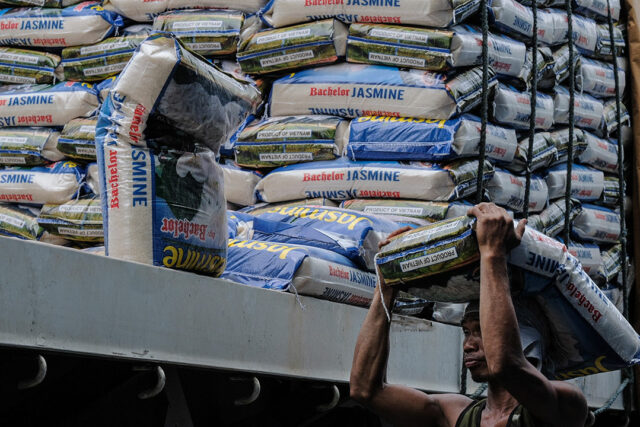
Wet palay is being dried on the street in Bula, Camarines Sur, Oct. 26, 2024. — PHILIPPINE STAR/NOEL B. PABALATE
By Luisa Maria Jacinta C. Jocson, Reporter
THE PHILIPPINES’ agricultural production plunged by 3.7% in the third quarter, the steepest decline in nearly four years, the statistics authority said on Wednesday.
Data from the Philippine Statistics Authority (PSA) showed the value of production in agriculture and fisheries at constant 2018 prices fell by 3.7% to P397.43 billion in the July-to-September period. This was worse than the 0.2% decline in the same period a year ago.
This was also the biggest drop in farm output since the 3.8% contraction in the fourth quarter of 2020.
In the first nine months, agricultural output shrank by 2.2%, a reversal of the 0.2% growth a year prior.
“This was attributed to the reductions in the values of crops, livestock and fisheries production,” the PSA said.
The Department of Agriculture (DA) in a statement said the lower farm production was due to adverse weather and the lingering impact of African Swine Fever (ASF).
Broken down, crops production slid by 5.1% in the quarter ending-September, worsening from the 0.2% drop a year earlier. Crops accounted for more than half or 53.2% of the total farm output.
In the January-September period, the value of production in crops slid by 4.6%, reversing the 0.9% increase a year earlier.
“Undeniably, the combined effects of El Niño and La Niña weighed down palay production, a major contributor to the crop sector, which accounts for more than half of the value of agricultural and fisheries output,” Agriculture Secretary Francisco P. Tiu Laurel, Jr. said.
Palay (unmilled rice) production primarily contributed to this decline, plunging by 12.3% in the third quarter.
PSA data showed sugarcane plummeted by 83.8% during the July-to-September period. Lower output was also seen in mango (-11.2%), ampalaya (-5.6%), rubber (-4.6%), cassava (-3.9%), banana (-1.1%), pineapple (-0.4%), and coconut (-0.1%).
“On the other hand, the value of corn production was 1.3% higher than last year’s same quarter level,” it added.
Meanwhile, livestock production, which accounted for 15.5% of the total, fell by 6.7% in the third quarter. This was a reversal of the 2.5% expansion a year ago.
The value of livestock output dropped by 3.5% in the first nine months from the 2.4% growth in the previous year.
This as hog production slumped by 8% in the third quarter, reversing the 3.3% expansion a year ago.
“There were also more livestock hit by the ASF this third quarter compared to the quarter a year ago,” Samahang Industriya ng Agrikultura Executive Director Jayson H. Cainglet said in mixed English and Filipino.
The latest bulletin from the Bureau of Animal Industry showed there are active ASF cases in 108 municipalities across 25 provinces as of Oct. 18.
There was also a drop in the value of production for goat (-4.1%) and carabao (0.5%). On the other hand, higher production was seen for dairy (6%) and cattle (0.9%).
Meanwhile, fisheries production declined by 5.5% in the third quarter, although improving from the 6.1% contraction in the same period in 2023.
Fisheries accounted for 14% of the agriculture sector’s total production in the quarter.
In the nine-month period, the value of fisheries output dipped by 0.9%, improving from the 7% contraction a year ago.
Double-digit declines were recorded for grouper or lapu-lapu (-31.9%), big-eyed scad or matangbaka (-23%), fimbriated sardines or tunsoy (-18.9%), Indian mackerel or alumahan (-18.8%); yellowfin tuna or tambakol (-18.6%), round scad or galunggong (-17.2%), tiger prawn or sugpo (-16.7%), mudcrab or alimango (-14.8%), slipmouth or sapsap (-14.7%); andsquid or pusit (-11.9%).
Production likewise declined for frigate tuna or tulingan (-7.5%), milkfish or bangus (-6.9%), Bali Sardinella or tamban (-6.7%), cavalla or talakitok (-4.6%), tilapia (-4.2%), and seaweed (-1.5%).
“The fisheries subsector also suffered from the adverse weather,” the Agriculture department said.
Mr. Cainglet said there were more typhoons this year compared to last year.
A number of storms and typhoons struck the country in the third quarter, resulting in significant agricultural damage.
These include the combined effects of southwest monsoon and Typhoon Carina (P4.73 billion), Severe Tropical Storm Enteng (P3.77 billion), and the combined effects of the enhanced southwest monsoon and tropical cyclones Ferdie, Gener, and Helen (P1.09 billion), according to DA estimates.
LONE BRIGHT SPOT Meanwhile, poultry was the only sector to post gains in the third quarter. Poultry production grew by 5.8%, faster than the 2.9% in the same period a year ago.
Poultry output expanded by 6.8% in the January-September period from 2.5% a year earlier. It accounted for 17.3% of the total value of agricultural production.
Growth was seen for chicken eggs (6.6%) and chicken (6%), while declines were seen in duck eggs (-5.7%) and duck (-3.2%).
Federation of Free Farmers National Manager Raul Q. Montemayor said that the contraction in overall farm output was also due to the sector’s vulnerability to shocks.
“While we can point to weather disturbances and animal diseases for the decline in output, it also reflects the low level of resiliency and vulnerability of the sector to external forces,” he said.
“The output decline was due mainly to a reduction in the volume, which was not able to offset a general upswing in prices,” he added.
Mr. Cainglet said that farmgate prices of palay and hog have continued to be low due to over importation and reduced tariffs. “Even the farmgate price of chicken, despite the growth, is below cost of production. The farmgate price of chicken is at P90 per kilo,” he added.
The executive order slashing tariffs on rice imports to 15% until 2028 took effect in July.
Mr. Tiu Laurel said the government is working on measures to support the sector, such as continuing to develop a vaccine for ASF.
“We’re implementing changes to the rice cropping calendar and building infrastructure like water impounding dams to mitigate the impact of climate change on the farming sector,” he added.
The DA is targeting 1-2% agricultural growth this year.
The agriculture sector typically accounts for about a tenth of the country’s gross domestic product (GDP). It also provides about a quarter of all jobs.
The PSA is scheduled to release third-quarter GDP data today (Nov. 7).
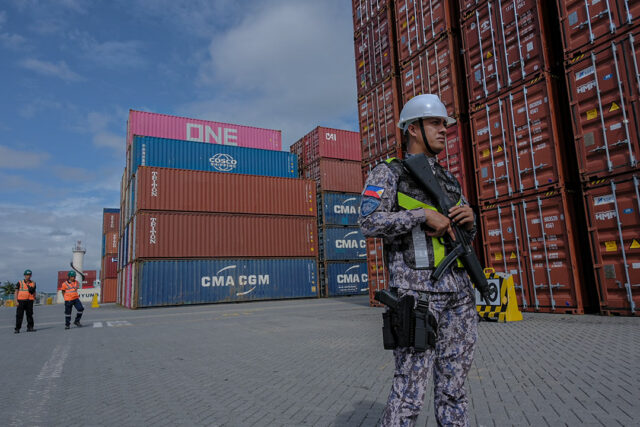
Container vans are seen in the port area in Manila. — PHILIPPINE STAR/RYAN BALDEMOR
By Aubrey Rose A. Inosante, Reporter
THE PHILIPPINES’ trade-in-goods deficit ballooned to $5.09 billion in September, the biggest trade gap in 20 months, the Philippine Statistics Authority (PSA) said on Wednesday.
Preliminary data from the PSA showed the trade-in-goods balance — the difference between exports and imports — stood at a $5.09-billion deficit in September, up by 43.4% from $3.55-billion gap a year ago.
Month on month, the trade gap rose by 15.81% from $4.39 billion in August.
The country’s balance of trade in goods has been in the red for 112 straight months (over nine years) since the $64.95-million surplus recorded in May 2015.
In September, exports declined 7.6% to $6.26 billion from $6.77 billion a year ago. This was the biggest drop since June.
For the first nine months, exports rose by 1.1% to $55.67 billion.
The Development Budget Coordination Committee (DBCC) expects 5% growth in exports this year.
On the other hand, the value of imports went up by an annual 9.9% to $11.34 billion in September from $10.32 billion in the same period last year.
In the nine-month period, imports inched up by 0.6% to $95.07 billion. This is below the DBCC’s target of 2% growth in imports for the year.
ELECTRONICS EXPORTS Among the major types of goods, exports of manufactured goods fell by 11.1% year on year to $4.95 billion in September, followed by mineral products ($645.24 million) and agro-based products ($492.62 million). Manufactured goods accounted for 79.2% of the total exports in September.
By commodity group, electronic products was still the country’s top exports in September with $3.15 billion, down 23.1% from $4.09 billion a year ago.
Semiconductor exports, which accounted for the majority of electronic goods, dropped by 30.6% to $2.31 billion in September.
Exports of other manufactured goods increased by 73.7% to $506.69 million, while other mineral products rose by 16.2% to $330.23 million in September.
The United States remained the top destination of Philippine-made goods, with exports valued at $1.08 billion. This accounted for 17.3% of total exports in September.
Hong Kong was the second-biggest market with an export value of $867.42 million (13.9% share), followed by Japan with $847.47 million (13.5%), China with $830.36 million (13.3%), and South Korea with $318.50 million (5.1%).
Other top export destinations include Thailand, the Netherlands, Germany, Singapore, and Taiwan.
IMPORTS By type of goods, imports of raw materials and intermediate goods increased by 19.5% to $4.33 billion in September, while capital goods inched up by 1.4% to $3.03 billion and consumer goods rose by 20.6% to $2.56 billion.
In terms of value, electronic products had the highest import value at $2.4 billion in September, up by 8.9% from last year. It made up 21.2% of the total imports in September.
Imports of mineral fuels, lubricants, and related materials slipped 11.4% year on year to $1.36 billion in September, while transport equipment also fell by an annual 3.1% to $1.12 billion.
In September, China was the biggest source of imports valued at $2.84 billion, which made up 25% of the total import bill.
This was followed by Indonesia with $1.09 billion (9.6%), Japan with $837.75 million (7.4%), South Korea with $784.65 million (6.9%), Thailand with $735.58 million (6.5%) and the United States with $6.298 million (6.7%).
GlobalSource Country Analysts Diwa C. Guinigundo said that the widening trade deficit was due to sluggish exports.
“We are strong in imports, but our exports are not doing very well precisely because the global economy was also not doing very well,” he said in a phone call interview.
“Exports declined because the global economy is not exactly robust, while our imports were driven by the demand for imports of capital goods, raw materials and intermediate products, as well as consumer imports like oil, cars,” he added.
Rizal Commercial Banking Corp. Chief Economist Michael L. Ricafort said the increase in imports was also due to a stronger peso.
The peso closed at P56.03 per dollar at end-September, strengthening from the P56.111 finish at end-August.
For the coming months, Mr. Ricafort said that the weakening peso would “make imports more expensive from the point of view of local buyers, but would make exports more price competitive from the point of view of foreign buyers.”
“Increased demand other economic activities during the Christmas holiday season would help spur more imports/production activities and export sales,” Mr. Ricafort said.
People submit their applications at a job fair in Manila. The jobless rate fell to 3.7% in September, the statistics agency said. — PHILIPPINE STAR/EDD GUMBAN
By Chloe Mari A. Hufana, Reporter
THE PHILIPPINES’ unemployment rate fell to 3.7% in September, driven in part by a growing number of female workers joining the labor force ahead of the holiday season, the statistics agency said on Wednesday.
Preliminary data from the Philippine Statistics Authority’s (PSA) Labor Force Survey showed the jobless rate dropped to 3.7% in September from 4% in August and 4.5% in September last year.
This translated to 1.89 million unemployed Filipinos in September, down by 177,000 from August and by 370,000 from a year earlier.
Despite the lower jobless rate, underemployment rose to 11.9% in September from 11.2% in August and 10.7% in September last year.
The number of underemployed Filipinos — those who want longer work hours or an additional job — increased by 831,000 to 5.94 million in September from 5.11 million a year ago.
In the first nine months of the year, the unemployment rate averaged 4%, lower than the 4.6% average a year ago.
PSA data showed the employment rate went up to 96.3% in September from 95.5% a year ago. This is equivalent to 49.87 million employed Filipinos, up by 2.2 million from 47.67 million in September 2023.
In September, the labor force participation rate (LFPR) increased to 65.7% in September, from 64.1% a year ago. This translates to a labor force of 51.77 million in September, up 1.84 million from 49.93 million a year ago.
Undersecretary and National Statistician Claire Dennis S. Mapa said 1.34 million of these new workers were women.
“In [the number of] employed persons year on year, the majority here are actually female workers,” he told a news briefing in mixed English and Filipino.
He noted there has been a steady increase in female workers for the past three months.
The LFPR among female Filipino workers rose to 55.7% in September from 53.4% a year ago. For male workers, the rate also rose to 75.6% from 74.7% a year ago.
“By and large, more and more women and youth are entering the labor force. This bodes well for our economic outlook as more Filipinos see increasing job opportunities. As the holiday season approaches, we expect more employment available in retail trade as well as accommodation and food services,” Finance Secretary Ralph G. Recto said in a statement.
Of the 883,000 new employees seen in September, the bulk or 802,000 were youth, bringing the youth employment rate to 90%.
National Economic and Development Authority (NEDA) Secretary Arsenio M. Balisacan said the government will continue to implement supply-side and demand-side interventions to ensure the government will hit quality employment targets.
“The government is urgently addressing the constraints to high-quality job creation and collaborating with the private sector to capacitate our workers with the right skills and competencies simultaneously,” he added.
Mr. Balisacan said the NEDA is also working to finalize the Trabaho Para sa Bayan Plan, a 10-year roadmap to encourage investments in priority sectors, improve the employability of the current and future workforce, and enhance labor market governance for the next decade.
DECLINING JOBS By industry, the services sector continued to employ the largest number of Filipinos with 31.31 million workers in September.
This was followed by the agriculture sector, which employed 9.48 million, and the industry sector with 8.56 million workers.
Meanwhile, the administrative and support service activities industry gained the biggest number of new employees year on year with 735,000.
Service activities added 559,000 workers year on year, followed by wholesale and retail trade; repair of motor vehicles and motorcycles with 486,000 and public administration and defense with 333,000.
The manufacturing sector added 200,000 jobs year on year in the third quarter.
On the other hand, accommodation and food service activities had the biggest annual decrease in jobs with 242,000, followed by agriculture and forestry (210,000), fishing and aquaculture (136,000) and construction (87,000).
On average, employed Filipinos worked 40.3 hours a week, slightly lower than the 40.7 hours in August and 40.8 hours in September 2023.
University of the Philippines School of Labor and Industrial Relations Assistant Professor Benjamin B. Velasco said the September unemployment and underemployment data implies that “more people entered the labor force but found part-time or temporary jobs only.”
“This is revealed in the rise in LFPR but lower average hours of work per week along with an increase in people wanting more hours of work,” he said in a Facebook Messenger chat.
“This can mean a greater number of young people employed in freelance work like virtual assistants, internet-based tasks, or delivery riders as shown in the comparative increases in sub-sectors like admin and support services and other service activities,” he added.
University of the Philippines Baguio economics instructor Edgar Antonio C. Suguitan said the underemployment trend reflects the precarious nature of employment in the country.
“It is a sign of a weakness of the economy because the economy does not have the capacity to accommodate a growing labor force,” he told BusinessWorld in a Facebook Messenger chat.
“Rampant in the labor market is this employment ‘flexibility’ as many workers are given temporary contracts,” he added.
Federation of Free Workers (FFW) President Jose Sonny G. Matula sounded the alarm over the rise in underemployment, which he said suggested workers’ incomes are insufficient to meet basic needs, driving them to seek more jobs to survive.
“This financial strain has potential health consequences for workers who are compelled to work longer hours or multiple jobs simply to make ends meet,” he told BusinessWorld in a Viber chat.
He said the decline of employment in the wholesale and retail, construction, human health, and social work activities sectors was concerning.
“While the rise in overall employment indicates resilience in certain areas of the economy, the downturn in these key sectors highlights underlying vulnerabilities,” he said.
PSA data showed wholesale and retail trade lost 597,000 workers month on month. Followed by 284,000 in construction and 177,000 in human health and social work activities.
The labor group leader said wholesale and retail are “traditionally a cornerstone for job creation.” Its decline in workers could potentially impact small businesses and consumer activity, he added.
HEADLINE INFLATION is seen to remain within the Bangko Sentral ng Pilipinas (BSP) 2-4% target in the coming months despite the uptick in October, analysts said.
“Yes, headline inflation did accelerate year on year, but we don’t think there is any reason to worry,” HSBC economist for ASEAN Aris D. Dacanay said in a report.
“In fact, price pressures were relatively (and fortunately) benign, considering how supply conditions weren’t favorable due to the typhoons in late September,” he added.
Headline inflation picked up to 2.3% in October from 1.9% in September but slowed from 4.9% a year ago.
This brought average inflation in the 10-month period to 3.3%, still within the BSP’s 2-4% target but above the 3.1% full-year forecast.
Mr. Dacanay said he expects inflation to average below 3% well into 2025.
“Despite a slight uptick this month, inflation is still expected to remain within manageable levels or between the 2% to 4% target range for the rest of the year,” former Finance Secretary Margarito B. Teves said in a Viber message.
Mr. Dacanay said the outlook for improving inflation was due to the continued downtrend in rice prices.
“Despite the supply shocks, the lower tariff rates on rice and the drop in global rice prices are finally in the works, keeping overall inflation at bay,” he added.
Rice inflation, which contributed 30.8% to overall inflation, quickened to 9.6% in October from 5.7% a month ago.
However, retail prices of rice have been on the decline since the executive order cutting tariffs on rice imports to 15% took effect in July.
Latest data from the Philippine Statistics Authority showed the average price of regular milled rice dropped to P50.22 per kilo in October from P50.47 in September. Well-milled rice prices likewise decreased to P55.28 per kilo from P55.51.
The PSA also said that rice inflation and retail prices are likely to continue to go down moving forward.
“Note that rice represents roughly 9% of the Philippine CPI (consumer price index) basket, so what happens to rice prices affects the overall outlook for Philippine CPI. And so far, risks to rice prices are tilted to the downside,” Mr. Dacanay said.
“Global rice prices are currently falling, and we likely have yet to see it through with India resuming its non-basmati rice exports. The full effect of the tariff rate cut of rice have also yet to fully filter through retail rice prices.”
Pantheon Chief Emerging Asia Economist Miguel Chanco said the uptick in October was due to food inflation and will likely continue into November but “less pronouncedly, before food price base effects turn more neutral.”
“Fundamentally, the outlook for food inflation continues to improve, with upstream pressures still subsiding,” he added.
This inflation outlook will help support the central bank’s plans to further cut interest rates.
“This would allow the BSP to continue with its monetary easing cycle which started in August with a 25-basis-point (bp) cut,” Mr. Teves said.
“This likely gives the BSP room to continue its easing cycle in December, when we expect the central bank to cut rates by 25 bps to 5.75%,” Mr. Dacanay added.
The Monetary Board is set to meet on Dec. 19 for its last policy review for the year. BSP Governor Eli M. Remolona, Jr. has signaled the possibility of a 25-bp cut for the meeting.
Since August, the BSP has cut borrowing costs by a total of 50 bps, bringing the benchmark to 6%.
On the other hand, Mr. Dacanay flagged risks to the rate-cutting cycle, such as currency volatility.
“We continue to expect the BSP to continue its easing cycle in December but flag the risk of a rate pause if FX (foreign exchange) volatility were to persist due to global events,” he said.
“If the (peso) weakens against the US dollar due to global events, such as the US election, the BSP may opt to briefly pause its easing in December to give itself some flexibility if financial markets were to remain volatile,” he said.
“Nonetheless, the BSP should eventually continue its easing cycle once the volatility subsides, bringing the policy rate down to settle at 5% by 2025. In other words, if there are delays to the easing cycle, those delays will likely be only brief.” — Luisa Maria Jacinta C. Jocson
Spotlight is BusinessWorld’s sponsored section that allows advertisers to amplify their brand and connect with BusinessWorld’s audience by publishing their stories on the BusinessWorld Web site. For more information, send an email to online@bworldonline.com.
Join us on Viber at https://bit.ly/3hv6bLA to get more updates and subscribe to BusinessWorld’s titles and get exclusive content through www.bworld-x.com.
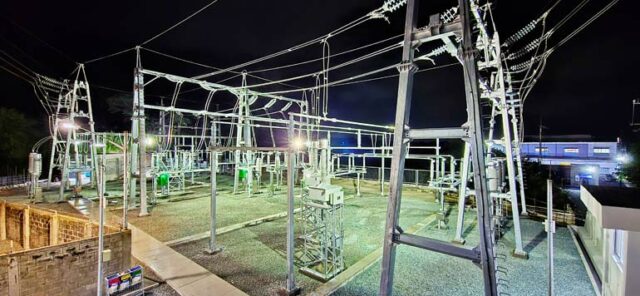
Meralco recently commissioned the Milagrosa 115-kilovolt (kV) Switching Station in Carmelray Industrial Park II in Calamba City, Laguna to support the power requirements of Solar Tanauan Corp.
As the year draws to a close, the Manila Electric Company (Meralco) continues to exhibit exceptional service, bolstering its commitment to innovation to enhance value for its customers and stakeholders.
The Manuel V. Pangilinan-led distribution utility closed the first nine months of 2024 with an impressive operational and financial performance, further solidifying its role as a leader in the energy industry and as an economic growth enabler.
Continuing initiatives to support customers’ needs
To ensure delivery of sufficient, reliable, and stable service at the least possible cost, Meralco continuously implements distribution network upgrades and strategic sourcing activities.
Among the major distribution network projects completed by Meralco in the third quarter of the year are the new gas-insulated switchgear (GIS) in a first full indoor substation at Elisco Road in San Joaquin, Pasig City; the Milagrosa Switching Station in Carmelray Industrial Park II in Calamba City, Laguna; and a third 300-MVA power transformer at the Duhat Delivery Point Substation in Bocaue, Bulacan.
Through its pole relocation program, a total of 924 poles were relocated for road widening projects of the Department of Public Works and Highways and various local government units (LGUs) while a total of 571 poles were relocated for the government’s Build Better More infrastructure program.
“Despite the challenges we have encountered so far this year, Meralco has been relentless in anticipating the needs of our customers and investing in projects that would be beneficial for them in the long run,” Meralco Executive Vice-President and Chief Operating Officer Ronnie L. Aperocho said.
Consistent with its Power Supply Procurement Plan approved by the Department of Energy (DoE), Meralco conducted the competitive selection process (CSP) for 600-MW baseload and 400-MW mid-merit supply requirements.
Meralco secured the best bids for the 600-MW baseload requirement from two (2) generation companies, which offered a levelized cost of electricity (LCOE) inclusive of line rental and Value-Added Tax (VAT) of P5.6015 per kWh and P5.7392 per kWh.
Meanwhile, the sole winning bidder of the CSP for the 400-MW mid-merit requirement offered an LCOE of P7.6816 per kWh, including line rental and VAT. These 15-year PSAs from the two (2) CSPs shall be submitted to the Energy Regulatory Commission for review and approval to be implemented beginning Aug. 26, 2025.
Aperocho added that Meralco is also working to ensure that the company is prepared to meet the supply needs of customers without unnecessarily exposing them to volatile energy prices.
“To this end, our efforts are centered on competitive biddings, which historically yielded lowest rates that translate into savings for our millions of customers. While there are still a lot of things to be done, our customers can be assured that Meralco will remain proactive in working with the energy industry players, and the regulator, in promoting consumer welfare,” he said.
Power generation business forges ahead
Meralco PowerGen Corp. (MGEN) the power generation investment arm of Meralco, was also a significant contributor to the distribution utility’s continued growth.
As of end-September, MGEN had a combined power generation capacity of 2,417 MW (net) in its diversified power generation portfolio in the Philippines and Singapore. During the period, MGEN delivered 11,556 GWh of energy, 3% more compared with the same period last year.
Terra Solar Philippines, Inc., MGEN’s cornerstone renewable energy project through SP New Energy Corp. (SPNEC), has secured green lane certification from the Board of Investments that entitles the project to streamlined processing alongside expedited approval of permits. This came on the heels of Terra Solar’s certification as an Energy Project of National Significance from the Department of Energy in July 2024.
Terra Solar is developing a 3,500-MWdc utility scale solar with 4,500-MWhr Battery Energy Storage System in Nueva Ecija and Bulacan spanning five (5) municipalities and 11 barangays.
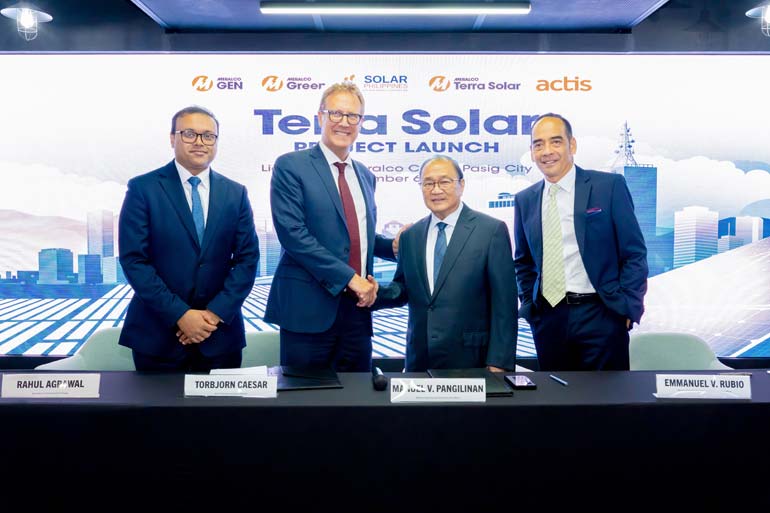
UK-based Actis has acquired a 40% equity stake in Terra Solar for the largest foreign direct investment for a greenfield infrastructure project in the Philippines. Seen in the photo are (from L-R) Actis Head of Southeast Asia Energy Rahul Agrawal, Actis Chairman and Senior Partner Torbjorn Caesar, Meralco Chairman and CEO Manuel V. Pangilinan, and MGEN President and CEO Emmanuel V. Rubio during the signing ceremony.
In September 2024, SPNEC announced the strategic entry of UK-based Actis through Actis Rubyred (Singapore) Pte. Ltd., which is set to acquire a 40% equity stake in Terra Solar for a total consideration of approximately US$600 million — by far, the largest foreign direct investment for a greenfield infrastructure project in the Philippines.
With the development activities of the project in full swing, Terra Solar entered an engineering, procurement, and construction contract with Meralco Industrial Engineering Services Corp. (MIESCOR) covering the connection assets that will link the power plant to the national grid.
These milestones are expected to positively impact the timely construction of the project, with the first phase involving 2,500 MW to be delivered on-track by the first quarter of 2026 — and Phase 2, a year later.
Aside from Terra Solar, power plants of MGEN Renewable Energy, Inc. (MGreen) operated efficiently and collectively maintained an impressive 97% average plant availability. The renewable energy arm of MGEN delivered a total of 483 GWh of clean energy, its highest generation of solar power to date — a 90% increase from 254 GWh the previous year, which is expected to grow further as new solar plants start operating.
“As we work on progressing all our projects in the pipeline, we also strive to maximize the efficiency of our current power generation assets. We expect to sustain this momentum as we realize gains from our energy portfolio,” MGEN President and Chief Executive Officer Emmanuel V. Rubio said.
Still in line with Meralco’s commitment to pursuing energy security, Meralco recently entered into partnerships with South Korean firms to study the adoption of nuclear energy in the Philippines.
Meralco signed a memorandum of understanding (MoU) with Doosan Enerbility Co. Ltd. to study the use of small modular reactors (SMRs) to help meet the country’s growing energy demand. Meralco also signed a separate MoU with Samsung C&T Corp. Engineering & Construction Group (Samsung C&T), for the sharing and discussion of technical design and capabilities of nuclear technology.
“Our recent partnerships with reputable South Korean firms to explore nuclear energy projects in the Philippines also reflect our commitment to the Government’s emphasis on sustainability,” Meralco Chairman and Chief Executive Officer Manuel V. Pangilinan said.
Social development initiatives that benefit Filipinos across the country
Alongside its efforts to grow its business, Meralco remains keen in advancing sustainability and implementing social development initiatives.
PRESERVING THE PLANET. Meralco Chairman and CEO Manuel V. Pangilinan (second from right) leads the acceptance of tree seedlings from Communications Electrical Equipment & Supply Co., Inc. (Celeasco) President Natalie G. Siy. The donated seedlings will form part of Meralco’s greening initiative under the One For Trees and PowerPlants environmental programs. Seen in the photo as well are One Meralco Foundation President Jeffrey O. Tarayao (left) and Meralco First Vice-President and Chief Sustainability Officer Raymond B. Ravelo (right).
Under the flagship One for Trees environmental program of One Meralco Foundation (OMF), Meralco in September launched the “Greening the Meralco Operating Center” initiative that aims to transform its Pasig City headquarters into “the lungs of the Ortigas business district.” In partnership with the Communications Electrical Equipment & Supply Co., Inc. (Celeasco), Meralco planted over a thousand seedlings to enhance urban green spaces in its compound.
As of end-September, the One for Trees program now covers a total of 2,400,803 trees in different parts of the Philippines.
As a testament to its steadfast commitment to support underserved communities, OMF’ssocial development programs benefitted7,059 families in the third quarter of 2024 alone. This includes energization of low-income households in parts of Metro Manila, Bulacan, Laguna, Batangas, and Quezon, and provision of solar lamps to indigenous families from a mountain community in Puerto Princesa City, Palawan.
To support the government’s national security efforts, the OMFalso provided solar lamps to soldiers from the Philippine Marine Corps — Marine Battalion Landing Team-9, which is assigned to secure the Kalayaan Island Group near the West Philippine Sea. On the disaster response front, the OMF continued its immediate distribution of relief packs to families affected by weather disturbances and fire victims in different parts of the country.
IN SUPPORT OF NATIONAL SECURITY. One Meralco Foundation turns over solar lamps to the Philippine Marine Corps — Marine Battalion Landing Team-9, which is assigned to secure the Kalayaan Island Group near the West Philippine Sea.
In helping promote quality education, the OMF along with Meralco Employees Fund for Charity, Inc., MGEN, MPower, and Vantage Energy, continued with the employee-led “Balik Eskwela” program which benefitted more than 1,200 kindergarten students.
The OMF has also undertaken a host of initiatives in partnership with MGEN, which has been expanding its footprint and actively supporting communities across the country. This includes the distribution of 150 home solar kits to residents of Sitio Tamale in Bongabon, Nueva Ecija which is an area outside of Meralco’s service area that has no access to electricity. To promote public health, the OMF supported MGEN’s Adopt-a-Health Center Program that benefitted 35 health centers and clinics in its adopted villages in Iloilo City, Nabas and New Washington, Aklan, and Toledo City, Cebu.
Sustainability wins and demonstration of excellence
Aligned with its long-term sustainability strategy, Meralco continues to heighten its environmental, social, and governance (ESG) performance.
The distribution utility recently improved its ESG rating with corporate governance research and analytics firm Sustainalytics — landing in the top 39% of the global electric utilities industry with its strong management of material ESG risk areas such as carbon emissions, community relations, and business ethics and governance.
For the fourth consecutive year, Meralco was likewise recognized in the FTSE4Good Index Series, which tracks global sustainability performance across key ESG areas, including risk management, labor standards, corporate governance, and anti-corruption. Meralco is the only Philippine electric utility company that is part of the index.
As Meralco continues to advance programs that benefit its stakeholders, the company has garnered numerous accolades from prestigious organizations for reflecting sustained excellence in business performance, sustainability, social development, human resource management, digital transformation, customer centricity, and corporate governance.
BEACON OF EXCELLENCE. Meralco took home eight (8) Stevies at the 2024 International Business Awards. Seen in the photo are (from L-R) Meralco FVP and Head of Customer Retail Services Charina P. Padua, OMF President Jeffrey O. Tarayao, Meralco EVP and Chief Operating Officer Ronnie L. Aperocho, Meralco FVP and Chief Sustainability Officer Raymond B. Ravelo, and Meralco SVP and Chief HR Officer Edgardo V. Carasig.
Among the recent feted honors are eight (8) Stevies at the 2024 International Business Awards. For the second consecutive year, Meralco First Vice-President and Chief Sustainability Officer Raymond B. Ravelo took home the Gold Stevie Award for Sustainability Hero of the Year in Asia, Australia, and New Zealand.
OMF President Jeffrey O. Tarayao was, meanwhile, recognized with a Silver Stevie under the Thought Leader of the Year for Non-Profit or Government Category.
Meralco also garnered two (2) more Silver Stevie Awards for its sustainability and corporate social responsibility efforts — the company’s sustainability campaign “Powering the Good Life,” and OMF’s “Leading Energy for Productivity in Underprivileged Communities in the Philippines” which championed inclusive development in geographically isolated and disadvantaged communities.
Meralco’s human resource and stakeholder management strategies, along with its digital transformation efforts, earned four Bronze Stevie Awards. These include the company’s employee engagement strategy “Nurturing a Vibrant Workforce: Meralco’s Approach to Engagement and Retention,” the diversity and inclusion program #Mbrace, the external stakeholder recognition program “The 9th Meralco Luminaries: Brighter New World,” and “Lighting the Way: Meralco’s Customer Experience Dashboard for Sales Analysis,” which was recognized for its innovative use of competitive intelligence to address evolving customer needs.
“We remain optimistic about the continued expansion of the country’s economy under the leadership and tutelage of President Ferdinand Marcos, Jr., with full-year economic growth forecasts hovering around 6%, and the potential to outpace other Southeast Asian nations. Easing inflation pressures and sustained spending on major infrastructure projects which Meralco actively supports and would help,” Pangilinan said.
Spotlight is BusinessWorld’s sponsored section that allows advertisers to amplify their brand and connect with BusinessWorld’s audience by publishing their stories on the BusinessWorld Web site. For more information, send an email to online@bworldonline.com.
Join us on Viber at https://bit.ly/3hv6bLA to get more updates and subscribe to BusinessWorld’s titles and get exclusive content through www.bworld-x.com.
CONGRESSMEN APPROVED Meralco’s franchise to operate four years ahead of its initial concession’s expiry. — PHILIPPINE STAR/JESSE BUSTOS
By Kenneth Christiane L. Basilio, Reporter
THE HOUSE of Representatives on Wednesday approved on third and final reading a bill granting Manila Electric Co. (Meralco) a 25-year franchise extension.
In a 186-7-4 vote, congressmen agreed to extend Meralco’s franchise to construct, operate, and maintain its electric distribution systems in the greater Metro Manila area, including Bulacan, Cavite, Rizal, and parts of Batangas, Quezon, Laguna, and Pampanga.
House Bill No. 10926 outlines that Meralco must offer at least 30% of its outstanding capital stock to Filipinos. Failing to do so would result in its franchise revocation.
The power distributor is also mandated to provide an annual report of its operations, including the rollout, development, and expansion of its operations to Congress. Meralco would incur a P1 million fine per working day of noncompliance to this requirement.
Congressmen approved Meralco’s franchise to operate four years ahead of its initial concession’s expiry.
Its counterpart measure, Senate Bill No. 2824, filed by Senator Emmanuel Joel J. Villanueva on Sept. 12, is currently pending at the Senate rules committee.
In a statement, Albay Rep. Jose Ma. Clemente S. Salceda said he expects the franchise bill to breeze through the Senate, even floating the possibility of Congress no longer needing to convene in a bicameral conference committee to discuss the measure.
Bills seeking to provide a legislative franchise to companies first originate at the House, undergoing the same legislative process as regular bills, according to the Energy department.
Meralco is the main power distributor for the National Capital Region and nearby areas, covering 39 cities and 72 municipalities, delivering electricity to at least 7.6 million Filipinos. It provides power to a region responsible for half of the country’s gross domestic product output.
“A stable and affordable power sector is necessary for economic growth, and Meralco has the burden of providing electricity to the nation’s most important economic hub,” Terry L. Ridon, a public investment analyst and convenor of think-tank InfraWatch PH, said in a Viber message before the bill’s approval.
“Extending Meralco’s franchise would erase uncertainty of Meralco in investing for expansion and improvement of its infrastructure and facilities,” Calixto V. Chikiamco, Foundation for Economic Freedom president, said in a Viber message also before the bill’s approval.
Earlier this year, Meralco announced that it committed to course P100 billion in investments to “critical projects” seen improving its power distribution infrastructure as part of its long-term sustainability strategy.
Meralco and its unit SP New Energy Corp. entered into a strategic partnership with global investment firm Actis for the Terra Solar Project, a P200-billion solar power plant in Central Luzon that is expected to generate more than five billion kilowatt-hours of electricity yearly.
The granting of an extended franchise to Meralco could lead to cheaper electricity for consumers, said Antonio A. Ligon, a law and business professor at De La Salle University in Manila. “One advantage, of course, is that Meralco’s adjustment on electric bills will lean toward providing ease to consumers,” he said before Meralco’s legislative franchise approval.
The approval of Meralco’s franchise could also drive down the generation prices of its power supply agreements with electricity generation firms, said Mr. Ridon, citing their need to “offer the lowest price” to secure deals with the power distributor.
In October, Meralco sought the Energy Regulatory Commission’s approval for 600-megawatt power supply deals, seen to result in P11.75 billion in consumer savings.
The bill needed more time for thorough review, said Gerry C. Arances, convenor of the Power for People Coalition, in a Facebook Messenger chat before the bill’s approval.
Meralco’s majority owner, Beacon Electric Asset Holdings, Inc., is partly owned by PLDT Inc.
Hastings Holdings, Inc., a unit of PLDT Beneficial Trust Fund subsidiary MediaQuest Holdings, Inc., has an interest in BusinessWorld through the Philippine Star Group, which it controls.