Home Blog Page 1906

Yields on Treasury bonds climb

BW FILE PHOTO

THE GOVERNMENT made a full award of the reissued Treasury bonds (T-bonds) it offered on Tuesday even as the average rate was above secondary market levels, with investors seeking to lock in higher yields ahead of an expected liquidity boost from cuts in banks’ required reserves by month-end.

The Bureau of the Treasury (BTr) raised P30 billion as planned via the reissued seven-year bonds it auctioned off on Tuesday as total bids reached P56.819 billion or almost twice the amount on offer.

This brought the total outstanding volume for the bond series to P224.7 billion, the Treasury said in a statement.

The bonds, which have a remaining life of five years and four months, were awarded at an average rate of 6.019%. Accepted bid yields ranged from 5.975% to 6.04%.

The average rate of the reissued papers was higher by 5.1 basis points (bps) from the 5.968% fetched for the series’ last award on Feb. 4 but 35.6 bps lower than the 6.375% coupon for the issue.

This was also 8.4 bps higher than the 5.935% quoted for the five-year bond — the benchmark tenor closest to the remaining life of the papers on offer — and 7.2 bps above the 5.947% seen for the same bond series at the secondary market before Tuesday’s auction, based on PHP Bloomberg Valuation Service Reference Rates data provided by the BTr.

The average rate fetched for the bonds on offer was slightly higher than market expectations amid risk-off cues overseas, a trader said in a phone interview.

Still, the auction saw strong demand as investors are loading up on higher-yielding government debt before the implementation of fresh cuts in banks’ reserve requirement ratios (RRR) by month-end, which would increase liquidity in the financial system, the trader said.

The RRR cuts are expected to free up about P330 billion in cash, which could lead to increased demand for government debt, Rizal Commercial Banking Corp. Chief Economist Michael L. Ricafort said in a Viber message.

By March 28, the RRR of universal and commercial banks and nonbank financial institutions with quasi-banking functions will be reduced by 200 bps to 5% from the current 7%, the Bangko Sentral ng Pilipinas (BSP) announced last month.

The RRR for digital banks will also be lowered by 150 bps to 2.5%, while the ratio for thrift lenders will be cut by 100 bps to 0%.

Rural and cooperative banks’ RRR has been at zero since October, the last time the BSP cut reserve requirements.

The RRR is the portion of reserves that banks must hold onto rather than lending out. When a bank is required to hold a lower reserve ratio, it has more funds to lend to borrowers.

BSP Governor Eli M. Remolona, Jr. has said the central bank is looking to bring down big banks’ RRR to as low as zero before his term ends in 2029.

From a high of 20% in 2018, the central bank has since brought down large banks’ reserve requirements to single-digit levels.

Meanwhile, bond yields slid on Tuesday in Asia with investors ducking for cover as new US tariffs on Canada, Mexico and China took effect, threatening to escalate global trade tensions, Reuters reported.

US President Donald J. Trump’s new 25% tariffs on goods from Mexico and Canada took effect, along with a doubling of duties on Chinese goods to 20%, at 12:01 a.m. EST (0501 GMT).

Minutes later, China said it will impose additional tariffs of 10%-15% on certain US imports from March 10. Canada has already said that retaliatory tariffs on the United States would take effect on Tuesday.

Mexico was expected to follow suit, with President Claudia Sheinbaum expected to announce her response during a morning news conference in Mexico City later on Tuesday.

Market moves were fairly muted in the immediate aftermath of the tit-for-tat tariff actions, although investors remained on edge, with worries of a wide-ranging trade war sapping sentiment.

The tariff actions led to a rally in US Treasuries. The yield, which moves inversely to bond prices, on the benchmark 10-year US Treasury note hit 4.115% in Asian hours, its lowest since Oct. 22.

The BTr is looking to raise P147 billion from the domestic market this month, or P22 billion from Treasury bills and P125 billion from T-bonds.

The government borrows from local and foreign sources to help fund its budget deficit, which is capped at P1.54 trillion or 5.3% of gross domestic product this year. — Aaron Michael C. Sy with Reuters


Throwing the baby out with the bathwater

REUTERS

(Part 1)

I fervently hope that the decision of the Trump Administration to freeze international development aid is temporary. Since former President John Kennedy founded the US Agency for International Aid in the 1960s, US taxpayers have done much good for the world’s poorest of the poor. Food aid from the Agency prevented the stunting of tens of millions of children. Even today, for example, Myanmar is facing a food crisis due to natural disasters and a spiraling civil war according to a Reuters report. An estimated two million people in this poorest ASEAN country are on the brink of famine. The US has been the largest aid donor to Myanmar. Especially in Africa, USAID has been very instrumental in preventing millions of deaths that would have happened without the anti-malaria campaign funded by US money. The US has been the top donor in the global fight against malaria, mostly through the President’s Malaria Initiative, known as PMI, set up under former President George W. Bush.

It is evident that it is a very unjust generalization to refer to USAID as a “criminal organization” or to refer to its top officials as “radical lunatics.” We can only hope that these were emotional outbursts provoked by some actual or imagined cases of corruption or misallocation in the uses of some of the USAID funds. As a development economist, I have worked with numerous officials of USAID over the last 40 years. I can attest to the fact that I never got the impression that the organization was “criminal” or that the officials were “lunatic.” In fact, a large number of these officials impressed me as really working for the common good of Philippine society, much more than can be said for some of our public officials. They were sincerely working with their equivalents in our local community on implementing programs focused on improving health (as in food aid and combatting malaria); alleviating poverty (as in rural development programs); providing emergency relief amid natural disasters or conflict (especially in Mindanao); enhancing the quality of education (as in teachers’ training program); and in improving governance, especially at the local government level.

Let’s not rely on sweeping generalizations uttered by top officials of the Trump Administration. As Melissa Conley Tyler, an honorary fellow at Asia Institute in Melbourne, Australia wrote in a Philippine daily, in the year 2023, the countries that received the largest amount of aid were Ukraine, Ethiopia, Jordan, Afghanistan, and Somalia. In the Indo-Pacific region, the Lowy Institute’s aid map shows that it received $249 million, while Southeast Asia received $1 billion. This total amount of aid went to fund 2,352 projects, including peacebuilding in Papua New Guinea, malaria control in Myanmar, early childhood development in Laos, and programs to improve the education, food security, and health of school-age children across the region.

To be sure, in my experiences working with programs and projects funded by USAID in the Philippines, I had to disagree with some of the approaches in some of the programs funded by the Agency. Especially in the last century when there was an obsession with birth control programs among international aid agencies, inspired by the ideology of the World Bank, I had to often disagree with some USAID officials who were aggressive in promoting family planning methods contrary to Filipino cultural and religious beliefs. I used to refer to attempt to push contraceptives and other artificial methods of birth control as “ideological colonization” — a term coined in the papal encyclicals. Especially after I participated in the writing of the Philippine Constitution which mandated that the “State shall protect the unborn from the moment of conception,” I objected to the financing by USAID of pills that were abortifacients which were obviously unconstitutional.

Other more recent forms of “ideological colonization” were those programs funded by USAID which included LGBT+ materials in the curricula of our public schools. It is obvious that the strong stand of the Trump Administration against the so-called “woke” culture (which gives prominence to the LGBT+ lifestyle) stems from President Donald Trump’s aversion towards what he considers ideologies inimical to family values and the Christian roots of American society.

In those cases of disagreements with the USAID officials about population control as a means to reduce poverty, I always respected their good but misguided intentions to help in poverty eradication. I just used my knowledge as an economist to argue that fighting poverty through controlling births would turn out counterproductive. There are many more means of helping the poor, such as rural and agricultural development, promotion of SMEs, fostering technical skills training programs (rather than obsessing with college diplomas), regional dispersal of industries, etc. As everyone knows today, especially Elon Musk, I was proven right. The very aggressive birth control programs of countries like Singapore, Thailand, and China have ended in economic disaster. They are now ageing so rapidly, among many other developed countries, that their respective economies are in danger of imploding.

I would be unjust, however, if I declare that USAID in the Philippines had officials who were “lunatics.”

They promoted numerous programs that helped reduce poverty in more positive ways, improved regional economic dispersal, turned out more competent local government officials, and improved the quality of basic education, among other very beneficial programs. I have more than a cursory knowledge of all these major contributions of USAID to Philippine society because I was a protagonist in some of the research programs needed to validate the usefulness of various projects being proposed for funding by the Agency. Let me enumerate some of them. Below is a very partial list of the most recent projects funded by the USAID:

1. Regulatory Reform Program for National Development (Respond). This project was under the Office of Economic Development and Governance (OEDG). Respond is a five-year policy and regulatory reform program which began in 2019 (which was projected to end in 2024 but was extended to 2027). It aims to improve regulatory control quality that will lead to enhanced competitiveness and, ultimately, contribute to higher levels of investment and trade, inclusive growth and self-reliance. This activity is an integral part of the USAID/Philippines Economic Growth, Democracy, and Governance with Equity (EGDGE) Project, which seeks to assist the Philippines to “strengthen their ability to become more self-reliant, improve democratic practices, and become a stable, middle-income economy by 2040.”

Within the original five-year project life of Respond (2019 to 2023), its policy advocacies resulted in the passage of key legislation that removed or lowered the barriers to trade and investment, thereby making the country more attractive to foreign direct investments (FDIs). Respond extended technical assistance to key regulatory/competition agencies (like the Anti-Red Tape Authority and the Philippine Competition Commission) to promote competition and the ease of doing business.

With the three-year extension, the scope of Respond’s policy focus likewise expanded to cover new areas like green minerals (extraction and processing to support downstream industries like e-vehicle/battery manufacture) and infrastructure development (e.g., the Public-Private Partnership Classroom Program). These new policy directions are aligned with the eight-point Agenda of the Ferdinand Marcos, Jr. Administration and the 2023-2028 Philippine Development Plan. Additionally, Respond provided for extending technical assistance to the Mindanao Development Authority (MINDA) as well as ministries of the Bangsamoro Autonomous Region in Muslim Mindanao (BARMM) in preparation of development plans and roadmaps.

As a practitioner of development economics, I must attest to the fact that all these activities funded by USAID went a very long way in helping the Philippine Government address the Number One complaint of both domestic and foreign investors, i.e., the proliferation of obstacles to doing business in the Philippines. The necessary legislation and implementation rules and regulations (IRRs) would have not been possible without all the necessary research that was funded by USAID and involved the leading economists, lawyers, and other professionals needed to do research. Financial assistance from USAID made it possible for the best minds in the country to use their respective professional expertise to help the public sector improve governance.

(To be continued.)


Bernardo M. Villegas has a Ph.D. in Economics from Harvard, is professor emeritus at the University of Asia and the Pacific, and a visiting professor at the IESE Business School in Barcelona, Spain. He was a member of the 1986 Constitutional Commission.

bernardo.villegas@uap.asia

Meralco, KEPCO partner to explore new energy technology

PHOTO SHOWS (from L-R) Meralco Executive Vice-President and Chief Operating Officer Ronnie L. Aperocho, Meralco Chairman and Chief Executive Officer Manuel V. Pangilinan, KEPCO President and Chief Executive Officer Kim Dong Cheol, and KEPCO Vice-President and Head of Global Business Department Chan Hyuk Chun.

POWER DISTRIBUTOR Manila Electric Co. (Meralco) and Korea Electric Power Corp. (KEPCO) have entered into a partnership to accelerate the adoption of new technology in the Philippine energy industry. 

The companies signed a memorandum of understanding (MoU) to foster technical cooperation and exchange programs in the field of new energy technology, Meralco said in a media release on Tuesday.

The collaboration covers nuclear energy, renewable energy, smart grids, microgrids, energy storage systems, electric vehicles, advanced metering infrastructure, smart substations, and distribution automation.

Meralco Chairman and Chief Executive Officer Manuel V. Pangilinan described the partnership as “an important step” for both companies in their “commitment to exchange knowledge, strengthen capabilities, and work together toward a smarter, more resilient energy future.”

“We’re looking forward to working together with KEPCO. This collaboration allows us to refine our strategies, integrate new technologies, and find better ways to power the future. Beyond the business objectives, we want to forge and strengthen relationships that will drive meaningful progress,” he said. 

Meralco and KEPCO will engage in technical competency development through information-sharing and employee exchange programs for specialized training courses.

The companies will also explore potential collaborations in advisory and consulting services, as well as other power and energy initiatives of mutual interest.

This latest partnership follows Meralco’s earlier MoU with KEPCO and its Knowledge Data Network, signed in November last year to advance the use of smart metering technologies.

Meralco’s controlling stakeholder, Beacon Electric Asset Holdings, Inc., is partly owned by PLDT Inc.

Hastings Holdings, Inc., a unit of PLDT Beneficial Trust Fund subsidiary MediaQuest Holdings, Inc., has an interest in BusinessWorld through the Philippine Star Group, which it controls. — Sheldeen Joy Talavera

Rare frescoes unearthed in Pompeii shed light on ancient rituals

POMPEIISITES.ORG.JPG

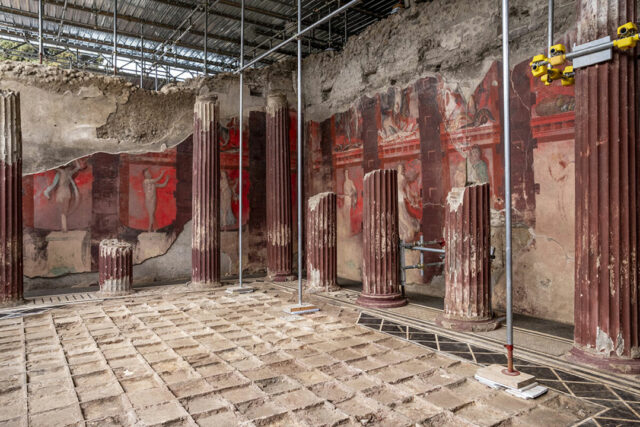
ROME — Archaeologists in Pompeii have uncovered rare, nearly life-sized frescoes that offer fresh insight into religious practices in the ancient city before it was destroyed by Mount Vesuvius in AD 79, the site said last week.

The discovery features a large-scale frieze that spans three walls of a banquet hall, presenting vivid imagery of the initiation rites for followers of Dionysus — the ancient Greek god of wine, fertility, theater, and religious ecstasy.

The initiation rituals, known as the Mysteries of Dionysus, were secretive religious rites dedicated to the god, promising spiritual enlightenment and possibly a blessed afterlife.

The fresco, dating to 40-30 BC, presents vivid imagery of Dionysian followers in states of ritualistic ecstasy, dancing and hunting, resembling the frescoes of the nearby Villa of the Mysteries which were uncovered 100 years ago.

“In 100 years’ time, today will be remembered as historic because the discovery we are presenting is historic,” said Italian Culture Minister Alessandro Giuli, who attended the unveiling of the frescoes.

“Alongside the Villa of the Mysteries, this fresco forms an unparalleled testament to the lesser-known aspects of ancient Mediterranean life.”

The giant frieze illustrates the female followers of Dionysus as both dancers and fierce hunters, carrying a slaughtered goat on their shoulders or holding a sword and the entrails of an animal in their hands.

At the center, is a fresco of an elegantly dressed woman who is possibly waiting to be initiated into the mysteries.

An upper frieze depicts live and sacrificed animals, including a fawn, a freshly gutted boar, roosters, and fish. Researchers said this juxtaposition underscored the dual nature of Dionysian worship, combining revelry with primal sacrifice.

“The question is, what do you want to be in life, the hunter or the prey?” said the director of Pompeii, Gabriel Zuchtriegel.

The once-thriving city of Pompeii and the surrounding countryside in southern Italy were submerged by ash when Mount Vesuvius exploded, killing thousands of Romans who had no idea they were living alongside one of Europe’s biggest volcanoes.

The archaeological site covers approximately 66 hectares, with about 44 hectares fully excavated. The latest dig is in an area known as Regio IX which began in early 2023 and has so far revealed over 50 rooms.

Some of the recent discoveries include a black salon depicting scenes from the Trojan War, an extensive bath complex and a fresco that depicts what might be an ancestor of the Italian pizza. — Reuters

PERA contributions rose to P491.4 million at end-2024

BW FILE PHOTO

FILIPINOS’ Personal Equity and Retirement Account (PERA) contributions jumped by 24% year on year at end-2024, data from the Bangko Sentral ng Pilipinas showed.

Accumulated contributions to PERA climbed to P491.4 million at end-2024 from P396.3 million as of 2023, the central bank said.

The total number of PERA contributors likewise rose by 6.4% to 5,912 at 2024’s close from 5,555 a year prior.

The bulk (69.5%) of the accumulated PERA contributions came from employee contributions, equivalent to P341.7 million at end-2024 across 4,211 contributors.

This was followed by overseas Filipino workers’ (OFW) contributions at P82.2 million with 789 contributors.

Lastly, there were 912 self-employed contributors for a total of P67.4 million in contributions.

Launched in 2016, PERA is a voluntary fund scheme meant to supplement retirement benefits from the Government Service Insurance System (GSIS) or the Social Security System (SSS), as well as private employers.

Contributors aged 18 and above and have a tax identification number are allowed to open a PERA account. Self-employed and locally employed contributors can make an annual contribution of P200,000 while OFWs can invest up to P400,000.

The PERA Law also offers various incentives to contributors, such as tax exemptions on earnings from PERA investments, a 5% income tax credit on contributions that can be used for paying income tax liabilities, and a tax-free distribution on qualified withdrawal of PERA investments.

“The increase in PERA contributions in 2024 suggests a growing awareness among Filipinos about the value of retirement planning, despite the relatively low number of participants,” John Paolo R. Rivera, a senior research fellow at the Philippine Institute for Development Studies, said.

“More Filipinos, especially the employed sector, are recognizing the need to secure their retirement, given economic uncertainties and the rising cost of living.”

Mr. Rivera said the rise in contributions could also be attributed to the effort of the central bank, financial institutions and employers to promote PERA.

“While many Filipinos still struggle with daily expenses, certain groups like OFWs and professionals, may have had more financial flexibility to set aside funds for retirement,” he said.

“With concerns over the long-term sustainability of the SSS and GSIS pension funds, some workers may be looking for alternative or supplemental retirement income sources.”

In 2020, the BSP launched the digital platform for PERA to make it more accessible, allowing Filipinos to open accounts, choose different accredited products, and settle transactions online.

The central bank earlier said the wider use of PERA can help increase government savings, foster investment and capital market development, which would support economic growth. — Luisa Maria Jacinta C. Jocson

Change or continuity? Honoring and strengthening commitments amid shifting times

PHILIPPINESTAR/WALTER BOLLOZOS

Diplomatic relations are not confined to bilateral, country-to-country ties. Often, there are wider alliances and groupings that must be pursued because each nation has something unique to bring to the table. Trilateral collaborations are an important way to participate in global and regional geopolitics with countries sharing the same values and priorities and even facing common threats.

The trilateral collaboration between the Philippines, Japan, and the United States easily comes to mind, with all three countries affirming their commitment to a secure and stable Indo-Pacific region.

The affirmation of the trilateral commitments could not come at a better time, as geopolitical risks persist, especially in the maritime domain. Last year, for instance, was a year of escalated tensions in the West Philippine Sea (WPS), the Senkaku Islands, and Taiwan. China became bolder in its aggressive operations in these three areas. In the WPS, China escalated tensions by using military-grade lasers and water cannons, and ramming Philippine Coast Guard vessels. The Chinese also swarmed the Senkaku Islands with their government ships. In the same year, over 3,000 Chinese military aircraft breached Taiwan’s Air Defense Identification Zone.

The taunting did not let up in the first two months of 2025.

On Feb. 18, a helicopter of China’s People’s Liberation Army (PLA) maneuvered just three meters away from an aircraft of the Bureau of Fisheries and Aquatic Resources (BFAR) over Bajo de Masinloc. The dangerous move imperiled the lives of the Filipino BFAR personnel who were in the aircraft.

A few days later, on Feb. 26, Chinese state media urged the Philippines to withdraw the US’ Typhon intermediate range missile from the WPS. China had the gall to say that the Philippines had acted in bad faith and that “the region needs peace and prosperity, not intermediate-range missiles and confrontation.”

Patrol ships of the China Coast Guard (CCG) have also been swarming the West Philippine Sea. This is similar to what is happening in the Senkaku/Diaoyu Islands in the East China Sea where CCG conducts a regular intrusion in Japanese territory.

DONALD TRUMP
Meanwhile, the United States President Donald Trump is in an uncommon situation where he is president again after leading for four years after the 2016 elections and then losing his reelection bid. It is but natural to wonder how many of his previous policies and pronouncements, and how much of his predecessor’s, he will keep this time around.

Admittedly, these times on the international stage are more challenging than when Trump was first president. China’s increased aggression and doublespeak have intensified, necessitating an approach that must be fully defined for all those concerned.

Seeing the animosity with which Trump speaks of former President Joseph Biden, his immediate successor and also his predecessor, concerns about Trump’s stance and action plan on China are valid. Specifically, will he take a hardline approach against the emerging power? Will he even honor the alliance commitments made under Biden, for instance the statement that the US commitment to Philippine security remains “ironclad”?

We have been observing the US’ recent overt pronouncements as well as the decisions and actions being undertaken in relation to this. At this point we believe we should have little reason for concern. Here is why.

The 6th Multilateral Maritime Cooperative Activity (MMCA), featuring naval and air assets from the US, Japan, Australia, and the Philippines jointly sailed the West Philippine Sea on Feb. 5, the first MMCA under the new Trump administration.

Aside from this, the Philippines was exempted from the US’ 90-day foreign aid suspension and was granted $336 million for the continuation of planned defense modernization programs, including naval, air, land, cyber, and support system enhancements. Taiwan also received this waiver, highlighting its strategic importance. This move underscores the US’ unwavering and ironclad support for its Indo-Pacific allies.

JAPAN
It’s not just the US commitment to the Philippines that appears secure.

On Feb. 7, Trump and Japan’s Prime Minister Shigeru Ishiba held their first official meeting where they emphasized the US-Japan Alliance as the foundation of regional security, with Japan pledging to bolster its defense capabilities.

The US reiterated its defense commitment, including nuclear deterrence, and confirmed that Article V of the US-Japan Treaty of Mutual Cooperation and Security applies to the Senkaku Islands. Both nations vowed to counter any attempts to disrupt Japan’s administration of the islands and to enhance security cooperation to address regional challenges.

These indications of sustained friendly policy continuity are truly reassuring given the escalating tensions caused by China, both in the West Philippine Sea and East China Sea, and opportunities for trilateral collaboration among the US, Japan, and the Philippines abound. Fortunately, the deep and strong diplomatic relations among our three countries are a testament to the democratic values that we like-minded partners share in the face of our common challenges.

These emerging dynamics will be the subject of a forum being organized by the Stratbase Group in connection with the Japan Foundation Manila on Friday. Titled “Navigating Shifting Tides: Security Challenges and Strategic Opportunities for the Philippines, Japan, and the US in the New Trump Administration.”

The lecture, featuring American, Japanese, and Filipino experts, will allow us to look at geopolitical, economic, and defense-related dimensions to deepen our understanding of the security policy of each country and outline practical strategies for strengthening trilateral and multilateral security cooperation.

As global tensions continue to rise, the importance of trilateral cooperation among the Philippines, Japan, and the United States cannot be overstated. Strategic alliances anchored in shared values and mutual security interests serve as a critical counterbalance to the persisting aggression of Beijing threatening the stability of the Indo-Pacific region


Victor Andres “Dindo” C. Manhit is the president of the Stratbase ADR Institute.

Megawide Construction Corp. to conduct Special Stockholders’ Meeting via remote communication on March 27


Spotlight is BusinessWorld’s sponsored section that allows advertisers to amplify their brand and connect with BusinessWorld’s audience by publishing their stories on the BusinessWorld Web site. For more information, send an email to online@bworldonline.com.

Join us on Viber at https://bit.ly/3hv6bLA to get more updates and subscribe to BusinessWorld’s titles and get exclusive content through www.bworld-x.com.

NPC seeks ERC approval to recover P21 million in forex-related costs

PHILSTAR FILE PHOTO

STATE-RUN National Power Corp. (NPC) is seeking approval from the Energy Regulatory Commission (ERC) to recover costs incurred due to foreign exchange (forex) fluctuations, amounting to approximately P21 million.

In its filing with the ERC, promulgated on Jan. 22, NPC is seeking to recover deferred accounting adjustments (DAA) corresponding to additional costs from foreign exchange fluctuations related to debt service payments and operating expenses, along with corresponding carrying charges in 2022.

The application covers the billing period from January to December 2022 under the incremental currency exchange rate adjustment (ICERA).

ICERA provides a mechanism for the recovery or refund of deferred incremental costs or savings resulting from foreign exchange fluctuations and carrying charges.

With board approval, NPC is proposing the recovery of P0.0384 per kilowatt-hour, to be charged to island grid customers over a 12-month period.

“The proposed ICERA DAA is fair and reasonable as it is computed in line with the ICERA Guidelines,” the company said.

NPC clarified that the proposed ICERA is based solely on foreign exchange-related adjustments attributable to its Small Power Utilities Group (SPUG), excluding costs associated with its operations in the main grids.

The company is also seeking ERC approval to implement the proposed rates on top of the existing subsidized, approved generation rate in both NPC-SPUG and delegated NPC-SPUG areas to determine the level of subsidy. — Sheldeen Joy Talavera

Small businesses told to secure payment system against scams

STOCK PHOTO | Image by David Dvořáček from Unsplash

By Beatriz Marie D. Cruz, Reporter

PHILIPPINE micro, small and medium enterprises (MSMEs) should invest in payment security to stop unscrupulous groups from stealing their money through malicious QR (quick response) codes, according to industry experts.

“Usually, the big companies have the budgets and have a point of sale device that can generate a QR code,” Jocel G. De Guzman, co-founder of group Scam Watch Pilipinas, said in a video interview. “Most victims [of QR code scams] are MSMEs that print their QR codes, and this can easily be tampered with.”

About 38% of Filipinos who use mobile wallets prefer QR codes as mode of payment, according to a study by Visa. This comes as the Bangko Sentral ng Pilipinas targets a 60% to 70% share of digital payments in total retail payments by 2028.

However, their popularity has led to the rise of fake or malicious QR codes that lead users to malicious websites or phishing attempts.

QR code phishing or quishing is a form of a modern social engineering cyberattack where users are tricked to give away personal and financial information to scammers.

One of the most common forms of QR code-related attacks include tampering legitimate QR codes, which allow scammers to easily steal information, according to information technology (IT) management provider ManageEngine.

“Scammers will change the QR code physically, like put a sticker on top of the QR codes, so when it is scanned, users will be redirected to phishing websites and get their information,” Onil Jaia Leyda, technical solutions consultant at ManageEngine, said in a Feb. 21 interview.

Fake and malicious QR codes have also been more sophisticated with the rise of artificial intelligence (AI), he added.

Data from the Philippine central bank showed that 59.48% of cyberfraud losses in 2023 were driven by phishing attacks, identify theft and account takeovers.

To protect themselves from fake QR codes, MSMEs and consumers should verify if the code is legitimate. They can do so by checking for misspelled words and suspicious URLs (uniform resource locators), according to IT security company Trend Micro.

Consumers should also update their mobile devices with security features, such as in-place web filtering and multi-factor authentication, to safeguard them against fake QR codes, Mr. Leyda said.

He also cited the need for the government and private sector to increase user education and awareness against fake and malicious QR codes.

AIA Philippines looks to incorporate mental health benefits into its products

FREEPIK

AIA PHILIPPINES Life and General Insurance Co., Inc. is looking to integrate mental health benefits into its products as its recent study showed strong demand for related services.

“First and foremost, we’re trying to raise awareness about the needs people have relating to their mental health and sustainable mental health. We’re raising awareness, breaking down taboos, breaking down stigmas, but also looking at how our AIA Vitality program can support mental wellness through daily check-ins on mood, through accessing other available third parties to coach and counsel where possible, but also to incorporate in our products benefits that enable access to mental health professionals that perhaps we had never done before,” AIA Group Chief Marketing Officer Stuart A. Spencer told reporters on Tuesday.

“Beyond raising awareness, adjusting our propositions, incorporating dimensions to our wellness programs, we’re all designed to make mental wellness as prominent and as crucial an element of overall health as physical wellness,” Mr. Spencer added.

AIA Philippines recently conducted a survey on 1,005 Filipinos aged 18 to 59 years old, which showed an increase in mental health awareness in the country.

The study showed that Filipinos are now moving towards a more holistic view of well-being, as more than half of the respondents or 52% said they define having a “healthy life” as having a healthy body, a healthy mind (30%), healthy financial habits (12%), and a healthy environment (7%).

“So, it’s (mental health) something that recently we have been looking to make more and more available, given the increasing concerns and awareness. People are now more open to seeking care and seeking support, and that’s something, as an insurance provider, we are aware of and need to respond to,” AIA Philippines Chief Marketing Officer Melissa Henson said.

The study showed that financial health is also linked to physical and mental health, as more than half or 59% of respondents said money worries are their top cause of stress, with 47% adding that their top obstacle in seeking healthcare is high costs.

It said that 65% of Filipinos rely on their personal savings as their fund source for unexpected events, followed by government assistance at 46%, insurance at 43%, loans from family and friends at 32%, and side business or freelance work at 28%.

Two out of five respondents or 42% said they felt their savings and insurance are not enough, with 66% of those who already own insurance planning to buy another policy.

“Filipinos worry about money the most… Becoming more financially healthy is key, as it helps resolve the physical and mental toll that come with financial worries, giving us peace of mind and enriching our overall well-being,” AIA Philippines said.

Majority or 80% of the respondents also said they are now more aware of the need to take care of their health as they have a family history of illness they want to avoid, with 16% of these being mental health issues.

The other most common family-inherited illnesses cited by respondents were diabetes (32%), heart-related diseases (30%), weight-related concerns (21%), and severe allergies or allergic rhinitis (18%).

“We want to break the cycle of family health history, so it motivates us to be healthy. We can reduce risks that come with our family history of illness by taking more proactive steps toward better health,” AIA Philippines said.

“We can redesign our path to wellness by incorporating diverse and interconnected habits that can help us achieve a healthy mind and body, while building financial resilience, and adopting sustainable practices.”

AIA Philippines booked a premium income of P12.07 billion in 2024, data from the Insurance Commission showed, with its life unit posting a net income of P3.53 billion. — A.M.C. Sy

Rare Banksy, owned by blink-182’s Mark Hoppus, heads to auction

CRUDE OIL (VETTRIANO) BY BANKSY — SOTHEBYS.COM

LONDON — A rare Banksy artwork, hand-painted by the elusive street artist and owned by US musician Mark Hoppus, heads to auction on Tuesday with a price estimate of up to $6.35 million.

Crude Oil (Vettriano) is Banksy’s re-imagining of the 1992 painting The Singing Butler by Scottish artist Jack Vettriano, whose death was announced on Monday.

It depicts Vettriano’s butler serenading a dancing couple on a beach, with Banksy’s addition of a sinking oil liner and two figures in hazmat suits moving a barrel of toxic waste in the background.

The painting, bought by the co-founder of pop-punk band blink-182 Mr. Hoppus and his wife Skye in 2011, is being offered at Sotheby’s London “Modern & Contemporary Evening Auction,” with an estimate of £3 million to £5 million ($3.81 million to $6.35 million).

“It was first exhibited in (Banksy’s) landmark exhibition in Notting Hill in 2005, which really propelled him into the public sphere,” Mackie Hayden-Cook, specialist, contemporary art at Sotheby’s, told Reuters.

“It’s rare for a work of this quality to come to market, and this one really has all the best ingredients. A fabulous owner, it’s hand-painted, impeccable exhibition history, and its subject is more urgent now than ever before.”

Speaking before news of Vettriano’s death was released, she linked Banksy’s decision to re-imagine his work to the parallels between the two artists at the time.

“Like Banksy, you have a really, really popular artist that is loved by the masses and appreciated by many. But for whatever reason, he was snubbed by the art world,” Ms. Hayden-Cook said.

Mr. Hoppus said part of the sale proceeds would go to medical charities and the California Fire Foundation, following the Los Angeles wildfires. He and his wife also intend to buy new art.

“Coming up in punk rock, it was always the ethos that if your band got any success, you brought your friends up with you,” he told Reuters on Sunday.

“So with this art sale, I hope to take some of the money and put it back into the art community with up-and-coming artists that we’re inspired by and just continue that… I want to be a punk rock Medici.” — Reuters

Atlanta Fed shock sounds ‘Trumpcession’ warning

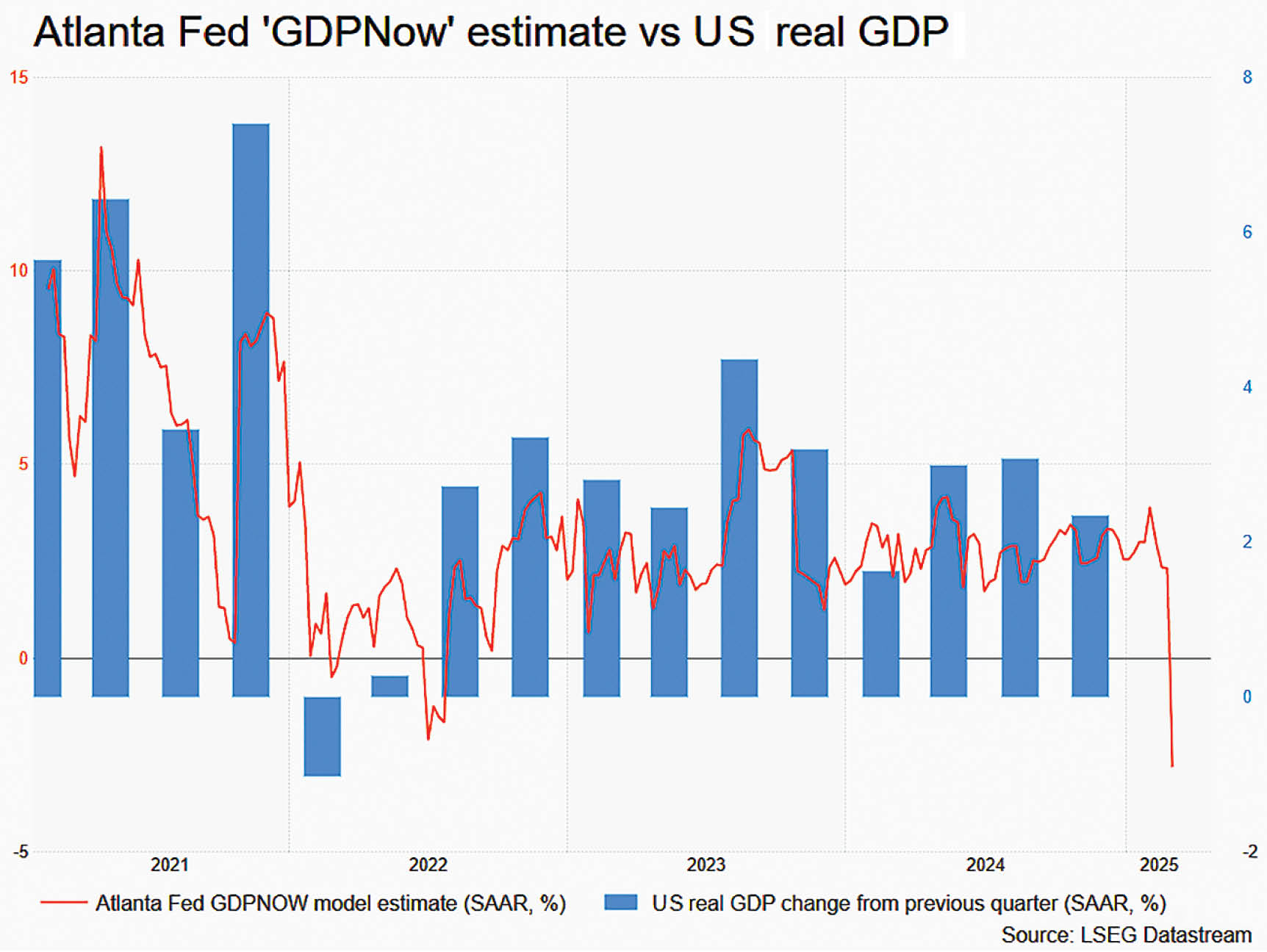
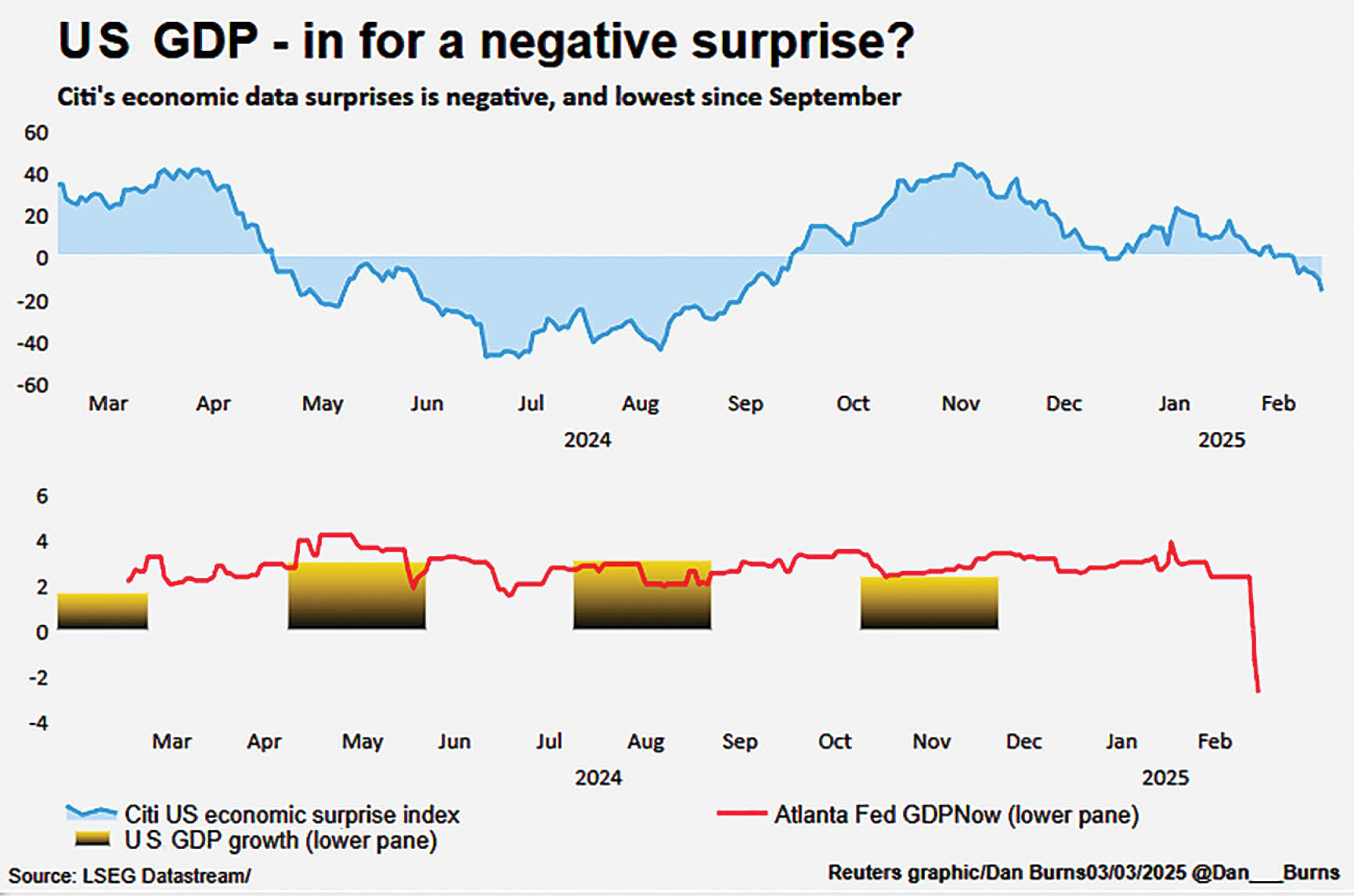
If you haven’t heard the term before, you will now, as a closely watched real-time US economic weathervane is signaling that the US’ GDP is shrinking at the fastest pace since the pandemic lockdown.

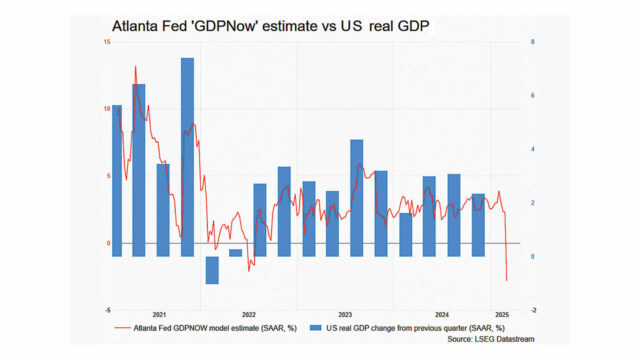
The Atlanta Fed’s GDPNow model estimate for annualized growth in the current quarter was a stunning -2.8% on Monday, down from +2.3% last week. A month ago the model showed that growth in the January-March period was tracking close to +4%.

These estimates are published regularly as new economic data is released, and can be quite volatile. There were 11 in February alone. Friday’s shock reading of -1.5% was led by a record-high $153-billion trade deficit in January, most likely as firms front-loaded imports ahead of tariffs, and Monday’s decline was driven by soft manufacturing activity.

There’s every chance -2.8% turns into a positive reading in a few weeks.

True, the Atlanta Fed number is an outlier for now. The New York Fed’s equivalent Nowcast real-time tracking model was updated on Friday to +2.9% annualized growth in Q1 from +3%. And the Dallas Fed’s “weekly economic index,” which doesn’t include the most recent data, was showing +2.4% on Feb. 27.

But the Atlanta Fed’s GDPNow real-time estimates are historically the most reliable of these models, and the negative figures didn’t come out of nowhere. A lot of soft economic indicators, like sentiment surveys, have been extremely weak in recent weeks, and some hard economic activity indicators are flashing red too. Consumer sentiment in January slumped the most in three and a half years, retail sales dropped by the most in nearly two years, real spending fell at the fastest rate since early 2021, and retail giant Walmart has warned of a tough year ahead. It’s perhaps no surprise that Citi’s US economic surprises index has slid into negative territory, hitting the lowest point since September.

A common thread running through all of this is the huge level of uncertainty being created by US President Donald Trump’s agenda: trade protectionism, particularly tariffs; his apparent growing closeness with Russia and distance from traditional allies like Europe; and the DOGE (Department of Government Efficiency) scythe being taken to federal spending and employment.

NEGATIVE WEALTH EFFECT
Markets are certainly signaling there could be trouble ahead. The Nasdaq has lost as much as 9% in 10 days, with Big Tech down even more. Investors are seeking the safety of US Treasuries: the two-year yield on Friday fell below 4% for the first time since October, and the 10-year yield has tumbled 60 bps since mid-January.

These moves could matter to the real economy because of the “wealth effect.” As Moody’s Mark Zandi noted recently, the top 10% of American households now account for around half of all consumer spending. That’s a record. They also own a lot of stocks, and if Wall Street is heading south, they are more likely to tighten their belts.

Economist Phil Suttle said he expected Trump’s agenda to weigh on the economy this year, but didn’t expect it to have such an apparently negative impact so quickly. But if the “blunt and chaotic” implementation of Trump’s spending and trade policies hit growth harder than imagined, the Federal Reserve may cut rates in the second quarter, Suttle reckons. The Fed’s rate-cutting cycle is on hold for now, largely because of the uncertainty surrounding Trump’s trade and fiscal policies. But an impending “Trumpcession” probably wasn’t on policymakers’ mind when they pressed the pause button. It likely is now.

(The opinions expressed here are those of the author, a columnist for Reuters.)

ADVERTISEMENT
ADVERTISEMENT