POWER DISTRIBUTOR Manila Electric Co. (Meralco) is aiming to supply approximately 35 megawatts (MW) of power to data centers this year amid rising demand for digital infrastructure.
Over the next decade, or until 2035, the company aims to provide at least 850 MW for data center energization, Ferdinand O. Geluz, senior vice-president and chief revenue officer of Meralco, told BusinessWorld.
“This expansion reflects the increasing demand for digital infrastructure and our commitment to delivering the necessary power solutions and service standards to support the sector’s growth,” he said via Viber.
Meralco has partnered with various industry players, including the Data Center Association of the Philippines, to better understand their need for a highly reliable and clean energy supply, he said.
Data centers are mission-critical facilities for companies with significant data processing and storage requirements.
Currently, key players in the data center industry include PLDT Inc. and ST Telemedia Global Data Centres Philippines (STT GDC). PLDT, through VITRO Inc., operates 10 data centers, while STT GDC has seven.
Meralco previously developed switching stations for the two companies to support the power needs of their hyperscale data centers.
In 2023, the company energized hyperscale-ready data centers with an initial capacity of 22 MW, which can scale up to 180 MW.
“Meralco’s support for data centers in the country aligns well with the current administration’s priorities under its socioeconomic agenda, particularly in energy security and infrastructure development,” the power distributor said.
Meralco’s controlling stakeholder, Beacon Electric Asset Holdings Inc., is partly owned by PLDT Inc.
Hastings Holdings Inc., a unit of PLDT Beneficial Trust Fund subsidiary MediaQuest Holdings Inc., has an interest in BusinessWorld through the Philippine Star Group, which it controls.
Although the Philippines has no formal diplomatic ties with Taiwan, the two countries have maintained a strong relationship, especially in tourism.
In 2024, the Taiwan Tourism Administration (TTA) ranked the Philippines as the fifth largest source of inbound tourists, with approximately 470,000 Filipino tourist arrivals.
photo by Almira Louise S. Martinez
One of the reasons why Filipinos prefer visiting the self-ruled island is its proximity. 700 miles away, Filipinos can easily reach Taiwan in around two hours by plane. The TTA added that roughly 130 flights between both countries are happening weekly between both countries, making it more convenient for travelers.
Apart from being close to the Philippines, it is also not that expensive to travel to Taiwan compared to other East Asian countries like Japan.
According to Google Flights, the cheapest roundtrip ticket to Taiwan from Manila currently costs around P8,000. The cheapest month to fly is September, while the most expensive is in January.
photo by Almira Louise S. Martinez
Lantern festival
The monumental celebration – the 36th Lantern Festival, held in Taoyuan City from February 12 to 23, became more accessible and travel-friendly to foreign visitors, including Filipinos, because was held near the international airport.
The main lantern exhibition hall was placed in front of the Taoyuan MRT A18 station which is 17 to 20 minutes away from Taoyuan International Airport. Meanwhile, the Lights Playground was at the A19 Station, making it more favorable for travelers.
photo by Almira Louise S. Martinez
On its first day, the Taoyuan City Government reported more than 970,000 people went to see the lighting of the main lantern, Infinite Paradise. Apart from this, the Little New Year celebration also showcased more than 300 works under 11 themes.
Some of the displayed works at the event are international friendship lanterns aimed to showcase Taiwan’s “friendly exchanges and cooperation with the world” and highlight the festival as a gateway for tourists to visit Taiwan.
photo by Almira Louise S. Martinez
Popular destinations for Filipinos
Ivy Chen, a tour guide from Edison Tour, said many Filipinos prefer to go to the largest metropolitan area in Taiwan called the Taipei-Keelung metropolitan area or the Greater Taipei. The metro covers three administrative divisions: Taipei City, New Taipei City, and Keelung City.
Popular destinations for Filipino tourists visiting Greater Taipei include Ximending, Taipei 101, Jiufien Old Street, and Queen’s Head.
“They haven’t got the opportunity to discover other places [in Taiwan]. Wherever you are visiting, you go to the most popular place in the beginning,” Ms. Chen told BusinessWorld.
The TTA said in an email interview that although Filipinos are largely familiar with the picturesque locations in the north, Taiwan has developed many “scenic areas and new tourism resources during the epidemic, such as theme parks, hot springs, and leisure farms” that may pique the interest of Filipinos.
Ms. Chen suggested that Filipinos engage in “deep travel” or seek deeper cultural immersion to see the real beauty of Taiwan and its people.
“Less is more, it’s a trend, an international trend. People don’t really need a lot, but they can go into very deep travel and experience the real nature [of the destination],” she said.
Tours
While the TTA recommends traversing the countryside, the language barrier remains a challenge for Filipino travelers. Unlike in Taipei, the country’s capital, where a few can understand and speak English, most people in rural areas only speak Mandarin, Taiwanese, and Hakka.
Roaming in Beipu Old Street with tour guide | photo by Almira Louise S. Martinez
To address this issue and ensure hassle-free travel for Filipinos, some travel agencies offer Tagalog-speaking tour guides to help tourists communicate better with Taiwanese people while exploring their beautiful culture, tradition, and cuisine.
“Whenever the Philippine guest comes, this guy can speak Tagalog to them,” Ms. Chen said as she highlighted her company’s 50 Tagalog-speaking guides.
Ms. Ivy added that although these guides are not all Filipinos, they underwent seminars and certifications to ensure they can speak and understand Tagalog fluently.
Those who prefer a “do it yourself (DIY)” trip can also opt to explore the island by taxi, train, or ride-hailing car.
Tourism Center
The government of Taiwan plans to open more tourism offices overseas to attract more visitors from around the globe.
“The government will serve as a leader in the tourism industry and drive the entire Taiwanese tourism industry to go global,” the TTA said in a press release.
Taipei Economic and Cultural Office (TECO) Representative Wallace Chow during the opening of Taiwan Tourism Information Center in Makati
The first Taiwan Tourism Information Center opened in the Philippines in December to boost the number of inbound tourists in Taiwan further. It aims to be a resource hub providing the latest information on Taiwan’s travel requirements, tourist destinations, and cultural attractions.
“We believe that Taiwan’s soft power and sturdy foundation will shine like the Taiwan Lantern Festival and let the world see Taiwan,” the TTA added.
Taipei Economic and Culture Office in the Philippines Ambassador Wallace Chow said last December he looks forward to reaching 500,000 Filipino tourists in 2025.
The visa-free policy for Filipino citizens going to Taiwan is valid until July 31, 2025.
BusinessWorld was part of the media familiarization trip in Taiwan hosted by the TTA from February 11 to 16.
UNLEASH PH, a Filipino pet lifestyle app, has taken a step to revolutionize pet care. Since it launched in October, the app has served as an e-commerce platform through its Animall feature, as well as promoted its advocacy of adoption from shelters.
On Feb. 28, Unleash PH unveiled more of its services. First is Meets, a dating feature designed specifically for pets. This addition to the app allows pet owners to help their pets find compatible mates, whether the same breed or not, bringing a social aspect to pet care.
Meanwhile, the Services feature offers networks for mobile grooming, telemedicine, vaccination, pet sitting, pet training, pet-friendly cafés throughout the country, and even arrangements for pet air travel.
These additions “demonstrate the app’s dedication to making pet care more accessible for pet parents everywhere,” said Unleash’s Chief Executive Officer Chie Malaki.
Muji Jaafar, director for operations at Unleash, told BusinessWorld at the sidelines of the gala night that all of these services were born from observations of the growing pet market.
“There used to be just an aisle of the department store or the grocery where you can see pet supplies. Come end of 2022 to 2023, if you’ve observed, there’s a whole portion of the store already for them. It’s getting bigger and bigger. There are also entire stores just for pets. That’s how big the market for pet needs has become,” Mr. Jaafar said.
He explained that Unleash started to connect pets needing adoption with humans looking for a pet to take home.
“It’s an all-in-one pet lifestyle app. Anything that you can think about pet parenting is there. Consumables like food, accessories — we have the Animall for that,” he said.
All products in the marketplace are carefully chosen, and the sellers themselves screened to ensure that they are licensed. Unleash hosts its own delivery service and courier, ensuring “a flawless experience,” according to Mr. Jaafar.
“This is our edge over other pet e-commerce platforms,” he said.
The app also has a Feed portion, which contains social media posts presented like TikTok and Facebook. The content there can connect to shops in the Animall, allowing pet owners to browse through the app with the convenience of not needing to go outside of it to make a purchase.
Mr. Jaafar reiterated that the heart of Unleash is adoption. “The Reads portion contains our advocacy, which is the shelter. People can send donations and also do adoptions,” he said.
But not everyone is ready to adopt. Thus, there is Playbook, a Tamagotchi-type game on the app where children can take care of a virtual pet. “Sometimes, little kids ask their parents for a pet, and these parents, you know, they don’t want to give that trust yet to their kids. This portion addresses that. If you can take care of your pet there, then you’re responsible enough [for a real pet]. We connect that to the advocacy of where families can adopt,” he explained.
As of February, the Unleash PH app has had over a million downloads, while the community itself has reached 17,000 members. Mr. Jaafar revealed that they are targeting 10 million downloads by the end of 2025.
“We see great potential in creating an entire world for them through this online platform. We have a vision of promoting proper pet care,” he said.
Unleash PH is available to download for free on both iOS and Android. — Brontë H. Lacsamana
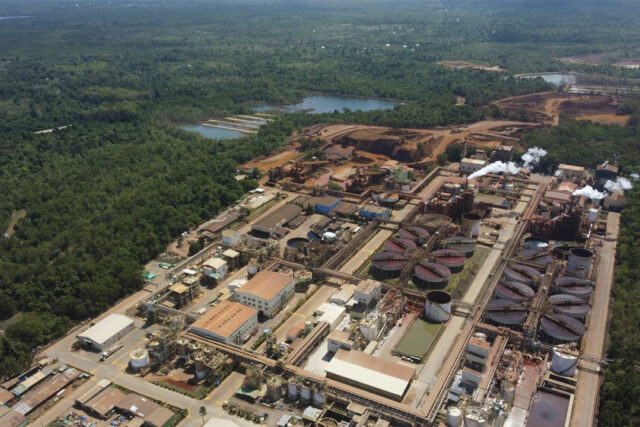
Rio Tuba Nickel Mining in Bataraza, Palawan — NICKELASIA.COM
LISTED Nickel Asia Corp. (NAC) said it expects upward pressure on nickel prices due to potential supply constraints amid rising demand from the stainless steel and electric vehicle sectors.
“Nickel supply visibility beyond 2027 is limited, considering the availability of ore supply, regulatory challenges, and execution risks of processing projects,” the company said in a report released late Wednesday.
NAC earlier said its revenues from ore sales declined by 8.5% to P19.56 billion from P21.38 billion last year, due to lower ore prices, which declined 14% to $20.04 per wet metric ton (WMT) from $23.30 per WMT.
Global nickel production is projected to grow by 3.8% in 2025, while consumption is expected to rise by 5% to 3.514 million tons, driven primarily by demand for stainless steel and renewable energy, according to a recent analysis by the Philippine Nickel Industry Association (PNIA).
It said nickel prices, which recently hit a four-year low, would likely average $16,750 per ton in 2025, with potential spikes to $20,000 early in the year.
Among the challenges that the industry is monitoring are China’s slowdown in stainless steel production and the shift to lithium iron phosphate batteries, which threaten the role of nickel-based batteries in electric vehicles.
Geopolitical risks in major producers like Indonesia and the Philippines may disrupt market stability, according to PNIA.
NAC and DMCI Mining on Wednesday said they had signed a memorandum of understanding “to explore the feasibility of developing and operating a nickel processing plant in the Philippines.”
NAC said it is still in the process of determining the equity structure of the potential joint venture entity for the plant’s development and operation. — Kyle Aristophere T. Atienza
ROBERT PATTINSON and Robert Pattinson in a scene from Mickey 17.
By Brontë H. Lacsamana, Reporter
Movie Review Mickey 17 Directed by Bong Joon-ho
THE WORLD can be described as cruel and uncaring, viewing people as expendable and the optics of power and influence as more important than empathy and compassion.
This movie satirizes that to an insane degree.
Mickey 17 follows Mickey Barnes (played by Robert Pattinson), who finds himself with the most unusual job — dying horribly for a living and getting reprinted over and over again. He is basically a lab rat or guinea pig, something that was ethically contested but still came to exist in this futuristic society, as a space colony tries to put down roots in an alien planet to build a human settlement.
At the heart of it is Pattinson’s multifaceted performance as Mickey, who dies repeatedly and finds himself as the compassionate moral compass, always wracked with guilt, in a world living without it. His dual role as the kindhearted albeit slow Mickey 17 and the more volatile, impulsive, and even murderous Mickey 18, showcases his impressive range. The two, drastically different forms of his character come to be when the 18th iteration is reprinted by the science team, believing that the 17th has already died, and so the two must coexist even when it is forbidden. Pattinson bounces the two portrayals off of each other with ease, his already uncharacteristically high-pitched voice utilized in two different ways.
Parasite director Bong Joon-ho’s most obvious trademark in his English-language films are the cartoonish people of power representing the worst of humankind. There was Tilda Swinton as an outrageous figure of authority on both the Snowpiercer train and in the Okja corporation, and Jake Gyllenhaal in Okja as a disturbed spokesperson and TV personality. In Mickey17 there is the tandem of Mark Ruffalo and Toni Collette as an egomaniacal couple with political influence.
Placed in a distant human settlement in space, Ruffalo and Collette as Mr. and Mrs. Kenneth Marshall ham it up big time, lording over the miserable group of people whom they’ve led into running a tight ship without compassion. Ruffalo in particular does something remarkable with his facial expressions and mannerisms, his jaw set into a permanent scowl that makes him the exact picture of a self-absorbed politician angling for a close-up, believing himself to be the savior of his people. It all pays off, the duo becoming the goofy, evil balance to the brief philosophical moments Mickey has and the heartfelt environmentalism (again, carrying over from Bong’s previous work) emerging even on an alien planet.
Naomi Ackie as Nasha is not to be overlooked. Playing Mickey’s love interest, she embodies the ferocious spunk and channeled the cleverness that he sorely lacks. Her badassery as a fighter, and sexual eagerness as a partner set her up to be just as abrasive as the rest of the crew, but she reveals a heart of gold that it turns out she and Mickey share (which also explains what she saw in him when he was first shown to be the biggest loser of them all). Steven Yeun as Timo, the toxic “best friend” who always either takes advantage of Mickey’s softness or leaves him behind, is appropriately the asshole of the century.
Fans of director Bong Joon-ho will notice that he tends to enjoy making riotous satires of the cruelty and carelessness of our times. As with his previous English-language films Snowpiercer and Okja, he does this through a sci-fi story that probes the ethics of making inhumane sacrifices for the survival of humanity. What sets Mickey17 apart, though, is that the wackiness is turned up to dangerous levels. Almost too much, even.
Audience members who are more familiar with his 2019 Best Picture Oscar-winning Parasite and his more grounded Korean films may be shocked to behold this crazy corner of his filmography, but at their essence, a sort of hope amid the bleak is shared. Snowpiercer is more about class struggle while Okja is more about environmentalism — and Mickey17 has both in spades! The initially scary creeper creatures that Mickey and Nasha encounter and later advocate for in the face of human cruelty are just as memorable as the cartoonish, uncaring people of power who seek to obliterate them for human needs.
Pattinson, Ruffalo, the digitally rendered creepers, and the rest of the cast may be good enough to carry the chaos, but this brand of sci-fi satire can quickly grow tired for some audiences. Bong Joon-ho runs a tight ship with his grounded work, and that’s more difficult to do with these wackier English-language ones. It may very well be his way of saying that Western and capitalist systems are deserving of more and more ridiculous satirical scrutiny as time goes by, and that it is all the more reason for us to lead with kindness and hope.
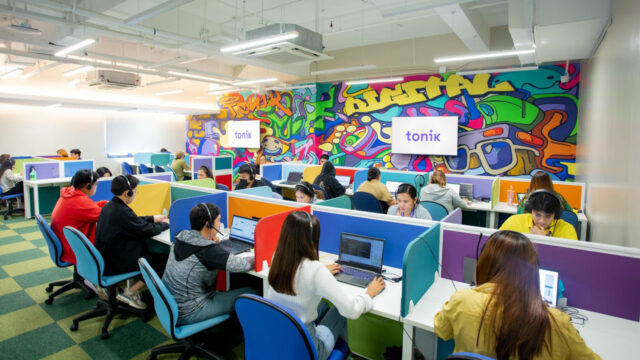
TONIK Digital Bank, Inc. has breached one million in cumulative loan disbursements, it said on Thursday.
“Reaching one million loans marks a major stride in our mission to deliver fast, accessible mass-market consumer credit across the Philippines. We’re scaling rapidly while turning an operational profit — a rare combo in fintech (financial technology) — and we see much more upside ahead,” Tonik Founder and Chief Executive Officer Greg Krasnov said in a statement.
Tonik, which was launched in 2021, said it expanded its loan portfolio by seven times and reduced unit operational service costs by five times in two years.
“This dynamic growth and cost focus helped the bank hit contribution margin breakeven in the fourth quarter of 2024, paving the way for cash flow breakeven within the next 9-12 months,” it said.
“Tonik also leads in average revenue per user and average margin per user across digital banking — showcasing a more robust monetization model than its payments-led peers.”
The bank said its focus on the unsecured consumer credit market, boosted by artificial intelligence (AI)-driven underwriting and the use of alternative data, has driven its growth.
“Consumer lending in the Philippines comprises just 5% of GDP (gross domestic product), far below the 21% regional average. Armed with a digital-only bank license, Tonik secures low-cost deposit funding, strongly outperforming fintech lenders forced to rely on more expensive wholesale capital,” Tonik said.
“With a diverse product lineup — payroll loans, shop installment financing, AI-powered digital cash loans, and upsell loans — Tonik is poised for accelerating its impact in 2025 due to aggressive deployment of AI across the organization.”
Tonik is one of the six digital banks licensed by the Bangko Sentral ng Pilipinas (BSP) to operate in the country.
Singapore-based holding company Tonik Financial Pte Ltd. holds a 60% stake in the digital bank, while Oak Drive Ventures, Inc. and Camerton, Inc. have shareholdings of 20% apiece.
Based on its annual report posted on its website, Tonik booked a net loss of P947.095 million in 2022, wider than the P643.9-million loss reported in 2021.
Tonik had total assets of P8.49 billion at end-September 2024, latest data from the BSP’s website showed. Its gross loan portfolio stood at P2.42 billion in the period, while its net loan portfolio was at P2.21 billion. Deposit liabilities stood at P6.03 billion.
The digital banking sector posted a combined P7.07-billion net loss in 2024, according to preliminary BSP data. — A.M.C. Sy
ST TELEMEDIA Global Data Centres (STT GDC) Philippines, a data center solutions provider, said its data centers are now powered by renewable energy.
“Operating on renewable energy is a significant step forward, showcasing our determination to lead the way in sustainability best practices within the data center industry,” STT GDC Philippines President and Chief Executive Officer (CEO) Carlomagno E. Malana said in a media release on Thursday.
STT GDC Philippines is a joint venture of Globe Telecom, Inc., Ayala Corp., and ST Telemedia Global Data Centres (STT GDC).
All of its operational data centers in the country now run on renewables, STT GDC Philippines said, noting that this move is part of the company’s net-zero commitment.
“We aim to be a catalyst for positive change, inspiring others to embrace renewable energy and contribute to the global push for a low-carbon economy,” Mr. Malana said.
The company said it has also adopted innovative energy solutions, including the use of rooftop solar for electric vehicle (EV) charging and EV operations.
“STT GDC Philippines remains committed to environmental sustainability within its operations. This commitment is supported by continuous innovation in energy-efficient design, water conservation, and sustainable infrastructure development, guided by globally recognized standards,” it said.
STT GDC Philippines has seven data centers in the Philippines with a combined IT load of 140 megawatts (MW), according to its website. — Ashley Erika O. Jose
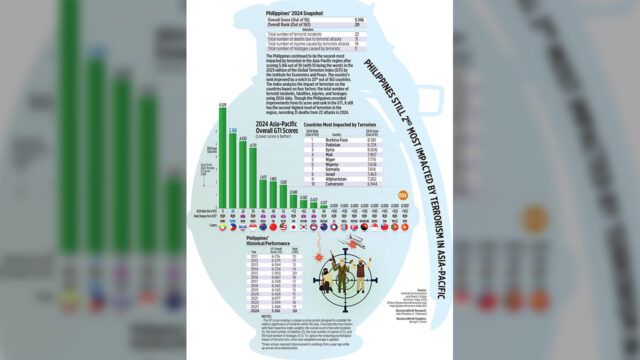
The Philippines continued to be the second-most impacted by terrorism in the Asia-Pacific region after scoring 5.166 out of 10 (with 10 being the worst) in the 2025 edition of the Global Terrorism Index (GTI) by the Institute for Economics and Peace. The country’s rank improved by a notch to 20th out of 163 countries. The index analyzes the impact of terrorism on the countries based on four factors: the total number of terrorist incidents, fatalities, injuries, and hostages using 2024 data. Though the Philippines recorded improvements from its score and rank in the GTI, it still has the second-highest level of terrorism in the region, recording 31 deaths from 22 attacks in 2024.
THE SISTINE CHAPEL, where papal conclaves traditionally vote for the next pontiff. — FRANCO ORIGLIA/GETTY IMAGES EUROPE VIA BLOOMBERG
As Pope Francis wrestles with a tenacious pneumonia, devout Roman Catholics praying for his recovery can at least be assured that their church has a time-tested succession process. Indeed, the papal conclave — where cardinal-electors choose the next pontiff — is the world’s oldest surviving electoral system for a head of state, as recently dramatized in the movie Conclave. Theologically, the Holy Spirit shepherds the cardinals — the church’s princes — to their decision. But, as the film shows, that guidance must be channeled through the ambitions of mortal men.
These are men who can’t let their ambition show. It’s unseemly for a cardinal to campaign openly for the papacy — especially while the occupant of the throne of St. Peter’s is still alive. However, as the church enters the holiest period of its calendar — the 40 days of Lent that lead to Good Friday and Easter — Vaticanologists will be scrutinizing those tasked with substituting for Francis at the processions, rituals, and masses that are the sacramental core of Catholic Christianity. Are these the favored candidates of Francis? Or is he trying to keep prelates on one side by offering them flattering roles as his understudies? I assume that Francis has a say in the scheduling. He may have trouble breathing, but the pope is not senescent and remains the church’s absolute monarch on earth. He has reportedly been conducting Vatican business from his bed in Gemelli Hospital, including meeting with his secretary of state, Cardinal Pietro Parolin.
Standing in for the ailing pontiff during Lent offers a cardinal the opportunity to impress his de facto candidacy not just on the nearly 1.4 billion believers around the world but, more specifically, on his peers. It’s a delicate role because the attention can remind electors of flaws as well as strengths. For this week’s Ash Wednesday ceremonies, the Vatican announced that Cardinal Angelo De Donatis will preside over liturgies leading to mass at the Basilica of Santa Sabina, elements of which date back to the 5th century. Last year, De Donatis, 70, was put in charge of the office that oversees excommunication and the forgiveness of serious sins. As such, it’s appropriate for him to oversee the most penitential of church seasons.*
De Donatis is not among the papabili (the “pope-ables” in Italian) listed in the College of Cardinals Report — a website put together by independent Vatican journalists. There will be deeper speculation if any of those 22 frontrunners plays a prominent role in Lenten ceremonies if Francis continues to be hospitalized. My favorite is Cardinal Luis Antonio Tagle of the Philippines, who’s now based in Rome as head of the church’s department of evangelization. I’m being parochial: I was born in the Philippines of Chinese ethnicity, and Tagle has Chinese roots through his maternal grandmother. We’re also roughly the same age.
It helps to be in Rome to be in line to substitute for an ailing pope, as demonstrated by a successful non-campaign for the papacy in 2005. As John Paul II slipped into the final throes of the Parkinson’s Disease that was taking his life, whispers went around that Germany’s Cardinal Joseph Ratzinger was once again a viable candidate. In the previous two years, Vatican observers had increased the odds against his rise to the top: Ratzinger had health issues, including two strokes; he was unpopular because of his role as John Paul’s ideological enforcer (the cardinal was head of the office that was the evolutionary descendant of the Inquisition); his nickname panzerkardinal was far from warm and fuzzy. Many cardinals wanted a more pastoral and less magisterial approach to the papacy — and theologian-in-chief Ratzinger didn’t fit that bill. One insider told my then-Time colleague Jeff Israely, who was the magazine’s Rome bureau chief: “Getting elected Pope is more a question of how many enemies you have than friends. And I thought Ratzinger still had too many enemies.”
In late February, when John Paul was admitted to the hospital, Ratzinger gave a sermon at the funeral of a prominent Catholic layman that outshined in vigor the eulogy delivered by a cardinal who was at the top of papabili lists at the time. Ratzinger prepared the much-anticipated text for the Good Friday readings of the Stations of the Cross — a role likely assigned by John Paul before his health took a turn for the worse. When the pope died six days after Easter, Ratzinger was again in the spotlight as he presided over the April 8 funeral mass. And as dean of the College of Cardinals — another John Paul appointment — he was seen as the man in charge, especially by visiting cardinals from around the world. Ratzinger became the man to see, even if he wasn’t the leader of the Vatican — yet.
By the fourth round of voting at the conclave, Ratzinger had amassed enough support to win the papacy and, without hesitation, chose the name Benedict XVI as if he’d prepared it all along. It was tribute in part to Saint Benedict of Nursia, who laid down the rigid rules for Christian monastic life. But the Holy Spirit moves in mysterious ways. According to one anonymous cardinal who took note of the tallies in the Sistine Chapel, the prelate who came in second place was Jorge Mario Bergoglio, archbishop of Buenos Aires. Eight years later, he would become Pope Francis.
BLOOMBERG OPINION
*De Donatis, 70, reportedly questioned the pope’s decision to waive the statute of limitations to reopen an investigation into decades-old sexual abuse claims against a prominent priest-mosaicist.
MILLA JOVOVICH and Dave Bautista in a scene from In the Lost Lands.
LOS ANGELES — English director Paul W.S. Anderson believes that fans of writer George R.R. Martin’s Game of Thrones and House of the Dragon will have their hunger for more fantasy stories satisfied with the film In the Lost Lands.
In the Lost Lands, which arrives in theaters on Friday and is distributed by Vertical, is a movie based on a dark fantasy short story of the same name by Mr. Martin.
“The story has the elements that people are familiar with from George’s work, which they love, the twisted characters, the intrigue, the dark setting, the monsters,” the Resident Evil director told Reuters.
“But then it’s a brand-new landscape, and it’s a world they’ve never seen before. So, it’s got all the content, but it’s not Westeros. It’s something very cinematic. We really tried to build something for the cinema rather than television,” he added.
In the Lost Lands stars Milla Jovovich and Dave Bautista, navigating a tale that is quite different from the dragons and power grabs within the fictional continent of Westeros from the Game of Thrones universe.
The film follows Mr. Bautista’s cowboy-esque drifter Boyce, who wanders the post-apocalyptic landscape of humanity’s future. His path crosses with a mystical witch named Gray Alys, played by Ms. Jovovich, who is very powerful but unable to turn down people’s requests.
A journey begins when a queen sends Gray Alys to the “Lost Lands” to grant her the magical power of transforming into a werewolf.
Together, Gray Alys and Boyce are caught in a political situation and are pursued by the religious arm of the kingdom who want to overthrow the queen.
In addition to his lead acting role, Mr. Bautista served as a producer for the film after regularly not having enough creative input in his other Hollywood roles.
“Because I care about what I’m doing, I care about the projects I’m involved with, I just want to have some say so, and so, that comes with being a producer,” the former wrestler told Reuters.
In the Lost Lands is now showing in Philippine cinemas. — Reuters
NEW YORK — A potential move by the US Federal Reserve to ease regulations on capital for US banks that would allow them to hold more Treasury securities has unleashed a torrent of so-called swap spread wideners in the bond market.
These are bets that increase demand for US Treasuries that will push their yields lower and closer to those of a competing class of risk-free assets called interest rate swaps. Analysts said this trade has already been successful this year.
The trade has become popular since the Nov. 5 US election on expectations President Donald J. Trump’s administration will push through deregulation, particularly making capital adequacy rules less restrictive for banks.
“Markets have seized on the possibility that looser regulation will free up some capacity for banks to hold more bonds, especially in times of stress,” said Steven Major, the global head of fixed income research at HSBC in Dubai.
“Early positioning from hedge funds was on the view that regulations would be adjusted. There is more to go.”
Swap spreads are a major component of the more than $500-trillion interest rate derivatives market. They express the basis-point difference between the fixed rate of an interest rate swap tied to the current Secured Overnight Financing Rate (SOFR) and the Treasury yield of the same maturity.
Investors and corporations use swaps to hedge interest rate risk or their exposure to US Treasuries, allowing them to exchange fixed-rate cash flows for floating-rate ones, or vice versa.
Swap spreads are currently negative across the curve, meaning yields on Treasuries are higher than those on swaps. But since the beginning of the year, spreads have turned less negative, or in bond market parlance, widened, which means Treasury yields have been trending lower.
US five-year swap spreads have widened since January by about 5 basis points (bps) to minus 29 bps on Tuesday. The spread reflects the difference between five-year Treasury yields currently at 3.925% and five-year swap rates at 3.6201%.
On the long end of the curve, 30-year swap spreads have increased by 8 bps to minus 78 bps.
BALANCE SHEET FLEXIBILITY Last month, Fed Chair Jerome H. Powell told Congress that it was time for the US central bank to ease the supplementary leverage ratio (SLR), which directs banks to hold capital against investments regardless of their risk and effectively discourages these institutions to hold Treasuries.
The Fed was forced to temporarily waive the SLR after the Treasury market seized up in March 2020, but it let that relief expire a year later.
Cutting SLR would significantly free up additional capacity for banks on their balance sheet, allowing them to add low risk-free assets such as Treasuries without having to allocate capital to cover potential losses.
The net effect of Mr. Powell’s recent comments on the SLR was to push yields lower, consequently widening swap spreads.
Swap spreads across the curve have been negative for years, and this has something to do with the structure of lending between the two risk-free assets.
“The credit risk between Treasury yields and SOFR swap rates is identical,” said Srini Ramaswamy, managing director and head of derivatives strategy at JPMorgan in San Francisco. “Treasury yields are higher and that has something to do with terming out the principal.”
Mr. Ramaswamy cited a five-year SOFR swap rate, for instance, which effectively is the average of rates that one can earn by doing lending in the repurchase or repo market daily for five years. The five-year Treasury note, on the other hand, represents lending money to the US Treasury five years at a time.
“You give up some flexibility when you lend money for five years to the Treasury, so the compensation is higher, as opposed to lending one day at a time in SOFR swaps,” Mr. Ramaswamy said.
And with the recent transition to risk-free SOFR from Libor, or the London Interbank Offered Rate, there is no longer a premium for credit risk embedded in swap rates that lifted them higher over Treasury yields in the past.
Major banks as a result have recommended swap spread wideners to take advantage of looming deregulation.
Barclays, in a research note, recommended swap spread wideners in the belly of the curve, specifically, the seven-year spread, where banks prefer to own Treasuries. It believes a change in the SLR could unlock additional bank demand for Treasuries as these financial institutions grow their assets.
TD Securities, on the other hand, sees more opportunity on the longer end of the curve, particularly in the 30-year sector, where spreads remain historically tight or more negative.
“We believe the widening has more room to run as regulators make progress,” said Gennadiy Goldberg, TD’s head of US rates strategy. — Reuters
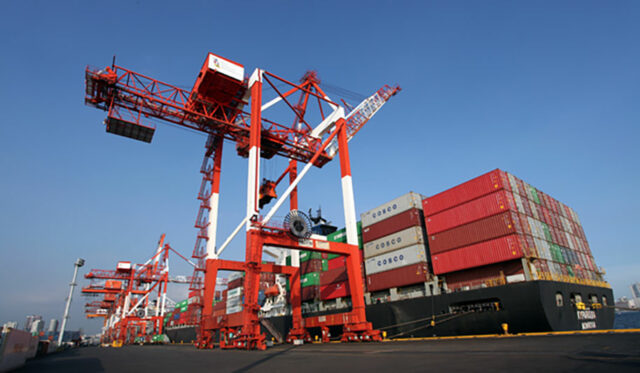
ASIAN TERMINALS, Inc. (ATI) said it has commissioned two ship-to-shore (STS) cranes to increase handling capacity and operational efficiency at Manila South Harbor, its flagship international container terminal.
“The deployment of these two new cranes significantly boosts Manila South Harbor’s capacity and efficiency, allowing us to handle larger vessels and more cargoes, which directly benefit the Philippines as an emerging economic center in the region,” ATI Director William Khoury said in a media release on Thursday.
ATI said the additional cranes at South Harbor will complement its 11 STS cranes, hybrid and conventional rubber-tired gantries, and other cargo-handling equipment.
The company said the cranes are critical to the modernization of Manila South Harbor and aligned with future market requirements.
“This is well-timed with the scheduled completion of Manila South Harbor’s Pier 3 redevelopment, highlighted by its extended quay length to nearly 600 meters to accommodate more and bigger vessels deployed by ATI’s international carrier partners,” ATI said.
The newly deployed cranes are Neo-Panamax cranes manufactured by Shanghai Zhenhua Heavy Industries. These are the largest among ATI’s existing quay-side equipment and are considered the biggest in the Philippines, with an outreach of 58 meters.
“In partnership with the government, we are lining up more investments in the coming years to future-proof our gateway terminals in Manila, Batangas, Cavite, and Laguna in support of the resilient and sustainable growth of the Philippine economy,” Mr. Khoury said.
In 2024, ATI handled a total volume of nearly 1.6 million twenty-foot equivalent units (TEUs), marking a 4% increase from the previous year.
The company said it is now capable of handling nearly 2 million TEUs in annual container throughput following the completion of its landside and seaside development projects, along with the deployment of new cranes.
At the stock exchange on Thursday, shares in the company gained 18 centavos, or 1%, to close at P18.16 apiece. — Ashley Erika O. Jose