
How PSEi member stocks performed — March 20, 2025
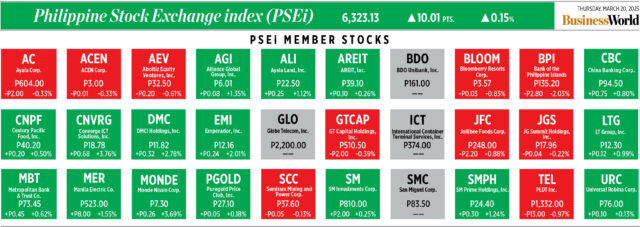
Here’s a quick glance at how PSEi stocks fared on Thursday, March 20, 2025.


Here’s a quick glance at how PSEi stocks fared on Thursday, March 20, 2025.

By Adrian H. Halili, Reporter
THE PHILIPPINES’ top prosecutor on Thursday denied having colluded with the International Criminal Court (ICC) to pave the way for former President Rodrigo R. Duterte’s trial for crimes against humanity over his deadly drug war.
The government of President Ferdinand R. Marcos, Jr. did not plan his predecessor’s arrest and surrender to the international tribunal, Justice Secretary Jesus Crispin C. Remulla told a Senate foreign relations committee hearing investigating last week’s events.
“We did not assist the ICC,” he told senators. “We never had contact with them. The investigation that they conducted was through their own methods and we did not, in any way, assist them.”
“We are not members of the ICC, so whatever relationship we have with the ICC is at arm’s length if we have to talk to them. But we have never spoken with them,” he added.
Local police arrested Mr. Duterte after the ICC ordered his arrest and sought the help of the International Criminal Police Organization (Interpol). The tough-talking leader was arrested shortly after arriving from Hong Kong and was put on a chartered plane to the Netherlands on March 11.
The ICC has been investigating Mr. Duterte and his cohorts for crimes against humanity that he allegedly committed when he was still the mayor of Davao City and for the first three years of his presidency, when the Philippines was still a member of the international tribunal.
The war on drugs was Mr. Duterte’s signature campaign platform that swept the mercurial, crime-busting former prosecutor to power in 2016, and he soon delivered on promises made during vitriolic speeches to kill thousands of drug dealers and users.
Senator Maria Imelda R. Marcos, who heads the committee, questioned the jurisdiction of the international court over Mr. Duterte, whose family she considers close friends.
“The Senate will seek answers,” the presidential sister told the hearing. “And if there is indeed wrongdoing, we will put up safeguards so this never happens again.”
The Philippines under Mr. Duterte withdrew from the ICC’s founding treaty in 2019 when it started looking into allegations of systematic extralegal killings.
Mr. Marcos earlier said his government was just doing its job in carrying out the ICC arrest warrant and cooperating with Interpol, adding that it was nothing personal.
During Mr. Duterte’s six years in office, 6,200 suspects were killed during anti-drug operations, by the police’s count. Human rights groups say the deaths could be as many as 30,000.
He could become the first former Asian head of state to stand trial at the ICC, a court that has largely handled cases from African nations.
Several Duterte allies have questioned the validity of his arrest, citing the countries’ exit from the international tribunal’s Rome Statute.
Mr. Remulla noted that despite the Philippines’ withdrawal from ICC, it still has jurisdiction over people and not countries.
“Jurisdiction of the ICC is throughout the world,” he said. “We belong to a community of nations that is tied together by a legal system called the International Humanitarian Law. It is something adopted by more than 150 countries.”
“The ICC tries people for individual crimes, not states. So, the Philippines, as a state, cannot be called upon by the ICC to do something for them. But when the ICC is running after individuals who are Filipino citizens, then that obligation becomes another kind of obligation,” he added.
Defense Secretary Gilberto Eduardo Gerardo C. Teodoro, Jr. also said his agency did not have a hand in Mr. Duterte’s arrest. “No government agency, [including] the Department of National Defense, cooperated with the ICC,” he told senators.
National Security Adviser Eduardo M. Año said the same thing at the hearing.
Earlier, Mr. Marcos said the government would not help the ICC “in any way, shape or form,” since it had no jurisdiction over the Philippines.
Interior Secretary Juanito Victor C. Remulla said the President and members of his Cabinet had only discussed rumors about his arrest warrant from the tribunal.
Mr. Duterte made his first appearance before the ICC on March 14 via video link, where judges informed him about his charges. The ICC scheduled his trial for Sept. 23.
Vice-President Sara Duterte-Carpio joined Thursday’s Senate hearing virtually and said the arrest of her father was “patently an illegal” that was orchestrated by the Marcos government to “demolish political opponents.”
“This is all about politics,” she said.
The ICC, a court of last resort, says it has jurisdiction to prosecute alleged crimes that took place before a member’s withdrawal.
By John Victor D. Ordoñez, Reporter
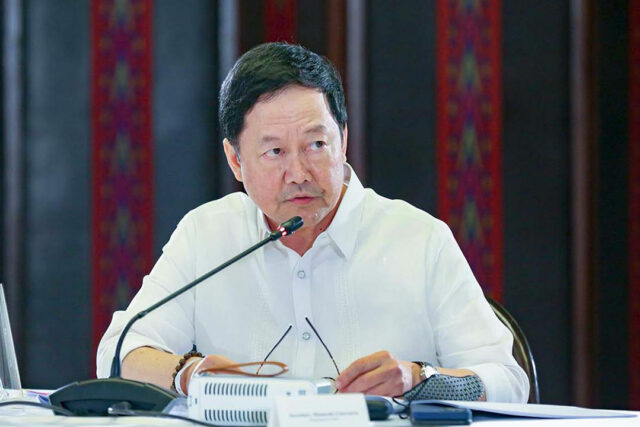
PRESIDENT Ferdinand R. Marcos, Jr. will not ask Solicitor General (SolGen) Menardo I. Guevarra to resign after he recused himself from Supreme Court lawsuits seeking to declare former President Rodrigo R. Duterte’s arrest as illegal, according to the Presidential Communications Office.
“When I asked him if SolGen would resign, he said: ‘I am not asking for his resignation.’ That’s all he said,” palace spokesperson Clarissa A. Castro told a news briefing on Thursday. “So, his trust in Solicitor General Menardo Guevarra remains.”
Supreme Court spokesperson Camille Mae L. Ting told reporters last week Mr. Guevarra had inhibited himself from representing state officials accused by Mr. Duterte’s children of having illegally enforcing his arrest and detention before he was flown to The Hague.
The country’s top lawyer earlier said he would leave it to the President to decide whether to keep him.
Justice Secretary Jesus Crispin C. Remulla told a forum on Wednesday Mr. Guevarra did not get his permission to withdraw from the lawsuits.
Mr. Duterte’s children — Sebastian, Paolo and Veronica — filed separate petitioners before the High Court seeking the firebrand leader’s release.
The tough-talking leader, who was President from 2016 to 2022, was arrested last week in Manila, marking the biggest step yet in the ICC’s probe of his alleged crimes against humanity during an anti-illegal drug crackdown that killed thousands and drew condemnation around the world.
The Hague-based tribunal has been investigating him for crimes he allegedly committed when he was Davao City mayor and during the first three years of his government, when the Philippines was still a party to ICC.
Last week, the Supreme Court rejected Mr. Duterte’s plea for an injunction on the government’s cooperation with the ICC.
Both Sebastian and Veronica said their father had been illegally arrested and was being detained by the ICC, which they said does not have jurisdiction over the Philippines.
Meanwhile at a virtual news briefing, Vice-President Sara Duterte-Carpio, who is in the Netherlands with her father, chided personnel from the Armed Forces of the Philippines for allowing the arrest to happen under “questionable circumstances.”
“Even more disturbing is the silence of the Armed Forces of the Philippines (AFP),” she said. “Why did the AFP stand idly by when a former commander in chief was taken from a military base under questionable circumstances?”
“If a former President can be taken without due process, what stops them from doing the same to any other Filipino?” she asked.
The Vice-President, whom and House of Representatives impeached in February, said she was still performing her duties online, and that bringing her father back from home is a duty she needs to carry out.
The war on drugs was the signature campaign platform that swept the mercurial Mr. Duterte to power in 2016. During his six years in office, 6,200 suspects were killed during anti-drug operations, by the police’s count.
Activists and human rights group say as many as 30,000 drug suspects died.
“I don’t want to stay here because my children are in the Philippines and my work is there,” Ms. Duterte said in mixed English and Filipino. “But as Vice-President, I also have a duty to a fellow countryman, a Filipino citizen who is being held against his will here at the ICC detention center.”

PRESIDENT Ferdinand R. Marcos, Jr. has vetoed a bill that seeks to declare the province of Pampanga as the culinary capital of the Philippines, citing potential discrimination against other provinces.
In a veto message to Senate President Francis “Chiz” G. Escudero dated March 12, the President cited the need for more studies and a historical basis to give Pampanga in the country’s north the distinction.
“In consideration of the possibility that the enrolled bill may cause discrimination, regional bias and loss of diversity, I am constrained to veto the abovementioned enrolled bill,” he said.
Mr. Marcos said the designation could “offend sensibilities in other provinces that are equally proud of their culinary contributions.”
Senator Manuel “Lito” M. Lapid, who filed the Senate version of the bill, had pushed for the bill’s approval before the plenary, saying the province has become “synonymous with Philippine cuisine,” with dishes such as sisig, tocino and kare-kare.
“We want to recognize the uniqueness of each region,” presidential spokesperson Clarissa A. Castro told a news briefing on Thursday. “That’s why it was vetoed — not to deny that Pampanga has great food and culture, but to acknowledge the excellence of every region.”
“If one region is declared as having the best or most delicious food, others, especially foreigners who want to visit the Philippines, might think that only one region is worth visiting for its local cuisine,” she added.
Senator Mark A. Villar, who sponsored the Senate bill, said the bill only seeks to recognize the province’s contribution to the country’s culinary history and does not seek exclusivity.
“The richness in terms of regional differences is the strength of our Filipino cuisine,” the President said.
“I extend my unwavering support to the leadership of both Houses of Congress for working in unison with the Executive and I look forward to more beneficial legislation that would highlight our unique culture without sacrificing our diversity,” he added. — John Victor D. Ordoñez

A LABOR group leader on Thursday asked the Supreme Court (SC) to declare provisions of the Magna Carta for Filipino Seafarers unconstitutional for being discriminatory and in violation of the equal protection clause.
In a petition, dated March 20, Federation of Free Workers President Jose Sonny G. Matula referred to Section 59 of Republic Act (RA) No. 12021, which imposed an “unjust” bond requirement on seafarers as a precondition for the execution of monetary awards.
“The Highest Court has consistently ruled that classifications must be based on substantial distinctions that are relevant to the law’s purpose. Section 59 fails this test because it arbitrarily singles out seafarers, imposing an additional financial hurdle that other workers do not face,” Mr. Matula said in a separate statement.
According to the petition, using the Agarang Kalinga at Saklolo para sa mga OFWs na Nangangailangan (AKSYON) Funds for the payment of premiums of the bond requirement violates the Constitution for appropriating public funds for private purposes.
AKSYON Fund, under Department of Migrant Workers Act, RA No. 11641, is created to provide legal, medical, financial, and other forms of assistance to overseas Filipino workers (OFWs), including repatriation, shipment of remains, evacuation, rescue, and any other analogous help or intervention to protect the rights of Filipino nationals.
“Section 59 of the Magna Carta for Seafarers deviates from the purpose of the AKSYON Fund by allowing the Department of Migrant Workers to also use the AKSYON funds for the payment of premiums of the bond requirement,” the petition read said.
The petition claimed the Magna Carta of Seafarers violates the principles of equal protection and due process by imposing an unjust financial burden on seafarers in enforcing claims they have already won, a requirement not imposed on other workers.
He urged the High Court to declare Section 59 unconstitutional and called on labor groups to support legal action to safeguard seafarers’ right to claim their rightful benefits without facing unconstitutional barriers.
Moreover, the petitioner noted the law usurped the exclusive power of the SC, citing Section 60, which prohibited non-lawyers to act as legal representatives of seafarers before labor courts and provided a compensation cap of not more than 10%.
The provision, which sets limitations on the appearance of lawyers and stipulation of legal fees, runs contrary to the constitutional prerogative of the SC to promulgate rules concerning pleading, practice, and procedure in all courts.
Mr. Matula also asked the top court to issue a temporary restraining order and a writ of preliminary injunction to stop the implementation of both sections and the implementing rules and regulations, pending resolution of the petition. — Chloe Mari A. Hufana
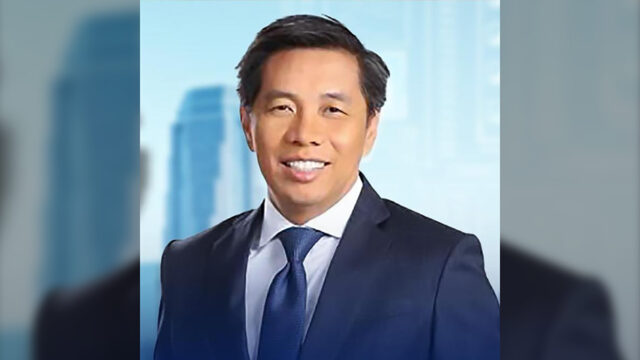
PHILIPPINE President Ferdinand R. Marcos, Jr. has named former UnionDigital Bank President and Chief Executive Officer Henry Rhoel R. Aguda as secretary of the Department of Information and Communications Technology (DICT), according to the Presidential Communications Office (PCO).
Mr. Aguda, who served as the digital infrastructure lead at the Private Sector Advisory Council, will replace former DICT chief Ivan John E. Uy, the PCO said in a statement. Mr. Uy did not give a reason for his resignation.
The new DICT chief was a director of Insular Health Care and chief technology officer at Globe Telecom, Inc., the Government Service Insurance System and Digtel Telecommunications Philippines, Inc.
He got his juris doctor and mathematics degree from the University of the Philippines and took graduate studies in advanced management at Harvard Business School and a strategic alliance program at Wharton School of the University of Pennsylvania.
Mr. Aguda also managed the corporate data network of Manila Electric Co. — J.V.D. Ordonez

THE PESO strengthened against the dollar on Thursday after the US Federal Reserve kept benchmark borrowing costs steady as expected and reiterated that they are in no rush to resume their rate-cut cycle.
The local unit closed at P57.222 per dollar on Thursday, rising by 7.8 centavos from its P57.30 finish on Wednesday, Bankers Association of the Philippines data showed.
The peso opened Thursday’s session stronger at P57.20 against the dollar. It traded higher than Wednesday’s close the entire day, posting an intraday low of just P57.255. while its best showing was at P57.11 versus the greenback.
Dollars exchanged went down to $1.296 billion from $1.72 billion on Wednesday.
“The dollar-peso closed higher after the Fed kept rates unchanged while Chairman Powell signaled a cautious approach amid uncertainties over inflation and the US economy,” a trader said in a phone interview.
The peso was also supported by lower global crude oil prices and US Treasury yields, Rizal Commercial Banking Corp. Chief Economist Michael L. Ricafort said in a Viber message.
For Friday, the trader expects the peso to move between P57 and P57.30 per dollar, while Mr. Ricafort sees it ranging from P57.10 to P57.30.
The Trump administration’s initial policies, including extensive import tariffs, appear to have tilted the US economy toward slower growth and at least temporarily higher inflation, Federal Reserve Chair Jerome H. Powell said on Wednesday, drawing the ire of President Donald J. Trump, Reuters reported.
Mr. Trump posted late on Wednesday on his Truth Social platform: “The Fed would be MUCH better off CUTTING RATES as US Tariffs start to transition (ease!) their way into the economy. Do the right thing.”
Earlier, in explaining why rates were being kept unchanged, Mr. Powell described the uncertainty faced by Fed policy makers as “unusually elevated.”
With overall sentiment sliding due to policy “turmoil,” prices are projected to rise faster than previously expected at least in part, and perhaps largely, because of Mr. Trump’s plans to impose duties on imports from US trading partners, Mr. Powell said after the Fed announced it had held its benchmark overnight rate steady in the 4.25%-4.5% range.
While Fed policy makers still expect the central bank to deliver two quarter-percentage-point rate cuts by the end of this year, matching their projection in December, that is largely due to weakened economic growth offsetting higher inflation, and what Mr. Powell called the “inertia” of not knowing what else to do given the muddled outlook.
There is “just really high uncertainty. What would you write down?” when making projections, Mr. Powell told a press conference after the Fed’s latest two-day policy meeting. “I mean it’s just… really hard to know how this is going to work out.”
“We understand that sentiment is quite negative at this time, and that probably has to do with turmoil at the beginning of an administration that’s making big changes,” Mr. Powell said.
Mr. Powell’s remarks and the Fed’s latest set of policy maker projections was heavily influenced by what has transpired since Mr. Trump took office on Jan. 20 with a vow to impose the import tariffs.
Data released along with the latest policy and economic projections showed Fed officials in near unanimity that the outlook was less certain than usual, and that risks considered balanced as of the Fed’s Jan. 28-29 meeting were now tilted towards slower growth, higher joblessness, and higher inflation.
“We now have inflation coming from an exogenous source,” said Mr. Powell, using a term economists employ to describe an outside shock, in this case tariffs that could, if Mr. Trump follows through with all his plans, lift the average tax rate on imports to levels not seen since the Great Depression.
The Fed cut its benchmark interest rate by a full percentage point last year, but has kept rates on hold this year as it waits for further evidence that inflation will continue to fall, and, more recently, for more clarity about the impact of Mr. Trump’s policies.
“We’re not going to be in any hurry to move,” Mr. Powell said. “Our current policy stance is well-positioned to deal with the risks and uncertainties we face… The right thing to do is to wait here for greater clarity about what the economy is doing.” — A.M.C. Sy with Reuters

THE MAIN INDEX rose on Thursday as both the US Federal Reserve and the Bangko Sentral ng Pilipinas (BSP) said they expect to resume their monetary easing cycles this year despite uncertainty stemming from the Trump administration’s trade policies.
The bellwether Philippine Stock Exchange index (PSEi) rose by 0.15% or 10.01 points to close at 6,323.13 on Thursday, while the broader all shares index slipped by 0.10% or 4.03 points to 3,745.32.
“The local market rose further on the back of the positive cues from Wall Street. This came as the Fed maintained its outlook of two policy rate cuts for this year,” Philstocks Financial, Inc. Senior Research Analyst Japhet Louis O. Tantiangco said in a Viber message. “Hopes that the Bangko Sentral ng Pilipinas will cut their policy rates at their April meeting also gave the market a boost.”
“Philippine shares made modest gains ahead of the FTSE rebalancing and after the Fed reaffirmed its outlook for two rate cuts in 2025, keeping rates at 4.25% to 4.5% despite expectations of higher inflation and slower growth. Fed Chair Jerome H. Powell downplayed the inflationary impact of tariffs, calling it transitory,” Regina Capital Development Corp. Head of Sales Luis A. Limlingan said in a Viber message.
Asia shares edged up on Thursday after a Wall Street rally as investor sentiment was lifted by the prospect that the Federal Reserve could still deliver two rate cuts this year, Reuters reported.
The Fed on Wednesday left rates unchanged in a widely expected decision, but maintained its projection for two quarter-percentage-point rate cuts by the year-end.
Meanwhile, BSP Governor Eli M. Remolona, Jr. told Bloomberg News on Wednesday that the Monetary Board could resume its easing cycle at their April 10 meeting following the surprise pause at their February review.
Mr. Remolona added that the BSP could deliver 50 basis points (bps) in cuts this year.
The Philippine central bank has brought down benchmark borrowing costs by a cumulative 75 bps since it began its easing cycle in August last year.
Most sectoral indices closed higher on Thursday. Mining and oil surged by 6.06% or 546.34 points to 9,548.32; property increased by 0.98% or 21.97 points to 2,261.97; industrials went up by 0.49% or 43.59 points to 8,832.88; services rose by 0.17% or 3.58 points to 2,057.36; and holding firms climbed by 0.13% or 7.04 points to 5,228.74.
Meanwhile, financials went down by 0.42% or 10.40 points to 2,440.62.
Value turnover went down to P5.6 billion on Thursday with 1.06 billion shares exchanged from the P7.84 billion with 966.38 million issues traded on Wednesday.
Advancers beat decliners, 103 against 98, while 44 names were unchanged.
Net foreign buying dropped to P166.83 million on Thursday from P392.22 million on Wednesday. — R.M.D. Ochave with Reuters

FINANCE Secretary Ralph G. Recto said the budget surplus recorded in January is unlikely to continue in the following months.
Asked if the surplus will be sustained in the runup to the elections, Mr. Recto told BusinessWorld: “No. Our deficit target this year is 5.3% of the GDP (gross domestic product).”
The government in January posted a P68.4-billion budget surplus, down from the P88-billion surplus a year earlier, the Bureau of the Treasury (BTr) reported on Tuesday.
The target deficit-to-GDP ratio is lower than the 5.7% target last year, and the government aims to further reduce this to 3.7% in 2028.
The midterm elections for national and local positions are scheduled for May 12.
Rizal Commercial Banking Corp. Chief Economist Michael L. Ricafort noted that the January surpluses of recent years typically follow “large deficits” in December.
The surplus will likely revert to a deficit in the following months.
The BTr also reported that revenue collection in January grew 10.75% to P467.1 billion, while government expenditure rose 19.45% to P398.8 billion.
Mr. Recto told reporters on Wednesday that the government is on track with fiscal consolidation efforts.
“We’re on the path. We surpassed our revenue targets. Last year, we had the highest revenue-to-GDP ratio in the last 27 years. That’s very good.”
Mr. Recto added that the Department of Finance will continue with its privatization efforts.
“We will be happy if we hit our target,” Mr. Recto said on Thursday via Viber when asked if the government will meet its P210.8-billion non-tax collection goal for 2025.
Non-tax revenue fell 19.16% to P29.6 billion, while tax collections rose 13.6% to P437.5 billion in January.
Mr. Recto said the proposed Excise Tax on Single-Use Plastics is still a priority.
The plastics tax is one of the priority bills in the Legislative-Executive Development Advisory Council common legislative agenda for the 19th Congress.
Mr. Recto also said higher spending during the elections will help the government meet its growth target of at least 6%.
This is the lower end of the government’s 6-8% target band for 2025, with the deficit projected at P1.534 trillion or 5.3% of GDP. — Aubrey Rose A. Inosante

THE Board of Investments (BoI) said the green lane-certified P7.5-billion Daanbantayan Solar Power Plant in northern Cebu has commenced with construction.
With its 150-megawatt capacity that is expected to supply electricity to 300,000 people, the project, which is being developed by Spanish infrastructure company Acciona Energia Global, has the potential to significantly reduce electricity costs in Cebu, the investment promotion agency said on Thursday.
“This development is a crucial step towards achieving energy sustainability, particularly in a region that has historically lagged in renewable energy adoption compared to highly urbanized areas like Metro Manila,” BoI said.
BoI Investment Assistant Service and One-Stop Action Center for Strategic Investments Director Ernesto C. Delos Reyes, Jr. said that the expedited processing due to the green lane treatment allowed the company to start project development this year.
“Typically, obtaining permits and clearances for a solar power plant takes nearly three years from the time they receive the service contract,” Mr. Delos Reyes said via Viber.
“They received the service contract on March 15, 2024, and based on the standard timetable, they would start project development three years later. However, the green lane certification issued on Aug. 1, 2024, helped expedite the necessary permits and clearances,” he added.
In February 2023, the government established Executive Order No. 18, the “green lane” system, at all government offices, expediting approvals and permits for strategic investments.
Trade Secretary Ma. Cristina A. Roque said that Acciona’s project reflects the impact of the green lane program and its success in attracting investors.
“It serves as a meaningful milestone, paving the way for more projects that advance our mission to promote green investments and create job opportunities,” Ms. Roque said.
The project will serve as a major link between the eastern and central segments of the Visayas grid.
Commissioning is expected by late 2026 and is projected to save about 259,000 tons of carbon dioxide emissions annually.
“This plant, with a peak capacity of 176 megawatts, 150 base, and a battery storage system, will begin operations in 2026, with expected production that is equivalent to the consumption of more than 300,000 people,” according to José Manuel Entrecanales Domecq, chairman and chief executive officer of Acciona.
“This plant is Acciona Energia’s first plant in the Philippines and the biggest under construction in the Visayas archipelago. This project supports the government’s goal of increasing the share of renewables in the energy mix, ensuring energy security, and promoting sustainable and inclusive economic growth,” he added. — Justine Irish D. Tabile

THE Department of Agriculture (DA) said its Cagayan Valley office has developed a zero-energy cooling chamber designed to extend the shelf life of freshly harvested vegetables like tomatoes and eggplant.
The P45,000 ZEC-C or Zero Energy Cooling Chamber is capable of storing 500 kilos, with larger capacities becoming more cost effective, the DA said in a statement.
“An economic analysis showed a return on investment of at least 71% for tomatoes and 32% for eggplant over a five to 21-day storage cycle,” it said.
ZEC-C, which took two years, was developed by researchers, farmers, cooperatives, and agribusinesses.
Principal technology author Mary Jane Ibarra of the Cagayan Valley Research Center in Ilagan City and her team conducted the trials comparing the performance of suitable materials, including coconut coir, charcoal, and a bricks-and-sand mix.
The trials in Aurora and Roxas, Isabela found that charcoal insulation effectively lowered temperatures by 5-10 degrees Celsius, and maintained humidity levels of 85-90% that are deemed ideal for vegetable storage.
Rose Mary Aquino, regional executive director for the DA’s Regional Field Office II, said ZEC-C preserved tomatoes for up to 21 days and eggplant for up to five days, based on initial freshness, firmness, and color.
The farmgate price of tomatoes in parts of the country in early March fell to as low as P4 per kilo due to excessive supply.
Due to lack of cold storage facilities, farmers in the Philippines either sell their excess at lower prices or dump them.
Ms. Aquino said other vegetables, such as bottle gourd (upo) and sponge gourd (patola) stayed in excellent condition for up to 6 days.
The ZEC-C technology launch and transfer are scheduled for late March at the Nueva Vizcaya Agricultural Trading Center, where two units with one-ton capacities will be awarded.
Additional units with capacities ranging from 200 kilos to one ton will be distributed to other towns in Isabela. — Kyle Aristophere T. Atienza

THE Department of Energy (DoE) encouraged the public to participate in the annual observance of Earth Hour and adopt responsible energy and water conservation practices.
In a statement on Thursday, the DoE said this year’s Earth Hour focuses on the “vital connection between energy conservation and water security” in achieving sustainability.
The DoE encouraged the public to adopt practical and effective demand-side management strategies without compromising productivity.
Energy Secretary Raphael P.M. Lotilla cited the interdependence of energy and water, saying that “every kilowatt-hour of electricity consumed requires water — whether for cooling processes in thermal power plants, hydropower systems, or the energy needed to pump, treat, and distribute water.”
“Using energy judiciously is not just about reducing consumption — it is about preserving life itself. Every watt saved is a drop of water protected, reinforcing the delicate balance of our environment,” he said.
“By embracing energy efficiency and conservation, we do more than cutting emissions, we secure the future of our most vital resources for generations to come,” he added.
Mr. Lotilla urged the public to observe in the Earth Hour on March 22, between 8:30 p.m. and 9:30 p.m., by switching off non-essential lights.
“Through small but consistent actions, individuals, businesses, and communities can make a lasting impact on energy and water conservation, strengthening climate resilience and promoting a more sustainable way of life,” Mr. Lotilla said.
Speaking at Energy Efficiency Day 2025, Alexander D. Ablaza, president of the Philippine Energy Efficiency Alliance, Inc., said that the Philippines should also focus on opportunities to advance energy efficiency beyond the grid.
“While it’s all interesting to talk about energy on the grid, let’s not forget that more than 50% of energy efficiency opportunities lie outside the grid, lie outside the power sector,” he said.
“So let’s also talk about energy efficiency in the maritime industry. Let’s talk about electrification of land transport. Let’s talk about sustainable fuels for aviation. Let’s talk about what we can do to make our cities more walkable and demotorize our economy,” he added. — Sheldeen Joy Talavera
