Home Blog Page 1873

FACTBOX: What happened in drug war that led to Duterte’s arrest by law enforcers?

PHILSTAR FILE PHOTO

FORMER Philippine President Rodrigo Duterte was arrested and taken into custody on Tuesday in Manila on an International Criminal Court warrant for the “war on drugs” that defined his term in office and which killed thousands of Filipinos.

Here are some facts about the drug war during his presidency from 2016 to 2022:

CAMPAIGN VOWS TO ‘KILL’
As longtime mayor of the southern Philippine city of Davao, Rodrigo Duterte was known as “the punisher” for his harsh policies. His profanity-packed speeches and death threats to drug gangs were a feature of his successful campaign for the presidency in 2016.

Among his statements during the campaign were: “Forget the laws on human rights. If I make it to the presidential palace, I will do just what I did as mayor. You drug pushers, hold-up men and do-nothings, you better go out. Because I’d kill you.”

He said his campaign in Davao kept citizens safe from crime.  “I say let’s kill five criminals every week, so they will be eliminated,” he told Reuters.

NATIONWIDE ROLLOUT
It did not take long for the same kind of police crackdowns to be implemented nationwide.

By the end of 2016, Mr. Duterte’s war on drugs was well under way across the nation, and the body count was setting records.

Police killed more than 2,000 people in the months after he was inaugurated on June 30 until the end of the year. Most of the deaths were described as shootouts.

Human rights monitors believed many were carried out by vigilantes with official sanction and said the true figure of deaths was much higher, both accusations that the government denied.

The crackdown and death toll did not dent Mr. Duterte’s popularity.

An opinion poll published by the Social Weather Stations research agency in December 2016 showed 77% of Filipinos were satisfied with his performance.

FINAL TOLL
By the time Mr. Duterte left office in 2022, the drug war’s official toll had at least tripled. Police said 6,200 suspects were killed during anti-drug operations.

The Philippine government has officially acknowledged 6,248 deaths due to the anti-drug campaign.

But activists say the real toll of the crackdown was far greater, with thousands of urban and poor drug users, many placed on official “watch lists,” killed in mysterious circumstances.

Mr. Duterte was unapologetic in his defense of his campaign and says he told police to kill only in self-defense.

Families of some of those killed and human rights advocates later exhumed bodies, sometimes accompanied by Reuters journalists, and compared the remains with death certificates and official reports.

Dozens of cases showed violent deaths where the death certificates listed natural causes. In one case, the death certificate listed pneumonia as the cause of death, although the exhumed body had a bullet hole in the skull.

ICC PROBE
In February 2018, the ICC prosecutor’s office said it would conduct a preliminary investigation into deaths in the Philippines.

Barely a month later, Mr. Duterte said he would withdraw from the ICC. The exit took effect in March 2019.

The ICC investigation was suspended in 2021 after the Philippines claimed it had a functioning judicial system capable of investigating and prosecuting alleged abuses.

However, in 2023, the ICC investigation was reactivated after the court said it was unsatisfied with Philippine efforts.

The government of President Ferdinand R. Marcos, Jr. initially said it would not cooperate with the ICC, but said in late 2024 it would comply with any arrest warrant, and its Justice chief told Reuters in January the government was open to cooperate with the international body. — Reuters

Climate-resilient PHL schools sought amid heatwave

Students attend a class at the Commonwealth High School, in Quezon City, Metro Manila, April 18, 2024. — REUTERS

A PHILIPPINE senator on Tuesday urged the Department of Education and local governments to increase investments in climate-resilient infrastructure amid the suspension of classes due to high heat.

“I am reiterating the need to make our basic education sector more resilient,” Senator Sherwin T. Gatchalian said in a statement. “This requires investing in climate-resilient infrastructure, accelerating digital transformation, and ensuring the readiness of our teachers and learners to utilize alternative delivery modes.”

Last week, local government units in the National Capital Region and surrounding provinces suspended classes at all levels due to an expected heatwave.

The Philippine Atmospheric, Geophysical and Astronomical Services Administration (PAGASA) in an advisory issued on March 3 said Metro Manila was set to experience heat of up to 46°C, within the state weather bureau’s “danger level.”

“I recognize the concerns of our teachers on how the suspension of in-person classes due to extreme heat could further aggravate learning loss,” Mr. Gatchalian said. “While we should uphold the safety of learners, we should also make sure that learning outcomes are being achieved.”

He said local governments and schools should be proactive and agile in changing schedules or transitioning to the use of alternative teaching modes.

He also called on schools to have proper ventilation, cooling systems and water or hydration stations in place in cases of extreme heat.

“Suspending in-person classes due to extreme heat will be a recurring problem every year,” the lawmaker said. “We cannot just be business as usual in ensuring that education continues amidst increasing heat and disasters.”

Meanwhile, the Second Congressional Commission on Education (EDCOM-2) and Teacher Education Council are seeking better training for teachers to produce “highly qualified educators” and promote “continuous professional development and learning.”

“This involves providing initial training that equips teachers with the necessary knowledge and skills, as well as ongoing professional development opportunities that allow them to stay up to date on the latest research and best practices,” Jennie Jocson, executive director of the council, said in a statement posted on the Senate website.

“Additionally, we need to create a culture of learning within the teaching profession, where teachers are encouraged to reflect on their practice and continuously improve their skills,” she said.

EDCOM-2 Executive Director Karol Mark Yee said the commission had provided a roadmap for reforming teacher education and ensuring that it is aligned with student needs.

“With the Teacher Education Council operationalized, we are positioned better than ever to make significant changes to the preservice and in-service training of our teachers,” she added.

EDCOM-2 and the council are among the various education agencies crafting the national education plan, which seeks to tackle the Philippines’ learning crisis. — Adrian H. Halili

Reforms, crackdown pushed after bullet-planting incident

REUTERS

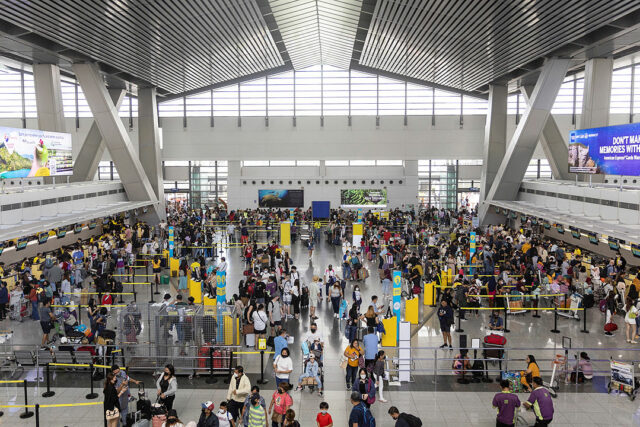
LAWMAKERS asked the Department of Transportation (DoTr) to introduce reforms and conduct a “top-to-bottom” crackdown on airport security personnel after the bullet-planting scheme in the country’s main gateway.

The DoTr’s Office for Transportation Security (OTS) should regularize thousands of its manpower, especially those involved with passenger screening to deter extortion schemes, such as bullet planting, Party-list Rep. Raymond Democrito C. Mendoza said in a statement on Tuesday.

“This is to protect the flying public, deter extortion of passengers and promote tourism by ensuring the professionalism of the OTS workforce,” Mr. Mendoza said.

This followed a March 6 Facebook post that went viral, in which a 69-year-old Filipina complained about an airport security officer supposedly found an amulet made out of an empty bullet in her luggage before her flight to Vietnam.

Transportation Secretary Vivencio B. Dizon on Monday said the three OTS personnel allegedly involved in the bullet-planting scheme have already been terminated. The agency is also investigating the incident.

The bullet-planting scheme issue started in 2015 after at least 30 cases were recorded of airport security officers allegedly targeting overseas Filipino workers.

“Many of these personnel may be tempted by need and opportunity to make the most out of a bad situation to engage in corruption and extortion of travelers,” Mr. Mendoza said.

In a separate statement, Senate President Francis G. Escudero urged the Transportation department to perform a “top-to-bottom” cleansing of their personnel to further crack down on the bullet-planting scheme.

In a separate statement, the Senate chief said the firing of OTS personnel could pave the way for the Transportation department to undertake more initiatives and reforms to improve the Philippines’ main airport.

“We have this window of opportunity to implement long-term initiatives that will transform the country’s image and enhance the experience of visitors and domestic travelers the moment they land and when they depart to their destinations,” he said. — Kenneth Christiane L. Basilio

PHL, Slovenia to sign labor deal

DEPARTMENT OF FOREIGN AFFAIRS FACEBOOK PAGE

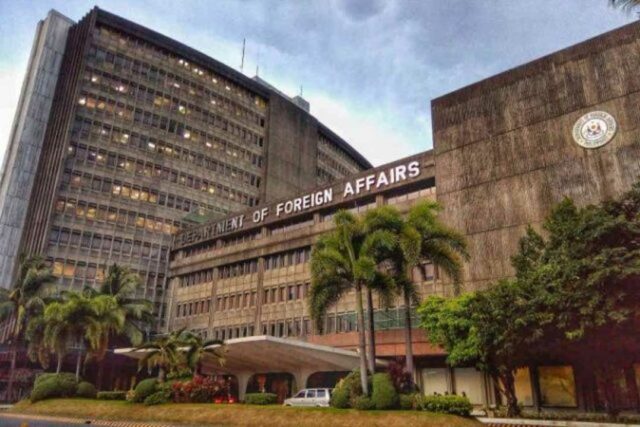
FOREIGN Affairs Secretary Enrique A. Manalo on Tuesday said that Slovenia and the Philippines are set to sign a memorandum of understanding on labor cooperation, following a meeting with Slovenian Foreign Minister Tanja Fajon.

“The Philippines and Slovenia will sign a Memorandum of Understanding (MoU) on Labor Cooperation during the Employment Forum organized by the Department of Migrant Workers (DMW),” he said in a statement.

“This MoU represents our shared advocacy for safe, orderly, and regular migration,” he added.

The Philippine foreign affairs chief did not provide details on the MoU.

Mr. Manalo had met with Ms. Fajon, who is on her first visit to the Philippines, to discuss the strengthening of their trade and investment cooperation.

“In addition, we will continue our cooperative activities in other sectoral areas, such as space, science and technology applications, nuclear energy, maritime education, training, sports, and labor,” Mr. Manalo said.

Ms. Fajon is joined by Slovenian business delegation, engaged in mobility, manufacturing, food and beverage, information and communication technology, science and technology, and hospitality. 

Mr. Manalo said that the meeting aims to encourage and promote “collaboration between our Chambers of Commerce and Industry, and between Philippine and Slovenian businesses.”

The delegation is set to meet with Philippine businesses during the Slovenia-Philippines Business Forum on March 12.

In a separate release, the DMW said that the MoU seeks to safeguard the rights of Filipino workers in alignment with the legal standards of both countries.

“The agreement details the responsibilities of Slovenian employers in relation to the recruitment of Filipino workers, emphasizing the necessity for ethical practices and adherence to applicable laws,” the agency said.

The DMW added that deal aims to facilitate the exchange of knowledge and expertise in labor policies, workforce development, and other areas pertinent to both countries’ economies.

The agreement also covers facilitation of the visa processes for Filipino workers in Slovenia and the certification and recognition of Filipino workers’ skills and qualifications. — Adrian H. Halili

Probe of budget graft suit halted

OFFICE OF THE OMBUDSMAN PHILIPPINES FACEBOOK PAGE

THE OMBUDSMAN has stopped its probe on a suit accusing key leaders of the House of Representatives, including Speaker Ferdinand Martin G. Romualdez, of falsifying legislative documents and graft, as a similar case is under Supreme Court review.

In a nine-page resolution dated March 7, Ombudsman Samuel R. Martires suspended further criminal investigation on the complaint filed by Duterte allies against the House leadership while junking a separate motion seeking their suspension.

“In the wink of an eye, common sense will remind any student of the law that judicial courtesy dictates that the quasi-judicial body should, and must yield and await the decision of the High Tribunal before acting on the case pending before it,” a part of the ruling by Mr. Martires stated.

A complaint was filed last month accusing House leaders of falsifying documents and committing graft over alleged P241-billion insertions in this year’s national budget. A similar challenge was raised with the Supreme Court, accusing the bicameral conference committee of submitting a budget with blank line items. 

“The alleged criminal liability of respondents Romualdez, et al., that is raised in the herein Complaint, refers also to the same blank line items in the Bicam Report that is the subject of the petition for Certiorari and Prohibition,” the resolution stated.

“If the Supreme Court declares RA No. 12116 unconstitutional and finds illegal the alleged insertions of P241 billion, then the Ombudsman shall correspondingly act on the criminal complaint,” it added. — Kenneth Christiane L. Basilio

Korean nabbed for human trafficking

NBI FACEBOOK PAGE

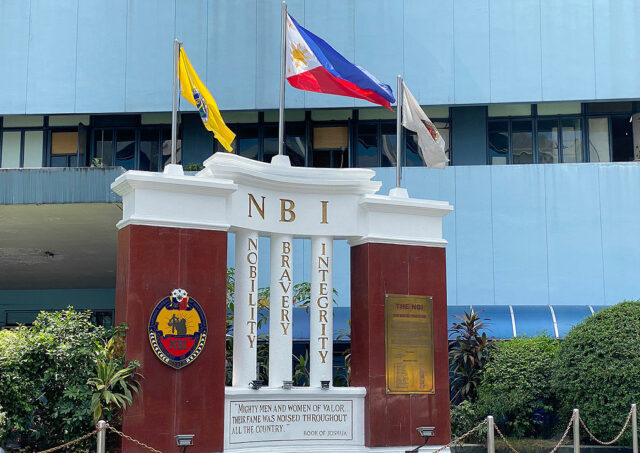
THE National Bureau of Investigation (NBI) nabbed a Korean man and his accomplices in Angeles City, Pampanga, on charges of human trafficking, it said on Tuesday.

In a statement, the agency said it rescued 12 victims, including five minors, who were allegedly being trafficked and exploited for entertainment services in a local club.

The probe was triggered by a complaint from the husband of one of the victims, who accused recruiters of illegally deploying women to Korea as performers without proper permits from the Philippine Overseas Employment Administration.

Authorities later uncovered that the scheme was a front to lure victims into working at an Angeles City club, where they were allegedly offered as models and entertainers for foreign patrons, with hotel check-ins as part of the arrangement.

The suspect was taken into custody following an operation led by the NBI-Bataan District Office, in coordination with the Philippine National Police and the agency’s Human Trafficking Division.

He and his associates were charged under the Expanded Anti-Trafficking in Persons Act of 2022 and the Special Protection of Children Against Abuse, Exploitation, and Discrimination Act.

They were presented for inquest proceedings before the Angeles City Prosecutor’s Office. — Chloe Mari A. Hufana

CHR backs changes to Safe Spaces Act

THE Commission on Human Rights (CHR) has welcomed proposed amendments to the Safe Spaces Act, expanding protections against gender-based sexual harassment across a broader range of public and digital spaces.

“The proposed amendments to the Safe Spaces Act are a crucial step toward ensuring that all spaces, whether physical or digital, urban or rural, remain safe and inclusive for everyone,” it said in a statement on Tuesday.

Enacted in 2019, the Safe Spaces Act aims to combat sexual harassment in streets, workplaces, schools, and recreational areas.

The Senate Bill No. 2897 significantly broadens its coverage by explicitly including rural settings such as farms, fields, coastal areas, and multi-purpose halls.

It also introduces legal definitions for new forms of harassment, notably the concept of grooming — defined as a predatory pattern of behavior aimed at establishing trust with minors for the purpose of sexual abuse or exploitation.

As the country’s Gender and Child Ombud, the CHR emphasized the importance of the bill in holding perpetrators accountable, particularly for offenses against women, children, and LGBTQIA+ individuals.

In recognition of evolving threats, the bill acknowledges the role of artificial intelligence and emerging technologies in facilitating gender-based online sexual harassment.

Additionally, it grants victims the right to seek protection orders to prevent further violations, offering a broader range of legal remedies than the original law. — Chloe Mari A. Hufana

Peso rebounds as US slowdown fears hit dollar

BW FILE PHOTO

THE PESO rebounded against the dollar on Tuesday as recession fears in the United States weighed on the greenback.

The local unit closed at P57.225 per dollar on Tuesday, strengthening by 18.5 centavos from its P57.41 finish on Monday, Bankers Association of the Philippines data showed.

The peso opened Tuesday’s session weaker at P57.45 against the dollar, dropping to as low as P57.50 intraday, reflecting market volatility. Meanwhile, its intraday best was at P57.20 versus the greenback.

Dollars exchanged rose to $1.38 billion from $815.69 million on Monday.

“The peso closed higher as the market reacted to concerns over the US economy due to softer US data recently and the appreciation of European currencies,” a trader said in a phone interview.

The yen was investors’ safe harbor of choice on Tuesday and it touched a five-month high as fears about a tariff-driven slowdown in US economic growth have rattled US stocks and the dollar, Reuters reported.

The Nasdaq fell 4% overnight and the S&P 500 slid 2.7% as equities caught up with what bonds and currencies have been saying for weeks: US growth is going to slow down.

The yen made a five-month peak of 146.55 per dollar before steadying around 147.24. China’s yuan also rose, ticking 0.2% higher to 7.2426 per dollar.

Other moves in the foreign exchange market were more muted, and analysts noted that a lot of the shifts in currencies had already happened. The dollar is down more than 7% from a six-month high it hit in January versus the yen and the greenback’s apparently dulled luster as a safe-haven coincides with a big rally in the euro and a broader re-think of how tariffs and a trade war play out in foreign exchange markets.

The risk-sensitive Australian dollar was a modest loser on Monday and loitered around its 50-day moving average at $0.6266 on Tuesday. Sterling was holding on above its 200-day moving average at $1.2875 and the euro was steady just above $1.08.

The Canadian dollar and Mexican peso are actually stronger since US President Donald J. Trump hit the two countries with 25% tariffs. Europe’s common currency is riding high on German plans to borrow and spend on defense and infrastructure.

The turmoil in equities was triggered by a Trump Fox News interview, in which the president talked about a “period of transition,” dashing investor bets he would back away from his aggressive policies.

The dollar index, however, had a hard time rallying and was mostly flat as small rises against the Aussie and sterling were offset by losses on the yen, leaving it at 103.8.

Meanwhile, the peso was also supported by the recent decline in global crude prices, Rizal Commercial Banking Corp. Chief Economist Michael L. Ricafort said in a Viber message.

Oil prices fell for a second day on Tuesday on worries that US tariffs would slow economies around the world and hurt energy demand while OPEC+ ramps up its supply, Reuters reported.

Brent futures fell 0.65% to $68.83 a barrel, while US West Texas Intermediate crude futures lost 0.82% to $65.49 a barrel.

For Wednesday, the trader expects the peso to move between P57.10 and P57.50 per dollar, while Mr. Ricafort sees it ranging from P57.10 and P57.30. — AMCS with Reuters

PSEi snaps winning run amid US recession fears

BW FILE PHOTO

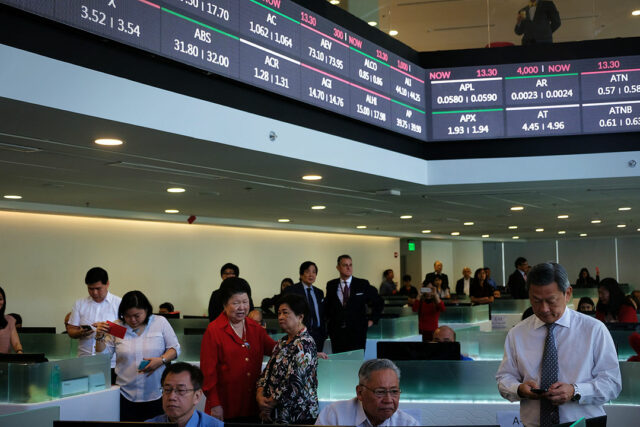
PHILIPPINE STOCKS snapped their six-day winning streak on Tuesday, joining the decline in global markets, amid recession fears in the United States.

The Philippine Stock Exchange Index (PSEi) dropped by 2.42% or 154.22 points to close at 6,206.55 on Tuesday, while the broader all shares index fell by 1.71% or 64.33 points to 3,684.59.

“The local bourse broke its six-day rally, weighed by negative spillovers from Wall Street. This comes amid recession fears in the US driven by their tariff policies,” Philstocks Financial, Inc. Senior Research Analyst Japhet Louis O. Tantiangco said in a Viber message.

“Philippine shares were sold down, fueled by investor worries that uncertainty surrounding tariff policies could lead the global economy into a recession. Concerns about the US have been escalating over the past month and was amplified by recent comments from the White House,” Regina Capital Development Corp. Head of Sales Luis A. Limlingan said in a Viber message.

Emerging market (EM) stocks remained under pressure on Tuesday, as concerns over a US economic slowdown which could lead to a recession weighed on equities, Reuters reported.

MSCI’s index for EM stocks was down 0.4% by 0832 GMT, with South Korean shares closing more than 1% lower, though a higher close in China and Hong Kong helped offset some losses.

Wall Street sold off sharply overnight, with the S&P 500 closing down 8.6% from its Feb. 19 record high, shedding over $4 trillion in market value since then and nearing a 10% decline that would represent a correction for the index.

US President Donald J. Trump’s tariff plans have stoked market volatility after the president late last week suspended the 25% tariffs on Canadian and Mexican goods which had come into effect on March 4. He had initially announced tariffs earlier this year and then postponed them by a month to early March.

Over the weekend, Mr. Trump declined to predict whether the US could face a recession, spurring a selloff in risk assets worldwide.

All sectoral indices closed in the red on Tuesday. Property sank by 4.45% or 102.72 points to 2,203.89; services retreated by 3.33% or 70.03 points to 2,031.68; industrials dropped by 2.13% or 189.30 points to 8,692.13; holding firms decreased by 1.77% or 94.02 points to 5,198.99; mining and oil went down by 1.75% or 156.03 points to 8,739.41; and financials declined by 0.78% or 18.63 points to 2,360.10.

“Only three index members closed with gains this Tuesday, led by Bank of the Philippine Islands, climbing 0.68% to P132.80,” Mr. Tantiangco said.

Value turnover rose to P7.71 billion on Tuesday with 753.65 million shares traded from the P6.41 billion with 627.42 million issues exchanged on Monday.

Decliners overwhelmed advancers, 157 versus 58, while 41 names closed unchanged.

Net foreign selling stood at P350.28 million on Tuesday versus the P1.41 billion in net buying seen on Monday. — R.M.D. Ochave with Reuters

NEDA opens Negros Island office

BW FILE PHOTO

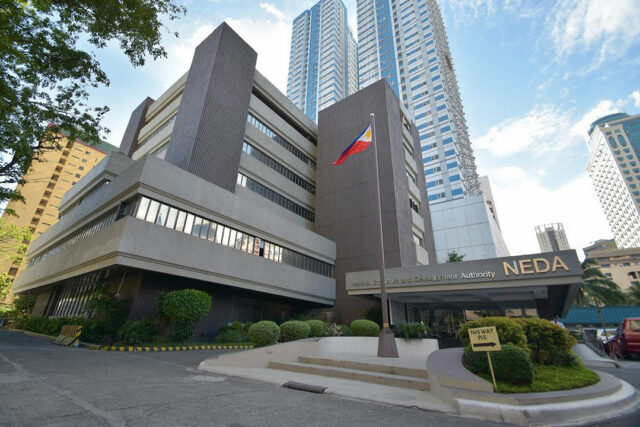
THE National Economic and Development Authority (NEDA) has inaugurated its new office in the Negros Island Region (NIR) on March 10.

“As an island region, the NIR holds distinct opportunities and needs. The NEDA-NIR office will play a pivotal role in crafting the region’s first Regional Development Plan (RDP) — a blueprint to harness growth, foster resilience, and ensure no community is left behind,” NEDA Secretary Arsenio M. Balisacan said in a statement on Tuesday.

NEDA noted this will be the agency’s 16th regional office.

NEDA will also facilitate the creation of a Regional Development Council following the May elections “to enable a more coordinated approach to policymaking and investment programming in NIR.”

The Republic Act No. 12000, the Negros Island Act, provided for the establishment of the NEDA-NIR Regional Office to ensure effective public service delivery in the region.

The same law consolidated the provinces of Negros Occidental, Negros Oriental, and Siquijor into one administrative region. — Aubrey Rose A. Inosante

P3.5-M drugs seized in Pangasinan

PHILSTAR FILE PHOTO

BAGUIO CITY — Authorities seized P3.57 million worth of crystal meth (shabu) and a .45 caliber pistol from a 57-year-old drug trader, early Tuesday in Urdaneta City, Pangasinan.

Operatives from Philippine Drug Enforcement Agency-Pangasinan and Philippine National Police Drug Enforcement Group Special Operations 1 (PDEG-SOU 1) caught “Odi” at around 2:35 a.m. on Tuesday for selling six pieces of knot-tied plastic, containing suspected shabu weighing more or less 525 grams. A pistol with inside holster, a magazine assembly, seven live ammunitions, mobile phones, several drug paraphernalia, and five bundles of unused plastic sachets were also confiscated from the suspect.

Operatives also seized an identification card and P2,0000 worth of cash in different denominations among other non-drug evidence.

According to PDEA-Region 1 Director Joel B. Plaza, the drug trader, who was taken to the PDEA-Pangasinan provincial office jail facility, will be facing charges for violation of Section 5 (Sale of Dangerous Drugs), Section 12 (Possession of Drug Paraphernalia), Article II of Republic Act No. 9165, the Comprehensive Dangerous Drugs Act of 2002, and RA 10591, the Comprehensive Firearms and Ammunition Regulation Act. — Artemio A. Dumlao

Maguindanao del Sur houses torched

COTABATO CITY — Gunmen burned down on Monday a health center and seven houses in Barangay Malingao in Shariff Aguak, Maguindanao del Sur whose occupants had earlier fled due to a shooting incident.

Municipal officials and barangay leaders told reporters on Tuesday that more than 200 villagers in Barangay Malingao were forced to relocate to safer areas two days before the fire after the same group shot their houses with M16 and M14 assault rifles.

Police investigators and traditional Moro leaders said the arson attack was meant to embarrass re-electionist Mayor Akmad A. Ampatuan, Sr., who is chairman of the multi-sector Shariff Aguak Municipal Peace and Order Council.

Army and police officials said they are investigating the assertions by displaced villagers that their mayor’s bid for a second term is being contested by a candidate who has armed followers that do not belong to either the Moro National Liberation Front, or the Moro Islamic Liberation Front (MILF).

Both fronts have separate peace agreements with the national government.

“Actually, the villagers affected by these troubles are identified with the MILF,” the vice-mayor of Shariff Aguak, Marop B. Ampatuan, said.

Brig. Gen. Romeo J. Macapaz, director of the Police Regional Office-Bangsamoro Autonomous Region, told reporters that intelligence agents from the Maguindanao del Sur Provincial Police Office and personnel of the Shariff Aguak Municipal Police Station are cooperating in identifying the gunmen behind the atrocities for prosecution. John Felix M. Unson

ADVERTISEMENT
ADVERTISEMENT