Home Blog Page 1871

A chilling stage adaptation of Kisapmata

How stories reflecting our history evolve over time

By Brontë H. Lacsamana, Reporter

Theater Review
Kisapmata
Presented by Tanghalang Pilipino

IN 1981, one of the best Filipino films ever made captured people’s imaginations. Kisapmata, directed by Mike de Leon and co-written with Clodualdo del Mundo, Jr. and Raquel Villavicencio, disturbed audiences with its twisted premise of a possessive patriarch unwilling to free his daughter from the tyrannical rule of his household.

Though it was based on a real-life crime story by Nick Joaquin called “The House on Zapote Street,” the film reshaped the narrative into a representation of the then ongoing Marcos dictatorship. This year, theater company Tanghalang Pilipino brings Kisapmata to modern audiences, now upfront in grappling with a history at risk of being forgotten.

Within the first few minutes, playwright Guelan Luarca immediately sets the adaptation apart from all versions that preceded it. It opens with Dely (played by Lhorvie Nuevo), the wife numbed to submission from years of living under the iron fist of her husband, ex-policeman Dadong. In neither the Nick Joaquin story nor the film does her character have a voice, but she does here.

The setting of Zapote Street (described by Joaquin in the original story as a residential area in Makati which was once an empty field of tall grass) provides the atmospheric, eerie overtones of the play. Dely opens with retelling how the area was once a silent overgrowth, now taken over by humans, though the grass (or talahiban) remains in the shadows. The elevated platform where the characters move is backgrounded and surrounded by stalks of this grass — the only design element present on the bare stage.

Pagmamahal ang batas (Love is the rule),” Dely whispers many times throughout the play. And this so-called love is enforced only by Dadong (played by Jonathan Tadioan) as he abuses his wife and daughter psychologically.

Compared to the film before it, Tanghalang Pilipino’s Kisapmata leans into the ridiculous yet chilling dynamics of the family’s suffocating household.

The story kicks off when the couple’s only daughter, a medical student named Mila (played by Toni Go), reveals that she is pregnant by her boyfriend Noel (played by Marco Viana). The latter, already a doctor, has been helping her study for her medical board exam. The two ask for permission to marry, though Dadong only agrees on the condition that a dowry is paid — and later, that they do not move out of his house.

One of the points of acclaim for the 1981 film was the production design (recognized at the 7th Metro Manila Film Festival, along with a plethora of major awards), due to the use of the split-level suburban architecture that made the house a perfect instrument for the family’s dysfunctional story. It was also an element described explicitly in Mr. Joaquin’s story, as it was a prevailing style for middle-class families.

The play goes for something completely different. It evokes the rigid rules of the house with a minimalist approach, the square elevated platform the actors move on never changing, no matter where the characters go. Be it indoors, outdoors, the hospital, right at the gate — the four walls of the house are always present.

No other actors appear in its entirety. It is only Mila, Noel, Dadong, and Dely, even if they speak to others on the phone or walk past people in a given scene. No matter where they go or what they do, the house and its unforgiving rules remain. The costumes also evoke this, all of them dressed in beige as if prisoners of their own making.

At the CCP Complex’s Tanghalang Ignacio Gimenez, Kisapmata plays out as a full tragedy, the unease, grace, and defiance in the movements of Toni Go as Mila giving the audience someone to root for. She shines in hopelessness as much as she does in the steadfast attempts to escape the grasp of her father, along with Marco Viana as Noel who gradually becomes desperate to free himself from the household’s intangible prison.

Wholly original, the scenes between mother and daughter are electric, the two women representing separate generations of submission, one who has accepted her doom and another who will fight it to the very end.

Meanwhile, Jonathan Tadioan’s take on the merciless Dadong is trickier to receive by those who’ve watched the film with its enormous performance by Vic Silayan. Tadioan puts his own spin on it, his voice softer and wheezier and his mannerisms more jovial compared to Silayan’s booming presence. But when his quiet, bodily presence is used to full advantage, usually when the character loses his cool, the effect is just as chilling.

The gradual rise of tension and escalation of intimidation tactics used by Dadong carry over strongly to the medium of theater. The anti-Marcos allegory reaches its peak when, in the throes of the character’s physical and sexual abuse of Dely, the screens around the hall flash with news clippings and reels of the oppression suffered during the Marcos dictatorship.

At this point, Nuervo’s haunting, whispery narration and commentary of events is given full context by the horrific beating she endures, similar to that of the Philippines during Martial Law. Creepily, the only props shown in any of the characters’ hands throughout the play are Dadong’s weapons — a gun and a machete — the rest merely pantomimed by the cast, driving home the reality of his rule over them.

The way everything boils over in the end is as impeccably paced as the film and the short story before it. Luarca’s take on Kisapmata also benefits from its tight running time of an hour and a half, with no intermission, leaving the audience barely any time to breathe.

It’s amazing to see a story’s journey from an actual true crime case to a well-written short story by Nick Joaquin, to the horror masterpiece by Mike de Leon, all the way to this gripping theater adaptation by Guelan Luarca. It reminds me of something Ricky Lee once said of the greatest stories in Philippine literature/cinema/theater — palagi iyan manganganak basta’t may dahilan para ikuwento pa rin ang kuwento (it will continue being reborn as long as there is still a reason to tell that story).

Tanghalang Pilipino proves that there are still many reasons to retell Kisapmata today.

Kisapmata runs until March 30 at the Tanghalang Ignacio Gimenez, Cultural Center of the Philippines Complex, Pasay City. It is restricted to audience members 16 years old and above. Regular tickets cost P1,500 while VIP tickets cost P2,000. For more details, visit Tanghalang Pilipino’s social media pages.

BTr fully awards reissued bonds

BW FILE PHOTO

THE GOVERNMENT made a full award of the reissued Treasury bonds (T-bonds) it offered on Tuesday as the papers attracted strong demand amid better risk sentiment and after Bangko Sentral ng Pilipinas (BSP) Governor Eli M. Remolona, Jr. signaled a possible rate cut next month.

The Bureau of the Treasury (BTr) raised P30 billion as planned via the reissued 10-year bonds it auctioned off on Tuesday as total bids reached P81.761 billion or almost thrice as much as the amount on offer.

The bonds, which have a remaining life of seven years and six months, were awarded at an average rate of 6.143%. Accepted bid yields ranged from 6.12% to 6.15%.

“With its decision, the Committee initially raised the full program of P30 billion while accepting further subscription through the tap facility. The total outstanding volume for the series is currently at P358.6 billion,” the Treasury said in a statement.

The average rate of the reissued papers was 17.5 basis points (bps) higher than the 5.968% fetched for the series’ last award on Feb. 11, but 60.7 bps lower than the 6.75% coupon for the issue.

This was also 4.7 bps above the 6.096% quoted for the seven-year bond — the benchmark tenor closest to the remaining life of the papers on offer — but 3 bps lower than the 6.173% seen for the same bond series at the secondary market before Tuesday’s auction, based on PHP Bloomberg Valuation Service Reference Rates data provided by the BTr.

“Strong demand was seen following the drop in US Treasury yields overnight. This morning, BSP Governor Remolona also said a cut is on the table for the April 10 Monetary Board meeting, adding to improvement in risk sentiment,” a trader said in a text message.

Stocks slumped globally on Monday, while US bond yields dropped as investor worries about the potential economic slowdown were exacerbated after President Donald J. Trump did not rule out a recession resulting from his tariffs, Reuters reported.

MSCI’s global stock index fell more than 2% for its biggest one-day drop since August while Nasdaq led Wall Street losses, ending down 4% for its steepest percentage loss since Sept 2022.

Investors had started seeking safety as early as Sunday when Mr. Trump in a Fox News interview talked about a “period of transition” while declining to predict whether his tariffs on China, Canada and Mexico would result in a US recession.

MSCI’s gauge of stocks across the globe fell 19.37 points or 2.27% to 832.73 after touching its lowest level since Jan. 13.

In fixed income, yields fell with US government bonds in demand after the Trump interview cut into investor confidence.

The 2-year note yield, which typically moves in step with interest rate expectations for the Federal Reserve, fell 10.4 bps to 3.898% from 4.002% late on Friday, on track for their largest daily drop since September.

The yield on benchmark US 10-year notes fell 9.3 bps to 4.225%, while the 30-year bond yield fell 6.9 bps to 4.548%.

Meanwhile, Mr. Remolona on Tuesday said a rate cut is “on the table” at the Monetary Board’s policy meeting next month, which has been rescheduled to April 10 from April 3 previously.

He added that the BSP is still on easing mode and expects to slash benchmark borrowing costs by “a few more times” this year.

In a move that surprised the market, the Monetary Board in February paused its nascent rate-cut cycle, which Mr. Remolona said was a “prudent” move amid uncertainty over the trade policies of US President Donald J. Trump and their potential impact on the Philippines.

He earlier said that the central bank will likely continue reducing interest rates by 25 bps at a time, with 50 bps in cuts still on the table this year.

The BSP last year cut benchmark rates by a total of 75 bps via three consecutive 25-bp reductions since it began its easing cycle in August, bringing the policy rate to 5.75%.

The BTr is looking to raise P147 billion from the domestic market this month, or P22 billion from Treasury bills and P125 billion from T-bonds.

The government borrows from local and foreign sources to help fund its budget deficit, which is capped at P1.54 trillion or 5.3% of gross domestic product this year. — A.M.C. Sy with Reuters

Throwing the baby out with the bathwater: Successful USAID-backed projects

JUDE BALLADO-PEXELS

(Part 2)

It is well known that a major obstacle to faster growth and, more importantly, a more equitable distribution of income wealth in the Philippines is the concentration of economic activities in the National Capital Region, which accounts for 40% of GDP. One reason for the very high poverty incidence in the country, which remains at double-digit rates of 16% to 23% (in contrast with single-digit rates among our peers in the ASEAN, e.g., Malaysia which has a poverty incidence that is close to zero), is the utter neglect of rural or countryside development. A very practical program which had been heavily funded by the United States Agency for International Development (USAID) over more than a decade was the Urban Connect project, whose goal was to promote inclusive and resilient economic growth in nine secondary cities within the USAID City Development Initiative framework. The idea was to make these nine secondary urban centers stimulants of growth and development of the rural territories surrounding them. These prospective regional centers of countryside development were Batangas, Iloilo, Cagayan de Oro, Zamboanga, Tagbilaran, Tacloban, Puerto Princesa, General Santos, and Legaspi.

Urban Connect focuses on local economic development and public service delivery. It promotes programs and activities related to investment promotion, the development of Medium Scale, Small and Micro Enterprises (MSMEs) with a focus on digitalization, inter-LGU cooperation, improved public financial system and revenue enhancement measures as well as the establishment of LGU data centers.

I have seen with my own eyes the success stories of the first three secondary cities chosen by the project: Batangas in Luzon, Iloilo in the Visayas, and Cagayan de Oro in Mindanao. The consultants that worked on these first three cities identified them as potential competitors to Metro Manila as domestic, regional, and international ports. They are better located and are much less congested than the port city of Manila. Because of the data provided by the consultants for this initial project, the LGUs and private investors were able to agree on relocating investments that were previously planned for the Metro Manila area. This was especially phenomenal in the case of Iloilo City, which has become an alternative location site for BPO-IT, real estate enterprise, logistics companies, and agribusiness investments in place of Cebu in the Visayas. Like Metro Manila, Cebu is overly congested, and the traffic has reached intolerable proportions.

I have seen a similar phenomenon in my home province, Batangas. Thanks to some of the data provided by the Urban Connect project (and the pro-active leadership of the LGU of the Province), this province, which is part of the Calabarzon region, is turning to be the epicenter of a new metropolitan area with Lipa City as the strategic center. Practically all the major real estate players in the country have constructed industrial economic zones with hundreds of manufacturing enterprises (the pioneer was the Lopez-owned First Philippine Holdings in Sto. Tomas, Batangas).

As a public disclosure, let me state that both my parents were born in Sto. Tomas, Batangas. When I was in high school in the 1950s, it was the sleepiest town in the province. Thanks to all the developments in the last 20 years in the province, even this laid-back town has become so highly urbanized that it now boasts of one of the largest SM Malls in the entire Calabarzon. The Ayalas are developing another Makati in the City of Lipa.

Thanks to the help that USAID extended to these regions through Urban Connect, regional development is no longer just an aspiration but is very real. I expect the same thing to happen in Cagayan de Oro and the other regional centers that have been chosen by the Urban Connect project. I can assure US President Donald Trump that the officials of USAID who conceived of and promoted this project were not “lunatics.”

Then there was the program called Better Access and Connectivity (Beacon). A five-year program that was launched in 2021, Beacon aimed to promote economic growth through better information and communications technology (ICT), helping bridge the digital divide in the Philippines. The COVID-19 pandemic had highlighted the urgent need for expanded digital infrastructure and broadband connectivity. Through Beacon, USAID aimed to help improve the Philippines’ ICT and logistics infrastructure; strengthen the regulatory, business, and innovation environment; and bolster cybersecurity. To help bridge the digital divide in the Philippines, Beacon intended to assist the government in automation and digitization efforts, and support community networks to expand low-cost internet access for underserved communities.

Beacon would have been a perfect complement for the US private business sector to help our country be a leading site for data centers. There is an under-ocean cable that Meta and Amazon have built connecting the US to Pagudpud in Ilocos Norte. Another site endowed with better telecom connections is Baler, Aurora Province. The city that will be especially attractive to those investing in data centers, which are very energy and internet intensive, is Laoag, Ilocos Norte. The region was a pioneer in both solar and wind energy. It has at present an excess production of energy that it is forced to sell to the national grid at a loss. Now that the region also has abundant telecom resources, Laoag can attract investors in data centers and other telecom and energy intensive businesses, in addition to its being a natural destination for tourists from Taiwan and China.

We should also be grateful to US billionaire Elon Musk, who is the head of the Department of Government Efficiency or DOGE under the Trump Administration, for building Starlink satellite facilities in many of our isolated islands.

Not satisfied with its laudable efforts to disperse economic activities to the regions outside of Metro Manila through its Urban Connect project, USAID launched the Cities for Enhanced Governance and Engagement (Change) which sought to strengthen democratic governance in the Philippine by making local governance more responsive to the needs of their constituents. It purported to strengthen the enabling environment for decentralization and governance and building capacity for multi-sector collaboration and collective action.

In addition to the nine Urban Connect cities, the following were added to its geographic coverage: Masbate, San Fernando (La Union), Tagum, Tanjay (Negros Oriental), and Victorias (Negros Occidental). It is worth mentioning here that these efforts for improved local governance can be substantially assisted by the efforts of the Taiwanese Government and private sector to help several Philippine cities become “smart cities.”

Finally, there is the Partnership for Skills, Innovation and Life-Long Learning (Upskill), a five-year project that aims to strengthen the Philippine higher education system for broad-based, inclusive growth. This program works closely with the Commission on Higher Education (CHED) and, given the emphasis of the Marcos Jr. Administration on technical skills, with the Technical Education and Skills Development Authority or TESDA, together with stakeholders in industry in supporting innovation and workforce development of higher education institutions or HEIs, faculty development, and curriculum improvements. It will also increase engagements for HEIs and industry and international partners, as well as bring design-thinking concepts to HEI management and administration.

In this light, especially with the temporary suspension of international aid by the Trump Administration, it would be wise for both government agencies and private groups (like the Philippine Chamber of Commerce and Industry) to turn to other Governments that can supplement the initial efforts of Upskill, especially in technical education. I am referring especially to potential aid donors from Germany, Taiwan, Israel, Australia and others that have advanced technical training programs that can be replicated in the Philippines, like Dualtech in Manila (a German-inspired model) and the Center for Industrial Technology and Enterprise or CITE in Cebu (established with the help of an NGO in Italy).

These examples of projects and programs funded by USAID in the past clearly prove that the assistance we received from the US Government through this agency have benefited numerous citizens of the Philippines, especially those belonging to the lower-income groups. It is hoped that, whether USAID continues to exist as a separate agency or the US State Department takes over its functions, the Philippines will continue to benefit from the generous assistance of the American taxpayers to attaining inclusive and sustainable growth.


Bernardo M. Villegas has a Ph.D. in Economics from Harvard, is professor emeritus at the University of Asia and the Pacific, and a visiting professor at the IESE Business School in Barcelona, Spain. He was a member of the 1986 Constitutional Commission.

bernardo.villegas@uap.asia

BSP to release regulations on the ethical use of AI in the financial sector

BW FILE PHOTO

THE BANGKO SENTRAL ng Pilipinas (BSP) is looking to release regulations on financial institutions’ ethical use of artificial intelligence (AI) by this semester.

“Since we are adopting the risk-based approach to supervision, most of the risks associated with AI — I think 80-90% — are already covered by existing regulations. That’s why the forthcoming regulations that will be issued by the BSP will only cover untouched areas,” BSP Director for Technology Risk and Innovation Supervision Department Melchor T. Plabasan said in a speech at the Asian Banking & Finance and Insurance Asia Summit held on Tuesday.

He said the BSP’s existing regulations on technology risk management, cybersecurity risk management, and data privacy, among others, already cover most risks associated with the use of AI.

“The remaining 10% or 20% relates to ethical use of AI — how to manage bias, and probably more on the accuracy. Those are the untouched or uncovered areas… The specific AI regulations that you can expect from the BSP are generally more clarificatory,” Mr. Plabasan said.

“AI is really exciting because it entails a lot of innovative ideas, but we should not lose sight of the risks associated with AI… We all know that striking the right balance in the way we are harnessing the potential of AI and also managing the risks associated with AI is quite challenging.”

The new regulations will be out within this semester, the BSP official said.

“I think we will also touch on AI-assisted cybersecurity because when we issued our first regulations on cybersecurity, we have yet to encounter [this]. So, that will also be covered,” Mr. Plabasan told BusinessWorld on the sidelines of the event.

The BSP official said in his speech that Philippine financial institutions are already using various AI technologies and solutions in their operations, based on a review conducted by the regulator last year.

The review’s findings will be included in a white paper that he presented at the summit, which the BSP will release to the industry soon, he said.

“Our financial institutions are already joining the AI revolution and are also excited to take advantage of the benefits of AI. A lot of them already have existing projects or are considering AI in their roadmap,” Mr. Plabasan said.

Some AI use cases in the Philippine financial sector include hyper-personalization to better address the needs of their customers, the assessment of clients’ creditworthiness via alternative data, and generative AI for customer service, he said.

“They are also using these to ensure seamless onboarding of clients. That’s why you would see that some digital banks are able to onboard clients in five to 10 minutes. Because of its capability to identify potentially suspicious transactions or out-of-pattern behaviors, it’s also used for management of AML (anti-money laundering) systems.”

Mr. Plabasan added that more than a third of Philippine financial institutions already have AI units comprised of data scientists and data engineers.

“Those that we surveyed are expecting increased profitability, primarily because of the improvement in the overall efficiency of their operations,” he said.

Financial institutions leveraging AI technologies must ensure their compliance with existing rules on technology and cybersecurity, Mr. Plabasan said. “And of course, so that we are able to strengthen the trust in the digital ecosystem, we will uphold human-centric values, particularly in AI strategies.”

“We should always prioritize AI solutions that are human-centric solutions associated with AI,” he said. “While there are a lot of groundbreaking benefits that can be reaped from the use of AI, we must always remember that AI is primarily driven by humans. AI needs the prompts, instructions of humans. It is humans that set the direction for AI.”

“The BSP is committed to fostering an enabling regulatory environment that would promote responsible use of AI, the trustworthiness, and the resilience of our digital finance ecosystem,” Mr. Plabasan said. — AMCS

DITO joins GSMA Open Gateway for digital security, innovation

BW FILE PHOTO

DITO Telecommunity Corp., through its enterprise arm DITO Business, has joined the GSMA Open Gateway to support initiatives against fraud and promote the growth of a secure digital landscape.   

“Connectivity is the backbone of progress, and true innovation happens when networks, businesses, communications service providers, developers, and system integrators collaborate in an open and secure environment,” DITO Telecommunity Chief Revenue Officer for Enterprise Adel A. Tamano said in a media release on Tuesday.   

DITO Telecommunity said its participation in the GSMA Open Gateway would also accelerate digital innovation in the Philippines, citing the need for a seamless and secure online space.   

GSMA Head of Pacific Julian Gorman said businesses, developers, and consumers stand to benefit from the collaboration, as the country’s telecommunications operators are driving digital innovation by addressing digital fraud through open network application programming interfaces (APIs).   

The GSMA Open Gateway is a framework of common network APIs designed to provide developers with access to operator networks, enabling faster service deployment and facilitating digital innovation.   

“At DITO, we recognize the critical role of seamless and secure connectivity in creating a digital ecosystem where people, businesses, and economies can thrive,” Mr. Tamano said. — Ashley Erika O. Jose

Arts & Culture (03/12/25)


Binangonan’s church now a National Cultural Treasure

THE National Commission for Culture and the Arts (NCCA) has officially declared the 225-year-old Santa Ursula Church in Binangonan, Rizal, a National Cultural Treasure. Founded in 1612, this historic Baroque-style church has retained its original altarpiece, paintings, and retablo from the 17th to 19th centuries. NCCA Chairman Victorino Manalo noted that the church’s wooden ceiling logs are a unique feature which may no longer be reproduced or recreated, further proving their antiquity and authenticity. The Santa Ursula Parish is one of four sites in the Province of Rizal declared a National Cultural Treasure for 2024 and 2025, alongside the churches in Angono, Baras, and Morong.


WWII photo exhibit at Greenhills

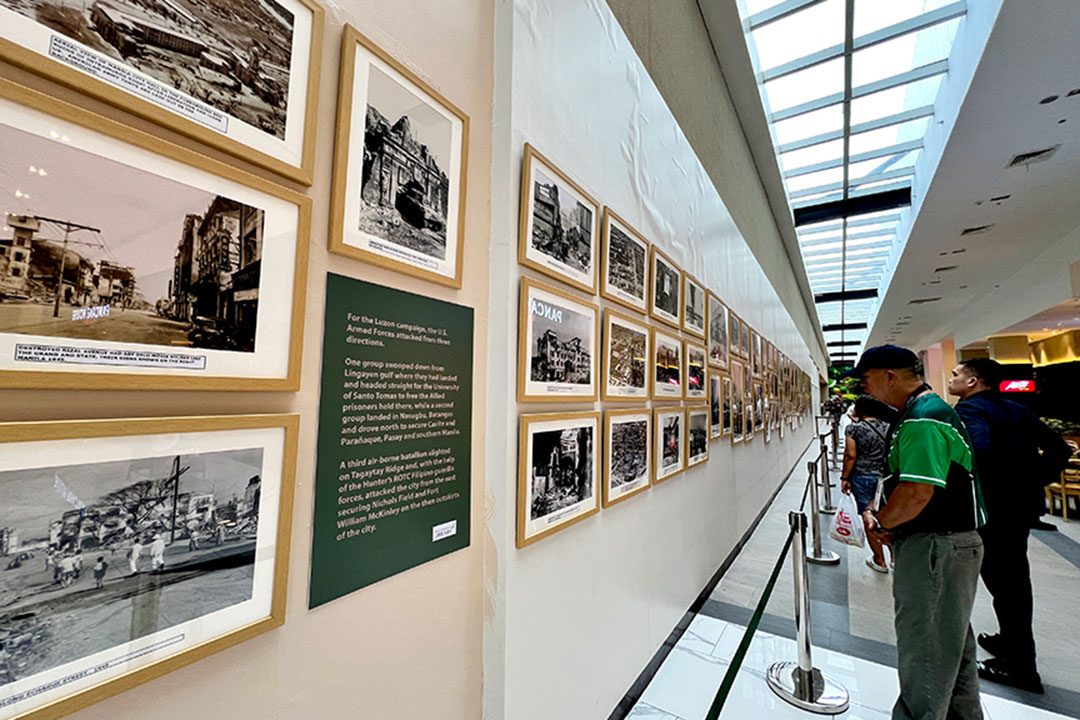
ON VIEW at the ground floor of the new GH mall in Greenhills is a photo exhibit commemorating the 80th anniversary of the Liberation of Manila, presented by the Ortigas Foundation Library. Manila was the second most destroyed city in World War II. The exhibit includes many never-before-seen photos from the AMRO collection. The exhibit is open during mall hours and is free.


Ani ng Dangal 2025 recognizes 39 artists

THERE are 39 awardees across Architecure and the Allied Arts, Cinema, Dance, Music, and Visual Arts categories for this year’s Ani ng Dangal. They were recently honored by the National Commission for Culture and the Arts (NCCA) at the Metropolitan Theater in Manila. There were seven awardees for Architecture and Allied Arts, eight for cinema, six dance groups, three for visual arts, and 15 honored for music. The full list can be found on the NCCA’s website and social media pages.


Pagcor photo exhibit at Okada Manila

OKADA MANILA is hosting a Philippine Amusement and Gaming Corporation (Pagcor) photo exhibit about Filipino heritage. Running until April 3, the exhibit showcases 48 award-winning photographs from PAGCOR’s 2023 and 2024 Photography Competitions, offering an immersive visual journey through the Philippines’ diverse destinations and agricultural communities. The exhibit is open to the public. In conjunction with the exhibit, there will be a photography workshop on March 21 in front of the photo exhibit at Okada Manila’s Fountain Foyer. This workshop is also open to the public.


Imahica holds group exhibit of women artists

THE ART OF SHE group exhibition, opening on March 15 at Imahica Art Gallery, features a collection of diverse and deeply personal expressions of womanhood. From the quiet joy of motherhood to the raw intensity of personal struggle, the artworks on display reflect the emotional depth, strength, and resilience of women across the globe, inspired by trailblazing icons like Frida Kahlo, Tracey Emin, and Louise Bourgeois. It also brings together a wide range of mediums and styles like metal sculptures, watercolors, and surrealist paintings. The Art of SHE: Diverse Expressions of Womanhood runs from March 15 to 31. The gallery is at Lee Gardens, Shaw Blvd. corner Lee St., Mandaluyong.


Slow art, shadowplay, math lectures at MCAD

THE Museum of Contemporary Art and Design (MCAD) of the De La Salle-College of Saint Benilde (DLS-CSB) is inviting the general public to a series of participative free public programs. These are in line with the ongoing exhibition, maria taniguchi: body of work, the first survey show of the internationally acclaimed visual artist. On March 15, artist Lesley-Anne Cao will headline “With Eyes Peeled,” a slow art activity which leads the participants to a deeper appreciation of Taniguchi’s art by looking at it more intently and just a little bit longer. On March 22, visual artist group Karilyo will conduct a shadowplay workshop titled “Hugis at Hubog,” inspired by Taniguchi’s work. The session welcomes 16-year-olds and above, to be held at the Ideation Room of the Atrium at Benilde from 2 to 5 p.m. On March 25, Dr. April Lynne Say-awen will facilitate “Patterns Without End: Mathematical Tilings and Maria Taniguchi’s Brick Paintings,” where the symmetry of tilings of a plane will be discussed at the campus’ Learning Commons. The exhibit maria taniguchi: body of work runs until March 30. MCAD is at the DLS-CSB Design and Arts Campus, Dominga St., Malate,  Manila.


French photographer holds solo photo exhibit

FROM March 20 to 24 at the rooftop of Connector Hostel in Poblacion, Makati, Patrice Boiteau’s photo exhibit MABUHAY will bring together abstract compositions and realistic portraits. These showcase different facets of Mr. Boiteau’s photographic work exhibited in Tokyo, Kyoto, Osaka and Paris over the last three years. On March 19, 7 p.m., there will also be a cocktail at Astbury in Poblacion where a short film that Mr. Boiteau co-produced, titled TRACÉ, will be shown. Entrance to the exhibit is free. Connector Hostel is located on Kalayaan Ave. corner Don Pedro St., Poblacion, Makati City.


Laforteza, Wilson join cast of Into the Woods

The Theatre Group Asia (TGA) has announced that actress Carla Guevara Laforteza and actor, director, writer, and singer Jamie Wilson are joining the cast of its production of Stephen Sondheim’s Into the Woods this year, to be held at the Samsung Performing Arts Theater at the Circuit Makati. Laforteza will be playing the Giant, Granny, and Snow White. Wilson is set to play Cinderella’s Father/Steward in the show. Into the Woods begins its run in August.


Cinemalaya films shown to female prisoners in Visayas

FOR Women’s Month, the Cultural Center of the Philippines (CCP) is presenting “Lakbay Sine Para sa mga Inday,” a series of special online screenings of selected award-winning Cinemalaya films for Women Deprived of Liberty (WDL) in three jails in Iloilo City, Pototan-Iloilo, and Bacolod City. The screenings will be held every Sunday and Monday of March for over 500 detainees across the three jails. The Cinemalaya films are all by women, about women, or for women: Sanglaan by Milo Sogueco, Mayohan by Dan Villegas and Paul Sta. Ana, Balota by Kip Oebanda, The Baseball Player by Carlo Obispo, Pan de Salawal by Che Espiritu, Utwas at Mga Handum nga Nasulat sa Baras by Arlie Sweet Sumagaysay and Richard Jeroui Salvadico, and Primetime Mother by Sonny Calvento. The screening schedules are: Iloilo on March 9, 16, 23, and 30, 9-11 a.m.; and in Pototan and Bacolod on March 10, 17, 24, and 31, 2-4 p.m.

Mobile wallets, e-payments seen to drive growth in PHL e-commerce transactions

STOCK PHOTO | Image by Pikisuperstar from Freepik

MOBILE WALLETS and other electronic payment methods are expected to account for a larger share of e-commerce transactions in the Philippines by 2028 as more Filipinos shift to digital methods for convenience, the International Data Corp. (IDC) said.

An IDC InfoBrief commissioned by global payments platform 2C2P and Antom titled “How Southeast Asia Buys and Pays 2025” showed that the Philippines’ gross e-commerce transaction value is expected to grow to $54 billion by 2028 from the projected $26 billion this year and the actual $16 billion in 2023, with digital payments likely to make up a bigger part of the total.

“Although the Philippines traditionally has a strong preference for cash, new payment methods such as mobile wallets are quickly gaining ground for e-commerce payments,” IDC said.

“The growing adoption of digital payments in the Philippines will likely lead to the displacement of older payment types such as COD (cash on delivery), and merchants must prepare for these changes,” it added.

Mobile wallets are expected to make up 30% of the Philippines’ total e-commerce transaction value by 2028, up from the 27% forecast for this year and the actual 24% share in 2023. This comes as the Philippines is expected to add 23 million mobile wallet users from 2023 to 2028, it said.

This is followed by domestic payments, which IDC expects to account for 25% of transactions by 2028, up from 24% this year and 23% in 2023.

Transactions via debit and credit cards will make up 22% of the total by 2028, also growing from the expected 21% this year and 19% in 2023. Buy now, pay later (BNPL) transactions will also grow to 6% of the total (from 5% this year and 4% in 2023), while those done with other payments method like cash will decline to 17% by 2028 (from 24% in 2025 and 30% in 2023).

“With a large proportion of unbanked and underbanked consumers, and consequently, limited access to cards, most consumers have turned to mobile wallets and domestic payments,” IDC said.

“Mobile wallets are the clear winner due to their accessibility, and growing acceptance both online and offline,” it added. “Other payment types such as domestic payments have also seen significant growth, with real-time transfers through InstaPay and PESONet growing 33% in the first quarter of 2024 compared to 2023. This growth is expected to continue.”

Data from the IDC showed that cards and mobile wallets are the top two most accepted payment methods in the Philippines in 2024, with 86% and 77% of merchants able to process these transactions.

“Transactions using mobile wallets as well as domestic payments in the Philippines have become more seamless for merchants due to government initiatives such as QR Ph which has created a unified standard that simplifies the acceptance of digital payments,” IDC said.

“In the future, merchants will need to pay more attention to domestic payments such as RTPs (real-time payments) and bank transfers, as IDC forecasts their share of transactions to continue to rise all the way to 2028.”

The Bangko Sentral ng Pilipinas wants digital payments to make up 60-70% of the total retail payments volume by 2028.

The study also showed that Philippine merchants reported increased preference for contactless or NFC payments in the past 12 months, along with mobile payment apps and mobile wallets, similar to other markets in Southeast Asia (SEA).

“Merchants in the Philippines are also gaining interest in initiatives such as cross-border payments and cryptocurrency to further expand their customer base,” IDC said.

Cross-border commerce in the Philippines is expected to grow by 5.8 times to $1.5 billion by 2028, it added.

The survey had 600 respondents representing enterprise merchants in the Philippines, Indonesia, Malaysia, Singapore, Thailand, and Vietnam, with 65% of them being the primary decision leaders for payments in their respective organizations.

Southeast Asia’s e-commerce market is expected to grow to $325 billion by 2028 from $137 billion in 2023, overtaking Australia, Japan, and South Korea, IDC said, mainly driven by the rapid adoption of digital payments.

Digital payments are expected to account for 94% of total e-commerce payments in Southeast Asia by 2028 from 87% in 2023, driven by domestic payments, mobile wallets, and real-time payments.

“The increasing share of digital payments in SEA’s e-commerce markets, as well as the changing ratios of digital payments, have prompted the need for merchants to adopt payments technology which enables them to keep pace with these changes and support popular new payment methods,” IDC said. — B.M.D. Cruz

Choose leaders who are strong on security

STOCK PHOTO | Image from Freepik

Candidates should no longer underestimate the Filipino voter. They must go beyond the usual motherhood statements and focus on issues that strike deep at the core of being Filipino — specifically, the protection of our own sphere against the maneuvering of another country, one that seeks to dominate and intimidate. In the latest Social Weather Stations survey held Feb. 15-19, eight out of 10 Filipinos said they prefer candidates in the 2025 elections who believe in asserting the Philippines’ rights against China’s aggression in the West Philippines Sea.

Results from the survey show that 78% of Filipinos prefer “a candidate who believes that the Philippines must assert our rights against China’s aggressive actions in the West Philippine Sea,” while only 22% prefer “a candidate who does not believe that the Philippines must assert our rights against China’s aggressive actions in the West Philippine Sea.”

Indeed, more Filipinos are becoming aware that defense and security have come to be urgent issues, and that we need candidates who must champion the Philippines’ assertion of its sovereignty against anybody who threatens it.

DEFENSE OF TECHNOLOGY
These days, security can refer to two things. Traditional security pertains to the protection of our territory, maritime domain, and airspace. Here, China has unabashedly shown its intentions, and we must respond firmly and in accordance with international law.

But defense, too, can mean a fight against an unseen enemy.

Economic development and global competitiveness are no longer possible without technological advancement. To survive and thrive in the modern economy, digital readiness is necessary, and countries that are not able to keep up will certainly get left behind and miss out on opportunities.

According to the Department of Trade and Industry in November 2024, the Philippines has become the fastest-growing digital economy in Southeast Asia, surging from $26 billion to $31 billion in 2024. This tells us that consumers in the Philippines have a growing preference for online transactions. This also indicates a vast potential to be a major player in the global digital economy.

But there is a tradeoff, and it carries with it great risk.

People have come to rely on technology even for basic necessities like transportation systems, energy, water, and telecommunications. And some malign elements are just waiting to exploit this reliance for their own aims. They only need to know where our individual and collective vulnerabilities lie.

Critical infrastructure is always a prime target. Because of the scale of its reach, it affects both national security and economic stability. Once our critical infrastructure is attacked, we will see major disruptions in our way of life as we know it. Disruption could easily lead to chaos.

Last year alone, there were approximately 5.4 million malicious attempts against 32 government agencies that are connected to national security operations, according to the Department of Information and Communications Technology (DICT). In a separate report, the department said these cyber-attackers frequently target critical infrastructure, with the most affected sectors being government and emergency services (42%), the academe (22%), the telecommunications sector (19%), and others.

Businesses, too, are exposed to the risks. Studies by telcos found that one in four firms faces cyber-attacks, including malware and phishing with an alarming 200,000 attacks daily, specifically targeting the telecommunications industry and its critical infrastructure.

These threats are evolving and growing by the day, not only in number and reach, but more so in terms of sophistication. The DICT and the Cybercrime Investigation and Coordinating Center (CICC) reported that cyber criminals employ unauthorized use of International Mobile Subscriber Identity (IMSI) catchers to compromise the privacy and security of mobile devices and their users. This tactic is often used for financial scamming, which affects both consumers and businesses in the country.

From a larger viewpoint, cybersecurity has also figured as part of gray zone operations. These include digital propaganda, disinformation and misinformation campaigns, and malign influence, aiming to erode public trust and destabilize democratic processes such as local elections.

Some 86.75 million social media users, who are exposed to various forms of misleading narratives and disinformation campaigns, are at risk. They must know how to protect themselves.

ENEMIES WITHOUT A FACE
This threat is equally dangerous because of its stealthy nature — the enemies and attackers do not have a face, and yet they know our vulnerabilities too well and can strike us where we are weakest.

So, while we focus on defending our maritime domain, we should treat cybersecurity as a priority area that is essential to our national security. Stakeholders — the government, the private sector, telecommunication companies, and civil society — must collaborate to address multifaceted challenges in the digital sphere. We will help do exactly this as the Stratbase Institute, in collaboration with the Embassy of Canada in the Philippines, is organizing a two-day conference entitled, “Forging Collaborative Cyber Resilience: Protecting Critical Infrastructure and Democratic Institutions.” The event will enable us to assess the cyber landscape, discuss problems, and explore solutions with various stakeholders.

Finally, we should also invest in strengthening people’s digital literacy and critical thinking. These are vital as they navigate a complex, technology-driven world, and also as they choose the next set of leaders who could enact and implement the right laws and policies for the good of our nation.


Victor Andres “Dindo” C. Manhit is the president of the Stratbase ADR Institute.

Bloomberry advances land acquisition for Cavite project

BLOOMBERRY.PH

BLOOMBERRY Resorts Corp. is advancing land acquisition for its planned third Solaire-branded integrated resort in Paniman, Ternate, Cavite.

Bloomberry Resorts Corp., through its subsidiary Solaire Properties Corp. (SPC), had acquired 223 lots covering a total of 2.04 million square meters (sq.m.) as of Dec. 31, according to a regulatory filing.

In May 2022, Bloomberry, through SPC, entered into an agreement to purchase 2.80 million sq.m. of land in Paniman at an average price of P2,700 per sq.m. from landowners Boulevard Holdings Inc., Puerto Azul Land Inc., Ternate Development Corp., and Monte Sol Development Corp.   

“SPC intends to develop the Paniman property into an integrated resort and entertainment complex with a world-class casino, hotel, golf course, commercial, residential, and mixed-use development,” Bloomberry said.   

The development timeline for the Paniman project has yet to be finalized, the company said.   

“Bloomberry is continually exploring potential projects in the Philippines and other parts of the world,” it added.   

Bloomberry said it aims to develop and open the Paniman property within the next five to ten years as land acquisition progresses.   

The Paniman project will be Bloomberry’s third integrated resort in the Philippines, following Solaire Resort Entertainment City in Parañaque City and Solaire Resort North in Quezon City, which opened in May last year.   

Bloomberry also has a presence in Jeju Island, South Korea, through the Jeju Sun Hotel & Casino.   

In 2024, Bloomberry reported a 73% decline in net income to P2.6 billion from P9.5 billion in 2023, due to higher depreciation and interest expenses from Solaire Resort North, as well as a P706.3-million one-off gross receipts tax charge.   

Gross gaming revenue rose by 6% to P61.7 billion, driven by new contributions from Solaire Resort North.   

On Tuesday, Bloomberry shares dropped 5.56% or 21 centavos to P3.57 apiece. — Revin Mikhael D. Ochave

Rare Caravaggio masterpieces showcased in Rome exhibition

CARAVAGGIO2025.BARBERINICORSINI.ORG

ROME — A major exhibition dedicated to baroque master Caravaggio opened on Friday in Rome, including normally out-of-reach works from private collections and others not seen in the artist’s Italian homeland for centuries.

Caravaggio, born as Michelangelo Merisi, was a virtuoso of the chiaroscuro technique of lighting to make his subjects seem to come alive. He led a short and turbulent life, which included a forced exile from Rome after killing a man in a brawl.

The exhibition in the Palazzo Barberini museum covers 15 years of his professional life, from his arrival in Rome in 1595, where he established himself as a rare talent, until his death in 1610, aged 39, in southern Tuscany.

“The paintings we have here represent a journey through his remarkable life, showing his transformation as an artist from his first works in Rome, through to probably his final work, as he desperately sought to end his exile,” said Francesca Cappelletti, one of three curators for the exhibition.

Amongst the works on display is Ecce Homo (Behold the Man), a depiction of a suffering Jesus Christ in a crown of thorns, which was rediscovered in 2021 in Spain after it was lost in the 19th century.

Other highlights are the portrait of Monsignor Maffeo Barberini, which went on public display for the first time a few months ago, and iconic Caravaggio pieces such as Self portrait as Bacchus and The Cardsharps.

The exhibition is “Caravaggio in its purest form, and in massive doses,” Cappelletti told reporters.

In total, the exhibition counts 24 paintings, drawn from private and public collections in Italy, the US, Spain, Ireland and Britain.

“Hundreds of thousands of people are going to be able to admire the greatest collection of Caravaggio paintings that will be impossible to put together again in the coming years, or even decades,” said another of the curators, Thomas Clement Salomon.

Running from March 7 to July 6, it is being held in conjunction with the Catholic Holy Year, or Jubilee, which is expected to bring up to 32 million tourists to the so-called Eternal City.

Palazzo Barberini has already sold some 60,000 tickets for the show and is billing it as one of the most important art events of the year in Europe. — Reuters

Woolly mammoths? Mars? Let’s take care of what we’ve got

WOOLLY MICE — COLOSSAL BIOSCIENCES

LAST WEEK, science delivered a really cute experimental result. Researchers created a “colossal woolly mouse,” a fluffy rodent that’s purported to be a step on the way to resurrecting woolly mammoths from the age of dinosaurs. But that project — along with Elon Musk’s obsession with establishing a colony on Mars — makes me wonder: Wouldn’t the enthusiasm and resources be better devoted to protecting the animals and planet we already have?

Colossal Biosciences, Inc., a Texas-based startup, provided details in a paper earlier this month, which hasn’t yet been peer-reviewed. Each mammouse — forgive me — had seven genes altered to give it an abundance of golden fluff and an altered fat metabolism. The mice will be observed to see if they’re better adapted to cold temperatures. The company’s aim is to genetically modify Asian elephants to express woolly mammoth traits; the mice offered a comparatively easier way to test the impact of the proposed tweaks. But some scientists are skeptical about whether this really brings us closer to creating a living woolly mammoth.

“Colossal’s team made a number of genetic changes… that are already known to produce longer, thicker, wavier — or woollier — coats in mice,” Tori Herridge, a senior lecturer at the University of Sheffield, said in an e-mailed comment. “A mammoth is much more than just an elephant in a fur coat. It isn’t yet known which sections of the genome are vital for achieving the characteristics needed to make an elephant fit for life in the Arctic Circle.”

Why bother in the first place? Colossal says it’s focused on “de-extinction,” with projects aimed at raising mammoths, dodos, and thylacines (also known as Tasmanian tigers) from the dead. The motivations for each species seem to vary — the modern dodo would be “a symbol of hope,” according to the company’s website, while the mammoth is billed as a “vital defender of Earth” for its role as an ecosystem engineer in the Siberian steppe. By grazing the grassland and trampling snow cover, the theory is that heavy herbivores could protect the permafrost and stop it releasing large amounts of greenhouse gases.

Colossal also points to another crisis of our times: “The rapid and accelerating loss of our planet’s biodiversity.” We’re in the middle of the sixth mass-extinction event in Earth’s history; this time, we only have ourselves to blame. According to the International Union for Conservation of Nature Red List, more than 46,300 species — almost a third of all assessed species – are threatened with extinction thanks to threats such as global warming, habitat loss, invasive species, and overexploitation. Yet the gap between current biodiversity finance and future needs has widened to $942 billion, according to BloombergNEF.

The money being devoted to reanimating dead species might better be spent on conservation efforts for the long-suffering animals we have left. Reinserting extinct species back into their old ecosystems does nothing to avert the threats we’ve created. Mammoths would be returned to an Arctic that’s warming four times faster than the rest of the planet. Thylacines, which only went extinct in 1936 when the last of the species died in a zoo, would still likely face persecution from sheep farmers, competition with wild dogs and habitat loss. There are also ethical issues — cloning often results in unnecessary animal suffering, such as miscarriage, early death, and genetic abnormalities.

Colossal says it’s on track to introduce the first mammoth calves in 2028. Even if these babies are healthy, a long journey looms to create a genetically diverse herd that could be released into the wild. An elephant’s gestation period is 22 months, and they take upwards of a decade to reach sexual maturity. The potential environmental gains from reincarnating mammoths won’t be realized for many, many years; solutions with nearer-term benefits are desperately short of funding.

In many ways, Colossal’s endeavors remind me of Musk’s plans to inhabit Mars. Sure, there are arguments in favor of transporting humans to the red planet, including scientific exploration, new economic frontiers and creating a planetary backup for when we stuff things up irredeemably here. But Musk estimates creating a self-sustaining city on Mars would cost several trillion dollars, and take decades. Consider what we might achieve if that money was spent on our climate-change obligations at home, allowing our livable and beautiful planet to thrive.

Of course, the journey matters as well as the destination. Colossal also aims to produce breakthroughs for animals alive today and is working on a mRNA vaccine for elephant endotheliotropic herpesvirus, the biggest killer of Asian elephant calves in managed care and a threat to wild populations. One of the greatest threats to biodiversity is the loss of genetic diversity, and Colossal’s work could help there, particularly in species like the northern white rhino, which has just two living females left.

Perhaps the real problem isn’t the ambition to bring back the mammoth, but the fact that it takes a novel, sci-fi-esque mission to sufficiently excite investors to raise $435 million in total funding and give a conservation-minded startup a valuation of $10.2 billion.

Humans should strive to achieve things that are hard, not just easy. But peering into the past and looking too far beyond our planetary boundaries risks forgetting that what we already have is remarkable — and that saving it would be the greatest achievement of humanity thus far.

BLOOMBERG OPINION

Lack of literacy, infrastructure delays PHL financial inclusion progress

FREEPIK

LOW LITERACY continues to hold back the Philippines’ financial inclusion progress, even with digitalization helping bring banking services to the unbanked and underbanked.

“Digital technology is not the end-all and be-all, that is just the enabler. Digital will not solve the problem — it has to be the education component that would really drive adoption,” Fintech Alliance.PH Chairman and Rizal Commercial Banking Corp. Executive Vice-President and Chief Innovation and Inclusion Officer Angelito “Lito” M. Villanueva said in a panel discussion at the Asian Banking & Finance and Insurance Asia Summit held on Tuesday.

“It is also striking because we are seeing the proliferation of online lending providers, yet there is also an alarming rate of nonperforming loans because literacy faces a critical role. Filipinos are considered financially illiterate. This has been a challenge.”

Digital payments made up 52.8% of the volume of retail transactions in 2023, up from the 42.1% share in 2022, latest Bangko Sentral ng Pilipinas (BSP) data showed.

In terms of value, 55.3% of retail transactions last year were done online, also rising from 40.1% the year prior.

The BSP wanted at least 50% of the volume and value of retail transactions done online by end-2023 under its Digital Payments Transformation Roadmap and to bring 70% of adults into the formal financial system.

Mr. Villanueva said the second goal was not achieved. As of 2022, 65% of Filipino adults had financial accounts, according to available BSP data.

“So, it is still a work in progress,” Mr. Villanueva said.

The BSP is now working on the next phase of its Digital Payments Transformation Roadmap.

JPMorgan Philippines Head of Payments Sari D. Mortel said many Filipinos remain unbanked even with the high rate of mobile phone use in the country.

“We’ve always been talking about technology, right? But at the end of the day, there’s more to that than that. We’ve talked about collaboration; we’ve talked about education. But at the end of the day, it’s a combination of all,” Ms. Mortel said.

Adrienne Heinrich, Union Bank of the Philippines, Inc. AI and Innovation Center of Excellence head, said the lack of infrastructure is hampering financial inclusion in the Philippines.

“I think one important aspect that’s a bit different here in the Philippines compared to other more developed countries is the infrastructure,” she said. “More and more we see that digital financial services should be the future. There will be no turnaround from that.”

Boston Consulting Group Principal Boston Sitti Reyes said the Philippines’ progress towards financial inclusion has been sluggish, noting small businesses’ limited access to funding.

“I think we have not moved as fast as we would have wanted as a nation,” Ms. Reyes said. “We are way behind other nations, even the similar emerging markets like Indonesia, Malaysia. There is a lot that we can do.” — ARAI

ADVERTISEMENT
ADVERTISEMENT