Home Blog Page 1868

Balancing public interest and private rights: Supreme Court issues new guidelines for valid administrative warrants

FREEPIK

Section 1, Article 3 of the 1987 Philippine Constitution ensures that “[n]o individual shall be deprived of life, liberty, or property without due process of law, nor shall anyone be denied equal protection of the laws.”1 As such, judges are entrusted with the responsibility of deciding the propriety of issuing arrest and seizure warrants, acting as protectors of justice to ensure that civil rights are not arbitrarily infringed upon by the State.

Nevertheless, the rule that only judges can determine the existence of probable cause for the issuance of such warrants does not apply to deportation proceedings, where the President or the Bureau of Immigration may issue deportation orders for the arrest of unwanted aliens for deportation.2 These warrants issued by an administrative agency are known as administrative warrants.

The very nature of this exception prompted the Supreme Court to issue new guidelines for the issuance of valid administrative warrants in the case of Board of Commissioners of the Bureau of Immigration and the Jail Warden v. Wenle.3

In July 2018, the Chinese Embassy requested the Bureau of Immigration (BI) to arrest and deport Yuan Wenle and other Chinese nationals due to their alleged involvement in crimes in China, leading to Wenle’s arrest on Aug. 22, 2018, pursuant to a Summary Deportation Order (SDO). Wenle then filed a Petition for Habeas Corpus on the ground that his due process rights were violated by the BI’s issuance of the SDO without sufficient notice or hearing. The Regional Trial Court of Manila, Br. 16, granted Wenle’s Petition, ruling that Wenle was not afforded any opportunity to challenge the charges against him.

Upon appeal, the Supreme Court examined the constitutionality of administrative warrants, including the BI’s practice of issuing SDOs against unwanted foreign nationals in the Philippines, and ruled in favor of their constitutionality. The Court emphasized that the power to deport is an attribute of sovereignty and pursuant to the international law principle of self-preservation.

Nevertheless, the Court reiterated that administrative warrants, including SDOs, must always be issued in accordance with due process standards. As such, the Court issued the following guidelines which must be strictly complied with by administrative agencies for administrative warrants to be valid and justified:

1. The danger, harm, or evil sought to be prevented by the warrant must be imminent and must be greater than the damage or injury to be sustained by the one who shall be temporarily deprived of a right to liberty or property;

2. The warrant’s resultant deprivation of a right or legitimate claim of entitlement must be temporary or provisional, aimed only at suppressing imminent danger, harm, or evil and such deprivation’s permanency must be strictly subjected to procedural due process requirements;

3. The issuing administrative authority must be empowered by law to perform specific implementing acts pursuant to well-defined regulatory purposes;

4. The issuing administrative authority must be necessarily authorized by law to pass upon and make final pronouncements on conflicting rights and obligations of contending parties, as well as to issue warrants or orders that are incidental to or reasonably necessary for the performance of the executive or administrative duty entrusted to it;

5. The issuance of an administrative warrant must be based on tangible proof of probable cause and must state a specific purpose or infraction allegedly committed with particular descriptions of the place to be searched and the persons or things to be seized;

6. The warrant issued must not pertain to a criminal offense or pursued as a precursor for the filing of criminal charges and any object seized pursuant to such writ shall not be admissible in evidence in any criminal proceeding;

7. The person temporarily deprived of a right or entitlement by an administrative warrant shall be formally charged within a reasonable time if no such period is provided by law and shall not be denied any access to a competent counsel of his or her own choice. Furthermore, in cases where a person is deprived of liberty by virtue of an administrative warrant, the adjudicative body which issued the warrant shall immediately submit a verified notice to the Regional Trial Court nearest to the detainee for purposes of issuing a judicial commitment order;

8. Any violation of any item of these guidelines is a prima facie proof of usurpation of judicial functions, malfeasance, misfeasance, nonfeasance, or graft and corrupt practices on the part of responsible officers.4

According to the Court, the new guidelines were issued to ensure that violence and oppression will not result from the fusion of executive and judicial powers in a single authority.

1 Philippine Constitution, Article 3, Section 1.

2 Salazar v. Achacoso, G.R. No. 81510, March 14, 1990.

3 G.R. No. 242957, Feb. 28, 2023.

4 Id.

The views and opinions expressed in this article are those of the author. This article is for general informational and educational purposes only and not offered as and does not constitute legal advice or legal opinion.


Jaims Gabriel L. Orencia is an associate of the Litigation and Dispute Resolution Department of the Angara Abello Concepcion Regala & Cruz Law Offices (ACCRALAW).

(632) 8830-8000

jlorencia@accralaw.com

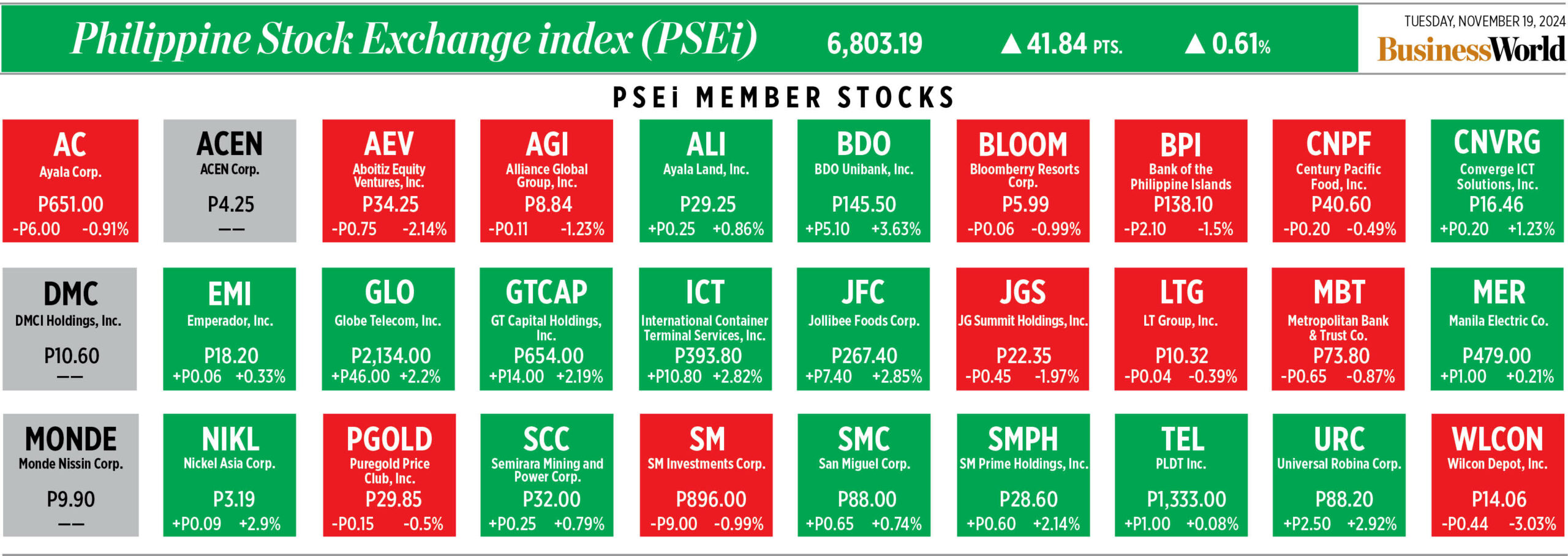
How PSEi member stocks performed — November 19, 2024

Here’s a quick glance at how PSEi stocks fared on Tuesday, November 19, 2024.


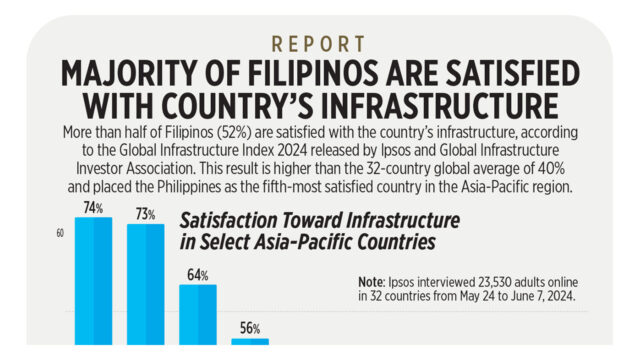
Majority of Filipinos are satisfied with country’s infrastructure

More than half of Filipinos (52%) are satisfied with the country’s infrastructure, according to the Global Infrastructure Index 2024 released by Ipsos and Global Infrastructure Investor Association. This result is higher than the 32-country global average of 40% and placed the Philippines as the fifth-most satisfied country in the Asia-Pacific region.

Majority of Filipinos are satisfied with country's infrastructure

RE contract processing via EVOSS resumes — DoE

STOCK PHOTO | Image from Freepik

THE Department of Energy (DoE) said it will start accepting applications for renewable energy (RE) contracts through the Energy Virtual One-Stop Shop (EVOSS) System next week, following the lifting of a five-month suspension.

Beginning Nov. 25, RE developers will be able to submit their official letters of intent and applications for RE contracts through EVOSS, the DoE said in a statement on Tuesday.

“This resumption marks a significant step in advancing the country’s renewable energy goals, facilitating more efficient project approvals while ensuring that future developments align with the updated regulatory framework,” Energy Undersecretary Rowena Cristina L. Guevara said.

Ms. Guevara is hoping for “greater investment and development in the renewable energy sector” following the improvements, contributing to the goal of increasing the share of RE in the power generation mix.

The processing of RE applications via the EVOSS System was suspended on June 25 to allow the DoE to tweak the application process, to bring it in line with the revised omnibus guidelines governing RE contracts issued on June 10.

The DoE has also changed the option for developers to obtain a certificate of authority (CoA) before signing a renewable energy contract. This allows developers to start permit processing, conduct surveys and pre-feasibility activities before the official 25-year contract term begins.

“With the inclusion of CoA in the EVOSS application process and a cleaner list of registered renewable energy project developers, we can now monitor projects more effectively,” Ms. Guevara said. 

“This will foster a more dynamic and competitive environment, driving innovation and efficiency, while ensuring that the energy transition is led by committed and capable developers,” she added. — Sheldeen Joy Talavera

SRA rejects claims of sugar oversupply

PHILIPPINE STAR/MIGUEL DE GUZMAN

THE Sugar Regulatory Administration (SRA) rejected claims of an oversupply of sugar, which has been blamed for a decline in millgate prices.

“For both raw and refined sugar, we are currently 35-37% below the levels recorded last year,” SRA Administrator Pablo Luis S. Azcona said in a statement.

The Sugar Council, a confederation of three sugar associations, has said demand for domestically milled sugar has weakened due to the entry of imports and the increased use of artificial sweeteners by the beverage industry.

The SRA has authorized imports of 240,000 metric tons (MT) of refined sugar, citing the need to shore up supply before the start of the 2024-2025 milling season.

According to the SRA, as of Oct. 20, raw sugar stocks amounted to 148,255 MT, while refined sugar inventory amounted to 323,983 MT.

Mr. Azcona added that inventories have remained at “proper levels, maintaining the needed buffers.”

In a joint statement last week, the Department of Agriculture and the SRA said they intended to postpone imports of refined sugar until May or June next year with sugar inventories expected to remain stable.

“As of Nov. 10, 2024, our production of sugar is down by 61%, and we have prepared for this with the proper buffer supply,” he said.

The regulator earlier estimated that raw sugar production during the current crop year would decline 7.2% from a year earlier due to crop damage sustained during the dry conditions brought about by El Niño.

The SRA said the crop damage will outweigh the increase in the area planted to sugar to 389,461 hectares, from 388,378 hectares in the previous crop year. — Adrian H. Halili

Legislator backs CARS-like incentives for more automakers

REUTERS

By Justine Irish D. Tabile, Reporter

MORE INCENTIVES are needed to support other carmakers not currently enrolled in the Comprehensive Automotive Resurgence Strategy (CARS) program, a legislator said.

Representative Rufus B. Rodriguez said that the expansion to other manufacturers of CARS, which rewards automakers that hit certain volume production quotas, will help the auto industry develop.

“We believe that even if the government spends by giving subsidies per unit to the members of the CARS program, what we give to subsidize production costs will be recovered by employment and taxes,” Mr. Rodriguez told reporters on the sidelines of the Auto Reverse Trade Fair.

Mr. Rodriguez’s House Bill No. 4206, also known as An act to strengthen the competitiveness of the Philippine motor vehicle manufacturing industry, has been with the House Committee on Trade and Industry since September 2022. As yet no counterpart bill has been filed in the Senate.

He said the economic contributions of automotive manufacturing remain significant, with motor vehicle and parts manufacturing output valued at P689 billion, or 10% of manufacturing output overall.

He added that the sector is among the most productive, generating that level of output with 109,808 workers.

“Imagine how much more the industry can contribute if we have a larger production base. My vision for the automotive industry is to truly become an engine of growth by increasing its value output, employment, and labor productivity,” he said.

He said that although the Board of Investments (BoI) included automotive manufacturing in the Strategic Investments Priorities Plan, the newly signed Corporate Recovery and Tax Incentives for Enterprises to Maximize Opportunities for Reinvigorating the Economy (CREATE MORE) Act is not sufficient to address the industry’s needs.

“CREATE MORE is a ‘one size fits all’ measure that may not address concerns that are peculiar to the automotive industry,” he said.

He said HB No. 4206 offers an inclusive and technology-neutral framework for fiscal and non-fiscal support covering all segments of the automotive industry.

“This is not only for car manufacturers but also for parts manufacturers. The people involved in parts manufacturing are all Filipino, benefiting 400,000 families,” he said.

He added that the bill will allow for more participants to join CARS-type incentive programs as long as the government can afford the subsidy.

BoI Industry Development Services Executive Director Ma. Corazon Halili-Dichosa said that the BoI is also waiting on the passage of the law to support local manufacturing.

“We support that. In fact, when the congressman calls for a committee hearing, we are in attendance. We hope it will be passed soon,” Ms. Halili-Dichosa said.

She said that manufacturers believe that “CREATE is not really enough, so that is why they want the CARS Program.”

She added that the machinery involved in the manufacture of cars is capital-intensive, making subsidies such as those given under CARS significant.

“Our automotive industry is beset with a lot of challenges that constrain its growth to full potential,” she said.

“The supply chain remains limited for various reasons, and there are also persistent regulatory challenges that make it easier to sell imported completely built units than locally assembled vehicles,” she added.

Between 2015 and 2023, she said imports accounted for 71% of auto sales.

According to CARS participants Toyota Motor Philippines Corp. and Mitsubishi Motors Philippines Corp., the local-content ratio of their Vios and Mirage compact car model exceeds 60% and 40%, respectively.

Manila, Cebu hotels seen benefiting from improved flight connections

ABOITIZINFRACAPITAL.COM

By Beatriz Marie D. Cruz, Reporter

HOTELS in Manila and Cebu are expected to be the main beneficiaries of greater flight connectivity over the year-end holidays, the Philippine Hotel Owners Association (PHOA) said.

“The destinations that will perform the strongest will be the ones with the most flights. So, Manila and Cebu will continue to get the bulk,” PHOA Executive Director Benito C. Bengzon, Jr., told BusinessWorld on the sidelines of an event late Monday.

Strong demand is also expected for in Bohol, Palawan, Boracay, and Siargao over the holidays, also due to the airline capacity dedicated to these destinations, he added.

In the nine months to September, international passenger traffic rose 40.5% to 20.41 million, according to the Civil Aeronautics Board.

“The holiday season has traditionally been a very strong period for hotels. We see a lot of inbound tourist traffic coming from foreigners and of course, from balikbayans,” Mr. Bengzon said. “So, the strong demand helps keep our occupancy rates at a very comfortable level.”

Mr. Bengzon is also expecting “very good” revenues over the remainder of the year, though they have not yet exceeded pre-pandemic levels.

“When you look at the 2023 figures, you’re talking about 5.5 million (visitors). So, there’s still a gap that has to be addressed,” he said, citing data from the Department of Tourism.

“And until such time that we go back to the 8.2 million foreign visitors, the revenues will not be quite the same as they were in 2019.”

“One thing that we have to consider is that the international flights to the Philippines have increased. That should be good for the hotels.”

Mr. Bengzon also noted a stronger recovery in the Philippines’ major source markets, such as the US, Japan, and South Korea.

As of Oct. 1, foreign tourist arrivals rose 9.76% year on year to 4.88 million, the Department of Tourism reported. The government target is 7.7 million foreign arrivals for 2024.

Wärtsilä says Visayas, Mindanao present opportunities to upgrade from coal power

THE Visayas and Mindanao present many opportunities for transitioning coal-fired power capacity to gas or renewable energy, Finnish power plant equipment maker Wärtsilä Oyj Abp said.

The Finnish company added that liquefied natural gas is a suitable as transition fuel compared with coal, which has “a messy environmental footprint.”

“The market can be broken down to three main islands. Most of the demand and generation is based here in Luzon. However, Visayas and Mindanao islands also have substantial demand,” Patrik Farkas, general manager for market development for the Middle East & Asia at Wärtsilä, said during the 4th Philippine Natural Gas Investment Summit on Tuesday.

Mr. Farkas noted, however, that the Visayas and Mindanao are most reliant on coal-fired power.

In 2023, 62% of power was supplied by coal-fired plants, the Department of Energy reported.

Wärtsilä equipment generates 74 gigawatts of power worldwide. The company has also delivered more than 80 energy storage systems to sites in 180 countries.

The company started operating in the Philippines 50 years ago.

“Over these five decades, we built more than 1.7 gigawatts of power generation capacity,” Mr. Farkas said. — Sheldeen Joy Talavera

Local-rep requirement may be waived for foreign digital firms

STOCK PHOTO | Image by andrespradagarcia from Pixabay

NON-RESIDENT digital service providers (DSPs) will not be required to appoint a local representative when registering under the newly enacted value-added tax law, according to draft regulations issued by the Bureau of Internal Revenue (BIR).

“In registering with the BIR, a Non-resident DSP need not have a local representative in the Philippines,” according to the draft dated Nov. 8 released for public consultation.

“However, it may appoint a resident third-party service provider (an individual or entity, e.g., law firm, accounting firm, consultancy firm) for purposes of receiving notices, record keeping, filing of tax returns, and other reporting obligations,” it added.

President Ferdinand R. Marcos, Jr. recently signed Republic Act (RA) No. 12023. It imposes a 12% VAT on foreign digital service providers.

The BIR previously signaled that foreign DSPs will be required to open a representative office or appoint an agent in the Philippines.

The 10-page draft regulations also outline the BIR’s power to issue closure or takedown orders against DSPs that fail to register or comply with the tax rules.

Such measures “include the blocking of Digital Services performed or rendered in the Philippines by a DSP, which shall be implemented by the Department of Information and Communications Technology, through the National Telecommunications Commission.”

Non-resident DSPs are required to register or update with the BIR within 60 days “from the effectivity of these regulations through the VDS portal and shall immediately be subject to VAT after 120 days from the effectivity of these regulations.”

RA 12023 authorizes the temporary closure of non-compliant establishments with a duration of not less than five days.

It will only be lifted upon compliance with requirements prescribed by the Commissioner in the closure order, it said.

The law requires a non-resident DSP to register for VAT if its gross sales for the past 12 months exceed P3 million.

The Philippines joins neighbors like Indonesia, Malaysia, Thailand, Singapore and Japan, in imposing a consumption tax on digital services. — Aubrey Rose A. Inosante

New round of fish imports due by December being studied after typhoons diminish catch

PHILSTAR FILE PHOTO

THE Department of Agriculture (DA) said on Tuesday that it is considering additional imports of small pelagic fish following the damage from consecutive typhoons sustained by Philippine fisheries.

“There was a discussion of possibly allowing the import of an additional 8,000 metric tons (MT), set to arrive before the end of the year,” Agriculture Assistant Secretary and Spokesperson Arnel V. de Mesa said in a briefing.

The new shipments, if approved, follow the 30,000 MT authorized earlier, and are for delivery in December. The DA said the imports will also ensure adequate supply during the closed fishing season.

Under Republic Act No. 8550 or the Fisheries Code, closed fishing seasons are declared over certain fishing grounds to help stocks regenerate. These closures typically lasts for three months.

Among the fish species the DA is seeking to authorize imports for are round scad (galunggong), mackerel, bonito, and moonfish.

Mr. De Mesa added that the six typhoons in November have affected the fish catch.

The latest storm to hit the country was Super Typhoon Man-Yi (Philippine name: Pepito).

Separately, he said the DA is looking for alternative sources for vegetables to head off a rise in market prices.

The DA has said that vegetable prices are expected to remain elevated due to the impact of the typhoons on vegetable-producing areas.

“The Bureau of Plant Industry and High Value Crop (office) were tasked to check on the volume, the supply and the prices and recommend to the Secretary within the week possible strategies,” Mr. De Mesa said.

“One is to check other supplies from other regions, and second, the possible import of key commodities,” he said, adding that the DA has yet to determine the vegetables that will be imported.

He said the priority for now is to source from parts of the country not hit by the typhoons if supply is available, like Bukidnon or Cebu. — Adrian H. Halili

DBM approves revised rules for gov’t procurement e-marketplace pilot test

BW FILE PHOTO

THE Department of Budget and Management (DBM) said on Tuesday that it approved the revised guidelines for the pilot run of an e-marketplace for government procurement.

In a statement, the DBM said Budget Secretary and Government Procurement Policy Board (GPPB) Chairperson Amenah F. Pangandaman approved the GPPB resolution 06-2024 dated Oct. 4.

The resolution, known as “Approving the Proposed Guidelines for the Pilot Implementation of the Philippine Government Electronic Procurement System Electronic Marketplace,” streamlines the process for accredited suppliers selling goods or services to the government.

“The electronic marketplace… allows procuring entities… to search, view, compare, select, and procure goods and services from legally, technically, and financially capable merchants,” Genmarie S. Entredicho-Caong, executive director at the DBM’s Procurement Service (PS) told BusinessWorld via Viber.

President Ferdinand R. Marcos, Jr. recently signed Republic Act 12009 or the New Government Procurement Act (NGPA), which seeks to “modernize and enhance transparency, efficiency, and accountability across procurement processes.”

“The ‘add to cart’ feature in our government procurement systems is underway. With the release of the new guidelines, we are advancing to the trial phase of our e-marketplace,” Ms. Pangandaman said.

The DBM said the pilot phase will focus on common-use supplies and equipment (CSE), such as motor vehicles, airline tickets, cloud computing services, and software licenses.

“Each CSE will be thoroughly validated by the Procurement Service to ensure they meet technical standards and are ready for inclusion,” the DBM said.

Procuring entities (PEs) will be allowed to source CSEs from other suppliers under specific circumstances, such as unavailability or when other options are deemed more efficient, and practical, under the NGPA.

The DBM said that the e-marketplace will feature electronic signatures and payments and an automated system to handle the submission and processing of procurement requests, reducing paperwork and delays.

The PS will train users in all agencies on the effective use of the platform, it said.

The pilot test is subject to review by the GPPB for refinements before a wider rollout.

Ms. Caong said the feature allowing agencies “to view, compare, and select is what’s new, in comparison to the virtual store, where agencies can already procure CSE items online but on a per-item basis, with no options, as there is only one supplier per item.” — Aubrey Rose A. Inosante

Bahrain steel products maker to invest P1.5B in Pampanga ecozone operation

TECOINDUSTRIALPARK.COM

THE Philippine Economic Zone Authority (PEZA) said it signed a registration agreement with Promet (Asia), Inc., its first such deal with a company from Bahrain, which plans to start a P1.5-billion facility in a Pampanga economic zone (ecozone).

In a statement on Tuesday, PEZA said Promet’s operation will be built in TECO Industrial Park in Mabalacat, Pampanga. It will employ more than 150 in the manufacture of safes and steel furnishings.

Citing Promet President Eugeniusz Pietrow, PEZA said the company studied other sites in ASEAN and India before selecting the Philippines.

PEZA Director General Tereso O. Panga said the investment is “a testament to our world-class brand of service and the ecozones’ (ability to provide) the best business ecosystem.”

According to PEZA, Promet hopes to complete its facility by the third quarter of 2025 and start operations by early 2026.

PEZA has approved P123.72 billion worth of investment pledges as of October, equivalent to nearly 62% of the agency’s target of P200 billion.

These comprise 198 projects expected to generate $3.07 billion in export revenue while creating 40,733 jobs. — Justine Irish D. Tabile