Home Blog Page 1848

Pork sellers largely ignoring MSRP — DA

PORK meat products are sold at the Murphy Market in Cubao, Quezon City, Feb. 11, 2021. — PHILIPPINE STAR/ MICHAEL VARCAS

THE Department of Agriculture (DA) said compliance with the maximum suggested retail price (MSRP) for pork has been spotty over a week after the scheme took effect.

The compliance rate among about 170 retailers monitored by the DA was 20%, Agriculture spokesman Arnel V. de Mesa told reporters.

Retailers have failed to comply with the MSRP because the price set by traders remains high, he said, even though the farmgate price for hogs has decreased.

On March 10, the MSRP was set at P380 per kilo for liempo (belly) and at P350 per kilo for kasim (shoulder) and pigue (rear leg).

The DA has also imposed a maximum suggested price of P300 per kilo for sabit ulo, the price at which traders pass on pork to retailers.

Pork sold in so-called “modern markets” such as supermarkets and hypermarkets is exempt from the MSRP scheme due to their higher operating costs.

Mr. De Mesa said farmgate prices have fallen to as little as P220.

“So, why can’t it reach P300 when in fact they agreed that the profit margin for viajeros (traders) should be P70 pesos?” he said.

The government first applied the MSRP approach to rice.

Mr. De Mesa said the DA was expecting the pork MSRP to be more broadly observed because hogs need to be sold in markets immediately after they are butchered.

“It’s not like rice that you can store for a longer time,” he said.

The level of compliance after the first week of the MSRP for rice was 40-45%.

Mr. De Mesa said prevailing prices remain high for pork belly (P420 per kilo) and rear leg (P380). — Kyle Aristophere T. Atienza

Ajinomoto Philippines sees food industry posting steady growth, revenue rising by double digits

FACEBOOK.COM/AJINOMOTOPHILIPPINESCORPORATION

AJINOMOTO Philippines Corp. (APC) said the food industry is expected to post “steady” growth this year, driving a double-digit rise in its sales.

“We do not reveal this information officially, but I can say (it will be) more than double-digit (growth). As you can imagine, the food industry is not an up-and-down business; it is a very steady business,” Koichi Ozaki, president of Ajinomoto Philippines, said, on the sidelines of a briefing on Monday.

In particular, he said that the company’s sales in the Philippines is expected to outpace the growth rate of the overall food and beverage industry, which he estimated at less than 10%.

“Now the driving force is, of course, our main business, which is the seasoning segment, which is growing steadily. But in addition to that, our other businesses are also our growth drivers,” he added.

Aside from seasoning products, APC also recently launched frozen food such as gyoza (dumplings), karaage (deep fried chicken) and instant soup preparations.

According to Mr. Ozaki, the Philippines is among Ajinomoto’s top markets within ASEAN in terms of sales. Its top market in the region is Thailand.

On Monday, APC launched the Ajinomoto Shared Value (ASV) program, which seeks to reduce the company’s environmental footprint by 50% and help increase global life expectancy by 2030.

The company “recognizes responsibility for how we impact the environment. Our ASV signifies our role is beyond providing Filipinos with key products that enhance taste in our food — it highlights our commitment to environmental stewardship,” Mr. Ozaki said.

The company has transitioned its two factories to renewable energy (RE) in partnership with ACEN Renewable Energy Solutions.

The company currently has two factories in the Philippines, located in Bulacan and Cebu, and employs 2,000 workers.

“The two factories are now being powered by 100% RE, significantly lowering their scope 2 carbon emissions, which prevents around 5,000 metric tons of carbon dioxide emissions per year,” the company said.

In partnership with FAST Logistics and MOBER Philippines, the company is also seeking greener logistics in its warehouse transfers and product deliveries. — Justine Irish D. Tabile

Domestic trade declines by value, volume in Q4 due to typhoons

REUTERS

DOMESTIC TRADE in goods by value posted a double-digit decline in the fourth quarter after multiple typhoons disrupted economic activity, the Philippine Statistics Authority (PSA) said, citing preliminary data.

According to the PSA’s  Commodity Flow in the Philippines report, the value of trade goods in the quarter fell to P246.22 billion from P326.56 billion a year earlier.

The PSA said domestic trade by value is the outflow value of commodities transported from the place of origin to the place of destination.

Commodity flow includes goods transported by water, air, and rail, with waterborne goods the dominant segment.

The volume of trade declined 25.9% year on year to 6.23 million tons.

“The slowdown in domestic trade can be attributed to natural calamities during the last quarter that have negatively affected supply chains in the country,” Reinielle Matt M. Erece, economist at Oikonomia Advisory and Research, Inc. said in an e-mail.

Mr. Erece added that subdued demand caused by global economic uncertainty and higher inflation expectations also slowed domestic trade in the fourth quarter.

In December, headline inflation accelerated to 2.9% year on year from 2.5% in November.

This brought 2024 inflation to 3.2%, in line with the central bank’s target.

Six typhoons between October and November caused more than P22 billion in damage, according to the National Disaster Risk Reduction and Management Council.

Of the 10 commodity groups monitored by the PSA, seven groups declined by value.

These were machinery and transport equipment, down 59.5%, followed by animal and vegetable oils, fats and waxes (-47.2%); food and live animals (-19.4%), beverages and tobacco (-14.7%); mineral fuels, lubricants and related materials (-10.2%); chemicals and related products (-7.8%); and crude materials, inedible, except fuels (-1.5%).

Commodity groups posting growth were manufactured goods classified chiefly by material (25.8%), miscellaneous manufactured articles (9%), and commodities and transaction not classified elsewhere in the PSCC (5.7%).

Food and live animals accounted for the most value among traded commodities at P72.07 billion during the period.

The category accounted for 29.3% of the value of  domestic trade in the fourth quarter. Machinery and transport equipment amounted to P47.48 billion (19.3%), and manufactured goods classified by material P45.15 billion (18.3%).

The National Capital Region accounted for the most goods traded by value with 53.3%. Outflows amounted to P131.31 billion and inflows P24.29 billion, resulting a surplus of P107.02 billion.

The value of inflows into the Western Visayas was P46.63 billion or 18.9% of the total.

Mr. Erece said that a rebound is expected in domestic trade, driven by easing inflation and expectations of higher government spending in the runup to the elections.

Inflation cooled to 2.1% in February, the weakest reading in five months. — Pierce Oel A. Montalvo

PHL, UK start joint trade committee talks

REUTERS

THE PHILIPPINES and the UK on Monday embarked on their first Joint Economic and Trade Committee (JETCO) meeting in London, the Department of Trade and Industry (DTI) said.

“We are just reinforcing our trade and economic ties through the JETCO mechanism,” Bureau of International Trade Relations Director Marie Sherylyn D. Aquia said via Viber.

She said that the Philippines is hoping that the JETCO will cover “infrastructure, energy, agriculture, trade promotion, and investment promotion.”

British Chamber of Commerce Philippines (BCCP) Executive Chairman Chris Nelson said that the JETCO is a reflection of how the UK and the Philippines see the trade going.

“It’s going to be increasing; it’s already reached 2.8 billion pounds, and there are a lot more opportunities. So this is a very encouraging start. I think from the Philippines, Trade Undersecretary Alan Gepty has gone to London,” Mr. Nelson said by phone.

“You have got to look at this as an overall increase in relations. And it follows on from the work we have been doing at the British Embassy,” he added.

He said JETCO signifies an upgrade of trading relations.

“The UK launched about two years ago the Developing Countries Trading Scheme (DCTS). Trade has continued to grow between the two countries, obviously due to the work of the embassy, business and trade, and also ourselves, the British Chamber,” he added.

The Philippines is currently a participant in the UK’s DCTS, which gives duty-free access to 92% of its product lines entering the British market.

“I’m sure it (the JETCO) would cover those under DCTS. I mean, I am not there at the discussions, but I am sure they are going to discuss all possible areas of cooperation,” he said.

The BCCP hopes the UK and the Philippines will also discuss priority legislation.

“For example, we’d like to see the Cybersecurity Act passed because we think that’s very important,” he said.

“We also want to see e-governance, as this will further improve the opportunities. If ease of doing business improves, this will, in our opinion, increase and assist in terms of investments coming into the country. So, we’re hoping that JETCO will also touch on that,” he added.

The DTI’s Export Marketing Bureau reported that total trade between the UK and the Philippines was $1.18 billion in 2024. The UK was the Philippines’ 23rd leading trading partner last year. — Justine Irish D. Tabile

Crackdown looms for fake cosmetics sold online

PHILSTAR FILE PHOTO

THE Intellectual Property Office of the Philippines (IPOPHL) said it has tied up with the Chamber of Cosmetics Industry of the Philippines (CCIP) to clear out counterfeit cosmetics from online platforms.

In a statement on Monday, IPOPHL said that it signed an e-commerce memorandum of understanding (MoU) with CCIP to work against the sale and marketing of counterfeit cosmetic products online.

“Through this MoU, the CCIP and its members will now be part of the collective drive of protecting both the cosmetics industry and the health and safety of the public,” IPOPHL Director General Brigitte M. da Costa-Villaluz said.

“This collaboration is a protective measure so that cosmetics products, from skincare to makeup, can be availed of by people around the world not only for their high quality but also for their authenticity,” she added.

The signing follows the partnership entered into by IPOPHL and CCIP in 2023 which centered on policing intellectual property (IP) violations.

CCIP President Christine Michelle P. Reyes said that the industry’s continuous growth makes it susceptible to online counterfeits.

“As the rise of e-commerce platforms has led to the rapid spread of counterfeit goods online, brands have difficulty in protecting their intellectual property due to damage to brand reputation and elevated risks to consumer safety from the sale of unsafe or substandard products,” she said.

The MoU brings together online platforms, brand owners, industry associations, and chambers of commerce with the aim of establishing a code of practice for online businesses, enhancing collaboration among signatories, and implementing notice and takedown procedures.

“Originally conceived as a stopgap measure, the MoU has proven to be an effective tool that gives us a fighting chance against IP violators who flood platforms with fake cosmetic products,” IPOPHL Deputy Director General Nathaniel S. Arevalo said.

“The MoU complements the goals of the Internet Transactions Act and has been recognized as a best practice within the ASEAN region,” he added.

To date, the e-commerce MoU has 65 signatories. — Justine Irish D. Tabile

Calamity funds worth P21 billion still unused

PHILIPPINE STAR/EDD GUMBAN

THE Department of Budget and Management said P21 billion worth of calamity funds remain unused as of the end of February, including P20 billion in the National Disaster Risk Reduction and Management Fund and P1 billion in the People’s Survival Fund (PSF).

At the end of February 2024, disbursals had amounted to P1.95 billion, leaving P19.17 billion unused.

The PSF is intended for local government units and accredited community organizations to pursue climate change adaptation projects. — Aubrey Rose A. Inosante

FPA taking new approach in regulating biofertilizers

SHUTTERSTOCK

THE Fertilizer and Pesticide Authority (FPA) said its oversight of biofertilizers will be “developmental,” easing the permit process to hasten their greater adoption.

It said the new regulatory approach applies to “emerging products” such as biofertilizer, biopesticide and bio stimulants, FPA Office-in-Charge and Executive Director Glenn DC. Estrada told reporters.

He noted that Southeast Asia has been embracing biofertilizer in light of the rising prices of inorganic fertilizer following the Russia-Ukraine war.

Biofertilizer gained traction in the Philippines in 2022 when the Department of Agriculture (DA) promoted a balanced fertilization program, Mr. Estrada noted.

“We are taking on the developmental side of the regulations,” he said, “rather than being too restrictive about it.”

The FPA has registered multiple biofertilizer products and is seeking to further ease the application process by going paperless.

Product registrations with the agency typically take over a year to process, Mr. Estrada noted.

“We started with fertilizer (applications); perhaps in a matter of six months, we can also do digital payments,” he said.

Mr. Estrada said the FPA is working with government and private laboratories to harmonize how they test fertilizers and pesticides.

“It’s a laboratory recognition program, so anywhere you can test (the product),” he said, noting that the agency only has one laboratory.

The FPA said it is seeking P1 billion over three years to establish more locally accesible facilities.

The FPA budget is about P200 million, of which P115 million goes to personnel, Mr. Estrada noted. — Kyle Aristophere T. Atienza

A new tax reform measure for the capital markets

Philippine taxation has undergone significant changes with the enactment of several tax reforms in 2024. These reforms include the Ease of Paying Taxes Act (RA No. 11976), the Real Property Valuation Act (RA No. 12001), the VAT on Digital Services (RA No. 12023), and the CREATE MORE Act (RA No. 12066), which generally aims to modernize the current tax system, making it simpler, fairer, and more efficient.

Following the signing of the bicameral conference report by Congress, another significant tax reform is on its way: the Capital Market Efficiency Promotion Act (CMEPA), which consolidated Senate Bill No. 2865 and House Bill No. 9277. The CMEPA is designed to simplify the complex taxation of passive income in the Philippines. It also seeks to align and promote our capital markets within the context of financial globalization, increased international mobility, and financial inclusion.

Here, we summarize the key proposed amendments under the CMEPA Bill:

STANDARDIZED THE FINAL WITHHOLDING TAX (FWT) RATE ON INTEREST INCOME
One of the major shifts in CMEPA is the standardization of the FWT on interest income at 20%, except for non-resident aliens not engaged in trade or business (NRA-NETB) and non-resident foreign corporations (NRFC), whose interest income will still be subject to 25% FWT. This change effectively removes the preferential final tax rates for:

• 15% on interest income earned by Foreign Currency Deposit Units (FCDUs)

• Tax-exempt status on interest income of non-residents from FCDUs

• Tax-exempt status on long-term deposits and investments

While the proposed final tax rate aims to address the inequitable distribution of the tax burden between investors who can invest in long-term savings and individuals who can only put money into savings deposits, the removal of preferential rates of FCDUs could make the Philippines less appealing to foreign investors, potentially affecting sources of foreign currency and our capital markets.

CAPITAL GAINS TAX ON THE SALE OF SHARES ISSUED BY FOREIGN CORPORATIONS
Currently, capital gains on sales of unlisted local shares of individuals and corporations are subject to 15% capital gains tax (CGT), while gains on sales of foreign shares are subject to the progressive income tax rate for individuals and the corporate income tax rate for corporations. The CMEPA Bill seeks to remedy the disparity by imposing the same tax rate of 15% CGT on the sale of shares issued by foreign corporations not traded on a stock exchange.

While the change might be beneficial for high net-worth individuals (HNWI) and corporations as it lowers the tax rate imposed on the gains on sales of unlisted foreign shares, this might have an unfavorable effect on our capital markets as the shift might make investing in domestic companies less attractive. Further, it is worth noting that CGT must be paid first before transferring ownership of the unlisted domestic shares, whereas there are still no clear regulations on how the transfer of unlisted foreign shares will be monitored.

LOWERING THE STOCK TRANSACTION TAX (STT)
To align the Philippines’ Stock Transaction Tax (STT) with the prevailing rates in other ASEAN-6 economies, CMEPA proposes reducing the STT on the sale or other disposition of shares of stock listed and traded through the stock exchange from 0.6% to 0.1% of the gross selling price or gross value in money of the shares. The proposed amendment also applies to shares of stock of domestic corporations listed and traded through a foreign stock exchange. The reduction aims to lower transaction costs in trading, making it more attractive for both domestic and foreign investors.

LOWERING THE DOCUMENTARY STAMP TAX ON THE ORIGINAL ISSUANCE OF SHARES
Existing rules provide for a documentary stamp tax (DST) on debt instruments and bonds at P1.50 of P200 (0.0075%), while the DST imposed on the original issuance of shares is P2.00 of 200 (0.01%). To equalize the cost of investing in bonds and equity shares and encourage the companies to raise capital through the stock market, the CMEPA Bill reduced the DST on the original issuance of shares from 0.01% to 0.0075%.

INCENTIVES ON MUTUAL FUNDS AND UNIT INVESTMENT TRUST FUNDS
To promote investing in several collective investment schemes (CIS), CMEPA grants income tax exemption for gains from redemption of a unit of participation in a mutual fund and a Unit Investment Trust Fund (UITF). It also removes DST on the original issuance, redemption, or other disposition of shares in mutual funds and the issuance of certificates or other evidence of participation in mutual funds and UITFs. However, these tax incentives do not extend to VUL products, despite being part of CIS.

ADDITIONAL DEDUCTION OF 50% ON EMPLOYER’S CONTRIBUTION TO PERA
The Personal Equity and Retirement Account (PERA) Act, which was introduced in 2008 to strengthen our capital markets, has faced several challenges that have hindered its widespread utilization in the Philippines despite its several tax incentives. To address the issue, CMEPA encourages private employers to increase their contribution by providing an additional 50% deduction on the employer’s contribution, provided that such contribution is at least equal to the contribution of their employees.

CMEPA represents a pivotal moment for the Philippine capital markets. By simplifying the tax rates on certain passive income and significantly reducing the transaction costs on investments, CMEPA is expected to increase participation in the stock market, boost trading activity, increase market liquidity, and enhance the country’s competitiveness in the global financial markets.

However, the success of these reforms will still depend on how well they resonate with the investors and how effectively the government implements the tax reforms. Will CMEPA become the breakthrough the Philippine market needs, or will it take time for both the government and investors to adapt to the changes?

While the full impact of CMEPA remains to be seen, one thing is certain — the future of the Philippine capital market is on the cusp of a major transformation, and this is just the beginning.


Marielle C. Baldemor is a senior in-charge for the Tax Advisory & Compliance Practice Area of P&A Grant Thornton. Tweet us: @GrantThorntonPH, Facebook: P&A Grant Thornton

pagrantthornton@ph.gt.com

www.grantthornton.com.ph

US-EU tariff conflict may imperil $9.5 trillion of business — AmCham

A 3D-PRINTED miniature model of US President Donald J. Trump and the European Union’s flag are seen in this illustration taken on Jan. 27, 2025. — REUTERS

BRUSSELS — The US-European tariff conflict is jeopardizing transatlantic business worth $9.5 trillion annually, the American Chamber of Commerce (AmCham) to the European Union (EU) warned on Monday.

AmCham EU, whose more than 160 members include Apple, ExxonMobil and Visa, showed in its annual Transatlantic Economy report a deepening relationship hitting records in 2024, such as goods and services trade of $2 trillion.

It talks of 2025 as a year of promise and peril for the world’s largest commercial relationship.

In the past week, Washington has imposed tariffs on steel and aluminum, the EU has set out plans for retaliation and President Donald J. Trump has threatened 200% tariffs on EU wine and spirits.

Mr. Trump has railed against the US goods trade deficit with the EU, although in services there is a US surplus, and urged manufacturers to produce in America.

AmCham said trade is only part of transatlantic commercial activity and that the real benchmark was investment.

“Contrary to conventional wisdom, most US and European investments flow to each other, rather than to lower-cost emerging markets,” it said.

US foreign affiliate sales in Europe are four times US exports to Europe and European affiliate sales in the United States are three times higher than European exports.

AmCham warned ripple effects from the trade conflict could damage these close ties.

The report’s lead author Daniel Hamilton said intra-firm trade making up about 90% of Ireland’s and 60% of Germany’s trade could be hit.

There was also a risk of spillover into services trade, data flows or energy, with Europe reliant on US LNG imports.

“Ripple effects of conflict in the trade space will not be confined to trade. They ripple through all of those other channels and the interactions are quite significant,” he said.

US and European companies had interlinking value chains to be globally competitive, such as for BMW cars exported from the US.

“I’m not sure you’re going to have isolated investments,” Mr. Hamilton said. “That’s just going to make things very inefficient.” — Reuters

Trump says both reciprocal and sectoral tariffs coming April 2

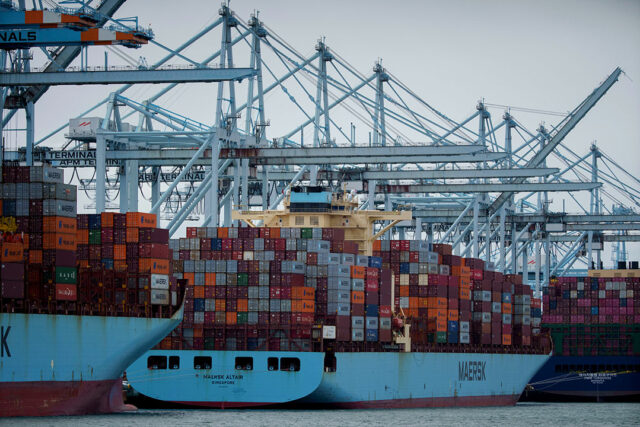
Cranes load ships at the Port of Los Angeles in Los Angeles, California, US, on Thursday, March 6, 2025. — BLOOMBERG

US PRESIDENT Donald J. Trump said he would be imposing both broad reciprocal tariffs and additional sector-specific tariffs on April 2.

Mr. Trump told reporters aboard Air Force One that “in certain cases, both” types of levies would be placed on foreign goods imported to the US.

“They charge us and we charge them and then in addition to that on autos on steel on aluminum we are going to have additional tariffs,” Mr. Trump said on Sunday.

The remarks signal that Mr. Trump plans to press ahead with a more aggressive tariff regime, despite initial moves roiling financial markets and straining alliances.

Mr. Trump has previously said that his administration is preparing what he’s dubbed reciprocal tariffs — which would hit imports from each country with a tariff rate determined based on a calculation incorporating its own tariff and nontariff barriers.

But the president has also said he wants to prepare key US industries, including automobiles, steel, aluminum, microprocessors, and pharmaceuticals. It hasn’t been clear whether those sectoral tariffs would be incorporated into or added on top of the reciprocal tariff regime.

“April 2 is a liberating day for our country,” Mr. Trump said. “We’re getting back some of the wealth that very, very foolish presidents gave away because they had no clue what they were doing.”

Mr. Trump has already imposed a 20% tariff rate in China, as well as a 25% levy on steel and aluminum. He also announced a 25% tariff on Canadian and Mexican goods, but subsequently offered a one-month extension for goods compliant with the North American trade deal, known as USMCA, negotiated during his first term. Mr. Trump has also said Canadian energy and potash, a key fertilizer, would only be hit with a 10% tax. — Bloomberg

Vatican releases first photo of Pope Francis in hospital

POPE FRANCIS concelebrates Holy Mass in the chapel of the apartment on the tenth floor of the Gemelli hospital, where he continues his treatment in Rome, Italy, March 16, 2025. — HOLY SEE PRESS OFFICE/VIA REUTERS

VATICAN CITY — The Vatican on Sunday released the first image of Pope Francis in hospital since he began treatment for double pneumonia, in which the 88-year-old pontiff appeared to be breathing unaided.

The pope was admitted to Rome’s Gemelli hospital on Feb. 14 with a severe respiratory infection that has required evolving treatment. He has not been seen in public since.

Francis is pictured from behind, sitting facing the altar in a chapel at the hospital. The side of his face is visible and his right hand rests on his lap. There is no sign that he is receiving the supplementary oxygen that he has been given throughout his stay.

The Vatican said the photo was taken on Sunday, when the pope celebrated Mass with other priests in the chapel.

In its latest medical update, issued on Saturday, the Vatican said Francis was gradually improving and was using less mechanical ventilation at night to help with breathing.

The pope has been described as being in a stable or improving condition for nearly two weeks, but the Vatican has not yet given a timeframe for his discharge, saying his recovery is going slowly.

Francis is prone to lung infections because he had pleurisy as a young adult and had part of one lung removed.

He has been receiving both respiratory physiotherapy to help with his breathing and physical therapy to help with his mobility. He has used a wheelchair in recent years due to knee and back pain.

Francis celebrated the 12th anniversary of his election as pope from hospital on Thursday.

Doctors not involved in the pope’s care have said he is likely to face a long, fraught road to recovery, given his age and other medical conditions. — Reuters

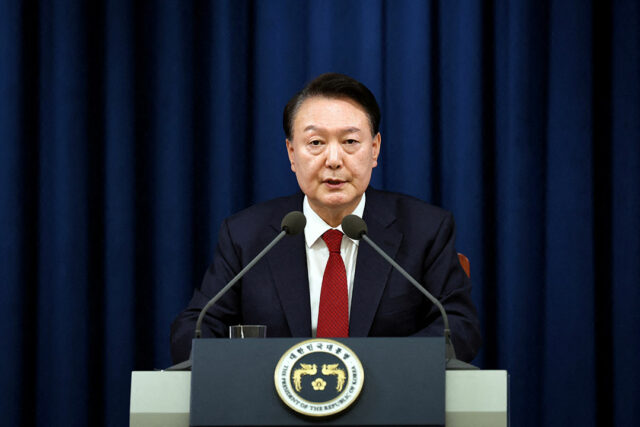
South Korea’s opposition says delay of Yoon impeachment ruling is irresponsible

SOUTH KOREAN President Yoon Suk Yeol delivers a speech to declare martial law in Seoul, South Korea, Dec. 3, 2024. — THE PRESIDENTIAL OFFICE/HANDOUT VIA REUTERS

SEOUL — South Korea’s opposition Democratic Party on Monday urged the country’s Constitutional Court to swiftly rule on President Yoon Suk Yeol’s impeachment, saying keeping the country waiting is “irresponsible” and deepening social division.

As the eight-member court continued deliberations well into the third week, political tensions have surged between those who demand Mr. Yoon’s ouster for declaring a short-lived martial law in December and supporters who want him reinstated.

The court had wrapped up arguments on Feb. 25, where Mr. Yoon said his martial law declaration was needed to root out “anti-state” elements but he never intended to fully impose emergency military rule.

“The country and the people have come to the breaking point,” a Democratic Party leadership member Kim Min-seok said. “We wait for the court’s responsible decision. Further delay is not normal and irresponsible,” he told a party meeting.

In 2017, former president Park Geun-hye was removed from office 11 days after the final arguments in the Constitutional Court in her impeachment trial.

South Koreans have gathered in huge numbers in the capital Seoul supporting and backing the conservative leader’s removal, saying the delay has been frustrating and made confusion worse.

Mr. Yoon was impeached by the Democratic Party-controlled parliament in December for violating his constitutional duty. He committed acts that are a grave threat to rule of law and more than disqualify him from office, the impeachment motion said.

Mr. Yoon is on a separate criminal trial on charges of leading insurrection, which is punishable by death or life in prison.

The fallout of Mr. Yoon’s martial law declaration has widened the rifts between the conservatives and liberals and those in the public, adding stress on institutions and putting much of the government policy making in limbo.

Some of the country’s top military commanders have been taken off duty and face criminal trials for their roles in the martial law decree. Arguments in the trial of former Defense minister Kim Yong-hyun on insurrection charges begin on Monday.

Prime Minister Han Duck-soo, who was briefly acting president after Mr. Yoon was impeached and suspended from power on Dec. 14, has also been impeached and the country is now led by the Finance Minister Choi Sang-mok. — Reuters

ADVERTISEMENT
ADVERTISEMENT