Home Blog Page 1769

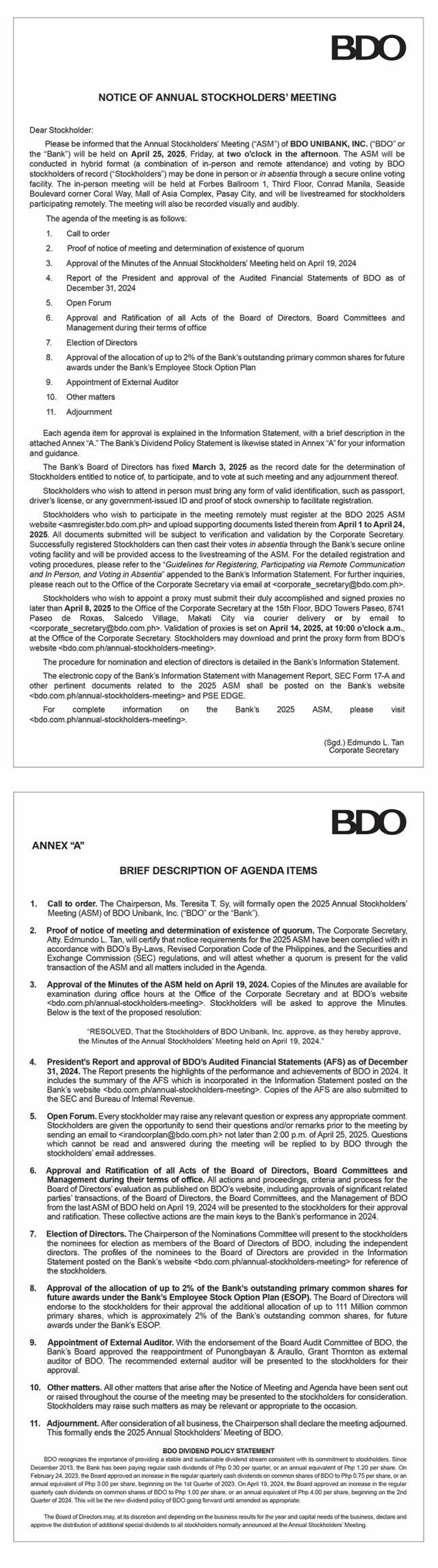
BDO Unibank, Inc.: Notice of 2025 Annual Stockholders’ Meeting (Second Publication)

BDO Unibank, Inc. will hold its Annual Stockholders’ Meeting on April 25, 2025, Friday, at 2:00 p.m., at the Forbes Ballroom 1, Third Floor, Conrad Manila, and will be livestreamed for stockholders participating remotely.


Spotlight is BusinessWorld’s sponsored section that allows advertisers to amplify their brand and connect with BusinessWorld’s audience by publishing their stories on the BusinessWorld Web site. For more information, send an email to online@bworldonline.com.

Join us on Viber at https://bit.ly/3hv6bLA to get more updates and subscribe to BusinessWorld’s titles and get exclusive content through www.bworld-x.com.

Manila Water moves forward with P95-B capex through 2027

MANILAWATER.COM

EAST ZONE concessionaire Manila Water Co., Inc. said it is continuing its P95-billion capital expenditure (capex) program for water and wastewater projects, which began in 2023 and will run until 2027.

“Manila Water will be undertaking considerable fundraising activities to support its substantial operating and capital expenditures from 2023 to 2047, intended primarily for water security, service accessibility, service continuity, and environmental sustainability programs,” the company said in its approved 2023 rate rebasing service improvement plan (RR23SIP).

For water supply projects, Manila Water’s proposed investments include the Wawa-Kaysakat-Pasig Water Supply System and Long-Term East Line Projects, based on its RR23SIP.

Among the major projects expected to be completed is the second phase of the East Bay Water Treatment Plant, which has a capacity of 200 million liters per day (MLD) of water.

“This system project is expected to result in an increase in water service coverage, serving Pasig, Pateros, Taguig, and Talim Island after its target completion. This new water source shall also de-load the Angat water system and serve as an augmentation source for Metro Manila,” said Manila Water.

For wastewater projects, the company is anticipating the completion of the Hinulugang Taktak Sewage Treatment Plant (STP) by the third quarter of 2025.

The facility will treat used water generated within the catchment area before discharging to Hinulugang Taktak Falls, meeting the priority requirement of the local government of Antipolo concerning the preservation of the falls.

Another project is the Mandaluyong West STP, which is designed to treat domestic wastewater generated from the western area of Mandaluyong, south of San Juan South, and south of Quezon City.

The STP is slated for completion by the third quarter of 2025.

Manila Water serves the east zone network of Metro Manila, covering parts of Marikina, Pasig, Makati, Taguig, Pateros, Mandaluyong, San Juan, portions of Quezon City and Manila, and several towns in Rizal province. — Sheldeen Joy Talavera

SM Prime sets sights on premium residential development

JOSE JUAN Z. JUGO

By Revin Mikhael D. Ochave, Reporter

REAL ESTATE company SM Prime Holdings, Inc. is entering the country’s premium residential market.

“The premium segment is shock-resistant,” SM Prime Holdings Executive Vice-President and Premium Residential Line Head Jose Juan Z. Jugo said in an interview with BusinessWorld.

“It can weather storms better than the broader market. It is more resilient. SM is seeing the opportunity to move to a wider spectrum of residential products with the premium market. There is enough space in this segment for another large player,” he added.

In November last year, SM Prime announced the expansion of its residential portfolio into the high-end horizontal and vertical principal homes, bolstering its current economic, mid-range, and leisure residential offerings.

The company is aiming to launch its first upscale residential project this year. It is a master-planned subdivision designed with a strong focus on sustainability, convenience, and community.

“We’re ready to work hard. We already are working hard. Definitely, this first project will make a significant impact in the high-end segment,” Mr. Jugo said.

“SM Prime is so big. When a company is this big, you have to start thinking about where you are going to get the growth. What an organization this large needs is a new engine. Hopefully, this will provide that to a certain extent,” he added.

He noted that the new venture aims to leverage the company’s expertise in creating upscale, large-scale developments, similar to its success in the mall sector.

“These new SM malls, they’re beautiful and very upscale. However, they also have not left behind the broader segment in the retail market. They’ve been able to adapt from being a very broad-based market leader to now entering and succeeding in high-end retail,” he said.

“If we do what we’re expected to do, we now become a full-line residential developer, from economic all the way to ultra-luxury. We’re trying our best to move the needle toward the upper spectrum,” he added.

Mr. Jugo brings over 23 years of real estate experience to SM’s new venture. He previously served as the executive vice-president of listed luxury property developer Shang Properties, Inc. until July 2023.

He was also the managing director of Ayala Land Premier, Inc., vice-president of Ayala Land, Inc., and director, chief executive officer, and non-independent executive director of Malaysian real estate developer MCT Bhd., now known as Avaland Bhd.

Mr. Jugo has a graduate degree from Escuela Superior de Estudios de Marketing de Madrid and an undergraduate degree from De La Salle University.

“What can be expected is that, because we’re a very large company, it will be a continuing thing. We do not expect to do just one premium project and then call it a day. It will be a succeeding series of high-end projects if we do things right,” Mr. Jugo said.

“The land is there. The resources are there. The commitment of the principals is there. We are being given leeway to grow our own organization the way we think we should to succeed. It will be a long-term thing,” he added.

Real estate consultancy firm Colliers Philippines said that demand for premium residential units is recovering, led by a cash-rich market.

It also advised property developers to prioritize the upscale and luxury segments due to steady demand amid market challenges.

“We’re creating our own brand. Right now, we are all SM Development Corp. (SMDC). However, we will eventually have our own brand, logo, and even our own legal entity. It is a development company for the premium segment. SMDC will be mid-market. We will be upper market,” Mr. Jugo said.

“It’s a startup. I tell my team members that this is a startup. Even our mindset has to be different. We’re building the organization,” he added.

SM Prime has earmarked P100 billion in capital expenditure for its malls, residences, and integrated property developments this year.

For 2024, the company posted a 14% increase in its consolidated net income to P45.6 billion as revenue climbed by 10% to P140.4 billion.

SM Prime’s portfolio consists of 87 local malls, 22 office towers, and more than 185,000 residential units launched. It is the real estate subsidiary of Sy-led conglomerate SM Investments Corp.

MPH plans to acquire at least 4 hospitals this year

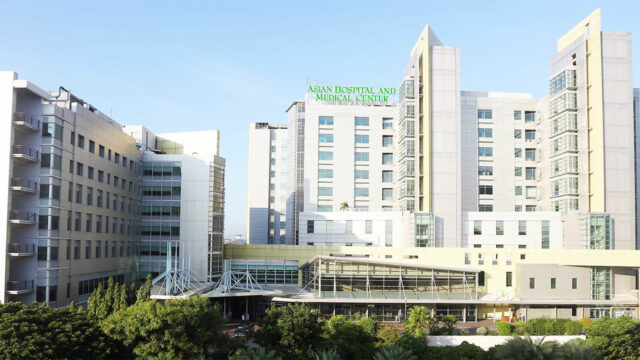
Asian Hospital and Medical Center — ASIANHOSPITAL.COM

METRO PACIFIC Health Corp. (MPH) is aiming to acquire at least four hospitals this year, the company’s president said.

“The last two years were rather good, with four transactions made in 2023 and 2024… I’m hoping we can do the same, if not more, this year,” MPH President and Vice-Chair Augusto P. Palisoc, Jr. said during a recent briefing.

Mr. Palisoc said that MPH has been in talks with many hospitals for possible acquisitions.

“That’s what we do every day. We talk to all the hospital owners and try to find the deals that are more imminent and are already ripe,” he said.

MPH currently has 27 hospitals in its portfolio. The company’s latest acquisition took place in November last year with the addition of the City of General Trias Doctors Medical Center, Inc. in Cavite.

MPH is the healthcare arm of the Pangilinan-led conglomerate Metro Pacific Investments Corp. (MPIC).

MPIC Chief Finance, Risk, and Sustainability Officer June Cheryl Cabal-Revilla said MPH experienced double-digit growth in both revenue and net profit last year.

“The (profit) contribution is P560 million (in 2024) versus P330 million (in 2023), increasing by 50%. We actually added more hospitals. There is a plan to add more,” she said.

“From an organic standpoint, on a same-facility basis, we’re seeing growth even without the added hospitals. Our healthcare group is doing very well. Double-digit growth across all financial metrics, from revenues down to core income. This is due to increases in inpatient and outpatient census,” she added.

Some of the other hospitals under the MPH network include Makati Medical Center, Asian Hospital and Medical Center, Cardinal Santos Medical Center, Davao Doctors Hospital, and Riverside Medical Center.

For 2024, MPIC recorded a 41% jump in its attributable net income to P28.2 billion due to non-recurring gains from its real estate business and a lower interest bill.

MPIC is one of three key Philippine units of Hong Kong-based First Pacific Co. Ltd., the others being Philex Mining Corp. and PLDT Inc.

Hastings Holdings Inc., a unit of the PLDT Beneficial Trust Fund subsidiary MediaQuest Holdings, Inc., has a majority stake in BusinessWorld through the Philippine Star Group, which it controls. — Revin Mikhael D. Ochave

BPI sees double-digit consumer loan growth

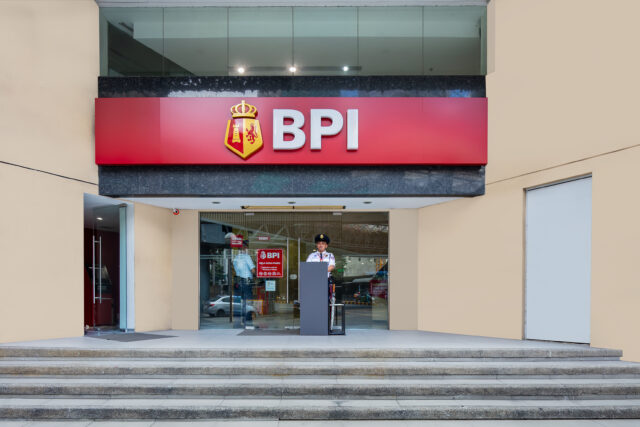
BPI/BW FILE PHOTO

BANK of the Philippine Islands (BPI) expects its consumer loans to grow by 10% to 12% this year as it continues to expand its customer base and with its auto and home lending businesses staying strong.

“We’ve crossed the P100-billion mark in auto loans and crossed the P200-billion mark in housing loans. 10 to 12% would be growth in our total consumer loan portfolio,” BPI Head of Consumer Banking and Executive Vice-President Maria Cristina “Ginbee” L. Go said on the sidelines of an event last month.

BPI is targeting about 20 million customers for its consumer banking business this year, she said. “We’re already at about 15 million. We never thought it’s even possible to grow double our customer base three years ago, but we have.”

“We have more appetite for risk because we believe that our penetration of consumer lending is still very low,” Ms. Go said. “Our consumer loan growth has been extremely impressive, but of course we want to make sure that we’re also able to manage the risks.”

The bank’s nonperforming loan (NPL) ratios for the consumer segment remain “well managed,” the official said.

“We are way below industry. Housing loans were 200 bps (basis points) lower than industry [in 2024]. Auto loans were 80 bps lower than industry. We have room to grow, definitely.”

BPI’s overall NPL ratio stood at 2.13% in 2024, while its NPL coverage ratio was at 106.2%.

Ms. Go added that the bank has “a lot of room to grow” in terms of microfinance lending, teachers’ loans through its subsidiary Legazpi Savings Bank, which became part of BPI following its acquisition of Robinsons Bank Corp. (RBC) in 2024, as well as personal loans.

BPI expects customer acquisition via online channels to continue as it continues to streamline its application process, she said.

Currently, more than half or 55% of BPI’s new-to-bank clients are acquired through digital channels, while the remaining 45% is on-boarded through branches, Ms. Go added.

The bank is also working to digitize all its branches and is looking at adding 80 more reformatted or digitalized branches this year, she said.

“We have 858 branches now, which is the combination of BPI and RBC branches. We will continue on branch transformation and optimization because part of the branch transformation is to make sure that we have the optimal branch footprint and that we’re able to provide the customer experience in-branch in light of all the digital capabilities that we already have, and make sure that we have an omni-channel experience,” Ms. Go said. “The digital format leverages on our digital capabilities and improves the customer experience because we shouldn’t be just transacting centers — we are advisory centers.”

BPI is also consolidating its branch network, the official said.

“There are areas wherein we’re saturated, particularly in Metro Manila. So, we will continue to consolidate branches, particularly since Robinsons Bank branches are also in the same areas where we are… We will retain the ex-Robinsons Bank branches in Robinson’s malls, where, of course, they have strategic locations.”

BPI’s attributable net income rose by 20.04% to a record P62.05 billion last year from P51.69 billion in 2023. — Aaron Michael C. Sy

FDC boosts 2025 capex by 20% to P24 Billion

ONE FILINVEST IN ORTIGAS AVENUE — FILINVEST.COM

GOTIANUN-LED conglomerate Filinvest Development Corp. (FDC) has allocated a P24-billion capital expenditure (capex) budget for 2025 to drive growth.

The conglomerate’s 2025 capex is 20% higher than the P20 billion set aside for 2024, FDC Chief Finance Officer Ven Christian S. Guce said during a briefing last week.

“Forty-seven percent of that will go into the expansion projects of our real estate. These are projects that are already ongoing or nearing completion. Forty percent will go into expanding the different portfolios of our segments, such as hotels, investments in renewables, and investments in our core power business,” Mr. Guce said.

“Ten percent will go into digitalization, which will improve operational efficiencies across the group,” he added.

FDC President and Chief Executive Officer Rhoda A. Huang said the conglomerate is on track with its roadmap of posting an average annual profit growth of 20% over the next five years.

“In terms of a roadmap towards that (growth), when we look at the year-to-date performance, it’s currently tracking. This is going to be consumption-led growth,” Ms. Huang said.

When asked about international business ventures, Ms. Huang said the company has seen opportunities but is focusing on businesses that complement its existing portfolio.

“I have not seen anything interesting enough to bring that forward. What we are trying to focus on will be businesses that will complement existing businesses,” she said.

Mr. Guce said the company’s current portfolio is sufficient to sustain growth over the next five years.

“Just looking at our portfolio, at least for the next five years, it’s enough to sustain the level of growth we want to achieve without having to look outside,” Mr. Guce said.

Last year, FDC recorded a record-high attributable profit, up by 36% to P12.1 billion, as total revenue and other income likewise rose by 22% to a record-high of P113.4 billion.

The conglomerate has interests in the banking sector through East West Banking Corp., the real estate business through Filinvest Land, Inc. and Filinvest Alabang, Inc., and the power sector through FDC Utilities, Inc.

It is also present in the hotel sector through Filinvest Hospitality Corp., in the sugar business through Pacific Sugar Holdings Corp., and in the infrastructure sector through a 42.5% stake in Luzon International Premier Airport Development Corp., which operates Clark International Airport.

FDC shares were last traded on March 28, closing unchanged at P4.90 per share. — Revin Mikhael D. Ochave

Ayala Land, Inc. sets 2025 Annual Meeting of Stockholders virtually on April 24


Spotlight is BusinessWorld’s sponsored section that allows advertisers to amplify their brand and connect with BusinessWorld’s audience by publishing their stories on the BusinessWorld Web site. For more information, send an email to online@bworldonline.com.

Join us on Viber at https://bit.ly/3hv6bLA to get more updates and subscribe to BusinessWorld’s titles and get exclusive content through www.bworld-x.com.

BSP may resume policy easing at modest pace amid uncertainties

THE BANGKO SENTRAL ng Pilipinas (BSP) could resume its monetary easing cycle this month and cut benchmark rates by at least two times this year but at a modest pace due to global and domestic uncertainties that could stoke inflation, GlobalSource Partners said.

“We believe benign inflation readings and forecasts should allow the BSP to sustain its easing cycle at least twice this year and in baby steps. Modest easing is critical when uncertainties abound, particularly regarding the prospects for growth and financial stability,” GlobalSource Partners said in a March 31 report written by country analyst Diwa C. Guinigundo and economic analyst trainee Audrey Herrera-Lim.

“With a potentially weak external payments position and the adverse exchange rate pass through, monetary policy could in fact remain generally cautious until the markers of global and domestic uncertainties relent,” it said.

BSP Governor Eli M. Remolona, Jr. last week said there is a “good chance” that the Monetary Board will cut rates by 25 basis points (bps) at their April 10 meeting, Bloomberg reported.

Mr. Remolona said the BSP remains on an easing cycle and could reduce borrowing costs by as much as 75 bps this year depending on data.

The central bank has brought down benchmark interest rates by a total of 75 bps since it began its rate-cut cycle in August last year, with its policy rate currently at 5.75%.

The Monetary Board in February unexpectedly kept rates unchanged amid uncertainties stemming from the Trump administration’s policies.

“With this information, we are convinced the BSP will resume what has now become its “calibrated rate-cutting cycle” during the next monetary policy meeting on April 10,” GlobalSource Partners said.

It expects Philippine inflation to average 1.7% to 2.1% this year, based on its own models.

“Such prognosis allows the monetary authorities ample leeway to further ease monetary policy. However, some word of caution is imperative. The previous BSP risk-adjusted forecasts are inching closer to the 4% upper end of the 2-4% inflation target. With both February and March inflation trending lower, risk-adjusted inflation forecasts that would be announced after the Board meeting on April 10, all other things being equal, could be lower than their current levels of 3.5% and 3.7% for 2025 and 2026, respectively,” it said.

The latest round of cuts in banks’ reserve requirement ratios that took effect last week, which released over P300 billion in additional liquidity, could also be inflationary, it added.

“Already, the BSP has suggested that the output gap could already be in a slight positive territory such that a rate cut if not appropriate and timely could add more price pressure.”

GlobalSource Partners added that while slowing domestic growth due to weakening business activities and global uncertainties amid the United States’ tariff policies could support sustained monetary easing, financial stability issues may lead the Philippine central bank to err on the side of caution.

The BSP in its latest Financial Stability report warned of risks stemming from global trade pressures, geopolitical tensions and domestic debt concerns.

“The content of the latest stability report has actually different implications for monetary policy. On the one hand, it calls attention to global uncertainty, which would require constant monitoring of market risks as well as cautious monetary policy,” GlobalSource Partners said.

“On the other hand, the issue of excessive household borrowing, especially unsecured consumer loans, might force the authorities to sustain easing to avoid squeezing borrowers and prevent banking stress. While the capital markets are presented as an alternative funding source, Philippine capital markets are rather shallow and may not allow this soon. At this point, capital markets could hardly serve as “spare tire” should banks decide to pull back.”

The Philippines’ weak external payments position could also put pressure on the peso, which may stoke inflation, it added.

The BSP expects the country’s balance of payments (BoP) position to swing to a deficit this year, as well as post a wider current account deficit, amid global trade volatilities.

The central bank’s latest projection shows the overall BoP will register a deficit of $4 billion this year, equivalent to -0.8% of gross domestic product (GDP).

In 2024, the BoP position stood at a surplus of $609 million, plunging by 83.4% from the $3.672-billion surplus at end-2023.

Meanwhile, the current account deficit — which covers transactions involving goods, services, and income — is expected to reach $19.8 billion this year, equivalent to -3.9% of economic output.

Latest data from the BSP showed the current account deficit widened by 41.4% to $17.5 billion last year from $12.39 billion in 2023. This marked the second-largest current account deficit on record after the $18.3-billion gap recorded in 2022.

“This would imply that a weak peso could proceed from an external deficit… Thus, it also means that the inflows from foreign investments and foreign debt would not suffice to reverse the huge current account deficit of nearly $20 billion in 2025 and over $21 billion in 2026. Unless the BSP keeps its policy rate steady, or shifts to a more cautious stance, inflation is bound to gather some pace due to exchange rate pass through,” GlobalSource Partners said. — A.M.C. Sy

PLDT eyes to finish Apricot submarine cable project by 2027

PLDTENTERPRISE.COM

PANGILINAN-LED telecommunications company PLDT Inc. said it expects to fully complete its Apricot submarine cable system by 2027.

“There are two landing stations, one in Baler and one in Digos,” PLDT First Vice-President and Head of Enterprise Product Management and Global Capacity Benedict Patrick V. Alcoseba told reporters on the sidelines of an event last week.

“It’s slated for 2027. A big part of what we need to complete is the Indonesian waters, but the Philippine waters are progressing well,” he added.

Originally scheduled for completion in 2026, the project is expected to upgrade and increase connections and capacity for stable internet, Mr. Alcoseba said.

“Apricot extends from the lower part of South Asia toward Guam. So, it increases the resiliency of the Philippines when we connect with different Southeast Asian countries. It also helps us connect to the US,” he said.

In March, the Pangilinan-led telecommunications company said it had completed the cable-laying phase of the Apricot cable system from Baler, Aurora, to Davao.

This development is expected to strengthen the country’s domestic network while positioning the Philippines as a transit hub for hyperscalers.

The 12,000-kilometer Apricot cable system will further expand PLDT’s international data capacity. It is a high-capacity fiber-optic submarine cable capable of handling more than 211 terabits per second.

The Apricot cable system provides a direct link from Singapore to Japan and is expected to offer telecommunications companies alternative routes.

This cable system is also expected to enhance and support the growing demand for connectivity within PLDT’s network in Luzon and Mindanao.

Further, the company is also targeting up to three new submarine cable projects, Mr. Alcoseba said, adding that this plan is still under exploratory discussions.

“No timeline yet for this, but definitely before the Apricot cable is up. We should be able to do the future cable, but it would depend on a number of considerations,” he said.

Hastings Holdings, Inc., a unit of PLDT Beneficial Trust Fund subsidiary MediaQuest Holdings, Inc., holds a majority stake in BusinessWorld through the Philippine Star Group, which it controls. — Ashley Erika O. Jose

Filipino drag excellence meets the world of musical theater

THE ENSEMBLE gives a preview of Delia D.

PRIDE month is coming early for fans of both the art of drag and musical theater — the brand-new musical Delia D.: A Musical Featuring the Songs of Jonathan Manalo will combine both in a grand, bedazzling onstage showcase.

The jukebox musical from Newport World Resorts’ production arm Full House Theater Company (FHTC) will have performances at the Newport Performing Arts Theater from April 25 to June 8.

The show features a unique blend of camp, comedy, and drama, while highlighting the values of perseverance, family bonds, and the pursuit of one’s passions. The musical revolves around its titular character, Delia D., a magnetic drag performer pursuing a dream to make it big.

Songs penned and arranged by the most streamed Filipino songwriter-producer of all time, Jonathan Manalo, will fill the musical with passion and emotion.

In March, he was ranked 140th among the top music producers in the world by Los Angeles-based music credit platform Muso.AI (and is the only Filipino on the list). All the songs he has helmed in the past two decades have amassed over 8 billion streams in total.

Some of his songs in the musical are “Tara Tena” (a 2001 Himig Handog winner), “Gusto Ko Nang Bumitaw” (recorded by Sheryn Regis and reprised by Morissette), “Pagbigyang Muli” (sung by Erik Santos and Regine Velasquez), “Boom Panes” and “Rampa” (both sung by Vice Ganda), and many more.

Mr. Manalo told the media at a March 13 press conference that he never imagined that his music would make this journey into musical theater.

“My music is in good hands,” he said. “I’m excited and super proud of the outcome, though hindi ko pa nakikita nang buo (I haven’t seen it in full) since rehearsals are ongoing. But I’ve seen bits and pieces of greatness.”

He added that Delia D. is a hybrid musical, which means it will contain a mix of existing hits and new material. There will be 40 songs from the catalog of Mr. Manalo, and six brand-new songs that he wrote specifically for the musical.

Following FHTC’s two previous productions, which were hit jukebox musicals, lead actor Phi Palmos expressed the importance of representation on such a big stage.

“It is such a big opportunity to represent my community. I am an advocate and a proud member of the LGBTQIA+ (lesbian, gay, bisexual, trans, queer, intersex, asexual plus community), and my advocacy is pushing for nuanced, sensitive, and truthful representation in media,” he said.

Mr. Palmos pointed out the title being Delia D. is a powerful message, akin to the weight of other musicals with lead characters in the title — Evita, Sweeney Todd, Annie.

Hindi na aasamin ng isang batang bakla na maging Kim sa Miss Saigon. Aasamin na niya maging Delia D. (Little gay boys won’t have to yearn to be Kim from Miss Saigon. They will yearn to be Delia D.),” he explained.

Aside from the titular role, the musical is filled with a colorful cast of characters, from Delia’s family members and fellow drag performers to music label executives and singing show contestants.

The supporting actors are Floyd Tena, Tex Ordoñez de Leon, Omar Udin, John “Sweet” Lapus, Shaira Optimar, Joanna Yap-Co, Joshua Cabiladas, Mimi Marquez, Rapah Manalo, Miah Canton, Alfritz Blanche, Natasha Cabrera, and Chaye Mogg.

For Mr. Tena, a gay actor who has been playing straight roles all his life, Delia D. is a huge opportunity. “It’s my first time to play a fully gay character,” he said. “I always tell my director to please guide me, because I know I’m gay but I don’t know how to play a gay character — which is weird, right?”

Mr. Palmos added that the show goes beyond using representation as a buzzword. “You have to see a manifestation of that dream. For me, I aim for this to be like a Lea Salonga Miss Saigon role, where years later I will see other Delia D’s,” he shared.

“In terms of the requirements of the stage, we’re showcasing different worlds. We have the drag world, the showbiz world, the world of the family, and the world of the singing contestants,” said director Dexter Santos at the press conference.

“We want to create all of those worlds as closely to reality as possible, so that we can see the delineations, the juxtapositions. And you can expect a lot of back-to-back numbers,” he added.

The production’s creative team includes playwright Dolly Dulu, musical arranger Vince Lim, choreographer Stephen Viñas, and many more.

Menchu Lauchengco-Yulo and Michael Williams, co-artistic directors of FHTC, told the press that the musical may be a triumph for the LGBTQIA+ community, but it is still “a story for everyone.”

“Anyone can relate. A parent, a child, a friend, anyone with a dream. Everybody is represented here,” said Ms. Lauchengco-Yulo.

Delia D. will run at the Newport Performing Arts Theater from April 25 to June 8. Tickets, ranging in price from P1,000 to P3,500, are available at all TicketWorld outlets, HelixPay, and the Newport World Resorts Box Office. — Brontë H. Lacsamana


Digital transformation in Philippine agribusiness

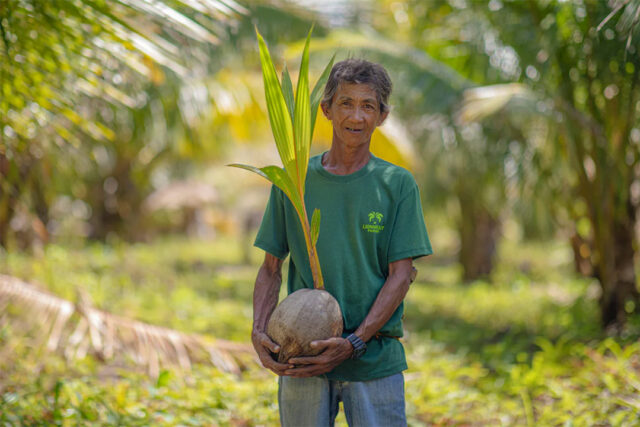
LIONHEART FARM

(Part 1)

The Philippine agriculture sector accounts for about 10% of total GDP but employs some 22% of the Philippine labor force, already exposing the low productivity of those working in farming. It is not a surprise that some 70% of those who fall below the poverty line (16% of the total population and about 22% of total households) are in the farming, fisheries and forestry sector. If we expand the definition from just farming to the entire value chain called agribusiness (which includes post-harvest, storage, logistics, food processing and retailing), the contribution to GDP can rise to 30%. The agriculture, forestry and fishing sector has been the weakest link of the Philippine economy, often posting volume declines and hardly averaging growth of 1% per annum over a 20-year period. If we want to achieve GDP growth rate of close to 8% annually over the next 10 to 20 years to be able to attain high-income status, we must accelerate the growth of the agriculture, forestry and fishing sector to at least 3% annually, a performance already attained by our ASEAN neighbors like Thailand and Vietnam.

Increasingly, with the expiration of the Comprehensive Agrarian Reform Law (CARP), there is a trend towards the bifurcation of the farming sector into two distinct agricultural models: on one side you have the millions of small farmers with two to three hectares of land each in such crops as rice, corn, vegetables, fruits and livestock. These farmers should be the target of government assistance in the form of farm-to-market roads, irrigation systems, post-harvest facilities, agricultural extension services and access to credit. Also playing a vital role in helping small farmers earn income above subsistence is the NGO sector, which includes cooperatives, social enterprises and philanthropic organizations. It must be kept in mind that such help to small farmers is primarily meant to eradicate poverty rather than attain significant increases in productivity. Only the second emerging sector, i.e., the large commercial farms that can attain economies of scale and employ the most advanced technology in agribusiness can help the country attain 8% GDP growth that is necessary for attaining high-Income status, say 20 years from now.

Fortunately, there are increasing signs that large-scale commercial farming is beginning to attract private capital. This is not only true for the traditional large-scale operations like those of banana and pineapple plantations, in which the Philippines has managed to keep up with other countries in Southeast Asia and South America. Now, we are witnessing long-term capital being invested in large-scale farming operations in coconut, palm oil, bamboo and dairy. I have high hopes that, if the BBM administration has the political will to help private investors reconsolidate millions of hectares (especially in the coconut industry) into larger farms of thousands of hectares each, we will see the success story of bananas and pineapples spread to other crops like coffee, cacao, mangoes, avocado, durian, pili, cashew, etc. It will not be easy because of the remaining agrarian reform mentality of some of our leaders. I am glad, though, that the present administration is no longer obsessed with agrarian reform as were past political leaders. I am witnessing small coconut farms being reconsolidated into bigger units through cooperativism, the nucleus estate model perfected by the Malaysians in palm oil production, and the conversion of denuded forest areas into commercial coconut farms. The pioneer in combining these three modes of farm consolidation is Lionheart Farm located in Rizal, Palawan. There are efforts to replicate this model (of about 3,000 hectares of coconuts) in such other regions as Quezon province, Samar, Leyte and Northern Mindanao.

How do we attain the goal of increasing agricultural productivity so that we can start growing at higher GDP growth rates of 8% or above? One answer given by some people in business and academe is to introduce digitalization and other forms of digital transformation into the whole agribusiness sector, starting with farming. This was the topic of a forum organized by the Center for Food and Agribusiness of the University of Asia and the Pacific (UA&P) in collaboration with the Southeast Asian Center for Graduate Study and Research in Agriculture (SEARCA). As mentioned by Annette Dacul, director of the Center for Food and Agribusiness of UA&P in her introductory remarks at the forum, digitalization is one of the strategic directions being implemented by the BBM administration to reverse the unfortunate reputation of agriculture as the sick sector of the Philippine economy. The other three strategic moves are product diversification, which will address the serious problem of overconcentration of our resources on rice to the detriment of many other crops in which the Philippines can be more productive and competitive; farm consolidation as explained above; and industrialization, i.e., processing agricultural materials we produce rather than just exporting them raw whenever commercially feasible. These topics will be addressed in future fora that will be also co-sponsored by CFA and SEARCA.

The agribusiness forum on March 14 on “Digital Transformation in Philippine Food and Agribusiness: Innovation for the Future” served as a platform to bring together key stakeholders in the Philippine food and agribusiness sector to discuss digital transformation and its role in shaping the future of the industry. It could be mentioned here that food security is being given the highest priority by the BBM administration. With rapid advancements in digital and related technologies, the forum explored innovative solutions to enhance productivity, efficiency and market access across the agricultural value chain.

Specifically, the forum and similarly, the other fora planned for the future on farm consolidation, diversification, and industrialization, are aimed at the following:

• Raise awareness: Highlight the importance of digital transformation in agriculture and food systems

• Showcase innovation: Present cutting-edge technologies and practices in farming, postharvest processing, logistics and market access

• Facilitate collaboration: Provide opportunities for networking and partnerships among industry leaders, government agencies, academe and private enterprises

• Strengthen policy advocacy: Advocate for policies supporting the digitalization of the food and agribusiness sector

There were panel discussions on “Digitalization in farm production and postharvest” led by Ana Cecilia Palma, founder and managing director of Yarran Consulting, and Christian Eyde Moeller, CEO at Lionheart Farms; Gilian Santos, CEO and co-founder of Anihan Technologies, Inc.; and Julius Barcelona, CEO at Harbest Agribusiness. The second panel discussion was on “Digitalization in logistics and market access,” which was moderated by Ruel Maningas, program director of the Master in Applied Business Analytics and professor of UA&P with panelists JT Solis, CEO and co-founder of Mayani; and Marc Concio, CEO and co-founder of KITA Agritech. The third panel was on “Financing in digital agriculture” moderated by V. Bruce Tolentino, former member of the Monetary Board with panelists Clarita de la Rosa and Laurence Hidalgo, program officer at LANDBANK; Tony Isidro, CEO at Fuse, the lending arm of GCash and Honorio Flameno, director of DA-ICT Service. The fourth panel discussed “Policy and partnerships” with Roehlano Briones, senior fellow at the Philippine Institute for Development Studies (PIDS) as moderator and panelists Mercedita Sombilla, former undersecretary for policy, planning and regulations at the Department of Agriculture; and Nerita Manalili, managing director at NEXUS Agriculture.

(To be continued.)


Bernardo M. Villegas has a Ph.D. in Economics from Harvard, is professor emeritus at the University of Asia and the Pacific, and a visiting professor at the IESE Business School in Barcelona, Spain. He was a member of the 1986 Constitutional Commission.

bernardo.villegas@uap.asia

Dollar wobbles as world waits for Trump’s reciprocal tariffs

US one-hundred-dollar notes are seen in this picture illustration taken in Seoul Feb. 7, 2011. — REUTERS

SINGAPORE — The dollar wobbled on Tuesday after a bruising quarter as weary investors braced for reciprocal tariffs from US President Donald J. Trump this week, a move that is likely to exacerbate the global trade war that has evoked US recession worries.

Investors’ focus has been firmly on the new round of reciprocal levies that the White House is due to announce on Wednesday, with details scarce. Mr. Trump said late on Sunday that essentially all countries will be slapped with duties this week.

That has left currency markets subdued as traders stayed on the sidelines awaiting clarity on Mr. Trump’s trade policies. Mr. Trump has already imposed tariffs on aluminum, steel and autos, along with increased tariffs on all goods from China.

“The second quarter may bring with it as much uncertainty and volatility for investors as the first quarter of the year,” said Anthony Saglimbene, chief market strategist at Ameriprise Financial.

“To date, there has been very little clarity on what and who these tariffs will target out of the gate. Market volatility could escalate depending on what and who is targeted.”

The euro was 0.11% lower at $1.0805 after gaining 4.5% in the first quarter of the year, its strongest quarterly performance since October-December in 2022, thanks mainly to Germany’s fiscal overhaul, although some investors are skeptical of the bull run lasting longer.

The Japanese yen was a shade stronger at 149.815 per dollar on Tuesday. The yen rose nearly 5% against the dollar in the January-March period on growing bets that the Bank of Japan would hike interest rates again.

Data on Tuesday showed business sentiment among big Japanese manufacturers worsened in the three months to March, a sign escalating trade tensions were already taking a toll on the export-reliant economy and complicating the Bank of Japan’s next move.

US DATA ALSO AWAITED
Beyond tariffs, a string of economic reports, including jobs and payrolls data, could shed much-needed light on how the US economy is holding up under a second Trump presidency.

Federal Reserve Chair Jerome H. Powell and other central bank officials’ speeches scheduled this week also could offer clues on the path for US interest rates.

The Reserve Bank of Australia (RBA) on Tuesday held interest rates steady at 4.1% and said it was still cautious about the outlook, though it dropped an explicit reference to being cautious about cutting rates again.

The Aussie was mostly steady, up 0.1% at $0.6256 in a muted response to the policy decision. The currency had touched a four-week low of $0.6219 on Monday, though it eked out a 1% gain in the first quarter.

“The RBA’s statement suggests they’re inching towards their next cut, but in no rush to signal one ahead of the election or the quarterly inflation figures,” said Matt Simpson, senior market analyst at City Index. Australia will hold a general election on May 3.

The RBA delivered its first rate cut in over four years in February but has since adopted a cautious tone on further easing, with Governor Michele Bullock and other top policy makers downplaying the likelihood of multiple cuts.

The dollar index, which measures the US currency against six rivals, was flat at 104.23. Sterling last fetched $1.2916, while the New Zealand dollar was at $0.56755. — Reuters

ADVERTISEMENT
ADVERTISEMENT