Home Blog Page 154

Meralco upgrades Caloocan substation

MANILA ELECTRIC CO.

POWER DISTRIBUTOR Manila Electric Co. (Meralco) has energized a substation in Caloocan City following a P208.45-million upgrade aimed at improving electricity service reliability in the city and nearby areas.

In a statement on Tuesday, Meralco said it installed a new 83-megavolt-ampere (MVA) power transformer bank, 34.5-kilovolt (kV) gas-insulated switchgear, four 115-kV power circuit breakers, and eight 115-kV disconnect switches.

The upgrade is intended to support rising power demand in key areas of North Caloocan and parts of San Jose del Monte, including Maynilad Water Services – La Mesa Water, SM Deparo, SM San Jose Del Monte, Regan Industrial Sales, Inc., and Converge J3 Caloocan data center.

The project is part of Meralco’s broader investments to support load growth and improve service reliability, with total spending amounting to P1.48 billion.

Meralco is the country’s largest private electric distribution utility, serving more than 8.2 million customers in Metro Manila and nearby provinces, including Bulacan, Cavite, Rizal, and parts of Laguna, Batangas, Pampanga, and Quezon.

Meralco’s controlling shareholder, Beacon Electric Asset Holdings, Inc., is partly owned by PLDT Inc. Hastings Holdings, Inc., a unit of PLDT Beneficial Trust Fund subsidiary MediaQuest Holdings, Inc., has an interest in BusinessWorld through the Philippine Star Group, which it controls. — Sheldeen Joy Talavera

When the world fractures, ASEAN must think strategically

STOCK PHOTO | Image by Pressfoto from Freepik

Recent tensions between the United States and Iran are a reminder that geopolitics never truly disappears. It simply fades into the background during periods of stability. When conflicts erupt again, they quickly reshape markets, trade routes, and investment decisions. What happens thousands of miles away can suddenly affect energy prices, shipping lanes, and investor confidence across Asia.

For many business leaders, geopolitical risk has long been treated as something distant, something for diplomats and policymakers to worry about. But that assumption is increasingly outdated. From the war in Ukraine to ongoing tensions between the United States and China, global business is now operating in an environment where politics and economics are tightly intertwined. The latest crisis in the Middle East reinforces this reality.

For ASEAN economies, the immediate concern is energy. A large portion of the world’s oil shipments pass through the Strait of Hormuz. Any disruption in that corridor has the potential to drive oil prices sharply higher, pushing up transportation costs, inflation, and the cost of doing business across the region. Countries that rely heavily on imported fuel, including the Philippines, are particularly sensitive to such shocks.

Higher oil prices ripple quickly across the economy. Manufacturing becomes more expensive as production costs rise. Logistics companies face higher fuel expenses. Airlines, shipping firms, and public transport operators must adjust fares or absorb losses. Food prices eventually follow because agriculture and distribution are energy intensive. For businesses operating on thin margins, these pressures accumulate quickly.

In the short term, therefore, the Middle East tensions present clear economic risks.

But global crises rarely stop at creating risk. They also rearrange the economic landscape.

History shows that major geopolitical disruptions often trigger shifts in investment flows and supply chains. The trade tensions between the United States and China several years ago pushed manufacturers to diversify production locations. Vietnam, Thailand, and Indonesia benefited as companies looked for alternative bases in Southeast Asia. The war in Ukraine accelerated Europe’s search for new energy partners and new supply routes.

In each case, instability in one region created opportunity in another.

This is where the ASEAN’s strategic position becomes important. Despite differences in political systems and economic structures, the region has largely maintained a posture of neutrality in global conflicts. ASEAN countries continue to engage with major powers across the spectrum while avoiding alignment with any single geopolitical bloc.

For global companies navigating uncertainty, that neutrality is valuable. Investors tend to look for locations that offer stability, predictable regulation, and access to growing markets. The ASEAN offers all three.

The region is home to more than 680 million people and one of the fastest growing digital economies in the world. Intra-regional trade continues to expand, supported by economic integration initiatives and growing connectivity among member states. Demographically, the ASEAN remains one of the youngest and most dynamic regions globally.

This combination makes Southeast Asia an attractive destination for capital seeking stability amid global turbulence.

However, opportunity does not automatically translate into advantage. It requires strategic thinking from both governments and businesses. In moments like this, leadership means looking beyond the immediate headlines and asking what structural shifts may follow.

For Filipino CEOs and business leaders, the more useful question is not whether geopolitical tensions will affect the global economy. They will. The more important question is how companies can position themselves before those changes fully unfold.

One area where businesses can act immediately is supply chain diversification and regional partnerships. Many companies still rely heavily on a single country for key components or manufacturing inputs. That approach worked in an era when globalization was predictable and trade flows were stable. But geopolitical tensions, trade restrictions, and logistical disruptions have shown how fragile concentrated supply chains can be.

Filipino companies can begin strengthening partnerships across the ASEAN, building supplier networks that span Vietnam, Indonesia, Thailand, and other regional markets. Even partial diversification can significantly reduce vulnerability. Companies can also explore joint ventures or regional production hubs that allow them to serve multiple markets within Southeast Asia. In the long run, firms that build regional supply ecosystems will be better positioned not only to withstand shocks but also to participate in the region’s expanding intra-ASEAN trade.

Energy resilience is another strategic priority that deserves more attention in boardrooms. The volatility created by global conflicts often shows up first in energy prices, and these shocks can persist longer than expected. Businesses that reduce their exposure to energy fluctuations gain a powerful competitive advantage during periods of instability.

Some companies are already exploring long-term power purchase agreements with renewable energy providers. Others are investing in energy-efficient technologies, modernizing equipment, or integrating solar generation into their operations. These steps may appear operational at first glance, but they increasingly shape long-term cost competitiveness. In an environment where oil prices can swing sharply due to geopolitical developments, companies with more stable energy costs are better able to plan, invest, and expand.

A third area where businesses should focus is productivity and digital capability. As labor markets tighten and competition intensifies, companies that harness emerging technologies to improve decision-making and efficiency will gain an edge. Artificial intelligence (AI) is beginning to play a role here, not as a futuristic concept but as a practical tool for forecasting demand, optimizing logistics routes, analyzing customer behavior, and improving operational planning.

Filipino companies do not need massive investments to begin exploring these capabilities. Even modest applications of data analytics and AI tools can improve forecasting accuracy, reduce waste, and strengthen operational agility. Organizations that start building these capabilities today will be far more resilient when economic conditions become unpredictable.

None of these moves are dramatic on their own. But together they reflect an important shift in mindset.

For many years, business leadership focused primarily on operational efficiency. Companies optimized supply chains for cost, expanded into new markets, and embraced globalization as a relatively predictable system. That world is changing.

Today’s business leaders must think more broadly about geopolitical developments, energy security, supply chain resilience, and technological capability. Strategic awareness is becoming as important as operational expertise.

This shift does not mean retreating from globalization. Rather, it means adapting to a more complex global landscape where resilience and flexibility matter as much as scale.

Periods of instability often reveal which economies and institutions are capable of responding with foresight. The ASEAN has the potential to demonstrate that capability. If the region strengthens cooperation, invests in resilient infrastructure, and deepens economic integration, it can emerge stronger from global disruptions rather than weakened by them.

Leadership, after all, is not defined only by how we perform in times of stability. It is defined by how we respond when the environment becomes uncertain.

For the ASEAN and for the Philippines, the current geopolitical tensions are a reminder that the global economy is constantly evolving. Risks will always exist. But within those risks also lie opportunities.

The challenge for leaders is to recognize them early and act with clarity. When the world becomes more uncertain, regions that offer stability, openness, and strategic vision become even more valuable.

In that environment, the ASEAN has every reason to step forward and think not just defensively, but strategically.


Dr. Donald Patrick Lim is the founding president of the Global AI Council Philippines and the Blockchain Council of the Philippines, and the founding chair of the Cybersecurity Council, whose mission is to advocate the right use of emerging technologies to propel business organizations forward. He is currently the president and COO of DITO CME Holdings Corp.


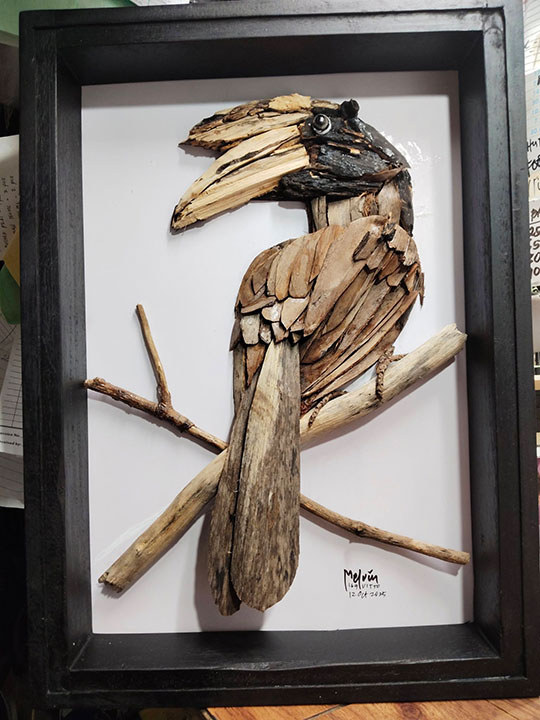
Philippine startup turns coastal litter into artwork

KALAW COASTAL LITTER DRIFTWOOD ART — MELVIN UPCYCLED COASTAL LITTER HANDICRAFTS FB PAGE

By Almira Louise S. Martinez, Reporter

KALAW COASTAL LITTER DRIFTWOOD ART — MELVIN UPCYCLED COASTAL LITTER HANDICRAFTS FB PAGE

A SMALL ENTERPRISE in Marinduque province south of the Philippine capital is converting driftwood and coastal litter into saleable artwork, offering an alternative use for marine waste while providing income to seaside communities.

Melvin Upcycled Coastal Litter Handicrafts, founded by Melvin M. Vitto, collects discarded materials such as driftwood and dried leaves — much of it washed ashore during typhoons — and turns them into portraits and decorative pieces.

“I’m the only person who likes a typhoon because I get to collect my materials,” Mr. Vitto told BusinessWorld in Filipino.

The initiative reflects a shift in how coastal cleanups are approached. Instead of discarding collected debris, the business treats biodegradable waste as raw material for craft production.

“We’ve changed the way we used to do coastal cleanups,” he said. “We’ve turned biodegradable trash into something more valuable.”

Mr. Vitto, who works at the Municipal Environment and Natural Resources Office in Marinduque, said the idea came from the volume of driftwood that accumulates along the province’s coastline after storms.

He began experimenting with driftwood in 2022 but initially struggled to secure support. Government programs could not help while the activity remained outside a formal business structure, he said.

The venture was launched in 2025 with an initial capital of P5,000. Since then, Mr. Vitto has produced customized portraits of politicians and pets using assembled pieces of wood shaped and arranged to form detailed images.

Support followed once the activity became a registered enterprise. “When it became a business, that’s when they helped us,” he said, referring to assistance from the Department of Trade and Industry.

Still, Mr. Vitto said products tied to environmental advocacy could be difficult to market.

“Businesses with good advocacy sometimes remain just ideas,” he said. “If it’s not widely promoted, it’s hard to sell.”

The enterprise also creates a secondary income stream for coastal residents. Locals collect driftwood and other usable debris, which the business buys at about P500 per sack.

This model links waste recovery with livelihood, particularly in areas where income opportunities are limited.

Marine litter remains a persistent issue in the Philippines. Data from the International Coastal Cleanup showed more than 306,600 kilos of waste were collected across 298 coastal sites nationwide in 2025. Metro Manila accounted for more than 135,000 kilos, while Central Visayas collected about 42,000 kilos. The Mimaropa region, which includes Marinduque, collected more than 12,000 kilos.

Mr. Vitto said changing perceptions of waste remains a challenge, noting that reusable materials are often still discarded.

“What’s hard with trash is even if it’s reusable, people still see it as waste,” he said.

For him, driftwood carries symbolic value beyond its commercial use.

“After everything it went through, it gets a new life,” he said.

Arts & Culture (03/18/26)


Fujifilm Philippines mounts photo and video exhibition

THIS YEAR, Fujifilm Philippines is celebrating visual stories from across the Philippines, all brought together in one space. In an exhibition, top entries from its Nationwide Photo & Video Walk 2025 will be compiled to highlight contrast, depth, diversity, and creative vision. Photographs from Walk Leaders across 32 locations nationwide will also be showcased for their unique perspectives. The exhibition will be open to the public from March 20 to 22 at Ayala Museum, Makati City.


FEU presents Haydn’s The Seven Last Words of Jesus Christ

FAR EASTERN UNIVERSITY (FEU), through the FEU Center for the Arts, is presenting the Pundaquit Virtuosi from Zambales in Haydn’s The Seven Last Words of Jesus Christ on March 31 at the FEU Chapel. A Holy Week presentation, it will include reflections between musical passages while surrounded by the chapel’s Stations of the Cross, a National Cultural Treasure created by National Artist Carlos “Botong” Francisco. This special Lenten event is presented in partnership with the FEU Campus Ministry. It is free to all visitors on March 31, 5 p.m., at the FEU Chapel. Limited seats are available so pre-registration is needed via https://forms.office.com/r/Tb3m5a9W49.


Purita Kalaw-Ledesma collection of posters on exhibit

THE exhibit Collecting the Moment: Art Exhibitions in Print is displaying gallery posters personally collected by art patroness, writer, and cultural worker Purita Kalaw-Ledesma. It tours viewers through the evolution of modern and contemporary art in the Philippines through 130 print materials. These are made in different ways, such as typography, imagery, and graphic design, each a reflection of shifting popular aesthetics, curatorial approaches, and cultural conversations across time. Spanning the 1970s and 1980s, the pieces are on view to the public until March 31 at A1201 Benilde Design + Arts Campus, 950 Pablo Ocampo St., Malate, Manila.


Manila International Performing Arts Market open for entries

THE Manila International Performing Arts Market (MIPAM), organized by the Cultural Center of the Philippines and CREATE Philippines, is inviting performing arts companies and artists to submit proposals until March 31 for showcase consideration. Performance groups and individual applicants for MIPAM 2026 must submit a proposal, including attached action photos and a one-minute rehearsal video, to mipam@culturalcenter.gov.ph. Bold and original works in folk reinterpretation, contemporary, and street-pulse styles are highly encouraged, as well as cross-border collaborations and tech-driven performances. MIPAM 2026 will take place from Sept. 11 to 13 at the Tanghalang Ignacio Gimenez (CCP Blackbox Theater) at the CCP Complex in Pasay City.

LANDBANK ties up with LMP to expand LGU financing

LAND BANK OF THE PHILIPPINES

LAND BANK of the Philippines (LANDBANK) has signed a memorandum of agreement with the League of Municipalities of the Philippines (LMP) to expand access to financing for local government units (LGU), supporting infrastructure and public service projects nationwide.

Under the partnership, 1,486 municipalities will gain broader access to development financing, technical assistance, and information on the bank’s lending programs.

“By providing municipalities with accessible financing, we empower local leaders to transform their communities and strengthen local economies,” Lynette V. Ortiz, president and chief executive officer at LANDBANK, said in a statement. “This partnership helps turn plans into action, enabling better services for their constituents.”

LGUs may tap funding for projects such as roads, healthcare facilities, sanitation systems and disaster resilience initiatives.

As of January, LANDBANK said its enhanced LGU lending program has disbursed P190 billion for infrastructure and socioeconomic projects. Its multi-developmental financing support program has approved P3.6 billion in loans, prioritizing third- to fifth-class municipalities with limited fiscal capacity.

Beyond lending, the bank said it would continue to support municipalities through guidance on borrowing, fiscal management and project development to ensure sustainable outcomes.

As of end-2025, LANDBANK had 10,412 touchpoints nationwide across all 82 provinces, including 615 branches and branch-lite units, 60 lending centers, and thousands of ATMs and agent banking partners. — Aaron Michael C. Sy

Maharlika completes stake acquisition in ATI

ASIANTERMINALS.COM.PH

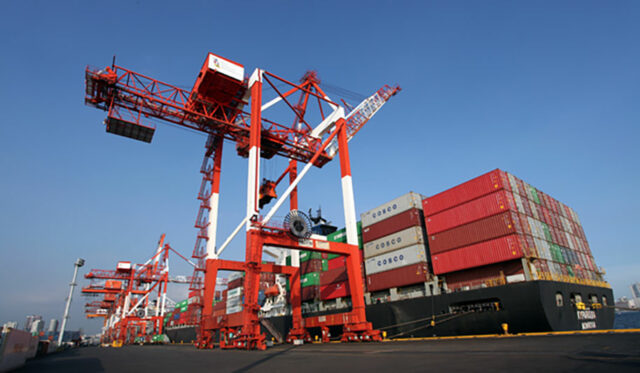
THE MAHARLIKA Investment Corp. (MIC) said it has completed its acquisition of shares in Asian Terminals, Inc. (ATI), securing a stake in the port and logistics operator.

“The accepted shares tendered in the transaction were crossed through the facilities of the Philippine Stock Exchange (PSE) on March 13, with settlement completed on March 17,” MIC said in a statement on Tuesday.

“Following this process, MIC has formally become a shareholder of ATI, securing an equity stake in one of the country’s most critical port and logistics infrastructure operators,” it added.

The shares were acquired from Seawood Resources, Inc., Kayak Holdings, Inc., and Asiasec Equities, Inc., among others.

The tender offer resulted in the acquisition of 177.61 million ATI common shares, of which 101.19 million were allocated to MIC and 76.42 million to ATI as part of its share buyback program.

Following the transaction, ATI’s public float fell to 0.74%, while combined tendered shares, excluded shares, and other non-public shares reached 99.29%, exceeding the 95% threshold for voluntary delisting.

ATI is scheduled to delist from the Philippine Stock Exchange on April 3, as previously announced.

MIC said the investment positions the company in a key segment of the country’s trade and logistics sector.

“When we first announced this intent in December, I described the port sector as the ‘circulatory system of the Philippine economy.’ Today, we have successfully secured our place within that system,” said MIC President and Chief Executive Officer Rafael D. Consing, Jr.

“This investment fulfills our mandate to capture value from assets with high barriers to entry and a direct correlation to our nation’s gross domestic product growth,” he added.

MIC said the investment could support job creation, improve logistics and supply chain efficiency, and facilitate the adoption of digital solutions in port operations.

Established under Republic Act No. 11954, MIC manages the Maharlika Investment Fund.

It is mandated to support economic development through strategic investments in sectors such as infrastructure, energy, agriculture, and digitalization. — Justine Irish D. Tabile

Understanding well-known marks in the Philippines

STOCK PHOTO | Image from Freepik

In a country where branding plays a powerful cultural role, trademarks now often become part of everyday life. Consumers quickly learn to associate a term, a logo, a color, or even product packaging with a particular level of quality or customer experience. Over time, certain marks grow beyond their original purpose of identifying goods or services and become associated with a certain level of trust, familiarity, and reputation. When this level of recognition is achieved, the law acknowledges that these brands require stronger protection to preserve both their value and to protect the public from unfair commercial practices. These are known as well-known marks — trademarks that have achieved a level of prominence and public recognition that they are formally declared as such by the proper authorities.

The protection of a well-known mark is governed by the Intellectual Property Code, relevant Supreme Court issuances, and rules issued by the Intellectual Property Office of the Philippines (IPOPHL). In 2025, the IPOPHL, through the Regulations on Well-Known Marks, formalized a system for the declaration of a well-known mark and its inclusion in a “Register of Well-Known Marks.”

This distinction carries significant advantages. For both registered and non-registered trademarks, a mark declared as well-known enjoys safeguards against the use of identical or confusingly similar marks covering related goods and services. If the mark is registered with the IPOPHL, the protection further extends to unrelated goods and services.

Yet achieving this status requires far more than simple popularity. It requires evidence. Applicants must present substantial evidence demonstrating that the mark has achieved a well-known status internationally and in the Philippines. Among the factors considered are the duration and geographical extent of the mark’s use, the scale of advertising and promotion, the degree of distinctiveness the mark has acquired, its market share, and the commercial value attributed to the brand. These criteria ensure that only marks with genuine and demonstrable reputation are granted the well-known mark designation.

Previously, a mark could only be declared well-known through an inter partes case, e.g., opposition cases, or through an IP violation case, e.g., infringement case. Now, with Regulations on Well-Known Marks, the process of declaration can be done ex parte or without any adverse party.

The process itself is straightforward. An applicant must file a notarized application with IPOPHL, accompanied by documentation supporting the mark’s claim of well-known status. Examiners review the evidence and may issue office actions requesting additional information, if necessary. This evaluation ensures that the claim of well-known status is supported by verifiable facts rather than mere assertions.

Once the application satisfies the examination requirements, it is published in the IPOPHL E-Gazette, allowing the public an opportunity to submit third-party observations within a prescribed period if they believe the mark does not meet the standards for well-known status. After reviewing the evidence, the observations, and the applicant’s responses, the Director of Trademarks issues the final decision on whether the mark should be declared well-known. This is one of the key differences that the Regulations bring. Now, it is not only the courts, the IPOPHL’s Director General, and the IPOPHL’s Bureau of Legal Affairs who can declare a mark well-known. Under the Regulations, this may also be done by the IPOPHL’s Director of Trademarks.

If approved, the declaration is published and the mark is officially entered into the Register of Well-Known Marks. The recognition is valid for 10 years from the date of declaration and may be renewed for successive 10-year periods, provided that the owner demonstrates continued use of the mark through the submission of Declarations of Actual Use, and maintains its well-known reputation.

However, a declaration may be revoked if the owner fails to renew the status, does not submit proof of continued use, or if substantial evidence shows that the mark no longer enjoys the level of recognition required under the rules. Third parties may also file petitions to challenge the continued well-known status of a mark if circumstances have changed.

In today’s global and digital marketplace, the importance of trademark protection has only grown. Counterfeit goods, imitation branding, and online marketplaces have made it easier for infringers to capitalize on the reputation of established brands. Even subtle similarities in packaging, logos, or brand names can spark the interest but mislead consumers and erode the distinctiveness that companies have worked hard to build. The well-known mark designation helps address these challenges by recognizing that certain trademarks carry powerful public associations.

Ultimately, our legal system reflects a broader goal: maintaining fairness and integrity in the marketplace. By identifying and protecting well-known trademarks, the law ensures that businesses are rewarded for building strong brands while consumers remain confident that the names and symbols they trust remain authentic.

In the end, the declaration of a well-known mark represents more than a legal status. It signals that a brand has crossed an important threshold, from simply identifying a product to becoming a symbol widely recognized by the public. When that happens, the law steps in to make sure that reputation, carefully built over time, remains protected.

This article is for general informational and educational purposes only and not offered as, and does not constitute legal advice or legal opinion.


Joan Janneth M. Estremadura is a Senior Associate of the Intellectual Property Department of Angara Abello Concepcion Regala & Cruz Law Offices (ACCRALAW).

jmestremadura@accralaw.com

+632-8830-8000

NephroPlus rolls out reward-based app as dialysis demand rises

NEPHROPLUS.PH

By Almira Louise S. Martinez, Reporter

INDIA-BASED dialysis provider NephroPlus Dialysis Centers Pvt. Ltd. has launched a mobile app to help patients manage their condition, as demand for treatment rises in the Philippines.

The app combines health monitoring with a reward system designed to encourage patients to stick to strict care routines required for chronic kidney disease.

“We want to build a community of dialysis guests, and we want to give them information on how to take care of themselves,” Country Head Gowtham Arumugam told BusinessWorld in an interview.

Patients can log vital signs such as blood pressure and pulse, track fluid intake and monitor their health over time.

Those who stay within recommended ranges earn “wellness tokens,” which can be used for transport, food, retail and health services.

“If you’re maintaining the range, you will get rewarded,” Mr. Arumugam said. “You are building that habit.”

The rollout comes as chronic kidney disease cases remain widely underdiagnosed. Data from AstraZeneca Philippines estimates about 7 million Filipinos are living with stage 3 and above kidney disease, with roughly 90% unaware of their condition.

At the same time, the number of dialysis patients is expected to climb sharply. Estimates from Ken Research show cases rising to almost 150,000 by 2030 from 40,000 in 2020, making dialysis one of the fastest-growing healthcare segments in Southeast Asia.

The app, called the NephroPlus Guest App, integrates clinic services with a learning platform and support network.

Patients — referred to by the company as “guests” — can upload laboratory results, with abnormal readings flagged for follow-up with doctors.

“Guests can enter their own vital signs into the app, allowing them to track their health regularly and monitor changes over time,” Alvin Marcelo, senior quality manager at NephroPlus Philippines, told a news briefing on March 13.

Managing fluid intake is a key part of dialysis care. Excess fluid between sessions can lead to swelling, breathing difficulties and added strain on the heart, Mr. Marcelo said.

The platform also offers video consultations with nephrologists, dietitian support, session booking and access to dialysis-friendly recipes.

NephroPlus said the reward feature is meant to improve adherence to treatment routines, which often require strict discipline.

“Dialysis requires controlling fluid intake, maintaining weight and attending sessions regularly,” NephroPlus Philippines Operations Head Mae Eileen Grace Torre told the same briefing. “The goal isn’t just rewards; it’s about keeping our guests motivated and engaged in their dialysis journey.”

NephroPlus Philippines conducts about 29,000 treatments monthly across 43 centers nationwide. The company plans to expand to 150 clinics by 2028 as it seeks to capture rising demand.

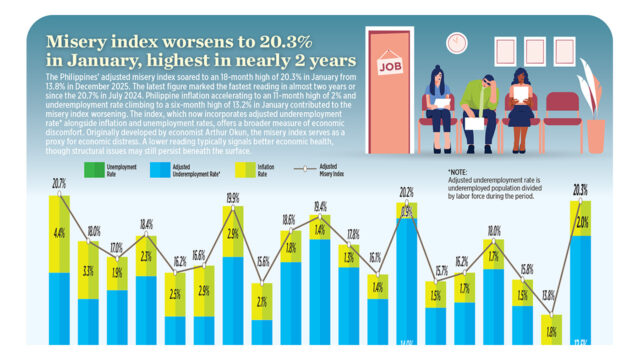
Misery index worsens to 20.3% in January, highest in nearly 2 years

The Philippines’ adjusted misery index soared to an 18-month high of 20.3% in January from 13.8% in December 2025. The latest figure marked the fastest reading in almost two years or since the 20.7% in July 2024. Philippine inflation accelerating to an 11-month high of 2% and underemployment rate climbing to a six-month high of 13.2% in January contributed to the misery index worsening. The index, which now incorporates adjusted underemployment rate* alongside inflation and unemployment rates, offers a broader measure of economic discomfort. Originally developed by economist Arthur Okun, the misery index serves as a proxy for economic distress. A lower reading typically signals better economic health, though structural issues may still persist beneath the surface.

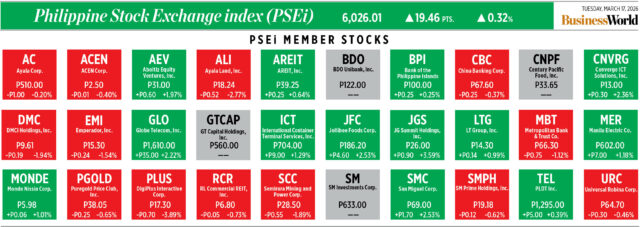
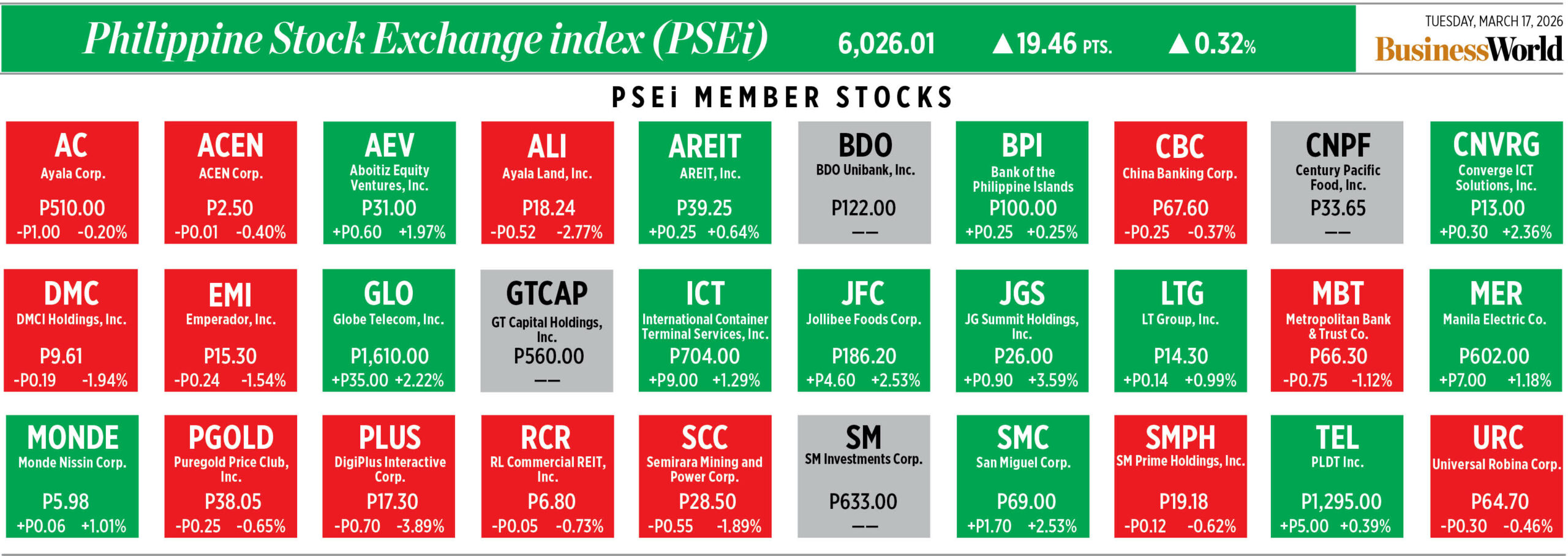
How PSEi member stocks performed — March 17, 2026

Here’s a quick glance at how PSEi stocks fared on Tuesday, March 17, 2026.


Palace: No need for state of emergency yet

A gas attendant is at work at a gasoline station in Manila in this file photo. — PHILIPPINE STAR/NOEL PABALATE

By Chloe Mari A. Hufana, Reporter

THE Philippines does not need to declare a state of national emergency to take over the oil industry as the situation remains “in control,” the Presidential Palace said on Tuesday, amid rising fuel prices driven by the Middle East crisis.

“We are not yet in that situation,” Palace Press Officer Clarissa A. Castro said Filipino in a livestreamed press briefing.

The government, through the Department of Energy (DoE) under Secretary Sharon S. Garin, maintains a constant communication with oil companies and their leaders, she noted, adding Congress’ move to draft a measure that grants President Ferdinand R. Marcos, Jr.’s emergency powers to reduce or suspend excise tax on fuel.
“Our only request is that, given the current circumstances, let us refrain from activities such as fear‑mongering, which only add to the anxiety of our people,” Ms. Castro also said.

“The President and the government remain in control of the situation.”

Ms. Castro’s comments followed calls for Mr. Marcos to declare a state of national emergency for the government to temporarily take over the oil industry to regulate fuel prices.

House Deputy Speaker Raymond Democrito C. Mendoza earlier this week said the President can invoke Section 14(e) of Republic Act No. 8479, which states that “in times of national emergencies, when the public interest so requires, the DoE may, during the emergency and under reasonable terms prescribed by it temporarily takeover or direct the operation of any person or entity engaged in the industry.”

The lawmaker said that while the conflict is thousands of kilometers away, it becomes a national emergency when it begins dictating how Filipino families eat, ride and pay for their needs.
Asked about the Palace’s position on calls to repeal Republic Act No. 8479 or the Oil Deregulation Law, which liberalized the oil industry, Ms. Castro said it is up to Congress.

“It is up to Congress to decide what they think or what they see as good for our country, and if they can show or influence our President through their drafting of laws, all that will benefit the country, the President will not oppose it,” she added.

Ms. Garin earlier said the agency has no authority to set price ceilings on fuel prices due to the said law but added she is in favor of revisiting the law to a certain extent.

Noel M. Baga, co-convenor of the Center for Energy Research and Policy think tank, said the Philippine government already has sufficient legal authority to shield consumers from surging fuel prices during crises, pushing back against calls for more drastic state intervention in the oil industry.

Existing laws such as the Price Act of the Philippines and the Philippine Disaster Risk Reduction and Management Act allow authorities to impose price ceilings on petroleum products during a declared national emergency, he said.

These powers, he added, are not curtailed by the Oil Deregulation Law, countering claims that government intervention would violate the country’s liberalized downstream oil market framework.

“The legal tools to protect consumers are already there,” he said via Facebook Messenger. “There is no need for an industry takeover when these powers already exist.”

Instead, the constraint lies in execution. Deploying price controls would require stronger political resolve as global oil volatility feeds into domestic inflation, disproportionately affecting low- and middle-income households.

“Every peso added to fuel prices is a peso taken from Filipino families,” he said.

Over the longer term, structural reforms remain key. Expanding domestic renewable energy capacity would reduce the Philippines’ exposure to external price shocks and lessen dependence on imported fuel, he said, providing a more durable solution than short-term market interventions.

DND may rethink fighter jets plan over funding concerns

AN F-16 FIGHTER JET from the 2024 US-Philippine joint military exercises at Basa Air Base, Pampanga. — PHILIPPINE STAR/WALTER BOLLOZOS

DEFENSE SECRETARY Gilberto C. Teodoro, Jr. on Tuesday said he would hold off on acquiring coveted multi-role fighter jets if funding falls short, stressing he would prefer buying enough aircraft to exert credible deterrence than settle for a few within the budget.

He said the government should buy a minimum of 40 advanced fighter jets to shore up air power, and he would proceed with the purchase if enough funding for those planes is provided.

“We will not allow buying only a few jets,” he told reporters in Filipino, based on a recording shared by the Department of National Defense (DND). “There is a minimum impact quantity when you order.”

“We cannot buy a few and then purchase more the following year, because the price will balloon and triple,” he added.

The Philippines has been scouting for multi-role combat jets as part of efforts to boost its inventory of air force planes, which mainly consist of turboprops, and as Manila faces a dispute with Beijing in the South China Sea.

China claims nearly all of the South China Sea via a U-shaped, 1940s nine-dash line map that overlaps with the exclusive waters of the Philippines, resulting in clashes at disputed maritime features as both the nations uphold their claims in the resource-rich waters.

“The force size we are asking for is 40 jets,” Mr. Teodoro said. “But still, that is not enough.”

Washington last year greenlit the Philippines’ request for 20 units of F-16 fighters from Lockheed Martin Corp., according to a Defense Security Cooperation Agency notice in April.

The proposed $5.6-billion arms deal includes missiles, bombs, radar units, backup jet engines and engineering and technical support services for the planes. Mr. Teodoro in 2024 said the government is allotting as much as $6.9 billion for the acquisition of 40 advanced military jets.

The Philippines has launched a $35-billion military modernization program aimed at bolstering its defense capabilities in the next decade, buying warships from South Korea, a missile system from India, all while letting a US missile battery that could hit the Chinese mainland stay in the country.

Manila is also seeking to deepen its security ties with other nations by forging agreements letting foreign militaries enter the country.

Mr. Teodoro also said the Philippines cannot escort ships through the Strait of Hormuz, as US President Donald J. Trump presses its allies to provide military support to open the crucial chokepoint.

“We don’t have the capability to escort,” he said, adding that authorities are doing “everything” to help Filipinos affected by the Iran war. Kenneth Christiane L. Basilio

ADVERTISEMENT
ADVERTISEMENT