Home Blog Page 1526

EDSA rehabilitation starts mid-June

Vehicles are stuck in traffic along EDSA-Taft in Pasay City, May 20, 2025. PHILIPPINE STAR/RYAN BALDEMOR

By Ashley Erika O. Jose, Reporter

THE P8.7-billion rehabilitation of the Epifanio de los Santos Avenue (EDSA) is set to begin on June 13 and expected to be completed by 2027, the Department of Transportation (DoTr) said on Monday.

The DoTr outlined plans to address the traffic congestion that is expected to worsen once parts of Metro Manila’s busiest highway will be closed for rehabilitation work.

“We will rebuild EDSA. This project by the Department of Public Works and Highways (DPWH) will rehabilitate the full stretch of EDSA and make it a green and walkable highway. We need to change the entire concrete structure of EDSA,” Transportation Secretary Vivencio B. Dizon said at a media briefing on Monday.

The EDSA rebuild project, which will run for two years, will be the highway’s first major rehabilitation since 1980. Around 437,000 vehicles use EDSA every day.

Public Works Secretary Manuel M. Bonoan said the project aims to make Metro Manila’s longest and most congested highway a more pedestrian and commuter-friendly road.

Preparatory works will begin on the night of June 13, while construction will go full blast a week after, Mr. Bonoan said. This will include laying out the sections as the rehabilitation project is intended to be implemented lane by lane.

“The concept of the rebuild project, our deliverables are to rebuild and reconstruct the entire EDSA. We will change the pavement into a new one, in other words we will flip the entire EDSA and adapt the latest technologies on concrete mix,” Mr. Bonoan said.

“We will deploy several contractors simultaneously. Construction will proceed lane by lane.”

Overall, a total of 200 kilometers of lane covering both northbound and southbound of EDSA will be rehabilitated, Mr. Bonoan said, adding that the south portion will be done first, followed by the northbound section next year.

“I do not think we can finish the southbound portion this year because it is already the middle of the year. We will continue the implementation of southbound and northbound until next year, simultaneously,” Mr. Bonoan said.

Starting mid-June, the government will work on the excavation of the existing surface and installation of new concrete, prioritizing the sections of Pasay and Guadalupe.

Mr. Bonoan said the EDSA Bus Lane, which serves nearly 200,000 average daily passengers, will continue to operate during the rehabilitation period.

He said the government is prioritizing the south portion of EDSA due to the country’s anticipated hosting of the Association of Southeast Asian Nations (ASEAN) Summit in 2026 which is expected to be held in the south of Metro Manila.

“Our consideration for this scheme is the ASEAN meeting. We will have to avoid the construction in EDSA during that time,” Mr. Bonoan said.

TRAFFIC MANAGEMENT
DoTr’s Mr. Dizon said that San Miguel Corp. (SMC) had agreed to waive the toll fee for some segments of the Skyway Stage 3 during the EDSA rehabilitation period.

“We understand that this temporary arrangement might result in loss of income to SMC, the operator of Skyway. In response, the DoTr and Toll Regulatory Board are exploring options to grant SMC some reprieve, including possible extension of their concession agreement with the government,” he said.

BusinessWorld also sought comment from SMC but it has yet to respond as of the deadline.

“The free toll will begin once the full blast of construction starts, so maybe that is July or August,” Mr. Dizon said.

The DoTr and the Metropolitan Manila Development Authority (MMDA) have also developed their initial traffic mitigation plans which include the deployment of 100 units of bus on EDSA Busway; and more trains at Metro Rail Transit Line 3 (MRT-3).

MMDA Chairman Romando S. Artes said the odd-even scheme for private cars will also be strictly implemented along EDSA for a 24-hour period except on Sundays.

Under this scheme, private cars with plates ending in odd digits will be barred from using EDSA during Mondays, Wednesdays, and Fridays, while vehicles with plate numbers ending in even numbers cannot use EDSA on Tuesdays, Thursdays, and Saturdays.

“With this scheme, we expect a 40% reduction of vehicles in EDSA. The existing coding schemes will continue to be in place for roads outside EDSA,” Mr. Artes said.

Electric vehicles, and hybrid cars are exempted from the number coding scheme, under the Electric Vehicle Industry Development Act (EVIDA) in the Philippines.

Transportation Network Vehicle Service (TNVS) like Grab and inDrive are also exempted from the odd-even scheme on EDSA.

Further, trucks and provincial buses will also be prohibited from using EDSA during 5 a.m. to 10 p.m. starting June 13.

ECONOMIC IMPACT
A 2018 Japan International Cooperation Agency (JICA) study had estimated the economic cost of traffic congestion in Metro Manila stood at around P3.5 billion a day.

“EDSA rehabilitation should have been done years ago. It would create temporary pains. I was part of the JICA study (in 2018), and the economic loss is now already bigger than that. It can go down, after the completion of EDSA rehabilitation,” Rene S. Santiago, former president of the Transportation Science Society of the Philippines, said in a Viber message to BusinessWorld.

Manila was the 14th most traffic congested city in the world, with an average travel time of 32 minutes for an average 10-kilometer distance, according to the latest edition of the TomTom Traffic Index.

John Paolo R. Rivera, a senior research fellow at the Philippine Institute for Development Studies, said that the closure of parts of EDSA would likely worsen traffic and affect consumer activity.

“The expected traffic disruptions caused by construction, coupled with the odd-even scheme, are likely to discourage individuals from visiting shopping malls, restaurants, and entertainment venues along EDSA. People may prefer to visit establishments outside of congested areas or accessible via alternate routes,” he said in a Viber message.

However, Mr. Rivera said that once the project is completed, it can deliver long-term benefits including improved traffic flow and reduced travel time.

“This will increase productivity and lower vehicle operating costs and fuel consumption. It will also help better road safety and commuter experience; higher business confidence and increased property values along EDSA,” he said.

Globalinks Securities and Stocks, Inc. Head of Sales Trading Toby Allan C. Arce said that the EDSA rehabilitation can have a significant impact on both traffic patterns and economic activities, especially for businesses reliant on foot traffic.

Mr. Arce said this may boost online shopping as consumers prioritize convenience.

“Some businesses may adapt by emphasizing delivery services or offering online shopping options. However, those unable to pivot effectively may suffer more severely,” he said.

Shopping malls and entertainment venues could face lower revenues, Mr. Arce said, noting that these businesses rely on impulse visits and foot traffic.

“Overall, while the rebuild project is necessary for long-term improvements, its short-term disruptions will likely affect consumer habits and business revenues unless proactive steps are taken to manage and mitigate the impacts,” he said.

Marcos backs ASEAN consensus to avoid retaliation against US

Malaysia’s Prime Minister Anwar Ibrahim stands next to Philippines’ President Ferdinand R. Marcos, Jr. before the plenary session at the 46th Association of Southeast Asian Nations (ASEAN) Summit in Kuala Lumpur on May 26, 2025. — MOHD RASFAN/POOL VIA REUTERS

By Chloe Mari A. Hufana, Reporter

PHILIPPINE President Ferdinand R. Marcos, Jr. on Monday welcomed the consensus of the Association of Southeast Asian Nations (ASEAN) to avoid retaliatory actions against the US, which slapped so-called reciprocal tariffs on its trading partners.

“We commend Malaysia’s leadership in convening the Special ASEAN Economic Ministers’ Meeting and welcome the consensus to avoid retaliatory measures,” Mr. Marcos said during his intervention at the 46th ASEAN Summit in Kuala Lumpur, Malaysia.

Mr. Marcos said the regional bloc’s commitment to a unified, rules-based response reinforces economic stability amid increasing geopolitical and trade uncertainty.

“This measured and unified approach upholds ASEAN’s commitment to dialogue, diplomacy, and a rules-based multilateral trading system,” he added.

The two-day ASEAN summit began on Monday amid heightened global market volatility arising from the Trump administration’s tariff threats.

Several ASEAN countries face higher-than-expected US tariffs, ranging between 32% and 49%. These tariffs could be imposed starting July unless these countries successfully negotiate lower tariffs with Washington.

The Philippines was slapped with a 17% tariff, the second-lowest tariff among ASEAN members.

Mr. Marcos said the regional bloc must continue to prioritize sustainable and inclusive growth even as geopolitical and economic pressures mount.

“Geopolitical tensions, unexpected trade barriers, and the unprecedented impact of climate change have the potential to disrupt our communities and supply chains and remove our hard-earned progress,” he said.

“Yet, by working together, strengthening our institutions, and building the resilience and capacities of our people, we can better navigate this increasingly uncertain future and turn challenges into opportunities for shared growth and stability,” he added.

ASEAN has increasingly positioned itself as a stabilizing force amid rising protectionism and US-China tensions.

The region’s collective gross domestic product (GDP) stood at $3.8 trillion in 2023, according to the ASEAN annual report. While the region ranks as the third-largest trading bloc globally, with total trade reaching $3.5 trillion.

The unified ASEAN response is a pragmatic one, said Francis M. Esteban, associate dean at the Far Eastern University’s Institute of Arts and Sciences.

“[Because] it is easier to build consensus among its member-states on this rather than retaliating against the US,” he said in a Messenger chat.

Retaliating against Washington might cause more disruption, he said, noting that the US was ASEAN’s largest source of foreign direct investments and the second-largest trading partner in 2024.

“This gives more certainty to the business sector since retaliatory tariffs often lead to further retaliations from the other party,” Mr. Esteban added.

“In a way, this is also ASEAN’s way of saying that it is open to strengthening its partnerships and engagements with other economic actors aside from the US,” he added.

However, a unified non-retaliatory stance against the tariffs may be a “tricky thing,” according to diplomacy lecturer at the De La Salle-College of St. Benilde, Josue Raphael J. Cortez.

“This is because retaliation — economically speaking — is an inevitable phenomenon in geoeconomics,” he said in a Messenger chat. “This may be viewed by other members of the global village as an exemplification of our surrender towards more powerful economies.”

For Mr. Esteban, the number one risk of a unified approach is how the 10 ASEAN members would defend their economies and shield consumers from the tariffs imposed by Washington.

“However, the opportunity really lies in diversifying economic partners,” he noted. “Trump is trying to challenge the rules-based order that the US has championed for so long, which I think many states benefited [from] and would want to see stay the same way.”

If the regional bloc remains firm in its commitment to non-retaliation, a free trade agreement with the world’s largest economy may thrive, Mr. Cortez said. He added the US could also possibly lower the reciprocal tariffs on individual ASEAN countries.

“As the US is eyeing Southeast Asian markets as alternatives to source the things China has offered it for the longest time, a non-retaliatory stance may be the more viable option at this point,” he added.

According to Mr. Cortez, the ASEAN consensus is among the primary pillars guiding the region’s dynamics, calling it an integral part in navigating trade and economic challenges.

“The majority of ASEAN members are developing — this has already been acknowledged by ASEAN leaders — hence, working collectively to ascertain that the negative repercussions of retaliatory tariffs would not impede the growth of ASEAN states is paramount,” he said.

Monetary policy not enough to shield PHL from trade shocks

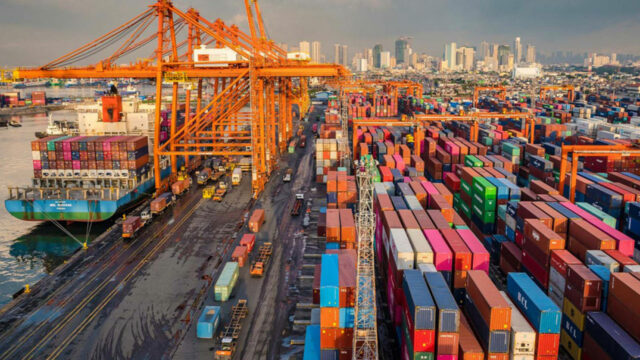
MANILA INTERNATIONAL CONTAINER TERMINAL — ICTSI.COM

MONETARY POLICY may not be enough to cushion the economy from the potential impact of trade shocks, the Bangko Sentral ng Pilipinas (BSP) said.

“Today, unprecedented policy shocks are fueling a befuddling kind of uncertainty. Monetary policy alone cannot fully shield the economy from the repercussions of these shocks,” BSP Deputy Governor Zeno Ronald R. Abenoja said at a forum hosted by the Philippine Institute for Development Studies (PIDS) and central bank on Monday.

“Broader, coordinated strategies would indeed help.”

Quoting BSP Governor Eli M. Remolona, Jr., Mr. Abenoja said that trade shocks are “more damaging” than supply shocks.

“Unlike your usual supply shocks, which tend to be transitory, trade shocks have deeper, more persistent effects,” he said.

Last month, US President Donald J. Trump slapped reciprocal tariffs on nearly all its trading partners. However, he suspended the implementation of the higher tariffs until July but kept the baseline 10% tariff.

“In particular, trade shocks affect the capital stock of developing economies. Left unchecked, they can slow growth trajectories and erode decades of hard-won progress,” Mr. Abenoja said.

Mr. Remolona earlier said that central banks have been concerned about the global trade uncertainties, prompting the need to update models and frameworks to better account for these risks.

However, Mr. Abenoja said the Philippines is “well-positioned to manage inflation.”

Headline inflation slowed to an over five-year low to 1.4% in April, bringing the four-month average to 2%.

“This gives us extra degrees of freedom to ease monetary policy which in turn can support growth,” he added.

Mr. Remolona has signaled the possibility of two more rate cuts this year, in “baby steps” or increments of 25 basis points (25 bps).

Last month, the Monetary Board lowered benchmark interest rates by 25 bps to bring the policy rate to 5.5%.

The central bank has so far slashed borrowing costs by a total of 100 bps since it began its easing cycle in August last year.

“The BSP stands ready to do what is necessary to keep inflation steady and maintain the country’s macroeconomic stability,” Mr. Abenoja added.

INDUSTRIAL POLICY
Meanwhile, PIDS Emeritus Research Fellow and former Trade Undersecretary Rafaelita M. Aldaba said the government must continue to pursue more structural reforms to benefit from the trade diversion arising from these tariff policies.

“A lot of countries are also strategizing, and hence it’s really important for the Philippines to quickly move swiftly towards the implementation of our strategies. We don’t want to be a passive beneficiary,” she said.

“What we want is for the Philippines to be a strategic player in this global economy,” she added.

Ms. Aldaba said the country is well positioned to take advantage of manufacturing and production relocation.

“These are opportunities, like I said, for relocation production from China and the ASEAN-5 countries can absorb these diverted investments,” she said.

For example, the Philippines and Malaysia are well-positioned to absorb the manufacturing of electronic products.

“Philippines also, we can be a location for light electric devices, appliances, footwear, garments, accessories, and toys,” she said.

Ms. Aldaba said there is a need to continue enhancing industrial policy.

“Our recommendation is, perhaps, to build on the new industrial policy that was started from 2012 onwards. We hope that we’ll be able to integrate this industrial policy with our trade policy.”

“There are two measures that I would like to highlight. One is on industrial policy, and the other is in terms of protecting our exports and improving our industries,” she added.

Ms. Aldaba said it will be vital for the country to be able to “move up the global value chain from final assembly to more high-value stages.”

There is also a need to diversify production and trade partners, she added.

“And in terms of the rules of our trade compliance, this is also very important. Of course, rescaling, upskilling the workforce to make more complex, more advanced production would also be a vital part of the middle elements for us to promote our industries.”

“Two very important elements of our strategy would be the industrial upgrading part and trade defense and monitoring mechanisms,” she added. — Luisa Maria Jacinta C. Jocson

National Power Corp. seeks P7.47-B fuel cost recovery

NATIONAL POWER CORP. FACEBOOK PAGE

STATE-RUN National Power Corp. (NPC) is seeking approval from the Energy Regulatory Commission (ERC) to recover P7.47 billion in deferred fuel costs incurred in 2023 for supplying electricity to off-grid areas.

NPC is proposing to recover deferred accounting adjustments (DAA) for fuel expenses at an average rate of P6.35 per kilowatt-hour (kWh) over a two-year period under its application for the 25th generation rate adjustment mechanism (GRAM), it said in a statement on Monday.

The company is proposing a recovery rate of P6.3926 per kWh for Luzon, P6.1927 for the Visayas, and P6.3257 for Mindanao.

The GRAM application covers the billing period from January to December 2023.

NPC is also seeking ERC approval to recover these amounts on top of the existing subsidized approved generation rates (SAGR) of NPC–Small Power Utilities Group (SPUG), as well as those of NPC-SPUG areas operated by new private-sector power providers.

The company is requesting continued collection of GRAM adjustments even after private-sector entities have entered a specific missionary area.

To supply power to missionary areas, NPC said it incurs additional operating expenses due to fluctuations in fuel prices.

It added that under existing rules, it is allowed to recover such costs — beyond approved rates — through the GRAM.

NPC said the expenses were already incurred in 2023 and that immediate recovery of the proposed adjustment “would help alleviate the operational funding of NPC.”

“This operational funding of NPC is actually insufficient even if the SAGR and the UCME (universal charge for missionary electrification) were adjusted starting 2019 due to the persistent rise of the price of fuel in the market,” it said.

NPC is mandated to provide electricity to remote and island areas not connected to the main grid through SPUG plants.

As of June 2024, the company operates 165 SPUG plants, mostly diesel-powered, across 155 areas.

“The proposed 26th GRAM DAA is fair and reasonable as it is computed in line with the GRAM rules as approved by the Honorable Commission,” NPC said. — Sheldeen Joy Talavera

Emperador affiliate Andresons Group buys P337 million in shares

EMPERADOR BRANDY FB PAGE

THE Andresons Group, Inc., an affiliate of Emperador, Inc., has increased its stake in the listed brandy and whisky producer with a P337-million purchase of 25 million shares on Monday.

The shares were acquired from the open market at P13.48 each, Emperador said in a regulatory filing on Monday.

Combined with previous purchases last week, the Andresons Group now holds 125 million Emperador shares, representing a 0.79% stake.

Both companies are controlled by tycoon Andrew L. Tan.

“Following the transaction, Emperador’s public float now stands at 20.32%, just a tiny fraction above the 20% requirement for index inclusion,” AP Securities, Inc. Research Head Alfred Benjamin R. Garcia said in a Viber message.

Unicapital Securities Equity Research Analyst Jeri R. Alfonso said the buying spree reflects a strategic investment by the Andresons Group, which likely views Emperador as undervalued.

“With the stock still trading at a bargain, the Andresons Group are taking the opportunity to buy while the rest of the market hesitates,” she said.

She added that further acquisitions are limited, as buying beyond 50 million more shares could reduce the public float below the required 20%.

Emperador has been expanding its vineyard portfolio in Spain and distilleries in Scotland as part of its plan to boost its global presence over the next five years.

The company reported a 6.5% growth in attributable net income to P1.85 billion in the first quarter, with revenues and other income rising 0.6% to P13.21 billion.

Emperador shares rose 0.58% or eight centavos to P13.88 apiece on Monday. — Revin Mikhael D. Ochave

TikTok singing tilt champ goes from the virtual to real life

SCREENSHOT from the music video of “My Angel” by Ryssi.

Ryssi releases debut single, sings before live audience

FOR Filipino singer-songwriter Ryssi Avila, known simply as Ryssi, her young son Angel served as her greatest inspiration in making it through TikTok’s global singing competition Gimme the Mic. So it is not a surprise that her debut single, “My Angel,” which was released this month, commemorates that love.

“Every lyric, every line of it, reflects my love and hopes for him because he’s truly my angel,” Ryssi said at a TikTok LIVE music session on May 23, held at 12 Monkeys in Pasig City. The event was also the first time she performed the song live.

Composed by fellow TikTok creator David Bhenn, the song was recorded by Ryssi, and comes with a music video featuring her son.

“That is my purpose, to give him the best life, so I’m willing to do anything for him,” the singer said.

According to TikTok Newsroom, Gimme The Mic, which was launched in 2023, “gives emerging artists and music creators an opportunity to build their fanbases on TikTok LIVE, the platform that makes it easier for singers and musicians to showcase their talents, share their art with a global community and make a real-world impact.”

Gimme the Mic 2024, judged by DJ and music producer Alan Walker, saw 26 contestants competing for the top spots. It was a “tough competition on every level,” the difficulty of which pushed them to be stronger singers, according to Ryssi.

The runners-up in the competition were Caramel from Indonesia and Adoo from South Korea. “I didn’t expect that I would win it, but the most unforgettable part was my supporters,” Ryssi said.

Meanwhile, the TikTok LIVE stage welcomed other music creators who use the platform to build their fanbases: David Bhenn, Rochelle Goco, Ian Manibale, and Joshua Garcia M.

For TikTok Philippines, the session “represents a new era where digital-first artists claim physical spaces, transforming virtual communities into concert crowds.”

Ryssi attested to this: “My story is my biggest strength. I’m grateful for TikTok Live because it became my safe space to share who I am, and gave me a chance to connect with my audiences and have a growing fanbase and community.”

She said that her late-night livestreams on TikTok continue to be her focus as a musician, though she teased that fans can expect “more content and more music” very soon.

“My Angel” is now on digital music streaming platforms. The music video is available on YouTube. — Brontë H. Lacsamana

AirAsia group installs new president at PHL unit

SURESH BANGAH

AIRASIA AVIATION GROUP Ltd. has named Suresh Bangah as president and general manager of AirAsia Philippines.

“Captain Suresh steps into this role at an important juncture. As AirAsia progresses into our next chapter, the Philippines remains a key pillar in our regional strategy — with strong potential in inter-island connectivity and broader regional integration into Asean and North Asia, among others,” AirAsia Aviation Group Chief Executive Officer (CEO) Bo Lingam said in a media release on Monday.

Mr. Bangah, who previously served as group director of Flight Operations at AirAsia Aviation Group, succeeds AirAsia Philippines CEO Ricardo P. Isla, who is stepping down.

Mr. Isla will remain as chief advisor to the general manager during the transition, the low-cost carrier said.

The newly appointed president has also held the positions of chief pilot and director of flight operations at AirAsia X Berhad, the group’s long-haul aviation arm.

In March, Capital A Berhad, owner of AirAsia Aviation Group, obtained approval from the Malaysian stock exchange for its regularization plan to exit PN17 status, a classification for companies in financial distress.

As part of the restructuring, Capital A will focus on non-aviation businesses while retaining an 18% stake in its aviation operations.

“Under [Isla’s] leadership, the airline navigated one of the most turbulent periods in aviation history — stabilizing operations, keeping our people grounded in purpose, and restoring confidence in the brand. We thank him for his steady leadership and are grateful that he will continue to support the transition as Advisor,” Mr. Lingam said.

AirAsia Philippines has carried three million passengers so far this year and aims to reach 7.5 million by yearend.

Last year, the airline flew seven million passengers. It is working to expand its operational fleet to 19 aircraft to meet rising demand and increase capacity. — Ashley Erika O. Jose

Lilo & Stitch, Mission: Impossible rack up nearly $500 million in worldwide ticket sales

A SCENE from Lilo & Stitch (2025).

THE live-action remake of Lilo & Stitch and the adrenaline-fueled Mission: Impossible — The Final Reckoning racked up a combined $494.2 million in worldwide ticket sales, including $208.5 million in the US and Canada, setting the stage for a record-breaking Memorial Day weekend.

Lilo & Stitch, which re-imagines Disney’s 2002 animated film about a mischievous blue alien who crash-lands in Hawaii and is adopted by two sisters, brought in $304.2 million around the world through Sunday, including $145.5 million from domestic sales.

The family-friendly movie set a domestic box office record for the first three days of the holiday weekend, besting 2022’s Top Gun: Maverick, according to Comscore. That helped propel ticket sales in the US and Canada to a record $262 million, Comscore reported.

Lilo & Stitch delivered one of the strongest performances for a remake of a Disney animated movie, behind the 2019 computer-animated remake of The Lion King, which brought in $192 million, and the 2017 version of Beauty and the Beast, with $175 million in ticket sales, according to Walt Disney Studios. It breathes fresh life into a valuable franchise that accounted for $2.6 billion in consumer product sales last year, and more than a half-billion-hours of viewing on the Disney+ streaming service.

Tom Cruise’s reprisal of his role as the death-defying spy Ethan Hunt in Mission: Impossible rang up $190 million in global ticket sales, including $63 million in the US and Canada. That tops the opening weekend performance of the series’ highest-grossing film, Mission: Impossible — Fallout, according to Chris Aronson, president of domestic theatrical distribution for Paramount Pictures.

Paramount mounted a massive marketing blitz to promote the culmination of the 29-year-old film series, including a global promotional tour and a creator campaign, in which Mr. Cruise took part. More than 40% of ticket buyers were ages 18 to 34, a significant number for a series that has historically appealed to older viewers.

“The sheer spectacle of what Tom and McQ put in as the major ingredients of this film are truly remarkable,” said Mr. Aronson, using the nickname for the film’s director, Christopher McQuarrie.

The strong holiday weekend haul marks an encouraging start to the summer, which typically accounts for 35% to 40% of the annual US box office. It also provides a shot in the arm for theater owners after a dismal March, when ticket sales were down 45% from a year earlier.

Analysts say the Memorial Day weekend box office could be a bellwether for the summer season for the entertainment industry, with a number of potential blockbusters reaching movie theaters.

Coming releases include Ballerina, a spin-off of the popular John Wick movies, starring Ana de Armas; a live-action remake of DreamWorks Animation’s How to Train Your Dragon; and another installment in the long-running science fiction series, Jurassic World Rebirth.

“From now up until mid-August, there is at least one new release coming out every weekend with the potential of making $100 million at the domestic box office,” said Daniel Loria, senior vice-president of The BoxOffice Company, which provides online ticketing services for movie theaters.

Movie ticket sales in the US and Canada are up 21% from a year ago, when the 2023 Hollywood strikes disrupted film production and truncated movie slates, according to Comscore analyst Paul Dergarabedian. Still, the box office is off nearly 29% from 2019, before the global pandemic shuttered movie theaters and fueled the growth of video streaming. — Reuters

Jollibee divests stake in C-Joy Poultry Realty

LISTED fast-food operator Jollibee Foods Corp. (JFC) has divested its 30% stake in C-Joy Poultry Realty for P33.8 million as part of its move toward an asset-light business model.

The stake was sold to Agrotex Commodities, Inc. through a share purchase agreement and deed of assignment involving 113,250 shares priced at P299.16 each.

C-Joy Poultry Realty owns the property in Sto. Tomas, Batangas, where the poultry processing plant of C-Joy Poultry Meats Production, Inc. is located.

“The divestment is aligned with JFC’s strategic shift toward an asset-light business model, enabling greater capital efficiency and sharper focus on scalable, high-return investments,” JFC said in a stock exchange disclosure on Monday.

C-Joy Poultry Meats supplies raw and marinated chicken to JFC brands including Jollibee, Chowking, and Mang Inasal.

JFC said it would retain its 30% stake in C-Joy Poultry Meats, while the remaining 70% is held by American food company Cargill, Inc.

JFC’s first-quarter net income fell by 8.1% to P2.41 billion amid higher non-operating expenses.

Systemwide sales climbed by 18.9% to P103.2 billion.

As of end-March, JFC operated 9,935 stores globally — 3,393 in the Philippines and 6,542 overseas.

Its global footprint includes 560 stores in China, 361 in North America, and 393 across Europe, the Middle East, and Africa. It also operates 865 stores under Highlands Coffee, 1,246 under The Coffee Bean and Tea Leaf, 340 under Milksha, 2,700 under Compose Coffee, and 77 under Tim Ho Wan.

JFC shares declined by 0.74% or P1.80 to close at P241 each on Monday. — Revin Mikhael D. Ochave

Signals from the Future: Leading in a world of invisible disruptions

FREEPIK

The Philippines just had an election on May 12 and with Filipinos so used to political maneuverings and the entertainment-colored lens with which the candidates were viewed, the results came as a major surprise. Many candidates that emerged as winners came from the periphery — those that did not expect to win but ran nevertheless in hopes of good governance. And a number of those who rode on the crest of surveys that predicted them winning, lost. Entertainers, political clans, traditional politicians banking on their status and influence that served them for many years did not see the loss coming. Unexpected, therefore unprepared — and all this happened without warning signs.

This Philippine experience mirrors the state of the global order today. Disruptions are moving stealthily, more subtly, are harder to detect, and remain invisible until we feel their effects cascade across industries, economies, and nations. They move beneath the surface, altering the landscape before many realize a shift has occurred.

The past few years had been trying times as business leaders contended with visible disruptions — a global pandemic, economic shocks, social upheavals, and disruptive technological advances, among others — testing their resolve and agility to navigate the effects. Rising above these crises took a while, but pivots are easier because the “enemies” are known and therefore can be managed. What happens when these changes are imperceptible forces that ripple quietly but are no less profound?

A FUTURE WITHOUT A BLUEPRINT
We live in a time of rising uncertainty, economic fragmentation, and global realignments — one where leaders can no longer rely on old playbooks to get through. Traditional anchors of power, influence, and predictability are shifting. We see an unfolding global order no longer defined by a single dominant power or narrative but characterized by dispersed influence, competing ideologies, and regionalized interests. We are entering a multipolar world, and this is a powerful foundational lens through which we understand deep disruptions and a future that no longer fits conventional blueprints.

A recent speech by Singapore Prime Minister Lawrence Wong captured it well: “We are in the midst of a messy transition.” He pointed out that the geopolitical tensions and shifting alliances are “reshaping the world as we know it — and we may be dealing with this landscape for years to come.”

The convergence of these two forces — invisible disruptions and a multipolar era — presents a unique and complex leadership challenge. It demands new thinking, new competencies, and a shift away from linear to exponential thinking, from traditional planning towards anticipatory leadership, from process-based operation to systemic awareness and organizational agility. It expects leaders not only to steer their organizations through volatility, but also to anticipate emerging risks, seize unorthodox opportunities, and lead with clarity amid ambiguity.

CUMULATIVE IMPACT IN A MULTIPOLAR WORLD
“… we are in a multipolar world, and my call is, rather than wishing this away, wishing that the world turns back to where it was, we work hard to make the best out of economic relations.” (IMF Managing Director Kristalina Georgieva)

Unlike the dramatic, headline-grabbing crises of the past, invisible disruptions can come from the periphery, sending signals through gradual shifts that may seem insignificant at first but eventually lead to substantial change. They can manifest through:

• Policy realignments that quietly alter trade flows and market access.

• Emerging technologies that displace or even erase the need for jobs even before regulations can catch up.

• Changing social contracts driven by generational expectations around work, sustainability, and governance.

• Cultural shifts amplified by hyperconnected digital communities that influence consumer behavior and public sentiment overnight.

A single disruption might be manageable, but multiple, interconnected forces create complex feedback loops that accelerate change and amplify risks. A regulatory tweak in one region, for instance, can ripple through international financial systems. The challenges are magnified in their cumulative impact.

Both Prime Minister Wong and IMF’s Georgieva appear to view these turbulences, however, through another lens — as fresh opportunities for recalibration, rebalancing, and even restarts — toward more agile, more resilient businesses. In this chaos can emerge innovation and growth.

HOW LEADERS CAN PREPARE
The complex realities that multipolarity brings reflect divergent social values, technological priorities, and business models that can amplify the already “fracturing of globalization” (Georgiva). Long-range plans can no longer be built on the assumption of relative stability. To survive and thrive in these shifting global dynamics, leaders must now embrace strategic agility — the ability to pivot quickly in response to emerging signals and to balance short-term resilience with long-term reinvention.

We cannot manage a complicated future with the incremental mindset that has long governed business management. The disruptive times call for building diverse leadership teams capable of interpreting weak signals, making bold calls under uncertainty, and nurturing a culture of continuous learning. Organizations must foster resilience and agility to thrive in a future without clear roadmaps.

The future belongs to leaders who can sense, interpret, and act on signals of change before they become tomorrow’s crises.

AGILITY, RESILIENCE IN A MULTIPOLAR ERA
The theme of the Management Association of the Philippines (MAP) 23rd International CEO Conference, “Leading Amidst Invisible Disruptions: Agility and Resilience in a Multipolar Era,” aims to be a platform to unpack these complex dynamics and ignite sparks towards shaping collective leadership responses. The conference will convene thought leaders, strategists, and CEOs navigating these realities in real time. It is an opportunity to gain the foresight and clarity needed to lead in times when the rules are being rewritten and the future remains uncharted. Join us on Sept. 9 at Shangri-La The Fort in BGC, Taguig.

For particulars, please contact the MAP Secretariat through <map@map.org.ph> or <map.philippines@map.org.ph>.


Alma Rita R. Jimenez is chair of the MAP CEO Conference Committee and co-vice-chair of the MAP Trade, Investments and Tourism Committee. She is the co-vice-chair of the MAP Research and Development Foundation’s Campaign Against Malnutrition and Child Stunting Committee. She is president and CEO of Health Solutions Corp. and is a former undersecretary of the Department of Tourism.

map@map.org.ph

Century Pacific Food, Inc. to conduct 2025 Annual Stockholders’ Meeting on June 30

Amended Notice of Annual Stockholders’ Meeting

Notice is hereby given that the Annual Stockholders’ Meeting will be held on Monday, June 30, 2025 at 8:30 in the morning.

The agenda for the said meeting shall be as follows:

  1. Call to Order
  2. Secretary’s Proof of Due Notice of the Meeting and Determination of Quorum
  3. Approval of the Minutes of the Stockholders’ Meeting held on July 1, 2024
  4. Management’s Report
  5. Ratification of Acts of the Board of Directors and Management During the Previous Year
  6. Election of Directors (including Independent Directors)
  7. Appointment of External Auditor
  8. Other Matters
  9. Adjournment

The meeting shall be presided by the Chairman of the Board and held at the principal office of the Corporation located at  7th Floor Centerpoint Building, Julia Vargas Ave. corner Garnet Road, Ortigas Center, Brgy. San Antonio, Pasig City. Copies of the Notice shall be published in two (2) newspapers of general circulation on May 27 and May 28, 2025.

A brief explanation of the agenda item which requires stockholders’ approval is provided in the Definitive Information Statement. The Definitive Information Statement, Management Report, and Annual Report for 2024 will be uploaded to the Company’s Website at https://www.centurypacific.com.ph/ and at PSE EDGE under Century Pacific Food, Inc. Company Disclosures.

The record date for the determination of the shareholders entitled to vote at said meeting is on May 9, 2025.

Stockholders may attend the meeting and vote via remote communication only.

Stockholders should pre-register at this link:
https://centurypacific.com.ph/investor-relations/ASM2025, from May 29, 2025 to June 3, 2025.

Upon registration, Stockholders shall be asked to provide the information and upload the documents listed below (the file size should be no larger than 5MB):

A. For individual Stockholders:

  • Email address
  • First and Last Name
  • Address
  • Mobile Number
  • Current photograph of the Stockholder, with the face fully visible
  • Stock Certificate Number and number of stocks held
  • Valid government-issued ID
  • For Stockholders with joint accounts: A scanned copy of an authorization letter signed by all Stockholders, identifying who among them is authorized to cast the vote for the account, as well as valid government-issued ID of the authorizing stockholders

B. For corporate/organizational Stockholders:

  • Email address
  • Name of stockholder
  • Address
  • Mobile Number
  • Phone Number
  • Stock Certificate Number and number of stocks held by the stockholder
  • Current photograph of the individual authorized to cast the vote for the account (the “Authorized Voter”)
  • Valid government-issued ID of the Authorized Voter
  • A scanned copy of the Secretary’s Certificate or other valid authorization in favor of the Authorized Voter

Stockholders who will join by proxy shall download, fill out and sign the proxy form found in https://centurypacific.com.ph/investor-relations/ASM2025. Deadline to submit proxy forms is on June 20, 2025.

All registrations shall be validated by the Corporate Secretary in coordination with the Stock Agent. Successful registrants will receive an electronic invitation via email with a complete guide on how to join the meeting and how to cast votes.

Only stockholders of record as of the close of business on May 9, 2025 are entitled to notice and to vote at the meeting.


Sgd.
MANUEL GONZALEZ
Corporate Secretary


Spotlight is BusinessWorld’s sponsored section that allows advertisers to amplify their brand and connect with BusinessWorld’s audience by publishing their stories on the BusinessWorld Web site. For more information, send an email to online@bworldonline.com.

Join us on Viber at https://bit.ly/3hv6bLA to get more updates and subscribe to BusinessWorld’s titles and get exclusive content through www.bworld-x.com.

Shakey’s Pizza Asia Ventures, Inc. to conduct 2025 Annual Stockholders’ Meeting on June 27

Notice of Annual Stockholders’ Meeting

Notice is hereby given that the Annual Stockholders Meeting will be held on Friday, June 27, 2025 at 8:30 in the morning.

The agenda for the said meeting shall be as follows:

  1. Call to Order
  2. Secretary’s Proof of Due Notice of the Meeting and Determination of Quorum
  3. Approval of the Minutes of the Stockholders’ Meeting held on June 20, 2024
  4. Management’s Report
  5. Ratification of Acts of the Board of Directors and Management During the Previous Year
  6. Election of Directors (including Independent Directors)
  7. Appointment of External Auditor
  8. Other Matters
  9. Adjournment

The meeting shall be presided by the Chairman of the Board and held at the principal office of the Corporation located at  WOW Center 15KM East Service Road corner Marian Road 2, Brgy. San Martin de Porres, Paranaque City. Copies of the Notice shall be published in two (2) newspapers of general circulation on May 27 and May 28, 2025.

A brief explanation of the agenda item which requires stockholders’ approval is provided herein. The Information Statement, Management Report, SEC Form 17A will be uploaded to the Corporation’s website https://www.shakeysgroup.ph/ and PSE EDGE.

The record date for the determination of the shareholders entitled to vote at said meeting is on May 9, 2025.

Stockholders may attend the meeting and vote via remote communication only.

Stockholders should pre-register at this link:
https://www.shakeysgroup.ph/ir/register from May 29, 2025 to June 3, 2025.

Upon registration, Stockholders shall be asked to provide the information and upload the documents listed below (the file size should be no larger than 5MB):

    A. For individual Stockholders:

    1. Email address
    2. First and Last Name
    3. Address
    4. Mobile Number
    5. Current photograph of the Stockholder, with the face fully visible
    6. Stock Certificate Number and number of shares held by the stockholder
    7. Valid government-issued ID
    8. For Stockholders with joint accounts: A scanned copy of an authorization letter signed by all Stockholders, identifying who among them is authorized to cast the vote for the account
    B. For corporate/organizational Stockholders:

    1. Email address
    2. Name of stockholder
    3. Address
    4. Mobile Number
    5. Phone Number
    6. Stock certificate number and number of shares held by the stockholder
    7. Current photograph of the individual authorized to cast the vote for the account (the “Authorized Voter”)
    8. Valid government-issued ID of the Authorized Voter
    9. A scanned copy of the Secretary’s Certificate or other valid authorization in favor of the Authorized Voter

Stockholders who will join by proxy shall download, fill out and sign the proxy found in https://www.shakeysgroup.ph/ir/register. Deadline to submit proxy forms is on June 17, 2025.

All registrations shall be validated by the Corporate Secretary in coordination with the Stock Agent. Successful registrants will receive an electronic invitation via email with a complete guide on how to join the meeting and how to cast votes.

Only stockholders of record as of the close of business on May 9, 2025 are entitled to notice and to vote at the meeting.


Sgd.
MARIA ROSARIO L. YBANEZ
Corporate Secretary


Spotlight is BusinessWorld’s sponsored section that allows advertisers to amplify their brand and connect with BusinessWorld’s audience by publishing their stories on the BusinessWorld Web site. For more information, send an email to online@bworldonline.com.

Join us on Viber at https://bit.ly/3hv6bLA to get more updates and subscribe to BusinessWorld’s titles and get exclusive content through www.bworld-x.com.

ADVERTISEMENT
ADVERTISEMENT