Home Blog Page 1520

Alibaba Cloud, Mapúa University team up to offer AI training

ALIBABA Cloud, the digital technology and intelligence arm of the Alibaba Group, has partnered with Mapúa University to provide artificial intelligence (AI) training for its students amid the growing need to upskill in an AI-driven market.

“Through this collaboration, we aim to bridge the gap between academia and industry, equipping students with the skills and certifications needed to excel in the rapidly evolving digital landscape,” Allen Guo, general manager for the Philippines at Alibaba Cloud Intelligence, said in a statement.

Through the Alibaba Cloud Academic Empowerment Program (AAEP), Mapúa students and faculty will be given access to AI and cloud computing courses, resources, laboratory experiences, and pathways to Alibaba Cloud certifications.

The AAEP offers various learning resources such as public lectures, training programs, webinars, and hands-on sessions for varied skill levels. Students can learn about foundational and advanced topics on cloud computing and AI, as well as Alibaba Cloud’s AI infrastructure and solutions.

“As a university with a century-long legacy of excellence in engineering and technology — and the first in the Philippines to offer AI engineering at the undergraduate level — Mapúa is firmly committed to preparing our students to lead in the age of AI,” Mapúa University President and Chief Executive Officer Dodjie S. Maestrecampo said.

“Our partnership with Alibaba Cloud allows us to integrate world-class AI and cloud computing technologies into our learning ecosystem, ensuring that our graduates are not only ready for today’s industry needs but are also equipped to drive innovation in an AI-powered world.”

Around 70% of Philippine executives said they prefer to recruit individuals with AI expertise, according to a 2024 study by Microsoft and LinkedIn.

The Alibaba Cloud Academy, which serves as the company’s training and certification division, offers some 250 online and offline certification courses and over 270 online hands-on labs in 19 languages.

To date, it has trained over 500,000 individuals globally, with strategic partnerships across 110 universities and educational organizations in over 23 countries and regions. — Beatriz Marie D. Cruz


Dining In/Out (05/29/25)


DTI holds food festival at Megamall

THE Department of Trade and Industry (DTI) presents Food Festival 2025 — a three-day showcase celebrating the richness of Filipino gastronomy and the innovative spirit of local food micro, small, and medium enterprises (MSMEs). It will be held be held from May 30 to June 1 at Megatrade Halls 1–3, SM Megamall. There will be over 250 exhibitors from across the country, blending culinary tradition with technology and innovation. The food fest will showcase heritage-inspired food products from Luzon, Visayas, and Mindanao through curated exhibits, live cooking demonstrations, and the featured Kayumanggi Philippine heritage recipe book. It also celebrates Iloilo City’s designation as a UNESCO Creative City for Gastronomy. The DTI food fest also marks the launch of the DTI Malikhaing Pinoy Website, a technological space for the DTI B2B Marketplace online platform designed to connect Filipino MSMEs with a wider market.


Hotel Okura holds Thai food fest

HOTEL OKURA MANILA at Newport World Resorts will hold its first Thai Food Festival at Yawaragi. The event features a Thai buffet by guest chef Phuvadol Chanasenee, the executive sous chef of The Okura Prestige Bangkok. Explore a selection of Thai dishes prepared using traditional techniques and seasonal ingredients sourced from Thailand: think scallop and herbal salad (Pla Hoi Shell), aromatic chicken coconut soup (Tom Kha Gai), and deep-fried seabass in three flavored sauces (Pla Sam Rod), and more. Yawaragi’s signature Japanese offerings will also be available. The Thai Food Festival will be held from May 30 to June 1, with lunch service from noon to 3 p.m. and dinner from 6 to 10 p.m. at Yawaragi Restaurant, 5th floor, Hotel Okura Manila. Rates are P3,850++ for adults and P1,925++ for children aged six to 12. Children five and below dine for free. For reservations or inquiries, contact 0917-842-9067 or e-mail yawaragi.service@hotelokuramanila.com.


The Whisky Library holds masterclass

IT WILL BE an evening of fine whisky, notable cigars, and elevated gastronomy with The Dalmore masterclass at The Whisky Library at Newport World Resorts. The focus will be on Highland single malt Scotch whisky through The Dalmore Collection: Sherry Cask Select 12 Years, Cigar Malt Reserve, and Port Wood Reserve. Resident Whisky Expert for Asia Dean Rosen and WSET Level 3 Certified Sommelier Damien Planchenault complement these whiskies with exceptional cigars and curated dishes. The evening’s dining selection includes Beef carpaccio, Jamon queso de bola, Sous vide US Sirloin Finisher, and chocolate pralines infused with the Dalmore Portwood. It will be held on May 30 from 7 to 9 p.m. The experience is priced at P5,000 net. For reservations, visit https://tickets.newportworldresorts.com/products/whisky-and-cigar-pairing-masterclass.


Café Summit reimagines Filipino cuisine

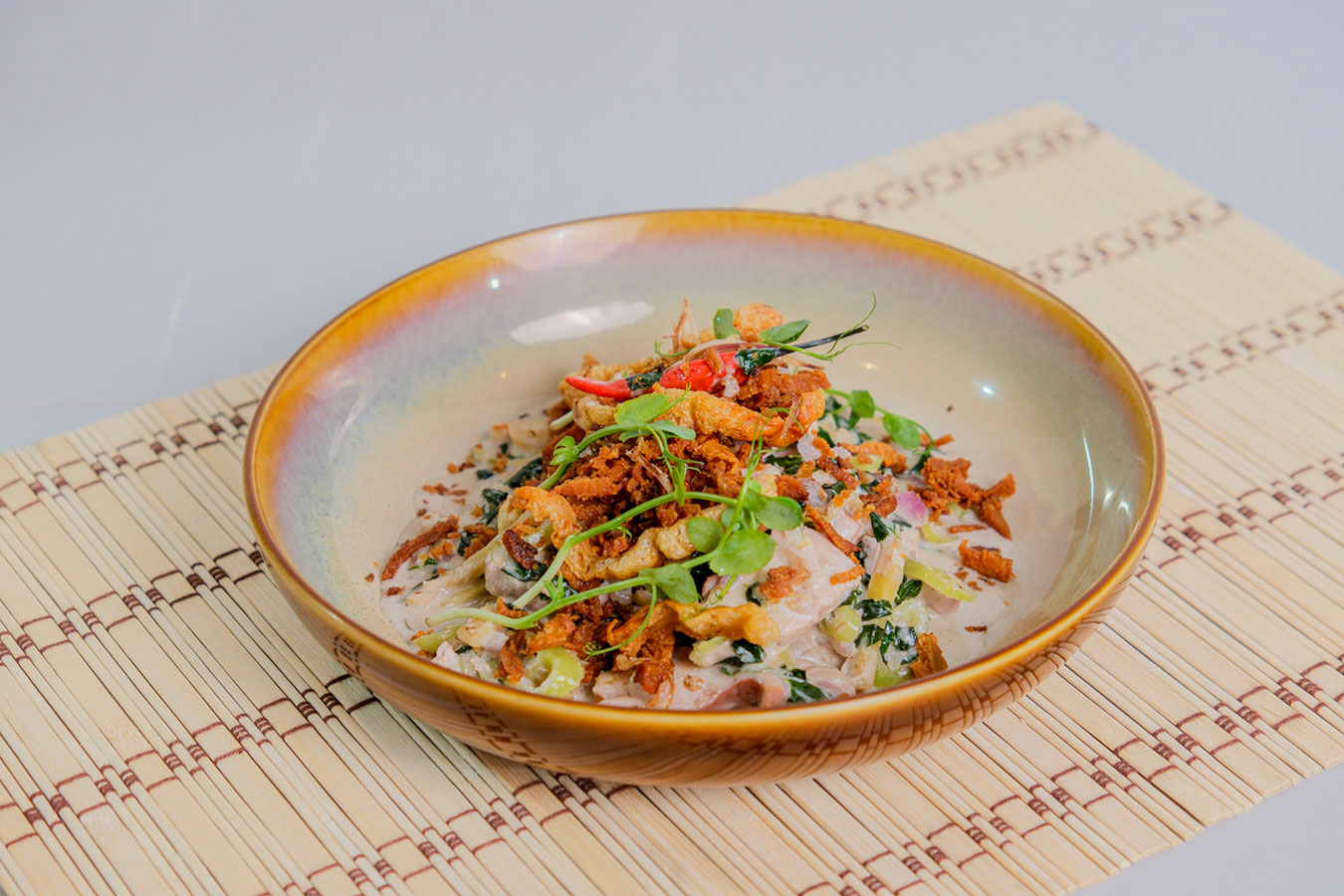
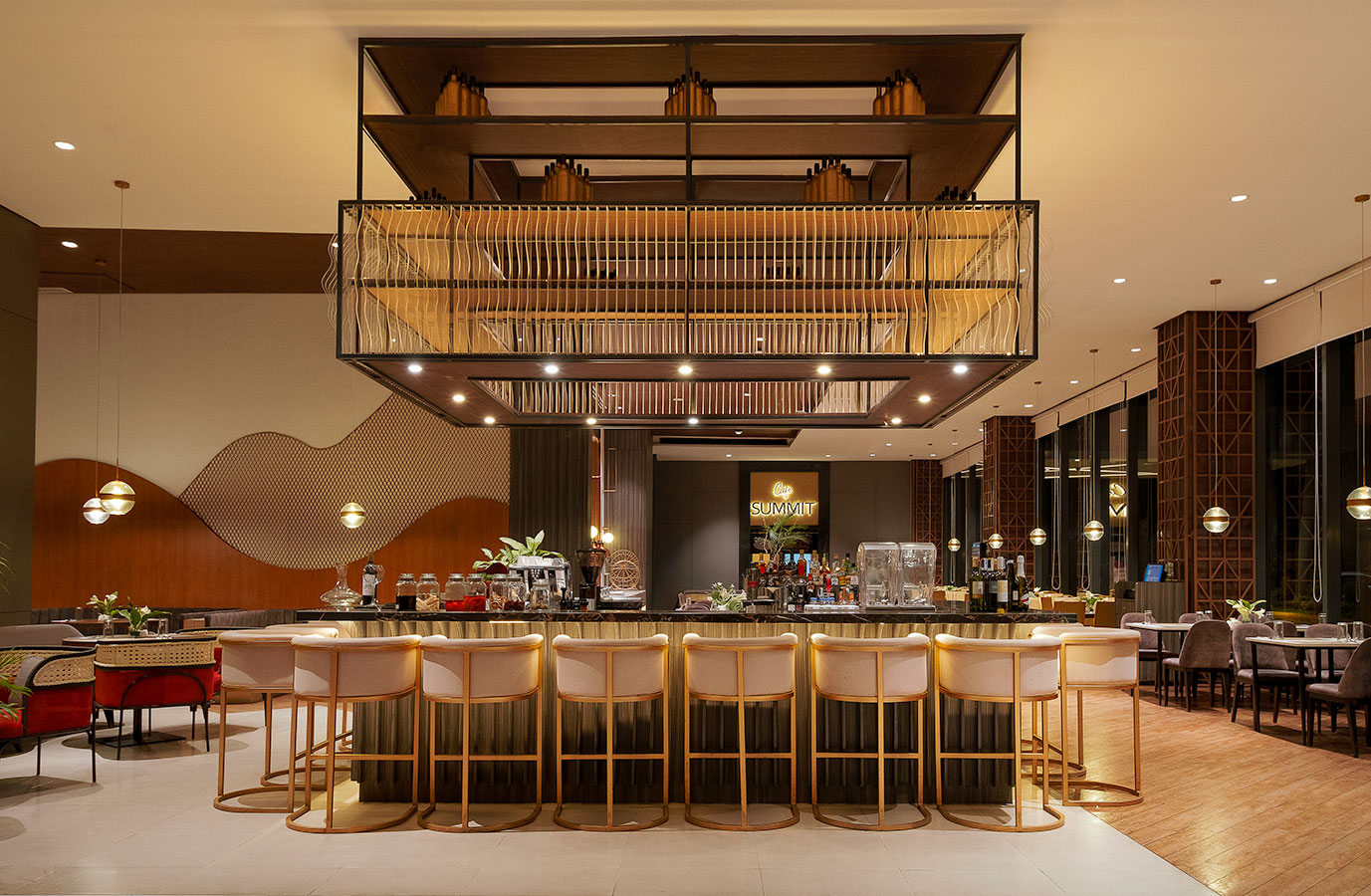
CAFÉ SUMMIT, the all-day dining brand of Robinsons Hotels and Resorts, presents a flavorful journey of heritage, innovation, and stories through Reimagined Filipino Cuisine, a two-month showcase of creative dishes from six of its chefs. From Monday to Saturday, a featured chef’s signature dish will be served at all six Café Summit branches nationwide. Guests can taste the Crispy Lechon Kinunot of Maurito “Mau” Dominguez, head chef of Café Summit Galleria Cebu, on Mondays; Café Summit Naga head chef Francis “Kiko” Joseph Tugnao’s Maya-maya, Kahel, at Lukban on Tuesdays; Café Summit Tacloban sous chef Ricky Norcio’s Chicken Hinatukan on Wednesdays; Café Summit Greenhills executive chef Arvin Ace Barsaga’s Braised Shortribs Kinamatisan Ravioli on Thursdays; Café Summit General Santos head chef Remie Malicy’s Beef Bulalo Riyandang on Fridays; Café Summit Tagaytay head chef Ernie Baculio Ernie’s Crispy Handrolled Palabok on Saturdays; and all the specialty dishes on Sundays. Reimagined Philippine Cuisine at Café Summit will be served starting June 9 until Aug. 10. For more information about Café Summit and its upcoming promos, visit https://summithotels.ph/.


Shakey’s brings back creamy spinach pizza

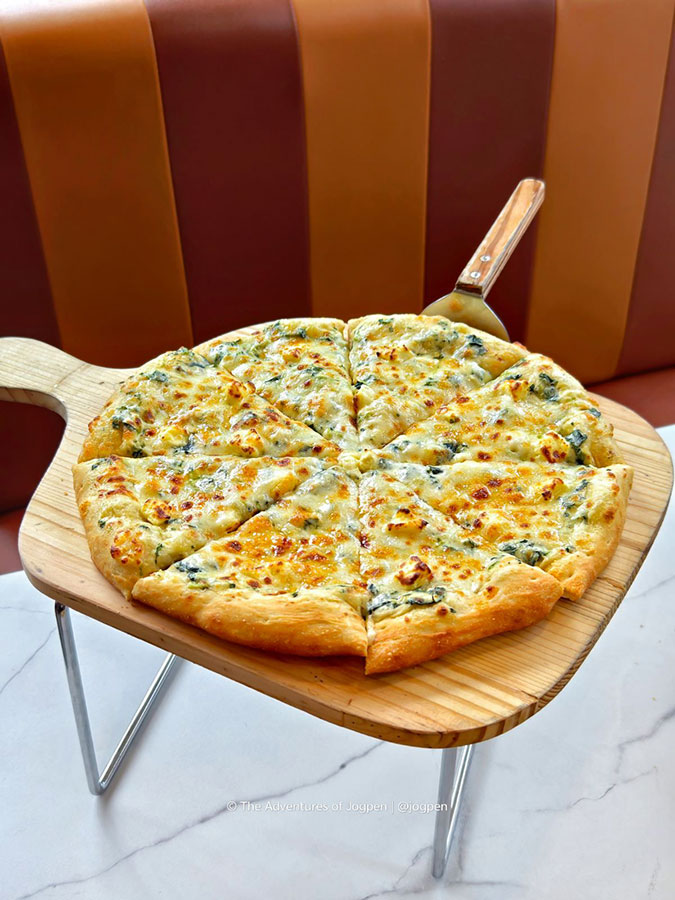
SHAKEY’S has relaunched its Creammmy Spinach Pizza, with a heartier layer of real spinach and a blend of ultra-creamy, melty cheeses, spread across a hand-tossed or thin crust. Shakey’s also has new variants: Spinach & Glazed Bacon, Spinach & Shrimp, and Spinach & Mushroom. Shakey’s new and improved Creammmy Spinach pizza is available in all Shakey’s stores nationwide via dine-in, take-out, and delivery. Guests can also opt to order via the Shakey’s Super App for deals and promos.


Nissin Cup Noodles releases new flavors

FOR an authentic Asian noodle soup experience, Nissin’s Spicy Korean Style Stew has spicy Korean flavors. For a cheesy choice, the Nissin Pasta Express Cheesy Ham & Bacon is made with Nissin’s Straight Noodle Technology. This gives an authentic pasta experience in just four minutes. The cheesy sauce combined with the meaty ham and bacon bits gives a filling bite. The new variants are available at supermarkets and via leading online shops.

Tyranny of choice

FREEPIK

BEHAVIORAL economists define the concept of “tyranny of choice.” Offering too many options to the consumer causes a mental block. Is there a way to unclog the mind and simplify the decision-making process?

In the latest model of a mobile phone, the capabilities of the gadget are given free rein. Add to this the app store offering even more choices. The user can be overwhelmed by the decisions he must make. Why not offer him a default option? This route requires no selection process and allows the user to simply go for the default setting — just one decision. This is expected to cover most of his requirements.

Rather than expecting the consumer to wade through multiple decisions and options, a small set of features are bundled together as a default option that gives convenience to the consumer.

The default approach has given rise to the “combo meals” offered by fast-food restaurants. The few combinations are numbered, laid out, and accompanied with pictures. This moves the line of customers faster, having only to choose among a few default packages rather than meditating on the infinite combinations of chicken thighs, drinks, noodles, soups, sauces, snacks, desserts, and sandwiches. The Japanese bento boxes serve the same default options, with a little of everything.

Another default approach involves offering only the features that 75% of users rely on and bringing down the price of the gadget — not an acceptable strategy for the profit-maximizing producer. (What are your bestsellers?)

Even online cash transfers and digital banking procedures periodically offer new and enhanced versions, of course with more choices. This often requires the user to migrate his banking app and learn a whole new process again with even more features. (Please change your password.) This move is accompanied by a warning that the present app will cease to function in one week. FOMO sets in and causes a quiet panic.

Offering default options indicate that not all the bells and whistles in an upgraded new model are necessary for the regular customer. Still, the price of the upgraded model is sure to be higher.

Choices are also encountered in corporate management. When the company is in the red, the choices for remedies and next steps are many. Usually, the default option is cost-cutting. This requires less imagination than redefining the mission statement or shifting the revenue stream to other businesses.

The first step always involves the expense side. When downsizing, companies identify the core skills needed to run the business and anything outside that definition is deemed dispensable. Thus, early retirement descends like a plague on people with unused or unusable skills. After all, if there are no fires, are fire extinguishers still needed?

Job descriptions are the default options. One can ignore the last item in this list — “And any other jobs that may be assigned from time to time.” The skills needed to cover routine tasks like taking charge of a unit, meeting budget targets, and showing up at the office, instead of always working from home.

Not factored into this default job description are such attributes as a sense of perspective, loyalty to the company, strategic thinking, the ability to build consensus, or the willingness to go the extra mile in crunch time.

Another version of the default option is the establishment of a routine. Why keep thinking of where to have lunch each time? Why not pick a place to go to every time and order the same thing without looking at the menu. (Sir, onion soup for you again today?)

Default options free us from having to confront the tyranny of choice. This simplified approach can also apply to personal relationships. The approach to handling disagreements and fault-finding are established. Why be stressed? Just listen to the music in your head — Tom Jones belting out “Delilah.”

A default mode of changing the topic when painful subjects like financial support of relatives or unexplained text messages should kick in. The conversation can switch to the default subjects of traffic, the constitutional amendment on political dynasties, and the state of the marital relationships of friends and distant relatives. Oops, that last one can open a can of worms… with the choices they offer.


Tony Samson is chairman and CEO of TOUCH xda

ar.samson@yahoo.com

Fed’s Williams calls for strong policy response if inflation deviates from target

REUTERS

TOKYO — New York Federal Reserve President John Williams said on Wednesday central banks must “respond relatively strongly” when inflation begins to deviate from their target.

Given high uncertainty around the economic impact of US tariffs and trade policy, central banks should focus on avoiding taking steps where the “cost of getting it wrong far outweighs the benefits,” rather than aiming for the perfect solution to the problem, he said.

Among the costly risks central banks must avoid are to allow inflation expectations to deviate from their targets, Mr. Williams said in a fireside chat with Bank of Japan Deputy Governor Ryozo Himino at the central bank’s conference held in Tokyo.

“You want to avoid inflation becoming highly persistent because that could become permanent,” Mr. Williams said. “And the way to do that is to respond relatively strongly” when inflation begins to deviate from the central bank’s target, he added.

Williams said shocks typically do not have long-lasting effects on inflation as long as inflation expectations are well anchored. But he warned there was always uncertainty on how supply-side shocks, such as those caused by the COVID-19 pandemic, could affect public perceptions on future price moves.

“Uncertainty has risen pretty significantly,” he said “We have to be very aware that inflation expectations could shift in any way that could be detrimental.”

Given such uncertainties, central banks must strive to not just anchor long-term inflation expectations, but ensure shorter-term expectations are “well behaved” so that public perceptions of future price moves emerge back towards central bank targets “within several years,” Williams said.

US President Donald J. Trump’s sweeping tariffs and erratic trade policies have complicated central bankers’ task of keeping inflationary pressure in check, without cooling too much economies already facing the damage from higher levies.

The Fed has kept its policy rate unchanged at 4.25%-4.5% since December, as officials pause for more clarity on the economic and price impact of Trump’s tariffs.

Policymakers are also having to grapple with volatile market moves caused by Mr. Trump’s on-and-off comments on US trade negotiations with other countries.

While global financial markets experienced “huge shocks” and volatility in April after Mr. Trump’s announcement of sweeping reciprocal tariffs, they did not see a “dissolution,” Mr. Williams said.

“One of the things you definitely saw in April was a lot of flow between buyers and sellers,” which was a sign markets were functioning, he added.

The level of reserves in the US is “clearly abundant” judging by many metrics the New York Fed monitors, and serves as a buffer against unforeseen shocks, Mr. Williams said.

“When you get big shocks and you’re seeing unanticipated shocks, it’s really nice that there’s a buffer” that absorb the market ramifications, he added. — Reuters

Lenovo launches cybersecurity tools for small organizations

LENOVO PHILIPPINES

TECHNOLOGY COMPANY Lenovo recently launched cybersecurity offerings that aim to protect small and medium businesses (SMBs) and other organizations with limited resources.

The company said its ThinkShield Solutions suite of security tools can help safeguard assets so that SMBs and other organizations can “prevent costly breaches, reputational damage from ransomware and malware threats, as well as minimize downtime.”

The tools provide a multi-layered security approach that reduces a target’s attack surface. They also use artificial intelligence (AI)-powered solutions for automated protection.

The product is designed for small organizations that have weaker cybersecurity infrastructure compared to large corporations and other institutions, leading cybercriminals to target their vulnerabilities, Lenovo said.

“Even though SMBs and schools are frequently attacked, many suffer under the misperception they are either too small to be a target or their resources are too limited for right-purpose security solutions to be within their budgets,” said Nima Baiati, executive director and general manager, Commercial Cybersecurity Solutions at Lenovo.

The Philippines reported over 17.7 million cyberthreat incidents last year, according to Kaspersky Security Network.

ThinkShield Solutions include the ThinkShield Extended Detection & Response (XDR) powered by SentinelOne, an AI-enabled security integrated across attack surfaces.

“XDR also automates threat management and response, reducing response times and proactively lowering the risk of breaches,” Lenovo said.

Meanwhile, ThinkShield Data Defense Select, powered by Cigent, helps protect data with prevention-based defenses embedded into secured storage devices in Lenovo PCs and within the files.

Lastly, the ThinkShield Hardware Defense, powered by Sepio, allows organizations to manage their hardware assets via a network inventory, also providing updated information on known asset vulnerabilities.

“With ThinkShield Solutions, businesses and organizations of all sizes are able to more easily deploy a series of smart, layered security solutions that scale across the business through a single trusted vendor with global reach,” Lenovo said. — BMDC

Meralco moves to lower smart meter prices

PHILSTAR FILE PHOTO

MANILA ELECTRIC Co. (Meralco) said it is exploring measures to lower the cost of smart meters under its advanced metering infrastructure (AMI) program, which aims to cover its eight million customers within its franchise area.

“Hopefully, we can do that,” Ronnie L. Aperocho, executive vice-president and chief operating officer of Meralco, told reporters on Tuesday when asked if the AMI program will cover all eight million customers.

Under the AMI program, Meralco plans to deploy 3.27 million smart meters between 2025 and 2029.

“We have to spread out the rollout. We are looking at ways to reduce the cost of smart meters,” he said.

The Energy Regulatory Commission (ERC) earlier said it is carefully evaluating the program due to its high cost.

“We are hoping it will be finally approved before the fifth regulatory reset. We hope there will be a decision by July,” Mr. Aperocho added.

The program also supports initiatives such as net metering and time-of-use tariffs, delivering additional customer benefits by improving energy consumption awareness and reducing response times to outages.

AMI refers to an integrated system of smart meters, communication networks, and implementation systems that enable two-way communication between utilities and customers.

Smart meters are digital devices that enable electricity consumers to monitor their power usage in real time.

The smart meter rollout is part of Meralco’s proposed P215-billion capital expenditure plan for the fifth regulatory period, covering 2026 to 2029.

Meralco completed its pilot test for postpaid smart meters on Dec. 9, 2024, with 5,248 active customers as of yearend. The company implemented a phased approach to onboard customers and collect extensive data across different areas, customer segments, and seasonal variations.

Meralco’s controlling stakeholder, Beacon Electric Asset Holdings, Inc., is partly owned by PLDT Inc.

Hastings Holdings, Inc., a unit of PLDT Beneficial Trust Fund subsidiary MediaQuest Holdings, Inc., has an interest in BusinessWorld through the Philippine Star Group, which it controls. — Ashley Erika O. Jose

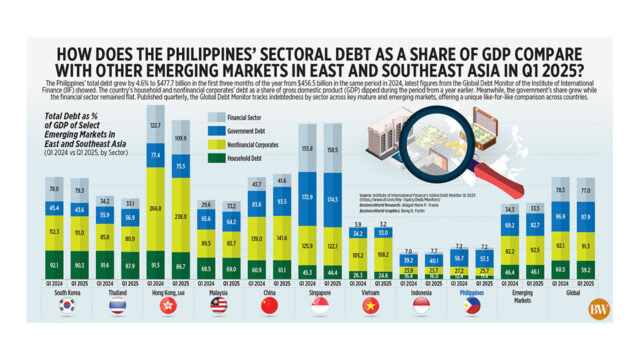
How does the Philippines’ sectoral debt as a share of GDP compare with other emerging markets in East and Southeast Asia in Q1 2025?

The Philippines’ total debt grew by 4.6% to $477.7 billion in the first three months of the year from $456.5 billion in the same period in 2024, latest figures from the Global Debt Monitor of the Institute of International Finance (IIF) showed. The country’s household and nonfinancial corporates’ debt as a share of gross domestic product (GDP) dipped during the period from a year earlier. Meanwhile, the government’s share grew while the financial sector remained flat. Published quarterly, the Global Debt Monitor tracks indebtedness by sector across key mature and emerging markets, offering a unique like-for-like comparison across countries.

How does the Philippines’ sectoral debt as a share of GDP compare with other emerging markets in East and Southeast Asia in Q1 2025?

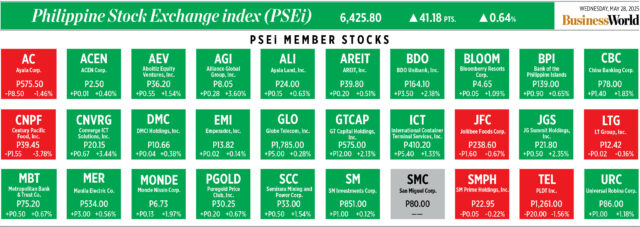
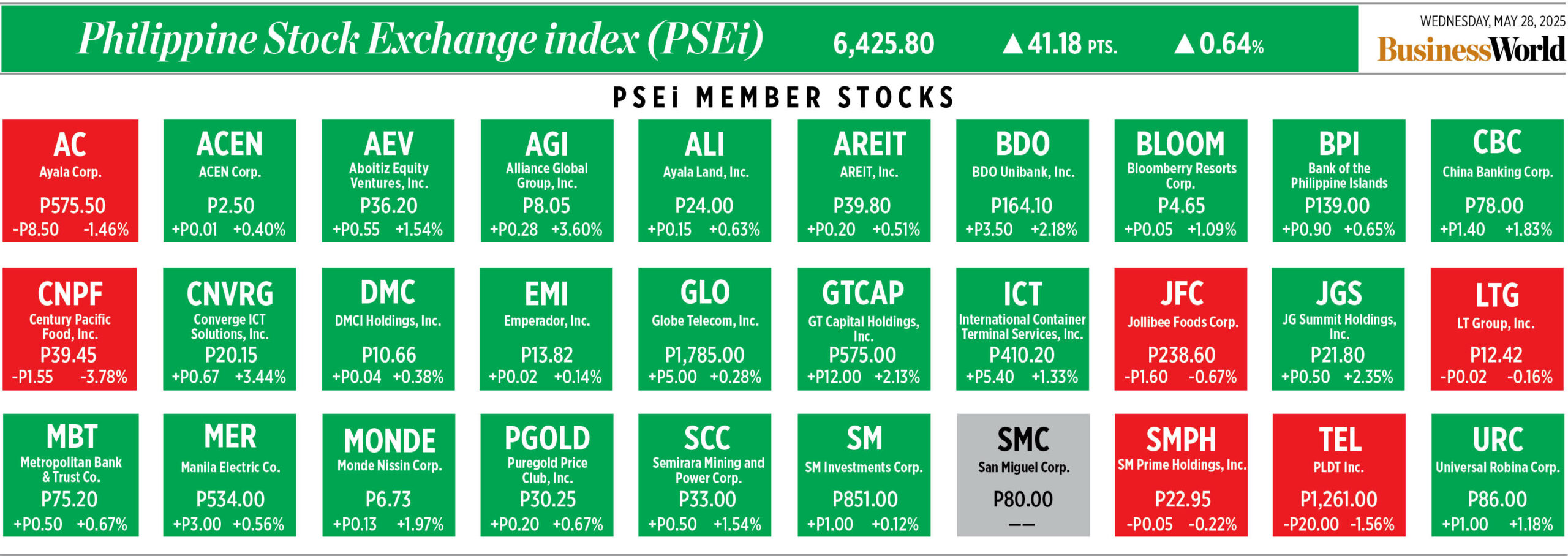
How PSEi member stocks performed — May 28, 2025

Here’s a quick glance at how PSEi stocks fared on Wednesday, May 28, 2025.


PHL, Indonesia lagging region in decarbonization efforts — WB

PIXABAY

THE PHILIPPINES and Indonesia are falling behind in the effort to decarbonize East Asia and the Pacific due to their continued reliance on dirty energy, the World Bank (WB) said in a report.

The bank said these two countries should consider removing fossil fuel subsidies and implementing carbon taxes or green subsidies. 

In its “Green Technologies Decarbonizing Development in East Asia and Pacific” report, the bank said progress toward decarbonization in the region has been uneven, but carbon intensity in most economies has declined due to the improved energy efficiency.

“This progress, however, has been partially offset by countries such as Indonesia and the Philippines, whose energy mix has become dirtier,” it said.

Philippine greenhouse gas emissions amounted to 204.33 teragrams of carbon dioxide equivalent in 2020, down 12.3% from 2015 levels.

However, the Philippines still relies heavily on fossil fuel for power generation.

The Philippines hopes to increase the share of renewable energy in its power generation mix to 35% by 2030 and to 50% by 2040.

The World Bank also noted Vietnam’s increasing carbon intensity, but its energy efficiency has not improved in the past decades. 

Meanwhile, China saw the biggest improvement in emission intensity, but the surge in its total emissions showed that “output growth fueled by dirty sources far outpaced the economy’s decarbonization process.”

The World Bank urged economies to move away from distortionary policies, such as fossil fuel subsidies and barriers to trade and investment.

“Complementary measures — such as assistance for low-income beneficiaries of fuel subsidies and retraining for workers in fossil fuel industries — would enhance the economic benefits and reduce the political difficulty of reforms,” it said.

In 2024, private investment in green projects declined 12% to $1.28 billion.

The report said additional investment in solar and wind energy projects was offset by the drop in waste management and green cement projects.

In the SEA-6 (Southeast Asia-6), composed of Thailand, Malaysia, Singapore, Indonesia, the Philippines, and Vietnam, the Philippines accounted for only 16% of total investment.

The bank also touted the “win-win” potential of addressing domestic market failures. These include imperfect information, which limits green credit, and lack of coordination, which limits investment in green infrastructure.

It urged economies to “induce the adoption of not-yet-viable technologies” through carbon taxes or green subsidies.

“How far the region is willing to go in this respect depends on commitments already made as well as the benefits they receive in return, through emission cuts, assistance, and technology transfers by the rest of the world,” it said.

Congress in February approved House Bill No. 11375 on second reading. The bill establishes a carbon pricing framework for companies. — Aubrey Rose A. Inosante

Exports starting to be disrupted by trade uncertainty — Airspeed

REUTERS

SOME Philippine export orders are currently on hold as buyers await US tariff developments, the parent company of logistics firm Airspeed International Corp. said.

“The US tariffs have really affected the ASEAN region because the tariffs are not yet stabilized and we are still in the 90-day grace period,” Rosemarie P. Rafael, chairperson and president of AIC Group of Companies Holding Corp., told reporters on Tuesday.

“The buyers, as we see, are on hold. They really do not know if they are really going to push ahead with the orders, which affects our outbound trade,” she added.

In particular, she said that some orders of furniture from Cebu and garments have been on hold since March.

The US imposed reciprocal tariffs on most of its trading partners last month, with the Philippines assigned a 17% tariff.

The reciprocal tariffs have since been suspended, with most countries being charged 10% in the interim.

“There are not a lot of sailings going out, especially from China,” Ms. Rafael said.

She noted the emergence of “blank sailings,” where container ships skip scheduled stops because they do not expect to take on loads that would justify the journey.

“It is very difficult because they need to go through some transit points, and the US is basically raising charges on shipments of Chinese origin,” she said.

“These challenges can be overcome by looking at other markets. But the mood right now is to wait and see,” she added.

For the Philippines, she said other export destinations could be developed in the Middle East, Africa, and elsewhere in Asia.

“There are so many markets that have remained untapped because our major partner is really the US. So this is, to me, an opportunity… people can really look to build other markets,” she added.

She said the impact is much more severe in manufacturing exporters like Vietnam, Cambodia, and Thailand.

“What we are trying to look at is how to collaborate with the ASEAN region as the bloc is considered the world’s fifth-largest economy,” she said.

“Looking at what we have, it is a big market in itself,” she said, adding that the region “needs to work together and collaborate and not compete because our products can be complementary.”

She said the region is hoping for successful tariff negotiations with the US, “because it is not only China that is affected but also other countries that export manufactured goods.”

She said international movements, particularly for export shipments, have slowed by around 10%, while domestic movements remain strong.

Asked how much growth the company is expecting this year, she said that the domestic market is stable and is projected to register 5-10% growth. — Justine Irish D. Tabile

Gastronomy tourism declared new focus area for attracting visitors

BAGUIO CITY PUBLIC MARKET FACEBOOK PAGE

THE Department of Tourism (DoT) said on Wednesday that it is seeking to establish the Philippines as a food and gastronomy destination within Southeast Asia.

Tourism Undersecretary Verna C. Buensuceso said at the launch ceremony for the gastronomy tourism roadmap that the program will tout the Philippines’ “culinary diversity and local produce.”

The roadmap includes strategies for creating food-focused tourism experiences to increase awareness of and recognition for Filipino food.

Tourism Secretary Ma. Esperanza Christina Garcia Frasco said the launch marks gastronomy tourism’s formal incorporation in the National Tourism Development Plan (NTDP).

“For the first time, gastronomy has been formally incorporated in the NTDP, not as an afterthought, but as a central pillar of our tourism strategy,” she said.

“It is not a top-down plan; it is a bottom-up strategy created in partnership with the people who know our food best,” she added.

In parallel, the DoT also launched its Market Tourism Product Development Program, which aims to transform public markets into destinations.

“Our markets are not merely venues for commerce and trade; they are our cultural landmarks. In Baguio, our pilot program has proven how a public market can become both a heritage site and an economic engine, and now we are ready to take this nationwide,” Ms. Frasco said. 

She said market tourism as a sub-product of gastronomy tourism took in ideas and contributions of culinary tourism advocates and the academic community.

“We will have market tours, and various places will now have an opportunity to become tourism destinations. We will give out handbooks to our local government units, which will serve as a guide on how to develop their markets into tourism circuits,” she said. — Justine Irish D. Tabile

PSE index back above 6,400 on bargain hunting

BW FILE PHOTO

PHILIPPINE STOCKS rebounded on Wednesday to snap a two-day losing streak, with the index returning above the 6,400 line, as market participants bought bargains.

The bellwether Philippine Stock Exchange index (PSEi) rose by 0.64% or 41.18 points to 6,425.80, while the broader all shares index improved by 0.47% or 17.56 points to 3,753.10.

“The local market bounced back as investors hunted for bargains after two straight days of decline,” Philstocks Financial, Inc. Senior Research Analyst Japhet Louis O. Tantiangco said in a Viber message. “The positive spillovers from Wall Street’s overnight performance also helped in Wednesday’s session.”

“Philippine shares tracked US’ performance, gaining 0.64%, as investors’ risk appetite recovered on the tariff pause. Wall Street was in the green following news on the postponement of 50% tariff on the EU (European Union),” Regina Capital Development Corp. Head of Sales Luis A. Limlingan said in a Viber message.

Wall Street surged on Tuesday as investor risk appetite was buoyed by US President Donald J. Trump’s latest tariff respite and an unexpected jump in consumer confidence, Reuters reported.

The S&P 500 is now within 3.6% of its record closing high reached on Feb. 19, having plunged as much as 18.9% below that level in the wake of Mr. Trump’s erratic tariff announcements, which have whipsawed markets for much of the President’s second term.

In the latest move, the President backed down from his 50% tariff threat against the European Union, delaying its implementation until July 9 to allow for negotiations between the White House and the 27-nation bloc. The move prompted Brussels to prepare for trade negotiations.

The Dow Jones Industrial Average rose 740.58 points or 1.78% to 42,343.65; the S&P 500 gained 118.72 points or 2.05% to 5,921.54; and the Nasdaq Composite gained 461.96 points or 2.47% to 19,199.16.

Back home, all sectoral indices closed in the green on Wednesday. Financials rose by 1.46% or 35.03 points to 2,427.87; services went up by 0.76% or 16.28 points to 2,143.68; industrials climbed by 0.28% or 25.14 points to 8,890.88; holding firms increased by 0.26% or 14.64 points to 5,461.9; property added 0.25% or 5.71 points to end at 2,255.06; and mining and oil inched up by 0.02% or 1.94 points to 9,790.77.

“Alliance Global Group, Inc. was the day’s index leader, climbing 3.6% to P8.05. Century Food Pacific, Inc. was the main index laggard, falling 3.78% to P39.45,” Mr. Tantiangco said.

Value turnover increased to P6.3 billion on Wedneday with 601.1 million shares traded from the P5.13 billion with 639.26 million issues exchanged on Tuesday.

Advancers bested decliners, 118 versus 80, while 48 names were unchanged.

Net foreign buying stood at P687.36 million on Wednesday, a reversal of the P55.76 million in net foreign selling on Tuesday. — Revin Mikhael D. Ochave with Reuters

ADVERTISEMENT
ADVERTISEMENT