Home Blog Page 1510

The CPG, retail, and consumer dynamic

IN BRIEF:

• Retailers and CPG companies are investing in technology and innovation to stay relevant and meet evolving consumer demands.

• The evolving relationship between retailers and CPG companies requires a focus on collaboration to address changing consumer behaviors.

• Companies that prioritize consumer needs and expectations will be best positioned to thrive in the future.

The relationship between consumer packaged goods (CPG) companies, retailers, and consumers has undergone significant changes over the past five years. Disruption and innovation have forced CPG and retail companies to rethink their businesses, while consumers have reevaluated how they shop and what they need. The evolving relationship between CPG companies and retailers presents an opportunity for a more radical rethink of how they both go to market and measure success.

CPG companies, which create merchandise that customers frequently use such as food, beverages, cosmetics, and cleaning products, and retail companies, have both invested in new technologies, channels, and consumer touchpoints to stay relevant.

However, their roles have overlapped, leading to tension and increased competition for attention as the traditional model no longer remains linear. CPG companies make products, but they now also deliver and sell them directly to consumers, while retailers sell and deliver products to consumers while also making them. Consumers buy products, but they often personalize and co-create them with CPG companies. Additionally, with consumers focusing more on value and price, they’re showing less interest in brands (apart from luxury goods) and are instead more interested in what retailers themselves have to offer.

Consumers, who ultimately hold the power in this dynamic, are more informed and demanding than ever. Companies that can deliver on consumer needs and expectations will be in the strongest position to reset the relationship.

This article explores how retailers and CPG companies can strengthen their partnership to overcome disruption, better serve consumers, and thrive in a rapidly evolving market.

RETAILERS GAINING CONFIDENCE AND MORE CONTROL
Retailers, especially in the grocery sector, have become more empowered and confident. The pandemic accelerated their technology adoption, enabling contactless payments, self-service checkouts, and delivery services. These innovations have driven convenience and cost efficiencies, allowing retailers to exert more control over what they sell and focus on delivering value. Additionally, many retailers have taken on broader roles as community hubs and defenders of consumer interests, pushing back against price increases from CPG companies.

EMBRACING DIRECT CONSUMER ENGAGEMENT
As consumer engagement becomes more highly prioritized, CPG companies are using technology to build direct connections with consumers through direct-to-consumer (D2C) business models, subscription services, and social selling. According to the EY Future Consumer Index, influencers are on the rise, with 45% of consumers sharing that they follow social media influencers. As much as 74% say they find influencer product recommendations trustworthy, and 61% share that they purchased a product based solely on an influencer’s recommendation.

CPG companies have also focused on making supply chains more flexible and responsive, reducing costs and being more sustainable. By exploring new physical channels and adapting to the growing power of larger retailers, CPG companies aim to maintain production and execute growth strategies to gain higher sales volumes.

CONSUMERS DRIVING CHANGE WITH NEW BEHAVIORS
Consumers are shopping differently, with increased price sensitivity and a preference for online shopping, home delivery, and buying from thrift stores. Due to being online more often, they are more informed about product ingredients, company practices, and the environmental impact of the companies they shop from.

According to the EY Future Consumer Index, consumers are turning away from once-favored brands as their priorities and options change. As much as 74% have mentioned awareness of shrinkflation in the form of branded products now coming in smaller pack sizes, while 50% would make the switch to a new product if it provided better quality. Consumers are also more willing to try private labels, with 41% having switched already. Brands were not considered an important factor in 48% of purchase decisions, putting CPG companies at a disadvantage.

This shift in consumer behavior is reshaping the relationship between retailers and CPG companies.

OPPORTUNITIES FOR COLLABORATION
As the relationships between CPG companies, retailers, and consumers have changed due to ongoing disruption and evolving needs, success now depends on fostering open, collaborative, and agile ways of thinking and working. By leveraging each other’s strengths and innovations, retailers and CPG companies can approach the future from a position of strength.

Creating seamless multi-channel experiences. Retailers and CPG companies must prioritize operating without friction across multiple channels to meet consumer demands. For example, some companies offer a “Buy Online, Pick Up In Store” (BOPIS) model and use mobile apps that allow customers to shop seamlessly across channels. By investing in marketing and innovation, they can create compelling offers for consumers wherever they are. Collaboration between retailers and CPG companies can help address common challenges and leverage each other’s strengths for mutual benefit.

BALANCING VALUE AND VOLUME
As consumers become more price-sensitive, retailers focus on delivering value, while CPG companies aim to drive volume. Both parties have a shared interest in striking the right balance between value and volume. Artificial intelligence or AI-led solutions, such as revenue growth management, can help customize and fine-tune portfolio, pricing, and promotions to achieve this balance. For example, a global food and beverage company uses artificial intelligence (AI) to enhance inventory prediction, utilizing analytics-driven software platforms to minimize inventory levels and costs while improving the accuracy of demand forecasting and streamlining supply chain workflows.

INNOVATING WITH DATA INSIGHTS
Retailers and CPG companies have vast amounts of consumer data but often lack a comprehensive view of future consumer behavior. By sharing insights and working together, they can gain a stronger understanding of consumer purchasing behaviors and create better-targeted campaigns. This collaboration can lead to more effective trade promotions and profitable business strategies. The use of CRM tools in particular can better stratify, assess, and create targeted promotional content for customers.

TURNING FRICTION POINTS INTO VALUE DRIVERS
The shopping experience has many points of friction, such as in apparel — customers expect the option to return unwanted goods at no cost to them and often engage in bracketing, which is defined as buying items in multiple sizes and sending back what doesn’t fit. To address this, retailers and CPG companies can use AI to help consumers make better buying choices and deliver a better shopping experience. The EY Index shows 59% of consumers trust AI-generated imagery to show them what a product would look like on them, 56% positively engage with AI to answer questions about an item, and 50% trust AI to take size measurements via their phone camera, as demonstrated by a Japanese clothing brand. Some companies also accept bracketing within defined limits, and offer faster or free returns to customers who meet a minimum actual spend or who are members of their loyalty programs.

LEVERAGING AI FOR GROWTH AND EFFICIENCY
AI offers endless opportunities to turn friction points into value drivers. Retailers and CPG companies can use AI to anticipate future consumer needs, reassess relationships, and drive growth and margin improvement. For example, a multinational CPG company uses an AI model that integrates forecasts and actual sales data between the company and its customers, linking consumer purchases directly to the source of materials. This approach eliminates traditional supply chain barriers and enhances data visibility, creating a cohesive ecosystem that connects different supply chains and optimizes inventory at distribution centers and stores. As AI becomes an essential part of the CPG and retail relationship, companies must align their strategies to maximize its potential.

FOSTERING A COLLABORATIVE MINDSET
Traditionally, CPG companies, retailers and consumers used to be a simple linear chain: CPG companies manufactured branded products, retailers sold them in their stores, and consumers bought them off shelves.

By focusing on collaboration, consumer-centricity, and innovation, retailers and CPG companies can strengthen their partnership and thrive.

This article is for general information only and is not a substitute for professional advice where the facts and circumstances warrant. The views and opinions expressed above are those of the author and do not necessarily represent the views of SGV & Co.


Maria Kathrina S. Macaisa-Peña is a business consulting partner and the consumer products and retail sector leader of SGV & Co.
Weightlifting in grand return to 2025 Palarong Pambansa

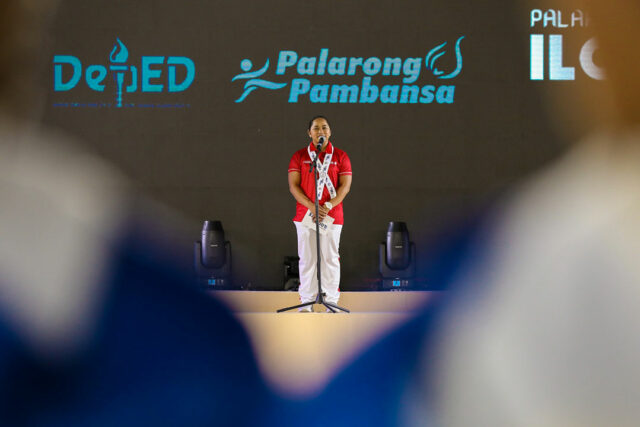
TOKYO OLYMPIC gold medalist Hidilyn Diaz-Naranjo — FACEBOOK.COM/DEPARTMENTOFEDUCATION.PH

LAOAG CITY — Weightlifting makes a giant leap — and lift — to hoisting national awareness and hopefully global excellence down the stretch in a grand return to the 2025 Palarong Pambansa here, four years after delivering the country’s breakthrough Olympic gold medal.

The booming sport, last included in the Palaro during the 80s, found its way back home to join almost 30 events to be played across 40 venues around Ilocos Norte for a glimmer of hope to replicate the momentous feat by Hidilyn Diaz-Naranjo in the Tokyo Olympics.

Over 1,700 medals are up for grabs among a 15,000-strong delegation from 18 regions led by 17-time champion National Capital Region starting with first three events of 3,000-meter run, long jump and javelin throw at 6 a.m. at the Ferdinand E. Marcos Memorial Stadium track oval.

Either of the three premier athletic events will deliver the coveted first gold of the 65th Palaro edition serving as only the second hosting since 1968 for Ilocos Norte, the home province of President Ferdinand R. Marcos Jr. from Batac City and the first Filipino Olympic medalist (bronze) Teofilo Yldefonso from the town of Piddig.

President Marcos led the opening ceremony on Saturday night while the Ilocano Shark Mr. Yldefonso is the silhouette on the official Palaro logo as a tribute to his incomparable legacy as an Olympian and war hero.

All other events will also start in different venues around the province dubbed as the “Renewable Energy Capital of Southeast Asia” owing to its wind farms with eyes on the medal-rich events like swimming, gymnastics, arnis and archery, where most of the bemedaled athletes rise.

But the spotlight, now more than ever, will also be shone brighter on weightlifting with no better — and also world’s best — luminary to advance the untapped discipline than the trailblazer Ms. Diaz herself.

Ms. Diaz, who’s also preparing for another shot at the 2028 Los Angeles Olympics, serve as the tournament director in a noble, larger-than-life dream of unearthing the Filipinos’ limitless potential of weightlifting and other sports as well.

Save for this time, the dream is closer to reality — which she first shed light on by bringing home the gold in the Land of the Rising Sun to snap a long and winding hunt by a multitude of Filipino athletes for the first Olympic glory in almost a century.

With five divisions each for boys and girls’ secondary, weightlifting will serve as a demo sport for now — along with other debuting exhibition sports like futsal and kickboxing — but what’s important for Ms. Diaz is finally having an annual platform like Palaro that she never had back when she was just a dreamer.

The international competition — and success like she had from scratch without any grassroots competition — can then wait after making the best out of here.

“I can see the Philippine weightlifting having more participants and quality athletes in Batang Pinoy and Palaro for, of course, an Olympic gold soon. We want to go down to the regions to teach.”

Meanwhile, the advance games of team sports football, baseball and softball as well as boxing already got going on Saturday followed by the Palaro ng Lahi (Kadang-Kadang, Patintero and Sack Race) on Sunday to roll the red carpet for country’s premier scholastic sports competition organized by the Department of Education in cooperation with the Philippine Sports Commission, Department of Interior and Local Government and Ilocos Norte led by Gov.  Matthew Manotoc. — John Bryan Ulanday

Pagdanganan shoots 72 for joint 18th at Riviera Maya Open

BIANCA PAGDANGANAN — LPGA.COM

BIANCA PAGDANGANAN failed to make headway on moving day, carding an even 72 as she ran five shots off the pace in the Mexico Riviera Maya Open in Mexico Saturday.

Aiming to bounce back after submitting a 74 in Friday’s second round, Ms. Pagdanganan managed only a birdie on the par-4 No. 6 against a bogey on No. 14 in Round 3 to find herself stuck at two-under for the tournament.

It’s been a struggle for the Filipina Olympian after she opened with a sizzling 68 and grabbed a share of the lead initially.

Ms. Pagdanganan, who hit just seven fairways on a 274-yard average drive and 14 greens in regulation and needed 31 putts in the penultimate round, now sits at joint 18th with 214 as Jenny Bae of the US held on to the lead at 209.

Ms. Bae turned in a 71 in the third round, enough to give her a slim one-shot upperhand against Chinese Yahui Zhang and Japanese Chisato Iwai, who closed in on the American with identical 68s.

Australian Gabriela Ruffels  (71) is one shot back at 211. — Olmin Leyba

Gilas boys whip Vietnam

GILAS PILIPINAS YOUTH — SBP.PH

GILAS Pilipinas Youth shook off early jitters before fully asserting itself against Vietnam, 113-62, at the start of the FIBA U16 Asia Cup SEABA Qualifiers in Pampanga on Saturday.

Travis Pascual and Prince Carino rifled in 16 points each while skipper Jolo Pascual had 14 and Justin Hallare and Jhello Lumague chipped in 10 apiece as the Philippines joined Indonesia and Thailand in the march of opening-day victors.

The Indonesians routed Singapore, 68-47, while the Thais turned back Malaysia, 56-47, in the other matches at the Bren Z. Guiao Sports Complex in San Fernando.

While the final winning margin was one-sided, it didn’t reflect the anxious moments coach LA Tenorio and the Gilas U16 had in the first three minutes of action.

The Vietnamese jumped the gun on the jittery Filipinos, 13-4, putting the home crowd in shock and forcing Mr. Tenorio to call a timeout.

But the boys emerged from the huddle all fired up.

With a 13-2 counter, Gilas wrested the lead, 17-15, and it went on to take a 29-20 lead at the end of the first period. Momentum on their side, the Pinoy U16s subjected the Vietnamese to a 32-13 bombardment in the second to pull away to 61-33 at the turn, never to look back.

Mr. Tenorio after picking up the W in his coaching debut. “It was a learning process — for the boys and myself. We all will need to learn from our mistakes.”

Mr. Tenorio’s crew for sure can’t afford to commit lapses like it did especially in the opening minutes of the game against Vietnam with Thailand as its next opponent on Sunday night. Olmin Leyba

The scores

The Philippines 113 – T. Pascual 16, Carino 16, J. Pascual 14, Hallare 10, Lumagub 10, Cruz 9, De Los Reyes 9, Restificar 8, Cabanero 6, Antolin 6, Tan-Chi 6, Miranda 3.

Vietnam 62 – Nguyen H.M.K. 13, Nguyen L.C.N. 12, Vo 10, Nguyen M.A. 5, Vu 5, Luu 5, Bui 5, Phan 3, Nguyen H.Q.B. 2, Nhu 2, Angus 0, Do, 0.

Quarterscores: 29-20; 61-33; 83-50; 113-62

Miranda comeback bid in drift race at Irohazaka Car Meet

DANIEL MIRANDA — INSTAGRAM.COM/DANIELMIRANDAA_

FILIPINO Daniel Miranda will launch his ambitious campaign  in the 2025 drift season when he sees action in the Irohazaka Car Meet unfurling soon at the R33 Drift Track in Pampanga.

The event will be the first of the five-legged series, which promises top-tier competition that aims to discover regional talent while kicking off the motorsport calendar.

Mr. Miranda’s comeback will be powered by Cebuana Lhuillier, headed by its President and Chief Executive Officer Jean Henri Lhuillier who is a known sports patron having supported not just softball from which he is its current head as well as tennis.

“We faced a few setbacks last year, but we’ve worked tirelessly to get everything dialed in during the off-season,” said Mr. Miranda. “I’m looking forward to pushing the limits and challenging some of the region’s best drivers throughout the series.”

“This season is all about performance, precision, and proving what we’re capable of,” he added.

The Irohazaka Car Meet brings together the region’s top drift competitors and car culture enthusiasts, providing a stage for unforgettable moments and breakout performances.

For Mr. Miranda, it’s more than just a race — it’s a statement of intent for the season ahead.

“A sincere thank you to Cebuana Lhuillier and all of my sponsors for your continued trust and support,” he said. — Joey Villar

T-Wolves rout Thunder

Conventional wisdom has continually noted that a playoff series doesn’t begin until homecourt advantage shifts. By this measure, the Western Conference Finals remains without an actual turning point; yesterday’s match between the Timberwolves and Thunder gave clear indications that the best-of-seven affair won’t be easily decided. With the season hanging in the balance, the hosts didn’t merely claim victory at Target Center; they presided over a 143-101 beatdown that underscored their capacity to take the measure of the competition.

With the emphatic triumph in front of 19,112 raucous fans, the Timberwolves didn’t as much avoid a zero-to-three hole as make a definitive statement. And considering the pressure they were under heading into Game Three, it’s fair to argue that they managed to change the tone of the series entirely. They came out with a level of urgency and aggression that had been missing in their previous showings at Paycom Center; they outscored the Thunder by a whopping 20 points after the first quarter, and the lead grew every period thereafter — to 31 at the half, to 37 after three, and to 42 at the final buzzer. There was simply no letup to their assault.

Needless to say, All-NBA selection Anthony Edwards led the charge. That said, equally important to the Timberwolves’ cause was the support he received — and not just on offense from such notables as Julius Randle, who put up 24 points, and rookie revelation Terrence Shannon Jr., who added 15 to complement his match-high 30. Hust about everybody in blue and white held the fort on the other end of the floor. And so dominant were they on defense that newly minted Valuable Player awardee Shai Gilgeous-Alexander could put up no better than 14 on a decidedly mortal four-of-13 shooting from the field.

There’s still a lot of hoops to be played, so it’s too early to say the Timberwolves  have found an answer to the league’s leading scorer. Nonetheless, head coach Chris Finch appeared to have latched on to something replicable: throw player after player at him, force the ball out of his hands, and clog the paint with smart and speedy rotations. It likewise helped that the bench tactician knew exactly when to call timeouts to nip potential danger in the proverbial bud, understanding that, given the faster pace and increased reliance on three-points shots in the modern era, no gap in the scores was safe.

There is, of course, still much to be done for the Timberwolves — beginning with the need to prevail once more tomorrow. Yesterday’s big win gives them momentum that they have to sustain, and the pressure shifts dramatically if they get to even the series at two games apiece. Make no mistake, however: It’s a big “if.” Forget about the shellacking; the Thunder are no pushovers, and Gilgeous-Alexander will be motivated to do much better. Which means the onus is on them to stay ready, and to keep believing in the cause.


Anthony L. Cuaycong has been writing Courtside since BusinessWorld introduced a Sports section in 1994. He is a consultant on strategic planning, operations and human resources management, corporate communications, and business development.

PHL Congress urged to push maritime research bill amid dispute with China

BW FILE PHOTO

By Kenneth Christiane L. Basilio, Reporter

PHILIPPINE lawmakers should come up with a measure that will provide the legal framework for maritime research in the South China Sea to boost the country’s entitlements to natural resources in contested areas amid worsening tensions with China, political analysts said.

This would let the Philippines to explore and exploit mineral-rich waters and strengthen its claims, said Josue Raphael J. Cortez, a diplomacy lecturer at the De La Salle-College of St. Benilde.

“There is an enormous risk that we do not have specific policies yet concerning such action within the disputed waters,” he said in a Facebook Messenger chat.

A top Philippine security official last week urged lawmakers to craft more laws bolstering the country’s entitlements and sovereign rights in its exclusive economic zone (EEZ) in the South China Sea. Manila already has laws governing territorial boundaries and international transit within its waters.

The Philippines remains locked in a long-standing dispute with China over features in the sea that often leads to confrontations. A United Nations-backed tribunal in The Hague in 2016 voided China’s sweeping claims for being illegal.

The tribunal ruled that China had interfered with Filipino fishermen’s right to access Scarborough Shoal, a prime fishing patch that is close to major shipping lanes, and that the energy-rich Reed Bank lies within the Philippines’ 200-nautical-mile EEZ.

Efforts to drill at Reed Bank for its oil and natural gas reserves have been hampered by the sea dispute. The feature may hold as many as 5.4 billion barrels of oil and 55.1 trillion cubic feet of natural gas, according to a 2013 report by the US Energy Information Administration (EIA).

Having a law allowing the exploration and exploitation of resources within the Philippines’ EEZ is crucial as the country seeks to diversify its power mix and fast-track its transition to renewable energy, House of Representatives Assistant Minority Leader and Party-list Rep. Sergio C. Dagooc, who is a member of the chamber’s energy panel, told BusinessWorld.

“It’s very important to concretize our claim over that area,” he said by telephone in Filipino, referring to Reed Bank. “Because if we venture into liquefied natural gas (LNG), but we still rely on imported supplies, it might lead to higher electricity costs.”

He said he would file a bill that would establish a legal framework for the country’s natural resource exploration in the South China Sea in the 20th Congress, which will open in mid-July.

“The crucial point here is that the bill should not come across as antagonistic to other claimant states,” Mr. Dagooc said.

Brunei, Indonesia, Malaysia, Taiwan and Vietnam also claim parts of the waterway, which is said to contain 11 billion barrels of untapped oil and 190 trillion cubic feet of natural gas, according to the EIA.

Policymakers should also look at criminalizing “illegal foreign activities” within Philippine waters, said Rocio Salle Gatdula, a defense economist taking up security studies at Georgetown University.

“New legislation should also criminalize illegal foreign activities, such as unauthorized fishing or resource extraction in Philippine waters, and require foreign vessels to secure prior clearance to emphasize both deterrence and legal clarity,” she said via Messenger chat.

The government should also engage with coastal communities via public information dialogues to inform fisherfolk of their maritime rights, she said. “This would increase vigilance within citizens as a key part of national maritime security.”

Lawmakers should not reallocate the budget allotted for the Philippine military’s modernization program during congressional hearing set later this year, said Michael Henry Ll. Yusingco, a senior research fellow at the Ateneo Policy Center.

“Efforts should be exerted to prevent the budget for the Armed Forces of the Philippines’ modernization program from being cannibalized by Congress,” he said in a Messenger chat.

The government should also ensure the proper management and implementation of the country’s Self-reliant Defense Posture law, he added.

Analysts: DFA revamp to help PHL diplomatic push

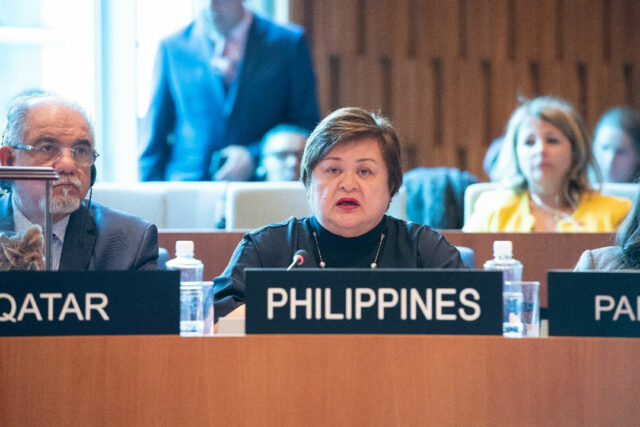
Foreign Affairs Secretary Ma. Theresa P. Lazaro — DFA.GOV.PH/UNESCO PHOTO

By Chloe Mari A. Hufana, Reporter

PRESIDENT Ferdinand R. Marcos, Jr.’s shake-up at the Department of Foreign Affairs (DFA) signals a strategic recalibration of Philippine diplomacy, as the country prepares to head the Association of Southeast Asian Nations (ASEAN) in 2026 and eyes a seat at the United Nations (UN) Security Council for 2027, political analysts said.

Francis M. Esteban, associate dean at the Far Eastern University’s Institute of Arts and Sciences, said the reassignment of Foreign Affairs Secretary Enrique A. Manalo to the UN is meant to boost the country’s bid for a nonpermanent seat at the Security Council in 2027.

“It is a welcome development to have him there, especially now that we’re eyeing a nonpermanent seat at the UN Security Council (UNSC),” he said in a Facebook Messenger chat. “His experience and his network with other top diplomats would surely bolster our bid.”

The new assignment followed Mr. Marcos’s order last week for all Cabinet officials to resign, part of what the presidential palace described as a “bold reset” to align government leadership with evolving national priorities.

Executive Secretary Lucas P. Bersamin later confirmed that Mr. Manalo would be reassigned as the Philippines’ permanent representative to the UN in New York — a post he held before becoming a secretary — while Undersecretary for Bilateral Relations and ASEAN Ma. Theresa P. Lazaro will take over as the country’s top diplomat effective July 31.

Mr. Marcos will attend the ASEAN Summit on May 26 and 27 in Kuala Lumpur to discuss geopolitics, economic matters and trade with the US with fellow Southeast Asian leaders.

The summit is expected to release a joint statement on the agreements among ASEAN leaders, the Gulf Cooperation Council and China.

Josue Raphael J. Cortez, a diplomacy lecturer at De La Salle-College of St. Benilde, said Mr. Manalo’s leadership was “proactive and pragmatic” amid regional tensions.

“His approach to multilateralism, as exemplified in the country’s forging of ties with other like-minded nations and bolstering existing ones, is indicative of this,” he said via Messenger chat.

He added that Mr. Manalo’s presence at the UN, the world’s central diplomatic stage, would help promote Philippine interests.

Mr. Esteban said the new diplomatic assignments show the Marcos administration’s emphasis on a rules-based international order.

“Having career diplomats in these key positions shields the agency from being politicized in a way that they can be more policy-oriented as well as goal-oriented, particularly in securing a seat at the UNSC and ensuring that ASEAN pushes an agenda and narrative consistent with the interest of the Philippines,” he added.

Ederson DT. Tapia, a public administration professor at the University of Makati, said the Cabinet revamp was expected after the poor performance of Mr. Marcos’ senatorial bets in the May 12 midterm elections.

“He does need to take decisive action, especially since some have already alluded to him being a ‘lame duck’ President,” he said in a Facebook Messenger chat. “That normally happens a year or so before the new administration comes in, but it’s too soon for Marcos.”

He said the courtesy resignations should not be a token act. “He should accept the resignations of Cabinet members, especially those with supervision over critical sectors, particularly communications.”

Mr. Esteban said Ms. Lazaro’s new post is a welcome development given her professional portfolio, as she led the DFA in high-profile meetings with several countries, including China.

“She will push a clear agenda, particularly perhaps in areas such as the South China Sea, ASEAN’s position in global wars and conflicts, such as in Ukraine and Palestine, as well as President Donald J. Trump’s actions in the Indo-Pacific, region,” he added.

Jeremy I. Gatdula, dean at the Institute of Law at the University of Asia and the Pacific, said her appointment could usher in a firmer Philippine stance on maritime disputes.

“[Expect] a more assertive stance in Philippine claims in the West Philippine Sea, with an emphasis on bringing up clearly the rule of law and international law,” he said via Messenger, adding that her experience in negotiating economic issues could help build alliances in support of the Philippines’ regional and global position.

The Stratbase Albert Del Rosario Institute also welcomed Ms. Lazaro’s appointment, citing her “critical role in continuing the Philippines’ assertive and principled stance in the West Philippine Sea.”

“The Stratbase Institute is confident that Secretary Lazaro will continue to advance the Philippines’ national interests, especially in the West Philippine Sea, continue efforts to enhance relations with like-minded partners and advocate for the promotion of a rules-based international order,” Stratbase President Victor Andres C. Manhit said in a statement.

Ms. Lazaro has more than four decades of experience in diplomacy. She held multiple posts at the Office of Asian and Pacific Affairs, including a stint as assistant secretary.

Her overseas assignments included ambassadorships to France, where she also served as the Philippines’ permanent delegate to the United Nations Educational, Scientific and Cultural Organization, and Switzerland.

She was consul general in Sydney, deputy consul general in New York and earlier served at Philippine missions in Madrid, Geneva and Bangkok.

Marcos leaves for ASEAN Summit in Kuala Lumpur

President Ferdinand R. Marcos, Jr., accompanied by First Lady Liza Araneta-Marcos, wave before their departure for the ASEAN Summit in Kuala Lumpur. — PHILIPPINE STAR/RYAN BALDEMOR

PRESIDENT Ferdinand R. Marcos, Jr. left for Malaysia on Sunday to attend the 46th Association of Southeast Asian Nations (ASEAN) Summit, where he is expected to engage in high-level discussions on regional cooperation, economic resilience and security challenges with fellow Southeast Asian leaders.

In a speech delivered at Villamor Air Base in Pasay City before his departure, Mr. Marcos said the Philippines fully supports Malaysia’s ASEAN chairmanship and its chosen summit theme of “Inclusivity and Sustainability.”

The Philippines will hold the baton next year as chief of the economic bloc.

Before his departure, Mr. Marcos tapped Executive Secretary Lucas P. Bersamin, Justice Secretary Jesus Crispin C. Remulla and Agrarian Reform Secretary Conrado M. Estrella III as government caretakers.

“We aim to build a future-ready ASEAN that is not only competitive but also people-centered and sustainable,” he said. “As always, our participation in the ASEAN Summit reaffirms our dedication to deepening regional cooperation and advancing the well-being of every Filipino and the entire Southeast Asian community.”

Among the key issues he identified were rising tensions in the South China Sea, the political crisis in Myanmar, threats to regional peace and maritime security and the broader impacts of climate change, economic volatility and digital disruption.

The summit, scheduled for May 26 to 27, will convene leaders from across the region to reaffirm ASEAN centrality and address key regional and global issues.

Mr. Marcos also said discussions are expected to touch on trade-related challenges within the region, including the disparate tariff schedules imposed by the US on various ASEAN economies.

He is accompanied by key officials including Trade Secretary Ma. Cristina A. Roque and Presidential Communications Office Secretary Jaybee C. Ruiz.

“We must find a way to find consensus amongst the disparate situations that the different member states are operating under,” Mr. Marcos said, adding that preliminary discussions had already taken place with Malaysian Prime Minister Anwar Ibrahim on the topic.

He reiterated the Philippines’ long-standing advocacy for an open, inclusive and rules-based international order, emphasizing peaceful resolution of disputes in accordance with international law.

He also said the Philippines would push the development of a common regional framework for ethical and responsible artificial intelligence aligned with ASEAN values.

Mr. Marcos likewise expressed optimism that the summit would address emerging regional issues and pave the way for constructive dialogue among ASEAN’s 10 member states. — Chloe Mari A. Hufana

LP lawmakers sign manifesto to back Romualdez speakership

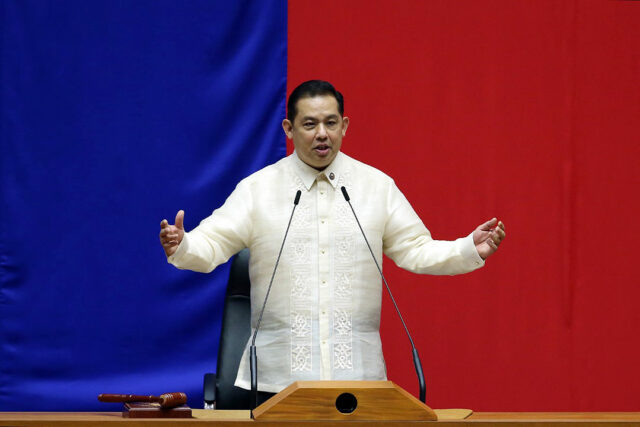
House Speaker Ferdinand Martin G. Romualdez — PHILIPPINE STAR/KRIZ JOHN ROSALES

By Kenneth Christiane L. Basilio and Adrian H. Halili, Reporters

THE Liberal Party of the Philippines (LP) has backed House Speaker Ferdinand Martin G. Romualdez, solidifying his hold in the chamber amid speculations of potential challenges to his leadership, a congressman said on Sunday.

In a statement, House Deputy Speaker and Quezon Rep. David C. Suarez said that four LP lawmakers signed a declaration of support for Mr. Romualdez, showing a broad consensus across party lines of keeping the President’s cousin as leader of the chamber.

“As of today, 285 House members have expressed support for Speaker Romualdez, with 278 lawmakers having already signed formal declarations — including four out of six members of the LP who are now part of the larger movement for legislative continuity and national stability,” he said, referring to the Liberal Party by its initial.

LP Acting President Lorenzo “Erin” R. Tañada III told BusinessWorld that his party has yet to receive confirmation on which lawmakers have backed Mr. Romualdez.

“I have not gotten any confirmation from our members on who the four are,” he said in a Viber message. “In our last meeting, we decided to table the issue for further discussion.”

Speculations have emerged following the May 12 elections that some lawmakers are positioning themselves for the House Speaker role, a post that wields significant influence over the more than 300 legislators representing congressional districts and sectoral groups nationwide.

Vice-President Sara Duterte-Carpio last week suggested to Davao City Rep. Paolo Z. Duterte, her brother, to gun for the speakership role in the 20th Congress, which would convene in mid-July.

The political rivalry between the Marcos and Duterte families has escalated ahead of the midterm elections as both camps have been courting politicians to consolidate influence and bolster their respective support bases.

“Speaker Romualdez has earned the trust of the current and incoming members of the House through principled, results-oriented leadership,” said Mr. Suarez. “What we are witnessing is no longer just support from traditional allies — it’s a political groundswell cutting across the entire spectrum.”

He said the “supermajority bloc” backing Mr. Romualdez now includes the LP, adding to a growing coalition of political parties that already comprises the Lakas-Christian Muslim Democrats (Lakas-CMD), Nacionalista Party, National Unity Party, Nationalist People’s Coalition and Partido Federal ng Pilipinas.

SENATE LEADERSHIP
The Senate could also see a leadership change in the new Congress with Senators-elect Maria Imelda “Imee” R. Marcos and Vicente “Tito” C. Sotto III, who was a former Senate President, announcing their bids for the post, currently held by Senate President Francis “Chiz” G. Escudero.

A change in Senate leadership will not lead to any significant change to the government’s policies, but it could increase the chances of Ms. Duterte’s acquittal, analysts said separately.

“A change won’t lead to any significant policy change. The senate will likely still be supportive of the economic agenda of the administration,” Michael Henry Ll. Yusingco, a senior research fellow at the Ateneo de Manila University Policy Center said via Messenger chat.

He added that the Senate is expected to operate in a more “transactional ethos” as dynastic politicians have dominated the upper house.

Hansley A. Juliano, a political science lecturer from the Ateneo de Manila University, likewise said economic policy change is not expected as the competing blocs have no “questions nor alternatives” to neoliberal policies.

He said that Senators will likely be more concerned on whether to align with West (Mr. Marcos) or to China (the Duterte’s). “Neither would be beneficial for the country’s long-term development and independence at this point,” he said in a Messenger chat.

Mr. Juliano added that a Senator seeking the Senate Presidency will need to court the pro-administration and pro-Duterte factions.

“If Mr. Sotto and (Mr. Escudero) will court the Duterte bloc, it would only be proper to think that they will be asked to support the acquittal of (the VP) in the impeachment in exchange of the Duterte bloc’s support,” Arjan P. Aguirre, assistant professor of political science at the Ateneo de Manila University, said in a Messenger chat.

“Should this be the case, the new Senate president will be duty-bound to comply to what has been promised,” he added, noting however that it would be difficult for the Senate leader to be seen as being beholden to the Dutertes with a “strong case” expected from the prosecution panel.

Ms. Duterte, who was impeached by more than 200 congressmen last Feb. 5, is expected to stand trial before the Senate as an impeachment court once her trial commences in July.

The impeachment complaint against the Vice-President includes the misuse of confidential funds, unexplained wealth, acts of destabilization and plotting the assassination of Mr. Marcos, his family, and the Speaker of the House. Ms. Duterte has denied any wrongdoing.

DFA told to summon US envoy over travel warning vs PHL

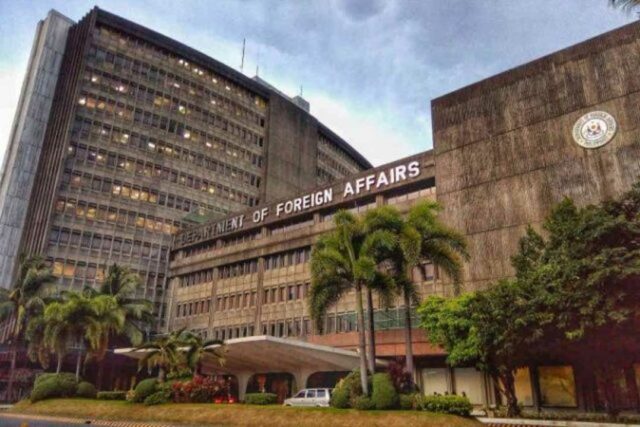
DEPARTMENT OF FOREIGN AFFAIRS FACEBOOK PAGE

MANILA’S Department of Foreign Affairs (DFA) should summon the US’ top envoy in the country after Washington’s Department of State issued a travel advisory warning Americans of increased security risks in the Southeast Asian nation, a congressman said on Sunday.

The DFA should summon US Ambassador to the Philippines MaryKay L. Carson to demand an explanation over a May 8 travel advisory by the US State department, which cautioned Americans from visiting the Philippines due to “crime, terrorism, civil unrest and kidnapping,” said Cagayan de Oro Rep. Rufus B. Rodriguez.

The US Embassy in Manila explained their travel advisories are based on “a careful analysis of local conditions.”

“We regularly evaluate our travel advisories to ensure that they provide the most accurate information to American citizen travelers.  Our travel advisory for the Philippines has not changed substantially since May 2024,” US Embassy in Manila spokesman Kanishka Gangopadhyay said in a Viber message.

President Ferdinand R. Marcos, Jr. should also ask Philippine Ambassador to the US Jose Manuel D. Romualdez and the Tourism department on what measures they have taken to address the concerns raised by Washington’s travel advisory, he added.

“This is an unfair, shotgun warning,” Mr. Rodriguez said in a statement. “There are certainly many places in our country that are safe to tourists.”

“The United States should review this advisory,” he added.

The May 8 advisory published on the US State department’s website said that armed groups have carried out kidnappings and attacks on public areas like tourist sites, markets and government facilities in the country.

“Violent crimes are also common in the Philippines such as robbery, kidnappings, and physical assaults,” it said. “Protests happen in the Philippines and could turn violent and/or result in traffic jams and road closures with limited capacity of the local government to respond.”

The Philippine National Police (PNP) in late March said that the nationwide crime rate declined by 18.4% in the first quarter of 2025 from the last quarter of last year.

The number of crimes recorded by the PNP dropped to 7,301 cases from 8,950 in the last three months of 2024.

Mr. Rodriguez said the US State department’s travel warning on the Philippines paints it in a bad light, unfairly portraying the country.

“It discourages not only Americans but other foreign tourists as well from visiting the Philippines. It will surely hurt our tourism sector,” he said.

The Southeast Asian nation has generated a record P760 billion in revenues from the tourism industry last year, according to the Tourism department

Around 5.95 million international visitors entered the country in 2024, up 9.15% from 2023 but well below the 7.7-million target set by the Department of Tourism. — Kenneth Christiane L. Basilio

CFO safeguards exchange program

BW FILE PHOTO

THE Commission on Filipinos Overseas (CFO) is intensifying efforts to protect Filipino participants in the US-Philippines Exchange Visitor Program (EVP), urging applicants to apply directly to accredited American sponsors.

“Applicants should go directly to their program sponsors,” Senior Emigrant Services Officer at the CFO’s Project Management Division, Kristine Joy D. Gacer, said in Filipino in a statement on Sunday. “The US government maintains an official list of designated J-1 visa sponsors on its website, categorized by field, whether for interns, teachers, physicians, or researchers.”

The move comes amid rising concerns over fraudulent practices by unauthorized agents, who often mislead or overcharge applicants.

Ms. Gacer also noted the importance of registering with the CFO upon receipt of a US visa — a step that includes attending a mandatory Pre-Departure Orientation Seminar. Failure to register, she said, may result in delays or denial of departure at Philippine ports of exit.

The EVP operates under the J-1 visa classification and is overseen by the US Department of State. It forms part of a longstanding bilateral initiative aimed at promoting cultural and educational exchange between the Philippines and the US. — Chloe Mari A. Hufana