Home Blog Page 1460

Netflix Tudum fan event reflects studio investment in global streaming

IMDB
IMDB

LOS ANGELES — Netflix continues to add more live content for viewers hungry for real-time entertainment, including the Tyson vs. Paul boxing match, National Football League games, and, most recently, the Tudum live fan event that showcased upcoming TV shows.

“This is the first time we’ve done the show in this way, a live format,” Shelly Gillyard, vice-president of series marketing for the US and Canada, told Reuters at the Netflix Tudum fan event last Saturday.

“Previous years was on the ground fan activations,” Ms. Gillyard added.

Tudum is named after the sound that plays before each Netflix movie and series.

For Netflix, it was important to ensure that they were incorporating talent from all over the world for the global fan event.

More than 100 Netflix stars and creators appeared in the show hosted by actor Sofia Carson, who starred in the airport thriller Carry On.

The first two Tudum events took place in São Paulo, Brazil, in 2020 and in 2023. However, for 2025, it was relocated to Los Angeles, California.

The 2020 Netflix Tudum in Brazil drew 50,000 people in four days and the post-COVID numbers for the 2023 Brazil Tudum were 35,000.

Ms. Gillyard said the live event could take place somewhere else in the future and Netflix is focused less on where it is held and more on making it available globally.

With major titles like Squid Game, Stranger Things, Wednesday, and Emily in Paris, combined with a performance by Lady Gaga, the streamer capitalized on fan interest.

One of the largest draws for viewers was the premiere date announcements for Emmy award-winning series Stranger Things.

The livestreamed event revealed that Stranger Things will have a fifth and final season split into three parts, with part one on Nov. 26, part two on Dec. 25, and the series finale on Dec. 31. — Reuters

Mixed bag so far for PHL property market and what to expect beyond 2025

COLLIERS.COM

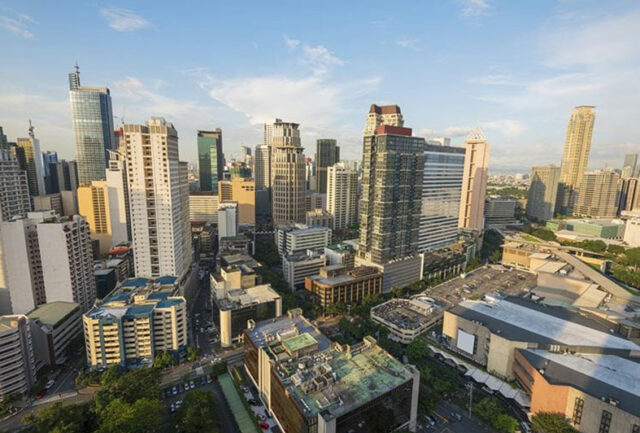
THE SUSTAINED pace of economic expansion makes the Philippines one of Southeast Asia’s bright spots. Consumer spending slowed in 2024 but the tempering inflation as well as the implementation of interest rate cuts should provide a boost to the household expenditure-led Philippine economy. The Philippines should benefit from economic pump-priming activities to be facilitated by direct and spillover impacts of election spending this year.

Office leasing in Metro Manila continues to see challenges, but it is important to note that pre-leasing in Metro Manila office is back.

Lower interest rates should help raise appetite for more residential projects, especially for horizontal developments outside Metro Manila. Developers should continue offering attractive payment terms.

The retail segment remains strong, with foreign brands expanding across the country and mall operators reporting the consumer traffic now is even stronger than pre-pandemic footfall.

Q1 2025 GDP BELOW GOV’T FORECAST
The Philippine economy grew by 5.4% in Q1 2025, below the projections set by the government and private sector analysts. The government’s economic planning department said the Philippines needs to grow by an average of 6.2% in the next three quarters to meet the lower-end of the government’s target of a 6%-7% GDP growth.

Colliers believes that an accelerated economic expansion for the remainder of 2025 should help support the property sector’s growth.

CENTRAL BANK RESUMES RATE CUTS AS INFLATION REACHES FIVE-YEAR LOW
The Bangko Sentral ng Pilipinas (BSP) or central bank reduced its policy rate by 25 basis points (bps) to 5.5% in April as inflation continues to ease. Analysts are projecting that the central bank will likely reduce rates by another 50 bps for the remainder of the year and this should have a positive effect on household spending.

Meanwhile, inflation slowed for the fourth consecutive month in May at 1.3%, the lowest since the 1.2% in November 2019. Average inflation reached 1.9% as of 5M 2024, below the government-projected full-year target of between 2% and 4%. Tempered inflation should eventually result in lower interest rates and this should prop up consumer appetite for the remainder of the year.

RESIDENTIAL: THE SHIFT FROM HEADWINDS TO TAILWINDS
The Philippine property market has been seeing some green shoots of recovery the past few quarters. As we always highlight at Colliers Philippines, the residential market outside of Metro Manila records strong take up, especially in key localities such as Cebu, Bacolod, Iloilo, Davao, Pampanga, Bulacan, Cavite, and Laguna.

While the condominium market within Metro Manila sees challenges, developers have been very aggressive in offering ready-for-occupancy (RFO) promos and these have been lifting take up for units either for long-term lease or sale. The results of our most recent briefing polls indicate that the preference for condominium units has been picking up, indicating that the RFO promos being launched and offered by developers left and right are bearing fruit.

Colliers believes that it is not all doom and gloom for the Metro Manila residential market. Developers have been launching fewer pre-selling units as they remain aggressive in introducing new residential projects in competitive localities outside of the capital region. Recovery will focus around launching the ideal residential product at the right location with a viable price and favorable terms.

RETAIL: FASTER THAN EXPECTED RECOVERY
It is obvious that the Philippine retail sector is getting back to full health from the establishment of new foreign retail brands to the expansion of existing brands, there’s no doubt that physical mall space take up has been reverting to pre-covid levels, resulting in lower Metro Manila retail vacancy and recovery in lease rates, especially in the more established business hubs that are recording brisk recovery.

Colliers is projecting mall vacancy to revert to pre-covid level by end-2026, indicative of Filipinos’ rising propensity to shop inside physical malls.

More malls have been lined up for completion beyond 2025 and these will also be located in thriving localities outside of Metro Manila. This proves that foreign brands are keeping an eye on key cities for expansion outside the capital region.

To continue locking in retail opportunities, mall developers should ramp up efforts in offering refreshed retail spaces and explore the viability of housing more popular retail segments that also absorb humongous retail space, including brands from home furnishing and personal accessory segments.


Joey Roi Bondoc is the director and head of research of Colliers Philippines.

joey.bondoc@colliers.com

Atome secures $75-M financing facility to expand in the Philippines

BUY NOW, PAY LATER provider Atome has secured a $75-million asset-backed financing facility from Lending Ark to fund its continued expansion in the Philippines.

“This strategic financing from Lending Ark Asia Secured Private Debt Fund… will further Atome’s mission in the Philippines to improve access to risk-managed, responsible and sustainable credit products for Filipino consumers,” it said in a statement on Monday.

“The Philippines is a key growth market for Atome. This financing reflects the continued confidence in Atome’s ability to deliver inclusive, risk-managed credit at scale. Lending Ark also supports our business in Indonesia and this latest expansion underscores the strength of our long-standing partnership. We’re grateful for their trust as we deepen our reach and empower more Filipinos with the tools to manage their finances responsibly,” Atome Chief Commercial Officer Andy Tan said.

Atome is part of Singapore-headquartered Advance Intelligence Group’s wallet platform Atome Financial, which is backed by investors including SoftBank Vision Fund 2 and Warburg Pincus. It is active in the Philippines as a buy now, pay later firm. It also offers insurance, savings, cards and lending services across Southeast Asian markets.

Lending Ark, advised by CITIC Securities CLSA Capital Partners (HK) Ltd., focuses on secured private credit opportunities in Asia-Pacific. It has invested $1 billion across the region.

“Atome has cemented its position as a leading fintech (financial technology) player in Southeast Asia thanks to its unique strengths in credit risk management, responsible lending, and consumer empowerment.

We’re excited to support Atome in the Philippines, a high-growth market with increasing demand for accessible, affordable credit and mobile-first financial solutions,” said Carol Lee Park, managing director of Lending Ark.

Atome Financial, which is comprised of Atome and Kredit Pintar, said it achieved profitability last year supported by a 45% increase in its revenues to $280 million and the 35% rise in gross merchandise value to $2.5 billion.

It also attributed its strong results to product portfolio profitability optimization and operational efficiency through the use of generative artificial intelligence across customer service, collections and product sales. — A.R.A. Inosante with Reuters

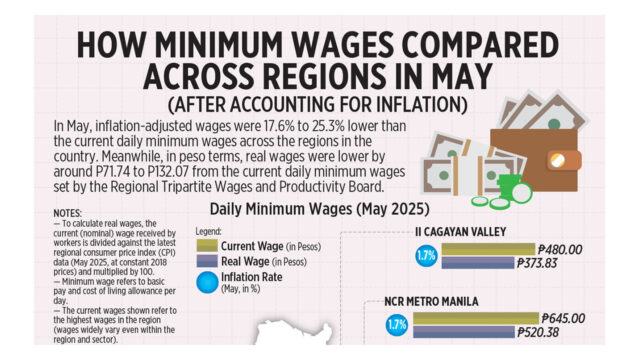
How minimum wages compared across regions in May

(After accounting for inflation)

In May, inflation-adjusted wages were 17.6% to 25.3% lower than the current daily minimum wages across the regions in the country. Meanwhile, in peso terms, real wages were lower by around P71.74 to P132.07 from the current daily minimum wages set by the Regional Tripartite Wages and Productivity Board.

How minimum wages compared across regions in March

Blanket wage hikes and sustainable development

PHILIPPINE STAR/RYAN BALDEMOR

By Jam Magdaleno

RECENTLY, momentum has been building in Congress and public forums for a proposed P200 mandated nationwide wage hike. Supporters of this proposal raise several arguments that downplay the risks associated with such a mandate. Let’s examine four of the most common claims and critically assess them one by one.

Claim 1: Real wage increases haven’t caught up with productivity gains, and “capitalists” are pocketing the difference.

This argument omits an important detail: 99.6% of all registered businesses in the Philippines are micro, small, and medium enterprises (MSMEs), which collectively employ over 62.4% of the total workforce. By lumping all “capitalists” into a single category, the argument ignores the vast differences in cost structures, pricing flexibility, and profit margins between large corporations and the overwhelming majority of employers.

Yes, the Top 1,000 corporations may be able to absorb a flat P200 wage hike by accepting slimmer profit margins. But for the over one million MSMEs, where wages often account for 30% to 60% of operating expenses (according to ADB, SSRN, and UP-CIDS), a blanket national wage hike could be existential.

While some attribute post-2020 productivity growth to labor, they often overlook a key point: recent productivity gains have largely been driven by capital-deepening — investments in automation, digitization, and AI — particularly in sectors like logistics, banking, manufacturing, and retail. These technologies have increased output per worker not because workers themselves became more productive, but because machines and systems now perform a larger share of the work.

The World Bank (2023) reported that labor productivity rebounded quickly in high-capital sectors post-COVID, while MSMEs in labor-intensive and informal sectors continue to lag behind pre-pandemic levels. Labor productivity is typically measured as GDP per worker or per hour worked. However, this aggregate figure includes gains from technological innovation, economies of scale, and cost efficiencies — factors that disproportionately benefit capital-rich firms. National productivity growth does not imply a uniform rise in productivity across all businesses or workers.

Claim 2: A wage hike won’t cause inflation or lead to job losses.

This assumes that labor demand is static, but decades of economic literature show otherwise. When labor costs rise, especially in price-sensitive sectors, firms adjust. This includes reducing headcount, freezing hiring, or shifting toward automation.

Minimum wage hikes often lead to reduced employment, particularly in small firms where labor demand is highly elastic. Simulations and policy projections from institutions such as the National Economic and Development Authority or NEDA (now the Department of Economy, Planning, and Development) and the Department of Labor and Employment (DoLE) have consistently warned that significant across-the-board wage hikes may lead to substantial job losses — especially among microenterprises and labor-intensive sectors like retail, hospitality, and agriculture. For instance, NEDA previously estimated that even a P35 daily wage hike in Metro Manila could result in up to 40,000 to 140,000 job disruptions. Extrapolating this to a large, nationwide increase of P200 highlights the magnitude of the employment risk involved.

Moreover, institutions such as NEDA, the Bangko Sentral ng Pilipinas, the Department of Finance, and international organizations like the World Bank and ADB have consistently cautioned against nationwide wage hikes. Instead, they recommend targeted, productivity-linked wage adjustments based on regional conditions and sectoral capacities. In 2024, NEDA Secretary Arsenio Balisacan warned against a proposed P100 wage hike, stating that it could result in 100,000 to 340,000 job losses and induce inflation ranging from 0.2% to 0.8%. Worse, UA&P economist Victor Abola noted that every P100 wage increase could add 3% to 4% to overall inflation.

To demonstrate this further, let’s look at disparities in income levels, cost structures, and market demand between urban and rural economies. While a large firm in Metro Manila may be able to absorb a P200 daily wage hike, MSMEs in regions like BARMM, Mimaropa, Region VIII, and Region VII face a drastically different reality.

Consider a small business in Cotabato with just five employees earning the current regional minimum wage of P430 for non-agricultural and retail/service industries (as of June 1). A mandated P200 daily increase would raise the per-employee wage to P630 — a 46.5% jump. For five employees working 26 days a month, this would translate to an additional P5,200 per employee monthly, or P62,400 annually. For the whole team, that’s an extra P312,000 in annual wage costs.

But that’s not all. Employers are legally required to remit additional contributions to SSS, PhilHealth, and Pag-IBIG based on monthly wages. These contributions increase proportionally with any wage hike. Using conservative estimates, the total additional cost burden from a P200 wage hike (including mandatory contributions) could approach P370,000 annually for a small business with just five minimum-wage employees, an amount that could easily wipe out businesses with already thin profit margins.

As the ADB noted in its 2023 Philippines: Private Sector Development Report, most MSMEs outside Metro Manila lack economies of scale, operate informally or semi-formally, and are highly vulnerable to wage shocks. In such contexts, a one-size-fits-all policy disproportionately hurts smaller players and undermines inclusive development.

Claim 3: The government can subsidize MSMEs to absorb the wage hike.

This proposal is both fiscally and logistically unsound. First, the fiscal position of the Philippine government is already under strain. As of end-2023, the national debt stood at P14.62 trillion, with a budget deficit of P1.51 trillion, equivalent to 6.2% of GDP. Interest payments alone consume more than 11% of the national budget, crowding out essential expenditures in health, education, and infrastructure.

A wage subsidy scheme could cost hundreds of billions of pesos annually, depending on the magnitude of the hike and the number of MSMEs covered. For example, a P100 daily subsidy for just half of the 17 million MSME-employed workers (about 8.5 million) would already cost over P400 billion annually — nearly 10% of the national budget, and larger than the entire budget of the Department of Health.

Second comes the governance challenge. With over 1 million registered MSMEs, many of them informal or semi-formal, administering a fair and efficient subsidy program would require massive bureaucratic capacity that the state simply does not possess. Even the Small Business Wage Subsidy (SBWS) program during the pandemic, despite being temporary and time-bound, faced delays, leakage, and exclusion errors.

Third, subsidies often create perverse incentives. They discourage productivity improvements, promote dependence, and are politically difficult to withdraw once implemented. Asking a heavily indebted government with limited administrative capacity to finance such a massive program is wishful thinking.

Claim 4: National wage hikes are needed for equality and fairness.

This claim leads to the politicization of wage-setting, undermining existing institutions. The Philippines adopted the regional tripartite wage board system (RA 6727) precisely to account for differences in regional cost of living and productivity. A national legislated wage hike would override this system, rendering wage boards ineffective and politicizing wage policy.

If wage-setting becomes a matter of legislation instead of technical consultation, it risks turning into a populist bargaining chip, especially in an election cycle. This weakens the credibility and functionality of the country’s wage institutions.

SUSTAINABLE DEVELOPMENT NOT POPULIST REDISTRIBUTION
A more sustainable and inclusive approach to improving workers’ welfare is not through blanket wage hikes but by increasing their real disposable income, which means the income left after paying for basic expenses like food, housing, transport, and utilities. This can be achieved through structural reforms that reduce the cost of living and improve economic efficiency.

Food alone accounts for about 35-40% of household expenditure among the poorest 30% of Filipinos, based on Philippine Statistics Authority Family Income and Expenditure Surveys. By liberalizing agricultural imports, particularly by removing quantitative restrictions (QR) and tariffs on staples such as rice, corn, chicken, pork, sugar, and fish, prices could fall significantly.

On the supply side, increasing farm productivity through reforms in land markets is critical. Raising land retention limits, which are currently capped at five hectares under agrarian reform laws, would encourage land consolidation, mechanization, and private investment. Fragmented farms result in low productivity and high food costs.

Filipinos pay some of the highest broadband costs in Southeast Asia. The proposed Konektadong Pinoy Bill, which promotes open access and competitive broadband markets, could lower prices by 30-50% over time, based on estimates by ICT advocates and the Department of Information and Communications Technology.

Taken together, these reforms, and a lot more, would have a far more meaningful and lasting impact on worker welfare than across-the-board wage increases that risk job losses, inflation, and business closures. Instead of shifting the burden onto struggling MSMEs, policymakers should focus on expanding access, reducing costs, and empowering consumers, paving the way for sustainable development.


Jam Magdaleno is a political and economic researcher, writer, and communication strategist. He is the head of Information and Communications of the Foundation for Economic Freedom, a Philippine-based think tank.


CREIT plans fundraising in 2026 to finance new property acquisitions

CREC.COM.PH

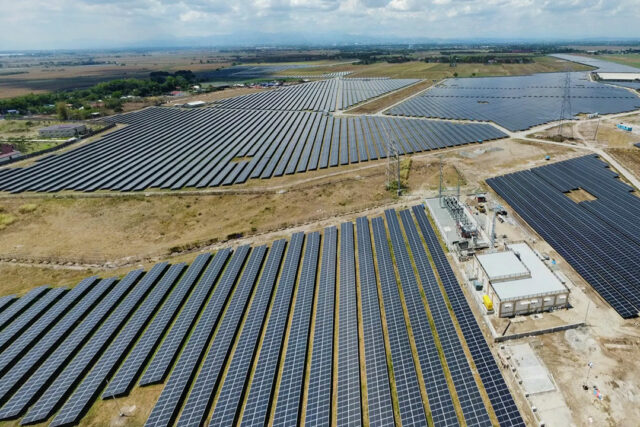
CITICORE ENERGY REIT Corp. (CREIT), the country’s first renewable energy real estate investment trust (REIT), is looking to pursue a fundraising initiative next year to finance new property acquisitions, its president said.

“Any new land acquisition would involve new fundraising which we are looking at around next year. So we will first complete the acquisition of the batch one of the solar assets before the end of the year before any plans of acquiring new properties,” CREC President and Chief Executive Officer Oliver Y. Tan said during the company’s annual stockholders’ meeting on Monday.

CREIT is acquiring solar power assets from its sponsor, Citicore Renewable Energy Corp. (CREC), which are targeted to be completed “on or before yearend.”

“We are aiming to acquire the first batch of approximately 250 megawatts worth of new solar on or before yearend,” Mr. Tan said.

“We’re waiting for the successful commissioning of these plants and also securing necessary regulatory approvals.”

In 2023, CREIT acquired seven assets which served as the sites of solar farms, which are part of the sponsor’s first gigawatt (GW) in its 5 GW in five years goal.

“The first batch of these solar assets will be operational third quarter to fourth quarter, where the sponsor is targeting to energize approximately 1 GW worth of new solar before the end of the year,” Mr. Tan said.

He said that a new fundraising activity is needed as the company already utilized the amounts raised from its issuance of green bonds in 2023.

CREIT issued P4.5 billion in ASEAN Green Bond offering, which was oversubscribed and was used to acquire green properties.

CREIT Chairman Edgar B. Saavedra said that the company is expecting stable growth as land assets for renewable energy pose an attractive opportunity for investors.

“We expect investors to continue setting their sights on REITs in 2025, seeing stable returns from these investments,” Mr. Saavedra said. “But with our unique portfolio grounded in supporting renewable expansion in the Philippines, CREIT offers green investors stability in generating returns and a positive impact on sustainable development.”

CREIT is the Philippines’ first REIT with a focus on renewable energy. It specializes in owning infrastructure projects, including income-generating renewable energy properties across the Philippines. — Sheldeen Joy Talavera

The Institute: Stephen King’s new TV thriller premieres in London

IMDB
IMDB

LONDON — American writer Stephen King and director Jack Bender have joined forces again for a new TV thriller The Institute, which premiered in London on Thursday.

Based on Mr. King’s best-selling 2019 novel by the same name, Mr. Bender said after working together on shows such as crime drama Mr. Mercedes and sci-fi show Under the Dome they were keen to find a new project.

“This show is about the power of youth coming together to rectify the world that all of us adults have screwed up a little bit,” Mr. Bender said.

As well as directing, Mr. Bender, along with Mr. King has an executive producer credit on the show, as does Ben Cavell, who also wrote the small screen adaptation.

Joe Freeman, in his first major role, stars as Luke Ellis, a teenager with unusual abilities, who is kidnapped and taken to The Institution, a facility full of trapped kids with psychological powers.

“He’s never acted and he’s remarkable… the minute I saw him on tape, it was: ‘Oh, my God, this kid is it. He’s so real,’” Mr. Bender said of 19-year-old Mr. Freeman, the son of actor Martin Freeman.

Asked if his dad, known for The Hobbit franchise and Sherlock had given him any advice, Joe Freeman said it was not to take anything for granted, as “the job (of an actor) is 99% rejection.”

Mr. Freeman stars alongside Emmy award winner Mary-Louise Parker as Ms. Sigsby, who runs the institution and Ben Barnes, who plays an ex-cop whose life becomes intertwined with the facility.

“It’s a sort of… a slow simmering sort of horrifying thriller rather than a horror,” Mr. Barnes said.

While the first series covers the book, there are plans to continue.

“We certainly intend to tell much more story… if there’s an appetite for it, we will absolutely continue this story because these characters, these actors, this crew… it all feels too good to leave behind,” Cavell said.

The show airs on US cable and satellite TV network MGM+. — Reuters

Rates of central bank’s short-term bills mixed

Bangko Sentral ng Pilipinas main office in Manila. — BW FILE PHOTO

YIELDS on the Bangko Sentral ng Pilipinas’ (BSP) short-term securities ended mixed on Monday even as both tenors were oversubscribed.

The BSP bills fetched bids amounting to P160.207 billion, higher than the P140-billion offer and the P156.054 billion in tenders for the P150-billion auctioned off in the week prior. The central bank fully awarded both tenors.

The auction was moved to Monday from the usual Friday schedule due to the Eid al-Adha holiday on June 6.

Broken down, tenders for the 28-day BSP bills reached P63.802 billion, above the P60-billion offer but lower than the P66.877 billion in bids for the same volume auctioned off the previous week. The BSP made a full P60-billion award of the one-month papers.

Accepted rates ranged from 5.52% to 5.62%, lower and a tad narrower than the 5.535% to 5.637% band seen a week earlier. This caused the average rate of the one-month securities to inch up by 0.51 basis point (bp) to 5.5852% from 5.5801% previously.

Meanwhile, bids for the 56-day bills amounted to P96.405 billion, above the P80-billion offering and the P89.177 billion in tenders for the same volume offered by the central bank a week ago. The central bank fully awarded the two-month securities.

Banks asked for yields ranging from 5.5375% to 5.61%, narrower than the 5.535% to 5.62% margin seen a week prior. With this, the average rate of the 56-day securities dipped by 0.23 bp to 5.5823% from 5.5846% logged in the previous auction.

The BSP fully awarded the short-term bills as the offer was oversubscribed, it said in a statement. “The resulting bid-to-cover ratios were 1.06 times for the 28-day tenor and 1.21 times for the 56-day tenor.”

The central bank uses the BSP securities and its term deposit facility to mop up excess liquidity in the financial system and to better guide short-term market rates towards its policy rate.

The BSP bills also contribute to improved price discovery for debt instruments while supporting monetary policy transmission, the central bank said.

The central bank securities were calibrated to not overlap with the Treasury bill and term deposit tenors also being offered weekly.

Data from the central bank showed that around 50% of its market operations are done through its short-term securities.

The BSP bills are considered high-quality liquid assets for the computation of banks’ liquidity coverage ratio, net stable funding ratio, and minimum liquidity ratio.

They can also be traded on the secondary market. — Luisa Maria Jacinta C. Jocson

Miriam College to open at Ayala Land’s Alviera estate by August

AYALA LAND, INC.

LISTED real estate developer Ayala Land, Inc. (ALI) said Catholic educational institution Miriam College will open a new campus within its Alviera mixed-use estate in Porac, Pampanga by August.

The 10-hectare campus is now accepting enrollees from kindergarten to Grade 10 for school year 2025–2026, with plans to expand its academic offerings in the coming years, ALI said in a statement over the weekend.

The campus will offer programs spanning basic education to graduate studies, technical-vocational training, and international degrees through a partnership with Camosun College in Canada.

“Creativity and innovation will be the characteristic of Miriam College Alviera. We will be the home of the creative generation. Miriam College looks forward to being a key player in shaping and building the Alviera community,” Miriam College Student Recruitment Officer Mirma Tica-Ortiz said.

Alviera is a 1,700-hectare mixed-use estate developed by ALI and Leonio Land Holdings, Inc., located near Angeles City and Clark International Airport.

The estate features various lifestyle developments such as the Alviera Driving Range, Alviera Country Club, and Alviera Open Grounds. It also includes residential projects such as Park Estates by Ayala Land Premier and Vermont Settings, along with commercial and investment spaces.

“Alviera is set to become the regional growth center of Central Luzon. We will become the center of progress, recreation, learning, and sustainability,” ALI Estate Development Head for Central Luzon Rica Balbido said.

“As the center of growth, we have developed our industrial and commercial blocks as locations where investors and businesses will flourish,” she added.

ALI shares were last traded on June 5, rising by 1.46% or 35 centavos to P24.25 apiece. — Revin Mikhael D. Ochave

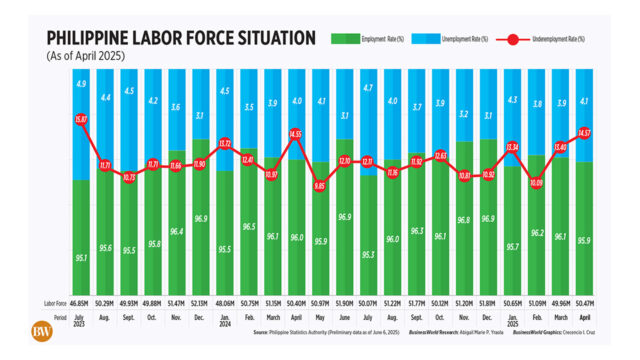
Philippine Labor Force Situation

Philippine Labor Force Situation

On declining inflation and the PhilAtom bill

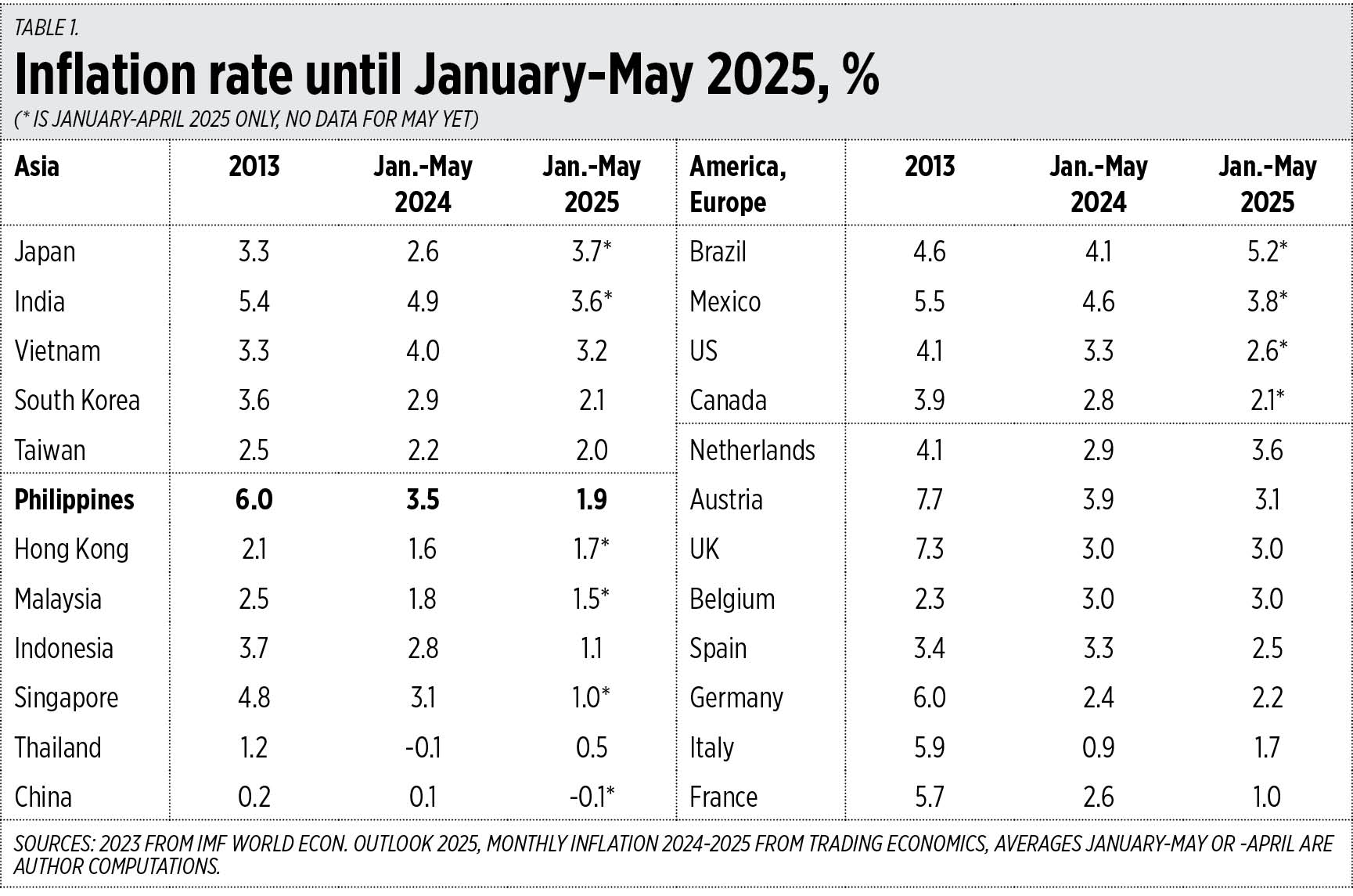
Last week, the Philippine Statistics Authority (PSA) released the country’s inflation rate for May and it was another piece of good news, it was only 1.3%, from 1.8% in March and 1.4% in April. Average inflation for January-May this year is only 1.9%, while that of Taiwan, South Korea, Vietnam, India, and Japan ranged from 2% to 3.7%.

Even the big economies of America and Europe have higher inflation rates this year than the Philippines, except Italy and France (see Table 1).

The persistent argument here that “high inflation contributed to the defeat of many administration candidates” in the last election is wrong for three reasons.

One, our inflation rate this year was low up to the month of the election itself.

Two, assuming that high inflation in 2023 and 2024 affected voters’ behavior, then it should have been reflected in various surveys like the SWS survey of May 6 but it did not. The survey showed that nine of 12 administration Senatorial candidates would win. It is not possible that between May 6 to May 12 the voters suddenly factored in the high inflation of the last two years and thus they voted against many administration candidates.

And three, elections are a political exercise with many political factors to consider, and many political actors and players that affect the political behavior of the voters and candidates themselves. Like the two senatorial candidates of the current administration who were belatedly endorsed by opposition leader Vice-President Sara Duterte and won. It is dishonest to downplay political factors just to hit the economic performance and secretaries of the administration.

NUCLEAR BILL
Meanwhile, the bill to establish a Philippine Atomic Energy Regulatory Authority (PhilAtom) was passed on second reading at the Senate last week. It was passed by the House of Representatives (HOR) in November 2023. If the Senate passes it on third and final reading on June 9, then the HOR adopts the Senate version and both Houses ratify it by Wednesday, then President Ferdinand R. Marcos, Jr. can sign it into a law. Otherwise, it will be back to square one in the next Congress that will start next month.

A review of the Philippines’ nuclear energy development can be gleaned from these recent reports in 2025 in BusinessWorld, written by Sheldeen Joy Talavera: “Filipino engineers gearing up for nuclear-powered future” (Jan. 10), “KEPCO reaffirms plan to invest in PHL RE, nuclear, smart grid projects” (Feb. 27), “Meralco in talks with foreign firms for new nuclear energy partnership” (March 24), “PNRI says nuclear safety fears can be addressed via regulation” (April 29), “Meralco awaits Senate action on proposed nuclear regulatory body” (May 5), and, “Meralco to explore partnerships with South Korean power firms” (June 2).

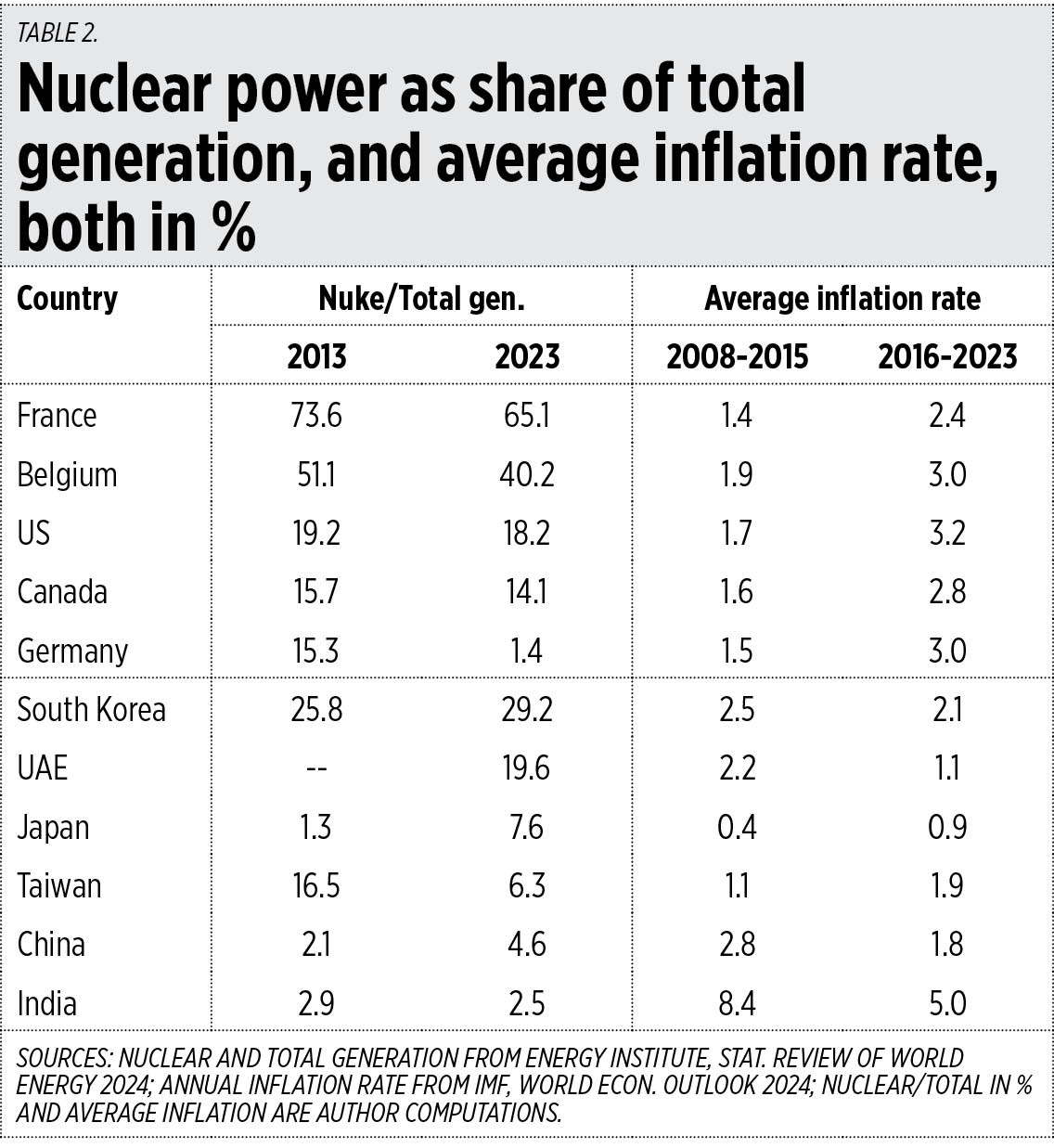
In many countries, there is a modest correlation between the high use of nuclear energy with low inflation rate. I computed the share of nuclear generation to total power generation of several countries, then paired it with the average inflation rate over a similar period.

Countries or economies with declining nuclear to total generation ratio experienced rising inflation rates: France, Belgium, Germany, and Taiwan. Some countries with a slight decline in the ratio but which experienced a rise in their inflation rate were the US, Canada, and Japan.

Countries with a rising nuclear to total generation ratio that experienced declining inflation rates were South Korea, China, India, and the United Arab Emirates (see Table 2).

Nuclear power has the highest energy density among all energy sources, so it is the most efficient, with the highest electricity output per unit of input. Nuclear power is generally safe — the last major nuclear accident was in Chernobyl, Ukraine (then part of the USSR) in 1986. The Fukushima incident in Japan in 2011 has no deaths or direct casualties, only a large-scale evacuation of people as a precaution.

The refurbishing and revival of the Bataan Nuclear Power Plant (BNPP) is the easiest and fastest way to have nuclear energy in the country. BNPP has “sister” nuclear plants in Brazil, Slovenia, Spain, and South Korea — all built by Westinghouse in the 1970s, all of which experienced cost escalations during their construction periods as safety measures increased, all of which were commissioned in the 1980s, all of which are running until now and producing cheap and stable electricity.

We missed the train of nuclear power development since the 1980s. This decade we have a chance to revive the BNPP, which has the potential to generate about 4,600 gigawatts per hour per year, higher than the combined generation of solar and wind yearly. The enactment of the PhilAtom bill into law is a major part of this great opportunity.


Bienvenido S. Oplas, Jr. is the president of Bienvenido S. Oplas, Jr. Research Consultancy Services, and Minimal Government Thinkers. He is an international fellow of the Tholos Foundation.

minimalgovernment@gmail.com

Haus Talk completes acquisition of property in Antipolo

PHILIPPINE STAR/WALTER BOLLOZOS

LISTED affordable housing developer Haus Talk, Inc. (HTI) has completed the acquisition of National Steel Corp.’s 13.6-hectare property in Antipolo, Rizal, for its next residential project.

The Antipolo property will be the site of HTI’s next flagship residential development, with land development scheduled to begin in the fourth quarter, the real estate developer said in an e-mail statement on Monday.

The project will comprise about 1,500 units and is expected to generate approximately P4.9 billion in revenue. It will also include commercial spaces to support the residential community.

The design will be benchmarked against the Granary project in Biñan, Laguna.

The acquired land is a discontinued project of National Steel with existing land development. HTI’s board approved the acquisition on May 13.

HTI President and Chief Executive Officer Ma. Rachel D. Madlambayan said the company is confident the new project will address the demand for quality affordable housing and contribute to long-term growth and profitability.

“Antipolo remains a highly sought-after location due to its terrain, climate, and provincial feel, all while offering excellent accessibility to Metro Manila,” she said.

“This acquisition underscores HTI’s aggressive strategy to bolster our land bank and solidify our position as a dominant force in the affordable housing sector,” she added.

HTI has business interests in providing quality, affordable residential real estate projects in prime locations.

Shares of HTI rose by 2.63% or three centavos to P1.17 apiece on Monday. — Revin Mikhael D. Ochave

ADVERTISEMENT
ADVERTISEMENT