Home Blog Page 1360

World economy faces ‘pivotal moment’ — BIS

Shipping containers in the port of Barcelona are seen behind a cross in Barcelona, Spain, April 3, 2025. — REUTERS/NACHO DOCE

LONDON — Trade tensions and fractious geopolitics risk exposing deep fault lines in the global financial system, central bank umbrella body the Bank for International Settlements (BIS), said in its latest assessment of the state of the world economy.

Outgoing head of the BIS, often dubbed the central bankers’ central bank, Agustin Carstens, said the US-driven trade war and other policy shifts were fraying the long-established economic order.

He said the global economy was at a “pivotal moment,” entering a “new era of heightened uncertainty and unpredictability,” which was testing public trust in institutions, including central banks.

The bank’s report is published just over a week before US President Donald J. Trump’s trade tariff deadline of July 9 and comes after six months of intense geopolitical upheaval.

When asked about Mr. Trump’s criticisms of US Federal Reserve Chair Jerome H. Powell, which have included Mr. Trump labeling Mr. Powell as “stupid,” he was not overly critical.

“It is to be expected at certain points in time that there will be friction,” former Mexican central bank governor Mr. Carstens told reporters, referring to the relationship between governments and central banks. “It is almost by design.”

The BIS’ annual report, published on Sunday, is viewed as an important gauge of central bankers’ thinking given the Switzerland-based forum’s regular meetings of top policymakers.

Rising protectionism and trade fragmentation were “particular concerning” as they were exacerbating the already decades-long decline in economic and productivity growth, Mr. Carstens said.

There is also evidence that the world economy is becoming less resilient to shocks, with population aging, climate change, geopolitics and supply chain issues all contributing to a more volatile environment.

The post-COVID spike in inflation seems to have had a lasting impact on the public’s perception about price moves too, a study in the report showed.

High and rising public debt levels are increasing the financial system’s vulnerability to interest rates and reducing governments’ ability to spend their way out of crises.

“This trend cannot continue,” Mr. Carstens said referring to the rising debt levels and he said that higher military spending could push the debt up further.

Hyun Song Shin, the BIS’ main economic adviser, also flagged the sharp fall in the dollar. It has been down 10% since the start of the year and on track to have its biggest first-half drop since the free-floating exchange rate era began in the early 1970s. 

He said there was no evidence that this was the start of a “great rotation” away from US assets as some economists have suggested but acknowledged that it was still too early to know given sovereign funds and central banks move slowly.

Shorter-term analysis, though, showed “hedging” by non-US investors holding Treasuries and other US assets appears to have made an “important contribution” to the dollar’s slide over the last few months.

“We haven’t seen anything (yet) that would give us any cause for alarm,” Mr. Shin added.

The BIS had already published one part of its report last week that gave a stark warning about the rapid rise of so-called stablecoins.

In terms of the BIS’ own finances, it said it made a net profit of 843.7 million IMF SDR ($1.2 billion), while its total comprehensive income reached a record high of SDR 3.4 billion ($5.3 billion) and currency deposits at the bank also reached a new high.

“It is important that the BIS has the highest creditworthiness out there,” Mr. Carstens said. — Reuters


CREC eyes P9.6-B investment in Pangasinan wind project

STOCK PHOTO | Image by Dayanara Peenee from Unsplash

CITICORE Renewable Energy Corp. (CREC) said its unit plans to invest P9.6 billion in a wind power project in Pangasinan, which is expected to generate 80 megawatts (MW) of electricity.

Citicore Wind Energy Corp. (CWEC), through its subsidiary Citicore Wind Pangasinan 2, Inc., is targeting to complete the wind project by the first quarter of 2028, CREC said in a disclosure on Monday.

The company said the project aims to reduce greenhouse gas emissions associated with power generation and maximize the economic potential of the mountainous areas of Sual and Labrador.

“The project is anticipated to provide clean electricity and local employment opportunities during its pre-construction, construction, and operational stages. Additionally, it seeks to reduce the Philippines’ dependence on fossil fuel energies and mitigate the impacts on climate change,” CWEC said.

“Furthermore, it seeks to lower electricity costs and increase the demand for electricity to enhance the stability of Luzon’s energy supply,” it added.

The project is among the winning bids under the second round of the Green Energy Auction Program (GEA-2) conducted in 2023, securing an offtake contract with the Philippine government.

CREC, directly and through its subsidiaries and joint ventures, manages a diversified portfolio of renewable energy assets, including solar, hydro, and wind platforms.

For 2024, CREC earmarked over $1 billion in capital expenditures, with the majority allocated to its first gigawatt (GW) of solar power projects.

To date, the company has a combined gross installed capacity of 285 MW from its solar facilities in the Philippines.

CREC aims to add 1 GW of capacity annually to the country’s energy mix through ready-to-build and under-construction projects, targeting approximately 5 GW by 2028. — Sheldeen Joy Talavera

Pop culture hub lands in the Philippines

BRONTË H. LACSAMANA

Funko opens first store in Southeast Asia

THE VIBRANT passion of Filipino fandom and pop culture geekdom has led to Funko opening its first Southeast Asia store in the Philippines — at SM Mall of Asia, Pasay City. The company behind collectibles for Disney, Marvel, DC, anime, and almost a thousand other licensed brands aims to take advantage of the passionate Philippine market through the brand-new store.

Andy Clempson, Funko Asia-Pacific’s vice-president for sales, said that the Philippines is their number one market in Asia. Evidence of this is the Funko Fanatics group on Facebook.

“The Funko fan in the Philippines is fantastically passionate, fantastically knowledgeable. Add to that, the environment in the Philippines is very keen in terms of pop culture,” Mr. Clempson told the press at the store’s media preview on June 26.

“The Funko Fanatics Facebook group has about 56,000 members,” he added.

Mr. Clempson said that geeks aren’t the only market for Funko Pop collectibles. Casual fans who don’t collect the Funko items but purchase a certain character or get them to give to others as gifts, make up a huge chunk of the market.

“You can be a real passionate collector who wants to collect everything we do, or you can be more casual and only, for example, love Harry Potter or Disney. But there’s a whole other third of our consumers that are actually just casual gifters,” he said.

Funko is known for its iconic Funko Pop! line, but it also has a miniature version called the Bitty Pop!, as well as games, plushies, apparel, and action figures.

In partnership with collectibles distributor Funtastik Enterprises Corp., the launch marks a milestone in Funko’s global expansion. According to Mr. Clempson, the traditional toy industry in 2024 saw relatively flat growth, whereas collectibles became the fastest-growing subcategory.

“Actually, when you look at Funko Pop versus something like Lego, Hasbro, Mattel, it’s actually pretty good here versus some of these traditionally very big, big toy companies,” he added.

The Philippine market in particular will be served by localized products.

“In this store, you will see over a period of time developing products,” Mr. Clemspon said. “We have a great example in the past where we ran a Jollibee Pop, a standard four-inch Pop, which was very successful.”

Funko’s 1,300-square-foot immersive flagship destination also hopes to “celebrate Filipino fandom,” with exclusive Philippine-themed collectibles and interactive zones dedicated to popular franchises.

Over 1,000 products will be available at the store, Mr. Clempson said, but something to look forward to are community gatherings that appeal to the “kidult,” which is about “remembering when you were a child, what you used to play with.”

“We’ll have regularly scheduled gatherings and fan meet-ups to foster a sense of community among collectors,” he explained.

Funko will officially open the doors of its first store in Southeast Asia on July 12. It is located on the second floor of the Entertainment Mall wing of SM Mall of Asia in Pasay City. — Brontë H. Lacsamana

Prime Infra consolidates Wawa water project under Manila Water

THE UPPER WAWA DAM — PRIMEINFRA.PH

MANILA WATER Co., Inc. has acquired full ownership of WawaJVCo, Inc., consolidating the Wawa Bulk Water Supply Project under its operations in a P37.8-billion transaction with parent firm Prime Infrastructure Capital, Inc. (Prime Infra).

In a regulatory filing on Monday, Manila Water said it acquired full ownership of WawaJVCo through common and non-voting preferred shares worth P37.8 billion.

Trident Water Company Holdings, Inc., a subsidiary of Prime Infra, holds control of Manila Water.

WawaJVCo, a joint venture between Prime Infra and San Lorenzo Ruiz Builders & Developers Group, was established to develop, operate, and maintain the Wawa Bulk Water Supply Project, which is intended to augment Metro Manila’s raw water supply.

The company’s portfolio includes the Tayabasan Weir in Antipolo, which has been operational since October 2022 with a capacity of 80 million liters per day (MLD), and the Upper Wawa Dam in Rodriguez, Rizal, with a capacity of up to 710 MLD.

In 2019, WawaJVCo signed a 30-year bulk water supply agreement with the Metropolitan Waterworks and Sewerage System and Manila Water for the supply of 518 MLD of water until 2050.

“The acquisition is financially accretive to [Manila Water] and is strategically aligned with its long-term operational and water security objectives,” the water concessionaire said.

“In anticipation of the full operation of the Upper Wawa Dam, it has been determined that [Manila Water] is best placed to directly manage, operate, and optimize the Upper Wawa Dam to ensure technical compatibility, system efficiency, and operational synergies,” it said.

WawaJVCo recently announced the completion of the Upper Wawa Dam, which is set to begin commercial operations in December and is expected to benefit over 700,000 households.

Manila Water said the acquisition will allow for “greater focus and flexibility in water resource allocation, while allowing for more efficient operations and overall cost management of the facility.”

The acquisition is expected to be finalized on Aug. 29.

“This transaction underscores Prime Infra’s strategic commitment to the water sector. By consolidating our assets under Manila Water as our core water infrastructure platform, we are enhancing system integration, operational efficiency, and service delivery,” Prime Infra President and Chief Executive Officer Guillaume Lucci was quoted as saying in a statement.

“This consolidation allows us to unlock greater value from our portfolio and strengthens our position as a leader across the entire water value chain.”

Manila Water serves the East Zone of Metro Manila, covering parts of Marikina, Pasig, Makati, Taguig, Pateros, Mandaluyong, San Juan, portions of Quezon City and Manila, and several towns in Rizal province. — Sheldeen Joy Talavera

Jaws and the two musical notes that changed Hollywood forever

A SCENE from the 1975 film Jaws.

“DA, DUH.”

Two simple notes — E and F — have become synonymous with tension, fear and, sharks, representing the primal dread of being stalked by a predator.

And they largely have Jaws to thank.

Fifty years ago, Steven Spielberg’s blockbuster film — along with its spooky score composed by John Williams — convinced generations of swimmers to think twice before going in the water.

As a scholar of media history and popular culture, I decided to take a deeper dive into the staying power of these two notes and learned about how they’re influenced by 19th century classical music, Mickey Mouse, and Alfred Hitchcock.

THE FIRST SUMMER BLOCKBUSTER
In 1964, fisherman Frank Mundus killed a 4,500-pound great white shark off Long Island.

After hearing the story, freelance journalist Peter Benchley began pitching a novel based on three men’s attempt to capture a man-eating shark, basing the character of Quint off of Mundus. Doubleday commissioned Benchley to write the novel, and in 1973, Universal Studios producers Richard D. Zanuck and David Brown purchased the film rights to the novel before it was published. The 26-year-old Spielberg was signed on to be the director.

Tapping into both mythical and real fears regarding great white sharks — including an infamous set of shark attacks along the Jersey Shore in 1916 — Benchley’s 1974 novel became a bestseller. The book was a key part of Universal’s marketing campaign, which began several months before the film’s release.

Starting in the fall of 1974, Zanuck, Brown, and Benchley appeared on a number of radio and television programs to simultaneously promote the release of the paperback edition of the novel and the upcoming film. The marketing also included a national television advertising campaign that featured emerging composer Williams’ two-note theme. The plan was for a summer release, which, at the time, was reserved for films with less than stellar reviews.

Films at the time typically were released market by market, preceded by local reviews. However, Universal’s decision to release the film in hundreds of theaters across the country on June 20, 1975, led to huge up-front profits, sparking a 14-week run as the No. 1 film in the US.

Many consider Jaws the first true summer blockbuster. It catapulted Spielberg to fame and kicked off the director’s long collaboration with Williams, who would go on to earn the second-highest number of Academy Award nominations in history — 54 — behind only Walt Disney’s 59.

THE FILM’S BEATING HEART
Though it’s now considered one of the greatest scores in film history, when Williams proposed the two-note theme, Spielberg initially thought it was a joke.

But Williams had been inspired by 19th and 20th century composers, including Claude Debussy, Igor Stravinsky, and especially Antonin Dvorak’s Symphony No. 9, From the New World.” In the Jaws theme, you can hear echoes of the end of Dvorak’s symphony, as well as the sounds of another character-driven musical piece, Sergei Prokofiev’s Peter and the Wolf.

Peter and the Wolf and the score from Jaws are both prime examples of leitmotifs, or a musical piece that represents a place or character.

The varying pace of the ostinato — a musical motif that repeats itself — elicits intensifying degrees of emotion and fear. This became more integral as Spielberg and the technical team struggled with the malfunctioning pneumatic sharks that they’d nicknamed “Bruce,” after Spielberg’s lawyer.

As a result, the shark does not appear until the 81-minute mark of the 124-minute film. But its presence is felt through Williams’ theme, which some music scholars have theorized evoke the shark’s heartbeat.

SOUNDS TO MANIPULATE EMOTIONS
Williams also has Disney to thank for revolutionizing character-driven music in film.

The two don’t just share a brimming trophy case. They also understood how music can heighten emotion and magnify action for audiences.

Although his career started in the silent film era, Disney became a titan of film, and later media, by leveraging sound to establish one of the greatest stars in media history, Mickey Mouse.

When Disney saw The Jazz Singer in 1927, he knew that sound would be the future of film.

On Nov. 18, 1928, Steamboat Willie premiered at Universal’s Colony Theater in New York City as Disney’s first animated film to incorporate synchronized sound.

Unlike previous attempts to bring sound to film by having record players concurrently play or deploying live musicians to perform in the theater, Disney used technology that recorded sound directly on the film reel.

It wasn’t the first animated film with synchronized sound, but it was a technical improvement to previous attempts at it, and Steamboat Willie became an international hit, launching Mickey’s — and Disney’s — career.

The use of music or sound to match the rhythm of the characters on screen became known as “Mickey Mousing.”

King Kong in 1933 would deftly deploy Mickey Mousing in a live action film, with music mimicking the giant gorilla’s movements. For example, in one scene, Kong carries away Ann Darrow, who’s played by actress Fay Wray. Composer Max Steiner uses lighter tones to convey Kong’s curiosity as he holds Ann, followed by ominous, faster, tones as Ann escapes and Kong chases after her. In doing so, Steiner encourages viewers to both fear and connect with the beast throughout the film, helping them suspend disbelief and enter a world of fantasy.

Mickey Mousing declined in popularity after World War II. Many filmmakers saw it as juvenile and too simplistic for the evolving and advancing film industry.

WHEN LESS IS MORE
In spite of this criticism, the technique was still used to score some iconic scenes, like the playing of violins in the shower as Marion Crane is stabbed in Alfred Hitchcock’s Psycho.

Spielberg idolized Hitchcock. A young Spielberg was even kicked off the Universal lot after sneaking on to watch the production of Hitchcock’s 1966 film Torn Curtain.

Although Hitchcock and Spielberg never met, Jaws clearly exhibits the influence of Hitchcock, the “Master of Suspense.”

And maybe that’s why Spielberg initially overcame his doubts about using something so simple to represent tension in the thriller.

The use of the two-note motif helped overcome the production issues Spielberg faced directing the first feature length movie to be filmed on the ocean. The malfunctioning animatronic shark forced Spielberg to leverage Williams’ minimalist theme to represent the shark’s ominous presence in spite of the limited appearances by the eponymous predatory star.

As Williams continued his legendary career, he would deploy a similar sonic motif for certain Star Wars characters. Each time Darth Vader appeared, the “Imperial March” was played to set the tone for the leader of the dark side.

As movie budgets creep closer to a half-billion dollars, the Jaws theme — and the way those two notes manipulate tension — is a reminder that in film, sometimes less can be more.


Jared Bahir Browsh is an assistant teaching professor of critical sports studies at the University of Colorado Boulder.

Entertainment News (07/01/25)

WARNER BROS. PICTURES

Tickets now on sale for Superman

TICKETS are now available for the new Superman movie, which opens July 9 only in cinemas and IMAX nationwide. Superman is directed by James Gunn and stars David Corenswet as the new Superman/Clark Kent, together with Rachel Brosnahan (Lois Lane) and Nicholas Hoult (Lex Luthor). To check schedules and book tickets, visit https://www.superman.com.ph/. Superman, DC Studios’ first feature film to hit the big screen, is set to soar into theaters worldwide, distributed by Warner Bros. Pictures. DC Studios heads Peter Safran and Mr. Gunn are producing the film, which Mr. Gunn directs from his own screenplay, based on characters from DC, Superman created by Jerry Siegel and Joe Shuster.


Itaewon Class creator to hold masterclass

AS part of the Korean Cultural Center’s “Meet the Mentor” series, the creator of the webtoon Itaewon Class, Cho Kwangjin, will visit Manila from July 4 to 6. The three-day event features exclusive talks, an interactive booth exhibit, and a masterclass highlighting South Korea’s webtoon and creative industries. Itaewon Class was adapted into a hit K-drama series in 2020.


Sinners streams exclusively on Max

WARNER BROS. PICTURES’ horror movie Sinners will make its global streaming debut exclusively on Max on Friday, July 4. The film stars Michael B. Jordan in a dual role as twin brothers who, in an attempt to leave their troubled lives behind, return to their hometown to start again, only to discover that an even greater evil is waiting to welcome them back. The movie, written and directed by Oscar-nominated filmmaker Ryan Coogler, also stars Hailee Steinfeld, Miles Caton, Jack O’Connell, Wunmi Mosaku, Jayme Lawson, Omar Miller, and Delroy Lindo. To subscribe to Max, go to  www.max.com or the Apple App Store or Google Play Store and subscribe for P149/month or P1,040 for 12 months. Max is also available via Cignal, Cignal Super, Smart and PLDT Home. Max will soon be renamed HBO Max.


SM Mall of Asia opens Ultimate LEGO Playground

THIS July, the LEGO Group will be going to the SM Mall of Asia in Pasay City to put up the LEGO Playground, a sensory, hands-on space where traditional larong Pinoy — Filipino games — are reimagined with LEGO bricks. The week-long event, scheduled for July 6 to 13, is free and open to all, with fun zones, build challenges, and a showcase of The LEGO Group’s latest 2025 sets.


Jurassic World Rebirth in cinemas

THE latest Jurassic Park movie, Jurassic World Rebirth, is now showing in Philippine cinemas through Universal Pictures. The film stars Scarlett Johansson, Mahershala Ali, Jonathan Bailey, and Rupert Friend and is directed by Gareth Edwards. Set five years after the events of Jurassic World Dominion, it shows how the planet’s ecology has proven largely inhospitable to dinosaurs, who remain in isolated equatorial environments, and how their DNA holds the key to a drug that will bring miraculous life-saving benefits to humankind.


Netflix’s Somebody Feed Phil goes to the Philippines

THE Philippines’ rich culinary scene and cultural heritage have been featured in Episode 7 of the latest season of Netflix travel and food series, Somebody Feed Phil. As part of the show’s 8th season, it follows host Phil Rosenthal’s journey through the food culture of Manila and Cavite. “If you really want the best of the best, I think you have to come. Because then you get to experience the richness of a culture that embraces its diverse influences and creates the sublime,” Mr. Rosenthal said on his website. One effect of the show on the local food scene was that the Diliman classic restaurant, Trellis, which was featured in the episode, announced that it had run out of its signature sisig for the first time in 45 years after the episode aired. The show is currently streaming on Netflix.


Jeniffer Maravilla releases new single

SINGER Jeniffer Maravilla dove into her vulnerable side and personal experience of yearning through her newest single, “Sana Nandito Ka.” “ I sang through memories, tears, and truths that I don’t often share. I also made more conscious choices in phrasing and dynamics to mirror my actual experiences, so what you hear is not just a performance, it’s a piece of me,” she said. The single is out now on music streaming platforms.


Rich Brian drops new single

THE new single by musician Rich Brian is “Oh Well,” the latest offering from his forthcoming album WHERE IS MY HEAD? due Aug. 15. Paired with a Jared Hogan-directed video, the single follows his first live performance in years at the 2025 Head In The Clouds Festival in Los Angeles in front of 40,000 fans. “Oh Well” offers an alternative R&B slow-burn side to the rapper and singer. It is out now on all music streaming platforms.

Ayala Land acquires New World Makati Hotel

Left to right: George Aquino, president and chief executive officer of AyalaLand Hospitality; Kwok Yan Chi of New World International Development Philippines; and Jose Eduardo Quimpo II, vice-president & head of corporate finance, Ayala Land, Inc.

AYALA LAND, Inc. has acquired New World Makati Hotel, expanding the portfolio of its hotel and resort development arm.

The acquisition is part of Ayala Land Hospitality’s (ALH) strategy to strengthen its presence in high-growth urban centers, particularly in Makati, ALH said in an e-mail statement on Monday.

New World Makati Hotel has more than 500 guest rooms and suites. It is located across Greenbelt and is within walking distance of major commercial offices and luxury retail establishments.

“This move reflects our continued focus on offering a cohesive and high-quality guest experience across key locations,” ALH President and Chief Executive Officer George I. Aquino said.

“The addition of New World Makati Hotel complements our existing portfolio and reinforces our commitment to serving evolving customer needs in one of the country’s most dynamic cities,” he added.

ALH said hotel operations will remain uninterrupted, with the current management team retained, and all existing bookings honored.

“ALH assures guests and partners of a smooth transition, maintaining the high standards of service the brand is known for. Business continuity will be maintained across all touchpoints,” it said.

ALH has over 4,000 rooms under its homegrown brands, including Seda Hotels, El Nido Resorts, and Huni Lio, as well as international luxury brands such as Raffles Makati, Fairmont Makati, and the upcoming Mandarin Oriental Makati. — Revin Mikhael D. Ochave

Squid Game stocks sink as blockbuster ends with mixed reviews

ACTOR Lee Jung-jae in a scene from Squid Game. — IMDB

SHARES in South Korean companies tied to Netflix Inc.’s blockbuster series Squid Game slumped on Monday following the release of the hit show’s final season, which debuted to a lukewarm audience reception despite topping global streaming charts.

Artist Co., an entertainment agency in which Squid Game’s main actor Lee Jung-jae is the largest shareholder, tanked as much as 21%. Artist Studio, Inc., a unit of Artist Co., also declined 24%. Dexter Studios Co., South Korea-based visual effects production firm and one of the partners of Squid Game production, fell 8.5%.

“Much of the criticism stems from how the show ended — viewers whose interpretation of the show’s worldview doesn’t align with theirs,” said Kim Hern-sik, a pop culture critic in Seoul. “It’s hard to top Season 1 — it was a global sensation.”

The third season of Netflix’s anti-capitalist parable, which premiered on June 27, topped the global TV show rankings on Netflix in all countries, according to FlixPatrol, which tracks viewing on streaming services. The Season 3 earned 83% approval rating among professional critics while 51% approval rating from audience, according to Rotten Tomatoes.

First released in 2021, Squid Game became a cultural phenomenon, igniting global conversations with its brutal social allegory and captivating visuals. It remains Netflix’s most-watched show of all time, drawing about 600 million views to date across the first two seasons. The Korean dystopian survival thriller has also won six Emmy Awards. — Bloomberg

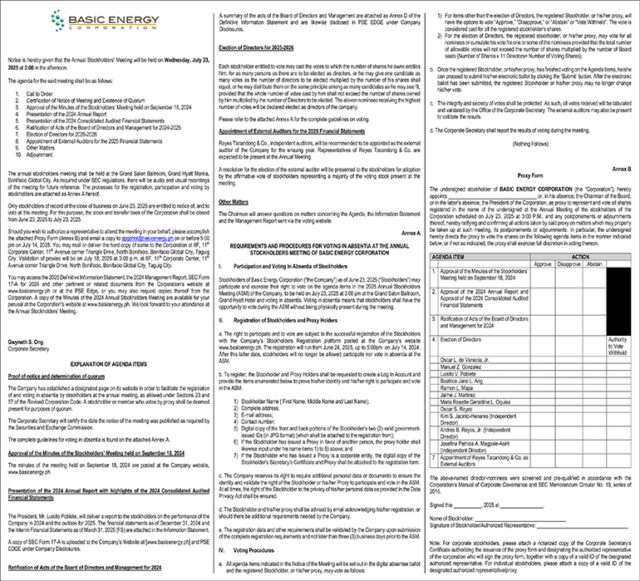
Basic Energy Corp. to hold Annual Stockholders’ Meeting on July 23


Spotlight is BusinessWorld’s sponsored section that allows advertisers to amplify their brand and connect with BusinessWorld’s audience by publishing their stories on the BusinessWorld Web site. For more information, send an email to online@bworldonline.com.

Join us on Viber at https://bit.ly/3hv6bLA to get more updates and subscribe to BusinessWorld’s titles and get exclusive content through www.bworld-x.com.

Century Pacific eyes double-digit growth despite US tariffs

CENTURYPACIFIC.COM.PH

LISTED food and beverage manufacturer Century Pacific Food, Inc. (CNPF) is maintaining its target of double-digit growth in revenue and profit this year, even as its export business has begun to feel the impact of tariffs imposed by the United States.

“Looking ahead, we remain cautiously optimistic in our full-year outlook and continue to target double-digit growth across topline and bottomline,” CNPF Executive Chairman Christopher T. Po said during the company’s annual stockholders’ meeting on Monday.

Mr. Po said the company has earmarked P4 billion to P5 billion in capital expenditure this year to support the growth of its business segments.

He added that CNPF plans to expand the capacity of its dairy, tuna, and coconut water businesses.

During a separate media briefing, CNPF President and Chief Executive Officer Teodoro Alexander T. Po said the tariffs have already affected the company’s export operations.

“It’s actually already affecting our US businesses because there’s already a 10% minimum straight tariff being imposed on exports to the US. Our significant exports of coconut water to the US are already affected by the US tariffs, and some of our tuna original equipment manufacturer and branded exports are also affected,” he said.

“For now, there is a combination of pass-on and absorption that’s happening in the market. But it’s quite volatile and unstable at this point,” he added.

The US imposed a 17% reciprocal tariff on Philippine goods on April 2, but the measure was suspended for 90 days pending negotiations until July 9. In the interim, most trading partners were charged a provisional 10% tariff.

“The silver lining that we’re hoping to get is that the Philippines will be better treated tariff-wise than our other global competitors in the export business,” Mr. Po said.

For the first quarter, CNPF reported an 11% increase in net income to P1.9 billion, driven by its branded segment. Consolidated revenue rose by 10% to P19.9 billion.

On Monday, CNPF shares rose by 0.63% or 25 centavos to close at P40.25 apiece. — Revin Mikhael D. Ochave

A.I. director Steven Spielberg opposed to using AI in front of the camera

HALEY JOEL OSMENT in a scene from 2001’s A.I. Artificial Intelligence. — IMDB

LOS ANGELES — When Steven Spielberg directed the film A.I. Artificial Intelligence, the technology was the stuff of science fiction — a device to tell a story about the ethics of creating sentient machines.

Now, AI is a concrete reality in Hollywood — one where Mr. Spielberg said he has drawn a line in the sand.

“I don’t want AI making any creative decisions that I can’t make myself,” said Mr. Spielberg, in an interview with Reuters. “And I don’t want to use AI as a non-human collaborator, in trying to work out my creative thinking.”

Mr. Spielberg spoke on Thursday after a ceremony dedicating the Steven Spielberg Theater on the Universal Studios lot. The event acknowledged the director’s decades-long relationship with the studio, which released such films as Jaws, Jurassic Park, Schindler’s List, and E.T. the Extra-Terrestrial.

The acclaimed director joked that his career at Universal began in 1967, when he took a tour of the lot as a high school student. He said he hid in the bathroom during a break, and waited for the tour to move on without him, “then I had the entire lot to myself that day.”

“Our hope and dream is that it’s not just the place that is founded on his extraordinary legacy,” said Donna Langley, chairman of NBCUniversal Entertainment & Studios. “But it is the place of future hopes and dreams of filmmakers and storytellers who are going to take this company into the next 100 years and the 100 years after that, people who come with a hope and a dream, people who have been inspired by Steven.”

Mr. Spielberg’s 2001 modest box office hit A.I. Artificial Intelligence was a meditation on love, loss, and what it means to be human through the eyes of a discarded humanoid robot. In the Pinocchio-like journey set in a futuristic dystopia, David, the android boy, yearns to be human, searching for love, in a world of machines and artificial intelligence.

The film hit screens when AI was still in its nascent stages and predated the launch of OpenAI’s ChatGPT by 21 years.

SPIELBERG AGAINST AI MAKING CREATIVE DECISIONS
“It wasn’t about artificial intelligence as much as it was about sentient existence, and can you love a sentient entity? Can a mother love a robot child?” said Mr. Spielberg. “It was not really where AI is taking us today. Eventually, there will be a convergence between AI and robotics.”

Mr. Spielberg said AI can be a great tool “if used responsibly and morally” to help find a cure for cancer and other diseases.

“I just draw a line — and it’s not a line of cement, it’s just a little bit of line in the sand — which gives me some wiggle room to say (that) I have the option to revise this thinking in the future,” he said. “But right now, I don’t want AI making any creative decisions.”

He said he has seen, first-hand, how technology can replace human talent while working on the 1993 film, Jurassic Park.

Mr. Spielberg initially planned to use renowned stop-motion clay animation artist Phil Tippett to create the dinosaurs roaming the island theme park. Visual effects artist Dennis Muren proposed an alternative method, using Industrial Light & Magic’s computer-generated imagery to create realistic dinosaurs. The director is an executive producer in Jurassic World: Rebirth which reaches theaters on July 2.

“That kind of made certain careers somewhat extinct,” said Mr. Spielberg. “So, I’m very sensitive to things that AI may do to take work away from people.”

Mr. Spielberg said he has yet to use AI on any of his films so far, though he is open to possible applications of it behind-the-scenes, in functions like budgeting or planning.

“I don’t want to use it in front of the camera right now,” Mr. Spielberg said. “Not quite yet.” — Reuters

BTr partially awards T-bill offer

TREASURY.GOV.PH

THE GOVERNMENT made a partial award of the Treasury bills (T-bills) it offered on Monday as yields were mixed amid expectations that headline inflation may have picked up anew in June following the surge in oil prices seen last month amid the Israel-Iran war.

The Bureau of the Treasury (BTr) raised just P23.95 billion from the T-bills it auctioned off on Monday, short of the P25-billion plan, even as the offer was more than twice oversubscribed, with total bids reaching P56.84 billion. However, the total demand seen was lower than the P65.47 billion in tenders recorded on June 24.

The government partially awarded the three-month paper as it rejected high bids, the Treasury said in a statement, with players asking for yields higher than secondary market levels. The BTr sold only P6.95 billion in 91-day T-bills on Monday, well below the P8-billion plan, even as total tenders for the tenor reached P18.125 billion. The three-month paper was quoted at an average rate of 5.526%, 0.4 basis point (bp) lower than the 5.53% seen in the previous auction, with bids accepted having yields of 5.49% to 5.548%.

Meanwhile, the government raised P8 billion as planned from the 180-day securities it offered on Monday as bids amounted to P20.9 billion. The average rate of the six-month T-bill was at 5.607%, rising by 5 bps from the 5.557% fetched last week, with accepted yields ranging from 5.583% to 5.64%.

Lastly, the Treasury raised P9 billion as planned via the 364-day debt papers as demand for the tenor totaled P18.715 billion. The average rate of the one-year T-bill inched down by 0.4 bp to 5.651% from 5.655% previously. Accepted bids carried yields of 5.629% to 5.669%.

“Average rates for the 180- and 364-day T-bills fell below prevailing secondary market rates,” the BTr said.

At the secondary market before Monday’s auction, the 91-, 182-, and 364-day T-bills were quoted at 5.479%, 5.642%, and 5.696%, respectively, based on PHP Bloomberg Valuation Service Reference Rates data provided by the Treasury.

The government made a partial award of its T-bill offer as demand was “modest to decent,” a trader said in a text message.

The trader added that the market is likely on wait-and-see mode to gauge the BTr’s awarding behavior at its upcoming bond auctions before making any “significant” moves.

T-bill yield movements were mostly marginal on Monday as oil prices and the peso-dollar exchange rate have normalized as Iran and Israel last week agreed to a ceasefire, easing the renewed inflation concerns sparked by the market volatility caused by the 12-day conflict, Rizal Commercial Banking Corp. Chief Economist Michael L. Ricafort said in a Viber message.

Still, the conflict is expected to have caused a pickup in headline inflation last month, he said.

Mr. Ricafort also noted that T-bill movements remained “modest” despite the 25-bp rate cut delivered by the Bangko Sentral ng Pilipinas (BSP) on June 19 and expectations of further monetary easing at home and in the United States.

Philippine inflation may have quickened slightly in June, with the spike in fuel costs likely to have been offset by broadly stable food prices, analysts said.

A BusinessWorld poll of 17 analysts yielded a median estimate of 1.5% for the June consumer price index, accelerating from the 1.3% in May but still below the BSP’s 2-4% annual target.

If realized, this would be the fastest clip in three months or since 1.8% in March. It would also mark the first pickup since December as the CPI has been on a downtrend since February. Still, this would be slower than the 3.7% print in June 2024.

The median estimate is also well within the BSP’s June forecast of 1.1% to 1.9%.

“Upward price pressures for the month are likely to be driven by higher meat and vegetable prices, elevated oil prices, and the depreciation of the peso. These pressures, however, could be partially offset by lower prices of rice, fish, and fruits, as well as lower electricity rates,” the BSP said on Monday.

“Going forward, the BSP remains committed to safeguarding price stability by ensuring that monetary policy settings are conducive to sustainable economic growth and employment.”

On Tuesday, the government will offer P30 billion in reissued seven-year Treasury bonds (T-bonds) with a remaining life of five years and 25 days.

The BTr wants to raise P250 billion from the domestic market in July, or P125 billion through T-bills and P125 billion via T-bonds.

The government borrows from local and foreign sources to help fund its budget deficit, which is capped at P1.56 trillion or 5.5% of gross domestic product this year. — A.M.C. Sy

ADVERTISEMENT
ADVERTISEMENT