Home Blog Page 1329

Fujifilm to build printer remanufacturing site in Laguna

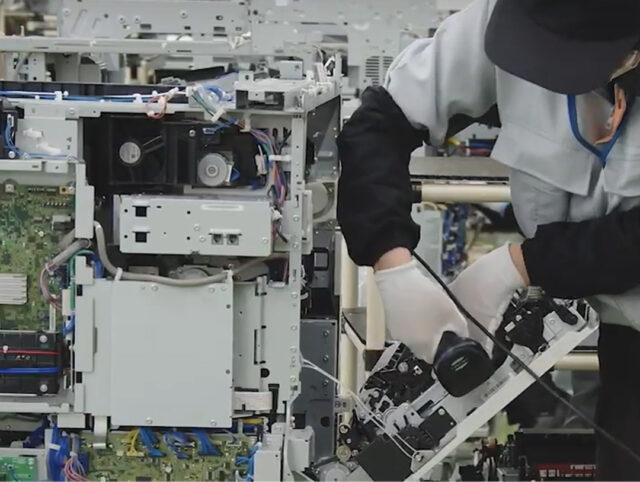
FUJIFILM Business Innovation Philippines Corp. is setting up a new manufacturing facility in Laguna to produce remanufactured printers, with operations scheduled to begin next year.

“The facility will be set up within Fujifilm Optics Philippines (FOPH). We’re starting construction in July this year and operations in August 2026,” Fujifilm Business Innovation Philippines President Hideaki Kato told reporters on Tuesday.

The facility will produce remanufactured multi-function printers from used multifunction devices collected from various countries across the Asia-Pacific region.

The printers will be disassembled, cleaned, and have parts replaced before being resold, with the same quality assurance as brand-new units, according to the company.

The Circular Manufacturing Center (CMC) will span 500 meters and will be located in the Calmeray International Business Park-Special Economic Zone in Calamba.

FUJIFILM currently operates CMC facilities in Japan and China, and the Laguna facility will be the first in Southeast Asia.

The facility will employ 50 individuals, the company said.

“The manufactured multi-function printer to be produced in the Philippines will be 5,000 units per year. We import 5,000 maybe some from the local market, but the majority import from other countries,” Mr. Kato said.

He said these include countries such as Korea, Taiwan, Hong Kong, Malaysia, Vietnam, Thailand, Singapore, New Zealand, and Indonesia.

“Each remanufactured multi-function printer undergoes the same rigorous inspection process as newly built multi-function printers to ensure they meet the same quality and reliability standards,” the company said. — Aubrey Rose A. Inosante

RCBC to redeem $300-M AT1 notes

RCBC/BW FILE PHOTO

Rizal Commercial Banking Corp. (RCBC) has issued a notice of early redemption to holders of its $300-million additional tier 1 (AT1) capital securities issued in 2020.

The bank will redeem the notes on Aug. 27, the first call date, based on the terms and conditions of the securities, the publicly listed Philippine lender said in a stock exchange filing on Tuesday.

It informed holders of the securities about the early redemption through The Bank of New York Mellon, London Branch, its paying agent.

RCBC said it would also surrender the registered global certificate representing the securities to the registrar for cancellation on the same date. The notes will be bought back at $1,000 per calculation amount, together with any accrued distributions up to but excluding the first call date.

“Upon redemption of the capital securities, [these] shall be canceled thereafter and delisted from the Singapore Exchange Securities Trading Ltd.,” the bank said.

The Bangko Sentral ng Pilipinas (BSP) approved the redemption last month.

RCBC said the proceeds of the issuance were used to support medium- to long-term asset growth, for general corporate purposes and to maintain sufficient buffers above the BSP’s minimum capital thresholds.

The bank posted a 10.26% year-on-year increase in attributable net income to P2.43 billion in the first quarter.

Its shares gained 35 centavos to close at P25.40 each. — Aaron Michael C. Sy

Muted no more: A renewed vigor in defending the Philippines’ territorial in-tegrity

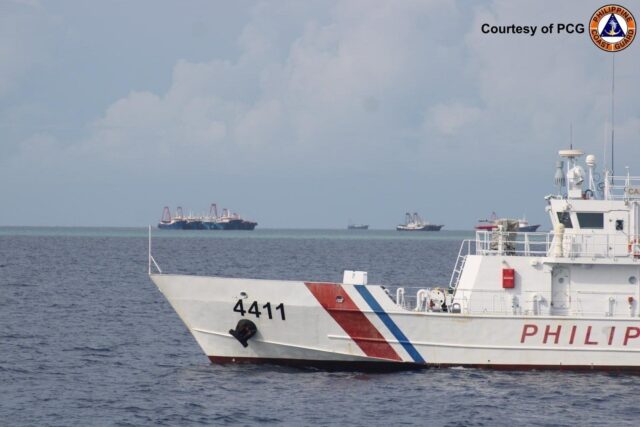
The Philippine Coast Guard (PCG) deployed two PCG vessels and an aircraft in response to reports of illegal swarming by Chinese Maritime Militia (CMM) in Rozul Reef on June 20, 2025. — PHILIPPINE COAST GUARD

Nearly nine years ago, on July 12, 2016, the Permanent Court of Arbitration (PCA) in The Hague ruled overwhelmingly in the Philippines’ favor and invalidated China’s claims on the South China Sea. China’s nine-dash line had no basis, the PCA said.

This was supposed to be a moment of victory for the Philippines. The legal validation that came from the arbitral court’s decision was intended to settle the questions that came with the territorial dispute with China. Grounded on international law, the verdict should have assured Filipinos that the areas comprising what we now know to be the West Philippine Sea are no longer disputed. That they belong to the Philippines is a fact.

Unfortunately, our own government under then-President Rodrigo Duterte downplayed the significance of the ruling. He then spent the next few years appeasing and accommodating China, even at the expense of our own interests. He always claimed that China was too big and so powerful that we cannot ever imagine going to war with it.

But who said anything about war? Our case at the PCA simply protested China’s provocations and illegal acts. It showed that we resorted to legal and diplomatic means to settle issues.

Emboldened by Mr. Duterte’s stance, China consistently undermined the arbitral award, insisting the PCA never had any jurisdiction over it. And for as long as the former president was in power, we were always very careful in asserting our legal rights, afraid to antagonize our giant neighbor.

The succeeding administration, however, had a decidedly different take on the issue of the West Philippine Sea. Early on in his term, President Ferdinand Marcos, Jr. said he would “not preside over any process that will abandon even one square inch of territory of the Republic of the Philippines to any foreign power.”

To be sure, these pronouncements have not deterred the Chinese from their aggressive acts on our seas. Reports of their harassment of Philippine vessels and fisherfolk, using water cannons and military-grade lasers, sideswiping and other tactics, and even spreading fake news, have become common — and consistent — in recent years.

In response, the Philippines has filed hundreds of diplomatic protests against China’s actions, registering our vehement objection to and condemnation of its acts. Our own military has adopted a new defense strategy, the Comprehensive Archipelagic Defense Concept.

Rightfully, this administration is acknowledging the significance — and power — that the ruling carries.

What was once a solitary legal and diplomatic triumph tragically muted by the Duterte administration that should have been the first to ensure its enforcement, has now evolved into a whole-of-society campaign.

Despite China’s aggression from sea to air, the military and the Philippine Coast Guard have stood firm in asserting the country’s sovereign rights, conducting regular patrols and resupply missions in the West Philippine Sea.

Civil society remains a crucial stakeholder — particularly Filipino fisherfolk, youth groups, advocacy networks, and church leaders as they continue to reinforce the Philippines’ stand over the West Philippine Sea. They have launched peaceful, civilian-led resupply missions in the West Philippine Sea. These missions underscore a message that resonates across the nation: the West Philippine Sea is not just a strategic issue — it is a Filipino issue.

Even the private sector — from corporations to business groups, to private educational institutions — has expressed strong support for the Arbitral Award. This support has taken shape through affirming the importance of a rules-based international order and increasingly calling out pro-China officials who undermine Philippine sovereignty.

This renewed vigor stems from a clear understanding that the arbitral award is not merely a piece of paper but a legal cornerstone for the Philippines’ sovereign rights and a rallying point for peace and stability in the Indo-Pacific.

Indeed, the current administration has placed international law at the heart of its foreign and defense policy. As a result, this stance has prompted like-minded countries, equally committed to upholding international law, to lend their support to the Philippines in various ways, from helping boost our defense capabilities, to making public statements of support, and sharing intelligence and other technological assets to combat incursions even in cyberspace.

The Stratbase Institute has always been at the forefront of championing the Philippines’ interests in the West Philippine Sea. In an international conference we are holding on Friday, July 11, titled “9th Year of the Arbitral Victory: Defending the Rules-Based Order through Reinforced Defense Capabilities and Partnerships,” we intend to demonstrate the broad-based support for the Philippine position.

The event will bring together representatives from Australia, the United Kingdom, Canada, the European Union, France, Germany, India, Japan, New Zealand, the United States, Vietnam, and other like-minded states. Joining them will be key members of the government, the Armed Forces of the Philippines, the Philippine Coast Guard, leaders from civil society, and representatives from the private sector.

This gathering is a testament to how the arbitral award has united a broad intercontinental coalition committed to upholding the rules-based international order, promoting regional stability, and defending Philippine sovereignty in the West Philippine Sea.

The PCA ruling gives the Philippines a firm and incontrovertible basis to assert our rights and demand that no other country trample on it. Indeed, it is a cornerstone of Philippine sovereignty, something that we should hold and cherish especially amid these challenging times in the region and in the world.


Victor Andres “Dindo” C. Manhit is the president of the Stratbase ADR Institute.

Archaeologists in Peru unveil 3,500-year-old city that linked coast and Andes

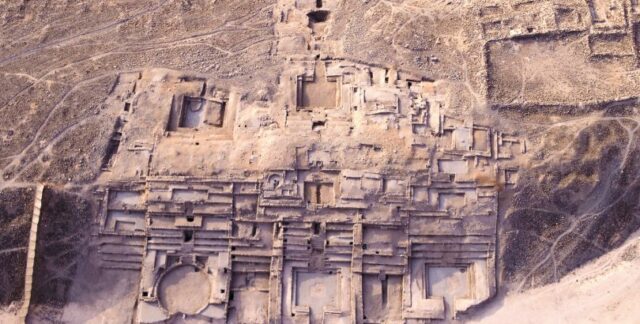
PEÑICO, the new archaeological gem of the Supe and Huaura valleys opens its doors to Peru and the world | Image from ZONACARAL.GOB.PE

LIMA — Archaeologists on Thursday unveiled a 3,500-year-old city in Peru that likely served as a trading hub linking Pacific coast cultures with those in the Andes and Amazon, flourishing around the same time as early civilizations in the Middle East and Asia.

Drone footage released by researchers shows the city center is marked by a circular structure on a hillside terrace, with remains of stone and mud buildings constructed some 600 meters (1,970 feet) above sea level.

The urban center, named Peñico, is located in the northern Barranca province and was founded between 1,800 and 1,500 BC. It is close to where the Caral civilization, the oldest in the Americas, developed 5,000 years ago.

Caral, comprised of 32 monumental structures, is considered a contemporary of civilizations in Egypt, India, Sumeria, and China. However, unlike them, it developed in complete isolation, according to researchers.

Ruth Shady, the archaeologist who led the research into Peñico, said the newly unveiled city is key because experts believe it emerged after the Caral civilization was devastated by climate change.

“They were situated in a strategic location for trade, for exchange with societies from the coast, the highlands, and the jungle,” Ms. Shady said.

Archaeologist Marco Machacuay, a researcher with the Ministry of Culture, said at a news conference that Peñico’s importance lies in it being the continuation of the Caral society.

After eight years of studies, researchers have identified up to 18 structures in Penico, including ceremonial temples and residential complexes.

The walls of a central plaza stand out for their sculptural reliefs and depictions of the pututu, a conch shell trumpet whose sound carries over long distances.

In other buildings, researchers found clay sculptures of human and animal figures, ceremonial objects and necklaces made from beads and seashells, they added.

Peru is a center of ancient cultures and home to archaeological sites such as the Inca ruins of Machu Picchu in Cusco and the mysterious Nazca lines located in the desert region along the country’s central coast. — Reuters

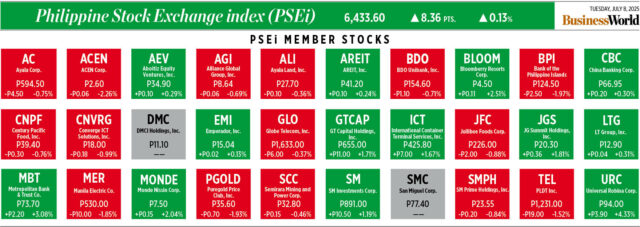
How PSEi member stocks performed — July 8, 2025

Here’s a quick glance at how PSEi stocks fared on Tuesday, July 8, 2025.


Peso advances as Trump signals tariff flexibility

BW FILE PHOTO

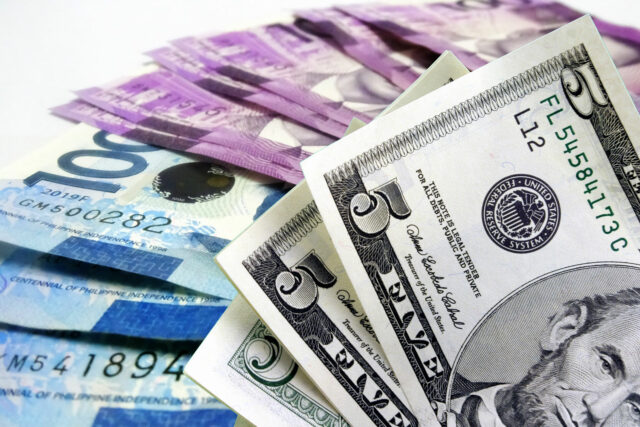
The peso appreciated against the dollar on Tuesday after US President Donald J. Trump’s announcement of higher tariffs on 14 countries, while hinting at being open to further trade negotiations.

It closed at P56.35 a dollar, up 33.5 centavos from its P56.685 finish on Monday, according to Bankers Association of the Philippines data posted on its website.

“The dollar-peso traded lower on risk-relief rally after President Donald J. Trump signaled he is open for trade talks,” a trader said by telephone.

The peso opened at P56.55, dipped to its weakest at P56.555, and strengthened to as high of P56.35. Trading volume rose to $1.67 billion, higher than the previous day’s $1.53 billion.

The peso was supported by Mr. Trump’s decision to extend the deadline for trade deals to Aug. 1 from July 9, Michael L. Ricafort, chief economist at Rizal Commercial Banking Corp., said in a Viber message.

On Monday, the US President signed an executive order moving the effectivity of reciprocal tariffs to Aug. 1 from the original July 9 deadline.

Starting Aug. 1, the US will impose varying tariffs — 25% on Japan, South Korea, Tunisia, Malaysia and Kazakhstan; 30% on South Africa and Bosnia and Herzegovina; 32% on Indonesia; 35% on Serbia and Bangladesh; 36% on Cambodia and Thailand; and 40% on Laos and Myanmar.

However, he left the door open for last-minute talks.

“If, for any reason, you decide to raise your tariffs, then, whatever the number you choose to raise them by, will be added on to the 25% that we charge,” Mr. Trump said in letters addressed to Japan and South Korea, released via his Truth Social platform.

The letters also emphasized that the tariffs would be separate from existing ones, including those on cars, steel and aluminum.

Mr. Trump said the Aug. 1 deadline is “firm, but not 100% firm.” “If they call up and they say we’d like to do something a different way, we’re going to be open to that.”

Markets have remained cautious as Trump’s broader trade strategy continues to affect global economic forecasts.

The trader expects the peso to trade from P56.10 to P56.50 on Wednesday, while Mr. Ricafort sees a slightly narrower range of P56.25 to P56.50. — Aaron Michael C. Sy

America’s copy-and-paste tariffs will rile ‘Mr. Japan’

STOCK PHOTO | Image from Freepik

“You will never be disappointed with The United States of America.”

So went President Donald Trump’s sign-off in his letters issued to 14 trading partners on Monday. But in Tokyo, Prime Minister Shigeru Ishiba will be more than disappointed. He’s entitled to be furious.

Japan was among the first countries to begin talks after April’s “Liberation Day” tariff announcement. It has spent months in negotiations, with Ishiba’s envoy making seven trips to the US for talks with Trump and other officials. The nation has been the largest investor in the US for the past five years and is a crucial security ally. All that only to end up with a tariff rate one percentage point higher than first proposed three months ago.

To add insult to injury, Japan was lumped in with countries that are far less vital partners, including Kazakhstan and Myanmar. While the threatened rates to be enacted on Aug. 1 were different between countries, the copy-and-paste wording sent to the respective leaders was virtually identical, including telling Tokyo to open its “heretofore closed trading markets” — whatever that means.

The warning signs were there after Trump erupted last week. Overnight, it seemed, Japan went from being respected, or “tough,” in Trump parlance, to being “spoiled.” And while “Mr. Japan,” as Trump seemingly dubbed Ishiba, may not have ended up with the 35% tariffs once threatened, months of talks have only led to further threats.

In Seoul, recently elected President Lee Jae Myung might be feeling hard done by, too. His country is moving to address US concerns over non-tariff barriers, but has been hampered by the political turmoil prior to Lee’s election. Japan might have thought it was getting the first-mover advantage Treasury Secretary Scott Bessent promised to countries that came to the negotiating table fast. Instead, an identical rate has been levied on both countries.

Markets in Tokyo and Seoul barely skipped a beat, buying into the TACO trade as it quickly became clear that the letter was, in effect, an extension of the July 9 deadline. Trump’s further suggestions that the deadline wasn’t “100% firm” make this clearly the latest in his Art of the Deal brinkmanship to wring out more concessions.

And in Japan’s case, Trump’s 25% auto tariffs — the elimination of which is Ishiba’s primary goal — are already in effect. That’s why the longest-lasting impact of Monday’s announcement will be to further chip away at trust between Washington’s most vital partner in staring down China.

The prime minister has stood surprisingly firm in the talks, while making good-faith efforts to engage with the US. But might his engagement have been too earnest?

Flattery and a bit of exaggeration may have been the better way to go, perhaps taking a page out of SoftBank Group Corp. founder Masayoshi Son’s handbook in dealing with the president. This might help sidestep Tokyo’s biggest problem: The difficulty in understanding what Trump actually wants. Local media have already reported how officials have been baffled by the open disagreements between the US negotiators. A vague hand wave — promises to place a Ford F-150 in every Japanese garage, or whatever Trump wants to hear — might be a better way to buy time.

Trump is clearly pulling out the seat at the negotiating table. But Ishiba already has his hands full with crucial Upper House elections on July 20, where he can’t be seen to be giving concessions or selling rice farmers down the river. Still, the latest move could even be advantageous to him; after all, no one likes a bully. Meanwhile, any expectations that the Bank of Japan will hike rates later this month — at a meeting scheduled the day before the tariffs come into effect — should prepare for disappointment.

The longer-term consequences are harder to read. It’s possible, even likely, that Trump will have another of his trademark changes of heart, and suddenly Japan, South Korea, and the other trading partners will be US friends again. Constantly kicking the can down the road indicates he doesn’t really want to follow through with his threats.

But such incessant bluster chips away at goodwill built up between the partners over decades. And that’s something that can’t simply be copied and pasted. — Bloomberg Opinion

Palace confident in US trade deal after neighbors get tariff letters

DTI PHOTO

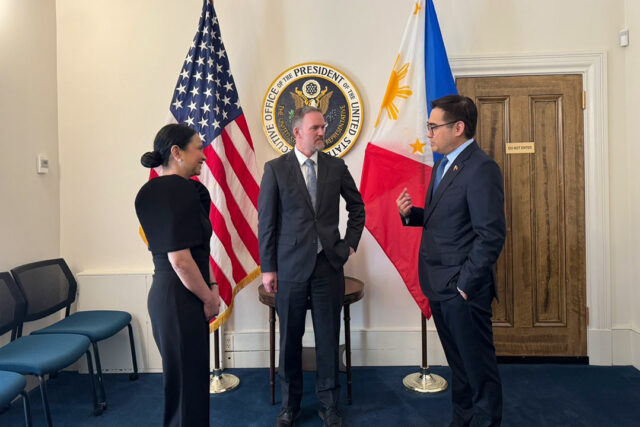
The Philippines is in a “good” position in trade negotiations with the US, Malacañang said on Tuesday, after President Donald J. Trump sent tariff letters to a number of countries in Southeast Asia.

“In our opinion, yes (we are in a good place), because the Philippines and the US, have reached an agreement that there will be cooperation on economic development,” Palace Press Officer Clarissa A. Castro told reporters at a briefing.

Asked where Manila and Washington are in negotiations, Ms. Castro quoted Secretary Frederick D. Go, Special Assistant to the President for Investment and Economic Affairs and one of the trade negotiators, as saying there are no updates as yet, with negotiations still ongoing.

Trade negotiators are bound by a confidentiality agreement.

Mr. Trump sent out tariff letters to Japan and South Korea on Monday, announcing both their rates on social media as 25%. He also sent similar letters to Myanmar (40%), Laos (40%), Indonesia (32%), and Malaysia (25%).

On April 2, the White House initially announced “reciprocal” tariffs of 24% on Japan, 25% on South Korea, 44% on Myanmar, 48% on Laos, 32% on Indonesia and 24% on Malaysia. The Philippines had initially been assigned a rate of 17%.

The reciprocal tariffs were suspended pending negotiations with various trade delegations, while a 10% tariff applied in the interim to most trading partners.

Vietnam has since been assigned a 20% as one of the first two countries to conclude a trade deal with the US.

Mr. Trump said changes to the tariffs charged on trading partners take effect on Aug. 1, though he was open to further negotiations.

Secretary of State Marco Antonio Rubio, will visit Asia for the first time on the occasion of an Association of Southeast Asian Nations (ASEAN) meeting next week.

Ms. Castro said there are no details yet on what the regional bloc will discuss with Mr. Rubio.

Reinielle Matt M. Erece, an economist at Oikonomia Advisory and Research, Inc., said the Philippines’ competitiveness in international trade may continue to improve.

“Increased competitiveness is beneficial for exports and economic growth,” he said via Viber.

“Now that competitiveness in terms of price is seen to be in favor of the Philippines, the next step is to improve the country’s industrial sector to produce even better products that can also compete in terms of quality,” he added.

The Foreign Buyers Association of the Philippines has warned that Philippine exports will struggle to compete if the US restores its 17% reciprocal tariff rate, especially after Vietnam secured its deal for a 20% tariff. — Chloe Mari A. Hufana

Five onshore wind projects get green-lane status

Cleantech

The Board of Investments (BoI) has granted green lane certificates to five onshore wind projects of Cleantech Global Renewables, Inc., involving a combined investment of P108 billion.

The certificates of endorsement cover Cleantech’s P18.29-billion Tayabas North Wind Power Project, which has a 144-megawatt (MW) capacity, and the P22.9-billion Tayabas South Wind Power Project.

The BoI also endorsed the company’s P24.10-billion 187.2-MW Bulacan 1 Wind Power Project, the P28.79-billion 237.6-MW Bulacan 2 Wind Power Project, and the P13.95-billion 86.4-MW Maragondon Wind Power Project for green lane treatment.

“The wind power projects are expected to generate more than 3,000 jobs. Cleantech is one of the fastest-growing 100% Filipino-owned independent power producers and renewable energy developers in the Philippines,” the BoI said in a statement on Tuesday.

Established in 2014, Cleantech is developing a portfolio of clean energy projects in the Philippines and controls an aggregate capacity of 650 MW for its solar plants in operation and under construction.

It also has 5,000 MW worth of renewable energy projects at various stages of development, the BoI said.

Green lane status will expedite and simplify the permit and licensing process for the five projects.

“The One-Stop Action Center for Strategic Investments shall coordinate with the relevant local government units to personally endorse these projects for green lane services,” the BoI said.

“This proactive approach will expedite and streamline the permitting process for projects identified as Strategic Investments,” it added.

As of June 30, the BoI endorsed 222 projects for green lane treatment, valued at a combined P5.748 trillion.

Of the green lane projects, 176 involve renewables, 31 food security, nine digital infrastructure and public-private partnerships, and six manufacturing. — Justine Irish D. Tabile

DA’s Laurel files for two-week medical leave

FRANCISCO P. TIU LAUREL, JR. — PHILIPPINE STAR/JESSE BUSTOS

Agriculture Secretary Francisco P. Tiu Laurel, Jr. is taking a two-week medical leave starting July 9, the Department of Agriculture (DA) said on Tuesday.

Mr. Laurel is expected to undergo an unspecified procedure in Hong Kong, which he said had been deferred since he joined the government in November 2023.

“I will continue to monitor developments on the ground. Tuloy-tuloy lang ang trabaho (the work continues),” he said in a statement.

He added that he made the announcement “to prevent any speculation about his impending prolonged absence from activities of the DA.”

In Special Order No. 874, DA said that Undersecretary for Operations and Agri-Fisheries Mechanization and for Rural Credit Roger V. Navarro was designated officer-in-charge during the period.

“As such, he shall perform the functions, duties, and responsibilities inherent to the designation and such others as directed by the secretary in concurrent capacity with his regular functions, duties, and responsibilities,” according to the order.

However, the DA said on Tuesday that Mr. Laurel is expected to resume his duties by July 24, days before President Ferdinand R. Marcos, Jr.’s State of the Nation Address.

In a separate statement, the DA said that it partnered with the Department of Social Welfare and Development (DSWD) to roll out P20 rice for beneficiaries of the DSWD’s “Walang Gutom” program.

Walang Gutom is a food stamp program employing an electronic benefit transfer card.

“Through this partnership, our beneficiaries can now buy rice at an unprecedented P20 per kilo from DA-accredited retailers and Kadiwa outlets,” Social Welfare Secretary Rexlon T. Gatchalian said.

“This significantly increases the value of their food credits, helping families access healthier meals,” he added.

Initial beneficiaries of the program include solo parents, senior citizens, and persons with disabilities.

Walang Gutom beneficiaries currently number over 300,000 families, and will expand to 750,000 households by 2028.

Mr. Laurel said that the P20 rice program also benefits rice farmers, as “every bag of rice sold frees up storage for two sacks of palay (unmilled rice) that the National Food Authority (NFA) must buy from farmers at fair prices.”

At a forum on Tuesday, NFA Administrator Larry R. Lacson said the grains agency held reserves equivalent to 12 days’ demand as of two weeks ago.

“We try to do our best to absorb (rice) from our farmers. But we have limitations. So hopefully these limitations will be corrected, probably within the year,” he said. —  Justine Irish D. Tabile

Subic containers flagged as possible record seizure of agricultural goods

ICTSI.COM

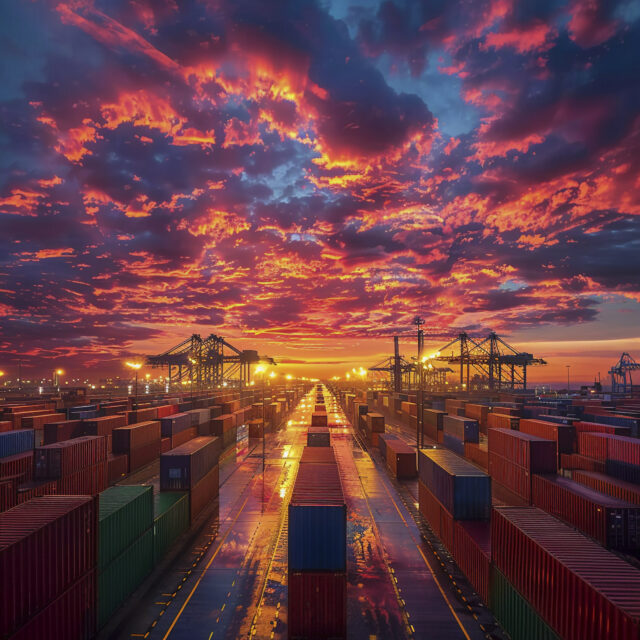
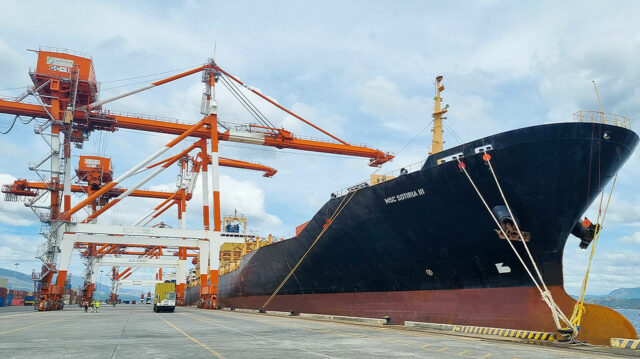
The Department of Agriculture (DA) said it is processing container shipments in Subic on suspicion they hold agricultural commodities imported from China without the required permits.

“(This is) potentially the biggest single seizure under the newly enacted Anti-Agricultural Economic Sabotage Act,” the DA said in a statement.

Ten containers were singled out for inspection out of 52 containers initially flagged by the Bureau of Customs. Of the 52, 21 have since been released after examination and clearance and 21 remain subject to inspection.

According to the DA, the shipments are being held on suspicion of violations of the Food Safety Act of 2013 and the Customs Modernization and Tariff Act.

“The goods loaded in 10 container vans estimated to be worth P100 million; the total value of the entire haul of (including the as-yet uninspected containers) could reach several hundreds of millions of pesos,” the DA said.

The 10 containers inspected on Tuesday were found to contain frozen mackerel, fresh carrots, and yellow onions, which lacked import permits.

“These products will be subjected to testing to determine their safety for human consumption. If found unfit, they will be destroyed immediately,” Agriculture Secretary Francisco P. Tiu Laurel, Jr. was quoted as saying.

“Our priority is the protection of public health and the livelihood of our farmers and fisherfolk,” he added.

Five of the inspected containers were consigned to a company identified as 1024 Consumer Goods Trading, and the remaining five containers were consigned to Berches Consumers Goods Trading, the DA said.

Separately, the DA also seized three containers consigned to Queenstar Industry Consumer Trading, which contained carrots and frozen mackerel, all lacking permits. They were not among the 21 awaiting inspection.

Starting last month, the DA filed 15 alert requests, which resulted in the seizure of 76 containers, including 59 which arrived in Subic.

“The intensified enforcement effort follows a direct order from President Ferdinand R. Marcos, Jr. to crack down on agricultural smuggling and protect the domestic food supply chain,” the DA said. —  Justine Irish D. Tabile

Bid notice posted for Virac airport upgrade

The Department of Transportation (DoTr) said it will set aside P264.62 million for the Virac Airport redevelopment project.

In a bid notice, the DoTr set a July 28 deadline for proposals to upgrade the airport serving Catanduanes.

The winning contractor will be given 720 days, inclusive of a 60-day allowance for days deemed unworkable, to complete the project.

The Virac Airport project involves site development for a building, the construction of a control tower, the extension of the runway, and the construction of turning pad.

For this year, the government has budgeted P7.7 billion for upgrades at 15 airports to help boost tourism and refurbish outdated air facilities.

The 15 airports include Virac, Sorsogon’s Bacon Airport, and Ilocos Sur’s Candon Airport.

Other projects include Tacloban City Airport, which is set to receive P2.3 billion of the total budget; and Busuanga, Palawan, and Laoag International Airports. —  Ashley Erika O. Jose

ADVERTISEMENT
ADVERTISEMENT