Home Blog Page 129

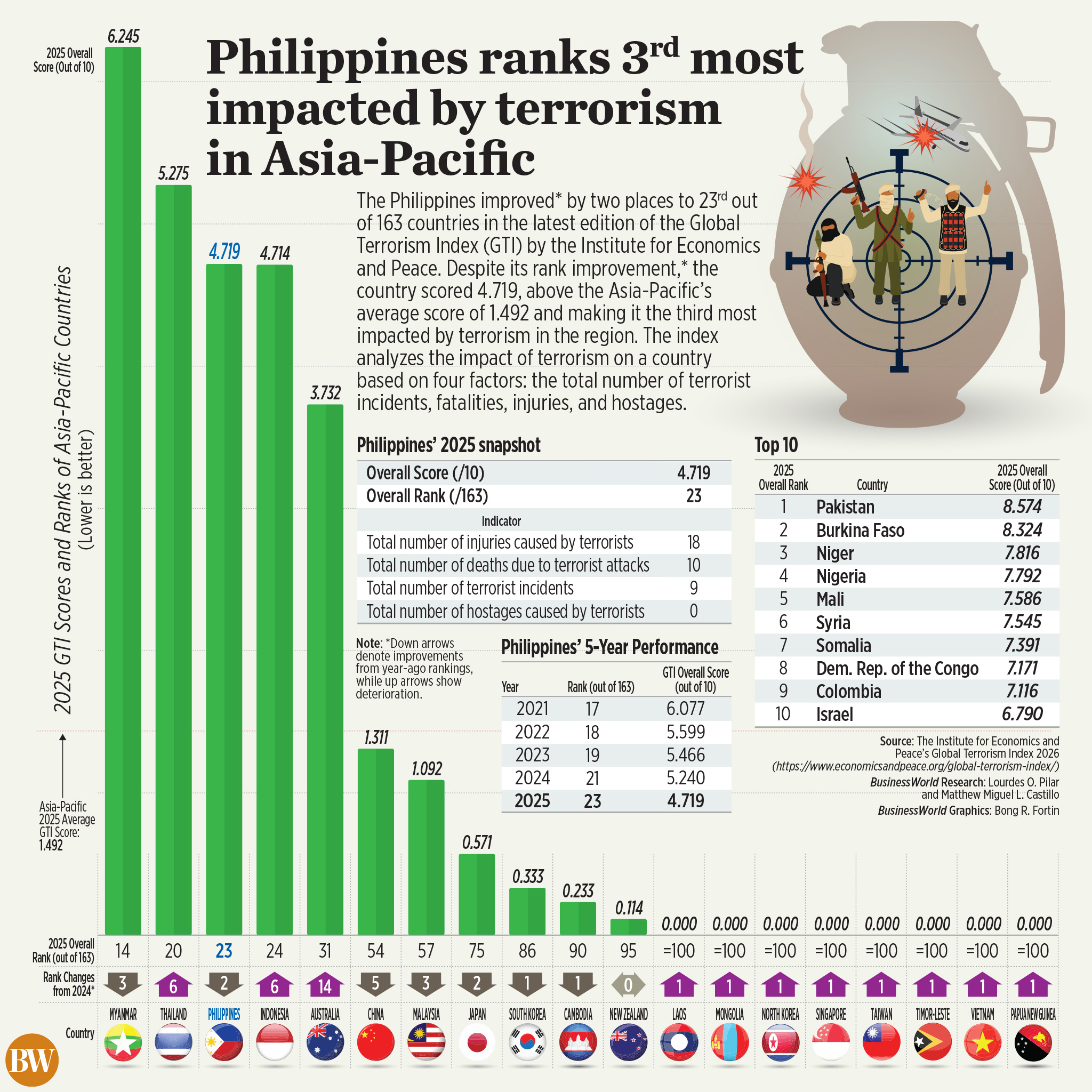
Philippines ranks 3rd most impacted by terrorism in Asia-Pacific

The Philippines improved* by two places to 23rd out of 163 countries in the latest edition of the Global Terrorism Index (GTI) by the Institute for Economics and Peace. Despite its rank improvement,* the country scored 4.719, above the Asia-Pacific’s average score of 1.492 and making it the third most impacted by terrorism in the region. The index analyzes the impact of terrorism on a country based on four factors: the total number of terrorist incidents, fatalities, injuries, and hostages.

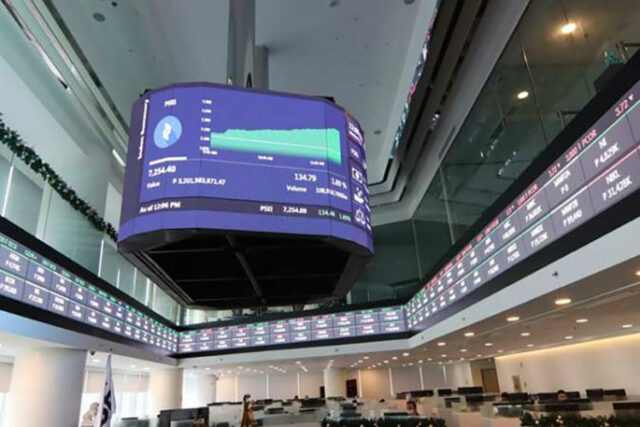
PSEi may extend losses on oil surge, peso slump

BW FILE PHOTO

By Alexandria Grace C. Magno, Reporter

PHILIPPINE shares may extend losses this week as surging oil prices and a weakening peso deepen inflation concerns and keep investors on the sidelines.

Analysts said sentiment remained fragile as war in the Middle East and a hawkish pause from the US Federal Reserve weighed on risk appetite.

“The local bourse closed the four-day trading week in the red, dictated by persistent risk aversion from escalating Middle East geopolitical tensions plus a hawkish pause from the US Federal Reserve,” brokerage 2TradeAsia said in a note.

The benchmark Philippine Stock Exchange index (PSEi) fell 0.6% or 36.83 points on Thursday to close at 6,018.62, while the broader all-share index declined 0.55% or 18.69 points to 3,344.87. Week on week, the PSEi slipped by 40.32 points.

Markets were closed on Friday in observance of Eid’l Fitr or the end of Ramadan.

Japhet Louis O. Tantiangco, research manager at Philstocks Financial, Inc., said investors largely stayed on the sidelines amid uncertainty.

“Trading was tepid for the most part of the week, implying that many are staying on the sidelines amid lingering uncertainties,” he added.

For the coming sessions, Mr. Tantiangco expects the market to remain under pressure as elevated oil prices and peso weakness fuel inflation risks.

Any signs of de-escalation in the Middle East conflict could support a rebound, while further escalation might drive additional losses, he added.

Investors are also closely watching the government’s response to rising fuel costs and their impact on the broader economy.

The peso’s slide to a record low added to concerns. It closed at P60.10 a dollar on Thursday, weakening by 58 centavos from P59.52 the previous day, according to Bankers Association of the Philippines data posted on its website. The latest level broke its prior record low of P59.87.

Technical indicators also point to continued risks. Mr. Tantiangco noted that the PSEi remains below its 10-day, 50-day and 200-day exponential moving averages, with the 50-day and 200-day lines nearing a “death cross,” a bearish signal for medium- to long-term trends.

“Both the MACD (moving average convergence divergence) line and the 14-day relative strength index are moving downwards, supporting bearish indications,” he said.

He expects the 6,000 level to be tested again this week, with support at 6,000 and resistance at 6,150. Brokerage 2TradeAsia placed immediate support at 6,000, with secondary support at 5,800 and resistance at 6,300 to 6,400.

Eala advances to Round of 16

ALEXANDRA EALA (PHL) reaches for a forehand against Laura Siegemund (GER) (not pictured) on day three of the 2026 Miami Open at Hard Rock Stadium. — REUTERS/GEOFF BURKE-IMAGN IMAGES

Sweeps Poland’s Magda Linette in two sets

CAN’T STOP, won’t stop.

Relentless Alexandra “Alex” Eala rocked and rolled her way to another Round of 16 stint, scoring a 6-3, 7-6 (7-2) romp of Poland’s Magda Linette in the Miami Open before a roaring pro-Filipino crowd at the Grandstand of the Hard Rock Stadium on Sunday.

Ms. Eala, WTA No. 29, recovered from a near meltdown in the second set with a torrid 7-2 rally in the tiebreaker to complete another sweep of the Polish veteran in the duel between youth and experience in one hour and 48 minutes.

The 20-year-old Filipina previously beat the 34-year-old Ms. Linette, WTA No. 50, in the quarterfinals of the WTA 250 ASB Classic in Auckland, New Zealand earlier this year, picking up where she left off to zero in on her lofty goals in Florida.

Ms. Eala, a wildcard qualifier who shocked the tennis world last year to become the first Filipina WTA semifinalist in Miami, is No. 31 seed in the main draw right away this time around after her meteoric rise that also included a similar Last 16 finish in the Indian Wells Open considered as the “Fifth Grand Slam” last week.

She is two wins away from retaining her place in the world’s Top 30 and recovering the hefty deduction of 390 ranking points she gained following her magical run last edition in the 1000-level WTA tour upon its expiration this week.

And she will try to move closer to that coveted bid against world No. 14 Karolina Muchova of Czechia on Monday (Manila time) for a slot in the quarterfinals. The 29-year-old Ms. Muchova, the No. 13 seed in Miami, scored a 6-3, 7-5 win over No. 67 Katie Boulter of Great Britain.

A win by Ms. Eala would set the stage against either fellow rising stars in No. 9 Victoria Mboko of Canada or No. 10 Mirra Andreeva of Russia after their easy victories in Round 3. Ms. Mboko, 19, drubbed Russian Anastasia Zakharova, 6-1, 7-5, while Ms. Andreeva, 18, beat Czech Marie Bouzkova, 7-6 (7-4), 6-2.

By the final four, either her good pal in No. 4 Coco Gauff or No. 6 Amanda Anisimova, both from the United States, is tipped to stand in the way.

“Being back in the 4th round, it makes me feel the same as I did last year. I’m so happy. I’m so excited. It’s such a privilege to be back in Miami,” said Ms. Eala, taking it one game at a time without thinking of the immense pressure on defending her ranking points to stay inside the Top 30.

Following the expiration of her ranking points, Ms. Eala is currently at No. 44 from as low as No. 50 according to the live WTA rankings after regaining 120 of those 390-point deduction with three wins so far.

As the No. 31 seed, she had a first-round bye before eking out a gritty a 6-7 (6-8), 6-3, 6-3 Round of 64 win against No. 53 Laura Siegemund of Germany.

She rode the momentum of that back-and-forth duel that lasted three hours and 20 minutes for the longest match of her career, looking “as fresh as a flower” as she unleashed a 4-1 finishing kick on Ms. Linette from a 2-all score for the win in the opening set.

Ms. Eala appeared headed to a cruise with another strong start in the second, 3-1, but Ms. Linette proved her worth as the second-round slayer of world No. 3 and Miami No. 2 seed Iga Swiatek, 1-6, 7-5, 6-3, by staging a 5-2 blitz to snatch the set point, 6-5.

The lefty ace then held serve in the 12th to drag the duel to an extension, where she just stamped her class marked by three break points for a convincing 7-2 win.

Last year, Ms. Eala beat three Grand Slam champions and Top 20 players in Ms. Swiatek, Latvia’s Jelena Ostapenko and USA’s Madison Keys one after another to harvest the said massive points, reach new feats for Philippine tennis and enter the world’s Top 100.

And in spite of an entirely different landscape now as one of the world’ rising stars from being an unknown qualifier last year, there is no stopping the Filipina pride. — John Bryan Ulanday


UP Fighting Maroons get back in UAAP Season 88 women’s volleyball semifinal race; Dongallo returns

FACEBOOK.COM/WEARETHEUAAP

Games on Wednesday
(Smart Araneta Coliseum)
9 a.m. – UST vs DLSU (Men)
11 a.m. – AdU vs Ateneo (Men)
1 p.m. – UST vs DLSU (Women)
3 p.m. – AdU vs Ateneo (Women)

UNIVERSITY of the Philippines (UP) made short work of the cellar-dweller University of the East (UE), 25-21, 25-15, 25-14, and checked a costly four-game dry spell to get back in the UAAP Season 88 women’s volleyball semifinal race on Sunday at the Smart Araneta Coliseum.

Kianne Olango led the way with 18 points on 14 hits, three blocks and an ace laced by seven receptions as the UP Fighting Maroons improved to 4-5, good for sixth place with a lot to play in the crucial second round.

UP, under new mentor Fabio Menta from Italy, was a revelation early in the first round after a 3-1 start including a massive upset of back-to-back reigning champion National University (NU) only to falter down the stretch.

Casiey Dongallo’s ACL injury took a toll on the Fighting Maroons’ campaign and never won since her absence before finally scoring one on the winless UE Lady Warriors in only 82 minutes of play behind a balanced onslaught.

Skipper Niña Ytang added 14 points on 10 hits and four blocks while Jelai Gajero chipped in 11 points, made possible by Jaz Manguilimotan’s 20 sets. Libero Yesha Capistrano provided 17 digs and 13 receptions.

“We had some problems with Casiey’s (Dongallo) injury. It took us a couple of games before we could find the balance. It’s not been easy to reorganize; slowly, we’re getting there,” said Mr. Menta as UP closes in on Adamson University (4-4) for fifth spot ahead of titanic clash against unbeaten De La Salle University (8-0) next Sunday.

Far Eastern University (FEU) and University of Santo Tomas are in third to fourth spot so far with 5-3 slates in an expected wild race to the finish.

Khy Cepeda was everywhere with 12 points, 17 receptions and 10 digs but the Lady Warriors’ remained in search for an elusive first win with their ninth straight defeat this season and 23rd since last year.

In the men’s division, Leo Ordiales (30) and Buds Buddin (25) joined forces as five-peat champion NU (7-2) got back on tormentor FEU (8-1), 28-26, 17-25, 24-26, 25-11, 15-8, to gain solo second.

University of the Philippines finally snapped its frustrating five-game slide with a hard-fought 25-22, 23-25, 25-23, 25-20 victory over the University of the East in the UAAP Season 88 collegiate men’s volleyball tournament at the Smart Araneta Coliseum on Sunday.

UP (3-6) in the first match ended a five-game skid by drubbing UE, 25-22, 23-25, 25-23, 25-20 (1-8) behind the 20 points of Nigerian ace spiker Olayemi Raheem. — John Bryan Ulanday

Setter Jia de Guzman will be back after a bad fall

PREMIER VOLLEYBALL LEAGUE

SHE will be back.

Creamline setter Jia de Guzman gave this assurance after a bad fall that left her leaving in the fifth and final set of the Cool Smashers’ crucial classification round duel with the Cignal Super Spikers on Saturday that resulted into a 25-19, 25-20,15-25, 26-28, 16-14 win at the FilOil Arena.

“I’m okay,” said Ms. de Guzman right after the duel that sent the proud Rebisco-owned franchise to its sixth win in nine outings and straight to the four-team crossover qualifying phase.

The beloved Alas Pilipinas captain stressed she decided not to return just to be on the safe side since the league is only halfway through.

“It was just a scare, a bad slip,” she said.

Ms. de Guzman will have time to heal and recover in time for a critical showdown with an old, familiar foe in Cignal on Thursday at the Smart Araneta Coliseum where the winner advance straight to the semifinals.

“We’re just going to observe overnight and try to get a check tomorrow (Sunday). Hopefully there’s none,” she said.

The other qualifying phase duel pits PLDT with Farm Fresh. — Joey Villar

Oklahoma City Thunder’s win streak at 11 as Wizards lose 15th straight

SHAI GILGEOUS-ALEXANDER scored 40 points as the visiting Oklahoma City Thunder beat the Wizards, 132-111, on Saturday to stretch their winning streak to 11 and Washington’s skid to 15.

Just before halftime, the Wizards’ Justin Champagnie and the Thunder’s Jaylin WIlliams got into a scuffle that led to their ejections along with Williams’ teammates, Ajay Mitchell and Cason Wallace.

The scuffle moved behind the basket, with the teams’ coaching staffs and security coming over to help break up the brawl.

Oklahoma City’s Chet Holmgren added 18 points and 10 rebounds and Jared McCain scored 18 off the bench.

Isaiah Hartenstein continued to make a significant impact early, with six rebounds and two assists before scoring his first points since March 1 to put the Thunder up by nine just four minutes in.

Hartenstein finished with nine points, a career-high-tying 20 rebounds and 10 assists, nearly missing out on his second career triple-double.

Though the Wizards (16-54) had been struggling and the Thunder (56-15) soaring, it wasn’t until a late third-quarter burst that Oklahoma City gained control for good.

After Will Riley’s three-point play with less than two minutes remaining tied it, Gilgeous-Alexander took over.

He scored seven points and had an assist in a 10-3 Thunder run to end the quarter. His first and last shots during that sequence were his most impressive.

After Riley tied it, the reigning MVP drove to the basket and got knocked off balance, flipping the ball underhand as he fell for a basket as he fell to the floor.

Then, with time winding down, Gilgeous-Alexander hit a step-back, 27-foot 3-pointer at the buzzer to keep the momentum heading Oklahoma City’s way.

Gilgeous-Alexander scored 16 points in the third, going seven for 12 from the floor with three assists. He finished 17 of 27 with seven assists.

It was Gilgeous-Alexander’s seventh 40-plus-point game of the season.

The Thunder scored the first 15 points of the final quarter to put the game away.

Washington didn’t score for nearly six minutes in the fourth, missing its first 10 shots.

Oklahoma City outscored Washington, 64-40, in the paint.

Bilal Coulibaly led six Washington players in double figures with 21 points while Bub Carrington added 19. — Reuters

WNBA corrections

For years, the WNBA had been living in two timelines at once: one defined by accelerating relevance, and the other by a compensation system that lagged stubbornly behind it. The numbers told the story: The league was breaking attendance and viewership marks, but still operating under a salary structure that rendered even its brightest stars conspicuously underpaid. With the new collective bargaining agreement (CBA) set to run through the next decade, however, it gets to adjust the scale in its favor.

Consider the immediate shift. The salary cap is projected to jump from roughly $1.5 million to $7 million, a staggering leap that signals both growth and intent. Average salaries are expected to rise to around $600,000, with minimum pay climbing past $300,000. Meanwhile, at the top end are supermax contracts worth about $1.4 million. All told, these are figures that, until recently, would have seemed aspirational at best. And these are structural realignments, anchored most notably by a revenue-sharing model that ties player earnings more directly to the league’s expanding fortunes.

To be sure, the most telling provisions are those that seem to have escaped notice. Lost amid the headline figures is a more consequential acknowledgment of the WNBA’s past obligations. The new CBA is said to include enhanced retirement benefits and even one-time payments to former players, all of whom helped prop up the league during its formative years. And, in a sense, these may be the most overdue corrections. After all, growth is rarely linear; it is layered atop the sacrifices of those who came earlier, often without the benefit of hindsight or leverage.

There are other pluses embedded in the agreement. Expanded rosters, improved travel conditions, and guaranteed housing speak to an organization intent on professionalizing not just its economics, but its ecosystem. The introduction of mechanisms such as early renegotiation for standout young players reflects a recognition of a new reality: Talent now arrives polished and, therefore, marketable, and the league needs to be nimble enough to take advantage. Needless to say, the correction includes the stretching of the calendar, with the longer season an implicit bet that demand will continue to meet supply.

Still, it would be a mistake to view the agreement as an endpoint; if anything, it formalizes a new baseline from which future tensions will inevitably emerge. Revenue sharing, while groundbreaking in this context, remains a negotiated percentage; it is far from absolute parity. The league’s cost structure, expansion ambitions, and uneven market performance will keep testing the durability of the new arrangement.

The good news is that, in the calm before the impending storm, the principle that players are stakeholders in growth has been settled; they are not merely beneficiaries. Which is why the deal ultimately lands with a sense of finality, not because it addresses every issue, but because it resolves the most fundamental one. The league has chosen to align its structure with its trajectory. And in so doing, it has altered not just the terms of employment, but the terms of belief: burnished by progress, anchored in recognition, and, for the first time, commensurate with the game it now sustains.


Anthony L. Cuaycong has been writing Courtside since BusinessWorld introduced a Sports section in 1994. He is a consultant on strategic planning, operations and human resources management, corporate communications, and business development.

Trimestral calendar impact on students’ job readiness expected to be ‘minimal’

BW FILE PHOTO

By Beatriz Marie D. Cruz, Reporter

GOVERNMENT PLANS to shift a three-term school calendar may have little impact on students’ employability, business groups said, noting that curriculum reform would better affect education outcomes.

Management Association of the Philippines President Donald Patrick L. Lim said changes to the school calendar require careful study and implementation.

“From a business perspective, we support reforms that enhance employability, but emphasize that outcomes and not the calendar structure, should remain the primary focus,” he said via Viber. 

In addition, a trimestral calendar may cause misalignment with internship cycles and hiring periods, Mr. Lim said.

It could also be costly for families and schools and increase teacher workload, he noted.

“While it may offer benefits such as continuous learning, its impact on job readiness will ultimately depend on whether it improves the quality of education and alignment with industry needs,” Mr. Lim added.

The Economy and Development (ED) Council last week approved the Department of Education’s proposal to implement a trimestral system starting school year 2026-2027.

The council, chaired by President Ferdinand R. Marcos, Jr. said the policy is expected to maximize learning time in the face of disruptions caused by bad weather and holidays.

“Our commitment to developing a globally competitive workforce begins with providing evidence-based solutions to bridge educational gaps in our country,” Economy Secretary Arsenio M. Balisacan, who also serves as the ED council vice chairman, said in a statement last week.

The proposal calls for 201 school days to be divided into three terms, with the first term running from June to September, the second September to December, and the third January to March.

Sergio R. Ortiz-Luis, Jr., honorary chairman of the Employers Confederation of the Philippines, said a trimestral system would align the Philippines with global practice.

However, he said that schools might not be equipped to implement a three-term grading system.

“I think this policy will need a lot of resources. Firstly, we don’t even have enough classrooms, and a trimestral system could also raise maintenance costs,” he said via phone.

On the other hand, a trimestral school calendar could address learning losses caused by class disruptions, he said.

The Department of Education told the Senate recently that 53 school days were disrupted in school year 2023 to 2024. Of the total, 32 were due to typhoons and extreme heat. 

American Chamber of Commerce of the Philippines Executive Director Ebb Hinchliffe said a trimestral calendar would have little impact on job readiness.

“Quality and curriculum are more important. The classroom shortage should also be considered,” he said via Viber.

Meanwhile, Makati Business Club Executive Director Rafael ASG Ongpin noted that the De La Salle schools have long been following a trimestral system, and “seem to be serving the needs of industry just fine.”

Farmers to receive additional P50-M fuel aid

PHILSTAR FILE PHOTO

THE Department of Agriculture (DA) said it obtained an additional P50-million sub-allotment to provide fuel assistance to mechanized farmers affected by rising fuel prices.

In a statement on Sunday, the DA said the funds will benefit 9,570 farmers who rely on mechanized equipment, with each receiving P5,000 to help offset higher production and transport costs.

Agriculture Secretary Francisco P. Tiu Laurel, Jr. said in the statement that the assistance will be limited to farmers in the government’s Registry System for Basic Sectors in Agriculture.

“For oil-importing countries like the Philippines, the impact is immediate and broad-based — raising input costs for agriculture, increasing transport fares, and adding pressure on food inflation,” the DA said.

The DA said mechanized farmers are particularly vulnerable, as diesel accounts for a significant share of operating costs during the planting and harvest cycles.

Meanwhile, the DA said a separate fuel subsidy for fisherfolk is being disbursed.

Mr. Laurel said the DA is also exploring additional support for farmers and fisherfolk to address the broader impact of high fuel prices.

“We will continue to look for resources to extend greater assistance to our farmers and fisherfolk — our food producers who are among those most affected by this conflict that we are not part of,” he said.

The DA recently tapped the P10-billion standby fund supporting the Presidential Assistance for Farmers and Fisherfolk Program to provide cash assistance to farmers and fisherfolk dealing with rising production costs.

According to Memorandum Circular No. 11, signed by Mr. Laurel on March 17, eligible rice, corn, and sugarcane farmers, as well as registered fisherfolk affected by the ongoing war in the Middle East, will receive P2,325 each. — Vonn Andrei E. Villamiel

Logistics firms losing money without price hikes 

OLYMPUS DIGITAL CAMERA

By Beatriz Marie D. Cruz, Reporter

MANUFACTURERS are expected to face higher logistics costs in the coming months due to the oil price shock, logistics industry officials said.

Jesus Carlos P. Villaseñor, chairman of the Procurement and Supply Institute of Asia, told BusinessWorld that costs will inevitably rise because current logistics pricing would leave companies in the industry unprofitable. 

“(Logistics firms) will have to remediate somehow. Their current pricing is not going to allow them to break even,” he said on the sidelines of a forum last week.

If the fighting in the Persian Gulf is prolonged, consumer demand may weaken, which will also slow down deliveries, Mr. Villaseñor said.

The Philippine Ports Authority has said that the Iran war will have an impact on freight rates, bunker costs, and cargo volumes.

Mr. Villaseñor welcomed a Department of Trade and Industry proposal to suspend the collection of logistics handling costs and tolls for the transport of basic goods.

However, he noted that these are only effective over the near term.

“You cannot always be subsidizing something over the long term,” he said. “Companies cannot keep on absorbing those cost increases. Eventually, they will have to make adjustments.”

Oil companies implemented a new round of double-digit increases in pump prices last week, pushing diesel costs beyond P100 per liter.

Regional shipping lines have raised passenger and cargo rates by up to 25% following a surge in fuel costs after global crude benchmarks exceeded $100 per barrel.

To cushion rising oil and logistics costs, manufacturers will likely be looking into modern warehouses near key ports or roads, Julius M. Guevara, senior director and head of capital markets and investment services at Colliers Philippines, said in an e-mail.

“While we have not seen warehouse leases increase yet, we anticipate a rise in demand for warehouses near the ports and those with easy access to expressways,” he said.

Rizal Commercial Banking Corp. Chief Economist Michael L. Ricafort said logistics firms may also consider shifting to renewable energy and electric vehicles, noting that these are more resilient against external shocks.

“Higher logistics costs, on top of higher oil prices, would add to second-round inflation effects in terms of higher prices of affected goods and services,” he said via Viber.

Headline inflation accelerated to 2.4% in February — the strongest reading in over a year — amid rising food and utility costs.

First turbine installation starts at Kalayaan, Laguna wind farm

ACCIONA.COM

SPANISH renewable energy developer Acciona Energia has started installing the first turbine of an P8.7-billion wind farm in Kalayaan, Laguna.

The wind farm will eventually have 17 turbines, due to enter commercial operations by the end of this year, Acciona Energia said in a statement on Friday.

The turbines were supplied by Chinese wind turbine manufacturer Goldwind.

Once completed, the facility is expected to generate enough power to supply around 85,000 homes while avoiding approximately 250,000 tons of carbon dioxide emissions per year.

The Kalayaan 2 Wind Power Project was among those bid out during the fourth green energy auction round. It was awarded a 20-year power purchase agreement by the National Transmission Corp.

The project is the first phase of the larger 350-MW Kalayaan project.

Last year, Acciona Energia, announced a pipeline of more than 2 gigawatts (GW) under development in the Philippines.

Aside from a wind farm, the company is also developing a 180-megawatt-peak solar power project in Daanbantayan, Cebu.

Acciona Energia, a unit of Spanish conglomerate Acciona SA, has a portfolio of 14.6 GW of renewable energy and presence in 24 countries. — Sheldeen Joy Talavera

Potable water costs in remote barangays falling

PHILIPPINE STAR/EDD GUMBAN

THE Department of Environment and Natural Resources (DENR) said residents in isolated barangays are seeing potable water costs fall by more than half with the rollout of government-supported water system programs.

In a statement on Sunday, the DENR said the Water Resources Management Office (WRMO) indicates that households in underserved communities are now paying less for drinking water after the installation of refilling and filtration facilities.

In areas served by local water districts, the DENR has deployed high-grade refilling equipment that allows barangays to reduce the retail price of drinking water to P15 per five-gallon container, or roughly half of prevailing commercial rates.

The DENR said installation was completed in 2025 in parts of Zamboanga del Sur, Lanao del Norte, Leyte, Negros Oriental, and Cagayan.

Meanwhile, the DENR said a separate filtration program reduced water prices in remote island communities in Romblon, Sorsogon, Occidental Mindoro, Bohol, and Zamboanga City to between P20 and P25 per container from previous levels of P50 to P70.

“In 2026, two additional sites are operational in Bohol and Bulacan, while the remaining sites are nearing completion, such as those in Zamboanga City, Occidental Mindoro, Palawan, and Eastern Samar,” the DENR added.

The DENR said it also undertook technical measures to support long-term water supply, including the completion of 66 georesistivity surveys as of May 2025.

The surveys, which are used to identify potential groundwater sources prior to drilling, were provided to local government units at no cost, the DENR said.

It added that the rollout of the Infiltration Gallery Project, which taps subsurface river flows, has benefited more than 79,000 individuals.

The WRMO expects its programs to provide safe water access to about 440,000 people by year’s end, supported by a P256.9-million budget for 2026.

Planned projects include new filtration and desalination systems in 59 barangays, support for 13 water districts to expand coverage, and upland spring water systems, some of which will incorporate micro-hydropower, the DENR said. — Vonn Andrei E. Villamiel

ADVERTISEMENT
ADVERTISEMENT