Home Blog Page 1241

Analysts warn DA’s rice import halt may stoke inflation, food insecurity
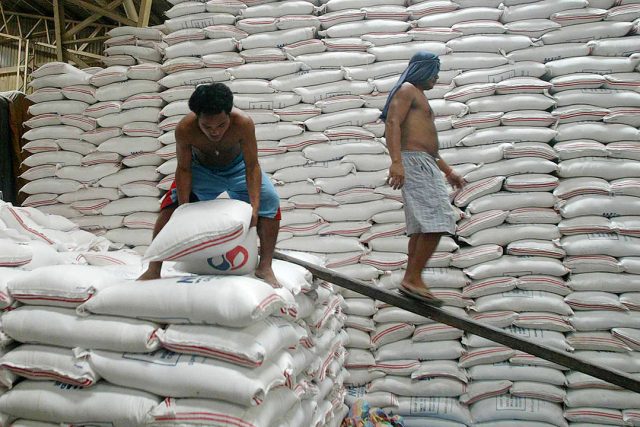
PHILSTAR FILE PHOTO

By Chloe Mari A. Hufana and Kenneth Christiane L. Basilio, Reporters

A PROPOSAL by the Department of Agriculture (DA) to suspend rice imports and restore higher tariffs could stoke inflation and worsen hunger, analysts said on Tuesday, as the Philippines continues to face food insecurity.

Marie Annette Galvez-Dacul, executive director of the University of Asia and the Pacific Center for Food and Agribusiness, said the import ban might benefit local farmers but risk triggering price increases.

“The proposed rice import halt and tariff hike may benefit farmers but could lead to higher rice prices and inflation, affecting low-income households the most,” she said in a Viber message. “It risks short-term food insecurity without immediate support or sufficient local supply.”

The presidential palace on Monday said the agency proposal aims to protect local rice producers from the influx of cheaper foreign rice, while ensuring a balance between farmer support and national food security.

Former Agriculture Secretary William D. Dar echoed concerns about the timing of the tariff hike, citing potential inflationary impacts and weather-related supply risks.

“Food inflation needs to be properly managed,” he said via Viber, adding that more extreme weather events are expected in the next three months, which could affect the country’s rice inventory.

He added that while raising tariffs might be justified in the future, the government should consider the timing. “We can start adjusting to a higher tariff on imported rice effective starting the harvest in November.”

Albay Rep. Raymond Adrian E. Salceda said the government could start hiking imported rice tariffs to support local producers after inflation slowed to a nearly six-year low in July.

“Now that inflation has eased, especially in food prices, we can afford to go back to policies that give our local farmers a fighting chance,” he said in a statement.

“The purpose of the lower tariff was to bring prices down,” said Mr. Salceda, who heads the House of Representatives special committee on food security. “Now that prices have dropped, it is only logical to restore tariffs to previous levels to support our rice farmers and maintain local production.”

He said the continued fall in rice prices is unsustainable for local producers, citing high input costs and falling farmgate prices.

The Philippines is the world’s biggest rice importer, and data from the Bureau of Plant and Industry showed the country had brought in 2.44 million metric tons (MT) of rice as of end-July. The Southeast Asian nation last year imported 4.7 million MT and is expected to import even more this year.

Local rice farmers have suffered due to the reduced rice tariffs, Samahang Industriya ng Agrikultura Executive Director Jayson H. Cainglet said.

“Farmgate prices for unmilled rice have plummeted to P6 to P8 per kilo, an unprecedented collapse in recent years,” he said in a Viber message. “From a previous range of P23-24 per kilo, this is a 60-70% drop, pushing many farmers into deeper financial distress.”

“We must shift the focus to protecting our local food producers — especially the farming communities growing palay, and raising pork and chickens,” he added, noting that food security should not depend on “short-term fixes” like tariff cuts to meet food demand.

On the other hand, Mr. Salceda’s recommendation to increase rice import tariffs fails to take into account the potential impact on consumers, who face higher retail prices, said Roehlano M. Briones, a senior research fellow at the Philippine Institute for Development Studies.

TIMING ADJUSTMENTS
“It will reverse some of the gains that have been made on reducing retail prices, which since August last year have fallen by 18% — the monthly price of regular milled rice,” he said in a Viber message.

In June, Agriculture Secretary Francisco P. Tiu-Laurel, Jr. told the House of Representatives he had recommended gradually restoring the rice import tariff to its original 35% rate from 15%, which was set under Executive Order No. 62 signed by President Ferdinand R. Marcos, Jr. in June 2024.

The 35% rate, valid until 2028, is subject to review every four months.

Mr. Tiu-Laurel also advised timing tariff adjustments with harvests in Vietnam and Pakistan — major rice exporters to the Philippines — to mitigate market disruptions.

The rice import proposal will be discussed during President Marcos’ state visit to India from Aug. 4 to 8 where he is joined by Mr. Tiu-Laurel and Finance Secretary Ralph G. Recto.

The debate comes as Philippine inflation slowed to 0.9% in July, the lowest since October 2019, according to data released on Tuesday by the Philippine Statistics Authority.

Food prices dropped, including a 15.9% year-on-year decrease in rice prices, helping ease overall price pressures.

Despite the decline in inflation, food insecurity remains a major concern. A Social Weather Stations (SWS) survey in April 2025 found that 20% of Filipino families — about 5.6 million households — experienced involuntary hunger at least once in the previous three months.

The rate includes 15.7% who experienced moderate hunger and 4.3% who reported severe hunger, particularly in Metro Manila, the Visayas and Mindanao.

President Marcos had campaigned on a promise to reduce rice prices to P20 per kilo. While subsidized rice has been made available through Kadiwa outlets in some provinces, nationwide rollout remains limited and heavily dependent on government subsidies.

Meanwhile, Foundation for Economic Freedom said higher rice tariffs and an import ban could restrict supply and artificially drive prices up.

The Agriculture department push would neither improve rice output nor ensure long-term price stability, it said in a statement.

The government should not “repeat the mistakes of the past,” it said, noting that the liberalization of the rice sector in 2019 was a landmark reform that “dismantled a failed quota-based regime” that it said had caused price spikes and enabled rent-seeking behavior.

Protectionist policies will shield the sector from need to reform, the group said. “The problem in Philippine agriculture is not over-importation but under-productivity.”

The group said capping rice imports at 1 million MT would result in a supply gap of more than 3 million MT. This could raise Philippine inflation by 1.2 to 1.4 percentage points, it added.

Even if Mr. Marcos adopts the DA’s recommendations, the relief would be temporary, Mr. Tiu-Laurel said, citing the need to amend the Rice Tariffication law to give the National Food Authority (NFA) greater flexibility in releasing its rice stocks and influencing both rough rice and rice prices.

“When its regulatory powers are restored, the NFA could provide the DA with more precise industry data, including consumption patterns and price trends, as well as supply levels per region and province, which are invaluable in crafting more responsive policies,” he added.

He also said allowing the NFA to resume selling stocks bought from local farmers would free up warehouse space and let the agency procure more rough rice. — with Kyle Aristophere T. Atienza
Freedom of Information measure filed in Senate

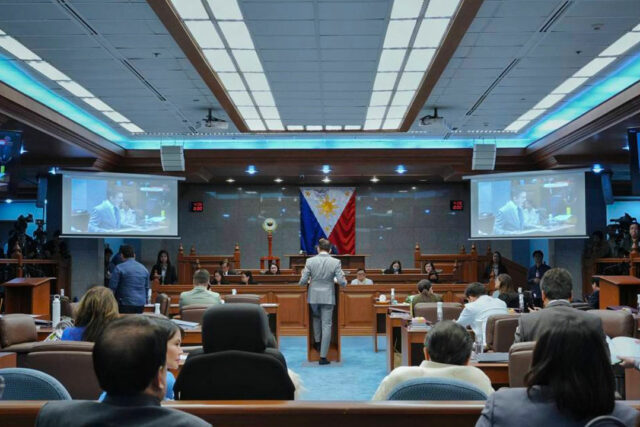
FACEBOOK.COM/SENATEPH

A SENATOR has filed a bill that seeks to institutionalize freedom of information by requiring all branches of government to make public key records, including the annual statement of assets, liabilities, and net worth (SALN) of public officials.

Filed on July 21, Senate Bill No. 723 mandates full disclosure of SALNs from officials in the Executive, Legislature and Judiciary. Covered are the President, Vice-President, Cabinet members, lawmakers, Supreme Court justices, officials of constitutional commissions and Armed Forces officers with general or flag rank.

“Our citizens deserve a government that is open, transparent and accountable,” Senator Francis “Kiko” N. Pangilinan, who authored the bill, said in a statement. “We can take a vital step forward in fighting corruption, strengthening public trust in government and enabling meaningful civic participation with the passage of the Freedom of Information (FOI) bill.”

The measure will enforce public access to government documents, records and data — extending beyond the executive branch to include Congress, the Judiciary, local governments, state colleges and universities, chartered institutions and government-owned or -controlled corporations.

Mr. Pangilinan noted that despite a constitutional guarantee of access to public information, no enabling law has been passed for more than three decades. A 2016 executive order under former President Rodrigo R. Duterte created FOI mechanisms for the executive branch but not for Congress and the Judiciary.

The bill requires agencies to publish annual budgets, itemized collections and disbursements, procurement plans, plantilla positions and vacancies and details on loans, bids and contracts. It also mandates timely updates of such records on agency websites.

FOI requests may still be denied if the information poses risks to national security, foreign relations, or is covered by executive privilege or closed congressional sessions.

Public officials who unjustifiably deny access to information face fines of P10,000 to P100,000 and imprisonment of one to six months.

Those who destroy or sell public records may be fined between P500,000 and P1 million, imprisoned for five to 15 years, or both.

Congressmen on Monday refiled a similar bill at the House of Representatives. Deputy Minority Leader and Party-list Rep. Leila M. de Lima said the bill gives Congress a chance to act on long-standing demands for transparency, particularly after President Ferdinand R. Marcos, Jr.’s recent remarks condemning corruption in infrastructure spending.

Although the 1987 Constitution recognizes the people’s right to access public information, an enabling law is needed for full implementation.

Several FOI proposals have been filed since 1992 but failed to pass, primarily due to a lack of legislative urgency.

House Bill No. 2897 requires all government agencies to make public “all information on official acts, transactions, decisions, as well as government research data used as a basis for policy development.”

Agencies must also publish monthly records on budgets, collections, expenditures, procurement plans, contracts, bidding documents and trade or investment agreements.

Exemptions include documents deemed sensitive to national security or foreign relations, as well as privileged court communications and records from congressional executive sessions.

Last year’s budget deliberations drew criticism after the bicameral conference committee reportedly increased unprogrammed funds to more than P500 billion and included so-called “blank line-items” — prompting concerns that changes were made after Congress ratified the budget.

Mr. Marcos, Jr., in his State of the Nation Address on July 28 warned Congress that he would reject any budget proposal that does not align with his administration’s priorities, even if it results in a reenacted budget. — Adrian H. Halili

Government rightsizing bill signed into law

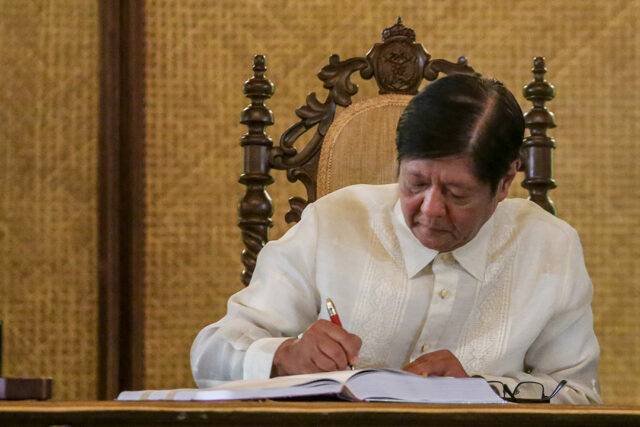
PRESIDENT FERDINAND R. MARCOS, JR. — PHILIPPINE STAR/NOEL PABALATE

A MEASURE granting President Ferdinand R. Marcos, Jr. authority to reorganize and streamline agencies under the executive branch to remove redundancies and build a more efficient and responsive bureaucracy has been signed into law.

Republic Act (RA) No. 12231, also known as the Government Optimization Act, was signed and published in the Official Gazette on Monday. It will be effective 15 days from Aug. 4.

The new law, identified as a priority measure by the Legislative-Executive Development Advisory Council, authorizes the President to strengthen, merge, or abolish executive agencies and functions considered redundant or misaligned, while ensuring the protection of civil servants’ welfare for a period of five years.

It also aims to promote and maintain efficiency and ethical accountability in the government, as well as enhance institutional capacity to improve public service delivery.

To do this, the government will provide resources to support an office’s essential role and minimize, if not eliminate, overlaps in its operations and simplify its systems and processes.

RA No. 12231 creates the Committee on Optimizing the Executive Branch (COEB), which will be chaired by the Executive Secretary.

The COEB will review mandates, functions, programs, projects, operations, operational structures, and workforce of government agencies. It may also recommend the creation of a new agency or dissolution of existing ones.

The new legislation will apply to all agencies under the executive branch, but it excludes. teaching and teaching-related positions, as well as military and uniformed personnel.

Legislative and judicial bodies, constitutional commissions, the Office of the Ombudsman, and local governments may adopt similar reforms on a voluntary basis.

Senate President Francis G. Escudero said the measure is not about downsizing or cost-cutting, as opposed to common belief.

“Its core intent is to transform government into a well-coordinated system — one that removes institutional bottlenecks and empowers agencies to serve with greater agility and purpose,” he said in a statement.

Mr. Escudero noted the measure exempts some sectors, including teaching and teaching-related positions in public schools and universities, as well as military and uniformed personnel. Constitutional bodies, the judiciary, legislature, and local government units are also excluded, though they may voluntarily adopt similar reforms.

“Ultimately, the law promotes career advancement and professional growth among government personnel,” he said. — Chloe Mari A. Hufana

NSC slams China over rocket launch

PHILSTAR FILE PHOTO

THE PHILIPPINE National Security Council (NSC) criticized China’s rocket launch on Tuesday after a stage of the rocket reportedly fell near a major city in the country’s southwest, calling the deployment “irresponsible” as it raised safety concerns over debris landing close to populated areas.

“We condemn in no uncertain terms the irresponsible testing done by the People’s Republic of China of its Long March 12 rocket, which alarmed the public and placed the people of Palawan at risk,” National Security Adviser Eduardo M. Año said in a statement.

The Chinese Embassy in Manila did not immediately respond to a Viber message seeking comment.

China on Monday launched the Long March-class rocket that is carrying internet satellites into low Earth orbit. It has two stages and is powered by six liquid oxygen-kerosene-fueled engines with a maximum payload of 12,000 kilograms up to 200 kilometers.

“While no immediate damage or injury has been reported so far, falling debris from the launch poses a clear danger and risk to land areas and to ships, aircraft, fishing boats, and other vessels that will pass through the drop zone,” Mr. Año said. — Kenneth Christiane L. Basilio

PHL eyes trade deal with India

PRESIDENT Ferdinand R. Marcos, Jr. and First Lady Liza Araneta-Marcos were formally welcomed by Indian President Droupadi Murmu and Prime Minister Narendra Modi at Rashtrapati Bhavan in New Delhi on Tuesday. — NOEL B. PABALATE/PPA POOL

THE PHILIPPINES is expediting efforts to close a preferential trade deal with India, President Ferdinand R. Marcos, Jr., said on Tuesday, as Manila seeks to diversify its economic partners and expand trade relationships with the world’s fourth-largest economy.

Speaking during a five-day state visit to New Delhi, Mr. Marcos said he and Indian Prime Minister Narendra Modi had directed their economic teams to push forward with trade talks and explore new investment opportunities.

“Prime Minister Modi and I have charged our economic teams to shepherd our commerce, now at $3.3 billion in the last year, towards a continued upward trajectory and expanded baskets of goods,” Mr. Marcos said following their meeting, according to a live-streamed video in the Radio Television Malacañang (RTVM) YouTube channel.

“To this end, we have decided to expedite the work that we are doing to forge a bilateral preferential trade agreement.”

The push comes as the Philippines looks to reduce its reliance on traditional markets such as China and the US amid rising global trade uncertainty.

A trade pact with India would open access to a market of more than 1.4 billion people and align with Mr. Marcos’ broader pivot to Indo-Pacific economies to fuel post-pandemic recovery and long-term growth.

India remains one of the Philippines’ most significant trading partners, with bilateral trade reaching $3.53 billion in fiscal year 2023–2024, up from $3.05 billion the year before, based on data from the Indian Embassy in Manila.

India exports engineering goods, auto parts, electronics, petroleum, steel, medicines, chemicals, rice, and meat to the Philippines. In turn, the Philippines exports electrical machinery, semiconductors, copper, lead, plastics, precious stones and animal feed.

The Philippines also imports about 20% of India’s pharmaceutical exports to Southeast Asia, making it a key partner in the region’s healthcare supply chain.

“We looked at leveraging mutual opportunities to boost two-way investment,” Mr. Marcos added.

“Our fast-growing, innovative private enterprises will play an important role in our common march towards progress and development, facilitating innovation, technology transfer, and upskilling and generating employment for our people.”

A total of 13 bilateral agreements were signed between Manila and New Delhi, spanning pacts across defense, trade, technology, and tourism.

To further boost trade and tourism, Mr. Marcos announced the resumption of direct flights starting in October and the implementation of reciprocal visa liberalization.

India will offer visa-free travel to Filipinos, a privilege the Philippines extended to Indian nationals in June.

Meanwhile, Mr. Marcos said India is now a strategic partner of the Philippines, the fifth country to have been granted with such status, he noted.

“Today, India becomes only the fifth strategic partner for the Philippines. This new apex attests as much to the remarkably rapid growth, broadening, and deepening of our 75-year-old bilateral relationship [and] the possibilities represented by the strong upward trajectory of our two economies as it does to the growing alignment of our interests and views on the challenges and imperatives of our time,” he added.

As part of the new strategic partnership, India and the Philippines also agreed to deepen military and maritime cooperation. India’s BrahMos missile system is already part of the Philippines’ defense modernization.

The partnership comes as both countries assert a stronger presence in the Indo-Pacific. Mr. Marcos reaffirmed Manila’s commitment to a free and open maritime order and thanked India for supporting the 2016 arbitral ruling that invalidated China’s expansive claims in the South China Sea. — Chloe Mari A. Hufana

House opens budget talks to groups

PHILSTAR FILE PHOTO

THE HOUSE of Representatives on Tuesday approved a measure allowing civil groups to sit in during budget discussions at the chamber.

In a voice vote, congressmen adopted House Resolution No. 94, paving the way for observers to monitor House budget deliberations amid calls for transparency in the budget process. The measure also mandates the House appropriations committee to establish accreditation guidelines.

In line with this Party-list Rep. Jude A. Acidre met with representatives from civil groups, holding a consultation meeting to understand how to make the budget process more inclusive and transparent.

“We believe that involving civil society groups at the very start of budget discussions will help us craft a national budget that is more responsive, inclusive and aligned with the needs of our people,” he said in a statement.

Meanwhile, a congressman on Tuesday called on the House of Representatives appropriations panel to release the full list of amendments made by a group of lawmakers to the 2025 budget bill after it was approved on third reading, saying that such a move would show the chamber’s commitment to budget transparency.

While the House budget panel plans to push the scrapping of the “small committee” reviewing budget amendments, Navotas Rep. Tobias Reynald M. Tiangco said it is only the “first step” to pushing transparency in the budget process.

“We cannot move forward and simply forget the wrongdoings of the past,” Navotas Rep. Tobias Reynald M. Tiangco said in a statement. “We have to uncover the sins of the 2025 budget.”

Lawmakers are pushing for a more transparent budget process following criticism of this year’s spending plan, which was marred by allegations of pork barrel insertions and controversy over the bicameral committee’s handling of unprogrammed funds. — Kenneth Christiane L. Basilio

Duterte asked to comment on House MR

VICE-PRESIDENT SARA DUTERTE-CARPIO FACEBOOK PAGE

THE SUPREME Court (SC) on Tuesday asked Vice-President Sara Duterte-Carpio and Davao-based lawyer Israelito P. Torreon to comment on the Motion for Reconsideration (MR) filed by the House on the same day.

They were given 10 days from Aug. 5 to comply with the court’s order.

The House had asked the High Court to overturn a ruling that declared Ms. Duterte’s impeachment as unconstitutional, through a motion filed electronically on Monday. The chamber submitted a physical copy to the SC on Tuesday.

The SC last month unanimously ruled that the complaint against Ms. Duterte violated a constitutional safeguard that only one impeachment proceeding may be launched against an impeachable official within one year. It also decided that the House violated the Vice-President’s right to due process.

A total of four complaints were hurled against Ms. Duterte since December last year. She was only impeached in February after more than 200 congressmen voted to send the ouster changes to the Senate without any hearing.

Meanwhile, a congressman on Tuesday urged the SC to handle with “utmost care” the House of Representatives.

The High Court should weigh the arguments cited in the House’s motion as Ms. Duterte’s impeachment is a “landmark” test in pursuing accountability for high-ranking officials, said Batangas Rep. Gerville R. Luistro.

“With all due respect to the Supreme Court, the Motion for Reconsideration must be resolved with utmost care,” Ms. Luistro, who was part of the House prosecution panel, said in a statement. “This is a landmark case in impeachment proceedings, thus both parties must be accorded ample opportunity to argue their respective positions.”

A likely contender in the 2028 presidential race, Ms. Duterte was accused of budget misuse, unexplained wealth and allegedly conspiring the assassinate President Ferdinand R. Marcos, Jr., his wife and House Speaker Ferdinand Martin G. Romualdez. She denied all accusations. — Kenneth Christiane L. Basilio

Bill penalizes use of AI for scams

REUTERS

A PHILIPPINE Senator on Tuesday said he has filed a bill criminalizing the use of artificial intelligence (AI) for spreading misinformation and investment scams.

Under Senate Bill no. 782, Senator Francis G. Escudero said that any person responsible for creating, generating, reproducing, duplicating, simulating, distributing, disseminating or publishing an individual’s physical attributes without their consent in any media content, regardless of the medium, platform or point of access used, will be held criminally liable.

“Used properly, AI could serve as a powerful tool for education, business, and other fields for improving productivity, research and finding solutions to complex problems. However, the reality is that AI is being exploited by some to cause personal harm or undermine public trust,” Mr. Escudero said in a separate statement.

The proposed measure penalizes individuals who create, generate, or share content containing a person’s physical attributes without prior consent or legal basis with up to two years of imprisonment or a fine not more than P200,000, or both.

Jail time of two up to four years, or a fine ranging from P200,000 to P400,000 may be faced for those who generate illegal content to acquire financial gain or profit.

Individuals that create content designed to facilitate or commit crime or fraud may face four to six years in prison, or a fine of P400,000 to P600,000, or both.

Mr. Escudero is also proposing imprisonment of up to 12 years or a fine of P600,000 to P1 million, or both for schemed that acquire financial gain or profit and to facilitate or commit a crime or fraud.

Public officials or employees who violate the measure may be faced with absolute perpetual disqualification from public office, along with the maximum penalties prescribed under the bill. — Adrian H. Halili

Customs seizes P25.3-M drug shipment

The BoC seized P25.3 million worth of drug shipment disguised as cable rolls at the Port of Clark. — CUSTOMS.GOV.PH

THE Bureau of Customs (BoC) on Tuesday said it seized P25.3 million worth of drug shipment disguised as cable rolls from Belgium at the Port of Clark.

In a statement on Tuesday, Customs said it intercepted a shipment carrying 5,062 grams of Ketamine concealed in a wooden cable reel declared as “data cable roll.” It was bound to San Rafael, Rizal.

The shipment, which arrived on July 24, was flagged for physical examination due to suspicious details in its declaration, the BoC said.

It added that a 19-kilogram wooden cable reel, covered with spray foam, has six transparent plastic pouches of a white crystalline substance and later confirmed as Ketamine after laboratory testing.

“Smuggled narcotics pose a serious threat to public safety. Protecting Filipino lives remains at the heart of every operation we carry out, this seizure is no exception,” Commissioner Ariel F. Nepomuceno said.

The BoC also said that in a related operation on July 29, the Port of Clark also intercepted two shipments bound for Quezon City containing 52 grams of MDMA (Ecstasy) worth P265,200 falsely declared as “Animal Food” from Paris. — Aubrey Rose A. Inosante

Yellow alert raised over Visayas grid

STOCK PHOTO | Image by Natsuki from Unsplash

A YELLOW ALERT was declared over the Visayas grid on Tuesday amid higher forecasted demand and power plants that were on forced outages, the National Grid Corp. of the Philippines (NGCP) said.

In an advisory, the NGCP said that the Visayas grid was placed on yellow alert from 1 p.m. to 9 p.m.

Peak demand hit 2,475 megawatts (MW) against the available capacity of 2,528 MW.

A total of 744 MW was unavailable to the grid as 17 power plants have been on forced outage and six are running on derated capacities.

Contributing to the declaration of yellow alert was the decrease in power imported from Mindanao due to the outage of Pulangi 4 Unit 3.

This marks the third time that the Visayas grid has been placed under a yellow alert this year following the alert notices issued on Monday evening and on Aug. 1.

A yellow alert is issued when the operating margin is insufficient to meet the transmission grid’s contingency requirement.

The Luzon and Mindanao grids are under normal conditions.

In 2024, the Philippines was placed under 16 red alerts and 62 yellow alerts which led to some brownouts and power interruptions.

In a statement, the Department of Energy ordered generation companies in Visayas and Mindanao to immediately restore power plants currently on forced outage to help stabilize the power supply across both grids.

“We expect full cooperation and accountability — delays are no longer acceptable at this point,” said Energy Secretary Sharon S. Garin.

The NGCP recently conducted its annual blackout drills to improve its grid response capabilities in case of large-scale power outages or system disturbances.

The activity involved discussions on black start services, actual restoration experiences, blackout restoration guidelines and procedures, breakout sessions, and workshops focusing on area-specific blackout restoration highways.

“Through these drills, NGCP can evaluate communication protocols, assess response times, and strengthen coordination efforts. We are able to identify weaknesses, if any, and address them proactively, in coordination with our partner stakeholders,” the company said. — Sheldeen Joy Talavera

Cops seize P1.7-M drugs in Marawi operation

COTABATO CITY — Policemen seized P1.7 million worth of crystal meth (shabu) from two dealers, both linked to the Dawlah Islamiya terror group, entrapped in Barangay Patani in Marawi City on Saturday, Aug. 2.

The suspects are now both locked in a police detention facility in Marawi City, the provincial capital of Lanao del Sur.

Brig. Gen. Jaysen C. de Guzman, director of the Police Regional Office-Bangsamoro Autonomous Region (PRO-BAR), said on Tuesday, that the two suspects yielded peacefully when they learned that they sold 250 grams of shabu, costing P1.7 million, in an entrapment operation.

Local executives and traditional Maranao leaders had told reporters that the two now detained suspects shared fractions of their earnings with the leaders of the now weakened Dawlah Islamiya terror group.

Mr. de Guzman said members of the multi-sector Lanao del Sur Peace and Order Council, and the office of Lanao del Sur Mamintal Adiong, Jr. supported the entrapment operation.

Officials of intelligence units of PRO-BAR are now investigating the assertions by Maranao leaders in Lanao del Sur that the duo are members of the Dawlah Islamiya and are verifying their possible involvement in recent bombings in Central Mindanao. — John Felix M. Unson

Hotshots’ William Navarro heads to South Korea with Busan KCC Egis

WILLIAM NAVARRO — PBA

PBA RISING STAR William Navarro of the Magnolia Hotshots is officially headed to Korea with Busan KCC Egis.

Busan on Tuesday announced the signing of Mr. Navarro for the upcoming 2025-2026 season, ending a short stint with Magnolia after a mid-conference trade from NorthPort in the just-concluded 2025 PBA Philippine Cup.

“Welcome, (Mr.) William. We ask for lots of support and encouragement to William Navarro, who is making a new start at KCC Egis,” said the Korean Basketball League (KBL) club.

It will be Mr. Navarro’s international league debut at last after a foiled stint with the Samsung Seoul Thunders in 2022.

The 6-foot-6 Ateneo standout then signed with Seoul but took a U-turn instead to honor his contract obligations with Gilas Pilipinas and the NorthPort, which had his playing rights after picking him as the No. 2 pick in the 2021 special draft.

Mr. Navarro eventually played for the Batang Pier but sustained an ACL injury in the same year before coming back to fine form as one of the team’s best players in 2023 and 2024.

The 28-year-old forward had his breakout performance this season, especially in the Philippine Cup with a double-double average of 20.57 points and 10.57 rebounds laced by 1.86 assists and 1.14 steals for the Batang Pier.

Midway through the tourney though, he was traded to the Hotshots in exchange for Calvin Abueva, Jerrick Balanza and second round pick in the PBA Season 51 draft.

Mr. Navarro played only five games for the Hotshots, who will be left without any returns from the Mr. Abueva trade after all in a new era under head coach LA Tenorio in lieu of long-time mentor Chito Victolero.

Aside from Magnolia, Mr. Navarro’s former team NorthPort also lost a key piece in Arvin Tolentino, who will likewise take his talents to Korea after signing with the Seoul SK Knights.

SK Knights topped the regular season with a 41-13 slate but bowed to Gilas ace Carl Tamayo and the Changwon LG Sakers in the KBL finals while Mr. Navarro’s team Busan missed the playoffs at ninth place with an 18-36 mark. — John Bryan Ulanday