Home Blog Page 1229

CIBI partners with Korean entities for credit data sharing

CREDIT BUREAU CIBI Information, Inc. has signed an agreement with South Korea’s NICE Information Service and JB Financial Group (JBFG) for the cross-border exchange of credit data.

The three entities recently signed a memorandum of understanding to establish a credit linkage system between the Philippines and Korea, CIBI said in a statement on Monday.

“Filipino nationals living in South Korea can leverage their credit information from the Philippines to access financial services, while Korean nationals in the Philippines can do the same using their home country’s credit data,” it said. “This partnership eliminates barriers by fostering a more inclusive and streamlined banking experience and enables both Filipinos and Koreans to navigate financial services with greater ease across borders.”

CIBI is the Philippines’ first credit reporting agency.

Meanwhile, NICE Information Service is Korea’s largest credit information company, specializing in credit bureaus and corporate intelligence, providing credit histories and financial data on individuals and businesses.

Lastly, JBFG is a leading financial institution in Korea whose subsidiaries include banks, credit finance and asset management companies.

“By providing access to essential solutions like credit and background reference checks, we are enhancing and supporting cross-border financial access and empowerment of both Filipino and Korean nationals,” CIBI President and Chief Executive Officer Pia L. Arellano said.

“As we begin this promising collaboration with JB Financial Group and NICE Information Service, CIBI remains committed to empowering individuals and communities through financial inclusion,” Ms. Arellano said. “By bridging the credit information gap and providing access to essential credit services like MyScore and Negative Records, we are not just enhancing cross-border financial access but also driving greater economic opportunities for both Filipino and Korean nationals.” — A.M.C. Sy

There are candidates we really shouldn’t support

BW FILE PHOTO

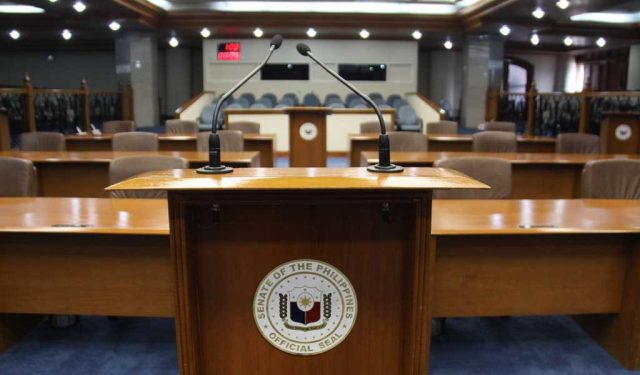
A number of political observers believe that the reason why Senate President Francis Escudero would not start the impeachment trial of Vice-President Sara Duterte is that the required two-thirds of the current 23-member Senate (Sen. Sonny Angara had resigned) or 16 senators voting “Guilty” to convict her would not be met. Put another way, eight senators of the current members voting “Not guilty” would acquit VP Sara.

The observers think that Mr. Escudero had set the opening of the impeachment trial sometime in July because by that time, the composition of the Senate would have changed, and the number of senators who would vote “Guilty” would have increased to meet the required two-thirds of the members of the Senate to convict VP Sara.

However, based on the projections of pollsters Social Weather Stations and Pulse Asia — they have been correct most of the time — Mr. Escudero’s supposed scheme would be for naught. While current senators thought to be supportive of VP Sara would no longer be in the Senate in July — because they have termed out or were not re-elected — there would still be at least nine senators, including re-elected and newly elected ones, who would vote “Not Guilty.” That would mean the required two-thirds of the 24-member Senate (the slot vacated by Angara would have been filled on July 1) voting “Guilty” to convict Sara would not be met.

But there are also political pundits who say that the incumbent senators had prevailed upon Mr. Escudero to schedule the impeachment trial to after the mid-term elections so that the electorate would not know how the senators, especially those running for re-election, would have voted in the trial of VP Sara. Politicians learned an unforgettable lesson from a previous impeachment trial.

During the nationally televised impeachment trial of President Joseph “Erap” Estrada in 2000, Senators Juan Ponce Enrile, Blas Ople, Miriam Defensor Santiago, Nikki Coseteng, Tessie Oreta, Gregorio Honasan, John Osmeña, Ramon Revilla, Sr., Francisco Tatad, Tito Sotto, and Robert Jaworski voted not to open an envelope believed to contain evidence so damning to the president that people thought it would lead to his conviction and consequent removal from office. The “No” vote of the 11 senators saved President Estrada from conviction. But the people were so infuriated by the 11 senators’ display of sycophancy towards President Estrada, or fear of him, that they (the people) took it upon themselves to pressure Mr. Estrada to resign.

Not only did they oust Erap, they also made the 11 senators pay for their sycophancy or cowardice by campaigning against their re-election. Except for Senators Ople and Revilla, who chose not to run for public office again, Senators Tatad, Honasan, Jaworski, Osmeña, and Santiago were repudiated at the polls the next time they ran for the Senate.

Nikki Coseteng, having reached her term limit as senator, ran for representative of her congressional district, but lost ignominiously. Ms. Aquino-Oreta deemed it wise not to run for office again. She instead fielded her daughter as candidate for representative of Malabon, the Oreta political bailiwick. Poor girl, she paid for the “sin” of the mother. Ms. Defensor Santiago made it to the Senate on her second attempt after the Erap fiasco because she rode on Vice-President Gloria Macapagal Arroyo’s lavishly funded and military-escorted campaign caravan when VP Arroyo ran for president in 2004.

Mind you, the 11 senators only voted against opening an envelope believed to contain evidence incriminating to Erap. They had not voted to dismiss the charges against him, yet the people considered that suppression of evidence that could have led to Erap’s conviction a betrayal of the trust of the people. And for that, the people disavowed them at the polling places. That is what the senators running for re-election want to avoid — casting their vote on the issue of whether VP Sara is guilty or not as it could result in their political demise.

That is precisely the reason the people wanted the trial of VP Sara to have proceeded, even if they knew that the required two-thirds or 16 senators voting “Guilty” would not have been met. They wanted to know who among the incumbent senators would have voted “Not guilty” in spite of the preponderance of evidence of anomalies committed by VP Sara, for that would have revealed what the senators’ true character and their values are — personal interests (the goodwill of the politically powerful and influential Dutertes) first before the common good (the permanent removal from public office of an official guilty of graft and corruption).

The House of Representatives’ impeachment process brought to the public’s attention the sordid details of some of the charges against VP Sara. Evidence of anomalies committed by VP Sara was so preponderant that 240 out of 318 members of the House of Representatives signed the impeachment complaint against her. That is 75% of the members of the House of Representatives.

The same evidence would have been presented in the impeachment trial if the Senate had held the trial and the senators had judged VP Sara guilty or not guilty of the charges leveled against her. If they voted “Not Guilty,” they would meet the same fate those senators who tried to prevent President Estrada’s conviction. If they voted “Guilty,” they would draw the enmity of the Dutertes. And woe unto those who cross the Dutertes.

That is why political pundits say Mr. Escudero is under tremendous pressure from his fellow senators to postpone the impeachment trial of VP Sara, in order to protect the senators running for re-election from possible punitive judgment by the people. Well, the people can prevent those running for re-election from getting away from harsh judgment.

The same political pundits have indicated how the senators, including those running for re-election, would have voted on the charges against VP Sara. They say that among the senators who would have voted “Not Guilty” if the trial had been held before the mid-term elections are those seeking re-election: Bong Go, Bato de la Rosa, Pia Cayetano, Francis Tolentino, Bong Revilla, and Imee Marcos. They are believed to be supportive of VP Sara because of their close personal relationships to the Dutertes or because they are staunch political allies of the Dutertes.

Meanwhile, current candidate for senator Camille Villar is the daughter of Senator Cynthia Villar, a loyal ally of former President Rodrigo Duterte. In fact, Camille, a member of the House of Representatives, did not sign the impeachment complaint against VP Sara. Neither did Senator Revilla’s wife Lani Mercado, and their sons Bryan and Jolo, all members of the House of Representatives.

Do not vote for candidates who support such political allies.


Oscar P. Lagman, Jr. was formerly the chief operating officer of a health insurance company and consultant to others.

Dahl drama and Benjamin Button shine at London’s Olivier Awards

ATGTICKETS.COM

LONDON — Giant starring John Lithgow as author Roald Dahl and a musical reimagining of The Curious Case of Benjamin Button were among the many winners at Britain’s Olivier theater awards on Sunday, picking up three prizes each.

Held at the star-studded Royal Albert Hall, the ceremony also saw Fiddler on the Roof receive three Olivier awards, with no one show dominating the accolades as is often the case.

US star Mr. Lithgow won the best actor prize for his turn as Dahl in Mark Rosenblatt’s Giant, an account of the fallout from a 1983 book review written by the author that provoked accusations of anti-Semitism.

“I am literally trembling all over. I have never been quite so shaken by a happy event,” Mr. Lithgow told Reuters.

“It was also extremely emotional to be embraced by the English theater community like that. I can’t even tell you what it means.”

Giant also won best new play and Mr. Lithgow’s co-star Elliot Levey won best actor in a supporting role.

The musical of F. Scott Fitzgerald’s short story of the man who ages in reverse, Benjamin Button — reimagined for the theater in a Cornish fishing village — won rave reviews since its West End run started last year.

It received awards for best new musical, outstanding music contribution, and best actor in a musical for John Dalgleish as Button.

Lesley Manville won best actress for her portrayal as Jocasta in Oedipus, scoring her second Olivier award.

“I am really shaky… It’s quite a big stage to walk out onto the Royal Albert Hall and see all those faces,” Ms. Manville told Reuters.

“But it’s wonderful. I am so pleased to have this award for this play and that part and what it meant to me.”

Imelda Staunton racked up her fifth Olivier, winning best actress in a musical for her turn as Dolly Levi in the hit show Hello, Dolly!. — Reuters

PAL to launch nonstop Da Nang-Manila flights by July

PHILIPPINE STAR/EDD GUMBAN

PHILIPPINE AIRLINES (PAL) is set to expand its Vietnam routes with the launch of nonstop Da Nang-Manila flights by July, the flag carrier said.

In a media release on Monday, PAL said it will offer the Manila-Da Nang flight three times weekly — on Tuesdays, Thursdays, and Saturdays — starting July 1.

Da Nang will be PAL’s third major expansion in Vietnam this year, following the launch of Manila-Hanoi flights and the planned debut of the Ho Chi Minh City route on May 2.

“PAL is committed to offering greater connectivity and promoting tourism and commerce between our capital city and the central Vietnamese heartland. We look forward to welcoming more leisure and business travelers onboard our flights to Da Nang,” said PAL President and Chief Operating Officer Stanley K. Ng.

For its Manila-Da Nang flights, PAL will deploy Airbus A321 jetliners, which can accommodate up to 199 passengers. PAL also offers flights to Ho Chi Minh City from Cebu, in addition to operating eight weekly flights between Manila and Ho Chi Minh City.

The airline also announced that it is increasing its Manila-Hanoi-Manila service to daily flights as part of its expansion in Vietnam.

At the local bourse on Monday, shares in PAL Holdings, Inc. closed 40 centavos, or 0.88%, lower at P4.50 apiece. — Ashley Erika O. Jose

Hamilo Coast’s M Village set for completion by 2028

COSTA DEL HAMILO, Inc. (CDHI), a subsidiary of SM Prime Holdings, Inc., said it expects to complete the Hamilo Coast’s M Village in Marina Estates by 2028.

The seven-hectare residential project is located in Papaya Cove, Nasugbu, Batangas.

It is the first residential community in Marina Estates, a beachside resort community under CDHI’s master-planned development, Hamilo Coast.

“M Village, a community nestled near a marina, offers a unique blend of luxury and a tranquil lifestyle. It redefines coastal living, being the residential area nearest to an international-standard marina that allows residents to moor their four- to six-meter boats and jet skis right at their doorstep,” CDHI said in a statement last week.

The groundbreaking ceremony for the project took place on Dec. 13, 2024. The development is expected to be completed by Dec. 31, 2028, according to Hamilo Coast’s website.

M Village offers 177 lots, ranging from 301 square meters (sq.m.) to 705 sq.m., with an elevation of about one to seven meters above mean sea level.

Key amenities within M Village include a modern clubhouse, adult and kiddie swimming pools, children’s play areas, meditation gardens, and scenic parks for leisurely strolls, biking, or picnics. It also features camping areas and bird observation sites for nature enthusiasts.

M Village features modern tropical architecture nestled in a forest setting. The development was designed with the help of Wimberly Allison Tong & Go (WATG Singapore), alongside Joel Luna Planning and Design and H1 Architecture.

The development is a five-minute drive from Hamilo Coast’s main entrance and is 10 minutes away from Pico de Loro Cove.

“With preserved mangrove forests, naturally flowing waterways, and carefully designed ponds to minimize environmental impact, M Village exemplifies living in tune with nature,” CDHI said. — Beatriz Marie D. Cruz

US tariff reciprocity, trade diversion, and the Philippines’ options

US President Donald Trump announced last week, on April 2, that his “Reciprocal Tariffs” and the rates for Asian countries are as follows: Cambodia, 49%; Laos, 48%; Vietnam, 46%; Myanmar, 45%; Thailand, 36%; China, 34%; Indonesia and Taiwan, 32%; Pakistan, 29%; India, 26%; South Korea, 25%; Japan and Malaysia, 24%; the Philippines, 17%; and Singapore, 10%. These will take effect this week, on April 9.

BusinessWorld reports related to this are: “Southeast Asia nations, hit particularly hard by US tariffs, prep for talks with Trump” (April 3), “US slaps higher tariff on Philippines” (April 4), “PEZA is seeking reduced tariffs for key economic zone exports to US” (April 7), and, “PHL to benefit from trade diversion due to US reciprocal tariffs” (April 7).

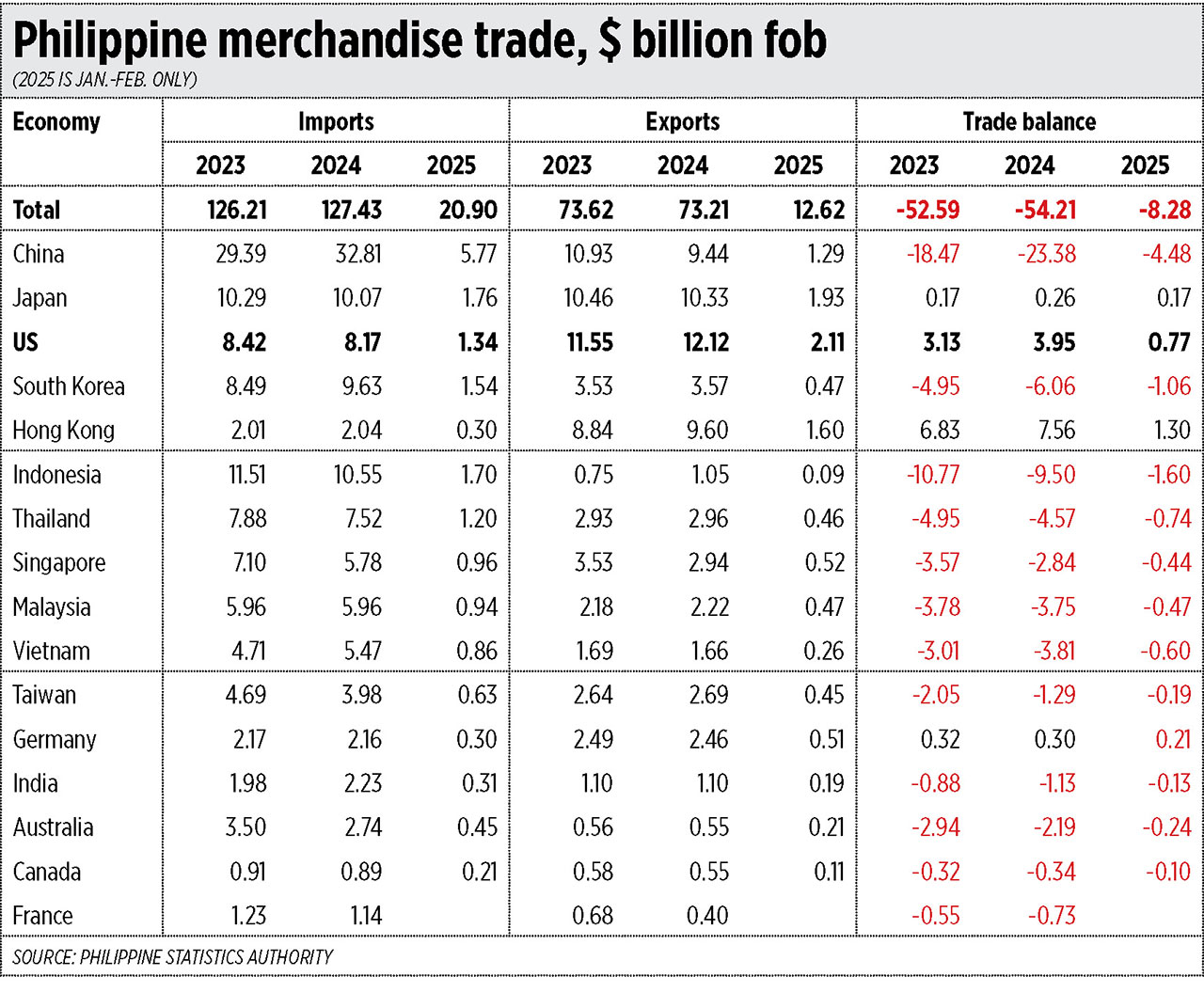
Before discussing further, check out the Philippines’ latest trade numbers and trends in the accompanying table. Here we see that, 1.) our main export market is the US followed by Japan and Hong Kong, 2.) our main source of imports is China, followed by Japan and Indonesia, 3.) of our total imports (exports plus imports), 21% is with China, which is a larger share than Japan and the US’ combined share of 20%, 4.) our largest trade deficit is with China while our largest trade surplus is with the US.

REACTIONS AND POLICY OPTIONS
Consumers, corporations, and governments have various reactions and policy options to deal with this new trade reality.

1. Reactions by governments abroad. Asian governments so far have had varied reactions. Vietnam and Taiwan have offered to set zero tariffs for US goods, while Taiwan says it will invest more in the US, so the US should drop or delay the high tariff rates. Cambodia has offered setting a low 5% tariff on US goods, while China has countered with its own tariff hike on US goods. The White House’s national economic council director Kevin Hassett said that over 50 countries have reached out to Trump looking to begin negotiations for lower tariffs.

2. US consumers will have two choices. One, keep buying imported products, especially those with specific qualities that they need, even at higher prices due to higher tariffs. And two, buy US made products. This is a micro — corporate and household — decision by the people there and not so much a concern for consumers abroad.

3. Trade diversion by US consumers. Trade diversion or supply chain changes, assuming the products’ quality are similar or comparable, is something US companies can consider. They will buy or import more from countries which have lower prices via lower tariffs like Philippines and Singapore, and import less from countries with higher tariffs like Thailand and Vietnam. US multinationals abroad will also follow this trend, with more investments in countries with lower US tariff rates.

4. Trade diversion by high-tariffed countries. Suppose there are 1,000 cargo ships from Japan going to US monthly, then this number drops to only 950 after the tariff hikes. The 50 ships are diverted to other Asian markets, and there are five additional Japan cargo ships going to ports in the Philippines on top of the regular Japan ships. This trade diversion is done via discount by exporting countries to entice more buyers and may lead to “dumping.”

5. Tariff options by destination countries. When more imports at cheaper prices come in, trade deficit in the Philippines (-$54.2 billion in 2024) or other countries can expand. There are three options: a.) raise Philippine tariffs for those countries to discourage more imports and control the deficit, b.) keep the tariff rates as is, or c.) further lower our tariffs to sustain a low level of inflation rate.

6. Hasten setting up FTAs and EPAs among countries. The Philippines has many pending free trade agreements (FTAs) and Economic Partnership Agreements (EPAs) with more countries or country blocs.

7. Unilateral free trade, zero tariffs for all countries. Hong Kong is the prime example of this. There is no need for trade negotiations, they just abolished tariffs decades ago, with exceptions on products with national security and public health effects. Hong Kong attracts more visitors, investors, and shoppers than we do. Hong Kong imports goods via hundreds of cargo ships, then “exports” these goods via millions of visitors’ shopping bags.

The Philippines should consider zero-tariff trade with the US, then a unilateral free trade policy like Hong Kong.

The ASEAN Economic Community (AEC) was implemented in 2015 and it is the realization of the ASEAN Free Trade Area (AFTA) that was started in 1992. This is a free-trade regionally integrated common market of nearly 700 million consumers.

END GAME: GLOBAL FREE TRADE
With the aggressive level of tariff reciprocity unleashed by Trump and quick reaction towards zero tariffs by some countries like Vietnam and Taiwan, I think Trump is actually aiming for mutually low or even zero tariffs among countries in the world.

Free trade immediately reduces animosity while creating more goodwill among countries, especially between neighbors. As Frederic Bastiat, a famous French economist said once, “If goods cannot cross borders, soldiers will.”

No tariffs mean more supply of useful goods from more countries and suppliers, which can lead to more productivity in the country. And free trade benefits are not only in merchandise goods but also in non-merchandise services, more tourism, and peace and prosperity for the world.


Bienvenido S. Oplas, Jr. is the president of Bienvenido S. Oplas, Jr. Research Consultancy Services, and Minimal Government Thinkers. He is an international fellow of the Tholos Foundation.

minimalgovernment@gmail.com

Third Avatar movie to introduce new adversaries on Pandora

LAS VEGAS — The next installment of the Avatar movie franchise will introduce a new challenge to the Sully family on the moon of Pandora, director James Cameron said as Walt Disney unveiled the first footage from the film on Thursday.

Avatar: Fire and Ash is scheduled to debut in movie theaters in December, continuing the saga of the blue Na’vi people. Sam Worthington plays Jake Sully, and Zoe Saldana portrays his wife, Neytiri.

Mr. Cameron delivered remarks via video to the CinemaCon convention of theater owners in Las Vegas. The Sully family “are really put through the wringer” in the new film, Cameron said from New Zealand, where he is finishing work on the movie.

“They face not only the human invaders, but new adversaries — the Ash people,” he said.

“I’m sending you a reel to give a taste of the spectacle, and the increased emotional heart and soul,” Mr. Cameron added.

Cinema operators are eager to show the next Avatar. The first installment ranks as the top box office hit of all time while part two is ranked third. Avengers: Endgame sits in between.

So far this year, overall movie ticket sales in the United States and Canada are running 11% below last year.

“I hope this film can provide a shot in the arm for theater owners,” Mr. Cameron said. “We’re still struggling after the one-two punch of the pandemic and streaming.”

Ms. Saldana appeared in person at CinemaCon and said the movie will also introduce the wind traders, “a peaceful, nomadic air traveling clan.” — Reuters

How minimum wages compared across regions in March

(After accounting for inflation)

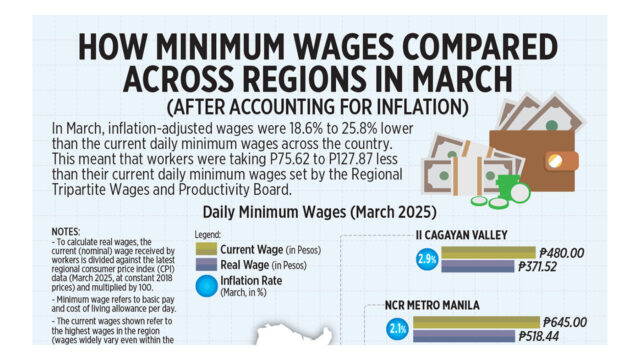
In March, inflation-adjusted wages were 18.6% to 25.8% lower than the current daily minimum wages across the country. This meant that workers were taking P75.62 to P127.87 less than their current daily minimum wages set by the Regional Tripartite Wages and Productivity Board.

How minimum wages compared across regions in March

No Fed ‘put’ when it’s unclear which way the US economy may pivot

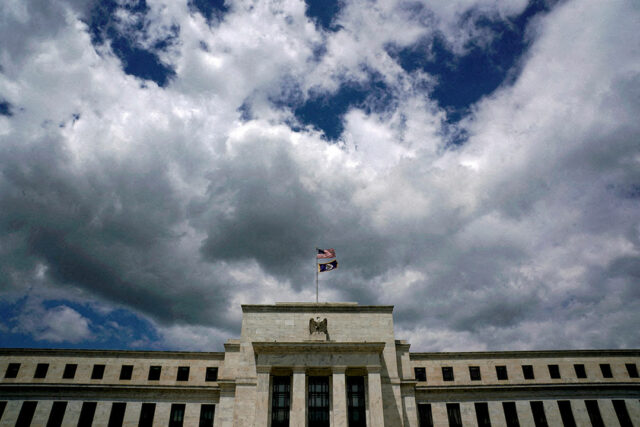
Flags fly over the US Federal Reserve building in Washington, US, May 26, 2017. — REUTERS

WASHINGTON — US Federal Reserve Chair Jerome H. Powell has sent strong messages when he felt they were needed, going on television to pledge maximum support for the economy when the COVID-19 pandemic struck, using a terse 2022 speech for a stern message about inflation, and jumping in to backstop financial markets after the 2023 failure of Silicon Valley Bank.

But with Mr. Powell and the Fed left guessing just as much as the rest of the world about where President Donald J. Trump is taking the economy, the Fed chair indicated on Friday this is not the moment for a “Fed put” — Wall Street’s term for actions to shore up free-falling stock markets — even as household wealth evaporates with real risks to economic activity.

“There’s a lot of waiting and seeing going on, including by us, and that just seems like the right thing to do at a time of elevated uncertainty,” Mr. Powell said, making it apparent the Fed won’t be rushing to cut interest rates as it would if there was a crisis calling for an obvious central bank response.

Indeed job growth in March remained strong, data out on Friday showed, though Mr. Powell was careful to note the figures were tallied before Mr. Trump’s tariff announcements.

“It’s not clear at this time… the appropriate path for monetary policy,” he said. “We’re going to need to wait and see how this plays out.”

Though stock price moves can affect the economy by changing household wealth and shifting expectations, the dynamics of Mr. Trump’s first weeks in office have created such a blizzard of conflicting signals that the Fed, so far, can’t pick a lane.

It has recently become a maxim of central banking to move fast and with force when a problem is clear.

But it has been as important to the Fed in its recent decisions to avoid making moves that then need to be undone. That is a risk it would run if Mr. Powell and others were to appear to lean in favor of rate cuts to stabilize the economy at a time when higher inflation, and the potential need for rates to remain higher, is also a threat.

DIFFERENT STRIPE OF SHOCK
The Fed raised rates fast starting in 2022 as it needed to tame inflation, then cut them a full percentage point last year as inflation slowed.

Policy makers now seem content to wait, with tariff hikes potentially followed by other fiscal and tax measures that could shift the outlook yet again.

In the current moment, Mr. Powell’s “first job is to take out the view that the Fed is on the verge of slashing interest rates a lot in a hurry,” said former Fed vice chair and Princeton economics professor Alan Blinder. “That does not mean the Fed will never cut interest rates in response to this. If this develops into a recession, the Fed will probably cut.”

No Fed official will ever admit to anything like a “Fed put” being part of their policy tool kit, but Wall Street has had faith in its existence for nearly four decades.

The term first surfaced as the “Greenspan put,” coined after former Fed chief Alan Greenspan cut rates and injected liquidity following the famous “Black Monday” stock market crash in October 1987. Successive Fed leaders have responded to ensuing crises with other big actions that have helped staunch market losses or even helped reverse them.

But for now, caught between the possibility of a weakening economy alongside a tariff-driven burst of inflation, the Fed may be sidelined.

“When we faced high inflation, it was painful for the country… but we knew what we needed to do,” and began raising interest rates to curb demand and price pressures, Powell said. “During the pandemic it was very clear the direction we needed to take, with force, and we did it,” with rapid interest rate cuts and an array of other programs to restore growth and jobs. 

What is developing now is a shock not from disease or snarled supply chains or oil embargoes, as happened in the 1970s, but from a White House policy decision to tax imports at levels far beyond what analysts expected, and in a way that has sparked retaliation from China with more countermoves expected from other nations.

The growing view, though, is that Mr. Trump’s tariffs will hinder growth, if not trigger recession outright. JPMorgan joined the recession camp on Friday, with its economists estimating full-year gross domestic product will decline by 0.3%, down from an earlier estimate of 1.3% growth, and the unemployment rate will climb to 5.3% from 4.2% now.

IN NO HURRY
The average tariff rate on the US’ roughly $3 trillion in annual imports is now due to jump perhaps tenfold, from around 2.5% to 25% or higher.

The initial impact is expected to be felt in prices as producers and importers pass at least some of those costs along to consumers.

Economists see those higher prices translating over the year into headline inflation perhaps a percentage point or more higher than where it otherwise would be, and that much further from the Fed’s 2% goal.

As households and companies adjust to the higher prices, a slowdown in demand is expected to develop as well — a mix that at least hints at stagflation.

Powell and other Fed officials don’t think they are yet at the point where their ability to reach their inflation target is directly in conflict with the goal of keeping unemployment low.

“We’re not in a situation like we were in the 1970s,” Mr. Powell said, when double digit inflation coincided with relatively high unemployment.

“But the effects at the margin right now would be for higher inflation and perhaps higher unemployment,” Powell said. “That’s difficult for a central bank” since the two challenges call for different solutions.

Until it becomes clearer which direction the economy is headed and how fast, “it feels like we don’t need to be in a hurry.” — Reuters


DITO appoints Tamano as chief revenue officer for consumer business

ADEL A. TAMANO — BW FILE PHOTO

DITO TELECOMMUNITY Corp. announced on Monday the appointment of Adel A. Tamano as chief revenue officer for the company’s consumer business.

In a statement, DITO Telecommunity said Mr. Tamano, who currently serves as the company’s head for enterprise and carrier business, assumed his new role on April 3.

“His ability to build and scale new business segments, combined with his expertise in regulatory and corporate governance, positions him well to drive the expansion of the consumer business… Mr. Tamano will continue to lead the enterprise and carrier business as chief revenue officer,” the company said.

Mr. Tamano previously served as the company’s chief administrative officer, corporate secretary, and spokesperson.

Last month, DITO Telecommunity, through its enterprise arm DITO Business, joined the GSMA Open Gateway to support initiatives against fraud and promote the growth of a secure digital landscape.

DITO Telecommunity said its participation in the GSMA Open Gateway would also accelerate digital innovation in the Philippines, citing the need for a seamless and secure online space.

The GSMA Open Gateway is a framework of common network application programming interfaces designed to provide developers with access to operator networks, enabling faster service deployment and facilitating digital innovation. — Ashley Erika O. Jose

Italpinas forms JV with AV Pamatong to develop Primavera City Phase 3

Città Grande at Primavera City — ITALPINAS.COM

LISTED sustainable property developer Italpinas Development Corp. (IDC) said its subsidiary, IDC Prime, Inc., has entered into a joint venture (JV) with contractor AV Pamatong Trading & Construction, Inc. (AVP) to develop the third phase of the Primavera City mixed-use complex in Cagayan de Oro City.

The third phase covers the construction of Città Grande, which is part of the Primavera City mixed-use condominium project and lifestyle hub that consists of residential, office, and commercial units, IDC said in a statement on Monday.

“This JV will enable the completion of Primavera City Phase 3 (Citta Grande) in a vastly more cashflow-efficient manner,” IDC said.

Under the JV, IDC Prime will contribute the land and supervise overall project development, while AVP will be in charge of the structural and masonry works, as well as construction documents such as bills of quantities, work schedules, and material delivery schedules.

Once finished, IDC Prime will retain 76% of the project’s total units, while AVP will own the remaining 24%.

“AVP’s quality and professional workforce, coupled with their knowledge of the region and impressive track record in major infrastructure projects, give us the security we need to move forward,” IDC Chairman and Chief Executive Officer Romolo V. Nati said.

AVP has constructed other IDC projects such as Phase 1 of IDC’s first project, Primavera Residences, as well as Phase 1 of Primavera City.

“With over 15 years of working together, we know that our teams can work together with collaboration and unparalleled rapport, to deliver high-quality, sustainable projects that will leave a lasting impact on the region,” AVP President and Chief Executive Officer Alex V. Pamatong said.

AVP is a contractor in Mindanao with experience in various infrastructure projects such as flyovers and airport constructions.

In March, IDC announced that it entered into five new JVs for real estate development projects, three of which are in Puerto Princesa, Palawan, while the remaining two are in Boracay and Pampanga.

IDC shares retreated by 1.82% or two centavos to P1.08 per share on Monday. — Revin Mikhael D. Ochave

Singapore seen easing as tariffs threaten growth

SINGAPORE — Singapore is expected to further ease monetary policy at next week’s review, following a move in January, as US tariffs against its trading partners cast a shadow over the outlook for the export-reliant city-state.

The central bank manages monetary policy by targeting the Singapore dollar nominal effective exchange rate, known as the S$NEER, rather than interest rates. It adjusts policy via three levers: the slope, midpoint and width of the policy band. Nine out of 10 analysts polled by Reuters expect the Monetary Authority of Singapore (MAS) to loosen policy at its April 14 review by reducing the slope of the band in which it allows the S$NEER to trade.

Lee Yen Nee, risk analyst at Fitch Solutions unit BMI, expects the MAS to ease policy given the mounting risks to growth, including the imposition of tariffs by US President Donald J. Trump.

“The latest tariff announcement by the US raises the risk of a global recession, which would be very negative for the Singapore economy given how trade-dependent it is,” said Lee, estimating that tariffs could knock around 1 percentage point off Singapore’s economic growth.

Trade minister Gan Kim Yong has said Singapore was reviewing its economic forecasts because of the tariffs. Currently, gross domestic product (GDP) is forecast to grow between 1% and 3% in 2025, after growth of 4.4% last year.

Maybank economists have cut their forecast for Singapore’s GDP growth this year to 2.1% from 2.6%.

HSBC economists also expect MAS to reduce the slope of the S$NEER, noting that inflation has undershot the central bank’s forecast range of 1% to 2% so far this year.

Core inflation fell to 0.6% in February, the lowest in nearly four years.

The outlier of those polled was RHB group chief economist Barnabas Gan, who expects the MAS to hold monetary policy.

He was reluctant to downgrade his growth forecast of about 2.8%, as growth still appeared to “be quite resilient”.

“We are still drawing hope that there may be some easing of tariff risks,” he said, noting that at 10% Singapore had the lowest US tariff rate across Southeast Asia.

Gan said there could be an easing in the second half of the year. — Reuters