Home Blog Page 1228

IMF raises Philippine growth forecast for 2026

A view of the central business district of Makati City on July 10. — PHILIPPINE STAR/RYAN BALDEMOR

THE INTERNATIONAL Monetary Fund (IMF) raised its gross domestic product (GDP) growth forecast for the Philippines for 2026 but kept its projection for this year amid heightened global uncertainty.

In its latest World Economic Outlook (WEO), the IMF upwardly revised its 2026 Philippine growth forecast to 5.9% from 5.8% previously. However, this would be below the government’s 6-7% GDP growth target for next year.

The IMF’s Philippine economic growth projection for 2026 is higher than Indonesia (4.8%), Malaysia (4%), and Thailand (1.7%).

IMF’s World Economic Outlook Growth Forecasts for Select East and Southeast Asian Economies

At the same time, the IMF maintained its GDP growth forecast for the Philippines at 5.5% this year, the same as its estimate in April. This would fall at the low end of the government’s 5.5-6.5% target range for 2025.

The IMF projects the Philippines’ GDP growth this year to outpace that of Indonesia (4.8%), Malaysia (4.5%), and Thailand (2%).

“Since the April 2025 WEO, uncertainty has remained elevated even as effective tariff rates have come down,” the IMF said in its report.

US President Donald J. Trump announced a 19% tariff on Philippine goods, following a meeting with President Ferdinand R. Marcos, Jr. last week. The new rate will take effect on Aug. 1

At the time the April WEO came out, the Philippines was slapped with a 17% tariff in Mr. Trump’s initial round of “Liberation Day” tariffs.

The IMF noted that the staff projections in the July update are “based on real-time current trade policy.”

IMF Chief Economist Pierre-Olivier Gourinchas in a speech at the report launch said that the US has “partly reversed course, pausing the higher tariffs for most of its trading partners.”

“Despite these welcome developments, tariffs remain historically high, and global policy remains highly uncertain, with only a few countries having reached fully fleshed out trade agreements,” he said.

“This modest decline in trade tensions, however fragile, has contributed to the resilience of the global economy so far.”

The IMF anticipates global growth at 3% for 2025 and 3.1% for 2026, both higher than its 2.8% and 3% projections in April.

“This resilience is welcome, but it is also tenuous. While the trade shock could turn out to be less severe than initially feared, it is still sizeable, and evidence is mounting that it is hurting the global economy,” Mr. Gourinchas said.

Mr. Gourinchas also warned that risks to the global economy “remain firmly to the downside” as the current trade environment remains “precarious.”

“Tariffs could well reset at much higher levels once the ‘pause’ expires on Aug. 1 or if existing deals unravel. If this were the case, model-based simulations suggest global output would be 0.3% lower in 2026,” he said.

Ongoing trade uncertainty would weigh on investment and activity without comprehensive agreements, he added.

“The geopolitical environment also remains fragile, with a potential for more negative supply disruptions.”

The IMF also flagged high public debt and deficits, which make economies vulnerable to financial shocks.

“The lack of fiscal space makes these countries especially vulnerable to a sudden tightening in financial conditions that increase term premia.”

“Such tightening becomes even more likely if central bank independence — a cornerstone of macroeconomic, monetary and financial stability — is undermined.”

Mr. Gourinchas said that vital policy recommendations include restoring stability in trade policy; preserving central bank independence; restoring fiscal space and efforts towards long-term productivity.

Meanwhile, Rizal Commercial Banking Corp. Chief Economist Michael L. Ricafort said the IMF may have maintained its 2025 growth projection due to expectations of the possible global economic slowdown stemming from the US tariffs.

“Though the local economy is relatively resilient and less affected amid relatively lower goods exports at around three to five times smaller compared to other major ASEAN (Association of Southeast Asian Nations) countries that are more export-dependent,” he said.

“Local economic growth would also be spurred by expansionary fiscal policy through deficit spending in view of wider budget deficits by the National Government, particularly the wider targets, provided by fiscal space available,” he added. — Luisa Maria Jacinta C. Jocson
Zero tariffs on US goods to result in up to P6B in foregone revenues

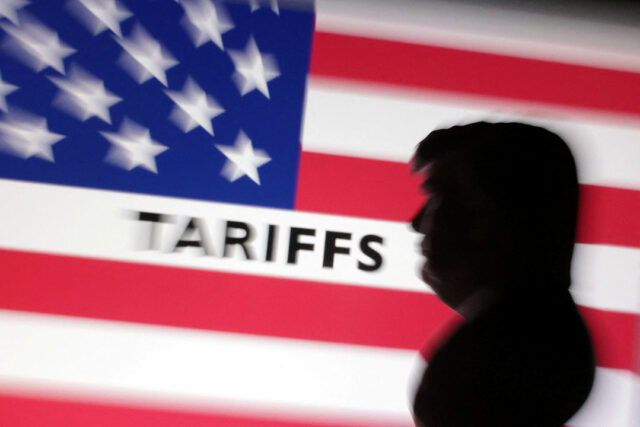
A 3D-printed miniature model of US President Donald J. Trump and the US flag pattern with the word “tariffs” are seen in this illustration. — REUTERS/DADO RUVIC/ILLUSTRATION

By Aubrey Rose A. Inosante, Reporter

THE PHILIPPINE GOVERNMENT is anticipating up to P6 billion in foregone revenues following its decision to grant zero tariffs on selected US products imported into the country.

“Our initial estimate is something like P3 billion to P6 billion. It depends if everything is included,” Finance Secretary Ralph G. Recto told reporters on the sidelines of the Post-State of the Nation Address (SONA) briefing on Tuesday.

While there is no final deal yet, Mr. Recto said the foregone revenue estimate assumes that the Philippines will grant zero tariffs on select products such as automobiles, wheat, soy and pharmaceuticals.

US President Donald J. Trump announced a 19% tariff rate for goods from the Philippines after a meeting with President Ferdinand R. Marcos, Jr. in Washington. This was a slightly lower rate than the 20% that Mr. Trump threatened to impose, but higher than the 17% “reciprocal tariff” announced in April.

“We concluded our trade deal, whereby the Philippines is going open market with the United States, and zero tariffs,” Mr. Trump said.

Mr. Recto said zero tariffs on US wheat and pharmaceuticals would translate to lower prices for consumers.

“Ayaw ba natin ng murang pandesal? Walang tariff sa wheat. Pabor sa atin ’yun (Don’t we want cheaper pandesal? There’s no tariff on wheat. That’s favorable for us),” he said.

At the same time, Mr. Recto acknowledged that the Philippines’ exports to the US would be affected “initially” as a result of the 19% tariff.

“We have one of the lowest tariffs in the world… As a whole, we have a better deal than many other countries,” he said.

The Philippines’ new US tariff rate is now the same as Indonesia, and slightly lower than Vietnam’s 20%.

However, Mr. Trump said on Monday most trading partners that do not negotiate separate trade deals would soon face tariffs of 15% to 20% on their exports to the United States, well above the broad 10% tariff he imposed in April, Reuters reported.

Analysts said the foregone revenues from slashing tariffs on some US goods are “minimal.”

“Yes, the P3-billion to P6-billion revenue loss sounds minimal in the grand scheme, but it’s not just about numbers — it’s about positioning. The deal opens the door to cheaper US goods like medicine, feeds (soyabeans and wheat) and cars, which helps consumers and could ease inflation,” Jonathan L. Ravelas, a senior adviser at Reyes Tacandong & Co. said in a Viber message.

Mr. Ravelas said the government has to monitor if local industries “get squeezed” as a result of the deal.

“Bottom line: it’s favorable for now, but we must stay agile and protect domestic competitiveness,” he said.

Union Bank Chief Economist Ruben Carlo O. Asuncion said the foregone revenue is a “manageable trade-off,” noting the deal’s long-term benefits in investment, defense, and technology cooperation.

“More importantly, the deal preserves access for Philippine exporters to a key market and opens doors for deeper cooperation in investment, defense, and technology — contributing to the country’s long-term growth and resilience,” he said in a Viber message.

John Paolo R. Rivera, a senior research fellow at the Philippine Institute for Development Studies, said the key is to ensure the gains from improved market access translates to more jobs and export growth which would offset the foregone revenue.

“If this concession helped lower the tariff on our goods and safeguard export competitiveness, albeit within limited bargaining power, especially in key sectors like electronics and garments, then the trade-off can be deemed acceptable on such ground,” he said in a Viber message.

Meanwhile, Jose Enrique A. Africa, executive director at IBON Foundation, said the reduction in tariff revenues would slash public funds for essential services.

“We still don’t even know the full extent of what deal President Marcos Jr. struck with the US, and the government is being opaque about any other economic, political or military concessions it might have given,” he said.

“But if the grossly one-sided tariff deal is any indication, the ambiguity could very well be hiding something even worse. Which could be the reason for the deal’s conspicuous omission from the President’s SONA.”

IBON Foundation had earlier estimated foregone revenues to reach P3.97 billion as a result from the zero-tariff treatment on some US goods.

BSP eyes prudential requirements for digital-centric banks

BW FILE PHOTO

THE BANGKO SENTRAL ng Pilipinas (BSP) is looking to set prudential requirements for “digital-centric” banks as it wants to level the playing field and ensure financial stability.

In a draft circular posted on its website, the central bank is looking to adopt progressive prudential requirements for digital-centric thrift, rural and cooperative banks to “ensure that regulatory standards remain commensurate with (risk exposures).”

“The progressive prudential requirements aim to foster innovation while ensuring the safety and soundness of the banking system,” the BSP said.

“This likewise promotes a level playing field for both incumbents and new entrants as banks navigate the opportunities and challenges brought about by rapid digitalization in the banking sector.”

Under the draft rules, thrift, rural and cooperative banks identified by the BSP as digital-centric will be considered as complex banks.

Complex banks are defined as those entities that use nonconventional business models, such as “using nontraditional delivery platforms such as electronic platforms.”

These banks may also have a business strategy “characterized by risk appetite that is aggressive, and risk exposures which are increasing, such as those with robust branch expansion programs or acquisition plans.” It could also refer to banks with digital-centric operations, it added.

“The BSP shall assess the extent of technology utilization of subject banks as well as the maturity or degree of their digitalization efforts.”

In assessing the level of digital centricity of a bank, the BSP will consider indicators such as capability to offer end-to-end e-KYC (electronic know your customer) and digital deposit funding; capability to digitally offer or service loans; and percentage of customers who avail of digital financial products or services; among others.

The proposed regulations will classify these digital-centric banks into three tiers with each tier representing a progressively higher level of digital centricity.

“Correspondingly, prudential requirements are calibrated to increase with each successive tier, reflecting the heightened complexity, scale, and risk profile of the bank’s digital operations.”

Tier 1 would cover rural or cooperative banks that have obtained an Electronic Payment and Financial Services (EPFS) license to enable the utilization of a mobile banking application and other channels that are capable of onboarding clients via e-KYC facilities and enable customers to fund their deposit accounts digitally.

They must also have at least 30% of its deposit or loan customers onboarded via digital channels; or have at least 30% of its deposits or loans out of their respective balances sourced from digital financial service offerings; or at least 30% of its total financial transactions as EPFS transactions.

This tier could also include rural or cooperative banks engaged in loan channeling arrangements whereby end-user loan clients are largely sourced digitally either by the thrift, rural or cooperative bank or their loan channeling partners.

Meanwhile, Tier 2 would include thrift, rural or cooperative banks that have at least 50% of their customers onboarded through digital channels; or deposits or loans sourced from digital financial service offerings; or their total financial transactions as EPFS transactions.

Banks under Tier 3 would have at least 75% of their customers and deposits or loans through digital channels, financial service offerings, or financial transactions.

Under the draft rules, banks must comply with prudential requirements depending on their tier.

Tier 1 banks would need to have a minimum capital requirement of at least P200 million.

Banks that fall under the Tier 2 category would need a minimum capital requirement of at least P500 million for rural and cooperative banks, while thrift banks’ minimum is set at P600 million.

Meanwhile, Tier 3 banks have a minimum requirement of at least P1 billion.

All three tiers must also ensure compliance with Basel III leverage ratio and other applicable prudential requirements; adopt an electronic anti-money laundering system; and implement automated and real-time fraud monitoring and detection systems.

“Once recognized as digital-centric and the corresponding level of digital centricity specifically identified, the (bank) will be required to provide regular updates or reports,” the BSP said.

These include the banks’ digitalization roadmap, specific plans and strategies related thereto and any manifestation on the extent of its operations that is technology-heavy or digitalized.

“Once a bank is classified under a specific tier, it shall no longer be permitted to adopt the capitalization or risk management requirements applicable to lower tiers, even if its level of digital centricity (i.e., percentage of digital accounts and/or transactions) subsequently declines.”

The BSP may also require banks “to immediately comply with the minimum capital requirements if the bank is observed to be performing excessive risk-taking activities.”

If a bank undergoes the voluntary conversion of an existing thrift, rural or cooperative bank to a digital bank license, they should immediately comply with the minimum capital of P1 billion.

“It shall submit an acceptable transition plan to comply with the other prudential requirements for a period of three years from the approval of the Monetary Board of its conversion to a digital bank.”

The draft rules also detail guidelines in establishing physical touchpoints for domestic banks. — Luisa Maria Jacinta C. Jocson

Love and revolution revived onstage

After winning awards in its first run, Walang Aray returns sharper

TWO YEARS after its debut, the original Filipino musical Walang Aray will return to reinforce its themes of love and revolution, at the PETA Theater Center from Aug. 29 to Oct. 12.

The musical garnered acclaim in 2023, with eight wins at the Gawad Buhay Awards in 2024, for outstanding Musical, Ensemble Performance, Stage Direction, Book, Original Score, Choreography, and acting performances for Neomi Gonzales and Shaira Opsimar.

This year, the Philippine Educational Theater Association (PETA) is giving Walang Aray new life, to be enjoyed by new audiences.

“This season, we explore how love and power intersect, examining how our romantic, familial, and national relationships are shaped and often wounded by systems of control,” said PETA artistic director J-mee Katanyag, at a press conference in Quezon City on July 28.

She added that Walang Aray “reimagines history and invites us to ask, what if love is not a feeling, but a revolutionary act?”

Inspired by Severino Reyes’ sarswela Walang Sugat, the latest production of Walang Aray is helmed by director Ian Segarra, playwright Rody Vera, and musical director Vince Lim. For this run, they are joined by Norbs Portales as associate director.

Walang Aray presents a love story between Julia and Tenyong, set during the Philippine revolution of 1896. Many of the award-winning lead cast are returning: Shaira Opsimar and Marynor Madamesila who alternate in the role of Julia, and Gio Gahol and Jon Abella as Tenyong. They are joined by a new cast member, transwoman Lance Reblando who also essays the role of Julia.

BLIND CASTING
The project marks Ms. Reblando’s first time to play a female lead, seen as a step forward for LGBTQ+ representation in musical theater.

“I’m thankful for PETA because I never knew this could happen, that I could be a leading lady. It’s a dream come true,” she said.

On what she will bring to the table as Julia, she said: “I think my presence alone gives a different flavor to the character, because I bring with me my lived experience as a transwoman.”

As for Mr. Gahol, who is the choreographer in addition to playing Tenyong, it was important that PETA open the various roles in the play to auditions from actors of different genders and identities.

“As a gay professional, I will always advocate for my community in any space. We didn’t feel the need to announce it as a marketing stunt. We just went and did it,” Mr. Gahol said.

He added that the exciting thing about having three different Julias to play off of is “to see the kind of love each Julia is capable of.”

The rest of the cast is a mix of old and new faces: Bene Manaois and Rendell Sanchez alternating as Miguel; Kiki Baento and Divine Aucina as Monica; Carlon Matobato and Ice Seguerra as Lucas; and Neomi Gonzales, Jolina Magdangal, and Gold Villar-Lim as Juana.

It will be Ms. Magdangal’s theater debut, and the first time for the role of Lucas to be played by a transman, Mr. Seguerra.

“When we did the rewrite, we had the chance to review the text and think of how it is relevant to the times. We discussed with Rody Vera that the Philippines was nonbinary until the Spanish colonized us,” Ms. Katanyag said.

“We cast these people because they fit the role. They were great when they auditioned.”

IMPROVEMENTS
As for what Walang Aray will be like in 2025 versus the original run in 2023, associate director Mr. Portales said that the themes are sharper now that they refined the dramaturgy.

“We want to manage the laughs, because we don’t want the sharpness of the wounds and the healing of these wounds to be lost amid the laughs,” he said.

Musical director Mr. Lim added that about “95% of the vocal and instrumental arrangements will be improved on.”

“The biggest difference is the new talent coming in, which brings a whole lot of good energy,” he said.

For Jun Reyes, grandson of Severino Reyes, the goal of Walang Aray is to “reinvent the sarswela into a modern musical.”

“The vision is for it to be translated to a modern audience, to actually entertain. Part of the entertainment process is the jokes, and the music with a more modern arrangement, so that the message of tumindig at umibig allows the classic sarswela of my grandfather to reach more audiences,” he explained.

“The basic spine of it has the original story, with the cast, the plot, the twists and everything, but we changed all the music. Essentially, it’s the same structure.”

Produced by PETA in partnership with Indie.Go Media and Metrobank, Walang Aray runs from Aug. 29 to Oct. 12 at the PETA Theater Center in Quezon City. Tickets are available via Ticket2Me. — Brontë H. Lacsamana

BTr fully awards 20-year bonds at higher rates before Fed meet

BW FILE PHOTO

THE GOVERNMENT fully awarded the reissued 20-year Treasury bonds (T-bonds) it offered on Tuesday even as rates rose as market players awaited the US Federal Reserve’s policy decision this week.

The Bureau of the Treasury (BTr) borrowed P20 billion as planned via the reissued 20-year bonds, with total bids reaching P39.511 billion or almost double the amount on offer.

This brought the outstanding volume for the issue to P212.7 billion, the Treasury said in a statement.

The reissued notes, which have a remaining life of 18 years and 10 months, were awarded at an average rate of 6.584%. Accepted yields ranged from 6.5% to 6.62%.

The average rate for the reissued papers went up by 9.8 basis points (bps) from the 6.486% fetched for the series’ last award on May 15 but was still 29.1 bps below the 6.875% coupon for the issue.

This was also 3.4 bps above the 6.55% seen for the same bond series and 1.6 bps higher than the 6.568% quoted for the 20-year paper at the secondary market before Tuesday’s auction, based on the PHP Bloomberg Valuation Service (BVAL) Reference Rates data provided by the BTr.

The government fully awarded its T-bond offer as the result was “well within market expectations,” a trader said in a text message.

“The average awarded rate of 6.584% was [close to] the lower end of the indications (6.55%-6.7%),” the trader said. “The bid-to-cover ratio was decent at 1.98 times the awarded volume.”

“The increase in yield compared to previous auction may have been tracking the upward trend in US Treasury yields overnight. Additionally, the lower demand may be due to the Fed’s meeting this week,” the trader added.

Rizal Commercial Banking Corp. Chief Economist Michael L. Ricafort likewise said in a Viber message that the T-bonds fetched higher rates amid elevated US Treasury yields recently due to lingering fiscal concerns in the world’s largest economy.

Yields on 10-year Treasuries held at 4.408% on Tuesday after having crept higher on Monday as markets braced for another steady decision on interest rates from the Federal Reserve, Reuters reported.

Futures imply a 97% chance the Fed will keep rates at 4.25%-4.5% at its meeting on Wednesday and reiterate concerns that tariffs will push inflation higher in the short term.

Analysts also assume one, or maybe two, Fed officials will dissent in favor of a cut and supporting wagers for a move in September.

The odds could change depending on a slew of US data this week including gross domestic product for the second quarter where growth is seen rebounding to an annualized 2.4%, after a 0.5% contraction in the first quarter.

The central bank has been cautious on rate cuts as officials want to determine the impact of tariffs on inflation before making decisions.

Mr. Ricafort added that T-bond yields climbed ahead of an expected retail Treasury bond offering by the government, which could siphon off some liquidity from the market.

Tuesday’s auction was the last for the month. The government raised a total of P262.1 billion from the domestic market in July, higher than the P250-billion plan, as it fully awarded all its T-bond offers and upsized some awards of Treasury bills (T-bills).

For August, the BTr is looking to raise P220 billion from the local market, or P100 billion via T-bills and P120 billion through T-bonds.

The government borrows from local and foreign sources to help fund its budget deficit, which is capped at P1.56 trillion or 5.5% of gross domestic product this year. — Aaron Michael C. Sy with Reuters

DigiPlus shares jump after SONA silence on online gambling

PHILIPPINE STAR/NOEL PABALATE/DIGIPLUS

By Revin Mikhael D. Ochave, Reporter

SHARES OF TANCO-LED DigiPlus Interactive Corp. jumped on Tuesday after President Ferdinand R. Marcos, Jr. made no mention of online gambling in his fourth State of the Nation Address (SONA), which analysts said may have eased investor concerns about a possible ban.

DigiPlus shares closed higher by 11.06%, or P3.55, to P35.65 apiece on Tuesday. The company operates the gaming platforms BingoPlus, ArenaPlus, and GameZone.

However, analysts warned that the stock could face volatility amid ongoing discussions on stricter online gambling regulations.

“It seems the market is taking a ‘no news is good news’ stance, with investors assuming that the lack of mention during the SONA means that a full ban is not forthcoming. However, we still believe that tighter regulation for the sector is inevitable,” AP Securities, Inc. Research Head Alfred Benjamin R. Garcia said in a Viber message.

During his SONA on Monday, Mr. Marcos covered economic growth, food security, energy reforms, and social services, but did not mention legislation seeking to outlaw or better regulate online gaming.

Bills seeking to either ban or regulate online gambling have been filed in the Senate and House of Representatives, citing concerns over its social impact.

Online gambling operators like DigiPlus have advocated for stricter regulation rather than a total ban, arguing that proper oversight would help deter players from shifting to unregulated or illicit platforms.

“This suggests that proposed restrictions on online gambling may not be priority legislation and, if pursued at all, may face a long and uncertain path to enactment after extensive revisions and debate,” DragonFi Securities, Inc. Equity Research Analyst Jarrod Leighton M. Tin said in a Viber message.

China Bank Capital Corp. Managing Director Juan Paolo E. Colet said in a Viber message that the omission bodes well for DigiPlus despite the proposed stricter online gambling regulations.

“The immediate post-SONA market reaction has been positive for online gaming stocks, especially DigiPlus. It’s a good exercise in prudence by the President to give legislators, regulators, and stakeholders the opportunity to reach an appropriate resolution,” he said.

“At this point, the most reasonable outcome would be an enhanced but economically sensible regulatory environment for legitimate digital gambling. Major players that can ensure compliant operations stand to benefit the most from a balanced gaming landscape,” he added.

Unicapital Securities, Inc. Research Head Wendy B. Estacio-Cruz said that mentioning stricter online gambling controls during the SONA could have sent the wrong signal to investors and stakeholders.

“This omission seems intentional. It’s possible that the President is still weighing economic considerations, as online gambling continues to generate substantial revenue for both the Philippine Amusement and Gaming Corp. and the government,” she said.

Despite the omission, Mr. Garcia projected continued volatility in gaming stocks such as DigiPlus until there is a clearer policy direction on online gambling.

“No mention of an online gambling ban in the SONA does not mean it’s not being considered, and calls for tighter regulation are too loud for the status quo to be maintained. So even if there is no outright ban, tighter restrictions will definitely hamper future growth,” he said.

“Without more details to work with, the market will continue to speculate, which could lead to wild swings. Even after more details become available, it will take some time for prices to settle down as investors attempt to price in the effects,” he added.

Ms. Estacio-Cruz said investors should remain cautious about gaming stocks amid the regulatory uncertainty.

“We believe investors should remain cautious until we see final word from the government,” she said.

“Unicapital Securities Research still has a neutral rating on gaming stocks due to regulatory risks,” she added.

NCCA holds inaugural choral competition

LOCAL CHOIR GROUPS, selected from the geographic clusters of Luzon, Visayas, Mindanao, and the National Capital Region, are set to compete at the culmination of Linggo ng Musikang Pilipino (LMP).

“Koro,” the name of this inaugural choral competition organized by the National Commission for Culture and the Arts (NCCA), will conclude on Aug. 2 at the Manila Metropolitan Theater.

As part of the nationwide celebration of Filipino musical heritage, the competition highlighted Original Pilipino Music (OPM) through the avenue of choral music. After reviewing 12-minute unedited audition videos, a panel of jurors selected two finalists per category per cluster.

The eight adult’s choir finalists are: the Adamson University Chorale and the Emilio Aguinaldo College Chorale for the National Capital Region (NCR); the Bicol Voices Chorale and the Bicol University Chorale for Luzon; the Bacolod Kalinaw Chorale and Panag-uyon Adelante Singers for the Visayas; and the Polomolok Chorale and University of Mindanao Digos Chorale for Mindanao.

The inaugural Koro competition welcomed only choir groups that had never competed before, whether nationally or internationally, with the goal of encouraging the youth to hone their craft.

While eight groups made it as finalists in the adult’s choir category, only one made it in the children’s choir category — the Matina Elementary School Choir from Davao City. They are set to hold a concert on competition night.

Iisa lang ang pumasa kasi mataas ang standards. Kailangan pagsikapin pa ng iba (Only one passed because of the high standards. The others still need to persevere),” said NCCA’s head of the subcommission on the arts, Arvin Manuel R. Villalon, at a press conference on July 21 at the Centro de Turismo in Intramuros, Manila.

“We try to find talents who are raw but promising,” he added.

The groups were judged based on harmony, teamwork, and passion for Philippine music founded in any of the following living music cultures of the Philippines: music of the indigenous peoples; music of the Bangsamoro peoples; music of the lowland Philippines; music of colonial influence; music of the academe and Western tradition; music of nationalism; music of social transformation; and music of popular culture and global influence.

NCCA Deputy Executive Director for Operations Bernan Joseph Cruz noted that music is one of the arts that is “above language.”

Kapag walang musika, walang ingay, walang saya, walang kwento, walang kahulugan (If there is no music, there’s no noise, no joy, no stories, no meaning),” Mr. Cruz said at the press conference.

In previous years, the NCCA’s Linggo ng Musikang Pilipino focused on band music and modern OPM. Last year, for instance, saw the girl group KAIA visit Capiz and perform there. There have also been multiple workshops held around the country over the years.

“It was very effective,” said Mr. Villalon, “But we thought, what if we use the choral form, very popular across the Philippines, and also something we are known for globally?”

The culmination of the Koro competition will take place on Aug. 2, 6 p.m. at the Manila Metropolitan Theater. Those interested in attending may register through the link: https://forms.gle/xMbwqzosP2tED6AZ6. — Brontë H. Lacsamana

BDO raises P115 billion via sustainability bonds

BW FILE PHOTO

BDO UNIBANK, Inc. has raised P115 billion from its latest offering of peso-denominated sustainability bonds.

“BDO successfully raised P115 billion for its fourth peso-denominated ASEAN Sustainability Bond issue, twenty-three times oversubscribed against the original offer of P5 billion,” the bank said in a disclosure to the stock exchange on Tuesday.

The bonds were issued, settled, and listed on the Philippine Dealing and Exchange Corp. on Tuesday.

The public offering for the bonds was initially set to run from July 9-22 but was closed earlier than planned amid strong demand.

“The issuance saw robust participation from both retail and institutional investors that prompted the early close of the offer period on July 14 after only four days,” BDO said.

“The net proceeds of the issuance are intended to finance and/or refinance eligible assets as defined in the bank’s Sustainable Finance Framework, support the bank’s lending activities, and diversify the bank’s funding sources.”

The bonds have a tenor of 1.5 years and carry a coupon rate of 5.875% per annum.

They were sold at a minimum investment amount of P500,000 and in additional increments of multiples of P100,000 thereafter.

ING Bank N.V. Manila Branch was the sole arranger and sustainability coordinator for the issuance. It also acted as a selling agent along with BDO.

Meanwhile, BDO Capital & Investment Corp. was the financial advisor for the transaction.

The issuance marks BDO’s fourth tranche of peso-denominated ASEAN Sustainability Bonds following the P55.7-billion issue in July 2024, the P63.3-billion tranche in January 2024, and the P52.7-billion issuance in January 2022.

The bank last week said it has funded P1.04 trillion worth of projects under its Sustainable Finance Program launched in 2010, including those in the energy, infrastructure, water, transportation, and community development sectors.

BDO booked a net income of P20.895 billion in the second quarter, steady from the same period a year prior, as higher expenses offset increases in both its net interest and non-interest earnings.

This brought its first-half net income to P40.76 billion, up by 3.12% year on year.

BDO’s shares went down by 50 centavos or 0.34% to close at P148.50 apiece on Tuesday. — A.M.C. Sy

Yuchengco firm’s solar project cleared for August launch

STOCK PHOTO | Image by Evgeniy Alyoshin from Unsplash

YUCHENGCO-LED San Jose Green Energy Corp. (SJGEC) is set to commence the commercial operations of its 19.6-megawatt (MW) San Jose Solar Power Project (SJSPP) in Nueva Ecija next month.

In a media release on Tuesday, SJGEC said it obtained provisional operating authority for the facility from the Energy Regulatory Commission.

The company also received approval from the Independent Electricity Market Operator of the Philippines to allow the facility to sell electricity to the Wholesale Electricity Spot Market.

Maria Victoria M. Olivar, vice-president for commercial operations and business development at PetroGreen Energy Corp. (PGEC), said that the project marks its second utility-scale solar project to reach commercial operations this year.

“Our Aug. 1, 2025, commercial operations date will also mark the commencement of SJSPP’s power supply agreement with SN Aboitiz Power,” Ms. Olivar said.

SJGEC is one of four renewable energy special purpose vehicles under Rizal Green Energy Corp., a joint venture between Japan’s Taisei Corp. and PGEC, the renewable energy arm of PetroEnergy Resources Corp. (PERC).

The company said that what distinguishes its solar power project from others is its agrivoltaics component, a dual land-use strategy that combines solar energy generation with agricultural production.

“This innovative feature enables crop cultivation beneath and around the solar panels, promoting food and energy security, while optimizing land use and reinforcing PGEC’s commitment to inclusive and sustainable development,” the company said.

In June, the company secured a P498-million term loan facility from Rizal Commercial Banking Corp. to partly finance the solar power project.

PERC is targeting to expand its generation capacity to 500 MW by 2029 from the current 145 MW. — Sheldeen Joy Talavera

Les Misérables: World Tour coming to Manila in January

JAC YARROW (right) and Emily Bautista play Marius and Eponine in Les Miz. — GMG/DANNY KAAN

LES MISÉRABLES: World Tour Spectacular — a reimagining of the famed musical, which is approaching its 40th anniversary of performances at London’s Sondheim Theatre — will be coming to Manila in January 2026 at The Theatre at Solaire, it was announced on Tuesday.

The World Tour Spectacular is expanded from Les Misérables The Staged Concert, which had over 200 performances in London’s West End. The production is, according to a statement, “on a scale never seen before in Manila, with a company and crew of over 110, including an international all-star cast and a large ensemble of musicians, both Filipino and international, performing live on stage.”

The World Tour Spectacular premiered across the UK and Europe in September 2024. During its recent Australian run, “the tour achieved record-breaking attendance, building on its unprecedented box office success.”

Produced by Cameron Mackintosh and Nick Grace Management, Les Misérables: World Tour Spectacular will run from Jan. 20 to Feb. 15, 2026, at the Theatre at Solaire, with the Manila season presented by GMG Productions. Tickets will go on sale on Aug. 11 exclusively via TicketWorld. Early access will be available through UnionBank of the Philippines, GMG Productions’ official 2025 season bank sponsor and pre-sale partner. Interested parties can also join the GMG Les Misérables: World Tour Spectacular Waitlist at www.gmg-productions.com. The pre-sale period runs from Aug. 4 to 7.

“We’re beyond thrilled to bring this monumental show back to Manila. This time in a groundbreaking, never-before-seen format,” GMG Productions Chief Executive Officer Carlos Candal was quoted as saying in a press release. “Filipino audiences have always shown an incredible passion for world-class theater, and we know Les Misérables: World Tour Spectacular will be unlike anything they’ve experienced before. It’s an epic reimagining of the world’s greatest musical, and we’re honored to be part of its journey around the world.”

AUB net income climbs 17% in first half

BW FILE PHOTO

ASIA United Bank Corp. (AUB) and its subsidiaries booked a higher net income in the first semester on the back of a strong topline performance.

The bank’s net profit rose by 17% to P6.1 billion in the six months ended June from P5.2 billion in the same period last year, it said in a disclosure to the stock exchange on Tuesday.

AUB said this was its highest first-half income so far.

This translated to a return on assets and return on equity of 3.3% and 21.1%, respectively.

The bank’s financial statement was unavailable as of press time.

“Sustaining our profitability since the pandemic is no mean feat, thanks to our robust core business and digital partnerships. We will remain relentless in our efforts to reach out to the unbanked and underserved, and in helping every Filipino achieve economic mobility,” AUB President Manuel A. Gomez said.

“Despite the downgraded growth forecast for the Philippine economy for this year mainly due to tariffs and trade uncertainty, geopolitical tensions, and other external headwinds, AUB remains optimistic it will hit its performance targets,” the bank said.

The bank attributed its strong first-half earnings results to the 13% growth in its revenues to P11.2 billion from P9.9 billion.

“Earning assets rose 21% to P382.6 billion from P316.5 billion, resulting in a 7% increase in net interest margin to P8.8 billion and a net interest margin ratio of 5%,” it said.

Non-interest income also climbed by 40% year on year to P2.4 billion on the back of higher trading and foreign exchange gains, service charges, and other fees from its operating activities, including credit cards, AUB PayMate, HelloMoney, remittance business, trust, and other branch-related transactions.

Meanwhile, AUB’s operating expenses increased by 8% to P3.6 billion due to higher compensation, capital expenditures, and business growth-related expenses.

This resulted in a cost-to-income ratio of 32.2%.

The bank added that its loan loss provisions increased by 134% year on year amid higher loan volume.

AUB’s loan book expanded by 36% year on year to P255.6 billion at end-June from P187.9 billion.

“Despite volume expansion, good asset quality was sustained with its nonperforming loan (NPL) ratio at 0.41% from year ago’s 0.43%. AUB remains sufficiently covered, with an NPL coverage ratio at 115.8%,” it said.

On the funding side, total deposits rose by 16% P325.8 billion. Of the total, 79% were low-cost current and savings account or CASA deposits, higher than the previous year’s 75% share.

AUB’s assets grew by 16% to P404.5 billion at end-June from P349 billion a year ago.

Total equity increased also increased by 26% to P64.9 billion, mainly from retained earnings.

The bank’s common equity Tier 1 ratio was at 18.13% and capital adequacy ratio was at 18.85%, up from 17.9% and 18.7% a year ago, respectively.

AUB’s shares rose by P1.10 or 1.99% to end at P56.50 each on Tuesday. — Aaron Michael C. Sy

Meralco weighs response to SMGP’s entry as shareholder

MERALCO.COM.PH

MANILA ELECTRIC CO. (Meralco) is weighing its next steps after San Miguel Global Power Holdings Corp. (SMGP) acquired shares in the company as a result of a long-delayed deal.

“That was discussed earlier at the board. No decision yet. We’re just looking at the options. It really depends on what San Miguel’s responses are,” Meralco Chairman and Chief Executive Officer Manuel V. Pangilinan told reporters on Monday.

A question was raised as to whether Meralco is open to acquiring the 43.23 million shares — equivalent to a 3.9% stake — that SMGP bought from state-run Land Bank of the Philippines (LANDBANK) at P90 per share.

In 2008, SMGP — then known as Global 500 Investment — entered into a share purchase agreement with LANDBANK involving Meralco shares. The state-run lender later rescinded the deal, prompting SMGP to sue for damages, arguing that the cancellation was unjustified. In November 2022, the Court of Appeals sided with SMGP, ruling that the bank’s decision to withdraw from the agreement had no factual basis.

While no decision has been made yet, Mr. Pangilinan said that SMGP is “welcome to become shareholder.”

As the country’s largest private distribution utility, Meralco serves over eight million customers across Metro Manila and nearby areas.

In line with its efforts to expand and improve electricity service in underserved regions, Meralco last year submitted an unsolicited proposal for a joint venture with Batangas Electric Cooperative II (Batelec II), following calls for more stable and reliable power in Batangas province.

Ariel Paciano D. Casanova, Meralco’s senior vice-president for external and government affairs, said the company is now seeking clarification from Batelec II on the process for competitive selection.

“We ask them how are they going to treat our unsolicited proposal? How will the selection be done? Will our unsolicited proposal be respected and then will they have it challenged? Or will they come up with an open bidding for selection? So those are the queries,” he said.

He said that the proposed joint venture would involve converting the electric cooperative into a stock corporation, to be supported through capital infusion by acquiring shares in the new entity.

Under the Electric Power Industry Reform Act, electric cooperatives are allowed to convert into either a stock cooperative or a stock corporation.

“We want to have a better, wider participation in the electric cooperative,” Mr. Casanova said. “So basically we’re empowering the electric cooperative by infusing capital and technology into our technical capability.”

Meralco’s majority shareholder, Beacon Electric Asset Holdings, Inc., is partly owned by PLDT Inc. Hastings Holdings, Inc., a unit of the PLDT Beneficial Trust Fund subsidiary MediaQuest Holdings, Inc., has an interest in BusinessWorld through the Philippine Star Group, which it controls. — Sheldeen Joy Talavera

ADVERTISEMENT
ADVERTISEMENT