Home Blog Page 1216

ArteFino does food with pop-up resto

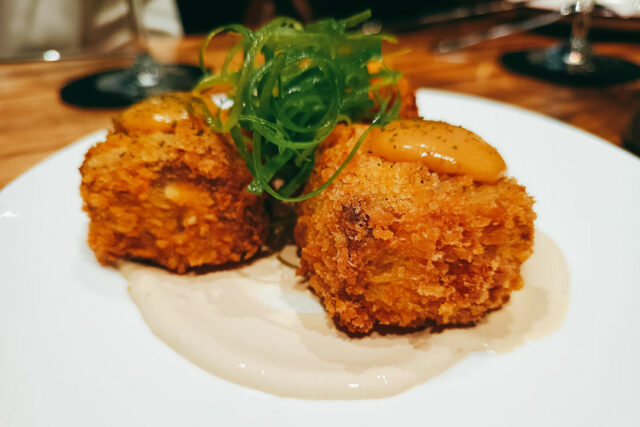
MONGHE, a minced pork, cheese, homemade banana ketchup, toyomansi cream meatloaf from Rizal Province. — JOSEPH L. GARCIA

AHEAD of the ArteFino Fair opening on July 31, the artisanal trade fair cooked up something else (literally), the ArteFino Lounge.

Daily until Aug. 3, the ArteFino Lounge features a collaboration with chefs Angelo Comsti and Don Baldosano’s Offbeat Bistro. Their new venture opened just a few months ago, featuring dishes that the chefs either grew up with, or Mr. Comsti has researched in his capacity as a food writer.

“This happened because we got word of a story that Angelo was doing research at the Lopez Library for heirloom and heritage recipes rooted in Philippine history,” said Marimel Francisco, ArteFino co-founder in a speech on July 25, at a tasting at the Chef’s Table at Rockwell’s Balmori Suites.

ArteFino Lounge, held a few floors below the main fair, will feature jewelry and accessories from ARAO, Caro Wilson, Golden Monstera, Katha Pilipinas, and Peewee Benitez. The preview and tasting also allowed us to see some furniture and home decor pieces which are also to be sold at the lounge.

The menu features small plates like Rizal Province’s take on meatloaf called Monghe (minced pork, cheese, homemade banana ketchup, toyomansi cream; P580) and Bread and Butter (beef fat Kabayan bread, crab fat butter, fried sweet potato leaves; P250). Unfortunately, these were the only courses we were able to enjoy because we had to leave early, but we’ll say that the Monghe was much better than expected with a dense, forward meat flavor; while the Bread and Butter, still warm, was incredibly rich and very indulgent (thanks to the contrast between the beef fat brushed on the crust; then the crab fat butter giving a hearty kick).

There’s more to look forward to, such as the TNT Pancit (noodles tossed in crab fat, egg yolk, smoked queso de bola, and shrimp salad; P490), and Lengua at Tinapa (tongue with smoked fish mayo, gribiche, and brioche). For the sides, they’ve got rice (plain, garlic, and Inihaw na Baboy Rice: smoked rice, egg, pork belly, and garlic chips) as well as a winged bean and egg salad. Big plates include a Seabream Miswa (noodle) dish, and a Steak Adobo. Prices range from P450 for fried chicken inasal — grilled chicken — to P2,400 for the steak adobo. Dessert selections include Mamon Tres Leches and Mais (Corn) Ice Cream.

“A lot of these recipes are rooted in our history,” said Ms. Francisco. “We value heritage and craft. We have not featured the culinary arts [in ArteFino], which is an art form in itself. Why not put a spotlight on that this year?”

Entrance to ArteFino will cost P150. One hundred percent of the ticket sales go towards HeArteFino, their nonprofit arm that awards grants to small artisanal brands. — Joseph L. Garcia

Meralco, Vietnam firms eyeing to build EV charging network

IN PHOTO ARE (L-R) Senior Vice-President and Chief Revenue Officer Ferdinand O. Geluz, Meralco Executive Vice-President and Chief Operating Officer Ronnie L. Aperocho, Meralco Chairman and Chief Executive Officer Manuel V. Pangilinan, Vingroup JSC Chief Corporate Development and Strategic Finance Officer Thuy Vu Dropsey, V-Green Philippines Chief Executive Officer Luu Viet Hung, and Green GSM Philippines Chief Executive Officer Dao Quy Phi.

POWER DISTRIBUTOR Manila Electric Co. (Meralco) has entered into a partnership with a Vietnamese electric vehicle (EV) firm and a ride-hailing service provider to support the development of green mobility solutions.

In a statement on Wednesday, Meralco said it signed a memorandum of understanding (MoU) with EV charging firm V-Green Global Charging Station Development Corp. and ride-hailing company Green and Smart Mobility Joint Stock Co. to support the country’s shift toward cleaner and more sustainable transport.

Under the partnership, the companies will identify and evaluate sites for EV charging stations and electric taxi hubs, support the rollout of charging networks, explore opportunities to scale up EV adoption, and engage in technical cooperation and knowledge exchange on EV technologies and system design.

“This partnership brings together our collective strength in infrastructure, technology, and experience that will redefine our cities and our communities. Together, we intend to reframe the way we think about energy, transport, and sustainability,” Meralco Chairman and Chief Executive Officer (CEO) Manuel V. Pangilinan said.

As the country’s largest electricity distribution company, Meralco said it is committed to taking the initiative in advancing the goals of the Electric Vehicle Industry Development Act through the deployment of integrated EV and charging infrastructure for businesses and the public.

V-Green CEO Nguyen Thanh Duong said that the partnership with Meralco would help the company in its mission to accelerate the “green mobility revolution” in Southeast Asia.

“By combining our expertise in EV charging infrastructure with Meralco’s strong local presence, we aim to rapidly deploy a reliable and accessible charging network across the Philippines,” he said.

“Together with VinFast and Green GSM, we are proud to contribute to a comprehensive EV ecosystem that supports the country’s journey towards a cleaner and more sustainable future,” he added.

Green GSM Philippines’ CEO Dao Quy Phi sees the Philippines as a “vibrant and fast-growing market” for clean mobility solutions.

“Through this collaboration with Meralco and V-Green, Green GSM is excited to expand our 100% electric ride-hailing service to more cities nationwide. Our goal is not only to provide safe, convenient, and affordable transportation, but also to play an active role in building a greener future for Filipino communities,” he said.

In Vietnam, V-Green serves as the exclusive charging infrastructure partner for VinFast electric vehicles. Green GSM, meanwhile, is an innovative electric ride-hailing platform that operates a fleet powered entirely by VinFast EVs.

“This collaborative model is poised to deliver meaningful benefits to the public, from cost-effective mobility to safer and seamless travel experiences, while laying a strong foundation for the country’s transition to a greener future,” Meralco said. — Sheldeen Joy Talavera

AI writing assistant Jenni AI sees PHL market as key growth driver

By Beatriz Marie D. Cruz, Reporter

JENNI, Inc. the US-based company that built artificial intelligence (AI)-powered writing assistant Jenni AI, is optimistic about expanding its presence in the Philippines as more universities explore the benefits of using AI tools in the academic setting.

“The Philippines is poised to become one of Jenni AI’s fastest-growing markets over the next 18–24 months for several reasons,” Justin Wong, head of commercial operations at Jenni AI, said in an e-mail. “Although English is considered a second language for most of the population, the Philippines ranks as one of the highest English-proficient countries in the world, which gives academics an advantage since the majority of scientific and research articles are published in English.”

Jenni AI is an AI-powered tool that provides writing and research assistance for both the academic and professional setting.

At present, it is being used by over 4.5 million academics worldwide, including 300,000 researchers, post-graduate students, and faculty based in the Philippines, the company said.

“We see that universities in the Philippines, such as the University of Santo Tomas and De La Salle University, are now pushing new digital transformation initiatives to implement ethical AI tools like Jenni into both learning and research workflows,” Mr. Wong said.

AI writing assistants like Jenni help ease academic workload by allowing users to focus on tasks that require more critical thinking, he said.

“By instantly cleaning grammar, suggesting specific phrasing, and automatically generating relevant citations, Jenni lowers the language and formatting barriers, enabling Filipino scholars to earn more recognition from top scholarly journals.”

Philippine users of Jenni AI mainly use its productivity features like the auto-citation, fluency improver, and outline builder, the company said.

Moving forward, Jenni AI is looking to roll out new features and product improvements every two weeks to better support academic users, including allowing document collaboration.

To help ensure the ethical use of AI, the company is also set to release an AI Usage Report feature, Mr. Wong said. This will help users strike a balance between their own inputs in their manuscripts with Jenni AI’s contributions.

This feature is expected to help users “ensure they are following the appropriate guidelines set by scholarly journals or their university,” the official said.

Another feature the company is working on is personalized article recommendations, where users can find new papers based on the sources they upload to Jenni AI.

The company also recently teamed up with CE-Logic, Inc. a local educational publishing and e-learning provider, to introduce AI solutions that can help enhance research productivity and learning in academic institutions nationwide.

“In partnership with leading experts and researchers, we’ve developed introductory and advanced modules to teach academics at every level how to use Jenni ethically,” Mr. Wong added.

The official said he believes banning the use of AI, especially in schools, is unrealistic.

“It is more important to keep the author in the driver’s seat, preserve academic integrity through transparent audit trails, and ultimately accelerate the journey from an idea to a peer-reviewed research contribution,” Mr. Wong said.

From content creator to business enabler

FACEBOOK.COM/REALTALKDARBS

In this plugged-in and socially connected age, we have grown to admire content creators — creative individuals who use their platform for entertainment, for selling, for education, and more. One such content creator is Real Talk Darbs, who I had the good fortune of speaking to in my podcast.

Most may know Darbie Kim Estrebillas as his online persona, Real Talk Darbs. Catapulted to online fame in 2020, Darbs has since expanded his lucrative role as content creator into, not one, but two more entrepreneurial avenues — selling personally branded food supplements and snacks, and establishing House Creatives. The latter is a swiftly growing company that enables other businesses to do what he has done so well: create content that clicks and sells online.

What I find genius about the evolution of Real Talk Darbs from content creator to business enabler and educator is how each of his businesses is a natural expression of his innate personality and passion.

CONTENT CREATION AS A SPRINGBOARD
Real Talk Darbs began his entrepreneurial journey as a content creator in 2020 when he resigned from a sales job in Dubai. It was just before the pandemic hit, and soon many workers around the world would be worried about job security. But Darbs recounted that he was ready for the challenge.

“I didn’t realize it at that time,” he said, “but that was the best time to quit because everybody was in their home listening to social media.”

He advised other entrepreneurs to “take that moment as an opportunity to really push forward because sometimes not having an option is a blessing.”

When Darbs started creating content on his page, he would be happy to make P3,000 from a single video. Soon, he was earning seven figures per month by the monetization of his content alone — a feat which is difficult to do these days, he quickly added, as the landscape has irrevocably changed.

This success didn’t come overnight. It was borne on the back of 10 years of struggle in Dubai, first as a call center customer service agent and then working in sales. And even before that, Darbs had struggled as a nursing student. But all the struggles led him to create the Real Talk Darbs page in 2018.

Many entrepreneurs say that they were lucky or they were simply in the right place at the right time. But not Darbs. “If somebody tells me right now that I’m lucky,” he said, “I’m gonna punch them in the face. No, I was not lucky.”

Through his long journey towards content creation, Darbs discovered that he had a gift, something inside him which he described as “innate.”

He said, “Mas maraming mas magaling sa akin na content creator. [There are many content creators who are better than me.] I truly believe my strength is [that] I’m able to transfer my knowledge efficiently.”

Darbs’ love and life advice on his channel has clearly found an audience. He credits his passion for his ability to create content that resonates. And it is this passion which would eventually lead him to other business ventures.

“I believe you can outperform other individuals if what is work for others is not work for you,” he said.

VENTURING INTO ONLINE SELLING
From there, Darbs didn’t stand still. He ventured into other businesses but these were still centered around his abilities as a content creator.

“I didn’t wait until the well dried up,” he said. “I dig another well while the other one is still working.”

With his ability to reach a wide audience, Darbs began to sell personally branded food supplements and snacks. He told the story of how his success selling products alone led to another breakthrough moment — and another business.

With just one video, he was able to sell P6 million worth of food supplements in 10 days — even without spending on ads. Darbs realized that he could share his newfound online selling knowledge with other business owners.

“I think there are businesses out there that if they just know this part, their business would explode,” he said. “And I think there’s a gap in that market.”

Darbs knew that he had something most business owners would want to have.

“In FB ads or paid ads right now, which most multi or billion businesses are built on, one thing is for certain, you need to have great creatives. So that’s where I come in.”

ENABLING BUSINESSES WITH HOUSE CREATIVES
For business number three, Darbs founded House Creatives, a company that is dedicated to “Create creators that influence transformation.”

In short, House Creatives is about education. It teaches other entrepreneurs how to create quality content that works.

This doesn’t mean going viral, Darbs insisted.

In his typically straightforward — yet strangely illuminating — manner, Darbs said, “Sa totoo lang, mabilis mag-viral. Kumain ka lang ng tae sa labas ng restaurant. [Truth be told, going viral is easy. Just eat shit outside a restaurant.] You can go viral. It’s hard to go viral if you’re pushing through the [brand] values, quality content, gourmet content.”

This gourmet content — in contrast to fast food content — is what House Creatives teaches.

Darbs continued: “Most of the time, people would not opt for gourmet content because it’s hard to do. Most of the time, the views are low. But in the long run, you develop quality viewers.”

Today’s content creation game isn’t just about views or impressions. It’s about quality — something that was rare five or 10 years ago. That’s why with House Creatives, Darbs focuses on “depth, not width.”

He explains, “Ang dami mo ngang followers (You have a lot of followers). Are they able to afford whatever it is that you’re selling? Just focus on the depth, the quality of the followers that you will have. Because at the end of the day, those are the people that could really impact other people’s lives as well.”

Today, House Creatives is rapidly growing, with plans to build their office later this year, which will enable them to expand to 60 employees. Darbs envisions House Creatives becoming a billion-peso company “hopefully in the next couple of years.”

In closing, Real Talk Darbs encourages other entrepreneurs to build their own “castle.”

“Having the opportunity to build your own castle is addicting,” he said. “Having the opportunity to build my own castle with my own bricks, that gave me a sense of fulfillment, even if it was difficult. Mind you, it was not easy. It was very, very difficult, but it was worth it.”


RJ Ledesma (www.rjledesma.com) is a Hall of Fame Awardee for Best Male Host at the Aliw Awards, a multi-awarded serial entrepreneur, motivational speaker, and business mentor, podcaster, an Honorary Consul, and editor-in-chief of The Business Manual. Mr. Ledesma can be found on LinkedIn, Facebook and Instagram. The RJ Ledesma Podcast is available on Facebook, Spotify, Google and Apple Podcasts. Are there entrepreneurs you want Mr. Ledesma to interview? Let him know at ledesma.rj@gmail.com

3-Michelin-star Paris restaurant Arpège switches to plant-based dishes

FRENCH CHEF Alain Passard poses in his restaurant Arpège, the three-Michelin-star restaurant which serves an exclusively plant-based menu in Paris, France, July 23. — REUTERS/GONZALO FUENTES

PARIS — French chef Alain Passard, known for his mastery of roasting techniques, has decided to drop almost all animal products from the menu at his three-Michelin-star restaurant, Arpège.

The decision follows his earlier move to eliminate red meat from Arpège’s dishes in the early 2000s. Mr. Passard’s updated menu excludes meat, fish, and dairy, although honey sourced from the restaurant’s own beehives will remain an exception.

Mr. Passard said he was motivated by his passion for nature, adding that using seasonal vegetables would also reduce the restaurant’s environmental impact.

Mr. Passard, 68, rose to fame for his roasted dishes, including poulet au foin, or chicken cooked in hay, but has since become a leader in Paris’ growing vegetable-based dining scene.

“Everything I was able to do with the animal will remain a wonderful memory,” Mr. Passard told Reuters.

“Today, I’m moving more towards a cuisine of emotion, a cuisine that I could describe as artistic. It’s closer to painting and sewing… Today, I’m a different chef.”

Arpège is the first restaurant with three Michelin stars in France to move to plant-based food, joining the ranks of Eleven Madison Park in New York, which made a similar transition under chef Daniel Humm.

On the menu is a “mosaic” of tomatoes, flamed aubergine with melon confit, and a dish made up of carrot, onion, shallot and cabbage. The priciest set menu costs €420 ($493) and lunch costs €260.

Some countries have seen consumers turn away from meat in recent years. At the Paris Olympics last year, organizers set out to cut the amount of meat served to athletes and spectators. — Reuters

Philippine Merchandise Trade Performance (June 2025)

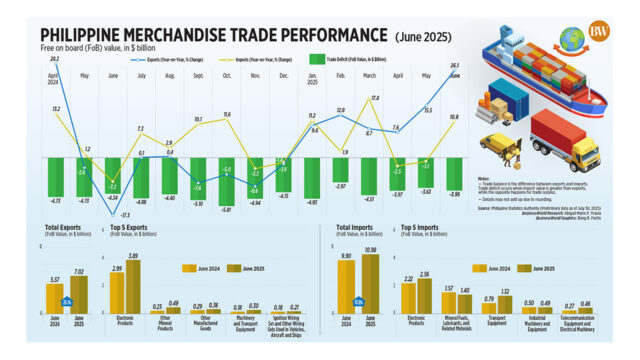
THE Philippines’ trade-in-goods deficit narrowed to $3.95 billion in June, as double-digit export growth was driven by frontloading in the run-up to higher US tariffs, the Philippine Statistics Authority (PSA) said on Wednesday. Read the full story.

Philippine Merchandise Trade Performance (June 2025)

PXP Energy Q2 net loss widens to P13.37M

PXP ENERGY CORP. saw a wider attributable net loss of P13.37 million for the second quarter of 2025, compared with P6.55 million in the same period last year, amid lower revenues and higher expenses.

In a stock exchange disclosure on Wednesday, the upstream oil and gas company reported a 22.9% decline in its petroleum revenues to P12.82 million from P16.62 million in the previous year.

Costs and expenses rose by 14.6% to P25.21 million from P22 million a year ago.

For the six months ended June, PXP said it had incurred a core net loss of P21.1 million, primarily due to softer crude prices, lower volumes from Galoc operations, and higher petroleum production costs.

Revenues dipped by 22.6% to P33.2 million, reflecting a 9.2% drop in sales volume to 280,742 barrels and a 13.9% decrease in the average realized crude price to $70.70 per barrel, amid global market adjustments.

“Galoc operations remained stable during the period, providing consistent output,” the company said.

Costs and expenses climbed by 12% to P33.2 million, mainly due to higher petroleum production costs and a one-off increase in overhead at a foreign subsidiary.

Regarding prospects, PXP said it continues to evaluate the feasibility of the Dalingding prospect under Service Contract (SC) 40, located onshore in northern Cebu. It is also keeping its doors open to pursuing other oil and gas opportunities across the country.

Furthermore, the company and its joint venture partners are awaiting the anticipated awarding of two pre-determined areas offshore in the southwest portion of the Sulu Sea basin for potential petroleum exploration. It is also on standby for its SC applications covering the former SC 6A Octon and SC 6B Cadlao blocks located offshore in northwest Palawan.

“Despite the ongoing force majeure over SCs 72 and 75, PXP and FEL (Forum Energy Limited) remain committed to the long-term potential of these blocks, maintain a prudent approach in managing existing commitments and continue to monitor developments across its portfolio of SCs,” the company said.

FEL, in which PXP holds a 99.35% controlling interest, is a company incorporated in the United Kingdom that focuses on the Philippines. — Sheldeen Joy Talavera

Peso plunges to four-month low before US GDP report

BW FILE PHOTO

THE PESO on Wednesday plunged to its worst close in four months against the dollar on expectations of strong US gross domestic product (GDP) data and before the US Federal Reserve’s policy decision overnight.

The local unit closed at P57.58 per dollar, dropping by 27 centavos from its P57.31 finish on Tuesday, Bankers Association of the Philippines data showed.

This was the peso’s lowest close in over four months or since its P57.69 finish on March 26.

The local opened the session stronger at P57.20 against the dollar. Its intraday best was at P57.115, while its worst showing was at P57.60 against the greenback.

Dollars exchanged increased to $1.86 billion on Wednesday from $1.73 billion on Tuesday.

“The dollar-peso closed higher due to lower trade balance data and anticipation of a stronger US GDP and ADP employment data,” the first trader said in a phone interview.

“The peso weakened anew amid expectations of a strong rebound in US economic growth for the second quarter,” the second trader likewise said in an e-mail.

US economic growth likely rebounded in the second quarter as the flow of imports subsided, but with consumer spending anticipated to have increased moderately and business investment in equipment stalled that would grossly exaggerate the economy’s health, Reuters reported.

The Commerce Department’s advance gross domestic product report on Wednesday would be heavily distorted by trade as was the case in the January-March quarter when GDP contracted for the first time in three years. Economists said President Donald J. Trump’s protectionist trade policy, including sweeping tariffs on imports as well as delaying higher duties, had made it difficult to get a clear pulse on the economy.

They urged focusing on final sales to private domestic purchasers, viewed by economists and policymakers alike as a barometer of underlying US economic growth, which is forecast to have slowed from the first quarter’s moderate growth pace.

A Reuters survey of economists forecast GDP likely increased at a 2.4% annualized rate last quarter after declining at a 0.5% pace in the first quarter. The size of the economy is also expected to swell above $30 trillion for the first time ever before accounting for inflation.

The survey was, however, concluded before data on Tuesday showed the goods trade deficit shrinking to its smallest in nearly two years in June and inventories rising marginally. That prompted economists to upgrade their GDP growth estimates by as much as 0.8 percentage point to as high as a 3.3% pace.

Trade chopped off a record 4.61 percentage points from GDP in the first quarter. Though a reversal is expected, some of the boost could be offset by low inventories, the result of the ebb in the flow of foreign merchandise. Trade and inventories are the most volatile components of GDP. Inventories added 2.59 percentage points to GDP in the January-March quarter.

Economists estimated the economy grew less than 1.5% in the first half of the year. They anticipated a lackluster second half, which would limit growth to around 1.5% or even less for the full year, a sharp slowdown from the 2.8% notched in 2024.

Though the White House has announced a number of trade agreements, economists said the nation’s effective tariff rate remained one of the highest since the 1930s and noted that about 60% of the nation’s imports remained uncovered by a deal.

The first trader added that the dollar remained strong on Wednesday amid higher global crude oil prices after fresh tariff threats from US President Donald J. Trump.

For Thursday, the second trader said the peso could rebound on potentially dovish hints from the Fed overnight after their policy meeting that could hint towards a rate cut at their September review.

The first trader sees the peso moving between P57.20 and P57.45 per dollar on Thursday, while the second trader expects it to range from P57.45 to P57.70. — A.M.C. Sy with Reuters

Garmin’s new premium fitness watch Venu X1 now in the Philippines

GARMIN INTERNATIONAL, INC.

GARMIN’S latest premium fitness smartwatch, the Venu X1, is now available in the Philippines.

The watch has a suggested retail price of P47,990 and is now available at all Garmin Brand Stores and through the official online Garmin Stores via Kinetic, Shopee, and Lazada. Customers can choose between two color options: black and moss.

“Venu X1 is the perfect blend of form, function, and style. Not only does it pack all of Garmin’s most popular features into a slim profile, but the large display makes it easy to see everything from preloaded maps and workout stats to health insights and smart notifications with stunning clarity,” said Susan Lyman, Garmin International, Inc. vice-president of Consumer Sales and Marketing.

The smartwatch has an ultra-thin design with an 8-millimeter rectangular watch case with rounded corners. It features a lightweight titanium caseback and scratch-resistant sapphire lens.

Its body weighs 34 grams and 40 grams when paired with the 24-millimeter quick-release ComfortFit nylon band.

It has a 2-inch AMOLED display with a 448 x 486 resolution that allows users to read data as well as maps easily, and its built-in watch faces are customizable. It also has more font sizes.

“Made to be worn all day every day, Venu X1 includes an LED flashlight that provides greater visibility in dark environments. The built-in speaker and microphone let users make and take calls from the watch when it’s paired with a compatible smartphone and use the phone’s voice assistant to respond to text messages,” Garmin said.

“Certain voice commands like “start a running activity” and “set a timer for 5 minutes” can also be activated right from the watch — no phone connection required.”

The Venu X1 has a battery life of up to eight days, the brand said. It has a 32 gigabyte memory.

It comes with health and wellness monitoring features, built-in mapping, safety and tracking features, as well as workout and training plans. It also has several activity profiles. — BVR

The art of a US deal

STOCK PHOTO | Image from Picryl.com

It seems unlikely that the Philippines will secure a significantly better trade deal from the United States between now and 2028. With the 19% tariff on Philippine exports set to begin on Aug. 1, this appears poised to remain unchanged throughout the Marcos II Administration, and possibly even through the end of the Trump II Administration.

Without further negotiation, the 19% “compromise” tariff, slightly reduced from an original proposal of 20%, could severely impact Philippine exports to the US. Thus, it is imperative for Manila to convince Washington that addressing its trade imbalance with the Philippines need not disrupt trade, jobs, and investments, and that protecting mutual strategic interests, particularly in the West Philippine Sea, is beneficial for both nations.

However, if Manila puts in deliberate and strategic effort, and with some luck, it might successfully lobby Washington for meaningful concessions. An initial, realistic goal could be reducing the tariff from 19% to 15% before Presidents Marcos or Trump leave office. Ultimately, the art of securing a better trade deal from the US hinges on what Manila can offer in return.

The US has granted tariff concessions to strategic partners such as Japan, Vietnam, and South Korea. While the Philippines received a small concession (the reduction from 20% to 19%), there remains considerable room for further negotiation. Manila should confidently pursue additional tariff reductions by offering reciprocal benefits, possibly beyond trade, including strategic security arrangements or other mutually beneficial agreements.

Timing also plays a critical role. The period between 2026 and 2027 represents a crucial negotiating window. As Presidents Marcos and Trump approach the end of their terms, both leaders might look for diplomatic victories to cement their legacies. Trade talks could serve as a tangible example of further “strengthening” the bilateral alliance, demonstrating that one nation’s success need not come at the expense of the other.

Moreover, despite common perceptions that the Philippines needs the US more than vice versa, the reality is more nuanced. The US equally needs strategic allies like the Philippines for regional stability, especially amid rising tensions with China. The relationship between Manila and Washington is, in fact, symbiotic, both for security and mutual economic benefit.

To leverage this relationship effectively, Manila must mobilize strong, data-driven advocacy. This advocacy must be supported by industry and business groups to demonstrate convincingly to Washington the disproportionate impact of a 19% tariff. Clearly framing how such tariffs unnecessarily undermine economic stability in a key US ally in Asia will bolster Manila’s negotiating position.

Furthermore, while the US typically employs tariffs as leverage to address global trade imbalances and support domestic industries, it is important to recognize that imposing higher import duties on trading partners also adversely impacts US consumers through higher prices. This reality provides an opening for the Philippines to engage allies within the US domestic market.

Here, US companies deeply integrated into Philippine supply chains can play a crucial role. Effective lobbying by US technology, electronics, and agri-food companies, which depend heavily on Philippine exports, could prompt a reconsideration of current tariff policy. Sectoral exclusions or targeted reductions for specific tariff lines could represent significant wins for the Philippines.

The Philippines indeed has a moderate to good chance of swaying the US to lower the tariff further to 15%, but achieving this will likely require visible reciprocal actions. These could include providing greater market access for US investors, clearer alignment on defense and security issues, or streamlined regulatory processes for US products entering the Philippine market.

In essence, bilateral negotiations will probably take precedence over broader, multilateral arrangements, potentially elevating the US to a more prominent trading position among the Philippines’ international partners. First among equals, so to speak.

Simultaneously, as Manila advocates for a comprehensive reduction to 15%, it should also seek immediate sector-specific relief. There is a high likelihood that the US might agree to reduce or exempt tariffs on strategically critical sectors like electronics, BPO-linked services, or key agricultural exports.

Manila’s message should consistently emphasize that lower tariffs help ensure Philippine economic stability, directly benefiting US security and economic interests in the Asia-Pacific region.

To enhance the effectiveness of its advocacy, Manila needs to build a broad coalition. Diplomatic engagement alone will not suffice; the Philippines must strategically engage US consumers, voters, and business stakeholders, especially those closely linked to Philippine-based businesses or supply chains.

Highlighting how tariff reductions could directly benefit US consumers through lower prices and greater product availability will increase domestic pressure on the US administration to reconsider its stance.

Furthermore, Manila should strategically leverage defense cooperation. Trade and security negotiations are inherently interconnected. Strengthening the economic relationship through mutually beneficial terms enhances the strategic stability of both nations, particularly bolstering the Philippines’ role as a key regional ally. This strategic alignment directly advances US interests by securing its access and influence within the increasingly contested Asian region.

In this context, the Philippine government must rapidly assemble robust, data-driven economic impact studies. These analyses should quantify the mutual benefits of tariff reductions, clearly illustrating potential job losses and negative regional economic consequences, including impacts on regional security, if tariffs remain at 19%.

Philippine trade and foreign affairs officials clearly recognize the necessity and urgency of further negotiations. Sectoral adjustments represent immediate, achievable gains, but broader tariff reductions require focused, high-level attention. Negotiations must therefore be prioritized while Presidents Marcos and Trump are still in office and while defense alignment remains a high priority for the US.


Marvin Tort is a former managing editor of BusinessWorld, and a former chairman of the Philippine Press Council

matort@yahoo.com

Fire, forest, and flavor: A feast with Baguio’s Mountain Man

IN THE pine-cloaked highlands of Baguio, where time slows and mist curls like memory, there is new kind of luxury experience, one that awakens the senses, honors Cordillera heritage, and tells stories by firelight.

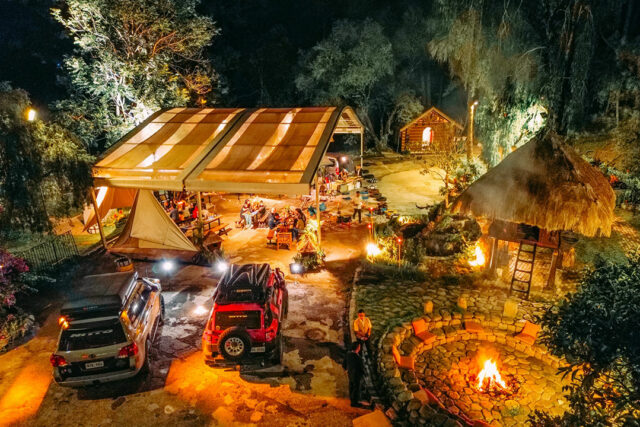
At the John Hay Hotels, managed by Landco Lifestyle Ventures (LLV), guests can experience a very different culinary ritual, the Baguio Mountain Man Fire Dinner. Set under a canopy of trees and starlight, this isn’t simply a meal, it’s a journey into ancestral memory and soulful living.

FIRE AND FEELING
The fire is lit hours before sunset. Smoke rises from open flames fueled by native wood, chosen for scent and story. There is no rush here, only rhythm. In the quiet of the forest, Chavi and Millie Romawac, the couple behind Baguio Mountain Man, begin their work.

Formerly a member of the alternative rock band Session Road, Mr. Romawac left the music scene and found himself in the culinary world, eventually developing an elemental way of cooking that reconnects with the land. Millie, his wife and partner, weaves narrative and care into each step of the experience that is the Fire Dinner. Together, they transform a forest clearing at John Hay Hotels into a dining space that feels timeless, a stage for storytelling through Cordillera cuisine.

Their approach is steeped in ritual — they cleanse the space with smoke, speak gratitude before cooking, select ingredients based on season, moon phase, and memory.

The ingredients are fresh, wild, and carefully sourced from upland farms, indigenous growers, and coastal fishing families. In this way, the Fire Dinner doesn’t just sustain guests, it sustains communities.

HOW IT ALL BEGAN
This fire dinner is the brainchild of the Romawac couple. Their culinary journey began not in the confines of a traditional restaurant, but on rugged roads, beside mountain rivers, and in intimate meals on their own roof deck kitchen during the height of the COVID-19 pandemic.

From creating food documentaries for the Department of Tourism to mapping indigenous ingredients and cooking traditions across all six Cordillera provinces, the Romawacs were repeatedly and spiritually called back to the mountains. One rainy day, cooking beside the Ibulao River in Kiangan, Ifugao, as firewood smoked and the community gathered despite the downpour, the couple experienced a moment of emotional clarity. Mr. Romawac says he stood by the river, arms open, in tears. That moment of unity with nature sparked what would become a lifelong mission: honoring Cordilleran foodways as a means of storytelling, healing, and remembering.

This is about more than cooking, it’s cultural stewardship. Their fire kitchen honors slow food, culinary rituals, and the Cordillera’s deep bond with nature. “Cooking in this way: open flame, river stones, clay pots, it’s not about trend,” said Mr. Romawac. “It’s about returning to the roots. Our roots. And sharing that with others in a way that’s real.”

FEAST IN THE FOREST
As dusk settles, guests gather around the fire. The dinner begins not with a starter, but with stillness. Lanterns glow. River stones heat. A soft hush falls. What follows is a culinary ritual steeped in Cordillera traditions and crafted to awaken all five senses:

The experience opens with a dish from the Ifugao heartland: Hinanglag, Kiangan-inspired pork belly slow-cooked in its own fat for five hours. The aroma is rich and primal, made of garlic and smoke. The pork dissolves on the tongue, melting, savory, tender. Inspired by watwat, a ritual of generosity and shared bounty, it evokes warmth and welcome in every bite.

This is followed by Baguio Chicken Rice, a reimagined pinikpikan, made with ethically raised native chicken (which do not undergo the dish’s traditional bruising), torched to release smoky notes, then simmered slowly with etag, the salted, sun-dried pork from the highlands. It is served with heirloom balatinao rice, whose deep violet grains release an earthy aroma. The accompanying ginger sauce sings with heat and healing.

A dramatic convergence of land and sea is the Mountain Man Clambake. It is a fresh seafood bounty of clams, crabs, and fish sourced from La Union and Pangasinan’s fishing communities, layered with tungsuy (mountain watercress) and steamed over fire-heated river stones. When the leaves are peeled back, a burst of brine and citrus fills the air. Each bite is a testament to freshness and fire.

Throughout are served seasonal side dishes — foraged fiddlehead ferns in vinegar; wild mushrooms from Abra which are grilled to smokiness; hand-fermented atchara, root pickles, and chili pastes bring brightness and bite. Each side dish is served in hand-thrown bowls by local potters, rugged with character, and uniquely Baguio.

Dessert is a medley of sticky mountain rice, sweetened with wild honey, cacao nibs, and native fruits. The scent is toasty, the texture rich and layered from creamy, chewy, to spiced. Served on banana leaves or carved wooden trays, it recalls festive endings, tribal sweets.

Each dish is prepared over open flame or heated river stone, plated on hand-crafted earthenware, and eaten with fingers to heighten texture and connection.

PURPOSEFUL LUXURY
The Baguio Mountain Man Fire Dinner is not a performance, it’s a philosophy. It celebrates slow food, deep roots, and conscious choices. It’s a response to a world of fast living, reminding diners that the most meaningful meals are those made with care and shared with intention.

For Landco Lifestyle Ventures, it’s also a powerful expression of purposeful luxury, the kind that uplifts local communities, preserves ancestral knowledge, and reimagines upscale experiences as something more soulful and sustainable.

Every aspect of the Fire Dinner experience is anchored in conscious collaboration. From the potters of Asin Road; farmers in indigenous communities across Benguet, Ifugao, Kalinga, Abra, and Pangasinan; and fisherfolk in Pangasinan and La Union, local small and micro enterprises are at the heart of this endeavor. The plates tell their stories. The ingredients carry their hopes. The fire becomes a bridge between guest and grower.

Every dish has a story, and every course is a conversation. Because sometimes, the most luxurious thing of all is to slow down, gather by the fire, and remember who we are and who we belong to.

“Through our partnership with Baguio Mountain Man, we’re elevating the highland experience, where guests don’t just eat; they immerse in and become part of a greater cultural narrative of the Cordilleras,” said Erickson Y. Manzano, president and chief executive officer of Landco Lifestyle Ventures. “At LLV, we believe in purposeful luxury that is both exquisite and ethical,” he said. “Together with Baguio Mountain Man, we support a movement where local artisans, farmers, and coastal communities become co-creators of a world-class cultural and dining experience. It’s luxury with a soul, designed to celebrate culture, land, and people.”

The Romawacs’ collaboration with Landco Lifestyle Ventures has given them a wider stage to amplify their advocacy for local food sovereignty, ancestral memory, and mindful tourism. Whether on their roof deck or beneath the trees of John Hay Hotels, the Mountain Man experience continues to grow, flame by flame.

For more information and reservations, call (074) 637-4720 | (074) 637-472, (+63) 939-986-4120; e-mail: reservationsatmanor@campjohnhayhotels.com; visit Landco Lifestyle Ventures website www.landcolifestyleventures.com; and socials on Facebook, Instagram, and TikTok.


Microsoft nears OpenAI agreement for ongoing tech access

The logos of Microsoft Corp. and OpenAI, as well as the ChatGPT 4 name, are seen in this photo illustration. — PHOTO ILLUSTRATION BY JONATHAN RAA/NURPHOTO VIA REUTERS CONNECT

MICROSOFT Corp. is in advanced talks to land a deal that could give it ongoing access to critical OpenAI technology, an agreement that would remove a major obstacle to the startup’s efforts to become a for-profit enterprise.

The companies have discussed new terms that would let Microsoft use OpenAI’s latest models and other technology even if the startup decides it has reached its goal of building a more powerful form of artificial intelligence (AI) known as artificial general intelligence (AGI), according to two people familiar with the negotiations. Under the current contract, OpenAI attaining AGI is seen as a major milestone at which point Microsoft would lose some rights to OpenAI technology.

Negotiators have been meeting regularly, and an agreement could come together in a matter of weeks, according to three people with knowledge of the situation, who requested anonymity to discuss a private matter. OpenAI Chief Executive Officer Sam Altman and Satya Nadella, his Microsoft counterpart, discussed the restructuring at the Allen & Co. conference in Sun Valley, Idaho, earlier this month, two of the people said.

While the tone of the talks has been positive, some of the people cautioned that the deal isn’t finalized and could hit new roadblocks. Moreover, OpenAI’s restructuring plans face other complications, including regulatory scrutiny and a lawsuit filed by Elon Musk, an early backer who split with the company and accused the startup of defrauding investors about its commitment to its charitable mission. (OpenAI has pushed back at Mr. Musk’s claims and said the billionaire is trying to slow down the company.)

Negotiations over OpenAI’s future as a profit-company have dragged on for months. Microsoft, which backed OpenAI with some $13.75 billion and has the right to use its intellectual property, is the biggest holdout among the ChatGPT maker’s investors, Bloomberg previously reported. At issue is the size of Microsoft’s stake in the newly configured company.

The talks have since broadened into a renegotiation of their relationship, with the software maker seeking to avoid suddenly losing access to the startup’s technology before the end of the current deal, which expires in 2030.

Microsoft and OpenAI declined to comment.

A FRAYING PARTNERSHIP
The partnership between the two companies helped inaugurate the AI age. Microsoft built the supercomputer that OpenAI used to develop the language models behind ChatGPT and, in exchange, won the right to bake the technology into its software offerings. The relationship began to fray when the OpenAI board fired (and then rehired) Mr. Altman in November 2023, an episode that shook Microsoft’s faith in its partner.

The rift only widened when the two companies began competing for the same customers — consumers who use their chatbots at home and corporations that have deployed the AI assistants to boost office productivity.

Even as executives publicly touted their close ties, OpenAI sought to loosen its dependance on Microsoft, winning permission to build data centers and other AI infrastructure with rival companies.

OpenAI is eager to alter its complicated nonprofit structure, in part to secure additional funding to keep building data centers to power its next-generation AI models. SoftBank Group Corp., which has said it would back OpenAI with tens of billions of dollars, has the option to reduce that outlay if OpenAI’s restructuring isn’t completed by the end of the year.

OpenAI wants a larger slice of the revenue currently shared with Microsoft, and has sought adjustments to Microsoft’s access to its intellectual property, two of the people said. Microsoft is looking for continued access to OpenAI technology after the current contract expires in 2030.

There are a range of concerns for OpenAI. The startup wants to ensure its business is well-positioned with whatever share of revenue and equity Microsoft receives in part to guarantee its nonprofit will be well-resourced with a significant stake in OpenAI, one person said. OpenAI also wants the ability to offer customers distinct products built on top of its models even if Microsoft has access to the same technology, the person said. And OpenAI wants to be able to find a way to provide its services to more customers, including government providers, not all of which are on Azure, Microsoft’s cloud computing platform, the person said.

At the same time, OpenAI seeks to guarantee that Microsoft adheres to strict safety standards when deploying OpenAI’s technology, especially as it gets closer to AGI, the person said.

THE AGI QUESTION
Reaching agreement on what happens once OpenAI achieves artificial general intelligence has been particularly thorny. It’s not clear why the language is in the contract, but it gives OpenAI a built-in way to strike out on its own just as its technology matures.

The startup publicly defines AGI as “highly autonomous systems that outperform humans at most economically valuable work.” The existing contract has separate clauses related to that threshold, which can be triggered by technical or business milestones, according to two people familiar with the matter.

OpenAI’s board has the right to determine when the company has reached AGI on a technical level. Under that scenario, Microsoft would lose access to technology developed beyond that point, one of the people said.

The business milestone would arrive once OpenAI has demonstrated it can reach around $100 billion in total profits for investors including Microsoft — giving it the wherewithal to repay the return Microsoft is entitled to under the existing contract, one person said. In that scenario, Microsoft would lose its rights to OpenAI technology, including products developed before that trigger, another person said.

Microsoft has the right to weigh in on the business milestone, but if the two companies end up at odds over the claim, they could wind up in court, two people said. Another provision in the current contract bars Microsoft from pursuing AGI technology itself, some of the people said.

Microsoft, for its part, has demonstrated some flexibility in revised contract terms. The company agreed to waive some intellectual property rights related to OpenAI’s $6.5 billion acquisition of io, the startup co-founded by iPhone designer Jony Ive, two of the people said.

The software giant was less accommodating over OpenAI’s proposed acquisition of AI coding startup Windsurf, the people said. That deal fell apart earlier this month, in part because of the tension with Microsoft, Bloomberg reported. Windsurf, which sells coding tools that compete with Microsoft’s products, didn’t want the tech giant to have access to its intellectual property — a condition that OpenAI was unsuccessful in getting Microsoft’s agreement on, people familiar said. Ultimately, Windsurf’s co-founders and a small group of staffers agreed to join Alphabet Inc.’s Google in a $2.4-billion deal.

In recent weeks, the companies have been negotiating Microsoft’s ownership in a restructured OpenAI — with the two sides discussing an equity stake for Microsoft in the low- to mid-30% range, according to a person familiar with the matter. The Financial Times previously reported on the stake talks. But if Microsoft deems the stake and other changes to the contract insufficient, the company is willing to abandon the talks and stick with the current contract terms, another person said.

“If a deal were to be signed, it would take away a hurdle, at least from the investor’s perspective,” Kash Rangan, an analyst at Goldman Sachs, said in an interview with Bloomberg Television on Tuesday. “Both parties have so much to gain from this.” Bloomberg

ADVERTISEMENT
ADVERTISEMENT