Home Blog Page 1141

Ben Rice’s 7-RBI night helps Yankees outscore Cardinals

BEN RICE drove in seven runs and scored twice as the visiting New York Yankees outslugged the St. Louis Cardinals 12-8 on Saturday night.

Rice recorded a three-run homer, a three-run double and a run batted in (RBI) single as the Yankees won for the fourth time in five games.

Aaron Judge had a homer, a double and two RBIs for New York. Trent Grisham went 4-for-5 with four runs, and Jose Caballero was 2-for-4 with two stolen bases and three runs.

Yankees starter Max Fried (13-5) allowed seven runs on eight hits in five innings. David Bednar got the final out for his 20th save of the year.

Masyn Winn hit a three-run home run, Nolan Gorman had a two-run homer, and Pedro Pages belted a solo shot for the Cardinals, who lost their fourth straight.

Cardinals starter Sonny Gray (11-6) allowed six runs on nine hits in five innings.

St. Louis outfielder Victor Scott II left the game with a left ankle sprain he suffered while attempting a leaping catch on Judge’s homer.

The Yankees took 2-0 first-inning lead as Judge ripped an RBI double, followed shortly thereafter by a Jasson Dominguez run-scoring single.

The Cardinals cut the lead to 2-1 in the bottom of the inning on Alec Burleson’s triple and Ivan Herrera’s RBI single. St. Louis, though, surged ahead 5-2 in the second inning on Scott’s RBI single and Winn’s three-run blast.

Judge’s third-inning homer cut the deficit to 5-3. Then the Yankees moved ahead 6-5 in the fourth on Caballero’s bunt single, Grisham’s single and Rice’s three-run homer.

Austin Wells, Caballero and Grisham loaded the bases with singles in the sixth inning, setting the table for Rice’s bases-clearing double to put New York up 9-5.

The Cardinals trimmed their deficit to 9-7 in the bottom of the inning on Jordan Walker’s double and Gorman’s homer.

New York pushed its lead to 12-7 in the seventh inning on Ryan McMahon’s homer, which was followed by Rice’s RBI single and Jazz Chisholm Jr.’s sacrifice fly.

Pages’ homer in the ninth inning made it 12-8.

DODGERS WIN AGAIN
The Los Angeles Dodgers turned six walks in the first two innings into five runs and moved back into sole possession of first place in the National League West with a 6-0 victory over the visiting San Diego Padres on Saturday.

Left-hander Blake Snell (3-1) went six scoreless innings against his former club as the Dodgers won consecutive games following a four-game losing streak. Los Angeles has not won three consecutive since a four-game winning streak June 29-July 3.

Dylan Cease (5-11) struggled with his command as the Padres right-hander gave up five runs (three earned) in 3 1/3 innings. San Diego center fielder Jackson Merrill dropped a fly ball at the warning track with two outs in the second inning that led to the two unearned runs for the Dodgers.

San Diego, which moved into sole possession of first place earlier in the week, has lost seven times in nine games against the Dodgers this season.

The Dodgers took advantage of a wild Cease from the outset. Shoei Ohtani, Mookie Betts and Will Smith walked in succession to open the bottom of the first. Teoscar Hernandez had a sacrifice fly for a run and Michael Conforto added a two-run single.

Ohtani and Smith also walked in the second inning then scored for a 5-0 lead when Merrill dropped Freddie Freeman’s fly ball to the warning track in right-center.

Los Angeles moved in front 6-0 in the fifth inning when Hernandez hit a home run to center off right-hander David Morgan, his 20th of the season. Hernandez has 20 home runs in each of the last seven full seasons, not counting the shortened 2020 pandemic campaign.

In his first appearance against the Padres since winning a National League Cy Young Award with them in 2023, Snell gave up five hits with two walks and three strikeouts. — Reuters

Final Draft

Under the cold light of a snowy mountain, they gather not as rookies on the rise, but as athletes once crowned and summoned back for another climb. Loaded with backpacks, they stumble uphill to a finish line that marks the first of a series of competitions promising ¥30 million to the last one standing. It is Final Draft, Netflix Japan’s answer to the survival-competition craze, and its conceit is equally blunt and compelling. What becomes of former champions when the games they hitherto excelled in have relegated them to the dustbins of history?

On paper, the format is brazenly familiar.

Final Draft borrows liberally from Physical: 100 and trades in the same mix of spectacle and strain. The difference lies in its cast. Twenty-five ex-athletes — ranging from Olympians to baseball stars to street workout specialists — are thrown into contests that test not only stamina but identity. Each stage is as much about how contestants wear their past as it is about who gets to meet with success in the immediate term. On tap are such events as a sit-up marathon that tilts into the absurd, a tug-of-war crawl that reduces pride to inches, and chase-tag set-tos that punish hesitation.

Final Draft works because it acknowledges that muscle alone cannot carry it. The competitors, stripped of the aura of youth, engage in stakes that redefine victory. The likes of an Olympic gold medalist juggling motherhood, a former baseball “superhuman” trying to justify the title, and niche athletes eager to be seen in a wider light endure the physical strain. In the process, they expose their fragile mental states. Viewers tune in for collisions of strength, but stay for glimpses of vulnerability.

That said, Final Draft wobbles under its own ambition. Some challenges feel overwrought or uneven, marred by technical glitches and questionable eliminations. The mountain climb that opens the series, designed for drama, plays flatter than intended. At times, the polish betrays the grit; edits push mood over momentum, and the pacing drags where tension should rise. And while the missteps don’t ruin the experience, they highlight the difficulty of balancing spectacle with sincerity. The show wants to parade unforgiving contests and portraits of candor in equal measure, but, in straddling the line, it sometimes loses its footing.

Still, the final impression is hard to shake. When Yoshio Itoi, the ex-baseball standout, literally claws his way to the end and pledges his winnings to support wheelchair athletes, the denouement feels earned. The series may stumble in its execution, but it sticks the landing all the same. Glory fades, the body declines, and yet the drive to compete — to matter again — remains. In highlighting athletes caught between what was and what might still be, Final Draft reminds us that the hardest battles are fought not for trophies, but for relevance.


Anthony L. Cuaycong has been writing Courtside since BusinessWorld introduced a Sports section in 1994. He is a consultant on strategic planning, operations and human resources management, corporate communications, and business development.

Putin wins Ukraine concessions but did not get all he wanted

RUSSIAN President Vladimir Putin holds a press conference with US President Donald J. Trump following their meeting to negotiate an end to the war in Ukraine, at Joint Base Elmendorf-Richardson in Anchorage, Alaska, US, Aug. 15. — REUTERS/JEENAH MOON

MOSCOW — In a few short hours in Alaska, Vladimir Putin managed to convince Donald J. Trump that a Ukraine ceasefire was not the way to go, stave off US sanctions, and spectacularly shatter years of Western attempts to isolate the Russian president.

Outside Russia, Mr. Putin was widely hailed as the victor of the Alaska summit while at home, Russian state media cast the US president as a prudent statesman, even as critics in the West accused him of being out of his depth.

Russian state media made much of the fact that Mr. Putin was afforded a military fly-over, that Mr. Trump waited for him on the red carpet, and then let the Russian president ride with him in the back of the “Big Beast,” the US presidential limousine.

“Western media are in a state that could be described as derangement verging on complete insanity,” said Maria Zakharova, Russia’s foreign minister spokeswoman.

“For three years, they talked about Russia’s isolation, and today they saw the red carpet rolled out to welcome the Russian president to the United States,” she said.

But Mr. Putin’s biggest summit wins related to the war in Ukraine, where he appears to have persuaded Mr. Trump, at least in part, to embrace Russia’s vision of how a deal should be done.

Mr. Trump had gone into the meeting saying he wanted a quick ceasefire and had threatened Mr. Putin and Russia’s biggest buyer of its crude oil — China — with sanctions.

Afterwards, Mr. Trump said he had agreed with Mr. Putin that negotiators should go straight to a peace settlement and not via a ceasefire as Ukraine and its European allies had been demanding — previously with US support.

“The US president’s position has changed after talks with Putin, and now the discussion will focus not on a truce, but on the end of the war. And a new world order. Just as Moscow wanted,” Olga Skabeyeva, one of Russian state TV’s most prominent talk show hosts, said on Telegram.

Russia launched its full-scale invasion of Ukraine in February 2022, saying Kyiv’s embrace of the West had become a threat to its security, something Ukraine has dismissed as a false pretext for what it calls a colonial-style land grab.

The war — the deadliest in Europe for 80 years — has killed or wounded well over a million people from both sides, including thousands of mostly Ukrainian civilians, according to analysts.

NO ECONOMIC RESET
The fact that the summit even took place was a win for Mr. Putin before it even started, given how it brought him in from the diplomatic cold with such pomp.

Mr. Putin is wanted by the International Criminal Court, accused of the war crime of deporting hundreds of children from Ukraine. Russia denies any wrongdoing, saying it acted to remove unaccompanied children from a conflict zone. Neither Russia nor the United States are members of the court.

Dmitry Medvedev, Russia’s former president and a close Putin ally, said the summit had achieved a major breakthrough when it came to restoring US-Russia relations, which Mr. Putin had lamented were at their lowest level since the Cold War.

“The mechanism for high-level meetings between Russia and the United States has been restored in its entirety,” he said.

But Mr. Putin did not get everything he wanted and it’s unclear how durable his gains will be.

For one, Mr. Trump did not hand him the economic reset he wanted — something that would boost the Russian president at a time when his economy is showing signs of strain after more than three years of war and increasingly tough Western sanctions.

Yuri Ushakov, Mr. Putin’s foreign policy aide, said before the summit that the talks would touch on trade and economic issues.

Mr. Putin had brought his finance minister and the head of Russia’s sovereign wealth fund all the way to Alaska with a view to discussing potential deals on the Arctic, energy, space and the technology sector.

In the end, though, they didn’t get a look in. Mr. Trump told reporters on Air Force One before the summit started there would be no business done until the war in Ukraine was settled.

It’s also unclear how long the sanctions reprieve that Mr. Putin won will last.

Mr. Trump said it would probably be two or three weeks before he would need to return to the question of thinking about imposing secondary sanctions on China, to hurt financing for Moscow’s war machine.

Nor did Mr. Trump — judging by information that has so far been made public — do what some Ukrainian and European politicians had feared the most and sell Kyiv out by doing a deal over the head of Ukrainian President Vladimir Zelensky.

Mr. Trump made clear that it was up to Mr. Zelensky as to whether he would agree — or not — with ideas of land swaps and other elements for a peace settlement that the US president had discussed with Mr. Putin in Alaska.

Although as Mr. Trump’s bruising Oval Office encounter with Mr. Zelensky showed earlier this year, if Mr. Trump thinks the Ukrainian leader is not engaging constructively, he can quickly turn on him.

Indeed, Mr. Trump was quick to start piling pressure on Mr. Zelensky, who is expected in Washington on Monday, saying after the summit that Ukraine had to a deal because, “Russia is a very big power, and they’re not.”

“The main point is that both sides have directly placed responsibility on Kyiv and Europe for achieving future results in the negotiations,” said Mr. Medvedev, who added that the summit showed it was possible to negotiate and fight at the same time.

DONBAS DEMAND
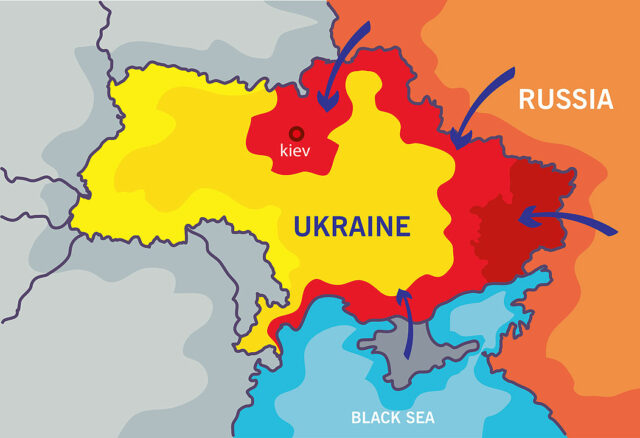
While deliberations continue, Russian forces are slowly but steadily advancing on the battlefield and threatening a series of Ukrainian towns and cities whose fall could speed up Moscow’s quest to take complete control of the eastern region of Donetsk, one of four Ukrainian regions Russia claims as its own.

Donetsk, some 25% of which remains beyond Russia’s control, and the Luhansk region together make up the industrial Donbas region, which Mr. Putin has made clear he wants in its entirety.

Mr. Putin told Mr. Trump he’d be ready to freeze the front lines in Zaporizhzhia and Kherson, two of the other regions he claims, if Kyiv agreed to withdraw from both Donetsk and Luhansk, a person familiar with the matter told Reuters.

Mr. Zelensky rejected the demand, the source said.

According to the New York Times, Mr. Trump told European leaders that Ukrainian recognition of Donbas as Russian would help get a deal done. And the US is ready to be part of security guarantees for Ukraine, German Chancellor Friedrich Merz said.

Some Kremlin critics said it would be a mistake to credit Mr. Putin with too much success at this stage.

“Russia has re-established its status and got dialogue with the US,” said Michel Duclos, a French diplomat who formerly served in Moscow and who is an analyst at the Institut Montaigne think-tank. “But when you have a war on your hands and your economy is collapsing, these are limited gains.”

Russian officials deny the economy, which has been put on a war footing and has proved more resilient than the West forecast despite heavy sanctions, is collapsing. But they have acknowledged signs of overheating and have said the economy could enter recession next year unless policies are adjusted.

“For Putin, economic problems are secondary to his goals, but he understands our vulnerability and the costs involved,” said one source familiar with Kremlin thinking.

“Both sides will have to make concessions. The question is to what extent. The alternative, if we want to defeat them militarily, is to mobilize resources more deeply and use them more skillfully, but we are not going down that road for various reasons,” the person said.

“It will be Trump’s job to pressure Ukraine to recognize the agreements.” — Reuters

Trump says he will set tariffs on steel and semiconductor chips in coming weeks

ABOARD AIR FORCE ONE — US President Donald J. Trump said on Friday he would announce tariffs on imports of steel and semiconductor chips in coming weeks.

“I’ll be setting tariffs next week and the week after on steel and on, I would say, chips,” Mr. Trump told reporters aboard Air Force One as he headed to a meeting with Russian President Vladimir Putin in Alaska.

He said the rates would be lower at the start to allow companies to build up domestic manufacturing in the US, rising sharply later, following a pattern he has also outlined for tariffs on pharmaceuticals. He gave no exact rates.

“I’m going to have a rate that is going to be lower at the beginning — that gives them a chance to come in and build — and very high after a certain period of time,” he said.

Mr. Trump said he felt confident that companies would opt to manufacture in the United States, rather than face high tariffs.

Mr. Trump has upended global trade by imposing sharply higher duties on nearly all countries’ exports to the United States, along with tariffs on specific sectors, such as automotive.

Mr. Trump in February raised tariffs on steel and aluminum to a flat 25%, but he announced in May that he would double the rate to 50% to boost domestic manufacturers.

It was not immediately clear if another tariff increase on the metals was in the offing.

Mr. Trump said last week he would impose a tariff of 100% on imports of semiconductors, but companies that committed to building up manufacturing in the United States would be exempt.

His remarks were made in tandem with an announcement that Apple would be investing an additional $100 billion in its home market. — Reuters

US stops visitor visas for people from Gaza

STOCK PHOTO | Image by Ally Thomas from Pixabay

WASHINGTON — The US State department on Saturday said it was halting all visitor visas for individuals from Gaza while it conducts “a full and thorough” review, a move that has been condemned by pro-Palestine groups.

The department said “a small number” of temporary medical-humanitarian visas had been issued in recent days but did not provide a figure.

The US issued more than 3,800 B1/B2 visitor visas, which permit foreigners to seek medical treatment in the United States, to holders of the Palestinian Authority (PA) travel document so far in 2025, according to an analysis of monthly figures provided on the department’s website. That figure includes 640 visas issued in May.

The PA issues such travel documents to residents of the Israeli-occupied West Bank and the Gaza Strip. The department’s website did not include a breakdown for the two territories.

The State department’s move to stop visitor visas for people from Gaza comes after Laura Loomer, a far-right activist and an ally of President Donald J. Trump, said on social media on Friday that the Palestinian “refugees” had entered the US this month.

Ms. Loomer’s statement sparked outrage among some Republicans, with US Representative Chip Roy, of Texas, saying he would inquire about the matter and Representative Randy Fine, of Florida, describing it as a “national security risk.”

The Council on American-Islamic Relations condemned the move, saying it was the latest sign of the “intentional cruelty” of the Trump administration.

The Palestine Children’s Relief Fund said the decision to halt visas would deny access to medical care to wounded and sick children in Gaza.

“This policy will have a devastating and irreversible impact on our ability to bring injured and critically ill children from Gaza to the United States for lifesaving medical treatment — a mission that has defined our work for more than 30 years,” it said in a statement.

Gaza has been devastated by a war that was triggered on Oct. 7, 2023, when Palestinian militant group Hamas launched an attack on Israel, killing 1,200 people and taking 251 hostages, according to Israeli figures.

Israel’s offensive against Hamas in Gaza since then has killed more than 61,000 Palestinians, according to local health officials.

The US has not indicated that it would accept Palestinians displaced by the war. However, sources told Reuters that South Sudan and Israel are discussing a plan to resettle Palestinians. — Reuters

Malaysia growth nears forecast in 2nd quarter, but central bank flags tariff uncertainty

A view of Kuala Lumpur skyline in Malaysia, Feb. 16, 2017. — REUTERS

KUALA LUMPUR — Malaysian economic growth came in close to expectations in the second quarter, official data showed on Friday, though the central bank said the outlook was clouded by uncertainty arising from US tariffs.

Gross domestic product (GDP) grew 4.4% in the April-to-June period from a year earlier, data from Bank Negara Malaysia (BNM) and the Statistics department showed, matching the pace of the first quarter. That was slightly below a Reuters poll forecast of 4.5%, which was also the government’s advance estimate.

The economy grew 2.1% on a quarter-on-quarter seasonally adjusted basis, faster than 0.7% growth in the previous three months, the data showed.

BNM said growth was driven by robust household spending and positive labor market conditions, but forecasting was challenging amid the uncertainty from US tariffs.

“Growth could move in different directions… we are operating in a different environment where changes happen very quickly,” BNM Governor Abdul Rasheed Ghaffour told a press conference.

A 19% tariff on Malaysian exports to the United States took effect earlier this month, although some goods remain exempt pending a review of US laws.

Of particular concern to Malaysia is President Donald J. Trump’s flagging of a 100% tariff on semiconductor imports from companies that do not have a US manufacturing footprint or plans to establish one.

Malaysia, a major player in the global semiconductor supply chain, has warned that tariffs on its chip exports to the United States would have a significant impact on its economy.

Total export growth is expected to be moderate in the second half of 2025, though there would be support from demand for electrical and electronic goods and higher tourism, Abdul Rasheed said, adding that visitor arrivals had recovered to pre-pandemic conditions.

Last month, the central bank lowered its growth forecast for 2025 to a range of 4% to 4.8% from 4.5% to 5.5%, which Abdul Rasheed said was “broad enough” to cover different outcomes arising from the US tariffs.

The bank also cut interest rates for the first time in five years in July to “preemptively preserve” the export-oriented economy’s growth.

Mohd Afzanizam Abdul Rashid, chief economist at Bank Muamalat Malaysia, said the rate cut and a narrower fiscal deficit would give authorities some capacity to counter expected slower growth in the second half of the year.

He said the fiscal deficit was 4.2% of GDP in the first half, down from 5.5% of GDP in the same period in 2024.

“This would give them some flexibility to spend on areas relating to cash transfers program which can have an immediate impact on growth,” Mohd Afzanizam said. — Reuters

Tough US stance casts gloom over plastics pollution deal after Geneva flop

STOCK PHOTO | Image by Hans Braxmeier from Pixabay

GENEVA — The collapse on Friday of a sixth round of United Nations (UN) talks aimed at curbing plastic output has dimmed hopes of tackling a key source of pollution and left many advocates of restrictions pessimistic about a global deal during the Donald J. Trump administration.

A three-year global push to reach a legally-binding treaty to curb plastic pollution choking the oceans and harming human health now appears adrift, participants said.

Many states and campaigners blamed the failure on oil-producers including the United States, which they said hardened long-held positions and urged others to reject caps on new plastic production that would have curbed output of polymers.

Debbra Cisneros, a negotiator for Panama, which supported a strong deal, told Reuters, the United States, the world’s number two plastics producer behind China, was less open than in previous rounds conducted under Joseph R. Biden’s administration.

“This time they were just not wanting anything. So it was hard, because we always had them against us in each of the important provisions,” she said at the end of the 11-day talks.

Anti-plastic campaigners saw little hope for a change in Washington’s position under President Trump, who in February signed an executive order encouraging consumers to buy plastic drinking straws.

“The mentality is different, and they want to extract more oil and gas out of the ground,” said Bjorn Beeler, International Coordinator at International Pollutants Elimination Network (IPEN), a global network of over 600 public interest non-governmental organizations.

The US State department did not immediately respond to a request for comment about its positions and its role in the talks. US delegate John Thompson declined to respond to questions from a Reuters reporter on the outcome.

A State department spokesperson previously said that each party should take measures according to its national context, while Washington has expressed concerns that the new rules could increase the costs of all plastic products. The Trump administration has also rolled back various US climate and environmental policies that it says place too many burdens on national industry.

Earlier this week, Washington also flexed its muscle in talks about another global environmental agreement when it threatened measures against states backing a proposal aimed at reducing shipping emissions.

For a coalition of some 100 countries seeking an ambitious deal in Geneva, production limits are essential.

Fiji’s delegate Sivendra Michael likened excluding this provision to “mopping the floor without turning off the tap.”

For each month of delays, the World Wildlife Fund (WWF) said nearly a million tons of plastic waste accumulates — some of which washes up on the beaches of island states.

‘CONSENSUS IS DEAD’
Some participants also blamed organizers, the International Negotiating Committee (INC), a UN-established body supported by the UN Environment Programme (UNEP).

A low point was a formal meeting an hour before the negotiations were set to conclude at midnight on Thursday which lasted less than a minute and was then adjourned until dawn, prompting laughter and jeering from delegates.

“Everyone was in shock as no one understood,” said Ana Rocha, Global Plastics Policy Director for environmental group GAIA. “It’s almost like they were playing with small children.”

France’s ecology minister Agnes Pannier-Runacher called proceedings “chaotic.”

Asked what went wrong, INC chair Luis Vayas Valdivieso blamed the rift between countries and called the negotiations complex. “But we have advanced and that’s important,” he said.

UN provisional rules require all states to agree — a constraint that some see as unworkable, especially under a US administration that is retreating from multilateralism.

“Consensus is dead. You cannot agree a deal where all the countries who produce and export plastics and oil can decide the terms of what the deal is going to be,” said IPEN’s Beeler.

Some delegates and campaigners suggested introducing voting to break the deadlock or even for the UN-led process to be abandoned altogether. The WWF and others called on ambitious states to pursue a separate deal, with the hope of getting plastics-producing nations onboard later.

Two draft deals emerged from the talks — one more ambitious than the other. Neither was adopted. It is unclear when the next meeting will take place, with states merely agreeing to reconvene at a later date.

One positive development was that top plastics producer China publicly acknowledged the need to address the full-life cycle of plastics, said David Azoulay, Managing Attorney of the Center for International Environmental Law’s Geneva Office. “This is new, and I think this opens an interesting door.” — Reuters

Four tropical cyclone-type vortices may emerge in the coming weeks

The PAGASA Astronomical Observatory within the University of the Philippines campus in Quezon City. — PAGASA.DOST.GOV.PH
Source: PAGASA

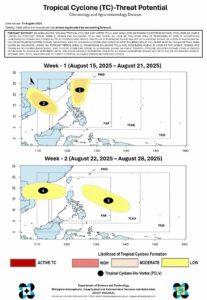
The development of four tropical cyclone-like vortices (TCLV) are possible to happen in the next two weeks, according to the Philippine Atmospheric, Geophysical, and Astronomical Services Administration (PAGASA) on Friday.  

In its tropical cyclone threat potential forecast bulletin, which evaluates the likelihood of tropical cyclone formation within the Philippine Area of Responsibility (PAR), PAGASA said that the first two TCLVs are likely to develop between August 15 to 21.  

TCLV 1 will likely form near Eastern Luzon and is predicted to move into eastern Taiwan, while TCLV 2 may develop over the West Philippine Sea, and is expected to track toward the Hainan-Vietnam area.  

The second two TLCVs are predicted to form between August 22 to 28, where TCLV 3 will likely emerge over the eastern boundaries of the PAR and Tropical Cyclone Advisory Domain (TCAD).  

TCV4 is forecasted to form over the northwestern boundary of PAR and will likely head towards the Hainan-Vietnam area.  

Due to the forecasts, PAGASA has raised the tropical cyclone threat potential starting Friday until next Thursday.Edg Adrian A. Eva

Researchers, inventors urged to seek DOST aid for funding, IP protection

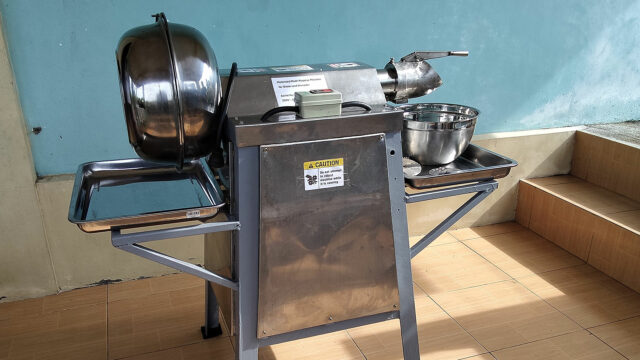
A multi-purpose cheese shredder and grater invented by Johnny B. Bañez | Photo by Edg Adrian A. Eva, BusinessWorld

Local researchers and inventors who are seeking funding and protection for their intellectual property can get assistance from the Department of Science and Technology (DOST), an official said.   

Caezar Angelito E. Arceo, chief science research specialist of the DOST-Technology Application and Promotion Institute (DOST-TAPI), told BusinessWorld that the agency has various programs to help Filipino inventors and researchers in their journey from research and development to commercialization. 

“Even if they have no intention yet to market or commercialize, as long as they already have a working prototype or a concept that is novel and patentable, we will support them,” Mr. Arceo said in both mixed English and Tagalog during a field site visit in Albay on Thursday.  

For researchers and inventors seeking to improve their concepts, DOST has various research councils that can help them, Mr. Arceo said. Some of these include the Philippine Council for Health Research and Development (PCHRD).  

They can also go to innovation hubs (i-hubs) located across the country, which serve as dedicated spaces for innovation and startups. In the Bicol Region, i-hubs can be found in all six provinces. 

On concerns over funding and intellectual property protection, Mr. Arceo said that TAPII is a dedicated arm of the DOST for these natters. The institute also ensures that researchers and innovators can bridge their work to the market.  

“We provide financial assistance — we directly give the money to the grantee. We also offer technical assistance; if there are gaps, we accommodate their concerns and also help link them to the right persons,” Mr. Arceo said.  

30-year old inventor, Johnny B. Bañez, demonstrates how his multi-purpose cheese shredder and grater works. | Photo by Edg Adrian A. Eva, BusinessWorld

Johnny B. Bañez, a 30-year old inventor of the motorized multi-purpose machine for grating and shredding, has received support from DOST-TAPII through funding and by securing a utility model patent. 

“Napaka-importante ng tulong ng DOST dahil may funds sila at may tao sila na handang tumulong sa mga ideas na pwedeng gawin [The help of DOST is very important because they have funds and people who are willing to support ideas that can be developed],” Mr. Bañez told BusinessWorld.  

Mr. Arceo said researchers and innovators should not hesitate to approach the DOST if they have novel discoveries, as the agency can help develop and protect their works and eventually bridge them for the benefit of the public.Edg Adrian A. Eva

China accuses Philippine vessels of ‘dangerous manoeuvres’ after its own ships collided

While trailing the Philippine Coast Guard, a China Coast Guard vessel collides with a Chinese Naval vessel | Screenshot from the video posted by Jay Tarriela, PCG Spokesperson for the West Philippine Sea

 – China’s defense ministry accused Philippine Coast Guard vessels on Friday of “dangerous manoeuvres” in response to reports of a collision earlier this week between two Chinese vessels near Scarborough Shoal in the disputed South China Sea.

The Philippine vessels’ actions “seriously endangered the safety of Chinese vessels and personnel,” ministry spokesperson Jiang Bin.

Mr. Jiang neither confirmed nor denied that there had been a collision involving two Chinese vessels on Monday.

“We demand that the Philippine side immediately stop its infringing and provocative rhetoric and actions,” Mr. Jiang said. “China reserves the right to take necessary countermeasures.”

The Scarborough Shoal has been a major source of tension in what is a strategic conduit for more than $3 trillion of annual ship-borne commerce.

Footage from the Philippine Coast Guard showed a Chinese coastguard ship trailing the PCG vessel before a Chinese navy ship suddenly cut across the path of the other Chinese ship, colliding with it and damaging the forecastle of the coastguard vessel.

It was the first known crash between Chinese vessels in the area.

The Philippines on Friday said it bore no responsibility for the collision.

“It was an unfortunate outcome, but not one caused by our actions,” Manila’s foreign minister Theresa Lazaro said in a statement.

The Philippine Coast Guard deployed three vessels on Monday to deliver supplies for Filipino fishermen in the Scarborough Shoal before the collision took place, Manila said on Tuesday.

The confrontation was the latest in a series of incidents amid a period of heightened tensions between Manila and Beijing over territorial disputes in the South China Sea.

A 2016 ruling of an international arbitral tribunal voided Beijing’s sweeping claims in the region, saying they had no basis under international law, a decision China rejects. – Reuters

June remittances rise 3.7% to six-month high

PHILIPPINE STAR/EDD GUMBAN

MONEY SENT home by Filipinos abroad grew faster in June to hit a six-month high, driven by remittances from land-based workers, the Bangko Sentral ng Pilipinas (BSP) said.

Cash remittances coursed through banks jumped by 3.7% year on year to $2.99 billion in June from $2.88 billion, the BSP said on Friday.

This was the highest value of monthly remittances seen in six months or since the $3.38 billion logged in December last year.

Overseas Filipinos’ Cash RemittancesThe year-on-year increase also picked up from the 2.9% logged in May, when remittances reached $2.66 billion.

“Cash remittances to the Philippines continued to grow in June of this year, with remittances from land-based overseas Filipinos (OFs) increasing faster than funds from sea-based OFs,” the central bank said.

Money sent home by land-based overseas Filipino workers (OFWs) climbed by 3.7% year on year to $2.43 billion in June, making up bulk of the total.

Remittances from sea-based OFWs also rose by 3.5% to $555 million that month.

“The increase in cash remittances drove an increase in personal remittances as well,” the BSP said.

Personal remittances, which include both cash coursed through banks and informal channels and in-kind remittances, climbed by 3.7% to $3.33 billion in June from $3.21 billion a year prior.

Workers with contracts of one year and above logged personal remittances worth $2.63 billion, up 3.6% year on year, while those with contracts of less thn one year sent home $610 million worth of cash and items, jumping by 3.9% from the previous year.

FIRST HALF
For the first semester, cash remittances from migrant Filipinos went up by 3.1% to $16.75 billion from the $16.25 billion recorded in the comparable year-ago period.

Money sent home by land-based workers rose by 3.3% year on year to $13.38 billion in the six months through June, while sea-based OFWs’ remittances increased by 2.2% to $3.38 billion.

The United States remained as the top source of cash remittances in the first half, accounting for 40.1% of the total.

This was followed by Singapore (7.1%), Saudi Arabia (6.2%), Japan (5%), the United Kingdom (4.9%), the United Arab Emirates (4.3%), Canada (3.3%), Qatar (2.9%), Korea (2.8%) and Taiwan (2.7%).

Meanwhile, personal remittances in the January-to-June period reached $18.67 billion, up by 3.1% from $18.1 billion a year prior.

Ruben Carlo O. Asuncion, chief economist at Union Bank of the Philippines, Inc., said the increase in cash remittances was “driven by sustained demand for Filipino workers abroad and improved remittance channels.”

“The growth was led by land-based workers, particularly in the Middle East and North America, where labor markets remain robust,” Mr. Asuncion said.

“It reflects continued resilience in global labor markets, especially in the US and Middle East, as well as seasonal boosts tied to school enrollment and mid-year expenses,” John Paolo R. Rivera, a senior research fellow at the Philippine Institute for Development Studies, likewise said.

He added that stronger exchange rates in destination countries may have encouraged overseas Filipinos to send more money back home.

The peso traded at the P55 to P57 levels against the US dollar in June, depreciating sharply mid-month as Israel and Iran exchanged attacks, with the US also joining the conflict later on before a temporary ceasefire was reached. However, the greenback’s strength that month was capped by dovish US Federal Reserve bets.

The BSP expects cash remittances to grow by 2.8% this year. — Katherine K. Chan

Trump and Putin to spar Ukraine peace and arms control at Alaska summit

FREEPIK

 – Donald Trump and Vladimir Putin hold talks in Alaska on Friday, with the U.S. president’s hopes of sealing a ceasefire agreement on Ukraine uncertain but with a last gasp offer from Putin of a possible nuclear deal that could help both men save face.

The meeting of the Russian and U.S. leaders at a Cold War-era air force base in Alaska, their first face-to-face talks since Mr. Trump returned to the White House, comes amid Ukrainian and European fears that Mr. Trump might sell Kyiv out.

Mr. Trump, who once said he would end Russia’s war in Ukraine within 24 hours, said on Thursday the three-and-a-half-year conflict had proven a tougher nut to crack than he had thought.

He said if his talks with Mr. Putin went well, setting up a subsequent three-way summit with Ukrainian President Volodymyr Zelenskiy – who was not invited to Friday’s meeting – would be even more important than his encounter with Mr. Putin.

Mr. Trump is pressing for a truce to bolster his credentials as a global peacemaker worthy of the Nobel Peace Prize, something he has made clear is important to him.

Ukraine and its European allies were heartened by their conference call on Wednesday in which, they said, Mr. Trump agreed Ukraine must be involved in any talks about ceding land. Mr. Zelenskiy said Mr. Trump had also supported the idea of security guarantees in a post-war settlement, although the U.S. president has made no public mention of them.

Wednesday’s call eased their fears of a Trump-Putin deal that would leave Ukraine under pressure to make territorial and other concessions.

Mr. Putin, whose war economy is showing signs of strain, needs Mr. Trump to help Russia break out of its straitjacket of ever-tightening Western sanctions, or at the very least not to hit Moscow with more sanctions, something Mr. Trump has threatened.

The day before the summit, the Kremlin leader held out the prospect of something else he knows Trump wants – a new nuclear arms control agreement to replace the last surviving one, which is due to expire in February next year.


TRUMP SAYS PUTIN WILL DO A DEAL ON UKRAINE

Mr. Trump said on the eve of the summit that he thought Putin would do a deal on Ukraine, but he has blown hot and cold on the chances of a breakthrough. Putin, meanwhile, praised what he called “sincere efforts” by the U.S. to end the war.

A source close to the Kremlin told Reuters it looked as if the two sides had been able to find some unspecified common ground beforehand.

“Apparently, some terms will be agreed upon tomorrow (Friday) because Trump cannot be refused, and we are not in a position to refuse (due to sanctions pressure),” said the source, who spoke on condition of anonymity because of the matter’s sensitivity.

Mr. Putin has set stringent conditions for a full ceasefire, but one compromise could be a phased truce in the air war, although both sides have accused the other of flouting a previous accord.

Analysts say Mr. Putin could try to look like he’s giving Mr. Trump what he wants while remaining free to escalate in Ukraine if he wants to.

“If they (the Russians) are able to put a deal on the table that creates some kind of a ceasefire but that leaves Russia in control of those escalatory dynamics, does not create any kind of genuine deterrence on the ground or in the skies over Ukraine… that would be a wonderful outcome from Putin’s perspective,” said Sam Greene, director of Democratic Resilience at the Center for European Policy Analysis.


TRUMP SUGGESTS LAND TRANSFERS WILL BE NEEDED

Mr. Zelenskiy has accused Mr. Putin of bluffing and playing for time to avoid U.S. secondary sanctions and has ruled out handing Moscow any territory.

Mr. Trump has said land transfers between Russia and Ukraine could be a possible way of breaking the logjam.

Mr. Putin, whose forces control nearly one fifth of Ukraine, wants Mr. Trump to start reviving the two countries’ shrunken economic, political and business ties and, ideally, not to make that process contingent on progress on Ukraine.

But it is unclear whether Mr. Putin is willing to compromise on Ukraine. In power for a quarter of a century, the Kremlin chief has staked his legacy on coming out of the war with something he can sell to his people as a victory.

Chief among his war aims is complete Russian control over the Donbas industrial region in eastern Ukraine, which comprises the Donetsk and Luhansk regions. Despite steady advances, around 25% of Donetsk remains beyond Russian control.

Mr. Putin also wants full control of Ukraine’s Kherson and Zaporizhzhia regions; NATO membership to be taken off the table for Kyiv; and limits on the size of Ukraine’s armed forces.

Ukraine has said these terms are unacceptable and tantamount to asking it to capitulate. – Reuters

ADVERTISEMENT
ADVERTISEMENT