Home Blog Page 1141

ICTSI shares decline despite developments

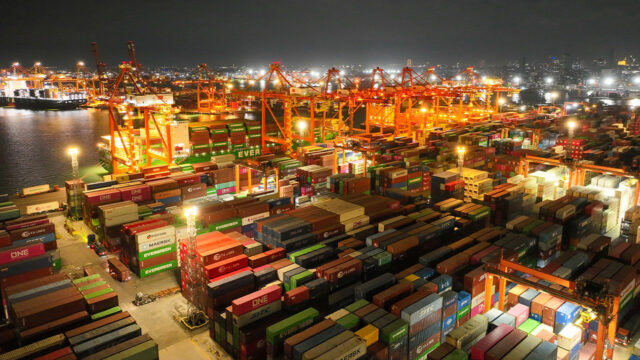
Aerial photo of ICTSI's flagship Manila International Container Terminal at the Port of Manila — ICTSI.COM

SHARES in International Container Terminal Services, Inc. (ICTSI) declined last week despite developments involving its overseas units aimed at boosting capacity.

Data from the Philippine Stock Exchange (PSE) showed that ICTSI was the most actively traded stock from May 19 to 23, with P4.74 billion worth of 11.65 million shares changing hands.

ICTSI shares closed at P404 apiece on Friday, down 1.5% from P410 on May 16. The services index declined by 1.1%, while the benchmark PSE index fell by 0.8%.

Year to date, the listed port operator gained 4.7%, outperforming the 1.3% growth in its sector and reversing the PSE’s 1.8% decline.

Toby Allan C. Arce, head of sales trading at Globalinks Securities and Stocks, Inc., said ICTSI’s weekly movement may have been driven by global uncertainties, sector-specific headwinds, and profit-taking.

“Persistent inflationary concerns, fluctuating interest rates, and geopolitical tensions continue to weigh on global and regional markets, leading to cautious investor sentiment,” Mr. Arce said in a Viber message.

He added that the services sector remains vulnerable to headwinds such as lower trade volumes and currency volatility, which likely impacted ICTSI along with its peers.

“[As for profit taking], ICTSI’s robust performance over the past year may have prompted profit-taking among short-term investors, adding to selling pressure,” he said.

Still, year-to-date gains may be attributed to strategic expansions, improved operating efficiency, and strong positioning in the global port sector.

“The company’s ability to sustain profitability and grow net income reflects strong management and effective cost controls, which appeal to investors despite broader market challenges,” Mr. Arce said.

He added that recent stock movements also reflect macroeconomic risks and logistics-related developments.

“While global stock markets are grappling with inflationary pressures and mixed macroeconomic data, developments related to shipping and logistics have affected ICTSI. But the company’s positive updates have helped sustain investor confidence,” he said.

Last week, ICTSI said its Mexican unit, Contecon Manzanillo S.A. (CMSA), had acquired two quay cranes and four hybrid rubber-tired gantry cranes as part of its terminal expansion efforts.

Once fully commissioned, the new quay cranes will allow CMSA to simultaneously handle three vessels with lengths of up to 400 meters.

CMSA aims to handle more than two million twenty-foot equivalent units (TEUs) annually.

In Poland, ICTSI is investing over $84 million through the Baltic Container Terminal (BCT) in Gdynia.

The company recently completed Phase 1 of a major upgrade at the Helskie Quay, involving a $42-million investment in a 400-meter quay with a 15.5-meter depth, new crane rails, hydrotechnical structures, roads, and utility networks.

Phase 2 will begin in September, with the commissioning of an additional 100 meters of quay and the entry into service of a newly expanded turning basin.

ICTSI’s attributable net income rose by 14.1% year on year to $239.54 million in the first quarter, while consolidated revenues increased by 12.9% to $773.91 million.

Mr. Arce projects ICTSI’s second-quarter net income at $207 million, supported by continued revenue growth and capacity expansion.

“Continued revenue growth from expanded terminal capacities, coupled with strategic investments, suggests a net income of $207 million in Q2 2025. However, exchange rate volatility and potential operational disruptions remain key risks,” he said.

For the week, Mr. Arce identified support at P395 and resistance near P430. — Abigail Marie P. Yraola

Paris court convicts Kim Kardashian jewel heist thieves

A FRENCH court on Friday convicted the jewel thieves who in 2016 tied up US reality TV star Kim Kardashian at gunpoint before making off with her $4-million engagement ring and other booty.

Ten people were in the dock, accused of involvement in the Paris heist. Robbers wearing ski masks and disguised as police tied up the billionaire celebrity before making off with the ring, given to her by her then-husband, rapper Kanye West (now known as Ye), and other jewels. Ms. Kardashian traveled to Paris to testify earlier this month, telling the court she had thought she was going to die.

The mixed panel of judges and jury convicted eight of the ten for crimes directly linked to the theft, while another defendant was found guilty of illegal weapons charges. One person was acquitted.

The heaviest sentences were handed down to five defendants who participated directly in the heist, with the mastermind of the robbery, 69-year-old Aomar Ait Khedache, getting a three-year jail sentence.

Ms. Kardashian’s lawyers said that she accepted the court’s ruling.

“I am deeply grateful to the French authorities for pursuing justice in this case. The crime was the most terrifying experience of my life, leaving a lasting impact on me and my family,” she said in a statement. “While I’ll never forget what happened, I believe in the power of growth and accountability and pray for healing for all.”

During her court appearance, she said she forgave Mr. Khedache, who had asked for forgiveness in a letter.

The thieves were dubbed the “grandpa robbers” by the press as many were of or near retirement age. At the time, the robbery was considered the biggest in France for more than 20 years. — Reuters

Free limited-edition STI Kit for Subaru WRX buyers

Subaru WRX Sedan with Cherry Red STI Kit — PHOTO FROM MOTOR IMAGE PILIPINAS

MOTOR IMAGE PILIPINAS, INC. (MIPI), exclusive distributor of Subaru vehicles in the Philippines, is offering the first 14 customers who will get a Subaru WRX a free STI Kit beginning last week. The enhancements, either black or red, are designed to suit either the sedan or wagon versions.

Based on the Subaru Impreza, the WRX is one of the brand’s heritage models. Originally designed for the 1992 World Rally Championship, over the years it has turned into an accessible sport compact car. The WRX is powered by a 2.4-liter direct-injection turbo engine with “ample torque, and the SI-Drive performance transmission which achieves sporty driving beyond expectation through the new powerful engine and a quick, direct shift feel.” Its safety “encompasses quick detect danger, safety on highway or dirt track, a collision-safe body, and eCall or SOS switch.” These create the sporty space expected of a WRX.

“The WRX has always had a special place in the hearts of every Subarist. To many, it is even considered a dream ride, which is why we wish to make it a memorable experience for them as they drive one home,” said MIPI Country Manager Karl Castillo. “This May, we are offering an STI parts and accessories package, without additional cost, to all our new WRX customers. Furthermore, new WRX STI buyers will have 20% discount offer on PMS parts for two years.”

For more information, follow and like Subaru Philippines’ official social media accounts: Facebook (@subaruasiaph) and Instagram (@subaru.philippines).

LANDBANK Q1 net income up 11%

LAND BANK of the Philippines (LANDBANK) saw its net income rise by 10.96% year on year in the first quarter amid continued loan growth.

The state-run lender’s net profit grew to P13.288 billion in the three months ended March from P11.975 billion in the same period a year ago, according to its financial statement posted on its website.

LANDBANK said in a statement that its first-quarter net income was 32% above its target for the period.

Net interest income rose by 15.06% to P26.28 billion from P22.84 billion a year ago. This came as interest income went up by 13.53% year on year to P38.03 billion, while interest expenses increased by 10.25% to P11.74 billion.

Other income climbed by 16.42% to P3.56 billion in the first quarter from P3.06 billion a year prior.

Meanwhile, other operating expenses grew by 11.395% year on year to P15.38 billion in the first three months from P13.81 billion.

LANDBANK’s gross loan portfolio climbed by 8% to P1.58 trillion at end-March.

Its agriculture, fisheries, and rural development loans stood at a record P844.61 billion in the first quarter, comprising 53.4% of its total loan portfolio.

“The bank supported nearly 28,000 new small farmers and fishers during the period, bringing total beneficiaries assisted to 4.04 million nationwide. This was accomplished through a mix of direct lending, credit conduits, and capacity-building interventions, spanning the entire agricultural value chain,” it said.

The bank’s investments rose by 14% to P1.5 trillion, supported by growth in both trading and non-trading portfolios.

On the funding side, deposits rose by 4.74% year on year to P3.02 trillion in the first quarter.

As a result, LANDBANK’s total assets expanded by 4.84% to P3.426 trillion as of end-March from P3.268 trillion a year ago.

Total capital was at P295.62 billion, up by 6.79% from P276.83 billion.

LANDBANK remitted a record P33.53 billion in cash dividends to the National Government in the first quarter, which is expected to help fund priority infrastructure and socioeconomic programs, it said. This was higher than its P32.12-billion remittance a year prior.

“The P33.53-billion dividend underscores LANDBANK’s unwavering support for government priorities that uplift lives and communities across the country. It also reflects our strong financial foundation and vital role as a pillar of inclusive growth, ensuring that our sustained performance translates into real and lasting impact,” LANDBANK President and Chief Executive Officer Lynette V. Ortiz said.

“LANDBANK’s record-breaking dividend reflects the institution’s solid fundamentals and strategic financial management. This contribution will help power President Ferdinand R. Marcos, Jr.’s infrastructure push, investments in education and healthcare, and food security agenda. And it does all this while staying true to its core mission: delivering accessible and responsive financial services to Filipinos across the country,” Finance Secretary and LANDBANK Chairman Ralph G. Recto said. — Aaron Michael C. Sy

Filinvest Hospitality keeps 5-year goal to add 2,000 rooms

ARTIST’S rendering of Grafik Pine House Baguio Façade. — BW FILE PHOTO

GOTIANUN-LED FILINVEST Hospitality Corp. (FHC) is expanding its hotel portfolio, with one property expected to open by yearend and another project set to begin construction, as it maintains its goal of adding nearly 2,000 new hotel rooms over the next five years.

FHC Senior Vice-President Francis Nathaniel C. Gotianun said the company is scheduled to open the 256-room Grafik Hotel Collection Baguio by the end of the year.

“We’re looking for intrepid new travelers to try out our hotel, and hopefully, we’ll bring something new and exciting to the Baguio scene,” he told reporters on the sidelines of a forum last week.

Mr. Gotianun added that FHC is scheduled to break ground on the over-300-room Crimson Clark Hotel in Pampanga within the year.

Amid these expansion initiatives, Mr. Gotianun said the company is maintaining its goal of opening approximately 2,000 new rooms by 2029. The target was initially announced in 2024.

“We’re still on track to do that. We have properties in Bohol. We have a little bit more land also in Boracay. We have land in Dumaguete and in Dauin also,” he said.

“We’re all aligned already and then we’ll be bringing them to market at the right time,” he added.

FHC currently operates seven hotels with a total of 1,800 rooms under brands such as Crimson, Quest, and Timberland Highlands.

The company also operates two 18-hole golf courses located in Filinvest Mimosa Plus Leisure City in Clark, Pampanga.

Mr. Gotianun said the company’s portfolio recorded a blended occupancy rate of around 75%, led by its properties in Mactan, Alabang, and Mimosa.

He added that FHC is undertaking renovations across its existing properties, including Crimson Mactan, Quest Hotels, and Mimosa Leisure Estate, to enhance guest experience.

“Crimson Mactan has a whole set of new restaurants. We’re going to be launching our new rooms there by the end of this year,” he said.

“We’ve also been doing a lot of work at Mimosa Leisure Estate… Then we’ve continued to renovate the Quest Hotel there as well. We have quite a few things going on,” he added.

FHC posted a 21% year-on-year increase in first-quarter revenue to P1.2 billion, driven by higher occupancy and average room rates, alongside improved contributions from its food and beverage segment. — Revin Mikhael D. Ochave

Cash-strapped universal healthcare faces uncertain future

FREEPIK

Has health sector reform run its course in the Philippines? The landmark Universal Health Care (UHC) law of 2019 was the culmination of two decades of health sector reform initiated by the late Health Secretary Quasi Romualdez in 1998.

But Congress is moving to amend the law before its full implementation. The House of Representatives and the Senate are now scheduled to start deliberations to amend the law, supposedly to correct “weaknesses” inflicted by legislators. This comes after the same legislators deprived PhilHealth of the funds to implement key elements of the law from 2023-2025.

To make matters worse, Congress diverted the sin taxes intended for UHC implementation to patronage programs that covered fewer, but more favored patients. By waging war on so-called “excess funds” in PhilHealth, Congress made it impossible for PhilHealth to implement fully the Konsulta package for primary care when it forced it to cough up P89.9 billion in 2024 to cover nonhealth related infrastructure projects.

Former Health Secretary Francisco Duque signed the implementing rules and regulations (IRR) of the UHC Law in late 2019, a few months before the COVID pandemic. He announced then that it would take at least P300 billion a year for UHC to be effective, on top of the current health sector resources. That was what it would take to bring down the out-of-pocket health costs of Filipinos close to 30% from 49% in 2019.

Secretary Duque intended much of that increased spending for UHC to go to primary care and increased value of health benefit packages, which were only covering one-fourth of hospitalization costs. Under the UHC law, the comprehensive out-patient benefit at the primary level of care will be rolled out two years after the implementation of UHC.

However, the Philippine Statistics Authority (PSA) reported that in 2023, only 6.6% of health spending went to primary care, much of it coming from local governments. Curative care spent in hospitals was the most expensive part of healthcare, at almost 38%, and medicines accounted for almost 32% of health costs.

FILIPINOS OUTPACE GOVERNMENT SPENDING IN HEALTH
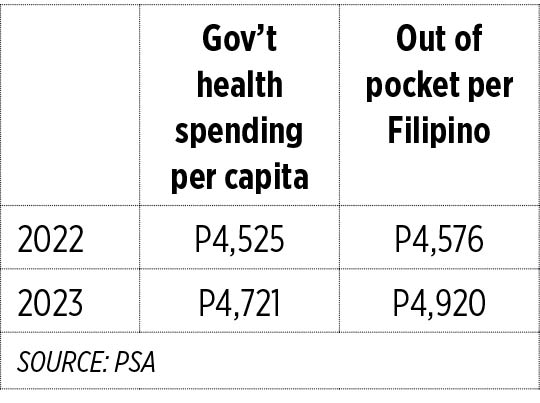
All of this health spending came up to P11,083 per Filipino in 2023. Despite the implementation of UHC, government (national, local and PhilHealth) covered only 42.6% of that, or P4,721 on average, for every Filipino. On the other hand, every Filipino spent P4,920 from his/her own pocket, more than what government could provide.

Compared with 2022 out-of-pocket spending, Filipinos have actually outpaced government spending:

In 2023, only two-thirds of PhilHealth’s budget allocation was released for indirect/indigent members, but the claims of indirect members exceeded PhilHealth’s allocation, resulting in a deficit for PhilHealth.

The continuing decline in PhilHealth’s budget is an imposition by Congress, which is seemingly unaware of the Department of Health’s (DoH)  requirement of at least P300 billion per year for UHC.  But the DoH and the old leadership of PhilHealth failed to explain this to Congress.

UHC amendments will dismantle and weaken the implementation framework of UHC.

The bicameral conference committee of Congress will soon convene to reconcile the House and Senate bills. The approval of a reconciled bill will then be submitted to the President for signing into law.

The bicam is a spectacle where Congress seeks to “solve” the problems it has caused by defunding the social health insurance program.

Further, the amendments that have been proposed are clearly toxic to UHC implementation. The amendments will result in every LGU running its own health system, reduce the capacity to sustain the funding of health systems by reducing premiums, weaken regulatory systems that could lead to inflation of health costs, and reduce the paying members and increase nonpaying beneficiaries.

Amendment A: Section 20 on the special health funds will be amended to add 1,400 municipalities and 111 component cities as special health fund holders.  That will increase their number more than 10 times, from 115 health systems (82 provinces and 33 highly urbanized cities).

The UHC was intended to be managed by 115 local health systems in the entire country. Adding over 1,500 independent health systems will result in duplication of infrastructure, a larger health workforce and loss of economies of scale.

Amendment B: Section 10 on premium contributions will see the Senate reduce the premium from 5% to 3.25% starting in 2025.

This amendment will reduce the capacity of social health insurance to fund primary care and limit the expansion of packages, which will result in congestion in hospitals and increasing morbidity and mortality in the population.

Amendment C: Section 34 will restrict the health technology assessment to a recommendation that may be ignored by DoH or PhilHealth.

This amendment will increase the discretion of DoH and PhilHealth to introduce new products, diagnostics and procedures without the benefit of health technology assessment. This will result in the vulnerability of the health system to inflation of health costs. It may also cause potential harm for patients, if the market is flooded with products with unproven claims that escape health technology assessment.

Amendment D: Section 4 (f) increases the eligible age of dependents to 23 from 18. This will have the twin effect of reducing paying members and increasing the number of nonpaying dependents. The current 2024 membership data of PHIC at 58.7 million members and 44 million may see equal numbers of members and dependents as the number of Filipinos between the ages of 18 and 22 is 10 million.

After defunding social health insurance, Congress is making PhilHealth’s situation worse.  When even the Philippines’ draft voluntary national report on sustainable development goals (SDG) shows that SDG 3 (on ensuring lives) is regressing, what Congress is doing to further emasculate PhilHealth and UHC must stop.


Jeepy Perez, a doctor, specializes in public health administration and primary healthcare, and worked with nine Health secretaries and three Economic Planning secretaries. He was undersecretary for population and development and executive director of the country’s Commission on Population and Development until his retirement in September 2022.  He occasionally writes for Action for Economic Reforms.

Fear of culling, imports dampen hog production

FREEPIK

By Kyle Aristophere T. Atienza, Reporter

THE testing requirements attached to receiving the African Swine Fever (ASF) vaccine and increased pork imports likely stalled hog farmers’ repopulation efforts, according to an industry representative.

“I think this is still a result of the ASF episode last year. A lot of backyard farmers and commercial farmers are still hesitant to repopulate,” National Federation of Hog Farmers, Inc. vice-chairman Alfred Ng told BusinessWorld.

“The news on record pork imports during the first quarter of the year further added to their anxiety,” he added.

Mr. Ng noted that many hog farmers were reluctant to participate in the pilot test of an ASF vaccine “due to numerous testing procedures” that the Bureau of Animal Industry (BAI) is requiring them.

“If tested positive, their animals will once again be culled,” he said.

Hog production in the first quarter fell 3.7% year on year to 403.79 thousand metric tons on a liveweight basis.

The Philippines imported 70.45 million kilograms of pork in the January-March period, up 42.5% from year earlier. This total accounted for 53.2% of all meat that entered the country in the quarter.

The Philippine Statistics Authority reported that the contraction in hog production in the first quarter narrowed from the 4.3% decline posted a year earlier.

As of March 31, the swine inventory fell 11.3% year on year to 8.84 million head.

About 71.1% of the swine was grown by smallholder farms, while 26.1% and 2.8% were grown by commercial and semi-commercial farms, respectively.

“The government’s repopulation program grants were temporarily stopped,” Mr. Ng added.

Asked to comment on the declining hog production, Meat Importers and Traders Association President Jess C. Cham said: “The Department of Agriculture (DA) apparently has not been able to get ASF under control, which is quite understandable given the ferocity of the disease.”

“After declining by 900,000 tons since 2019, it is disheartening to see a further decline.”

The DA on Saturday expressed optimism for a possible commercial rollout of ASF vaccine before the end of 2025, citing a May 19 meeting between the BAI and Food and Drug Administration officials.

Mr. Cham said the drop in hog production was likely the reason behind the failure of a maximum suggested retail price (MSRP) for pork.

The MSRP, which was halted on May 13 after over two months following low compliance by pork dealers, was set at P300 per kilo for the whole slaughtered pig, P350 for pork shoulder and hind leg and P380 for pork belly.

“The MSRP was implemented with a requested cap on farm liveweight prices at P230 even when many affected farmers needed to sell at a higher price to recover their losses,” Mr. Ng said.

“Only big farms are on expansion mode, but it will still take some time to increase their population as it takes one year to produce a fattener pig,” he added.

Agriculture Secretary Francisco Tiu Laurel, Jr. said industry participants had sought to discontinue the MSRP to allow for a recovery period.

To bring pork prices down, the DA should expand the (MAV) quota “to accommodate more pork importation at in quota rates.”

Mr. Laurel said in mid-May that the DA had allocated this year’s 54,210-metric ton minimum access volume (MAV) for pork.

“The MAV will have the same breakdown as last year,” he said. “We had to do it because of the tariff negotiations with the US.”

He said any changes to be made in the MAV allocation “will be for 2026.”

Pork imports under the MAV arrangement are charged a tariff of 15% for shipments within the quota allocation. Outside the quota, shipments pay a 25% tariff.

The DA said in April that it plans to overhaul the MAV system since the rules were formulated almost three decades ago, noting that the system has been “exploited by a small number of accredited importers.”

Style (05/26/25)


Paul Syjuco and Kristine Dee join Rustan’s Silver Vault

RUSTAN’S Makati Silver Vault unveils two additions to its roster of jewelry designers — Paul Syjuco and Kristine Dee. Born into a family of artists, Paul Syjuco is a third-generation jeweler who has carved out his own space in the world of fine jewelry. A GIA-trained gemologist and designer, he seamlessly blends personal narratives with locally sourced materials such as mother-of-pearl and carabao horn. Kristine Dee earned her Master’s Degree in Industrial Design from the Pratt Institute in New York in 2001, where she specialized in jewelry and furniture. She further honed her skills through special studies in Scandinavian furniture design at the Denmark Design School in Copenhagen. Her collections, including “Beauty in Asymmetry” and “Essence,” celebrate imperfection, offering clients the opportunity to personalize pieces that are both elegant and unconventional. Each piece is handcrafted in limited quantities, ensuring that no two creations are ever truly the same. Shop these brands at Rustan’s Makati.


In the pink with Nuxe

PLUMP UP your kisses with the Nuxe Very Rose Plumping Lip Serum. Its hyaluronic acid and Rose Centifolia-infused formula deeply moisturizes the lips, instantly boosts their volume, and leaves a transparent, glossy finish. Its exclusive rose-shaped cap adds to this lip serum’s charm. Pair this with Nuxe Very Rose Soothing Cleansing Gel. This gel-to-foam product allows quick rinsing with water, gently removes impurities, and softens the skin. The Nuxe Very Rose Radiance Face Scrub gives a radiance boost to all skin types. This creamy scrub with apricot kernel powder has a granular texture that delicately exfoliates the skin. It gently removes dead cells from the skin’s surface without any tugging sensations. Cleanse with Nuxe Soothing Cleansing Micellar Water, now with up to 99% ingredients of natural origin. Use this in the morning as a cleansing step, and at night as a makeup remover–no rinsing required. For a great night routine, start with the Nuxe Multi-Correction Glow-Boosting Cream-Gel and Multi-Correction Glow-Boosting Cream, both designed to alleviate the first signs of aging while brightening the skin. For the eyes, the Nuxe Multi-Correction Eye Balm-Gel reduces dark circles by lightening the eye area. The Nuxe Night Recovery Oil Balm helps the skin recover while you sleep. In the morning, prep your skin with the Nuxe Multi-Perfection Smoothing Primer, an ideal makeup base that melts over the skin, creating a “bare skin effect,” and working for touch-ups during the day. To finish off your routine, try the Nuxe Huile Prodigieuse Florale and Nuxe Huile Prodigieuse® Or Florale. Add the Huile Prodigieuse Florale to your makeup routine for a light, subtle sheen, and the Huile Prodigieuse® Or Florale for a soft rose gold shimmering glow.

Nuxe is exclusively available in-store at Rustan’s and Mitsukoshi Beauty; and online on Rustans.com, Lazada, and Shopee. Nuxe is exclusively distributed by Rustan Marketing Corporation.


Paul Cabral’s ‘Filipino Elegance’ show attended by Japanese royal

FILIPINO culture and creativity took center stage in Tokyo as Her Imperial Highness Princess Takamado and Yoshiko Ishiba, spouse of Prime Minister Shigeru Ishiba, graced the Philippine Fashion Showcase on May 19. The event was held at The Kudan, the official residence of the Philippine Ambassador to Japan and the only Philippine National Historical Landmark outside the country. Organized by the Department of Trade and Industry (DTI) through its Philippine Trade and Investment Center in Tokyo, the showcase featured the “Filipino Elegance” collection by celebrated Filipino designer Paul Cabral. The event is a key initiative under the Malikhaing Pinoy program, DTI’s flagship strategy to promote the Philippines’ creative economy globally. Mr. Cabral’s 30-piece collection reimagined the barong and terno through the use of piña. Elements of tradition were integrated with contemporary tailoring. The showcase also highlighted the Philippines’ growing footprint in Japan’s creative economy. It attracted fashion professionals, cultural leaders, and business stakeholders.

Yields on central bank securities drop further

BW FILE PHOTO

YIELDS on the central bank’s short-term securities declined further on Friday as both tenors were oversubscribed.

The Bangko Sentral ng Pilipinas (BSP) securities fetched bids amounting to P157.049 billion on Friday, higher than the P110-billion offer and the P152.319 billion in tenders for the P90 billion auctioned off in the previous week. The central bank fully awarded its offering.

Broken down, tenders for the 28-day BSP bills (BSPB) reached P70.992 billion, well above the P50-billion offering and the P59.611 billion in bids for the P40 billion placed on the auction block a week ago. The BSP made a full P50-billion award of the one-month securities.

Banks asked for yields ranging from 5.565% to 5.619%, lower than the 5.61% to 5.649% band seen a week earlier. This caused the average rate of the one-month securities to decline by 2.52 basis points (bps) to 5.607% from 5.6322% previously.

Meanwhile, bids for the 56-day bills amounted to P86.057 billion, higher than the P60-billion offering but lower than the P92.708 billion in tenders for the P50-billion offer the week prior. Still, the central bank made a full award of the two-month papers.

Accepted rates for the two-month tenor were from 5.55% to 5.613%, a wider and lower band compared to the 5.6% to 5.63% margin seen a week prior. With this, the average rate of the securities fell by 3.28 bps to 5.5878% from 5.6206% in the prior auction.

The central bank said in a statement that the BSP bills continued to see good demand even as it hiked the total volume it offered at Friday’s auction.

“Both tenors were oversubscribed, with bid-to-cover ratios of 1.42 times for the 28-day BSPB and 1.43 times for the 56-day BSPB,” it added.

The central bank uses the BSP securities and its term deposit facility to mop up excess liquidity in the financial system and to better guide market rates.

The BSP bills were calibrated to not overlap with the Treasury bill and term deposit tenors also being offered weekly.

Data from the central bank showed that around 50% of its market operations are done through the BSP bills.

Short-term instruments offer more stability and predictability, the BSP has said. These are also considered high-quality liquid assets, giving banks more flexibility. — Luisa Maria Jacinta C. Jocson

GAC Motor Philippines offers discounts across lineup

GAC M8 — PHOTO BY KAP MACEDA AGUILA

ASTARA PHILIPPINES-LED GAC Motor Philippines is offering deals this month — ranging from discounts, low down payment options, to flexible payment plans.

The Emzoom crossover SUV line gets the following discounts: Emzoon 1.5 GS DCT (less P153,900), Emzoom 1.5 GB DCT (less P153,900), and Emzoom 1.5 GL DCT (less P184,900). The GS8 2.0 GT AT is now priced at P2.148 million, after a P250,000 discount. The Empow sedan receives the following price cuts: Empow 1.5 GB DCT (P300,000) and Empow GE DCT (P20,000). Meanwhile, the Emkoo 1.5 GL DCT crossover is now priced at P1.463 million (less P35,000), while the Emkoo 2.0 Hybrid DCT now goes for P1.653 million (less P45,000).

The M8 luxury MPV gets a P120,000 discount on its M8 Master GL variant (now at P2.878 million), and P160,000 for its M8 Master GX variant (now at P3.788 million). Lastly, the M6 Pro GS is now priced at P1.178 million (less P100,000), and the M6 Pro GL goes for P1.553 million (less P45,000).

GAC Motor Philippines is also offering a range of flexible financing. Customers can choose low down payment plans starting at P43,000 for select models, along with affordable monthly payments from P22,750 for models like the Emzoom 1.5 GS DCT. Other financing plans with flexible terms are also available to suit different preferences and budgets. All GAC Motor vehicles come with an after-sales warranty for five years or 150,000 kilometers, whichever comes first. Customers also receive 24/7 emergency roadside assistance for the first year of purchase.

Cignal TV sets goal to double app registrations within 12 months

CIGNALSUPER.COM

PANGILINAN-LED Cignal TV, Inc. aims to add one million new users within 12 months through its new all-in-one app bundling multiple streaming services.

“As an aggregate, we have reached a million registrations across all our apps,” Cignal TV President and Chief Executive Officer Jane Jimenez-Basas said last week, noting the company hopes to double its current registrations within the next year.

On Friday, Cignal TV announced its partnership with India’s Tata Play to formally launch its OTT aggregator application, “Cignal Super,” which integrates at least eight streaming services into a single platform.

The app offers access to MAX, VIU, Lionsgate Play, Hallmark+, Curiosity Stream, Fuse+, Pilipinas Live, and Cignal Play.

“Cignal Super solves the consumer’s need for simpler and easier access to the most diverse and widest range of local and international content. Instead of maintaining multiple subscriptions, we offer access to multiple streaming services all in one app,” she said.

Cignal Super currently offers two plans: P799 per month for access to all streaming platforms, and P499 per month for a curated selection.

Ms. Jimenez-Basas said Cignal TV plans to add more partner streaming services within the year.

“We are talking to a lot. Some are easier to talk to than others. There are a lot who are interested but have technology limitations,” she said, adding the platform could add two more streaming services by yearend.

MediaQuest Holdings, Inc., chaired by Manuel V. Pangilinan, is the holding company of Cignal TV.

Hastings Holdings, Inc., a unit of PLDT Beneficial Trust Fund subsidiary MediaQuest, has a majority stake in BusinessWorld through the Philippine Star Group, which it controls. — Ashley Erika O. Jose

Unlocking the Philippines’ potential

The BusinessWorld Economic Forum 2025, “Unlocking the Philippines’ potential,” held on May 22, focused on assessing the Philippine economy (where are we now?), exploring key risks, emerging opportunities and the evolving landscape across sectors.

Department of Economy, Planning, and Development (DEPDev) Secretary Arsenio M. Balisacan said in his keynote speech: “The Philippine economy today stands at a crossroads. We find ourselves at this juncture, and significantly, when various developments and trends affect all economies, large and small… We live in a time of profound transformation, where influential megatrends disrupt the global landscape, posing risks but presenting opportunities to economies such as the Philippines. These forces are interconnected, complex, and dynamic, pushing nations to adapt, innovate, and position themselves strategically.”

Secretary Balisacan boasted of the full-year 2024 GDP growth rate of 5.6% and the decline of inflation to 1.4% as of April 2025 — better than targets. “But PH growth has relied more on factor accumulation while its ASEAN neighbors’ formula has been Total Factor Productivity (TFP),” he said. Factor accumulation is an increase in the quantity of a factor, usually capital or sometimes human capital, according to the University of Michigan. TFP measures the efficiency of labor, capital and other countable inputs. TFP tells us how much can be produced without adding more inputs — the “secret sauce” of how a business is run, according to the US Bureau of Labor Statics.

We have to revise strategies for the medium to long term, Secretary Balisacan, on quality education, food security, connectivity such as infrastructure to promote inclusion, and innovation. “It’s not about catching up (with our ASEAN neighbors) but sustaining growth,” he added.

ASEAN+3 Macroeconomic Research Office (AMRO) Senior Economist Andrew Tsang, the second keynote speaker at the BusinessWorld forum, concurred that boosting the Philippines’ economic productivity is key to achieving a higher income status. The more critical growth measure of gross national income (GNI) per capita ($4,230 in 2023, up from $3,950 in 2022) places the Philippines in the lower-middle income status.

Mr. Tsang said the Philippines could get upper middle-income country (UMIC) status by 2026 if GNI per capita increases by 6.8% from the 2023 level. World Bank Group Lead Economist and Program Leader for the Prosperity Unit for Brunei, Malaysia and the Philippines Gonzalo Varela earlier said the Philippines is more likely to achieve UMIC status by 2027. Mr. Balisacan has said the economy needs to grow by 6% until next year to achieve their targeted UMIC status.

Frederick Go, special assistant to the President for investment and economic affairs, and third keynote speaker at the BusinessWorld conference, cited the Philippine Development Plan (PDP) 2023-2028, which aims “for deep economic and social transformation to reinvigorate job creation and accelerate poverty reduction by steering the economy back on a high-growth path.” “This growth must be inclusive, building an environment that provides equal opportunities to all Filipinos, and equipping them with skills to participate fully in an innovative and globally competitive economy,” he added.

The Public Financial Management (PFM) Reforms Roadmap 2024-2028 also seeks to harmonize policies across government agencies and promotes transparency in the use of public funds, in line with PDP 2023-2028. It addresses 11 strategic focus areas that cover all PFM aspects, including planning and budgeting linkage, cash management, public asset management, accounting and auditing, PFM capacity development, digital PFM, PFM policy and legal framework, public procurement, disaster risk reduction and management, PFM for local government units (LGUs), and monitoring and evaluation for public expenditure.

Secretary Go proffered the Corporate Recovery and Tax Incentives for Enterprises to Maximize Opportunities for Reinvigorating the Economy (CREATE MORE) law, which is expected to effectively position the Philippines as a key investment destination in the new global order.

Yes, all three keynote speakers at the conference worried about the shifting global alliances and trade relationships, even geopolitical shifting and the trend towards protectionism, perhaps initiated and exacerbated by the tariff controls and changes by US President Donald Trump. Will there be a trade war among and between nations?

Bangko Sentral ng Pilipinas (BSP) former Deputy Governor Diwa Guinigundo, a panelist at the BusinessWorld conference, explained that Trump had domestic economic problems to address, for which he envisioned the drastic tariff increases on foreign trade partners to be the solution. He wanted to be “good-looking” to the American people by his “MAGA” (Make America Great Again) mantra of redeeming governance. MAGA means less taxes on Americans, but more taxes on foreigners. Less imports for the US, because the US will be going to manufacture and produce its own goods and services to boost local production and labor.

Governor Guinigundo pointed out that the 17% reciprocal tariff rate imposed by Trump on the Philippines as of May 22 is the lowest in the ASEAN 5, except for Singapore.  This is an advantage for competitiveness in exports, specially that China and the EU have been slapped the most shockingly high tariff rates by the US.

In an analysis soon after Trump assumed his second term (Biden term sandwiched between) as US President, economist Bernardo M. Villegas said: “The Philippines will be one of the least negatively impacted by the global economic slowdown that will be precipitated by the tariff wars that US President Donald Trump has already launched so very early in his presidency.”

He continues: “The Philippines is practically immune to global economic crises because of its very low export-to-GDP ratio, which currently stands at 27%, compared with the 100% to 150% of neighbors like Singapore, Hong Kong, Vietnam, etc. Our weakness in global trade becomes a strength during times of crisis. As practically all large, medium and small enterprises in the country can attest to, their business predominantly depends on domestic demand generated by 120 million people residing in the country.

“Consumers will continue to be loaded with purchasing power from the $40 billion of OFW remittances, which will have greater purchasing power because the exchange rate will continue to depreciate at the P58 to P59 level,” Mr. Villegas said. “The moves of the Trump government to deport residents will hardly include Filipinos in the US because they don’t belong to the ‘criminal illegal immigrants.’ In fact, they are among the most helpful to the American public as nurses, caregivers, tourist workers, teachers, and even IT professionals,” he added.

And so, much of the panel discussions at the BusinessWorld economic forum echoed optimism for the potential of the Philippines to rise in competitive development with its ASEAN neighbors, despite the challenges in the near term. Energy Undersecretary Rowena Guevara and Energy Regulatory Commission CEO Monalisa Dimalanta, both panelists, assured the conference that the government has defined and strategized energy needs and directions of the country. “We are No. 1 in policy. The execution depends on the private sector,” Ms. Guevara said.

The private sector represented at the conference presented their own plans and actions in line with government economic programs, and in view, of course, of their own microeconomic and profit goals. Ruben J. Pascual, secretary-general of the Philippine Chamber of Commerce and Industry, stressed “the importance of digital infrastructure, connectivity, digital education, skills and digital governance sovereignty to strengthen the country’s position in areas such as trade, technology and human capital development.”

Mr. Pascual deplored the weakness of the agricultural sector and the decline of the manufacturing sector, which would have been strong and sure pillars sustaining economic growth. He summarized the compounded failures of the Arroyo, Aquino, Duterte and Marcos administrations in:

1. Poverty and inequality: metrics versus inclusive development; bureaucratic delays and corruption.

2. Infrastructure deficits: slogans versus performance

3. Fiscal irresponsibility: corruption

Alfredo Panlilio, president of the Management Association of the Philippines (MAP), and Eduardo Francisco, president of BDO Capital, agreed with Mr. Pascual that skill set changes are needed to educate and retrain the workforce. There is also a need to harness critical thinking and the single-mindedness of the country towards a shared, inclusive long-term socioeconomic vision.

“Unlocking the Philippines’ potential” was a tough issue to tackle at the BusinessWorld Economic Forum 2025.

On the same day, breaking news announced that President Ferdinand “Bongbong” R. Marcos, Jr. had asked his entire Cabinet and direct-report assistants to the President to submit courtesy resignations.

The Presidential Communications Office (PCO) said the request for resignations would give Mr. Marcos “elbow room to evaluate the performance of each department and determine who will continue to serve in line with his administration’s recalibrated priorities. With this bold reset, the Marcos administration signals a new phase — sharper, faster and fully focused on the people’s most pressing needs.”

“The move comes following the poor performance of administration-backed senatorial candidates in the May 12 midterm elections, and amid global uncertainties due to trade concerns that could threaten the Philippine economy.” But what now, of the continuity of plans and programs designed and already ongoing, by the Cabinet and think-tanks/assistants of the President?

At the BusinessWorld Economic Forum 2025, it was sadly not discussed (because of coincidental timing of the news) that politics would trump patriotic, long-term economic planning and strategizing for the sustainable and inclusive socioeconomic development of the country.


Amelia H. C. Ylagan is a doctor of Business Administration from the University of the Philippines.

ahcylagan@yahoo.com