Home Blog Page 1107

Talking integrity and living with corruption

STOCK PHOTO | Image from Freepik

At the 8th General Membership Meeting (2025) of the Financial Executives of the Philippines (FINEX), the discussion topic over lunch was “Integrity: Inspiring Progress and Growth.”

Francis Ed. Lim, the Chairman of the Securities and Exchange Commission (SEC) and former FINEX President (2021), opened the talks with a dire warning, “Our integrity as a nation is being tested… we must be catalysts for change.”

“Integrity is the invisible currency of our markets. It underwrites every transaction, every investment, and every decision. When we uphold it, resources flow to their best uses and investors come in,” Mr. Lim said. He added that financial executives can uphold governance standards in every transaction, ensure integrity of companies’ financial statements, and champion investor protection.

He challenged FINEX directly, saying that “as finance leaders of boardrooms, banks, investment houses, and more, (they) can help grow the capital market in the Philippines — which should also be anchored on ethics.”

Integrity Initiative Chairman Alexander Cabrera, who is the Chairman Emeritus of PWC-Isla Lipana and Co., added that finance officers and the public in general must continue to check on government projects. He said one cannot just be silent — even those in the business community. “Calling out government,” he said, “is everyone’s role.”

“The government may suffer from deliberate deafness, call them out anyway and once in a while, let’s sue them because there’s only one way to make the shameless ones react — by a lawsuit,” Mr. Cabrera urged.

Then spoke the fiery Heidi Mendoza, former Commission on Audit (CoA) Commissioner who was appointed undersecretary general for the internal oversight services of the United Nations (UN) in 2015. Now retired, she has focused on her advocacies for integrity.

Ms. Mendoza recounted her public service career of more than two decades, where she was involved in controversies for pointing out anomalies in government — receiving death threats and being tagged in corruption allegations as she testified in court hearings that jailed some corrupt officials.

Napakalalim, napakalawak ng usapan sa kinukurakot na flood control projects (The discussion on the corrupt flood control projects is very deep, very broad),” she said, bewailing current issues of graft and corruption in flood control projects that have deprived the people of adequate protection and survival during the recent typhoons and monsoon rains. She hopes finance officers and CEOs and COOs can lend their voice to strongly push for accountability and transparency in government processes, including in bidding and procurement. She urged business executives to champion integrity, not just within their company, but the whole country as well.

The same urgency for all concerned citizens to act, and be involved in reforms towards good governance and integrity, was called for by Dr. Jesus P. Estanislao, Founder and Chairman of the Center for Excellence in Government, co-founder of the University of Asia and the Pacific (UA&P), and a former economic planning and finance secretary under the Corazon Aquino presidency after the 1986 EDSA People Power Revolution.

“We may have gotten used to the oft-repeated phrase, ‘progress and growth’ that we miss what they substantially call for — transformation. This is what we need to work for, our national transformation, since the endemic problems of corruption, poverty, and lack of civic-mindedness — that have been weighing us down — cannot be resolved by progress and growth alone. Indeed, they call for no less than a radical transformation of our nation,” Dr. Estanislao said.

“Transformation to a ‘Dream PH’ can only be pursued and achieved through a concerted process that starts with the four core values that our very laws mandate: maka-Diyos, maka-Tao, maka-Kalikasan, maka-Bansa (for God, for People, for Nature and for Country). That is what integrity means: cohesion — full consistency — between the values we profess and the actions we do and the decisions we make as we go through all our ordinary, day-to-day duties,” Dr. Estanislao stressed.

“Our core values do not allow us to be lazy, inactive, passive on-lookers and fence-sitters, waiting for largesse to fall from Congress pork barrels and budgetary insertions. No to ayuda (assistance)!” He cried out. “We must have a fixed time frame and a strategy map to execute, working in common-hearted teams bound in internal value chains working cohesively with other teams, such that the external value chains enable a common-good-oriented external solidarity network.” Dr. Estanislao was visibly impassioned.

Perhaps the passion roused upon the audience by the speakers was doused by the perfunctory call for questions from the floor. The first question asked was a reality-check, “We talk of integrity as an abstraction. But what about the reality of corruption — antithetical to integrity; and do we notice fearfully enough, the creeping culture of impunity that suffocates justice and blows away hopes for that ‘Dream PH’ that Dr. Estanislao envisions? What are we to do about the pervading corruption and condoned impunity in our country today?”

“I am sorry, but we have run out of time — that question is complex and will need much discussion with the panel of speakers — that deserves another lunch-meeting,” the moderator intervened.

Alas, all that philosophical talk about abstract integrity, and no time to recognize and analyze the actual physical/material corruption devouring society with impunity. Does it suggest no time, nor enough interest, to prioritize careful strategizing for that “Dream PH” that Dr. Estanislao so positively envisioned?

It is scary that at this time, issues and cases against integrity and good governance abound. Exposés on graft and corruption end with villains eventually going scot-free of both punishment and public censure.

The Philippine Daily Inquirer issue of Aug. 21 headlined Sen. Panfilo Lacson saying, “only about 40% of funding for flood control projects (P351 billion) are actually utilized… 20% to 25% usually goes to the funder or project proponent who is a politician.”

The Freeman of Sept. 30, 2024 reported that the World Bank, ADB, and IMF estimated that corruption in the Philippines diverts 20% of the budget to politicians’ pockets. The enacted Philippine national budget for FY 2025 is P6.326 trillion, while the proposed National Budget for FY 2026 is P6.793 trillion.

On Feb. 5 this year, 215 members of the House of Representatives signed an impeachment complaint against Vice-President Sara Duterte on charges that include corruption, plotting to assassinate President Ferdinand Marcos, Jr., involvement in extrajudicial killings, and incitement to insurrection and public disorder. The impeachment has been dribbled and delayed by technicalities of the law bartered between competing branches of government processing the case.

Former president Rodrigo R. Duterte is awaiting trial in the International Criminal Court for the extrajudicial killings of at least 8,663 people in his “drug war.” (The Philippine Commission on Human Rights state that the real number of “drug war” killings is possibly triple the number included in the UN report — hrw.org, Feb. 13, 2023).

The glamorization of unexplained wealth and dynastic power by sensationalist media engulfs a half-interested society that must go about its business and other individualistic priorities. Where have our core values of “maka-Diyos, maka-Tao, maka-Kalikasan, maka-Bansa” gone?

The United Nations Office on Drugs and Crime (unodc.org) posits four major theories used to explain why corruption occurs:

1. Principal-agent theory. The desire for personal gain is often understood as the primary cause of public sector corruption. Public officials (agents) serve to protect the interests of the public (the principal); however, in reality, the interests of the agents often diverge from the interests of the principal, and while the former can prescribe the pay-off rules in the principal-agent relationship, there is informational asymmetry to the advantage of the agent, which could be used by him or her for personal benefit (Groenendijk, [1997]).

2. Collective action theory. Systemic corruption is a collective problem, because people rationalize their own behavior based on the perceptions of what others will do in the same situation. When corruption becomes a social norm, everyone starts seeing it simply as the way to get things done (Persson, Rothstein and Teorell [2013]).

3. Institutional theory. This stresses that while corruption can occur on an individual level, it can also be institutional in nature in cases where institutions are structured in a way that makes them deviate from their original purpose.

A paradigmatic example is private financing of political campaigns in the United States. “[t]he institutionalized practice of receiving private funds for electoral campaigns makes the institution of democratic elections depend on… the arbitrary influence of financial powers” (Ceva and Ferretti [ 2017]).

4. Game theory. This theory borrows from risk analysis in economic literature. For example, in the area of public procurement, where participants in corruption include private sector actors that are unsure of the actions of others. The fear of being outdone by competitors acting illegally or unethically thus motivates otherwise ethical companies to engage in procurement corruption.

The European Consortium for Political Research (ECPR) says that “Corruption is one of the most important obstacles to economic development and accountability, as it undermines effective governance and erodes trust in institutions. Combating corruption requires a combination of approaches, including intrinsic ethical elements within the public sector, external controls like laws and regulations, and broad public participation,” the ECPR suggests.

And we go back to Dr. Jess Estanislao’s call at the FINEX conference on Integrity: “We need to work for our national transformation — let’s work that transformation from the roots — starting with good governance and stressing ethics as ground rules from the smallest units in society — the family; from the smallest businesses and up the organizations of big business.”

And most especially, integrity, transparency and accountability must be firmly upheld and sacredly observed in public service. The Law must punish the Corrupt.

We cannot just be talking Integrity and living with Corruption.


Amelia H. C. Ylagan is a doctor of Business Administration from the University of the Philippines.

ahcylagan@yahoo.com

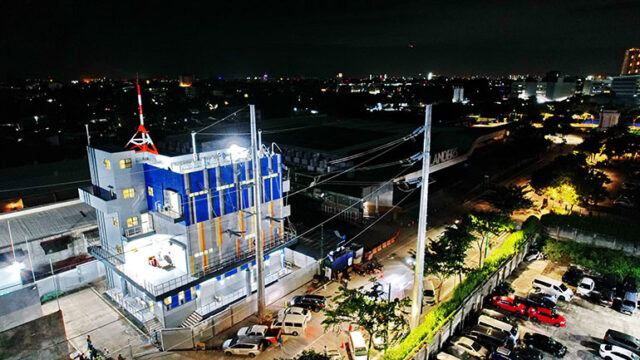
ALLHC shifts Artico Mandaue cold storage to 100% RE

ARTICO MANDAUE cold storage facility. — AYALALAND LOGISTICS HOLDINGS CORP.

LISTED industrial park and real estate logistics provider AyalaLand Logistics Holdings Corp. (ALLHC) has transitioned the operations of its Artico Mandaue cold storage facility in Cebu to 100% renewable energy (RE).

Artico Mandaue completed the shift on July 26 through its participation in the government’s green energy option program (GEOP), which allows eligible end-users to directly source their power from certified RE suppliers, ALLHC said in an e-mailed statement over the weekend.

The company said the transition to renewable energy is expected to cut the facility’s electricity expenses by about 30% each month.

The GEOP is part of government efforts to increase the share of RE in the power generation mix and reduce dependence on fossil fuels.

“This is a major milestone for Artico Cold Chain and a concrete step forward in the sustainability journey of ALLHC,” ALLHC President and Chief Executive Officer Robert S. Lao said.

“Our participation in the GEOP not only demonstrates our commitment to a greener future but also enhances our operational efficiency. We are proud to be contributing to a more sustainable and resilient energy sector in the Philippines,” he added.

In April last year, ALLHC’s Artico Biñan 2 cold storage facility in Laguna also switched to GEOP. The company plans to transition more facilities to the program.

ALLHC is a subsidiary of listed real estate developer Ayala Land, Inc. (ALI). The RE transition aligns with ALI’s medium-term sustainability goals of achieving carbon neutrality by 2030 and net-zero emissions by 2050, the company said.

“By sourcing its electricity from renewable sources such as solar and geothermal energy, the facility will significantly reduce its carbon footprint and mitigate greenhouse gas emissions,” ALLHC said.

ALLHC shares fell by 0.69% or one centavo to P1.44 apiece on Friday. — Revin Mikhael D. Ochave

Philippines’ Misery Index falls in June 2025

The Philippines’ adjusted misery index declined to 16.1% in June 2025 from 18.5% a year earlier, reflecting easing inflation and marginal improvements in labor market conditions. The index, which now incorporates adjusted underemployment* alongside inflation and unemployment, offers a broader measure of economic discomfort. Originally developed by economist Arthur Okun, the misery index serves as a proxy for economic distress. A lower reading typically signals better economic health, though structural issues may still persist beneath the surface.

Philippines’ Misery Index falls in June 2025

Chery Tiggo Cross Hybrid now available

Priced at P1.198 million The Chery Tiggo Cross Hybrid is positioned as one of the most affordable hybrid electric vehicles in the market. — IMAGE FROM CHERY AUTO PHILIPPINES

CHERY AUTO PHILIPPINES recently launched the all-new Chery Tiggo Cross HEV (hybrid electric vehicle), positioning it as one of the “most attainable hybrid subcompact SUVs in the country.” Priced at P1.198 million, the model is said to “bring together advanced technology, exceptional fuel efficiency, and premium features in one smart, stylish package,” said Chery Auto Philippines in a release, and it marks an “integral step” in the brand’s push toward sustainable mobility in the country.

Featuring Chery Super Hybrid (CSH) Technology, the all-new Tiggo Cross HEV boasts a driving range of up to 1,200 kilometers on a single tank, with output of 204ps and “class-leading torque” of 310Nm. The vehicle has received a five-star ANCAP safety rating. It gets six air bags, a high-rigidity body structure, and 14 advanced driver assistance system (ADAS) functions. Chery also integrates a 360-degree camera with transparent view, adaptive cruise control, and other smart safety features.

A tiger-inspired design, starry diamond grille, and crystal vertical marker lamps are visual highlights on the exterior of the crossover. Inside, drivers are greeted with a 10.25-inch HD dual display, wireless Apple CarPlay and Android Auto compatibility, voice-activated controls, 50W wireless charging, and power sunroof — in addition to six-way power-adjustable seats and four-way lumbar support, plus dual-zone climate control with rear vents.

The Chery Tiggo Cross HEV comes with an eight-year/160,000-km high-voltage battery warranty and a five-year/150,000-km (whichever comes first) bumper-to-bumper warranty. The model will be featured in the Chery Super Hybrid Roadshows scheduled as follows: Aug. 21 to 27 at SM North EDSA (ground floor of The Block), Sept. 2 to 8 at SM Marikina (ground floor), Sept. 10 to 16 at SM Dasmariñas (lower ground floor, near the food court), and Sept. 19 to 25 at SM East Ortigas (ground floor, main atrium exhibit area).

Italy’s Valentino hires fashion industry veteran Bellini as CEO

SMALL Vsling Grainy Calfskin Handbag in English Green.

ROME — Valentino has appointed industry veteran Riccardo Bellini as new chief executive, it said on Wednesday, hiring him from the Qatari fund Mayhoola which is the Italian fashion house’s parent company.

Mr. Bellini, who will take up the role at the start of September, replaces Jacopo Venturini whose departure was announced last week.

The appointment is part of the large-scale change in management and artistic direction sweeping across the fashion industry as it grapples with a deep slump in key US and Chinese markets.

New designers will debut at labels including Chanel, Balenciaga, Loewe, Maison Margiela, and Versace in upcoming fashion weeks in September and October.

“I am honored to join Valentino, an iconic maison that blends extraordinary heritage and craftsmanship with a unique creative voice,” Mr. Bellini said in a statement.

Mr. Bellini had been managing director at Mayhoola, a role he took up only in January, according to his LinkedIn profile.

He will work alongside creative director Alessandro Michele as part of a new top team at Valentino. Michele joined Valentino last year.

Mr. Bellini previously served as chief executive officer (CEO) of luxury brands Maison Margiela and Chloé, and held leadership roles at Diesel and Procter & Gamble.

His appointment comes at a time of uncertainty for Valentino, founded in Rome in 1960 by Valentino Garavani and Giancarlo Giammetti.

The label is now part-owned by French luxury conglomerate Kering, which bought a 30% stake from Mayhoola for €1.7 billion ($2 billion) in 2023, with a commitment to buy the rest by 2028.

Last month, Mayhoola denied a newspaper report that the two shareholders were considering selling Valentino.

Kering, which will have former Renault boss Luca de Meo as its new CEO from next month, declined to comment at the time. — Reuters

Yields on gov’t debt drop

YIELDS on government securities (GS) mostly went down last week, with the Bangko Sentral ng Pilipinas (BSP) expected to cut rates again on Thursday and as markets awaited the US Federal Reserve’s annual symposium.

GS yields, which move opposite to prices, declined by an average of 2.22 basis points (bps) week on week, based on the PHP Bloomberg Valuation Service Reference Rates as of Aug. 22 published on the Philippine Dealing System’s website.

At the short end of the curve, yields on the 91-, 182-, and 364-day Treasury bills went down by 3.43 bps (to 5.2578%), 2.36 bps (5.483%), and 6.07 bps (5.5985%), respectively.

At the belly of the curve, yields ended mixed. The rates of the two- and three-year Treasury bonds (T-bonds) rose by 1.43 bps (to 5.674%) and 0.58 bp (5.7419%), respectively. Meanwhile, the four-, five-, and seven-year T-bonds went down by 0.11 bp, 0.4 bp, and 0.33 bp to yield 5.7948%, 5.8429%, and 5.9221%, respectively.

Lastly, at the long end, rates dropped across the board, with yields on the 10-, 20-, and 25-year bonds going down by 0.66 bp (to 6%), 6.51 bps (6.3514%), and 6.61 bps (6.3509%), respectively.

GS volume traded slid to P53.37 billion on Friday from P61.1 billion a week prior.

“Prospects of the much awaited 25-bp cut by Bangko Sentral ng Pilipinas has pushed rates lower,” Jonathan L. Ravelas, a senior adviser at Reyes Tacandong & Co., said in a Viber message.

“Investors are convinced that BSP will be able to deliver a 25-bp cut [this] week,” a bond trader likewise said.

The Monetary Board will hold its policy meeting on Thursday (Aug. 28).

BSP Governor Eli M. Remolona, Jr. earlier said that another rate cut is “quite likely” at this week’s review as they expect inflation to remain within target this year.

The bond trader added that GS yields were “generally lower” last week following the “strong” 10-year bond auction on Tuesday.

“However, profit taking was seen ahead of the Jackson Hole symposium,” the trader added.

The Bureau of the Treasury borrowed P25 billion as planned via the reissued 10-year bonds it auctioned off last week at an average rate of 5.997%.

For this week, the market will likely monitor the BSP’s meeting for potential policy hints, the bond trader said. “The market is just waiting for confirmation before we head another leg lower in terms of bond yields.” — Pierce Oel A. Montalvo

WTO committee backs Indonesia in EU biodiesel dispute

REUTERS

GENEVA — A World Trade Organization (WTO) panel backed Indonesia on several key claims in its complaint over countervailing duties imposed by the European Union (EU) on biodiesel imports originating in the country.

Indonesia brought the dispute to the WTO in 2023, alleging the EU’s imposition of duties on imports of biodiesel from the Southeast Asian nation broke the body’s rules.

“We recommend that the European Union bring its measures into conformity with its obligations under the SCM Agreement,” the panel said in its conclusion, referring to a WTO agreement on subsidies and countervailing measures.

The EU is Indonesia’s third-largest destination for palm oil products and is an important market for its biodiesel, a product made from palm oil. Indonesia is the world’s biggest palm oil producer.

Indonesia appreciates the ruling and is preparing for its implementation, chief economic minister Airlangga Hartarto told Reuters on Saturday, without providing further details.

The finding can be appealed, but no final ruling is possible since the WTO’s top appeals court is no longer operational.

The WTO Appellate Body ceased functioning in 2019 due to repeated blockages of judge appointments by the first administration of US President Donald Trump. — Reuters

Hospital design: Blueprints for healing

STOCK PHOTO | Image by Upklyak from Freepik

When people think of hospitals, what usually comes to mind are doctors, nurses, and other healthcare professionals applying their expertise through medicines, diagnostic tests, and medical procedures to treat patients. Less visible, but equally vital, is how hospital design and planning shape health outcomes and influence the experience of patients, families, and staff.

On the week of Aug. 6-12, the country observed National Hospital Week, a reminder of the essential role hospitals play in promoting health. According to architect Alexander Balce, who has designed more than two dozen private hospitals, patient-centered design is not merely about aesthetics. Rather, it is grounded in evidence-based design principles that enhance safety, comfort, and healing. When applied well, these elements foster dignity, efficiency, and emotional well-being for all who enter a hospital’s doors.

The COVID-19 crisis underscored how hospital infrastructure must adapt to meet the challenges of airborne disease outbreaks. Mr. Balce noted that hospitals are now being designed with infection control, flexibility, resilience, and staff well-being as core considerations. Key features include enhanced air filtration and ventilation systems to minimize viral transmission; room adaptability that allows spaces to be converted for different levels of care; and separated traffic flows between clean and contaminated hallways to reduce cross-infection.

Also integral are decentralized hand hygiene and PPE zones to improve infection control compliance; modular expansion and surge capacity to manage sudden spikes in patient load; and telemedicine integration to maintain continuity of care while reducing crowding.

Other innovations now widely incorporated include touchless technologies such as automatic doors and faucets, antimicrobial surfaces like copper or coated materials, and staff wellness-centered features including respite rooms, lounges, natural light, calming colors, ergonomic furniture, and access to nature. These are no longer luxuries but essentials in future-ready healthcare facilities.

Beyond infection control, hospital architects are increasingly integrating digital health and green technologies into their blueprints. In many countries — including those in Southeast Asia, the Middle East, and across Europe and North America — private hospitals are using architecture not just to house technology but to enable and amplify its use. Collaboration between architects and IT specialists ensures seamless digital infrastructure across the facility, including robust network connectivity, data security, and centralized systems for electronic health records (EHRs) and telemedicine.

These investments make healthcare delivery more efficient and responsive. At the same time, the rise of green hospital design is helping reduce environmental footprints while improving the indoor environment for patients and staff.

This includes energy-efficient construction, renewable energy adoption, waste reduction systems, and sustainable procurement practices. Greener hospitals are healthier hospitals.

Drawing from Department of Health (DoH) guidelines and global best practices, Mr. Balce integrates several patient-focused elements into his projects. Among these are single-occupancy rooms that improve privacy, reduce infection risk, and promote recovery; nature views and art in patient rooms, which reduce stress and anxiety while improving mood; and accessible hand hygiene stations to support patient safety and infection prevention.

Other elements being integrated are clear signages that guide patients and visitors to departments, rooms, and emergency exits, easing stress and confusion; and LED lighting with adjustable intensity, which can be tailored for healing, reduce eye strain for medical staff, and lower energy use.

Also being considered are family-friendly spaces such as play areas, lounges, and comfortable waiting rooms, which provide a sense of normalcy, support recovery, and reduce stress for both patients and caregivers. These features transform hospitals from being merely places of treatment into environments of healing and reassurance.

The Philippines’ aging population and the growing burden of non-communicable diseases (NCDs) will significantly influence future hospital planning. Facilities will need to adapt for longer patient stays, geriatric care, and chronic disease management. This means designing for accessibility, long-term care, disability support, and staff sustainability.

Mr. Balce emphasized that hospital infrastructure must evolve to meet these demographic realities or risk falling behind healthcare demands.

The DoH issues guidelines that cover hospital planning and design, from site selection and building layout to essential services such as water supply and fire protection. These standards are critical to ensuring patient safety and functional efficiency. To stay abreast of trends, the United Architects of the Philippines (UAP) and the Professional Regulation Commission (PRC) organize Continuing Professional Development (CPD) programs for architects specializing in healthcare facilities. This ensures that Filipino professionals are equipped with the specialized skills required for hospital architecture, a field that demands not only design expertise but also knowledge of healthcare planning, patient safety, and regulatory compliance.

Given these, hospitals are not just buildings but they are blueprints for healing. Their design influences recovery rates, staff performance, infection control, and even family experience. As healthcare evolves, so must the spaces where care is delivered. By marrying functionality with humanity, and technology with sustainability, hospitals can become true sanctuaries of healing.


Teodoro B. Padilla is the executive director of Pharmaceutical and Healthcare Association of the Philippines which represents the biopharmaceutical medicines and vaccines industry in the country. Its members are at the forefront of developing, investing and delivering innovative medicines, vaccines and diagnostics for Filipinos to live healthier and more productive lives.

Meralco shares slip on profit taking after PSEi rebalancing

BW FILE PHOTO

MANILA ELECTRIC CO. (Meralco) shares fell last week as investors took profits following gains from the recent Philippine Stock Exchange index (PSEi) rebalancing, with analysts citing technical factors as the main driver.

Data from the Philippine Stock Exchange showed Meralco was the eighth most traded stock of the week, with 1.33 million shares worth P717.51 million changing hands by Friday.

The stock closed at P547 last Friday, down 2.3% from a week earlier, defying the 0.7% rise in the industrial sector week on week. However, it mirrored the 0.5% decline in the benchmark PSEi.

Franco Fernandez, equity research analyst at Dragonfi Securities, said Meralco’s decline was primarily driven by technical factors following a sharp price increase the previous Friday due to the PSEi rebalancing.

Effective Aug. 18, the PSE announced changes to its indices, which included the removal of Bloomberry Resorts Corp. from the PSEi and the addition of DigiPlus Interactive Corp.

In the industrial index, Concepcion Industrial Corp., Citicore Renewable Energy Corp., and Vitarich Corp. were added, while Basic Energy Corp., EEI Corp., and Max’s Group, Inc. were removed.

Additional changes were made to the Mining and Oil, MidCap, and Dividend Yield indices to reflect the latest market capitalization and liquidity review.

“This led to profit taking as the stock approached a resistance level,” Mr. Fernandez added.

Year to date, Meralco’s share price has risen 12.1%, compared with the PSEi’s 3.8% decline.

In an Aug. 15 disclosure, Meralco reported an attributable net income of P13.19 billion for the second quarter, up 2.7% from P12.84 billion a year earlier. This brought the first-half bottom line to P23.64 billion, 5.3% higher than the P22.44 billion in the same period last year.

Meanwhile, consolidated revenues reached P130.71 billion in the second quarter, down 1.7% from P132.93 billion a year earlier. For the first half of 2025, revenues stood at P245.22 billion.

“The slight revenue contraction and softer sales growth across customer segments prompted some caution (in the market),” said Jervin De Celis, equity trader at The First Resources Management and Securities Corp.

Luis A. Limlingan, head of sales at Regina Capital Development Corp., said that Meralco’s earnings stood out as notably strong compared with its previous performance, despite lower spot market prices compressing margins.

In a statement on Aug. 19, Meralco said it had signed an agreement with South Korea’s DL Engineering & Construction (DL E&C) to conduct studies on the possible deployment of small modular reactors (SMRs) in the Philippines.
The company has expressed strong interest in SMRs as a solution to energize off-grid areas.

“This was seen as a forward-looking move that could largely contribute to the company’s energy diversification and electrification in off-grid areas,” Mr. De Celis said via e-mail.

However, he added that the market appeared to view the development as only a mildly positive signal, since the studies remain in the preliminary stage and are unlikely to have any immediate effect on earnings.

Similarly, Mr. Fernandez noted “limited immediate impact until feasibility results are clearer and capital intensity is better defined.”

For the third quarter, Mr. De Celis forecast Meralco’s attributable net income at P11-12 billion.

Mr. Fernandez estimated core net income for the year at P50-51 billion. He also pegged immediate support and resistance at P520-530 and P550-560, respectively.

Likewise, Mr. Limlingan placed support at P531 and resistance at P560.

Mr. De Celis sees support at P531 and resistance at P548, with stronger resistance at P560-580. 

Meralco’s controlling stakeholder, Beacon Electric Asset Holdings, Inc., is partly owned by PLDT Inc. Hastings Holdings, Inc., a unit of PLDT Beneficial Trust Fund subsidiary MediaQuest Holdings, Inc., has an interest in BusinessWorld through the Philippine Star Group, which it controls. — Heather Caitlin P. Mañago

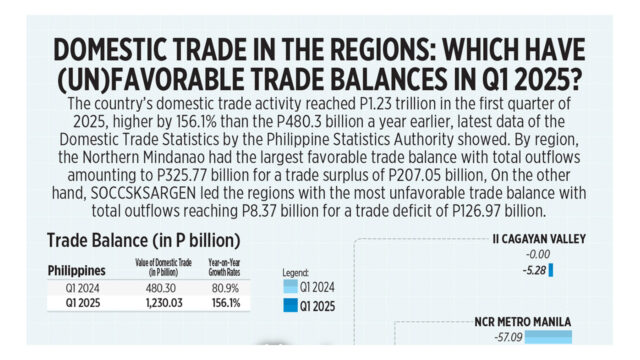
Domestic trade in the regions: Which have (un)favorable trade balances in Q1 2025?

The country’s domestic trade activity reached P1.23 trillion in the first quarter of 2025, higher by 156.1% than the P480.3 billion a year earlier, latest data of the Domestic Trade Statistics by the Philippine Statistics Authority showed. By region, the Northern Mindanao had the largest favorable trade balance with total outflows amounting to P325.77 billion for a trade surplus of P207.05 billion, On the other hand, SOCCSKSARGEN led the regions with the most unfavorable trade balance with total outflows reaching P8.37 billion for a trade deficit of P126.97 billion.

Domestic trade in the regions: Which have (Un)favorable trade balances in Q1 2025?

VinFast VF 7 targets ‘young, eco-conscious drivers’

PHOTO FROM VINFAST

ELECTRIC VEHICLES are said to be reshaping car culture as automakers embrace the “fashionization” of design. In a release, VinFast Philippines asserted that for younger, eco-conscious drivers, cars like the VF 7 are becoming expressions of personal style.

And without internal combustion engines, designers are said to be free to explore new forms and aesthetics. “EVs remove constraints, opening the door to cleaner, more innovative design. The newest electric models lean into sleek, aerodynamic profiles that echo the clean lines of modern architecture and fashion. Designers are favoring smooth surfaces, sculpted silhouettes, and flush panels that reduce drag while elevating visual appeal,” continued the release.

Designed by Italy’s Torino Design, the VinFast VF 7 “illustrates a new design philosophy that maintains the futuristic spirit of concept cars while preserving that essence in a commercial vehicle.” The all-electric C-SUV, priced from P1.76 million, draws inspiration from aerospace engineering, especially supersonic aircraft. Its sharp lines and bold forms suggest speed and precision. Hidden door handles, widened proportions, and a tapered roofline contribute to both visual drama and improved aerodynamics. All of these are the results of over 80,000 hours of work by Torino.

Inside is an expression of what Torino Design calls “Asymmetric Aerospace,” a driver-focused cockpit that prioritizes the person behind the wheel. Functionality, clean lines, and minimal physical controls reflect contemporary tastes.

The VF 7 Plus model delivers 500 Nm of torque, accelerating from a standstill to 100kph in 5.8 seconds. The base model, with a single motor, offers a 430 kilometers of range on a full charge. Both versions include features like hill-start assist, traction control, and adaptive cruise control. A 10-year battery warranty underscores VinFast’s focus on durability and peace of mind.

Style (08/25/25)


Lazada launching Labubu V3, Crybaby on Aug. 27

LAZADA is partnering with Pop Mart to launch its inaugural Super Brand Day (SBD), which will take place in-app on Aug. 27. During the regional SBD across Southeast Asia, there will be the timed release of Pop Mart products such as The Monsters and Crybaby. There will be storewide discounts of up to P320 off during the SBD, and buyers will receive an exclusive limited-edition gift-with-purchase, while stocks last. These products will be exclusively available on the Pop Mart brand store within Lazada’s LazMall during the SBD event. Pop Mart will increase its stock levels and scale up visibility on its LazMall storefront to meet demand. As part of the collaboration, a whole set of Hirono Reshape Series Figures will also be given away via Lazada’s Facebook and Instagram pages on Aug. 27.


Vintage Filipiniana exhibit up

THE University of the Philippines’ College of Home Economics (CHE) Costume Museum will be holding its anniversary exhibit, featuring garments from the Jurado Study Collection and the terno designs of Bachelor of Science in Clothing Technology students, entitled Aberrations. It is ongoing until Oct. 30, Tuesdays to Fridays, 11 a.m. to 3 p.m. at the Exhibit Hall of the CHE Museum. Of particular note is the collection of Dr. Leonarda Jurado who started a collection of traditional Filipino clothing in 1959. The collection, composed of 2,500 pieces of historical and cultural clothing, textiles and accessories, is now the Jurado Study Collection of the CHE Costume Museum. It is now on special exhibit, straight from the baul.


Anko launches Home Living Collection in PHL

ANKO is launching its new Home Living Collection in stores at TriNoma, Glorietta 2, and Alabang Town Center, starting on Monday, Aug. 25, for a limited time only. Designed by Anko’s in-house buying and design team in Melbourne, the collection brings sculptural forms, rich textures, saturated hues, and pops of accent colors, with curvy furniture and oversized accents to color-blocked cushions, ripple-edged mirrors, and textured ceramics. Among the offerings are a sage-toned ceramic kitchenware set (P900-P1,400); a Lava Rock Diffuser (P550); the minimalist white Mali Lounge Chair (P9,990), a collapsible Square Storage Ottoman (P800); striped cushions (P480) in pink-and-red and green-and-white colorways; a Muslin Cotton Quilt Cover Set (P1,790-P2,490), in sizes ranging from double to super king, available in seagrass and white; Trellis Laundry Basket and Hampers (P490-P1,290); and a Curved Boucle Floor Mirror (P3,290). Anko is also hosting an Interior Design Masterclass for Anko Club members on Sept. 8 at its TriNoma store. Guests can get expert styling tips from Sarah Dummett. To become a member, download the Anko Club app or sign up at www.anko.com/anko-club.


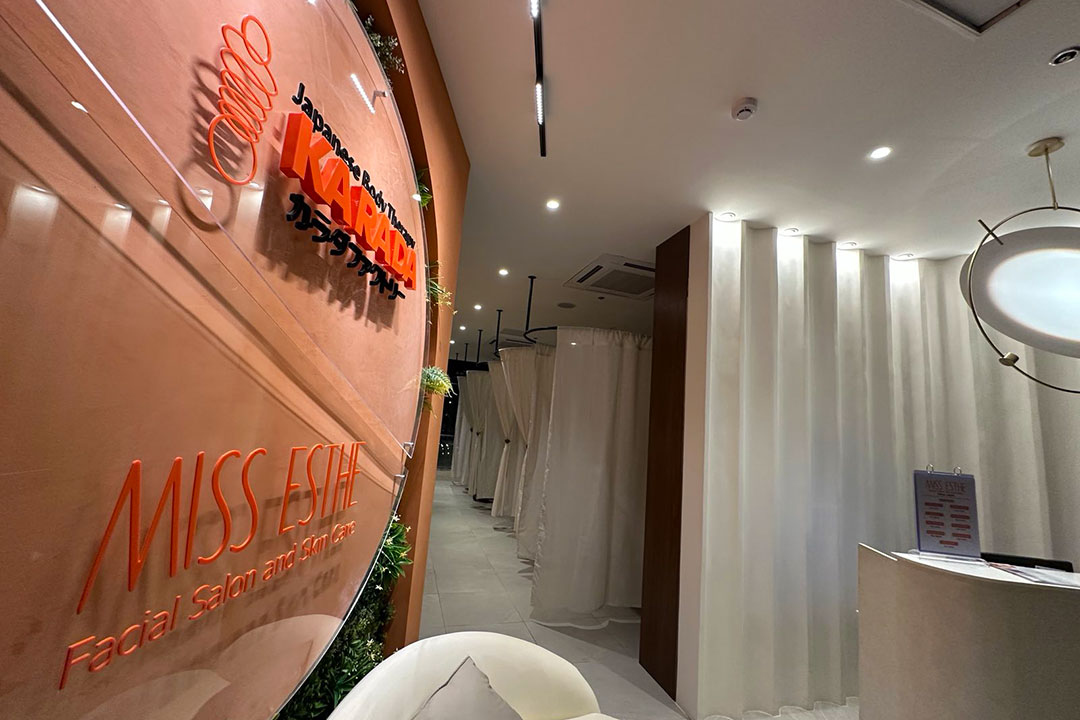
Miss Esthe now in Westgate Alabang, Newport City

MISS ESTHE, a facial and skin care salon from Tokyo, Japan, has opened new branches at the Newport Circle, Newport City and Westgate Alabang, with soon-to-open branches at The Rise Assembly Grounds in Makati and at Shangri-La Plaza Mall. Each branch of Miss Esthe Facial Salon and Skin Care is equipped with state-of-the-art technology that is non-invasive, with estheticians who are trained by experts. Miss Esthe is known for its anti-aging facial as well as whitening, acne, sensitive skin, instant lifting, deep whitening and deep acne and open pores treatments. Each treatment includes a calming face and decollete massage which is unique to the Miss Esthe. Miss Esthe opened its first Philippine branch in 2018 at Uptown Mall in Bonifacio Global City (BGC). This was followed by another location at the Wellness Place, Glorietta 3 in Makati City. To make a reservation, call 0935-336-4720 for Uptown BGC, Taguig; 0906-285-7811 for Wellness Place, Glorietta, Makati; 0915-932-9182 for Newport Circle, Pasay; 0915-932-9184 for Westgate Hub, Alabang; or 0977-669-7513 for The Rise Assembly Grounds, Makati.


Hoka collaborates with Supervsn on sneaker

HOKA’S latest collaboration is with Supervsn, a Los Angeles-based creative house and lifestyle brand. This launch marks Supervsn’s official debut in footwear, reimagining the Hoka Clifton One9 through the lens of Inner Space Exploration — a concept coined by Supervsn founder Gavin Mathieu to reflect an astro-futurism aesthetic rooted in personal introspection. The collection features three colorways of the Clifton One9 silhouette: the Mantis Green and Ice Grey colorways will be available globally, while a third, Neon Gold, will be released in an extremely limited run of just 99 pairs, making it the rarest HOKA style ever produced. The launch includes a $25,000 donation from Hoka to The STUDIO Foundation, a mentorship program meant to educate, empower, and usher in the next generation of creative visionaries and entrepreneurs. The Supervsn x HOKA collection is available at HOKA exclusive stores in One Ayala Mall, GH Mall, SM Aura, and Ayala Malls Manila Bay.


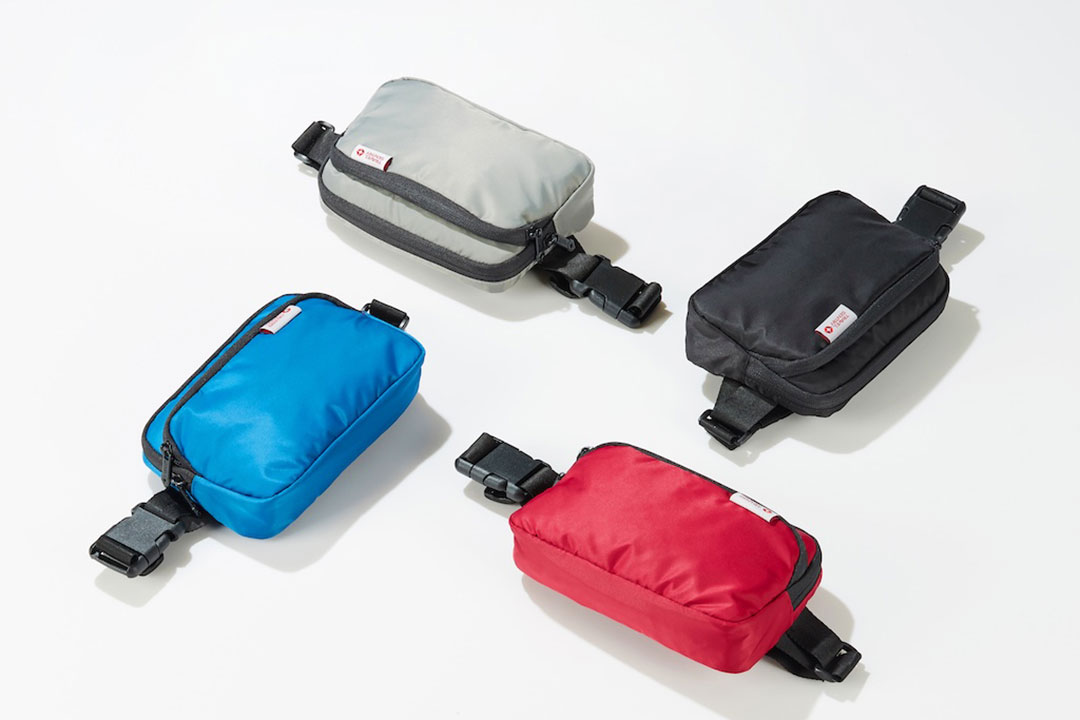
Travel Sentry offers eco-chic accessories

TRAVEL SENTRY Accessories are meant for eco-conscious jetsetters who want to explore the world without compromising on fashion or function. Made from 70% to 100% recycled RPET Nylon and Polyester, these accessories are not just functional, they are eco-friendly. Each piece is crafted in GRS-certified factories, ensuring that high environmental and social standards are met from start to finish. Travel Sentry pieces are lightweight, stain-resistant, and feature quality stitching, breathable mesh panels, and RFID pockets. All items come in FSC-certified, minimal-glue boxes, making recycling easy. Travel Sentry accessories are available at select True Value, SM Department stores, Landmark Department stores, Robinsons Department stores, Urbanize, and Duty Free stores.


Fendi unveils kids fall/winter collection

FENDI unveils its Kids Fall/Winter 2025-26 collection which also delves into the brand’s centenary year celebration. Timeless codes such as the iconic FF logo are accompanied by the Fendi Roma 1925 lettering on stripes or the Fendi Crest, a heraldic crest shield divided into four parts, featuring the Pequin stripe and the FF logo, the Giano Bifronte and the Fendi squirrel. Also present throughout the collection is the squirrel itself, part of the original 1925 Fendi logo. For girls, the collection blossoms with floral motifs that become delicate macro-FFs on white cotton poplin and muslin dresses, skirts, and blouses with puffed sleeves, and embroidered flowers on organza. An off-shoulder white dress features eyelet lace and subtle Fendi Roma 1925 lettering, also embroidered on a light blue organza piece and on knitwear sets in a punch-hole pattern with a 3D effect. Mini Me chambray pieces in a blue denim shade are adorned with signature ruffles and ton sur ton floral prints from the Women’s collection, or feature a FF logo interior as seen on a maxi skirt or Fendi Go To Jacket. For boys, a playful all-over pattern explores holiday elements. Surfboards, sunglasses, cameras, bananas, and many more shape an FF logo on poplin sets, nylon jackets, and an explorer backpack. The same little objects become prints or embroideries on T-shirts or polo shirts that also feature the distinctive Fendi Kids teddy bear. There are also charms including ping pong rackets, apples or badminton shuttlecocks. The collection has bon ton gabardine pieces with a mix-and-match of sporty details, such as technical piqué fabrics and polo necks as well as the incorporation of Fendi Roma 1925 stripes or the number “25.” There are tartan patterns in red-blue for girls and blue-green for boys, combined with FF logo piping, or embroidered Fendi Crest patches.


Cotton On offers denim collection

COTTON ON focuses on denim this month, with the Care Bears x Sesame Street collection. This includes a nightie and a limited-edition cardigan. There are also the Music License Tees, with a strong focus on iconic music legends, tapping into nostalgic appeal and generational fandom. These legendary artists not only bring bold graphic energy to the T-shirts but also connect with parents and kids alike through recognizable and timeless cultural moments.

ADVERTISEMENT
ADVERTISEMENT