Home Blog Page 1103

Veteran banker Stephen CuUnjieng joins Maharlika board

THE MAHARLIKA Investment Corp. (MIC) has appointed investment banker Stephen Anthony T. CuUnjieng as an independent director.

MIC President and Chief Executive Officer (CEO) Rafael D. Consing, Jr. on Tuesday said the appointment of Mr. CuUnjieng as chair of the investment committee took effect on July 1.

“The Maharlika Investment Fund operates on a different timeline than most investment vehicles; its primary duty is to cultivate long-term, intergenerational wealth for the Philippines. Mr. CuUnjieng’s appointment is a testament to our commitment to that prudent, long-view approach,” he said in a Viber message.

Mr. Consing said the appointee brings the “sophisticated judgment” needed to navigate market cycles and identify assets that offer sustainable value.

Mr. CuUnjieng has more than 35 years of leadership experience in investment banking, private equity, and corporate governance, holding senior roles in global financial institutions across Asia, the US, and Europe.

He previously served as chairman and chief executive officer of Evercore Asia and held leadership positions at Macquarie Capital, Merrill Lynch, and Salomon Brothers.

He has also served on the boards of Century Pacific Food, First Philippine Holdings Corp., and the New York Philharmonic.

The MIC board is chaired by Finance Secretary Ralph G. Recto, with Mr. Consing as vice chairperson.

Members include Land Bank of the Philippines President and CEO Ma. Lynette V. Ortiz and Development Bank of the Philippines President and CEO Michael O. de Jesus.

Mr. CuUnjieng joins German Q. Lichauco II and Roman Felipe S. Reyes as independent directors.

Among major investments of the MIC is its acquisition of a 20% stake in Synergy Grid & Development Phils., Inc., giving it a “foothold” in the National Grid Corp. of the Philippines.

The sovereign wealth fund also signed an agreement with Saudi Arabian energy company ACWA Power to develop renewable energy projects for off-grid locations in the Philippines. — Aubrey Rose A. Inosante
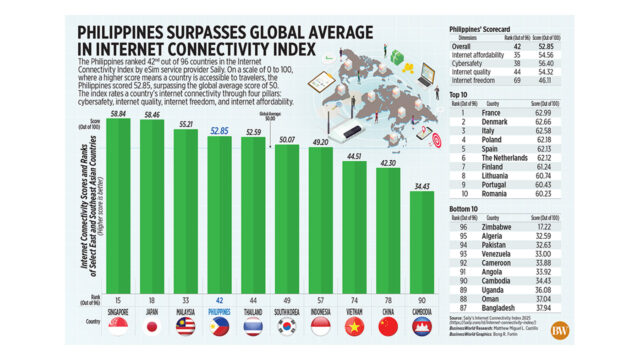
Philippines surpasses global average in Internet Connectivity Index

The Philippines ranked 42nd out of 96 countries in the Internet Connectivity Index by eSim service provider Saily. On a scale of 0 to 100, where a higher score means a country is accessible to travelers, the Philippines scored 52.85, surpassing the global average score of 50. The index rates a country’s internet connectivity through four pillars: cybersafety, internet quality, internet freedom, and internet affordability.

Philippines surpasses global average in Internet Connectivity Index

How PSEi member stocks performed — August 26, 2025

Here’s a quick glance at how PSEi stocks fared on Tuesday, August 26, 2025.


PSEi tumbles to four-month low on tariff threats

REUTERS

PHILIPPINE SHARES plummeted on Tuesday, with the benchmark index falling to the 6,100 level and hitting a four-month low, following US President Donald J. Trump’s latest tariff threats. 

The bellwether Philippine Stock Exchange index (PSEi) fell by 2.17% or 136.34 points to close at 6,145.24, while the broader all shares index dropped by 1.41% or 53.03 points to end at 3,684.55.

This was the PSEi’s worst close in over four months or since it finished at 6,138 on April 21.

“The local market started the week on a negative tone as the US’ latest tariff threats weighed on sentiment. US President Donald Trump warned of significant tariffs against China if the country would not export rare earth magnets to the US,” Philstocks Financial Inc. Research Manager Japhet Louis O. Tantiangco said in a Viber message.

“The US President also warned of additional tariffs to countries that would not remove taxes and other measures on digital services,” he added.

On Monday, Mr. Trump said China had to give the United States rare earth magnets or “we have to charge them 200% tariff or something,” Reuters reported.

Senior Chinese trade negotiator Li Chenggang is expected to travel to Washington this week to meet US officials, a United States government spokesperson said, with the two superpowers looking to chart a path beyond their current truce.

Mr. Trump also threatened countries that have digital taxes with “subsequent additional tariffs” on their goods if those nations do not remove such legislation.

“The market saw a decline today as most stocks were weighed down by heavy selling pressure,” Regina Capital Development Corp. Head of Sales Luis A. Limlingan said in a Viber message.

“Investors are positioning ahead of the Bangko Sentral ng Pilipinas’ (BSP) policy rate decision this week, with all eyes on how the stock market will react once the central bank’s move is confirmed,” he added. The BSP is widely expected to deliver a third straight 25-basis-point cut at the Monetary Board’s policy meeting on Thursday.

Almost all sectoral indices closed lower on Tuesday. Services fell by 5.46% or 124.49 points to 2,151.69; financials sank by 3.02% or 64.05 points to 2,052.40; holding firms went down by 0.41% or 21.67 points to 5,183.79; property declined by 0.26% or 6.43 points to 2,438.03; and industrials retreated by 0.1% or 9.75 points to 9,103.17. 

Meanwhile, mining and oil rose by 1.04% or 99.50 points to 9,588.74. 

“Ayala Land, Inc. was the top index gainer for the day, jumping 5.17% to P28.50. BDO Unibank, Inc. was the worst index performer, plunging 7.99% to P131.20,” Mr. Tantiangco said.

Value turnover jumped to P14.32 billion on Tuesday with 1.55 billion shares traded from the P6.44 billion with 803.64 million shares exchanged on Friday.

Decliners outnumbered advancers, 112 versus 81, while 64 names were unchanged.

Net foreign selling swelled to P2.04 billion on Tuesday from P721.91 million on Friday. — Revin Mikhael D. Ochave with Reuters

Business chambers welcome Konektadong Pinoy enactment

PHILSTAR FILE PHOTO

BUSINESS CHAMBERS said on Tuesday that the Konektadong Pinoy Act will improve the economy’s competitiveness and hasten the Philippines’ digital transition.

The Joint Foreign Chambers, the EU-ASEAN Business Council, the IT and Business Process Association of the Philippines, and the US-ASEAN Business Council welcomed the new measure in a joint statement.

“We see this as a landmark achievement that will significantly improve internet access, boost the Philippines’ economic competitiveness, and strengthen its digital ecosystem as ASEAN develops its regional Digital Economy Framework Agreement (DEFA),” the groups said.

However, they said the “law’s success will be dependent on the development of implementing rules and regulations (IRR) that protect the free and seamless flow of data across borders.”

In particular, they said that the IRR needs to ensure that businesses are able to innovate and scale to fully harness the potential of the digital economy.

“We remain committed to supporting the Philippines’ digital transformation and look forward to the full and immediate implementation of this law,” they added.

The Konektadong Pinoy bill, which lapsed into law on Sunday, relaxes the entry requirements for investing in the data transmission industry, thereby increasing internet access and the development of digital infrastructure.

Opponents of the law cited the risks it poses to national security, with incumbents threatening to mount legal challenges.

One of the sticking points is a provision in the law allowing new data transmission entrants to operate without obtaining a legislative franchise or a certificate of public convenience and necessity.

The Department of Information and Communications Technology said it is currently working on the draft IRR which will be presented in a public consultation. The final IRR is due to be released within 60 days. — Justine Irish D. Tabile

Rice-importing powers pushed for FTI, Planters

THE Department of Agriculture (DA) proposed to legislators that Food Terminal, Inc. (FTI)  and Planters Products, Inc. be granted the power to import rice on behalf of the government.

The proposal follows efforts to amend the Rice Tariffication Law, which had stripped the National Food Authority (NFA) of its import powers and opened up the import trade to private traders.

In a statement, the DA cited the need to exert regulatory power over rice imports to prevent oversupply, which it said has “depressed” farmgate prices earned by domestic farmers.

“We must regain control,” Agriculture Secretary Francisco P. Tiu Laurel, Jr. said. “Rice is a commodity imbued with too much public interest to leave entirely to the private sector.”

At present, the NFA is required to build up its rice reserves by procuring domestic rice, but it can only purchase about 5% of the palay (unmilled rice) harvest “due to limited warehousing and drying capacity,” the DA noted.

It added that the NFA’s impact on the market is limited to releasing rice during calamities.

The DA said if needed, government corporations under its umbrella like FTI and the Planters Products “could import on behalf of the government.”

“The proposed changes aim to strike a balance between ensuring affordable rice for consumers and protecting the livelihoods of Filipino rice farmers,” it said.

The DA, however, clarified that the rice import function will remain largely with the private sector.

Mr. Laurel has told the Senate that private importers should be required to share the responsibility of maintaining the country’s rice reserves.

“If we aim to have a 20-day rice buffer stock, we’re thinking of a 50-50 split between the NFA and the private sector,” he said.

Under the proposed setup, rice imports will follow the sugar import model, under which the Sugar Regulatory Administration  issues import allocations only to qualified importers. 

Rice importers will also be required to maintain their reserves by procuring palay from domestic farmers at fair prices.

A private sector role in maintaining the buffer stock, sourced from local rice farmers, will also reduce the cost to the government of maintaining its rice reserve, Mr. Laurel said. — Kyle Aristophere T. Atienza

La Niña could bring more typhoons by September

PHILIPPINE STAR/MIGUEL DE GUZMAN

A POTENTIAL La Niña could start influencing weather patterns as early as September, mainly in the form of more typhoons, the government weather service, known as PAGASA (Philippine Atmospheric, Geophysical and Astronomical Services Administration), said.

In a statement, PAGASA said the prevailing weather pattern in the tropical Pacific, known as the El Niño Southern Oscillation (ENSO)-neutral, is most likely to persist until October.

However, climate models indicate an increasing probability of a brief La Niña episode emerging between September and December.

La Niña, the cool phase of ENSO, is characterized by unusually cool sea surface temperatures in the central and eastern equatorial Pacific.

PAGASA said a La Niña Watch is issued when conditions are favorable for the development of La Niña within the next six months, and the probability rises to above 55%.

It said La Niña typically result in an above-average number of tropical cyclones towards the end of the year and above-normal rainfall in most of the Philippines, possibly bringing floods and landslides to vulnerable areas, it added.

PAGASA said it will continue to “closely monitor the ongoing El Niño, its effect on the local climate, and the possibility of La Niña.” — Kyle Aristophere T. Atienza

Vehicles procured via e-portal valued at nearly P290 million

DBM

VARIOUS agencies have taken possession of nearly P290 million worth of motor vehicles (MVs) procured via the e-Marketplace platform, the Department of Budget and Management (DBM) said on Tuesday.

The DBM’s Procurement Service (PS) reported that 153 vehicles have been delivered to 50 government agencies as of Aug. 26.  The vehicles were acquired for a combined P289.936 million.

The DBM also reported that 30 more agencies are awaiting the delivery of 56 vehicles, valued at P115.72 million.

“When compared to the Authority to Purchase Motor Vehicle — a documentary requirement for procuring entities to procure MVs which indicates the budget ceiling for purchase — the savings shoot up to P27.43 million,” the DBM said via Viber.

The e-Marketplace is an official electronic commerce platform where agencies can directly procure supplies and equipment from vetted suppliers.

The PS said only motor vehicles are currently available on the e-Marketplace but expects to add airline tickets, cloud computing services, and software and licenses soon.

The e-Marketplace currently lists 83 vehicle models available for procurement, including multi-purpose vehicles, passenger vans, utility vans, sport utility vehicles, sedans, buses, mini buses, and pick-up trucks. 

The e-Marketplace had been projected to process at least P320 million in transactions this year.

The e-Marketplace is a feature of the New Government Procurement Act, which was signed into law by President Ferdinand R. Marcos, Jr. in July 2024. — Aubrey Rose A. Inosante
Aramco acquisition of 25% stake in Unioil cleared by competition regulator

UNIOIL.COM

THE Philippine Competition Commission (PCC) said it cleared the proposed acquisition by Aramco Asia Singapore Pte. Ltd. of a 25% stake in Unioil Petroleum Philippines, Inc. and Unioil Energy Pte. Ltd.

In a statement, the regulator said it does not see the transaction resulting in a substantial reduction of competition in the relevant markets.

The PCC noted that “the parties have limited shares, there is substantial competition from other established players, and the entry of new players is likely, timely, and sufficient due to low barriers to entry.”

Aramco Asia is an affiliate of Saudi Arabian Oil Co. (Saudi Aramco) and renders sales, marketing, procurement, and logistics services out of Singapore.

Unioil Petroleum is a fuel retailer while Unioil Energy is a trading company that ships in gasoline and diesel to the Philippines.

In February, Aramco Asia and Unioil Petroleum announced a definitive agreement for a stake sale, marking Saudi Aramco’s return to the Philippine market.

Saudi Aramco used to own 40% of Petron Corp. but divested in 1994.

Under the Philippine Competition Act, the PCC is tasked with reviewing mergers and acquisitions (M&As), including foreign transactions, that meet notification thresholds, to ensure that the deals do not harm competition.

Earlier this year, the PCC raised the thresholds for notifiable M&A deals to a size of party of P8.5 billion and a size of transaction of P3.5 billion. — Justine Irish D. Tabile

PHL digitalization deepens, but rules for AI in education lacking

STOCK PHOTO | Image from Freepik

By Aaron Michael C. Sy, Reporter

THE DIGITALIZATION of Philippine industries is deepening, with adopters starting to harness its full potential in response to regulation supporting more access to services, industry representatives said.

“In the past 12 months, we see that the questions are now more of: how do I use all this potential? And particularly for those that are in the learning and development in organizations, it’s more around how do you keep up with the best versions and upskill your employees?” Michelle Alarcon, AI Association of the Philippines president, told a panel at the Manila Tech Summit on Tuesday.

However, companies and regulators are working to counteract risks stemming from emerging technologies such artificial intelligence (AI) as adoption accelerates, such as scams, summit participants were told.

Ms. Alarcon said the Analytics and AI Association of the Philippines (AAP) has grown to more than 1,000 members from only 20 last year.

Benito Teehankee, De La Salle University professor of Management and Organization and chairman of the AAP’s Responsible AI Council, noted that the education industry AI push has been hampered by lack of development in rules governing student use.

“Students cannot string sentences together anymore because of their abuse of AI. Let’s put it as plain as that. But teachers are trying to better guide them on how to use it properly,” he said.

Over the last year, organizations have been working to upskill their employees on AI and other digital tools to ensure that humans remain in the loop.

“I think what has happened is people have realized over the last 12 months that… organizations need to be digital-ready and AI ready,” according to Eugene S. Acevedo, an Asian Institute of Management vice chairman and former Rizal Commercial Banking Corp. president and chief executive officer.

He noted that digitalization has been led by regulators upskilling their own workers.

“The good thing is that our Monetary Board was actually first in terms of trying to upskill themselves when it comes to AI and AI strategy. I mean, we’re not expecting them to be technical in terms of AI, but understanding the technology so that when they do discuss policy, they understand the effect and impact of this technology. I think it starts with enabling them with the knowledge.”

Eugene C. Teves, chief information officer of the Bangko Sentral ng Pilipinas Technology and Digital Innovation Office, said consumer trust should be the main focus of organizations as digital attacks such as fraud and scams have only become more frequent as digitalization deepens.

“How do we still maintain trust in the financial sector? I think one thing we are encouraging financial institutions to look for is use cases where AI can really secure our financial network. But on top of that, there’s good that AI creates, but there’s also bad. You’ll see a lot more scams, more issues, because of this new AI.”

PPP being considered for LRT-2 West extension line 

LRT-2 / TWITTER

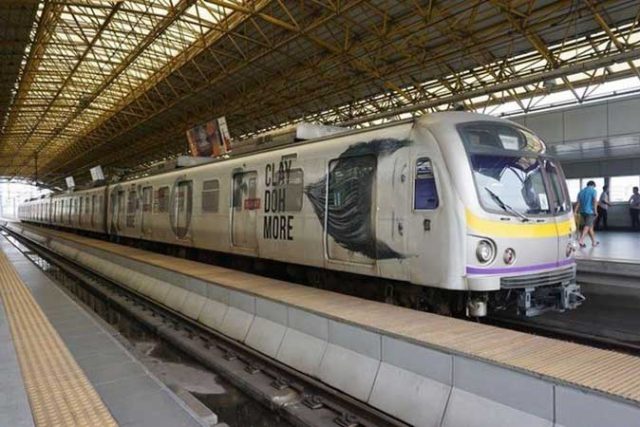
THE Department of Transportation (DoTr) said it is planning to tap the private sector for the Light Rail Transit Line 2 (LRT-2) West expansion project.

Transportation Secretary Vivencio B. Dizon said in a statement that the DoTr is considering implementing the project through a public-private partnership (PPP) due to limited funds.

“The LRT-2 project is currently in the development stage for PPP structuring, covering its operations and maintenance; rehabilitation and expansion,” the PPP Center said when queried by Viber. It said this includes an option to tap the private sector for the West Extension project.

The feasibility study for this project is expected to be completed by the end of this month, the PPP Center said.

In January, the Light Rail Transit Authority (LRTA) said the construction of LRT-2’s West Extension project had suffered further delay due to funding unavailability.

The operator of the LRT-2 line has said that no definite construction date has been set for the project as a result, with the rail line also lacking a multi-year obligational authority, a prerequisite for budgeting projects that take multiple fiscal years to complete.

The DoTr said last year that it is hoping to begin construction of the West Extension project in 2025.

The proposed LRT West Extension covers three kilometers from the current Recto Avenue station terminus to Pier 4. This line will have three stations: Tutuban, Divisoria and Pier 4.

The project also includes the procurement of additional light rail vehicles to meet growing passenger demand.

The LRTA has obtained P2 billion for the project to support preliminary activities such as acquiring right of way.

Also on Tuesday, Mr. Dizon said the DoTr is set to order e-commerce platforms to block listings for reselling beep cards.

Beep cards, created by AF Payments, Inc., are stored-value cards used on trains and buses in Metro Manila.

Mr. Dizon said charges are pending against e-commerce platforms for allowing the unauthorized sale of beep cards online.

The DoTr added that there is no shortage of beep cards following the delivery of around 300,000 units for Metro Rail Transit Line 3 (MRT-3); LRT-1 and LRT-2. — Ashley Erika O. Jose

Hong Kong IPA touts low taxes, market access to PHL investors

REUTERS

By Beatriz Marie D. Cruz, Reporter

HONG KONG is touting its favorable tax regime and market access to attract investment from Philippine conglomerates, technology companies, and high net worth individuals.

Invest Hong Kong (InvestHK), the city’s investment promotion agency (IPA), added that the Philippines “also has a lot of wealthy family businesses, large conglomerates. So, when they want to plan for their wealth management, traditionally, a lot of them have done in Singapore, but they know about Hong Kong now,” Alpha Lau, director-general of investment promotion at InvestHK, said at a media roundtable on Tuesday.

“We want to see more opportunities, particularly for tech companies and entrepreneurs, to expand overseas and Hong Kong is the best place to do it,” she said.

Last year, Hong Kong was the Philippines’ fifth-largest trading partner with bilateral trade in goods worth $13.9 billion.

Ms. Lau noted key investment opportunities in Hong Kong’s emerging technology sector, particularly in artificial intelligence, life and health science, advanced manufacturing, sustainability and green technology, and financial technology.

She also cited potential investments in traditional sectors like financial services, wealth management, and family offices.

Hong Kong enjoys easy access to Asia’s key markets like China, Singapore, and Japan, all reachable in under four hours, Ms. Lau said.

It is also one of the world’s busiest container ports, with about 320 container vessel sailings weekly to 470 destinations.

Investing in Hong Kong also ensures access to the Guangdong-Hong Kong-Macau Greater Bay Area, which accounts for 11% of China’s gross domestic product (GDP), Ms. Lau said.

She also cited Hong Kong’s tax rate of 8.25% on the first 2 million Hong Kong dollars  (HK$) in profit and 16.5% on profits above HK$2 million.

She added that Hong Kong charges no tax on capital gains and does not have value-added tax and withholding tax on investments, among others.

Hong Kong is home to over 2,700 family offices and 2,633 listed companies.

“We also allow for multiple listings, as we have an agreement with the stock exchanges around the world,” Ms. Lau said. “So, if a Philippine company wants to get listed, you can do it in Hong Kong, but if you want to also support your home IPO (initial public offering) market, then you can do a dual listing.”

Ms. Lau said the global tariff situation is currently “difficult to understand.”

“If you have multinational businesses or are trading with many countries, you need to have a quick reaction center to manage your supply chain and financials,” Ms. Lau said.

The Philippines and Hong Kong are set to conduct a second round of negotiations on a double taxation agreement in October, according to Libera Cheng, director-general of the Hong Kong Economic and Trade Office in Jakarta.