Home Blog Page 1055

Outrage, memes, and amnesia
PHILIPPINE STAR/RYAN BALDEMOR

By Jam Magdaleno

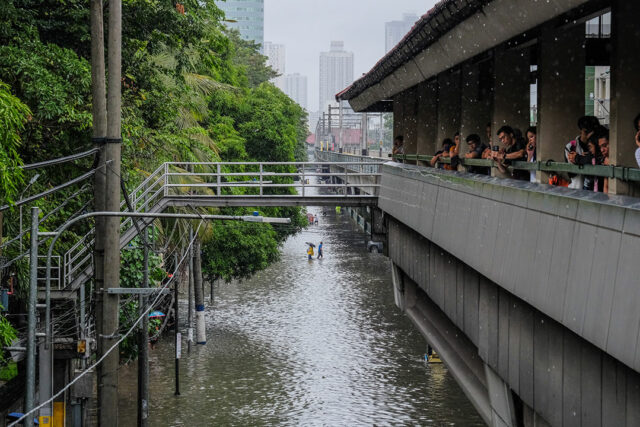
THE RECENT flood control fiasco offers a textbook case of our political cycle of outrage and forgetting. Ironically, the same cycle happens every few months. Last year, everyone seemed to be preoccupied with POGO and Alice Guo. A few weeks back, the same public gaze was turned towards online gambling. While it is understandable that people are enraged, what is concerning is that these events reveal a cyclical pattern in our public discourse.

For one, the endpoint of these issues almost always leads to more government intervention. Once the flood subsides — no pun intended — it is predictable that the result of these hearings will be yet another layer of government oversight. While oversight and fact-finding bodies are important to extract justice in some form, they are merely ex post facto. If we are to have any hope of addressing these decades-old problems, shouldn’t we be more creative? Some proposals, like Ramon Ang’s plan to fix Metro Manila’s flooding, have already been forgotten.

Former Solicitor General Florin Hilbay rightly suggests that perhaps it is time to seek private-sector intervention, given that the cost of government-led flood control projects is often inflated by leakages.

Waiting for the government to carry out a self-inflicted overhaul is like waiting for Godot. No matter how many good-governance officials are in place, the very nature of politics ensures that self-interest trumps the public interest.

To understand why this is the case, we turn to the concept of public choice. Public choice theory, pioneered by Nobel laureate James Buchanan and Gordon Tullock, views politicians, bureaucrats, and voters not as benevolent guardians of the public good but as rational actors driven by incentives, much like participants in a marketplace. Officials seek re-election, agencies seek bigger budgets, and voters often pursue short-term benefits without regard for long-term costs. In this view, politicians and bureaucrats are not moral guardians. If we adopt this perspective, it becomes clear that the next steps must focus on changing the environment rather than moralizing the issue.

What, then, is the problem with moralizing the issue? It pollutes public discourse, reducing it to individual-level fault-finding and “memeing” rather than fostering informed discussion and genuine problem-solving. One way this manifests is through the shaming culture so rampant today. TikTok and Facebook are flooded with memes targeting contractors, politicians, and even their relatives. But does this solve anything? No. Instead, it creates a false sense of action, widening the awareness-action gap. This gap arises because awareness is often easier and more emotionally gratifying than action. Social media makes it especially visible: we get the feeling of having done something by liking, sharing, or memeing, but in reality, nothing changes on the ground. It trivializes complex problems and makes them easy fodder for virality. By this point, the PR directors of these politicians are already busy figuring out how to spin the outrage into their favor for 2028. Once the dust has settled, we will be left only with memes to carry into 2028, being none the wiser.

If outrage and forgetting are the default cycle, the challenge is to design ways of breaking it. Scandals will always come and go, but institutions can be built to outlast the news cycle. One promising model is already here in the Philippines: the Citizen Participatory Audit (CPA) program of the Commission on Audit. Since 2012, CPA has embedded citizens into audit teams alongside state auditors, producing joint reports on flood control projects, health centers, sanitation, and road construction. These audits have exposed irregularities ranging from poor construction to procurement defects, leading in some cases to resignations and legal action. Unlike traditional post-mortems, CPAs keep pressure alive by institutionalizing citizen oversight and transforming outrage into evidence-based accountability.

The temptation is to believe that politics will correct itself if only “good people” are elected. Public choice theory warns us otherwise. Since self-interest is always at play, the real task is to design rules that channel self-interest toward the public good. This means procurement systems where contracts are open and competitive, infrastructure deals with automatic performance benchmarks, and even sunset clauses for programs that require renewal to continue. These may sound boring compared to fiery hearings or viral memes, but boring is exactly what enduring reforms look like.

International models prove that such institutional design works. The Netherlands, for example, entrusts flood control to independent water boards (waterschappen), which have existed since the Middle Ages. These boards raise their own revenues through dedicated local levies and wastewater fees, fund 95% of their own budgets, and are legally required to upgrade defenses every five years to meet strict safety norms — such as preparing for one-in-10,000-year flood events in critical zones. Their financial autonomy and regulatory power mean that flood protection is insulated from electoral cycles and partisan interference. The result: the Dutch have not experienced a catastrophic flood like 1953’s North Sea disaster in over 70 years, despite rising seas and climate risk. These lessons matter for Metro Manila and the Philippines.

Mr. Hilbay is right: massive public works are too prone to leakages when left entirely to the government. A Philippine version of the Dutch model, whether through independent authorities funded by user fees, or through public-private partnerships with contracts tied to measurable results, could help ensure that self-interest works in service of the public good.

But none of this will matter if public discourse itself remains trapped in the cycle of outrage, memes, and amnesia. Social media platforms reward trivialization. This is not a reason to abandon them but to rethink how they can be manipulated for a more mature and sustained social movement. If virality is inevitable, can it be redirected to sustain reform pressure rather than dissipate it? Civic groups have already experimented with digital scorecards, fact-checking campaigns, and “explainers” that keep issues alive well after the headlines fade. The task is to scale these efforts so that memes do not merely mock politicians but pin them down with evidence-based demands.

Ultimately, the larger point is that waiting for politics to correct itself is futile. Scandals will fade, personalities will come and go, and 2028 will arrive whether or not we have learned anything. The only way forward is to redesign the environment, through stronger institutions, smarter contracts, and civic innovations that make accountability harder to dodge. Ostensible outrage without follow-through only guarantees that we will face the same problems again. The real test is whether we can channel outrage into structures that endure after the floodwaters— and the memes — have receded.


Jam Magdaleno is a political and economic researcher, writer, and communication strategist. He is the head of Information and Communications of the Foundation for Economic Freedom (FEF), a Philippine-based think tank.

Venice Film Festival: Camus classic The Stranger revitalized

A scene from The Stranger.

VENICE — Adapting a book for the screen is always “a betrayal,” French director François Ozon says, but in bringing Albert Camus’ The Stranger to the Venice Film Festival he hopes to generate fresh debate around a French classic.

Shot in black and white, the film follows Meursault, a detached young Frenchman living in colonial Algeria in the 1930s who kills an Arab on a beach and is put on trial, with a possible death sentence hanging over him.

Mr. Ozon, 57, is one of France’s most prolific filmmakers, known for works such as Swimming Pool, 8 Women, and By the Grace of God. He said his latest project was born after he revisited Camus’ novel, which he had first read in his teens.

“I realized how much the book still resonates with the present day,” he told Reuters. “I launched into this adaptation with a bit of fear, because I’m tackling a masterpiece of French literature.”

Published in 1942, the book was brought to the screen in 1967 by Italian director Luchino Visconti, in a film starring his compatriot Marcello Mastroianni.

Mr. Ozon has said he was very keen to produce a French-language version of Camus’ existentialist classic, although he was aware that not everyone will appreciate his effort.

“Adapting a book always involves a degree of betrayal, but it’s a reinterpretation in another language. It’s not the language of literature; it’s the language of cinema.”

He said the novel’s themes of absurdity, alienation, and colonial injustice remain pressing.

“When you see what’s happening, the wars, the rise of the far right, the misdeeds of colonialism, the destruction of nature, all these philosophical questions are in Camus’ book.”

Actor Benjamin Voisin, who plays Meursault, said it was extremely tough to portray such an emotionally detached and indifferent character.

“It was hard for me to be asked to never ‘act.’ But I had to find a compromise between the role, Camus’ philosophy, and Ozon’s film,” he said.

The Stranger is one of 21 films competing for the prestigious Golden Lion, which will be awarded on Sept. 6. — Reuters

BSP may deliver one last cut in December

BW FILE PHOTO

THE BANGKO SENTRAL ng Pilipinas (BSP) could pause its easing cycle at its next meeting and deliver its final rate cut in December.

“We had expected BSP to cut in August. We also penciled in a pause for October, largely because we feel the BSP will be watching the Fed and what the Fed decides to do. That’s why we actually expect the last cut for this year to come around at their December meeting,” Nicholas Antonio T. Mapa, chief economist at Metropolitan Bank & Trust Co., said on Money Talks with Cathy Yang on One News.

“So, pause in October, wait things out — just see how data plays out, see where the Fed takes policy rates — and then maybe decide by December. With inflation still quite manageable, with growth still needing a bit of a boost, this could give Governor Remolona enough leeway to cut policy rates before the end of the year.”

Last week, the Monetary Board slashed the target reverse repurchase rate by 25 basis points (bps) for a third straight meeting to 5%. It has now slashed borrowing costs by 150 bps since it began its easing cycle in August 2024.

BSP Governor Eli M. Remolona, Jr. said the latest cut puts the policy rate at a “sweet spot” in terms of both inflation and output, signaling that the central bank is nearing the end of its rate-cut cycle.

However, he said one last reduction could be possible this year if economic conditions warrant more support.

The Monetary Board’s last two meetings this year are scheduled for Oct. 9 and Dec. 11.

Mr. Mapa said headline inflation may have picked up slightly last month due to higher prices of electricity, fish and vegetables.

“On the downside, we’re looking at rice disinflation or deflation to continue to weigh or to offset some of the uptick in headline inflation,” he said.

The Philippine Statistics Authority will release August inflation data on Friday, Sept. 15. A BusinessWorld poll of 16 analysts conducted last week yielded a median estimate of 1.3% for the August consumer price index.

Headline inflation sharply eased to a near six-year low of 0.9% in July from 1.4% in June, bringing the seven-month average to 1.7%, below the BSP’s 2-4% annual target.

He added that the impact of the government’s move to halt rice imports for two months on prices is likely to be limited as it coincides with the harvest season.

“September is generally a low import volume month… We also do have quite a bit of domestic rice supply. So, I don’t think the ban would impact prices significantly in the sense because there’s so much rice in our stocks. We’ll likely just see headline inflation tick slightly higher,” Mr. Mapa said.

The 60-day suspension of rice imports began on Sept. 1 and will end on Oct. 30. It covers imports of regular milled and well-milled rice but excludes varieties that are not commonly produced locally. — Katherine K. Chan

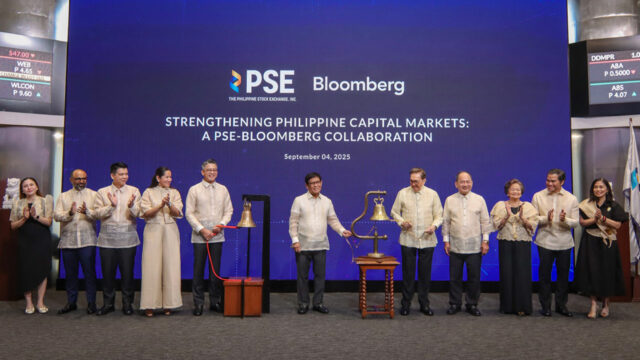
PSE launches new partnership to boost global investor outreach

Bloomberg Philippines Head of Sales Charina Evangelista, Bloomberg ASEAN Head of Market & Product Specialists Vignesh R S, Bloomberg ASEAN Head of Sales Kelvin Cen, Bloomberg APAC Head of Market & Product Specialists Manju Sakhrani, Bloomberg APAC Head of Sales Bing Li, Securities and Exchange Commission Chairman Francis Ed. Lim, PSE Chairman Jose T. Pardo, PSE President and CEO Ramon S. Monzon, PSE Independent Director Chief Justice Teresita Leonardo De Castro (ret.), PSE COO Roel A. Refran, and PSE Corporate Secretary Aissa V. Encarnacion. — PHILIPPINE STOCK EXCHANGE

THE PHILIPPINE STOCK EXCHANGE (PSE) and Bloomberg, a global financial data and media company, have announced a partnership aimed at boosting global investor awareness of the Philippine capital markets, through a series of joint outreach initiatives both locally and internationally.

The partnership was launched on Thursday with a bell-ringing ceremony and a panel discussion featuring PSE President and Chief Executive Officer Ramon S. Monzon, Bloomberg’s Asia-Pacific Head Bing Li, and Securities and Exchange Commission (SEC) Chairman Francisco Ed. Lim.

Under the agreement, the PSE and Bloomberg will organize various investor-focused activities such as virtual roadshows and C-suite roundtables. They also plan to explore enhanced training opportunities for Philippine-based investor relations professionals.

During the 40-minute panel discussion, Mr. Monzon noted that the Philippines is home to some of Asia’s most dynamic companies, which are actively pursuing growth, expansion, and sustainability. Mr. Lim, for his part, said that integrity and credibility are vital to the development of the capital markets.

“Our objective really is to be able to leverage the global reach and expertise of Bloomberg so that our companies can reach out to global investors. And hopefully global investors will get to know about our listed companies and invest,” Mr. Monzon said.

Asked about the potential benefits for listed firms, Mr. Monzon said the collaboration provides a platform for companies to share key information — such as earnings, strategic initiatives, and growth plans — with an international audience.

“And because they’re on a global stage, I think it helps them become more transparent. It’s one of the transparency [requirements] of the global market,” he added.

Mr. Monzon expressed hope that continued dialogue with market participants would generate stronger global interest in Philippine-listed companies.

Meanwhile, Mr. Li said the outreach efforts highlight the Philippine market’s openness and growing appeal to global investors, particularly those eyeing Southeast Asia.

“This initiative can start an important dialogue with local market participants about how they can better tell their story to global investors through transparency and data,” Mr. Li said. — Alexandria Grace C. Magno

From sinking streets to carbon solutions

FLOOD SITUATION near the corner of Mother Ignacia and Sgt. Esguerra street in Barangay South Triangle, Quezon City after a heavy downpour on Aug. 30. — PHILIPPINE STAR/MIGUEL DE GUZMAN

By Angela Arnante

WHEN Quezon City streets went underwater after just a few hours of localized rain on Aug. 30, many were shocked. It is unusual for short bursts of rainfall to paralyze a major city in Metro Manila. We can’t predict the next similar downpour, but we know our infrastructure cannot adapt anymore, either due to corruption or the changing climate. And one thing is for sure, we know who pays for it: everyone.

Economists call this kind of spillover damage an externality — costs created by one actor but borne by others. When carbon emissions go unchecked, the rest of society shoulders the impact through stronger storms, disrupted harvests, health risks, and billions spent on response and recovery. Worse, such billions are pocketed and infrastructure — like flood control projects — are haphazardly done or not done at all.

The challenge is that these costs remain invisible in balance sheets. Without rules to make them matter, there is little incentive for firms to change their behavior. The question, then, is how to bring the hidden damage back into the decision-making of those who cause them.

SCARCITY CREATES PROPERTY RIGHTS
The late economist Harold Demsetz offered an answer: property rights emerge when externalities grow too large to ignore. When resources are abundant, there is little reason to define ownership. But when scarcity creates conflict or harm, societies invent property rights to manage them.

That is exactly what carbon credits represent. The atmosphere’s capacity to absorb greenhouse gases safely is limited. Once emissions exceed that capacity, damage multiplies in the form of extreme weather and economic disruption. Carbon markets establish property rights over a scarce global resource by turning each ton of emissions into a tradable credit. Polluters can no longer treat the air — the atmosphere — as a free dumping ground.

BARGAINING MAKES IT CHEAPER
Ronald Coase — later awarded the Nobel Prize in Economics — showed that once property rights are clear, people can bargain to resolve externalities more efficiently. Carbon markets embody this principle. A company that can reduce emissions or remove emissions from the atmosphere can sell credits to one that cannot. The outcome is the same — emissions fall — but at a much lower overall cost to society.

This is why carbon trading has taken root worldwide, from the European Union’s Emissions Trading System to regional initiatives in California and Asia. The point is not to excuse polluters. It is to harness market incentives so that reductions happen where they are most efficient, ensuring every peso or dollar spent on climate action goes further.

CARBON CREDITS AS PERSONAL PROPERTY
For the Philippines, a country highly vulnerable to climate risks, this economic logic carries particular weight. Each storm that disrupts farms, damages infrastructure, or displaces families is a reminder that climate change is not only an environmental problem, but also an economic one. Yet our current system leaves the costs scattered across government budgets, relief operations and ayuda (assistance), and household losses.

Carbon markets offer a different approach: make responsibility visible and tradable. A factory that emits must either invest in reducing its pollution or buy credits. A community that restores mangroves or protects watersheds — natural buffers against extreme weather — can earn credits and sell them. This transforms responsibility into an economic transaction: emitters pay, protectors gain, and society benefits.

For carbon markets to work in the Philippines, carbon credits must be firmly anchored in law. The clearest path is to recognize them as personal property — intangible but transferable, like royalties or intellectual property. This classification matters because it separates the carbon service from the land itself.

Under the Revised Civil Code, whoever owns the land is presumed to own the trees, and by extension, the carbon they store. On government forestlands, this rule means that carbon rights would revert to the State once the 25-year tenure — renewable for another 25 years — contract expires. This leaves communities and project developers without lasting claims. Carbon projects are required to last at least 30 years and ideally until 100 years.

Recognizing carbon credits as personal property breaks this dependency on land ownership. It ensures that those who generate and maintain carbon projects continue to own the credits they produce, even if their land tenure is temporary, even if land ownership changes.

The same principle should apply to projects on ancestral domains and private lands. Carbon credits should still be treated as personal property, distinct from land ownership. The key difference is that tenure limits do not apply: the land and its produce are already privately held. What matters in this case is a fair allocation of benefits and incentives among the stakeholders involved.

Only once credits are firmly recognized as property should they be treated as securities when pooled or marketed as investment products. This sequencing matters: without property rights as a foundation, securitization risks producing fragile paper claims without real ownership behind them.

In short, property first, securities second, if needed. When carbon credits are secured as personal property, ownership is clear, trade is possible, and incentives are aligned for long-term investment in climate action.

MAKING RESPONSIBILITY COUNT
Externalities always impose costs. The question is whether those costs remain hidden and passed on to the public, or whether they are assigned to the actors who create them. Demsetz helps explain why carbon credits had to be invented: because the atmosphere’s capacity to house carbon safely is scarce. Coase explains how trading those rights makes reductions efficient. Together, they point toward a system where responsibility is no longer invisible, but shared and allocated fairly.

Storms will still come, but the way we prepare for them can change. With carbon markets, the burden of climate responsibility need not fall entirely on ordinary Filipinos. It is time to reward activities that cut emissions and absorb carbon — from protecting forests and planting new ones, to generating renewable energy, capturing methane, improving farm practices, and investing in carbon removal technologies. And for carbon markets to succeed, carbon credits must rest on secure and clearly defined property rights.


Angela Arnante is a policy consultant at the Foundation for Economic Freedom.

angela.arnante@fef.org.ph

Venice Film Festival: Kathryn Bigelow spotlights nuclear threat in Venice comeback film

Rebecca Ferguson in A House of Dynamite

VENICE — US director Kathryn Bigelow launched her latest movie, A House of Dynamite, at the Venice Film Festival on Tuesday, saying she hoped the tense thriller would sound the alarm over the ever-present danger of nuclear catastrophe.

Her first film in eight years traces the launch of a lone, unidentified ballistic missile towards the United States, triggering a desperate race to find out who is responsible and how to respond.

“This is a global issue, like where we are with nuclear weapons,” said Ms. Bigelow, who in 2010 became the first woman to receive the best director Oscar for her Iraq war movie The Hurt Locker.

“Of course, hope against hope, maybe we reduce the nuclear stockpile someday, but in the meantime we are really living in a house of dynamite,” she told a press conference, alongside some of her stars, including Idris Elba and Rebecca Ferguson.

“How is annihilating the world a good defensive measure?”

The film tracks the 18 minutes it takes for the missile to be launched from the Pacific until it reaches Chicago, unfolding through the eyes of myriad officials — from the US president to an anti-missile crew based in Alaska to military brass working inside US Strategic Command.

“(There are) these incredibly competent people operating on an infinitesimally short timeline, and the fate of the world is at stake,” Ms. Bigelow said.

Ms. Bigelow’s last major movie was the 2017 historical crime drama Detroit. Before that, she dramatized the decade-long hunt for Osama bin Laden in Zero Dark Thirty.

With A House of Dynamite, Ms. Bigelow revisits the sweeping, politically resonant storytelling that defined her most celebrated work.

MUTUALLY ASSURED DESTRUCTION
Defense analysts believe there are up to 13,000 nuclear weapons in the world, in the hands of nine countries — more than enough warheads to destroy life on earth many times over.

“We’ve constructed this weaponry that could end all life, and it’s miraculous, frankly, that something horrific hasn’t happened already. So many of these weapons are on a hair trigger system in countries like ours,” said the scriptwriter Noah Oppenheim, a former president of NBC News.

Cast members said portraying characters caught inside a nuclear crisis was harrowing.

“I learned I don’t have the courage to be in politics,” said Mr. Elba, who plays the US president. Jared Harris, who plays the US defense secretary echoed that sentiment. “I am grateful that I will never be put in that situation,” he said.

A House of Dynamite is one of three films US streamer Netflix is showcasing at Venice. The other two are Guillermo del Toro’s Frankenstein and Noah Baumbach’s Jay Kelly.

All three are competing for the prestigious Golden Lion prize, which will be awarded on Sept. 6. — Reuters

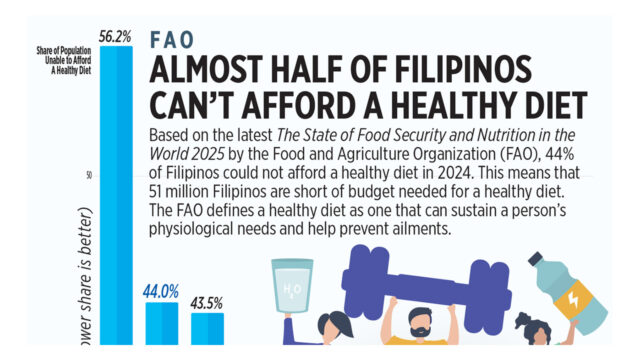
FAO: Almost half of Filipinos can’t afford a healthy diet

Based on the latest The State of Food Security and Nutrition in the World 2025 by the Food and Agriculture Organization (FAO), 44% of Filipinos could not afford a healthy diet in 2024. This means that 51 million Filipinos are short of budget needed for a healthy diet. The FAO defines a healthy diet as one that can sustain a person’s physiological needs and help prevent ailments.

FAO: Almost half of Filipinos can’t afford a healthy diet

BSP, DoLE sign information exchange agreement

BW FILE PHOTO

THE Bangko Sentral ng Pilipinas (BSP) said it signed an information-sharing agreement with the Department of Labor and Employment (DoLE) to enhance the central bank’s capacity to maintain price stability.

In a statement on Thursday, BSP Governor Eli M. Remolona, Jr. said the memorandum of understanding will help the bank compile a comprehensive view of labor conditions in aid of formulating sound policy.

“Together, we can align our policies to serve the people better. I am excited for what this partnership will bring,” Mr. Remolona said.

“Good data lead to good policy, and good policy leads to good progress,” he added.

“Using DoLE’s labor market data, the BSP will produce research that can help DoLE strengthen its employment policies, sharpen labor market strategies, and improve the delivery of employment facilitation services,” the central bank said.

Labor Secretary Bienvenido E. Laguesma said he expects the partnership to improve employment opportunities and service quality.

“We at DoLE are optimistic and confident that this strategic partnership will drive progress that genuinely reaches all Filipinos, especially our jobseekers — ultimately strengthening our employment facilitation services, our workforce, and elevating the quality of employment available to everyone,” Mr. Laguesma said. — Katherine K. Chan

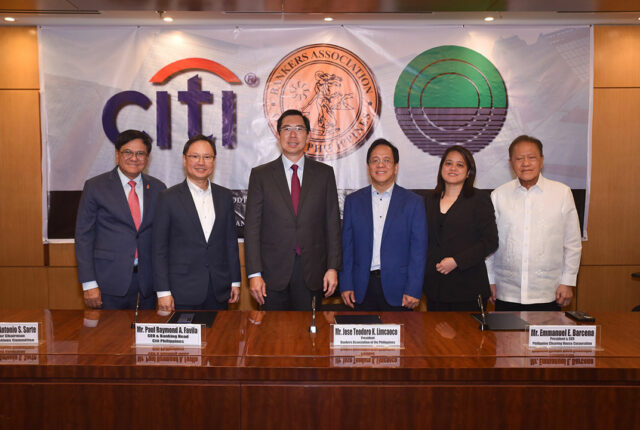
BAP renews partnership with Citi Philippines, PCHC to strengthen PDDTS and PvP System

BANKERS ASSOCIATION OF THE PHILIPPINES

THE BANKERS Association of the Philippines (BAP) has renewed its partnership with Citi Philippines and the Philippine Clearing House Corp. (PCHC) for the enhancement and continued management and operation of the Philippine Domestic Dollar Transfer System (PDDTS) and the Payment-versus-Payment (PvP) System.

BAP, Citi Philippines, and PCHC signed an agreement on Aug. 28 to extend the partnership until Aug. 17, 2030.

“The success of the PDDTS/PvP has always been a story of collaboration — among our committees, our partners, and the broader financial community. Together, we will continue to strengthen our systems, adapt to change, and serve the needs of our economy,” BAP President Jose Teodoro K. Limcaoco said in a statement on Thursday.

BAP said the agreement is part of its efforts to further develop the Philippines’ financial market infrastructure.

BAP is the owner and the governing body of both the PDDTS and PvP System. Citi Philippines serves as the settlement bank, while PCHC acts as clearing operator and an operator of a designated payment system.

PDDTS was launched in 1995 and enables real-time domestic US dollar (USD) transfers among participating Philippine banks. Meanwhile, the PvP System, which was introduced in 2003, reduces settlement risk in cross-currency transactions.

Both systems were recognized and designated by the Bangko Sentral ng Pilipinas (BSP) as systematically important payment systems in 2022.

“The PDDTS and PvP systems, established by the BAP, have long supported financial stability, liquidity management, and efficient settlement across the banking sector,” the group said.

Under the extended partnership, BAP, Citi Philippines, and PCHC committed to key enhancements of the systems.

These include “improved IT infrastructure and service levels targeting 99.5% system uptime, faster incident response, proactive maintenance notifications, and upgraded business continuity protocols to ensure stronger disaster recovery and operational resilience.”

PDDTS will also shift its account interest calculations to use the Effective Federal Funds Rate from the London Interbank Offered Rate, which was phased out globally in 2023.

“With this venture, the banking industry is poised to benefit from stronger alignment with global payment systems, greater efficiency in domestic USD settlements, and enhanced support for financial market stability and industry innovation. These developments also reinforce operational stability and regulatory compliance, guided by the BSP in its critical roles as operator of PhilPaSS, settlement bank for the PHP leg of PvP transactions, and primary regulator of all designated payments in the country,” BAP said. — A.M.C. Sy

Suntrust acquires 40% stake in Westside Bayshore, gains indirect interest in casino project

SUNTRUSTRESORTHOLDINGS.COM

LISTED casino developer Suntrust Resort Holdings, Inc. said it has acquired a 40% stake in Westside Bayshore Holding Corp. (WBHC) after subscribing to 400 million common shares in the company to fast-track the development of the Westside Integrated Resort Project in Parañaque City.

In a stock exchange disclosure on Thursday, Suntrust said the shares represent 40% of WBHC’s total outstanding and issued common shares. WBHC is a subsidiary of Tan-led Travellers International Hotel Group, Inc.

“Through this acquisition, Suntrust will effectively hold an indirect interest in Entertainment City Resorts Corp. (ECRC), a subsidiary of WBHC, which assumed all rights and obligations related to the Westside Integrated Resort Project to ensure its timely construction, development, completion and operation,” the company said.

The development follows Travellers International’s move to gain control of the Westside project under a strategic working agreement with Suntrust, ECRC, Westside City, Inc., and WBHC.

The $1.2-billion integrated resort, initially targeted for completion in December 2025, is now expected to open in the third quarter of 2026.

The project will feature a five-star hotel, casino, mall, and theater complex. It will have 475 rooms and suites, a pool deck, spa, wellness center, ballroom, theaters, a grand opera house, a performing arts theater, a mall with food and beverage and retail outlets, four cinemas, and a parking facility with more than 1,000 slots.

The casino will have 281 gaming tables, 1,126 slot machines, and 134 electronic table games.

Located in Parañaque’s Entertainment City, Westside will rise alongside integrated resorts such as Okada Manila, Solaire Resort, and City of Dreams Manila.

On Thursday, Suntrust shares rose by 1.61% or one centavo to close at 63 centavos each. — Beatriz Marie D. Cruz

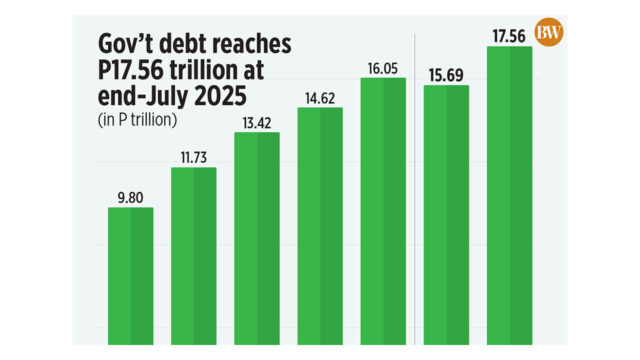
Gov’t debt reaches P17.56 trillion at end-July 2025

THE NATIONAL GOVERNMENT’S (NG) outstanding debt ballooned to a record P17.56 trillion at the end of July, breaching its full-year projection for 2025, data from the Bureau of the Treasury (BTr) showed. Read the full story.

Gov’t debt reaches P17.56 trillion at end-July 2025

Western dysfunction is bolstering China

STOCK PHOTO | Image by User6702303 from Freepik

By Marc Champion

THE POST-GAME ANALYSIS of this week’s gathering near Beijing of non-Western leaders is in. The spectacle of China’s Xi Jinping, India’s Narendra Modi, and Russia’s Vladimir Putin holding hands, hugging, and sharing rides was judged by some as marking a transformative shift in global alliances, and by others as theater. But perhaps they miss the point. We should be judging Xi’s show of strength by its ability to contrast with the chaos and weakness among his competitors in the US and Europe.

What emerged from Monday’s Shanghai Cooperation Organization (SCO) summit was, in concrete terms, thin gruel: A development fund without details or monetary commitments, to be put at the service of a military network that lacks either a collective defense clause or joint command structure. The more substantive message probably came a day later, as Xi oversaw a display of Chinese military power, flanked by Putin and North Korea’s Kim Jong Un, two outlaws of the liberal, US-led order he seeks to destroy.

As my colleague Mihir Sharma has written, no photo op or rhetoric can disguise the fact that India — Xi’s trophy guest at the SCO — remains threatened by China, even as it tries (and likely fails) to achieve some form of detente. The two countries have longstanding border disputes that turned violent as recently as 2020-2021. Just as worrying for New Delhi is that Beijing has become the chief supplier of arms and economic support to Pakistan, India’s nemesis. In May, Islamabad used Chinese fighter jets and PL-15 air-to-air missiles that outrange their US equivalent to humiliate India’s air force, downing brand new French Rafales.

So while India may be the world’s most populous nation and a future superpower, it still needs the US. Putin is now so dependent on Beijing and so overstretched by his invasion of Ukraine that Moscow can offer little of the counterbalance it did through much of the Soviet era. In fact, India’s military is so overmatched by China’s that its dependence on US arms and backing in some ways echoes Europe’s. But again, this misses the point.

It’s less important how fast or effectively China is building its alternative to the US-dominated international systems than that its actions are coherent and have an achievable trajectory. This is what Monday’s SCO diplomacy and Tuesday’s military parade achieved. In the process, they highlighted the contradictory, if not self-destructive, trade and foreign policies of the US administration. And while European policy goals may be more consistent, they’re unachievable absent US support (and therefore largely irrelevant).

How much sense, for example, does it make to compare the SCO’s lack of a collective defense commitment with the North Atlantic Treaty Organization’s Article 5, when Trump has been busy chipping away at the provision’s credibility, and Xi and Kim are supplying Putin with critical components, troops, arms and munitions to fight his war? And why does China need joint command structures to aid Russia in Ukraine? Especially as the US defunds its support for Kyiv and Europe is unable to fill the gap? A British or French military parade held after China’s would be painful to watch.

Modi and other leaders who showed up in Tianjin are far from naïve enough to believe Xi’s rhetoric of equality (or even democracy) among states, his offer of “win-win” solutions, or claimed disinterest in establishing Chinese hegemony. But how they react — by submitting or building up the defenses needed to ensure independence — depends on finding a backer capable of deterring Chinese predations. The US no longer looks like a reliable bet.

In fact, if there is any strategic case to be made for Trump’s effective abandonment of Ukraine, it would be as a step toward repairing US relations with Russia to peel it away from China, America’s only true peer rival. That would severely misinterpret Putin, but it seems unlikely ever to have been a serious US policy goal, given the administration’s willingness to drive Modi, quite literally, into Xi’s arms.

The importance of China’s summitry should not be measured just by how well it did in building the financial institutions and military alliances it wants to replace. Some version of a new Chinese order will come, whether regional or global. Judge it instead by the mirror it has held up to the chaos in Washington and Europe. India, Egypt, Turkey, Vietnam, and other nations either at or watching Xi’s show will draw their own conclusions.

BLOOMBERG OPINION

ADVERTISEMENT
ADVERTISEMENT