Home Blog Page 1035

‘E-luxe’ people mover


The all-electric Zeekr 009 seven-seater is priced at P4.199 million, while the six-seater costs P4.399 million. — PHOTO BY KAP MACEDA AGUILA

Zeekr brings in all-electric ‘luxury MPV’

By Joyce Reyes-Aguila

LOCAL DISTRIBUTOR Autohub Group recently relaunched the Zhejiang, China-headquartered new energy vehicle marque Zeekr with the introduction of the Zeekr 009, a fully electric, luxury multi-purpose vehicle (MVP) — said to be the first of its kind in the Philippines.

Zeekr Philippines Principal and Autohub Group President Willy Tee Ten described the MPV as a vehicle that offers “power, innovation, and comfort… without compromising on luxury and safety. Zeekr has been known in the EV segment as (boasting) luxury, if not ultra-luxury. This is our chance to level-up the Filipino experience in electric vehicle rides.”

Two models are available in the market, the Executive six-seater and the Lounge seven-seater. The fully electric vehicle is equipped with a dual-motor drive system and can deliver 580kW (777hp) and 810Nm of torque. Acceleration time from a standstill to 100kph is a claimed 3.9 seconds. Meanwhile, its 108-kWh Li(NiCoMn)O2 battery provides up to 702km of range between charging sessions. According to the brand, the MPV provides a “first-class cabin experience” with Sofaro premium airline seats on the second row, a foldable table, and Nappa leather upholstery. All seats, including the first row, have electric massage functions.

Enhanced ride comfort comes from air suspension and the CCD Electromagnetic Vibration Reduction System, “minimizing road disturbances.” The Zeekr 009 gets a 15.05-inch touchscreen OLED display, a ceiling-mounted 17-inch OLED display for rear passengers, and a 30-speaker Yamaha surround system.

Safety features include seven air bags and a high-strength integrated rear aluminum structure.

Zeekr International Vice-Chief Marketing Officer Derek Peng, in town for the launch, reported on the company’s goals and achievements. According to him, the Chinese brand has sold more than 470,000 units in the past four years, and targets to sell 320,000 vehicles worldwide in 2025. “(The goal is to deliver) one million units to the global consumers annually by 2026,” he revealed. “(We want to make) Zeekr one of the world’s most respected luxury new energy car groups.

“The Zeekr 009… changed the luxury mobility experience of our consumers and as a luxury brand, we believe in tailor-making the 009,” he continued. “(Our) consumer-centric mindset (has led) to some very notable achievements, (such as) success in the Southeast Asian right-hand drive market where the 009 is the region’s first luxury MPV, surpassing 1,500 units in sales. In Hong Kong, China, it’s dominating as an all-electric luxury MPV since its debut last year in April and claimed the top-selling MPV position in April 2025.”

Both executives announced that the opening of the brand’s Bonifacio Global City showroom is scheduled this month. The launch also provided guests with the opportunity to preview the Zeekr 7X electric mid-size crossover sport utility vehicle (SUV).

The Zeekr 009 seven-seater is priced at P4.199 million, while the six-seater costs P4.399 million. Autohub is offering a special introductory price of P3.999 million and exclusive down payment terms valid until the end of June.
Yields on gov’t debt rise amid geopolitical risks

YIELDS on government securities (GS) ended slightly higher last week amid the continued rise in US Treasuries due to safe-haven demand amid the worsening conflict between Iran and Israel.

However, the rise in yields was capped at the end of the week after the Bangko Sentral ng Pilipinas (BSP) delivered a second straight rate cut on Thursday while signaling further easing to support growth amid benign inflation and global uncertainties.

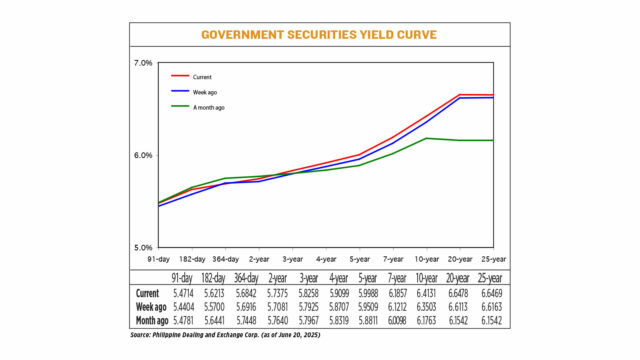
GS yields, which move opposite to prices, increased by an average of 3.81 basis points (bps) week on week, data from the Bloomberg Valuation Service Reference Rates as of June 20 published on the Philippine Dealing System’s website showed.

Rates of all tenors rose except the 364-day Treasury bill (T-bill), which dropped by 0.74 bp to fetch 5.6842%.

At the short end, yields on 91- and 182-day T-bills increased by 3.1 bps and 5.13 bps to 5.4714% and 5.6213%, respectively.

At the belly of the curve, the rates of the two-, three-, four-, five-, and seven-year Treasury bonds (T-bonds) went up by 2.94 bps (to 5.7375%), 3.33 bps (5.8258%), 3.92 bps (5.9099%), 4.79 bps (5.9988%), and 6.45 bps (6.1857%), respectively.

Lastly, at the long end, the 10-, 20-, and 25-year debt papers climbed by 6.28 bps, 3.65 bps and 3.06 bps to yield 6.4131%, 6.6478%, and 6.6469%, respectively.

GS volume traded fell to P27.93 billion on Friday from the P33.32 billion traded a week prior.

“Government securities saw mixed movements [last] week… reflecting cautious sentiment,” Jonathan L. Ravelas, senior adviser at professional service firm Reyes Tacandong & Co., said in an e-mail.

“The BSP’s 25-bp policy rate cut prompted a mild rally in longer-dated bonds as investors priced in easing inflation and slower growth. Market players shifted to medium- and long-term securities, expecting further monetary accommodation,” Mr. Ravelas added.

Yields were mostly higher as the BSP’s policy decision was mostly priced in already before the meeting, a bond trader said.

“It looks like we can expect the BSP to hold in the August monetary policy meeting given expected higher inflation in July amid the increase in oil prices and provisional fare hike,” the trader said.

On Thursday, the Monetary Board lowered benchmark interest rates by 25 bps for a second straight meeting, bringing the target reverse repurchase rate to 5.25%, as expected by 15 out of 16 analysts in a BusinessWorld poll last week.

It has now reduced benchmark borrowing costs by 125 bps since it began its easing cycle in August last year.

BSP Governor Eli M. Remolona, Jr. said they could deliver at least one more 25-bp cut this year, but noted that they remain watchful of emerging risks, including geopolitical tensions and the uncertainties brought about by trade policy shifts among the world’s largest economies.

The Monetary Board has three more policy meetings this year.

On Friday, concerns about the Middle East conflict supported demand for safe haven bonds, Reuters reported.

In the US bond market, which was open again after a federal holiday on Thursday, benchmark 10-year notes rose 2.8 bps to 4.423% from 4.395% late on Wednesday.

Yields had edged higher on Wednesday when US Federal Reserve Chair Jerome H. Powell said borrowing costs are still likely to fall in 2025.

Mr. Powell cautioned against holding on too strongly to forecasts and said he expects “meaningful” inflation ahead as consumers pay more for goods due to the Trump administration’s planned import tariffs.

Meanwhile, US forces struck Iran’s three main nuclear sites, President Donald J. Trump said late on Saturday, and he warned Tehran it would face more devastating attacks if it does not agree to peace.

After days of deliberation and long before his self-imposed two-week deadline, Mr. Trump’s decision to join Israel’s military campaign against its major rival Iran is a major escalation of the conflict and risks opening a new era of instability in the Middle East.

“The strikes were a spectacular military success,” Mr. Trump said in a televised address. “Iran’s key nuclear enrichment facilities have been completely and totally obliterated.”

In a speech that lasted just over three minutes, Mr. Trump said Iran’s future held “either peace or tragedy,” and there were many other targets that could be hit by the US military.

“If peace does not come quickly, we will go after those other targets with precision, speed and skill.”

The US reached out to Iran diplomatically on Saturday to say the strikes are all the US plans and it does not aim for regime change, CBS News reported.

Mr. Trump said US forces struck Iran’s three principal nuclear sites: Natanz, Isfahan and Fordow. He told Fox News’ Sean Hannity show that six bunker-buster bombs were dropped on Fordow, while 30 Tomahawk missiles were fired against other nuclear sites.

The strikes came as Israel and Iran have been engaged in more than a week of aerial combat that has resulted in deaths and injuries in both countries.

Israel launched the attacks on Iran saying it wanted to remove any chance of Tehran developing nuclear weapons. Iran says its nuclear program is for peaceful purposes only.

Diplomatic efforts by Western nations to stop the hostilities have so far failed. United Nations Secretary-General Antonio Guterres called Saturday’s strikes a “dangerous escalation in a region already on the edge — and a direct threat to international peace and security.”

Both sides’ attacks on energy infrastructure, including by Israel on Iran’s South Pars gas field and the risk of a complete shutdown of the OPEC member’s oil production, as well as Iran targeting shipping in the Straits of Hormuz, have fueled fears of a spike in oil prices and impacts on economies worldwide.

Israel launched attacks on June 13, saying Iran was on the verge of developing nuclear weapons. Israel is widely assumed to possess nuclear weapons, which it neither confirms nor denies.

For this week, Mr. Ravelas expects GS yields may trend sideways to slightly lower, especially in longer tenors, as the market digests the BSP’s rate cut and awaits the release of June Philippine inflation data.

“Investor demand could remain strong for benchmark issues amid dovish sentiment,” he said.

Meanwhile, the bond trader expects yields to stay elevated, especially if the Bureau of the Treasury (BTr) shows “a sign of aggressiveness” at this week’s T-bond auction.

On Wednesday, the BTr will offer P40 billion in reissued T-bonds in a dual-tenor auction. Broken down, it will auction off P20 billion in seven-year bonds with a remaining life of two years and 10 months, and P20 billion in 25-year notes with a remaining life of 24 years and seven months.

“The market will also wait for the third-quarter borrowing schedule,” the trader said. — Lourdes O. Pilar with Reuters

Philippines climbs in Global Child Rights Index

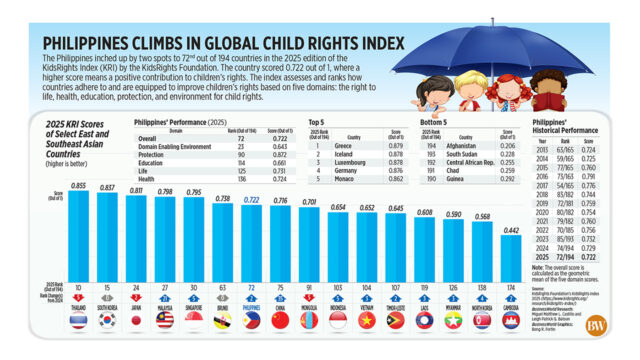
The Philippines inched up by two spots to 72nd out of 194 countries in the 2025 edition of the KidsRights Index (KRI) by the KidsRights Foundation. The country scored 0.722 out of 1, where a higher score means a positive contribution to children’s rights. The index assesses and ranks how countries adhere to and are equipped to improve children’s rights based on five domains: the right to life, health, education, protection, and environment for child rights.

Philippines climbs in Global Child Rights Index

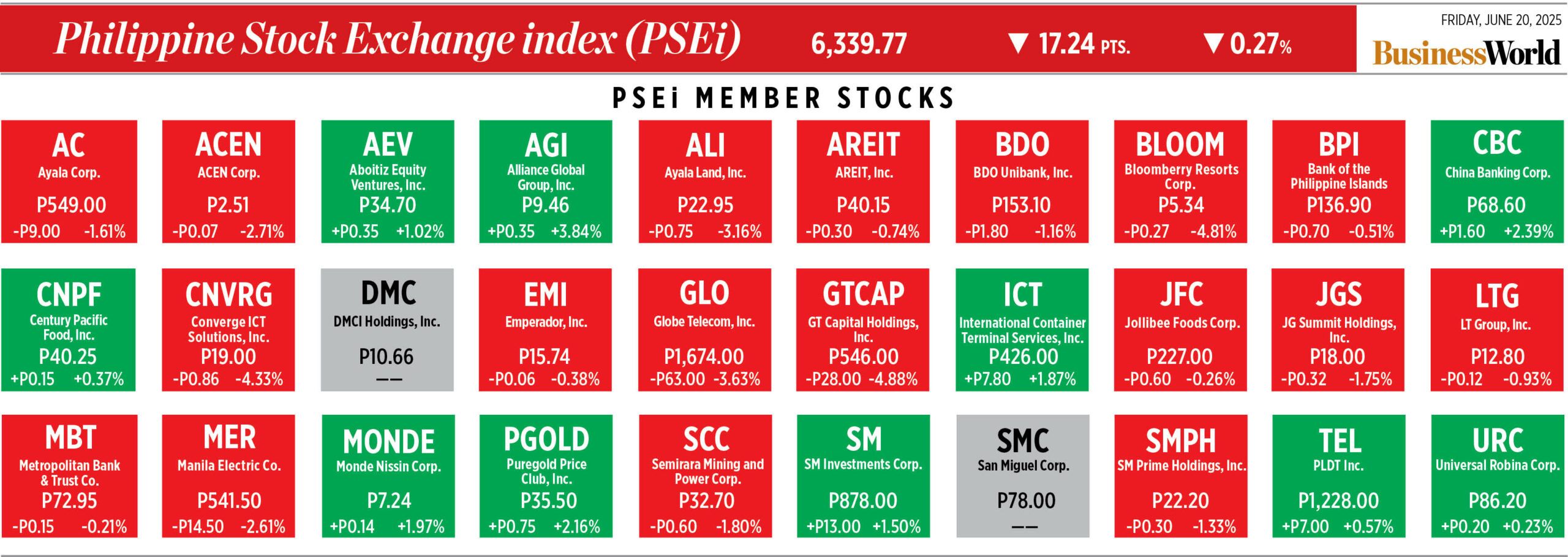
How PSEi member stocks performed — June 20, 2025

Here’s a quick glance at how PSEi stocks fared on Friday, June 20, 2025.


PHL told to strengthen programs for returning OFWs from Israel, Iran

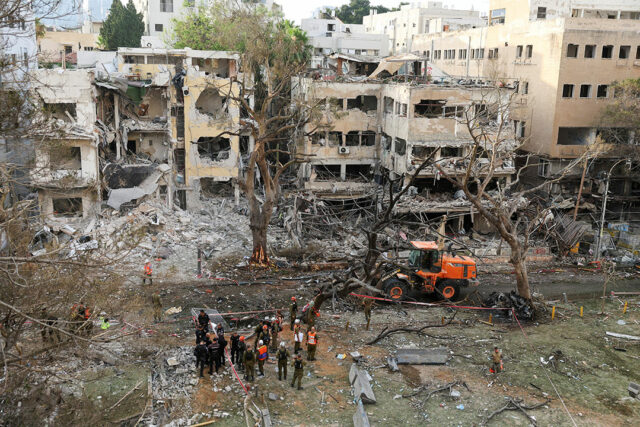
EMERGENCY personnel worked at an impact site after missiles were launched from Iran to Tel Aviv, Israel on June 16, 2025. — REUTERS/RONEN ZVULUN

By Adrian H. Halili, Reporter

THE PHILIPPINES should strengthen its support programs for repatriated overseas Filipino workers (OFWs), analysts said, amid the expected influx of Filipino returnees displaced by the ongoing conflict between Israel and Iran.

Federation of Free Workers (FFW) President Jose G. Matula said that the government should enhance its programs for financial, psychological, and logistical support to all returning OFWs, along with better term reintegration programs.

“Beyond safe repatriation, the challenge lies in ensuring that our returning OFWs are not forgotten the moment they step foot on Philippine soil,” Mr. Matula said in a Viber message.

The Department of Foreign Affairs on June 21 raised the crisis alert level in Israel and Iran to Alert Level 3, calling for the voluntary repatriation of Filipinos amid the increasing tensions between the two countries.

As of June 21, the Philippine Embassy in Israel reported it has received 223 repatriation requests, including 26 OFW repatriation requests that have been confirmed.

Earlier, Israel launched a surprise attack on Tehran as it targeted Iran’s nuclear and ballistic missile facilities and top commanders. Iran launched retaliatory strikes to Tel Aviv a day later.

“OFWs are not just victims of crisis — they are agents of development. With meaningful government intervention, their return can become a stepping stone toward a stronger, more inclusive economy,” FFW’s Mr. Matula added.

He said that the government’s reintegration program continues to be fragmented, limited in its scope, and “Manila-centric.”

“Many OFWs receive one-time aid but no sustained pathway toward reintegration or decent work. This is a missed opportunity,” he added.

He said that government agencies should offer free skills retooling and upskilling for repatriated OFWs that are aligned with needs of the domestic job market.

He added that the agencies should also enable enterprise development for OFWs who plan to start businesses.

Mr. Matula added that putting up more localized reintegration centers in the provinces would ensure that services reach the provinces where most of these workers return.

“The government should disburse funds to assist returning OFWs from Israel and Iran. The (Overseas Workers Welfare Administration) has funds for reintegration of migrants with additional government assistance in cases such as the current emergency of the Israel and US attack on Iran,” said Benjamin Velasco is an assistant professor at the University of the Philippines Diliman School of Labor and Industrial Relations said in a Messenger chat.

He added that the government should evaluate the livelihood projects of OFWs, as many of them face difficulties.

Mr. Velasco said that the Philippines should be more vocal in advocating for an end to the conflict between the middle eastern countries.

“As a labor sending and oil importing country, it is in our national interest to have peace not war, especially in the Middle East. This is strategically what will help OFWs, more than repatriation,” he added.

The Philippine government has not yet issued a mandatory evacuation of Filipinos in the two Middle Eastern countries.

There are more than 30,000 Filipinos living in Israel, while there are more than 1,000 in Iran.

Senator-judges can’t be gagged during VP Sara’s trial, says senator-elect

VICE-PRESIDENT SARA DUTERTE-CARPIO FACEBOOK PAGE

THE SENATE president does not have the power to bar senator-judges from commenting on the impeachment trial of Vice-President (VP) Sara Duterte-Carpio, according to an incoming senator.

“It Is only the senator-judges, and not the presiding judge of the Senate impeachment court, who can decide to refrain from making public comments on the issues surrounding the pending trial of Vice-President Sara Duterte-Carpio,” incoming Senator Panfilo “Ping” M. Lacson said in a statement.

He added that the senator-judges could agree among themselves not to make public comments on impeachment issues.

Last week, congressmen-prosecutors called on Senate President Francis G. Escudero to remind senators that they should not make opinionated statements about the trial.

This came after allies of Ms. Duterte were urged to recuse themselves from the trial given their political bias for the Vice-President.

Senate impeachment court spokesman Reginald A. Tongol told a news briefing on Saturday the impeachment body would use Rule 18 of the Senate Rules of Procedure on Impeachment Trials “sparingly.”

The rule mandates the presiding officer and members of the Senate to refrain from making any comments or disclosures in public about the trial.

Mr. Lacson, however, argued that Mr. Tongol “should not limit himself to the sentiment of the presiding officer.”

Ms. Duterte is expected to be tried in July under the 20th Congress.

Critics have accused Mr. Escudero of delaying her trial, but he insists the Senate would adhere to the law and would not be influenced by parties for and against the Vice-President.

Ms. Duterte, a likely contender in the 2028 presidential election, is accused of secret fund misuse, unexplained wealth, acts of destabilization and plotting the assassination of President Ferdinand R. Marcos, Jr., his family and the Speaker. She has denied any wrongdoing.

The impeachment complaint was filed and signed in February by more than 200 congressmen, more than the one-third vote required by law before it could be sent to the Senate.

Mr. Escudero last week said the Senate impeachment court could only proceed with the trial once she and House of Representatives prosecutors submit their written responses to the impeachment court’s summonses.

He noted that before the Senate adjourned last week, it ruled that the Senate president of the incoming 20th Congress would be the one to schedule the next hearing.

The Senate convened as an impeachment court on June 10, ordering the Vice-President to respond to its summons within 15-days. House prosecutors were given five days to reply to her comment within five days.

As soon as it did so, the court sent back the charges to the House to certify that it did not violate the 1987 Constitution when it impeached the Vice-President.

Speaker Ferdinand Martin G. Romualdez earlier said the decision was “deeply concerning,” adding that they followed the Constitution in impeaching the Vice-President.

Ms. Duterte earlier said her legal team was reviewing the summons issued by the impeachment body.

Her impeachment is the culmination of a months-long feud with Mr. Marcos, following their falling out after his allies in the House launched an inquiry into her use of confidential and intelligence funds.

Presidents in the Philippines are limited to a single six-year term, and Mr. Marcos is expected to seek to maintain his political influence by anointing a successor.

The Speaker said the House would comply with the order of the impeachment court to ensure the process continues. — Adrian H. Halili

US risks losing focus on Indo-Pacific amid Israel-Iran war, analysts say

EMERGENCY personnel worked at an impact site after missiles were launched from Iran to Tel Aviv, Israel on June 16, 2025. — REUTERS/RONEN ZVULUN

By Kenneth Christiane L. Basilio, Reporter

THE US could lose its security focus on the Indo-Pacific region due to escalating war in the Middle East, with dire consequences for the Philippines’ push against Chinese expansion in the South China Sea, political analysts said at the weekend.

Beijing might take advantage of the war between Israel and Iran by stepping up its militarization of the waterway, which could strain regional stability and test Manila’s capability to protect its maritime interests, they added.

“The US is a major security partner in the Indo-Pacific region and underpins much of the region’s defense agreements,” Sherwin E. Ona, a security analyst and associate professor at De La Salle University, said in a Viber message. “So, tensions in the Middle East and their effect on the US defense posture is worrisome.”

Israel launched surprise air attacks against Iran early this month, targeting key nuclear and ballistic missile facilities as well as senior military leaders, in what it described as an effort to cripple Tehran’s ability to develop nuclear weapons.

Washington joined Israel’s military campaign against Iran on Sunday, launching airstrikes on key nuclear sites well ahead of President Donald J. Trump’s two-week timeline to decide on US involvement.

It was a “spectacular military success,” Mr. Trump said in a televised Oval Office address, explaining that US bombers had “totally and completely obliterated” Iran’s vital nuclear facilities. He opened the door for further military action if Iran does not pursue peace. “Future attacks would be far greater — and a lot easier,” he said.

“The US has identified the Indo-Pacific region as a priority theater, but Middle East tensions nevertheless could take away its focus occasionally,” Julio S. Amador III, chief executive officer at Manila-based geopolitical risk firm Amador Research Services, said in a Viber message. “But that does not mean that the South China Sea is being disregarded.”

“The US has to look at both and see whether what should be prioritized,” he added.

An aircraft carrier in the Indo-Pacific was heading to the Middle East, discarding its planned dock at Vietnam. The Philippine Navy was not concerned of the USS Nimitz’s repositioning, with navy spokesman Rear Admiral Roy Vincent T. Trinidad last week saying that the country is capable of defending itself.

The Philippines and US are bound by a 1950s Mutual Defense Treaty that compels both countries to defend each other in case of an armed attack.

“The US is not the Philippines’ security guard,” Mr. Amador said. “The alliance with the US should complement the efforts to defend our maritime domains, but not supplant it.”

An escalation in the Middle East could embolden China to step up harassment of Filipino fishermen in the South China Sea, Chester B. Cabalza, founding president at Manila-based think tank International Development and Security Cooperation, said in a Facebook Messenger chat.

Chinese vessels separately harassed Philippine ships last week at two contested areas in the South China Sea — the Spratly Islands and Scarborough Shoal — as more than 50 Chinese militia ships were spotted anchored near the disputed Iroquois Reef.

China claims nearly all of the South China Sea via a U-shaped, 1940s nine-dash line map that overlaps with the exclusive waters of the Philippines and neighbors like Vietnam and Malaysia.

“Considering that two People’s Liberation Army Navy carrier battle groups are operating near Taiwan and the constant swarming tactics in the South China Sea, [the Middle East conflict] can embolden China to be more aggressive,” Mr. Ona said.

“We cannot discount the possibility that the Middle East tensions can open malign opportunities for Beijing,” he added.

The Chinese Embassy in Manila did not immediately reply to a Viber message seeking comment.

‘UNLAWFUL ACTIONS’
The Philippines should urge regional allies such as Japan and Australia to bolster their presence in the South China Sea and expand joint naval drills with Manila to offset a possible security vacuum that could be created if US pivots more to the Middle East, Mr. Ona said.

“Diplomatic efforts must also be strengthened,” he said, citing the need to push a code of conduct in the disputed waters that aims to prevent conflict in the South China Sea.

The Philippine government should also continue its military modernization efforts to counter China’s military might in the region and continue to “expose” Beijing’s harassment at sea, Mr. Amador said.

Manila has allotted about $35 billion for military upgrades over the next decade.

Mr. Cabalza said the Philippines should maintain a neutral stance in the Israel-Iran conflict and position itself as a potential peace broker by advocating for multilateral dialogue.

Meanwhile, the National Maritime Council condemned China’s Coast Guard (CCG) for its “aggressive” actions against Philippine civilian ships near Scarborough Shoal last week.

In a statement, the agency said a CCG vessel hit a fishery bureau ship with a water cannon on June 20 while its was delivering supplies to Filipino fishermen near the shoal.

“We call on China to cease unlawful actions, act with restraint and adhere to international law to maintain regional peace and stability,” it said.

The Philippine Coast Guard on Friday said two ships of the Bureau of Fisheries and Aquatic Resources were harassed by the CCG near Scarborough Shoal, with authorities monitoring two Chinese navy vessels loitering nearby.

“These actions violate international law,” the council said, adding that their activities jeopardize the safety of fishermen in the area.

Chinese ships have repeatedly barred Filipino fishermen from accessing Scarborough Shoal, which lies within Manila’s exclusive economic zone. The atoll is a vast fishing lagoon near major shipping lanes that China seized in 2012 after a standoff with Philippine troops.

The shoal is 240 kilometers west of the main Philippine island of Luzon and is nearly 900 kilometers from Hainan, the nearest major Chinese landmass.

Marcos secures clean energy, shipping deals in Japan working visit

President Ferdinand R. Marcos, Jr. is joined by Tourism Secretary Ma. Esperanza Christina G. Frasco in a courtesy call of Japanese tourism partners during a working visit in Japan. — PRESIDENTIAL COMMUNICATIONS OFFICE

The Philippines is set to benefit from investment pledges and partnership agreements following a working visit by President Ferdinand R. Marcos, Jr., to Japan, aimed at boosting economic ties and showcasing the country’s potential in clean energy, green shipping, and tourism.

In a statement on Sunday evening following his return, Mr. Marcos said the trip yielded “new opportunities that will create jobs, bring in investments, and help improve the lives of Filipinos.”

Among the deals announced were a collaboration between Japanese firm Kanadevia Corporation and Philippine Ecology Systems Corp. on a waste-to-energy project aimed at waste management while generating renewable power.

Tsuneishi Group, a Japanese shipbuilding conglomerate, committed to construct the world’s first methanol dual-fueled KAMSARMAX bulk carrier in Cebu.

Mr. Marcos also engaged with Japanese tourism executives to bolster arrivals to the Philippine and expand opportunities for Filipino workers.

Discussions with the Japan Aerospace Exploration Agency opened avenues for cooperation in space-based technologies focused on disaster monitoring and agricultural productivity.

The President capped his visit with a meeting with members of the Filipino community in Osaka, lauding their contributions to the economy and image of the Philippines abroad.

He also visited the World Expo 2025, where the Philippine Pavilion was promoted as a symbol of the nation’s innovation and commitment to sustainable growth.

This trip, from June 19-22, was Mr. Marcos’ third time visiting Japan during his presidency. – Chloe Mari A. Hufana

Escalating Iran-Israel conflict to weigh on PSEi

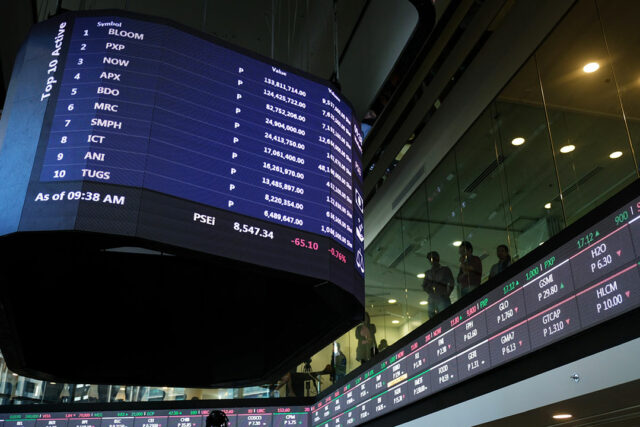
BW FILE PHOTO

PHILIPPINE SHARES may drop further this week as market sentiment could remain bearish due to escalating conflict between Israel and Iran.

On Friday, the bellwether Philippine Stock Exchange index (PSEi) fell by 0.27% or 17.24 points to 6,339.77, while the broader all shares index dropped by 0.49% or 18.62 points to 3,760.56.

Week on week, the PSEi went down by 0.87% or 55.82 points from the 6,395.59 close on June 13.

The market’s performance last week was driven by geopolitical concerns over the Iran-Israel conflict as well as the Bangko Sentral ng Pilipinas’ (BSP) policy decision on Thursday, online brokerage 2TradeAsia.com said in a note.

“The market’s wall of worry continues to steepen. The recent flare-up between Iran and Israel dominated global headlines, reviving concerns of oil supply disruptions and clouding inflation outlook just as central banks were trying to pivot. At the same time, trade tensions have not abated materially…,” it said.

“Back home, the BSP’s long-telegraphed 25-basis-point cut finally came through. With inflation soft and the peso stable, the central bank had room to act, and on paper, is in alignment with the easing bias we have flagged in previous notes,” it added.

For this week, market sentiment may remain bearish due to the escalating conflict between Israel and Iran, Philstocks Financial Inc. Research Manager Japhet Louis O. Tantiangco said in a Viber message. “If the said conflict continues to push oil prices higher and cause the peso to depreciate further, then these may pull the local market lower. A further escalation of the said conflict is also expected to be a significant headwind for the local bourse.”

“Technically, the local market is still moving sideways. However, this sideways movement is exhibiting a downward bias, especially with the market being unable to get past its 10-day exponential moving average,” Mr. Tantiangco said. He placed the PSEi’s major support at 6,150 and major resistance at 6,400.

US forces struck Iran’s three main nuclear sites, President Donald J. Trump said late on Saturday, and he warned Tehran it would face more devastating attacks if it does not agree to peace, Reuters reported.

After days of deliberation and long before his self-imposed two-week deadline, Mr. Trump’s decision to join Israel’s military campaign against its major rival Iran is a major escalation of the conflict and risks opening a new era of instability in the Middle East.

Rizal Commercial Banking Corp. Chief Economist Michael L. Ricafort said in an e-mail that the PSEi’s minor support is at 6,290-6,300 and resistance is at 6,500.

2TradeAsia.com pegged immediate support at 6,300 and resistance at 6,500-6,550.

“In the current environment, portfolio strategy must favor calibration over conviction. Markets remain highly sensitive to exogenous shocks — both geopolitical and policy-driven…,” it said. — Revin Mikhael D. Ochave with Reuters

Peso may remain under pressure amid worsening conflict in the Middle East

BW FILE PHOTO

THE PESO may remain at the P57 level against the dollar this week due to worsening geopolitical concerns after the United States struck Iran’s nuclear sites to join the ongoing conflict in the Middle East.

On Friday, the local unit halted its eight-day losing streak as it closed at P57.17 per dollar, rebounding by 28 centavos from its near three-month low finish of P57.45 on Thursday, Bankers Association of the Philippines data showed.

Week on week, however, the peso dropped by 96 centavos from its P56.21 close on June 13.

“The peso’s recovery today was driven by a softer dollar, improved global risk sentiment, and a technical correction after recent weakness. Easing US inflation data and expectations of a less aggressive US Federal Reserve supported emerging market currencies, including the peso,” Philippine Institute for Development Studies Senior Research Fellow John Paolo R. Rivera said in a Viber message on Friday.

The local unit climbed as Bangko Sentral ng Pilipinas (BSP) Governor Eli M. Remolona, Jr. said the central bank will intervene in the foreign exchange market more strongly if the peso’s weakness threatens inflation, Rizal Commercial Banking Corp. Chief Economist Michal L. Ricafort said in a Viber message.

The dollar was also generally weaker early on Friday on hopes that the US would not join the conflict between Iran and Israel, Mr. Ricafort said. However, on Saturday, the US attacked Iran.

For this week, Mr. Rivera said the market will monitor US economic data and global oil prices to drive peso-dollar trading, adding that geopolitical shocks could cause the local unit to weaken.

Mr. Rivera sees the peso moving between P57 and P57.50 per dollar this week, while Mr. Ricafort said it could range from P56.90 to P57.40.

A US attack on Iranian nuclear sites could lead to a knee-jerk reaction in global markets when they reopen, sending oil prices higher and triggering a rush to safety, investors said, as they assessed how the latest escalation of tensions would ripple through the global economy, Reuters reported.

The attack, which was announced by President Donald J. Trump on social media site Truth Social, deepens US involvement in the Middle East conflict. That was the question going into the weekend, when investors were mulling a host of different market scenarios.

In the immediate aftermath of the announcement, they expected the US involvement was likely to cause a sell-off in equities and a possible bid for the dollar and other safe-haven assets when trading begins, but also said much uncertainty about the course of the conflict remained.

Mr. Trump called the attack “a spectacular military success” in a televised address to the nation and said Iran’s “key nuclear enrichment facilities have been completely and totally obliterated.” He said the US military could go after other targets in Iran if the country did not agree to peace.

A key concern for markets would center around the potential impact of the developments in the Middle East on oil prices and thus on inflation. A rise in inflation could dampen consumer confidence and lessen the chance of near-term interest rate cuts.

While global benchmark Brent crude futures have risen as much as 18% since June 10, hitting a near five-month high of $79.04 on Thursday, the S&P 500 has been little changed, following an initial drop when Israel launched its attacks on Iran on June 13.

Before the US attack on Saturday, analysts at Oxford Economics modeled three scenarios, including a de-escalation of the conflict, a complete shutdown in Iranian oil production and a closure of the Strait of Hormuz, “each with increasingly large impacts on global oil prices.”

In the most severe case, global oil prices jump to around $130 per barrel, driving US inflation near 6% by the end of this year, Oxford said in the note.

Economists warn that a dramatic rise in oil prices could damage a global economy already strained by Mr. Trump’s tariffs.

An escalation in the conflict could have mixed implications for the US dollar, which has tumbled this year amid worries over diminished US exceptionalism.

In the event of US direct engagement in the Iran-Israel war, the dollar could initially benefit from a safety bid, analysts said. — Aaron Michael C. Sy with Reuters

Farm output seen posting strong Q2

PHILIPPINE STAR/MICHAEL VARCAS

By Kyle Aristophere T. Atienza, Reporter

AGRICULTURE is expected to post stronger growth in the second quarter, driven by a significant rise in rice and corn output, the Department of Agriculture (DA) said on Sunday.

Palay (unmilled rice) output is projected at 4.36 million metric tons (MMT) in the second quarter, which would be up 13% from a year earlier, the DA said in a statement.

This also represents an upgrade to the 4.34 MMT forecast issued in April.

The increase is driven by the growth in riceland to be harvested — up 9.2% at 972,730 hectares — and improved yields, projected at 4.48 MT per hectare, up from 4.32 MT previously.

The DA cited favorable weather, increased government support through the Rice Competitiveness Enhancement Fund (RCEF), contract farming initiatives, and stronger palay procurement by the National Food Authority (NFA).

The NFA currently buys palay at between P18 and P24 per kilo.

The farmgate price of palay has averaged P17.75 per kilogram, down 28.9% year on year in May.

Month on month, the palay farmgate price fell 1.6% in May.

The DA said corn production is expected to grow “even more dramatically,” noting that based on the standing crop as of May 1, the government projects second-quarter output to increase 27% year on year to 1.487 MMT.

The land area to be harvested is set to expand 16% to 402,690 hectares.

Rice and corn production are major contributors to crop production, which accounts for about 57% of agricultural output.

Meanwhile, the DA said in a separate statement it is putting the “final touches” on a draft bill that aims to restore critical functions of the NFA.

The bill seeks to amend the Rice Tariffication Law to grant certain regulatory powers to the NFA to “better manage buffer stocks” and “regulate rice distribution and marketing,” it said.

The bill also seeks to empower the NFA to set a floor price for palay, and support farmers’ cooperatives and recipients of rice processing systems funded under the RCEF.

“It will also refine protocols for DA-led rice imports to ensure the country can respond swiftly to supply shortages and sudden spikes in commodity prices,” the DA added.

“Critically, the measure grants the NFA greater flexibility in managing the appropriate level of buffer stock and ensuring that they are always of optimum quality — an essential tool in supporting not only the P20-per-kilo rice goal but also broader government efforts to ensure price stability and protect both producers and consumers,” the DA said.

PHL-EU third round of FTA talks make ‘good progress’

REUTERS

THE Department of Trade and Industry (DTI) said the third round of negotiations last week for a Philippines-European Union (EU) free trade agreement (FTA) was marked by “good progress.”

“Good progress has been made in the text-based negotiations,” Trade Undersecretary for International Trade Policy Allan B. Gepty said via Viber.

“Our fourth round of negotiations will be in October in Manila, but we have agreed to take advantage of intersessional (consultations) to help fast-track the negotiations,” he added.

Mr. Gepty was in Brussels last week for the third round of FTA negotiations.

“This is a very important FTA for the Philippines not only because the EU remains one of our major trade partners but also because it is also a major source of investment,” he said.

“This FTA will further deepen and strengthen our economic relations with the EU,” it added.

Last month, EU Ambassador to the Philippines Massimo Santoro cited the importance of speedily concluding negotiations for the FTA without compromising quality in the face of recent events, including the new US tariff measures.

He also noted that both parties aim to include a digital trade chapter in the FTA, which is considered vital in improving services and access in an archipelago like the Philippines.

“The potential gains from this agreement extend far beyond trade and investments as we cover elements also on sustainability, good governance, and cooperation,” Mr. Gepty said.

The EU is a key market for Philippine tuna, coconut, cacao, pineapple, semiconductors, and electronics.

In 2024, the Philippines exported $8.073 billion worth of goods to the EU, while importing $7.463 billion. — Justine Irish D. Tabile