Home Blog Page 102

BSP cuts key rate, signals easing cycle nears end

Bangko Sentral ng Pilipinas (BSP) Governor Eli M. Remolona, Jr. -- Reuters

By Katherine K. Chan

THE Bangko Sentral ng Pilipinas (BSP) on Thursday lowered its benchmark policy rate anew by 25 basis points (bps) to 4.5% and signaled the current easing cycle is nearing its end.

The Monetary Board cut its target reverse repurchase rate for a fifth meeting in a row, bringing the rate to its lowest in over three years or since September 2022.

It likewise trimmed rates on the overnight deposit and lending facilities by 25 bps each to 4% and 5%, respectively.

This was in line with a BusinessWorld poll conducted last week where 17 out of 18 analysts anticipated a 25-bp cut at the Board’s last meeting of the year.

“Depending on the data, (the easing cycle) may have ended already. This may be the last cut,” BSP Governor Eli M. Remolona, Jr. said during a press briefing. “But depending on what else we see, we can still con-sider another cut.”

The central bank has so far lowered key borrowing costs by 200 bps since it began its easing cycle in August last year. It delivered a 25-bp cut at each of its meetings in April, June, August and October this year.

“On balance, the Monetary Board sees the monetary policy easing cycle nearing its end,” it said in a statement.

The Monetary Board’s decision to deliver a fifth straight cut came on the back of expectations that the economy will continue to weaken due to downbeat business sentiment amid the ongoing flood control controversy.

“The Monetary Board noted that the outlook for domestic economic growth has weakened further. Overall business sentiment has continued to decline on concerns about governance issues and lingering uncertainty over global trade policy,” it said.

“Nevertheless, domestic demand is expected to rebound slowly as the full impact of monetary policy easing works its way through the economy and as the pace and quality of public spending improves.”

The Philippine economy saw its weakest growth in over four years at 4%, a slump from the 5.5% seen in the second quarter and the 5.2% a year ago. This brought gross domestic product (GDP) growth to an average of 5% as of September, below the government’s 5.5-6.5% growth target.

“Sentiment remains weak due to the corruption issue as we can gauge from various sentiment indices,” Mr. Remolona said.

Business and investor sentiment has weakened as an ongoing probe revealed some government officials, lawmakers and private contractors received billions in kickbacks from anomalous infrastructure projects.

“The (rate) cut will revive economic activity a bit at a time when painful governance issues around infrastructure investments have weakened government spending, business confidence, and domestic demand,” Mr. Remolona said.

BSP Deputy Governor Zeno Ronald R. Abenoja said the GDP growth may settle around 5% by yearend.

The central bank chief said the economy might only start to rebound by the second half of 2026, noting that rate cuts usually take one to two years to take full effect.

“I was hoping we would recover by the first half,” Mr. Remolona said. “With the new data we’re getting, it looks like it’s more (going to) be in the second half rather than the first half.”

“And we’re hoping by 2027, we will be more or less back on target,” he added.

Still benign inflation likewise prompted the BSP to cut benchmark rates, after the consumer price index (CPI) eased to 1.5% in November on negative food inflation, slower than the 1.7% in October and 2.5% a year ago.

November marked the ninth consecutive month that inflation settled below the central bank’s 2%-4% target and brought the 11-month CPI to average 1.6%.

“The outlook for inflation continues to be benign, and inflation expectations remain firmly anchored,” the BSP said.

The central bank now expects inflation to end at 1.6% this year, lower than its earlier projection of 1.7%. However, it hiked its inflation forecasts for next year to 3.2% from 3.1% and for 2027 to 3% from 2.8%.

Mr. Remolona noted that supply shocks may push inflation faster, but negative investor sentiment could help it slow down.

“The high inflation scenario would be due to possible supply shocks such as power rate adjustments and increased rice tariffs. The low inflation scenario would be if investor sentiment remained negative for a protracted period,” he said.

The peso hitting the P59-per-dollar level has not impacted inflation “for now,” he said.

“It hasn’t weakened enough, and the oil prices have been benign,” the BSP chief said. “It’s when the two of them move in an adverse direction together that we begin to worry about.”

On Tuesday, the peso sank to its lowest ever at P59.22 against the dollar after the greenback strengthened on expectations of a Fed cut.

However, it recovered on Thursday after closing at P58.99 per dollar, up 22 centavos from its P59.21 finish on Wednesday, Bankers Association of the Philippines data showed.

FURTHER EASING LIMITED

While Thursday’s cut may be the end of the central bank’s easing cycle, Mr. Remolona still left the door open for another reduction if economic conditions turn “worse than they thought.”

“Any additional easing will likely be limited and will be guided by incoming data,” the BSP said in a statement.

“Looking ahead, the BSP will ensure that overall policy settings remain consistent with maintaining price stability conducive to sustainable economic growth.”

Oxford Economics Lead Economist Sunny Liu also said that this could be the last cut following the BSP’s cautious monetary policy signals, but dismal economic growth may still call for further easing.

“We expect no further rate cuts in 2026. That said, a sharper-than-expected slowdown in economic activity could still prompt additional easing,” she said in a note.

However, Pantheon Macroeconomics Chief Emerging Asia Economist Miguel Chanco said the Monetary Board may deliver another 25-bp cut at its first meeting next year.

“We continue to believe that the Board won’t stop easing until its benchmark interest rate falls to a terminal level of 4.25%; we now expect the last 25-bp move to come almost immediately at its first meeting in 2026,” he said in a note.

“It’s clear that the Board still sees space and a reason to potentially ease further in the foreseeable future,” he added.

Rizal Commercial Banking Corp. Chief Economist Michael L. Ricafort said that benign inflation and the need to boost economic growth provide the BSP additional room to ease more next year.

He projects inflation to remain below target until March next year, before accelerating to between 2% and 3% by April until December.

Flood control fiasco imperils Philippines’ credit rating — Fitch Ratings

A protestor holds a placard depicting a crocodile during the second Trillion Peso March at the People Power Monument in Quezon City, Nov. 30. -- PHOTO BY MIGUEL DE GUZMAN, The Philippine Star

By Katherine K. Chan

THE Philippine economy continues to bear the brunt of the ongoing flood control corruption scandal, Fitch Ratings said, noting that further unrest could spill over to the country’s credit rating.

Fitch Ratings Head of Asia-Pacific Sovereigns Thomas Rookmaaker said the controversy surrounding the anomalous government flood control projects threatens the country’s political stability, fiscal policy implementation, as well as business and consumer confidence.

“We believe that the flood control corruption scandal in the Philippines poses an ongoing risk to political stability, fiscal policy execution, and business and consumer confidence,” Mr. Rookmaaker told BusinessWorld in an e-mail.

Government officials, lawmakers and contractors have been accused of getting billions of pesos in kickbacks from substandard or nonexistent flood control projects. This has triggered widespread protests, slowed government spending, and hurt investor and consumer sentiment.

“The overall impact the scandal will have on the Philippines’ public finances is still uncertain,” Mr. Rookmaaker said.

“Public investment spending is likely to remain weak for quite some time, but continued social unrest could simultaneously lead to spending pressures to head off public discontent.”

In October, government spending fell for a third straight month to P430.6 billion, down 7.76% from P466.8 billion a year ago. Revenues likewise slipped by 6.64% to P441.7 billion from P473.1 billion last year.

Mr. Rookmaaker noted that the immediate impact of the scandal was reflected in the sharp economic slowdown in the third quarter.

Philippine gross domestic product (GDP) expanded by an over four-year low of 4% in the third quarter, as household final consumption expenditure and government spending slowed amid the corruption mess.

For the first nine months, GDP growth averaged 5%, well-below the government’s 5.5-6.5% full-year target.

Public investments likewise took a hit from the corruption issues, he added.

In the third quarter, foreign investment pledges approved by investment promotion agencies plunged by 48.7% to P73.68 billion, Philippine Statistics Authority data showed.

“Persisting social tensions could become more of a drag on growth if confidence among foreign and domestic investors suffers,” the Fitch analyst said. “Tensions could also serve as a distraction for policymakers, impeding the passage of reforms that have the potential to enhance economic productivity and competitiveness.”

Mr. Rookmaaker said implementing reforms to enhance accountability and governance could bolster private investments and promote growth in the medium term.

Still, he noted that continued instability may negatively impact the debt watcher’s outlook on the Philippine economy, which could potentially lead to a credit rating downgrade.

“If social unrest would reduce our confidence in strong, stable medium-term economic growth and continued adherence to sound economic policies, this could lead to negative rating action,” Mr. Rookmaaker said.

“Failure to maintain a stable government (debt-to-GDP) ratio, for example due to scaling back fiscal consolidation further to support growth, or a significant deterioration in the foreign currency reserve buffers, could also put the rating under downward pressure,” he added.

Fitch Ratings last affirmed its “BBB” long-term foreign currency issuer default rating and “stable” outlook for the Philippines in April. A “stable” outlook means the Philippines will likely maintain its rating in the next 18 to 24 months.

Budget Undersecretary and Principal Economist Joselito R. Basilio said in October that Fitch Ratings had “verbally” affirmed its outlook on the Philippines.

However, in a separate report, Mr. Rookmaaker noted that the Philippines’ ongoing fiscal measures amid the economic slowdown may dampen fiscal consolidation and cause public debt to worsen.

He added that social unrest due to the widening corruption issues could intensify next year, raising further fiscal and economic risks.

“Bouts of political unrest have the potential to weigh on sovereign economic and fiscal performance, and to influence governance standards and institutions,” he said in Fitch Ratings’ Asia-Pacific Sovereigns Outlook 2026 dated Dec. 8.

Still, Mr. Rookmaaker said the country could keep its credit rating by improving governance standards to match its peers and bringing government debt ratios well below the “BBB” median.

“Stronger medium-term growth and continued adherence to sound macroeconomic policies, supporting faster convergence of GDP per capita towards peer levels, could also improve the sovereign credit profile,” he added.

Taiwan pushes for closer economic links with Philippines amid China tensions

A Taiwan flag can be seen on an overpass ahead of National Day celebrations in Taipei, Taiwan, Oct. 8. -- REUTERS/Ann Wang

By Kenneth Christiane L. Basilio, Reporter

KAOHSIUNG, TAIWAN — Taiwan is looking to bolster its economic ties with the Philippines through potential engagements and industry expansion, as both grapple with shared security concerns in the region, Taiwanese officials said.

Taipei is seeking to forge an economic corridor with Manila that is similar to a project started last year by the US, Japan and the Philippines in northern Luzon, which aims to enhance the connectivity of the main Philippine island’s key economic regions, Taiwan Deputy Minister of Foreign Affairs Chen Ming-Chi said late on Tuesday.

“Taiwan aims to align with the strategic objectives of our like-minded partners and deepen bilateral economic ties with the Philippines,” he said at an opening gala of a port development forum organized by Taiwan’s Ministry of Foreign Affairs here.

“The Philippines is a key partner for Taiwan, with our interests and strategies closely aligned,” he added. “Both nations are committed to upholding freedom, democracy and regional peace and stability.”

Taipei and Manila share a trade relationship, and they are forging deeper ties amid mounting tensions with China. Beijing sees Taiwan as its own territory and is not shying away from taking control of the island by force, while Chinese ships have repeatedly clashed with Philippine vessels within the Southeast Asian nation’s exclusive economic zone in the South China Sea.

The Taiwan-Philippines Economic Corridor will help Manila in port development, with Taipei also planning to build data servers in the Philippines and expand cooperation in agriculture and workforce training, Ministry of Foreign Affairs Director-General for International Cooperation and Economic Affairs Yu-Ping Lien said on Wednesday.

She said Taiwan is seeking to train young Filipino workers to build a pool of skilled talent that could help attract more Taiwanese companies to invest in the Philippines.

“The Philippines has a demographic dividend, and Taiwan is in shortage of labor,” she told BusinessWorld in an interview on the sidelines of the port development forum.

Taipei also aims to help modernize the Philippines’ food sector by sharing artificial intelligence (AI) technology to boost industry development and increase agricultural yields, Ms. Lien said.

The Taiwanese government plans to collaborate with the Philippines on its national food hub in Clark, Pampanga, helping in managing its distribution and logistics systems, she added.

“We use smart devices to do distribution management. We are very good at management and distribution,” said Ms. Lien. “We would like to cooperate with the Philippines to be a part of the partners in the food hub.”

The Clark hub is viewed as a gateway for Philippine agricultural goods to reach global markets, offering services such as distribution, storage and processing of high-value produce for domestic and overseas buyers. Construction is underway after the project was launched in late October.

Ms. Lien said Taiwan is also looking at possibly having some of its data centers hosted in the Philippines.

“It’s very important for data storage and data flow… to have a second place,” she said. “We would like to find a second place to establish our AI data center so that when anything happens, there will be a safe harbor for our data.”

China claims Taiwan as a breakaway province and has threatened to annex the island, putting its 23 million people and the world’s most advanced semiconductor factories at risk.

“Taiwan suffers a lot of pressure from the other side of the Taiwan Strait,” Ms. Lien said. “We know that the China problem is not only for Taiwan, but also for the world, especially the First Island Chain,” referring to the string of nations stretching from Japan in the north through Taiwan and the Philippines to Indonesia in the south.

“This is another very important strategic reason that we want to strengthen our ties with the Philippines… Why not we work together to manage this kind of threat from China? So that the First Island Chain will be a united force to face the threat,” Ms. Lien said.

Sought for comment, the Chinese Embassy in Manila told BusinessWorld: “There’s but one China in the world and Taiwan is part of China. This is an undeniable historical and legal fact, and an unchangeable status quo in the Taiwan Strait. The Taiwan question is purely China’s internal affairs and is at the core of China’s core interests.”

The US, a close ally of the Philippines and Taiwan, released its national security strategy last week, in which it urged allies along the First Island Chain to grant greater US military access to their ports and other facilities.

“One needs to bear in mind the relationship of economic and defense sectors. That at the end of the day, what can bolster the military and defense capabilities of a country is also defined by its economic strength,” Josue Raph-ael J. Cortez, a diplomacy lecturer at De La Salle-College of St. Benilde, said in a Facebook Messenger chat.

“Deepening the trading ties that it has with other nations is one way of strengthening its economy,” he added.

Taiwan’s ports are automated and technologically advanced, while the Philippines is working to modernize its facilities to keep pace with growing shipping demand.

Ms. Lien said Taipei wants to boost the development of Philippine seaports. “We want to have more cooperation, especially in the port management… we all put our energy into that,” she said.

“The movement of goods and people between our two countries relies heavily on the efficiency and effectiveness of our ports,” Mr. Chen said.

INDUSTRIAL PARK

Also on Wednesday, Ms. Lien said Taiwanese authorities are considering establishing an industrial park in the Philippines that would serve as a site for Taiwanese companies’ investments in the country.

“We are evaluating the possibility,” she said. “We would like to own the park, then we manage the park, and we will introduce our investment, the whole ecosystem in the park.”

Ms. Lien said Taiwan has already shared its proposal with Philippine authorities, and that Taipei wants a memorandum of understanding with Manila for the negotiations on the proposed investment site, which she said could host Taiwan’s data centers, factories and clean energy facilities.

“The concept has already been conveyed to the Philippines government,” she said. “We also want to sign a memorandum of understanding to establish an institutional structure so that the following negotiation or consultation will be in a frame and guided in the same objective that is agreed by both sides.”

ADB approves $500-million loan to support Philippines’ blue economy

A fisherman tries to catch fish in Taal Lake, Talisay, Batangas. Photo by RYAN BALDEMOR, THE PHILIPPINE STAR

THE ASIAN Development Bank (ADB) has approved a $500-million (around P29.56-billion) policy-based loan to support the development of the Philippines’ blue economy and improve the resilience of coastal communities.

The financing for the Marine Ecosystems for Blue Economy Development Program Subprogram 1 was approved on Thursday, the multilateral lender said in a statement.

This loan seeks to “strengthen the productivity and diversity of the country’s ocean-based economy, and improve the health and adaptability of coastal areas and communities,” the ADB said.

The program also aims to improve the plastic and solid waste management value chain to ensure long-term ecological and economic resilience in the Philippines.

“More than half of the Philippine population is dependent on the country’s oceans and rich marine biodiversity for food and livelihoods, with the blue economy having great potential to be central to attaining inclusive, resilient, and low-carbon development,” ADB Country Director for the Philippines Andrew Jeffries said.

“This is ADB’s first extensive cross-sector program focused on fostering national blue economy development in the region. We are committed to assisting our host country in achieving its climate resilience and low-carbon objectives,” he added.

In addition, Agence Française de Développement and Germany’s KfW Development Bank are set to provide cofinancing of up to €200 million (about P13.82 billion) each for Subprogram 1.

Last year, key blue economy sectors generated P1.01 trillion ($17.17 billion) to the country’s economy, accounting for 3.8% of gross domestic product.

The blue economy includes fisheries, manufacturing of ocean-based products, tourism-related services, shipping, and offshore energy.

However, marine ecosystems in the Philippines are being affected by plastic and solid waste pollution, as well as extreme weather.

The Philippines, the world’s second-largest archipelagic nation, is battered by around 20 typhoons each year, with cyclones growing stronger in recent years.

The Marine Ecosystems for Blue Economy Development Program is aligned with the Philippine Development Plan 2023-2028 and supports the implementation of the National Adaptation Plan (NAP) 2023-2050.

The NAP is a joint initiative of the Climate Change Commission and the Department of Environment and Natural Resources to craft fit‑for‑purpose, science‑based adaptation strategies for sectors already facing and expected to face the impacts of climate change.

The program leverages ADB’s backing for climate action under the Climate Change Action Program, the bank’s first climate policy‑based loan in the region.

The loan complements the Philippines Flyway Project, which focuses on conserving and managing three priority wetlands, such as Candaba in Luzon, and Lake Mainit and Sibugay wetlands in Mindanao. This aims to bolster biodiversity, expand sustainable livelihoods, and improve climate resilience.

Earlier this year, ABD expressed its support for the proposed Blue Economy Act to improve marine-based livelihoods and ensure the long-term sustainability of the ocean economy.

The Senate passed Senate Bill No. 2450 in August last year, while the House approved its counterpart in December 2023. However, lawmakers failed to ratify a reconciled measure before the end of the 19th Congress.

Senators Lorna Regina “Loren” B. Legarda and Senator Risa N. Hontiveros-Baraquel have refiled the measure since the 20th Congress opened.

President Ferdinand R. Marcos, Jr. will support renewed efforts to pass the Blue Economy Act, Palace Press Officer Clarissa A. Castro said in July.

The ADB was the second-biggest development partner of the Philippines in 2024 with 59 loans and grants worth $11.05 billion. — Aubrey Rose A. Inosante

ICTSI signs 25-yr deal to operate South Africa’s Durban terminal

transnet.net

By Ashley Erika O. Jose, Reporter

Listed port operator International Container Terminal Services, Inc. (ICTSI) has signed a 25-year partnership with Transnet SOC Ltd., South Africa’s state-owned logistics company, to manage and upgrade Durban Container Terminal (DCT) Pier 2.

Under the deal, Transnet retains ownership through a majority stake in the special purpose vehicle Newco, while ICTSI will handle the terminal’s day-to-day operations, a move seen as potentially giving the company additional scale and influence in a key global logistics corridor.

“This partnership marks a shared commitment to revitalizing South Africa’s maritime infrastructure and unlocking new opportunities for growth for South Africa and the entire region,” ICTSI Senior Vice-President Hans-Ole Mad-sen said in a media release on Thursday.

Transnet, established as South Africa’s state-owned freight and logistics operator, manages the country’s port, rail, and pipeline network. According to its website, it operates 16 port terminals across seven South African ports (excluding Mossel Bay), covering automotive, bulk and break-bulk cargo, containerized cargo, and minerals.

The partnership covering the management, upgrade, and development of Pier 2 will formally take effect in January 2026.

DCT Pier 2 is Transnet’s largest container terminal, handling more than 70% of Port of Durban’s throughput and roughly 46% of South Africa’s port traffic. The terminal has 1,760 meters of operational quay length and 120 hectares of container storage and backup area.

“Through our deliberate and expansive investment in new equipment across our terminals, the performance of DCT Pier 2 has been on an upwards trajectory. We expect that our partnership with ICTSI will further propel this crucial terminal to its full potential,” Transnet Group Chief Executive Officer Michelle Phillips said.

The terminal is expected to expand capacity from 2 million to 2.8 million twenty-foot equivalent units (TEUs) through new equipment and technology upgrades. These improvements are projected to reduce logistics costs, enhance service quality, broaden market access, and attract additional cargo volumes, ICTSI said.

Globalinks Securities and Stocks, Inc. Head of Sales Trading Toby Allan C. Arce noted that the partnership “could meaningfully lift consolidated throughput, diversify earnings further away from cyclical Asian and Latin American exposures, and strengthen ICTSI’s positioning as one of the most globally diversified port operators based in an emerging market.”

AP Securities, Inc. Equity Research Analyst Shawn Ray R. Atienza said Transnet’s operational expertise is expected to help smooth ICTSI’s development of the Durban port by leveraging its local presence and reducing the regulatory risks typically associated with operating overseas.

“Should the partnership prove successful, this opens up ICTSI for expansion to more countries, thereby positioning itself as one of the biggest port operators globally,” he added in a Viber message.

In 2023, ICTSI was selected as Transnet’s preferred partner following an international tender process. The award was later challenged by Danish shipping giant Maersk, but South Africa’s High Court ruled in ICTSI’s favor in October, upholding the contract and dismissing Maersk’s petition.

Established in 1987, ICTSI operates 33 terminals across 20 countries on six continents.

For the January-to-September period, its attributable net income rose 18.81% to $751.56 million from $632.58 million a year ago, while consolidated revenues grew 16.42% to $2.34 billion from $2.01 billion in the same period last year. Its largest revenue contributor remains in Asia, generating $985.63 million, followed by the Americas at $919.70 million, and Europe, the Middle East, and Africa (EMEA) at $432.46 million.

“Entering South Africa at a time when the government is actively seeking private-sector partners for turnaround initiatives positions ICTSI as a preferred operator for future African port liberalization efforts,” Mr. Arce said in a Viber message.

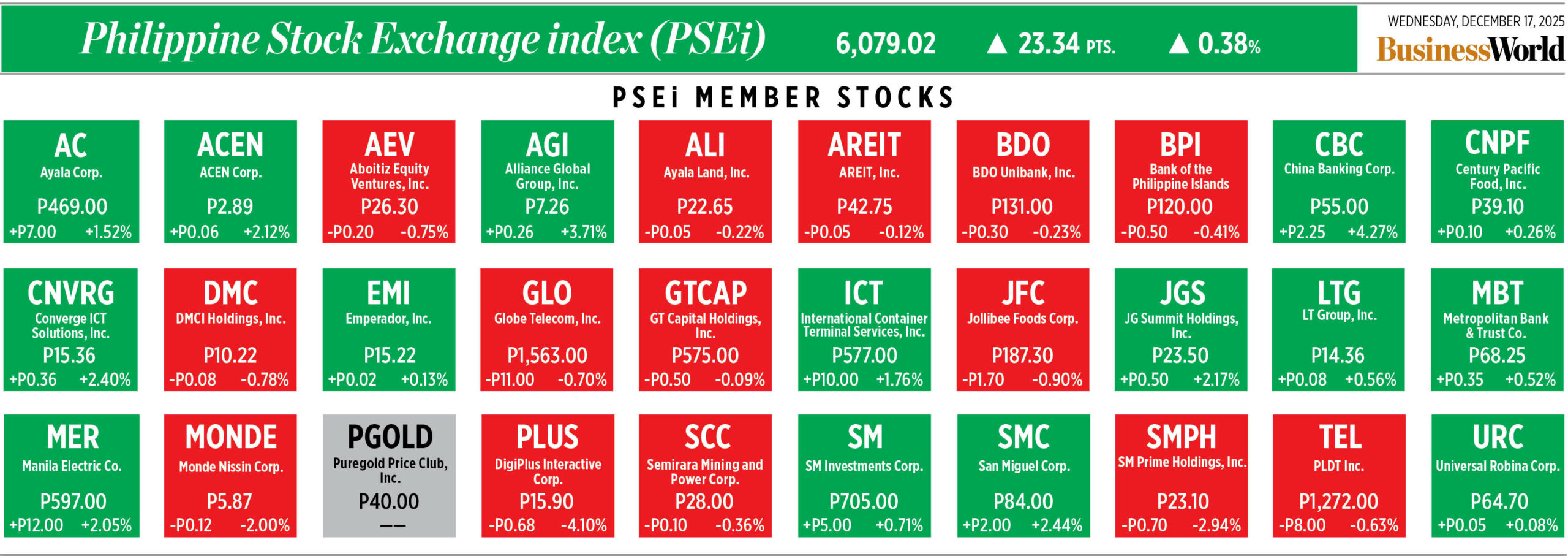
At the Philippine Stock Exchange on Thursday, shares in ICTSI rose P10, or 1.67%, to close at P608 apiece.

ACEN-Citicore JV secures P2.59-B loan for solar operations

acenrenewables.com

ACEN CORP. and Citicore Solar Energy Corp.’s joint venture (JV) Greencore Power Solutions 3, Inc. has secured a P2.59-billion loan from the Development Bank of the Philippines (DBP), aimed at supporting the Pampanga solar plant and its renewable energy operations, the companies said.

ACEN and its subsidiary ACEN Global Development Group, Inc. have signed an omnibus loan and security agreement with DBP to act as sponsor and share collateral guarantor for Greencore 3, according to a regulatory filing on Thursday. Citicore Solar will serve as sponsor and collateral grantor for the loan.

Greencore 3 operates the 115.671-megawatt Arayat-Mexico Photovoltaic Solar Power Plant in Pampanga.

The facility began full commercial operations in August 2022 and currently supplies electricity for over 19,450 households.

ACEN also plans to subscribe to additional shares in Greencore amounting to P859.11 million to help the joint venture meet its financial obligations.

The transaction involves the purchase of 2.41 million common A shares at P1 each and 41.97 million redeemable preferred A shares at P20.41 apiece.

ACEN said the subscription is part of a planned increase in Greencore 3’s authorized capital stock, pending approval by the Securities and Exchange Commission.

The Pampanga solar plant is part of ACEN’s 7.1-gigawatt renewable energy portfolio across the Philippines, Australia, Vietnam, India, Indonesia, Laos, and the United States.

The company has earmarked over P80 billion in capital expenditure for 2026 to support its renewable energy pipeline. — Sheldeen Joy Talavera

RISING WATERS, RAISING RIGHTS: Cinemata presents human rights through the lens of water

SHORT FILMS that explore human rights in relation to water — as survival, environment, memory, livelihood, and resistance — make up “Rising Waters, Raising Rights,” a film festival commemorating human rights.

Exhibited online, the festival kicked off on Dec. 10, which was International Human Rights Day, at the University of the Philippines, and will run until Dec. 20. It is organized by Cinemata, a video platform dedicated to showcasing independent films from the Asia-Pacific region, with a strong focus on social issues, community storytelling, and human rights advocacy.

“Often, environmental rights are seen as separate from human rights, but water is a fundamental human right. It’s about the territories we live in, our access to a healthy environment, and our survival,” Eunice Hel-era, the festival’s film programmer, told BusinessWorld in a Facebook message.

The Philippine edition of the program is co-organized by Film Workers Against Corruption and curated by Elevated Frames PH, which Ms. Helera leads. In addition to the online screenings, there are also physical and communi-ty-based screenings to be announced, including talkbacks and facilitated discussions, mounted across partner venues and organizations within the 10-day screening window.

The chosen films, divided into three interconnected thematic programs, present stories of coastal labor, climate vulnerability, displacement, queer becoming, cultural memory, and community resistance:

Sinking Grounds — This program centers on climate, flood, and survival, with five films that tackle environmental destruction, displacement, and everyday adaptation. The films are: Dahican (2023) by Boogs Rosales; Sunog sa Sugbo (2025) by Jon Owen Lepiten; Kung Bakit Madumi ang Ilog sa’min (2024) by Aaron Alsol; Here, Here (2020) by Joanne Cesario; and Dagami Daytoy (2020) by Noni Abao.

The program offers subtle depictions, like in Here, Here, where water is not directly seen but is instead heard, to show how mining operations pollute and disrupt communities. It also offers straightforward documentary, like Dagami Daytoy, which shows the effects of mining on indigenous lands.

Ms. Helera pointed out that the films don’t only guard against overt violence. “Sometimes it’s about how people fight to preserve their environment and their way of life,” she said, adding in a timely note that “we shouldn’t glo-rify resilience when people are struggling with the consequences of government neglect.”

Tides of Silence — A unique take on the overarching theme is “Tides of Silence,” which presents stories of queer identity, psychological violence, longing, myth, and becoming. The films here are: Sea Lullabies (2025) by Mina Cruz; Silang Mga Naligaw sa Limot (2021) by Vahn Pascual; Read-Only Memory (2022) by Kristine Camille Sulit and David Corpuz; More Than Just Ripples (2024) by Xanthe Baldonado; and Astri & Tambulah (2017) by Xeph Suarez.

“We do think it’s important to recognize that the urgency of these recent films reflects the immediate crises we’re facing — climate change, political tension, and social upheaval,” Ms. Helera explained.

On the more cultural themes of family, love, loss, and memory, she told BusinessWorld that the films may be new, but their subject matter is not. “The issues and concerns we fight for in human rights have been longstanding and have always been here longer than what we’re currently sharing in our program,” she said.

Fisherfolk & Frontlines — Finally, showcasing stories about labor and livelihood at risk is “Fisherfolk & Frontlines.” In it are depictions of the realities of maritime labor, ancestral waters, and survival under economic and ecolog-ical pressure. The films here are: Salog Ning Diklom (2021) by Siege Ledesma; Lusong (2023) by Nolz Dela Cruz; Dambuhalang Panganib sa Pakil (2025) by Joanna Robles; Yaman ng Dagat: Batanes (2012) by Nick Deocampo; and Objects Do Not Randomly Fall From the Sky (2024) by Maria Estela Paiso.

Ms. Helera said that she and the programmer for the Malaysian edition of the festival curated the films based on advocacies close to them. “For me, it was the current strong wave of the times back in September, about the flood control projects, and the release of [the documentary] Food Delivery which talked about territory disputes,” she said.

The program on fisherfolk takes viewers from Batanes and Zambales to Laguna and Bicol. The documentary Lusong, set in Bulacan, highlights the reality of those without access to jobs or food security and how they turn to dan-gerous electric fishing to provide for their families.

To conclude, Ms. Helera expressed her hope that films that speak to Filipino realities will continue to be supported.

“We hope that viewers will appreciate seeing how water has been a lens for human rights over time,” she said. “This is an ongoing conversation, and we want to keep that door open for more perspectives.” Organizations, institutions, and film clubs that wish to mount a free community watch party may coordinate directly with the organizing team via e-mail: contact@cinemata.org. For more information on the screenings, follow Cinemata’s official Facebook page at https://www.facebook.com/cinematavideo. — Brontë H. Lacsamana

SMIC sees growth opportunities in 2026 despite hesitant investor sentiment

smsupermalls.com

SM INVESTMENTS CORP. (SMIC) expects continued growth next year, citing opportunities outside the National Capital Region (NCR) and in infrastructure and energy, even as investors remain cautious amid political developments, supply chain disruptions, and currency pressures, its executives said.

“We’ll just have to do our work in spite of all of the political noises. So for us, we’re going to continue what we have planned. And I think we will be able to achieve our targets next year,” SMIC Vice-Chairperson and BDO Uni-bank, Inc. Chairwoman Teresita T. Sy-Coson said in a speech late Wednesday.

BDO President and Chief Executive Officer Nestor V. Tan said business uncertainty is likely to continue into 2026, as investors remain cautious amid supply chain disruptions, geopolitical risks, and political developments.

“2025 was a rollercoaster year. We started out very strong, honestly. I’m talking about the bank and the business environment. We had a very strong fourth quarter last year. It was carrying over. And then, liberation day happened. So people started to pull back. And then as things are starting to stabilize, things are starting to improve, then what happens? We have geopolitical risks, problems, and then as things are starting to settle, supply chains are being normalized, then we have the flood control thing. And now, the mood is I would say at best, somber,” he said.

He added that the uncertainty is not due to a lack of willingness to invest, but rather because investors prefer to wait for clearer signals.

“From a business perspective it’s tough this year and we continue to think that 2026 will understand because the business is uncertain. The business community is not sure what’s likely to happen and therefore if they’re not sure what’s likely to happen and therefore, if they’re not sure, then they will hold back. Not because they don’t want to invest, but they will hold back a little. And we expect that to happen going into 2026,” he said.

Mr. Tan also noted that the weaker peso could affect sentiment.

“Magkakaroon ng pressure sa currency natin. And the perception of the currency is also important (There will be pressure on our currency, and perception of the currency is also important),” he said.

He also cited the recent downgrades in the Philippines’ growth forecasts.

“Sends a negative message. So people will probably rethink or just defer whatever they need to do,” he said.

Despite these challenges, Mr. Tan said opportunities remain in certain areas.

“But it’s not all doom and gloom because there are still pockets of opportunities outside of the environment that we see. We still see provincial expansion going on. It’s growing faster than NCR in the average. So we still see some positive light there. We still see some activity in infrastructure, in energy and the like. So then, people continue to invest. It’s just not a general positive move across the board,” he said.

Foreign direct investment (FDI) net inflows fell 25.8% to $320 million in September from $432 million a year earlier, according to the latest Bangko Sentral ng Pilipinas (BSP) data. This marked the lowest monthly FDI inflow in more than five years, since $313.79 million was recorded in April 2020.

For the first night months, SMIC’s net income grew 6% to P64.4 billion from P60.9 billion a year earlier, driven by its banking arm.

Meanwhile, BDO’s nine-month net income rose 4.07% to P63.09 billion from the same period last year, supported by sustained growth in its core businesses. — A.M.C. Sy

Del Monte Pacific says Q2 profit jumped to $16.8M on strong sales

DELMONTEPACIFIC.COM

DEL MONTE Pacific Ltd. (DMPL) said its net profit for the second quarter (Q2) ended Oct. 31 jumped nearly seven-fold to $16.8 million from $2.3 million a year ago, driven by higher sales.

For the first half of its fiscal year 2026, Del Monte’s net profit from continuing operations rose to $56.3 million, up from last year, supported by a 10% increase in sales to $423.3 million, it said in a statement on Thursday.

Sales growth was led by the Philippines, where packaged pineapple and mixed fruits recorded strong demand. Packaged pineapple benefited from nutrition-led campaigns, while mixed fruits expanded beyond seasonal fruit salads to year-round desserts, lifting market share by 4 percentage points, according to the company.

Internationally, fresh pineapple exports rose 23%, with North Asia remaining the company’s largest market for imported pineapples at a 51% share.

Net debt of continuing operations declined 4.79% to $994.9 million from $1.04 billion a year ago, reflecting improved cash flow and stronger operating results.

Del Monte deconsolidated its US subsidiary Del Monte Foods Corp. effective May 1, 2025, after the unit filed for Chapter 11 bankruptcy in April due to heavy debt and shifting consumer preferences.

The US unit secured $912.5 million in financing to continue operations while selling most of its assets under court supervision.

Joselito D. Campos, Jr., DMPL and Del Monte Philippines, Inc. (DMPI) chief executive officer, said: “Our excellent results demonstrate the underlying strength and potential of our Asian business. With DMPL’s deconsolidation and complete write-down of its US investment and other assets, we have a clear path forward. We are proactively working on capital initiatives at the DMPI level to enhance our financial flexibility as we invest in growth.

At the Philippine Stock Exchange on Thursday, DELM shares closed 1.38% higher at P5.15 apiece. — Alexandria Grace C. Magno

It will take cost-cutting to create more Avatar films after Fire and Ash

A scene from Avatar: Fire and Ash

LOS ANGELES — For James Cameron, following the release of the 2025 movie Avatar: Fire and Ash, it’s imperative to cut costs for future Avatar franchise films.

If the Canadian and New Zealand filmmaker can’t find a way to make the cost of production “cheaper,” he may be “doing something else” before getting to the fourth and fifth Avatar films that he’s previously announced plans for.

“There are many, many variables ahead of us before we can talk about four and five and beyond,” he told Reuters.

“It’s a universe, like the (George) Lucas universe, for example, it’s open-ended. I’ve only imagined a few more stories. Maybe it continues. Maybe it doesn’t,” he added.

Avatar: Fire and Ash, distributed by Disney, is scheduled to debut in movie theaters on Dec. 19, continuing the saga of the blue Na’vi people. Sam Worthington plays Jake Sully, and Zoe Saldaña portrays his wife, Neytiri.

It opens in the Philippines on Dec. 17, and has an MTRCB rating of PG.

All three of the Avatar films that have been completed utilize advanced motion capture technology, requiring large-scale budgets.

Mr. Cameron worries that with the popularization of streaming platforms, less people will see films in the movie theaters, including his Avatar projects. However, he remains optimistic.

“I still think people want to go have that deeper, more profound experience that you have when you can’t pause it (a movie). The second you can pause it, you lose that,” the Oscar-winner said.

For the cast members, it was meaningful to find emotional connections to their characters to keep themselves immersed in the fictional world.

“I plastered burn victims all over my trailer, which was horrific,” said Oona Chaplin, who portrays the new antagonist named Varang, the Na’vi leader of the volcano-dwelling clan. While she said she doesn’t think she would do that again, it did help her channel some of her character’s anger and grief.

Similarly, Zoe Saldaña, who reprises her role as Neytiri, said that being a real-life mother helped her channel Neytiri’s grief after losing a child.

Mr. Cameron applauded each actor’s authentic performance, noting that Avatar does not use any generative AI (artificial intelligence) to develop films.

“We have not historically used generative AI on Avatar films. I think the broad public doesn’t know how we’ve made these movies. They think it’s some kind of computer thing and now AI,” he added.

While the idea of synthetic actors replacing human actors worries the Titanic director, he does see the value in using AI as a supplementary tool to support creative endeavors. — Reuters

PNB raises P15.7 billion from sustainability bond offering

THE PHILIPPINE STAR

PHILIPPINE National Bank (PNB) has raised P15.7 billion from the sale of dual-tranche bonds to fund sustainable initiatives.

This was over five times the bank’s initial target of P3 billion, it said in a disclosure to the stock exchange on Thursday.

“The issuance marks the bank’s successful return to the domestic debt capital market since 2019, garnering an orderbook that was more than 5.2 times oversubscribed the initial target size on back of the strong support from in-stitutional and retail investors,” PNB said.

“The net proceeds from the bonds will be used to finance or refinance eligible projects under PNB’s Sustainable Financing Framework consistent with the ASEAN Sustainability Bonds Standards, a reflection of the PNB’s resolute commitment towards sustainable financing in tandem with the bank’s growth mode.”

The bonds were issued, settled, and listed on the Philippine Dealing & Exchange Corp. on Thursday.

Broken down, PNB raised P10.88 billion from three-year Series A ASEAN Sustainability Bonds that were priced at 5.4877% per annum. It also issued P4.82 billion in five-year Series B ASEAN Sustainability Bonds, which carry an interest rate of 5.7764% per annum.

The papers were sold at a minimum investment amount of P100,000 and in increments of P50,000 thereafter.

This marked the first issuance from the bank’s P50-billion bond and commercial paper program that was approved earlier this year.

PNB’s investment banking arm PNB Capital and Investment Corp., ING Bank N.V. Manila Branch, and Standard Chartered Bank were the joint lead arrangers and bookrunners for the transaction.

Meanwhile, PNB, ING Bank, and Standard Chartered were the selling agents.

PNB saw its net income rise by 25.79% year on year to P6 billion in the third quarter, backed by higher revenues. This brought its nine-month profit to P18.51 billion, up by 22.91% from P15.06 billion a year pri-or.

Its shares dropped by 10 centavos or 0.2% to close at P50.90 each on Thursday. — Aaron Michael C. Sy

We are hardwired to sing — and it’s good for us, too

Photo Credit | UNSPLASH

ON THE FIRST SUNDAY after being named leader of the Catholic Church in May 2025, Pope Leo XIV stood on the balcony of St. Peter’s Basilica in Rome and addressed the tens of thousands of people gathered. Invoking tra-dition, he led the people in noontime prayer. But rather than reciting it, as his predecessors generally did, he sang. In chanting the traditional “Regina Caeli,” the pope inspired what some have called a rebirth of Gregorian chant, a type of monophonic and unaccompanied singing done in Latin that dates back more than a thousand years. The Vatican has been at the forefront of that push, launching an online initiative to teach Gregorian chant through short educational tutorials called “Let’s Sing with the Pope.” The stated goals of the initiative are to give Catho-lics worldwide an opportunity to “participate actively in the liturgy” and to “make the rich heritage of Gregorian chant accessible to all.” These goals resonated with me. As a performing artist and scientist of human movement, I spent the past decade developing therapeutic techniques involving singing and dancing to help people with neurological disorders. Much like the pope’s initiative, these arts-based therapies require active participation, promote connection, and are accessible to anyone. Indeed, not only is singing a deeply ingrained human cultural activity, research increasingly shows how good it is for us.

THE SAME OLD SONG AND DANCE
For 15 years, I worked as a professional dancer and singer. In the course of that career, I became convinced that creating art through movement and song was integral to my well-being. Eventually, I decided to shift gears and study the science underpinning my longtime passion by looking at the benefits of dance for people with Parkinson’s disease.

The neurological condition, which affects over 10 million people worldwide, is caused by neuron loss in an area of the brain that is involved in movement and rhythmic processing — the basal ganglia. The disease causes a range of debilitating motor impairments, including walking instability. Early on in my training, I suggested that people with Parkinson’s could improve the rhythm of their steps if they sang while they walked. Even as we began publishing our initial feasibility studies, people remained skeptical. Wouldn’t it be too hard for people with motor impairment to do two things at once?

But my own experience of singing and dancing simultaneously since I was a child suggested it could be innate. While Broadway performers do this at an extremely high level of artistry, singing and dancing are not limited to pro-fessionals. We teach children nursery rhymes with gestures; we spontaneously nod our heads to a favorite song; we sway to the beat while singing at a baseball game. Although people with Parkinson’s typically struggle to do two tasks at once, perhaps singing and moving were such natural activities that they could reinforce each other rather than distract.

A SCIENTIFIC CASE FOR SONG
Humans are, in effect, hardwired to sing and dance, and we likely evolved to do so. In every known culture, evidence exists of music, singing or chanting. The oldest discovered musical instruments are ivory and bone flutes dating back over 40,000 years. Before people played music, they likely sang. The discovery of a 60,000-year-old hyoid bone shaped like a modern human’s suggests our Neanderthal ancestors could sing. In The Descent of Man, Charles Darwin speculated that a musical protolanguage, analogous to birdsong, was driven by sexual selection. Whatever the reason, singing and chanting have been integral parts of spiritual, cultural, and healing practices around the world for thousands of years. Chanting practices, in which repetitive sounds are used to induce altered states of consciousness and connect with the spiritual realm, are ancient and diverse in their roots.

Though the evolutionary reasons remain disputed, modern science is increasingly validating what many traditions have long held: Singing and chanting can have profound benefits to physical, mental and social health, with both immediate and long-term effects.

Physically, the act of producing sound can strengthen the lungs and diaphragm and increase the amount of oxygen in the blood. Singing can also lower heart rate and blood pressure, reducing the risk of cardiovascular diseases. Vocalizing can even improve your immune system, as active music participation can increase levels of immunoglobulin A, one of the body’s key antibodies to stave off illness.

Singing also improves mood and reduces stress. Studies have shown that singing lowers cortisol levels, the primary stress hormone, in healthy adults and people with cancer or neurologic disorders. Singing may also rebalance autonomic nervous system activity by stimulating the vagus nerve and improving the body’s ability to respond to environmental stresses. Perhaps this is why singing has been called “the world’s most accessible stress reliever.”

Moreover, chanting may make you aware of your inner states while connecting to something larger. Repetitive chanting, as is common in rosary recitation and yogic mantras, can induce a meditative state, inducing mindfulness and altered states of consciousness. Neuroimaging studies show that chanting activates brainwaves associated with suspension of self-oriented and stress-related thoughts.

SINGING AS COMMUNITY
Singing alone is one thing, but singing with others brings about a host of other benefits, as anyone who has sung in a choir can likely attest. Group singing provides a mood boost and improves overall well-being. Increased levels of neurotransmitters such as dopamine, serotonin, and oxytocin during singing may promote feelings of social connection and bonding. When people sing in unison, they synchronize not just their breath but also their heart rates. Heart rate variability, a measure of the body’s adaptability to stress, also improves during group singing, whether you’re an expert or a novice. In my own research, singing has proven useful in yet another way: as a cue for movement. Matching footfalls to one’s own singing is an effective tool for improving walking that is better than passive listening. Seemingly, active vocalization requires a level of engagement, attention, and effort that can translate into improved motor patterns. For people with Parkinson’s, for example, this simple activity can help them avoid a fall. We have shown that peo-ple with the disease, in spite of neural degeneration, activate similar brain regions as healthy controls. And it works even when you sing in your head.

Whether you choose to sing with the pope or not, you don’t need a mellifluous voice like his to raise your voice in song. You can sing in the shower. Join a choir. Chant that “om” at the end of yoga class. Releasing your voice might be easier than you think.

And, besides, it’s good for you. — The Conversation via Reuters Connect

Elinor Harrison is a Lecturer at the Performing Arts Department, and Faculty Affiliate in Philosophy-Neuroscience-Psychology at the Washington University in St. Louis. She has received funding from the National Institutes of Health, the National Endowment for the Arts, and the Grammy Museum Foundation. She is affiliated with the International Association of Dance Medicine and Science and the Society for Music Perception and Cognition.