Home Blog Page 10040

Euronext wheat falls in 2019

PARIS — Euronext wheat closed with an annual decline after a year-end rally only partly offset a price drop linked to a recovery in European production.

March milling wheat, the most active contract on the Paris-based exchange, settled 0.25 euros, or 0.1%, down at 188.75 euros ($212.08) a ton after a shortened session on Tuesday ahead of the New Year holiday.

The contract was consolidating below Monday’s six-month high of 189.75 euros. That peak came after a rally in international wheat markets linked to an initial US-China trade agreement, steady export demand and global harvest concerns.

Over the year, spot futures on Euronext, including the current March contract, showed a 7.1% decline from the 203.25 euro close at the end of 2018.

European Union common wheat production rose 14.5% this year from the drought-hit 2018 harvest, according to the European Commission.

However, a global price rally, brisk export demand and an expected drop in the sown area for next year’s harvest helped the European wheat market recover towards the end of the year.

“We’re seeing good international demand along with a drop in wheat area in France, Germany and Britain, which means there’s no room for a major weather upset,” said Arthur Portier of consultancy Agritel.

The wheat market was also monitoring transport strikes over pension reform in France, which could disrupt a wave of shipments to Morocco.

Rapeseed futures on Euronext ended the year with a sharp gain, reflecting the impact of a 13-year low for EU production and a broad year-end rally in oilseed markets.

February rapeseed on Euronext ended Tuesday’s session 0.3% down at 411.50 euros a ton.

It was consolidating below Monday’s high of 414.75 euros, the highest spot price since the end of April 2017.

Over 2019, spot rapeseed prices rose nearly 13%.

The smaller maize (corn) futures market on Euronext showed a 5.6% annual decline in spot prices, ending the year at 168.50 euros a ton.

Euronext crop futures will resume trading on Thursday after Wednesday’s New Year closure. — Reuters

A century’s worth of incredible wealth went through the Cartier empire

BY THE TIME the final chunk of the Cartier jewelry empire was sold off in the 1970s, its founding family was almost entirely dispersed and disinterested.

Almost everyone was wealthy — the Cartier family had an uncanny knack for marrying into money, then making even more of it. And even though four generations of Cartier men had worked tirelessly to create a business that elevated jewelry salesmanship from “mere trade” to an art form, their descendants were more interested in bobsledding in St. Moritz than hawking the company’s famous Tank watches.

This rise and then — instead of a “fall,” let’s call it a “plateau” — is artfully documented in a new book, The Cartiers, by a member of the family’s sixth generation, Francesca Cartier Brickell.

Several years ago, Brickell discovered a trunk full of family correspondence in her grandfather’s wine cellar and used it as a starting point to chronicle her illustrious family.

What saves the book from being yet another variation on the “from shirtsleeves to shirtsleeves in three generations” parable is that the family business hinged on the shifting fortunes of the world’s super rich. As a result, the story of the Cartier family is the story of wealth creation in the 19th and 20th centuries as it moved in waves from country to country.

Massive wealth, at least from the Cartiers’ perspective, was often a zero-sum game: The Russians bought until the Bolsheviks came to power, at which point the Americans stepped in. After the Depression hit, the Americans bowed out, at least for a time, to be replaced by celebrities and petroleum-rich Middle Easterners.

Cartier managed to benefit from both the rises and the falls. The company would sell jewels at retail prices to its rich clients, then buy them back wholesale (or sell them on commission) once those same clients fell on hard times. “The same grand duchesses who had been snapping up diamond tiaras and sapphire stomachers before the war,” Brickell writes, “were now selling them back, often gemstone by gemstone, just to survive.”

ROYAL PATRONAGE
The Cartier dynasty was founded in the late 1840s by Louis-Francois Cartier. His little Parisian shop, where he sold mostly knickknacks, took off only when he began to enjoy the patronage of Princess Mathilde Bonaparte, the niece of Napoleon I.

Initially, she asked him to repair a necklace, but she soon became a bona fide customer, purchasing more than 200 items. And even though Cartier’s first client base was wiped away after Napoleon III abdicated following the Franco-Prussian war, the company continued to expand thanks to Louis-Francois’s son, Alfred, who married an heiress to a manufacturing fortune.

Alfred first worked in London after the Franco-Prussian war “as a middleman between fellow French exiles forced to sell their gems to pay for their new lives, and the English aristocracy whose daily rituals demanded a change of jewels for every meal,” Brickell writes. After moving back to Paris, he expanded until the company counted multiple princes and princesses among its clientele.

WORLD DOMINATION
Even though Cartier was selling significant jewels to significant people (it made the wedding jewels for Princess Marie Bonaparte’s marriage to Prince George of Greece in 1907), it was still a distant second or third to such companies as Boucheron, Fabergé, and even Tiffany. It was only the next generation of Cartier children — Louis, who first married a French heiress, and then a Hungarian heiress; Pierre, who married an American heiress; and Jacques, who did the same — who elevated Cartier to a global powerhouse.

Using the Rothschilds as a template, the three brothers agreed to open outposts in separate world financial centers. Louis, the oldest, opened in Paris; Pierre, the middle son, in New York; and Jacques, the youngest, in London.

Louis helped develop the famously playful aesthetic known as the “Cartier style” and, most important, broke into the Russian market.

His entree was via Grand Duchess Vladimir, a jewel-obsessed sister-in-law of the czar of Russia. Not only did she buy a six-strand pearl necklace interspersed with diamond eagles, Brickell writes, but she opened doors for the Cartier family, making introductions to other members of the Russian imperial family and facilitating sales.

Meanwhile, Pierre first set up the London office (Jacques would later take it over) and then moved to New York, where he began to cultivate the country’s nouveau riche. He sold the Hope Diamond to Evalyn Walsh McLean for $180,000 (about $4 million today), and exchanged a $1 million pearl necklace for Cartier’s Fifth Avenue flagship mansion, which it still owns today.

Jacques, something of a late bloomer, traveled first to India to build relationships with the country’s fabulously rich Maharajas, and then took over the London branch, creating jewels for the royal family and English aristocracy. Queen Elizabeth II, for instance, eventually tasked Cartier with turning a 23.6-carat pink diamond into a brooch.

DEATH AND TAXES
Even as the brothers were expanding their client list, that clientele was changing dramatically. The first blow was the Russian revolution. Grand Duchess Vladimir escaped Russia and had one of her friends sneak out several suitcases filled with jewels from her St. Petersburg palace. Prince Yusupov, another Cartier client and one of the richest men in the world, also escaped the Bolsheviks with many of his jewels intact, and, like the grand duchess, began to discreetly sell them through the Cartiers.

The family’s commitment to discretion, combined with their rolodex, made them the perfect intermediaries. “The Cartiers were privy to levels of trust from the Romanovs that would have been impossible to reach had they not visited their family homes prior to the revolution,” Brickell writes. “As a result, they were often the first to learn when exiled Russians were keen to sell their imperial jewelry, a key advantage when competing with their professional peers.”

The same thing would happen to the Maharajas, whose fortunes were obliterated by land reforms and new taxation structures in the 1970s.

Suddenly, Arab sheikhs and American movie stars like Liz Taylor were the clients spending the big money. But by that time, all three brothers were dead, and their children, with the exception of Jacques’s son Jean-Jacques, were part of the jet set themselves.

Because The Cartiers is the story of the family rather than the company, it begins to peter out well before Cartier’s eventual sale in 1974. (Today the company is owned by luxury goods conglomerate Richemont.)

Brickell, the granddaughter of Jean-Jacques, has no discernible nostalgia for the lost business, and as a result the book’s real value comes as a chronicle of the global vicissitudes of extreme wealth.

In 1958, for instance, King Faisal II of Iraq informed the family that his fiancee’s bridal registry would be at Cartier. A few weeks later, he and his family were murdered in a coup. “As with the Bourbons and the Romanovs,” Brickell writes, “the flip side to great wealth and power was inequality and, with it, social instability.” — Bloomberg


Safer road trips with Hella

HELLA, a leading European manufacturer of auto parts, believes being smart on the road is the key to avoiding vehicular accidents, be it night or day. Hella advocates for road safety by improving visibility when driving through sight and sound. With its high-quality, secure, and stylish products, Hella hopes to provide the market with the right tools needed to become smarter drivers and car owners.

CLEARER AND SAFER DRIVE
Vehicular safety can be best ensured by having a clear view of the road through your windshield. It also helps you see crossing pedestrians who are on their way home or going to the office, especially those working the night shift.

Hella offers a wide range of wipers that can be installed for passenger vehicle use. They feature a nanotechnology graphite-coated rubber blade for smooth and quiet operation with clear visibility, and contact points with even downward pressure to deliver a clean wipe at every point. Some of Hella’s wipers have a robust spoiler design to endure extremely harsh weather and environmental conditions. Hella offers Premium Wiper Blade, Curvo Wiper Blade and Razor Wiper Blade.

For commercial vehicles, Hella has wipers that have thicker graphite-coated rubber, a heavy duty steel frame for maximum stability and durability, glossy surface powder coating for rust protection in all weather, and multiple adaptors for maximum vehicle coverage.

OPTIMAL SOUND PERFORMANCE
The sound within the surrounding helps drivers to navigate the road better. In fact, horns make it easier for drivers to be heard, especially during emergencies or heavy rains. They also come in handy when alerting other nearby vehicles.

Hella offers horns that have varying sounds including a soft timbre and mellow sound for a more harmonic tone like the Royal Twin Tone trumpet horn, and a strong penetrating tone that is ideal for tough off-road use like Super Tone Horn. They have twice the lifetime of OE specification, are corrosion-resistant and can be installed easily in tight and limited spaces.

A BRIGHTER CHOICE
Lights are an essential part of the driving experience. They help you see the road more clearly, especially during those long late night or early morning drives to avoid rush hour traffic. Uniquely designed and engineered with high-quality standard, Hella’s bulbs produce xenon-like natural daylight output for higher contrast and better visibility.

Hella’s bulb offerings have wider field and longer range of clearer vision that allow faster reaction time for safer driving. They employ high-quality UV-filtered quartz glass which reduces eye strain. They come in two variants: PowerBleu and Platinum performance bulbs, both designed for easy plug-and-play installation and directly interchangeable with original equipment (OE) bulbs.

A careful driver ensures that his vehicle is free of defects by installing quality and well-maintained car parts. With Hella’s high-quality and stylish product offerings, roads can become safer even after the holiday season because drivers and consumers now have access to tools they need to travel smarter.

How the Philippines can emulate South Korea’s success

On Aug. 15, 1945, Emperor Hirohito announced Japan’s surrender following its invasions of countries in the Asia Pacific region. Its colony in Korea was divided into two spheres, with the south administered by the United States and the north by Russia. The two Koreas existed with tension between them and this culminated in June 1950 when the North invaded the South. The two Koreas have been at war ever since.

The South embraced free trade, economic deregulation, and privatization under the leadership of Harvard-educated statesman, Syngman Rhee. Rhee served as the nation’s President from 1948 to 1960. Rhee and his equally successful successor, Park Chung Hee, shaped South Korea’s institutions and legal system into one conducive to capitalism. They established a strong legal system where property and human rights are upheld. They invested in education. They even went so far as to provide credit, subsidies, and lucrative contracts to certain companies who blazed the trail for the country’s rapid industrialization. Called chaebols, the likes of Hyundai and Samsung invested billions in highly technical industries that would serve as the backbone of the South Korean economy. These included steel mills, petrochemical plants, and high precision electronic factories.

The situation was different in the north. Kim Il-Sung established himself as the country’s dictator in 1947 with the help of the Soviet Union. He organized the North Korean economy as one that was centrally planned and controlled in accordance with the so-called Juche System (where self reliance is the core principle). In Kim Il-Sung’s world, ownership of properties were outlawed, free markets were banned, and freedoms were curtailed in all aspects of life. The citizens received only basic education with emphasis on the country’s propaganda. Like a monarchy, Kim Il-Sung’s descendants became his successors, all of whom subscribed to the same Juche System.

Decades later, South Korea evolved into an industrial powerhouse and a leader in numerous high-technology industries including computer manufacturing, robotics, and telecommunications. It is the 12th largest global economy today and its citizens enjoy the same standard of living as the people of Spain and Italy. In contrast, the North Korean people are starving, literally. Their industrialization failed and their agricultural sector survives on a hand to mouth basis. The living standards of the North Koreans are similar to the people of Somalia. Worse, life expectancy of North Koreans is 10 years less than their southern relatives.

From being one and the same nation just seven decades ago, the two Koreas have become stark opposites of the other. How did this happen?

According to economists Daron Acemoglu and James A. Robinson, the manner in which the laws and institutions of a nation are organized largely dictates whether a nation succeeds or fails. Successful nations are those that encourage economic participation by the masses to make the best use of their talents. It is one where no one from the political or business elite have undue advantages over the rest. Successful nations have inclusive economies and they foster economic activity, productivity, growth, and prosperity.

On the other hand, unsuccessful nations concentrate power among a narrow elite who enrich themselves at the expense of the masses. This model is called an “extractive economy.”

Inclusive economies are those that are organized as free market economies, conform to fair competition, adhere to the rule of law, possess strong banking systems, and adapt to the democratic selection of leaders.

A free market situation provides incentives for the people to work hard, to invent, to innovate, and to become efficient. By doing so, they are able to grow their businesses and enrich themselves. This, in turn, triggers a snowball effect of job generation, productivity, and increased revenues for government by way of taxes.

In countries like North Korea and Cuba where markets are controlled by their governments and where the ownership of private property is prohibited, its citizens have little incentive to invest or exert effort to increase productivity. They do not bother to hustle or toil as doing so will not make a difference in their lives. The stifling regime represses innovation and douses the entrepreneurial spirit with cold water.

Fair competition and an even playing field is another ingredient to a nation’s success. When governments disrupt the free market by coddling monopolies, giving preferred treatment to certain individuals, increasing barriers to entry, or demanding payola from private companies — all these prevent real competition from taking place. It makes the dominant player even more dominant but also more inefficient. This inefficiency translates to higher costs for the consumers and, more often than not, to poor service. While the dominant company can boast of scandalous profits, it is usually unable to hold up against with competition from abroad.

On the other hand, when corporations are allowed to compete on an level playing field, the entire industry becomes efficient. The company that emerges as the dominant force is the one that is more outstanding than the rest in terms of innovation, creativity, and capability. It will be in the position to conquer foreign markets.

The ability to uphold the rule of law is another characteristic of successful economies. The law is the great equalizer. All citizens, and especially government, must respect the rule of law as without it, chaos, mayhem, and/or human rights violations ensue. Private enterprises must be able to rely on the rule of law when certain forces (like government or politicians) try to disrupt free market forces or when injustice occurs. The rule of law puts order to free trade. It protects corporations and it does so by allowing due process to take its course.

A strong banking system is another prerequisite. Great ideas and a strong entrepreneurial spirit means nothing without the funds to turn concepts into something concrete. Successful economies have strong banking systems to support large conglomerates and humble entrepreneurs alike. The more banks of good standing in an economy, the better. In Singapore, there are 205 banks to support its population of 5.12 million. In Uganda, only 25 banks service a population of 52.86 million. No surprise, Singapore has become a preferred destination to do business. Banks also help increase the savings rate of a country.

The ability to change a nation’s cast of leaders through a democratic election is fundamental to keep the country on a steady road to improvement. Term limits discourage the abuse of power from incumbents; it encourages politicians to do good so as to leave a good legacy; it leaves them less time to delve into corruption; it gives others the opportunity to serve and infuse fresh ideas; it limits the amount of favor trading in government.

Countries vary in their economic success because they are organized differently. The Philippines is a work in progress. While our constitution is set up in way that encourages a free market, certain provisions still give extra privileges to the elite. I personally find it suspect that foreigners are prohibited from investing in infrastructure projects, mass broadcasting, and public utilities. It reeks of protectionism of interests of certain elite families.

If the Philippines is to go the way of South Korea, it must fully deregulate its investment climate and allow foreign investors full participation. It needs an earnest reform of the justice system, and it should break down political dynasties. If we do this, there is no reason why the Philippines cant be the next industrial powerhouse like South Korea.


Andrew J. Masigan is an economist.

Outlier: Jollibee stock a bargain after slide in 2019, say analysts

DESPITE investors unloading shares of Jollibee Foods Corp. for the majority of 2019 due to profitability concerns, the stock may once again be back on the shopping list with one analyst saying the current stock price is already at a bargain.

The Caktiong-led company was the ninth most traded stock last week, with P381.92 million worth of 1.77 million shares exchanged hands on the local bourse during the two-day trading week from Jan. 2 to 3, data from the Philippine Stock Exchange showed.

Jollibee shares closed at P214.80 apiece on Friday, down 0.56% from its closing price of P216 each on Dec. 27. Its stock price registered a full-year loss of 26% in 2019.

“Jollibee’s significant drop last year brought on by investors’ initial assessment of its CBTL (The Coffee Bean & Tea Leaf) acquisition had been overdone, thus, presenting a bargain,” said Philstocks Financial, Inc. Research Head Justino B. Calaycay, Jr. in an e-mail.

To recall, Jollibee reported on July 24 it will acquire California-based CBTL for a total of $350 million. The coffee chain would then add 14% to its global system-wide sales and 26% to its total store network. This marked Jollibee’s largest acquisition to date following the company’s $210.25-million takeover of American fast-food chain Smashburger.

Reports noted CBTL incurred losses amounting to $26.8 million and $21.1 million in 2017 and 2018, respectively, with the loss in 2018 being equivalent to around 12% of Jollibee’s profits that year.

Jollibee has completed the acquisition on Sept. 24, two months after the deal was announced.

The listed firm bought CBTL on a debt-free basis, which means that the latter will have no debt upon acquisition. JFC used its Java Ventures, LLC as the acquiring entity. This is a US-based unit of Singapore-based Super Magnificent Coffee Co. Pte. Ltd., which in turn is a subsidiary of Jollibee Worldwide Pte. Ltd.

“Expectations of sustained robust consumer spending this year brings the dominant food retail as among the favorites, depending solely on its legacy brands. Additionally, its ability to bring Smashburger and CBTL to profitability adds another positive element to the outlook,” Philstocks’ Mr. Calaycay said.

Jollibee reported on Nov. 14 its attributable net income in the third quarter fell 8% to P1.87 billion. Revenues went up by 7% to P43.18 billion during the period, but was weakened by the 8% rise in direct costs to P36.75 billion.

In the nine months to September, the company’s attributable net income dropped 26% to P4.53 billion with an 11% rise in direct costs to P107.61 billion weighing on revenues, which grew 9% to P127.21 billion.

Philstocks’ Mr. Calaycay noted that while it is hard to say whether Jollibee’s share price would move this week, he is “confident of [its] prospects for the rest of the year and beyond” as the homegrown food giant “remains a market leader.”

Meanwhile, Mercantile Securities, Inc. Analyst Jeff Radley C. See said the stock “might move sideways” due to continued selling pressure.

“It is best to wait for a strong support level before getting in. If the stock can hold P210, there is a chance for it to move up and hit its resistance levels,” Mr. See said.

Mr. See also noted the stock is “fairly valued” at its current level.

“The market is still waiting for Jollibee’s expertise if their new acquisitions can give them good returns,” he said.

Mr. See pegged the stock’s support levels at P210, P204, and P198, while resistance levels are at P224, P233, and P238.

For Philstocks’ Mr. Calaycay: “Strong support remains at the P180 level, with initial catch level at P200-207. Resistance is initially at P227-P230.” — Lourdes O. Pilar

SEAOIL partners with new online delivery platform, Mr. Speedy

SEAOIL PHILIPPINES, Inc. (SEAOIL), the country’s leading independent fuel player, has signed an exclusive partnership with online delivery platform Mr. Speedy, with the exclusive SEAOIL Boosted VIP card to be given to its drivers.

“As part of its plans to continue giving more perks and benefits to its consumers, we are happy to announce SEAOIL’s new partnership with Mr. Speedy. We want to give Mr. Speedy’s couriers more incentives to enjoy while using SEAOIL fuels,” said Jayvee Dela Fuente, SEAOIL Philippines VP for Corporate and Consumer Marketing.

Mr. Speedy is an online delivery platform that caters to small and medium businesses. Users can schedule deliveries through the Mr. Speedy website or its mobile app.

The Boosted VIP cards issued to Mr. Speedy users will have the highest level in the VIP card tier or Auto-Gold status. The cards will have an exclusive point conversion wherein P100 is equivalent to three points for gasoline, or a P3.00 rebate. The exclusive point conversion is available at participating SEAOIL outlets. Earned points can be used to purchase fuel and lubricants from SEAOIL and may be redeemed as cash.

US biodiesel output rises to 144M gallons in Oct.

CHICAGO — US biodiesel production rose to 144 million gallons in October from 142 million gallons a month earlier, the US Energy Information Administration said in a report on Tuesday.

Soybean oil remained the largest biodiesel feedstock, with 558 million lbs used in October, or about 51 percent of the total. In September, soyoil used in biodiesel production was 599 million lbs. — Reuters

Singular ‘they’ is voted Word of the Decade by US linguists

US LINGUISTS on Friday chose “they” as their Word of the Decade, recognizing the growing use of third-person plural pronouns as a singular form to refer to people who identify their gender as neither entirely male nor entirely female.

Separately, the American Dialect Society bestowed its Word of the Year honors on the increasingly common practice of introducing oneself in correspondence or socially by the set of pronouns one prefers to be called by — declaring in an e-mail, for example, “pronouns: she/her.”

The two awards were decided by some 350 members of the society at its annual meeting of academics, graduate students, and word lovers who voted by a show of hands, said Ben Zimmer, a linguist and lexicographer who chairs the group’s New Words Committee.

The most popular pick for Word of the Year was “(my) pronouns,” a reflection of “how the personal expression of gender identity has become an increasing part of our shared discourse,” the society said in a statement announcing the outcome.

The same trend was behind the selection of “they” as the Word of the Decade, recognizing its growing use to refer to a person whose gender identity is non-binary. The singular use of “they” was previously designated as the 2015 Word of the Year.

“People want to choose something that stands the test of time and sums up the decade as a whole,” said Zimmer, who writes a language column for the Wall Street Journal.

Social media has turbo-charged the way words or phrases become popular, leading to some recent multi-word champions for Word of the Year, including “tender-age shelter” (a detention facility for young undocumented migrant children separated from their parents) in 2018 and “fake news” in 2017.

Other decade nominees considered on Friday included:

• “#BlackLivesMatter,” the hashtag used to protest alleged disparities in police use of force against African Americans.

• “Climate,” reflecting increased interest in the impact of climate change.

• “#MeToo,” the movement that has highlighted widespread patterns of sexual abuse and harassment that women have faced at the hands of men across many spheres of life, including business, politics and entertainment.

The society, founded in 1889 and dedicated to the study of the English language in North America, started selecting its “Word of the Year” in 1991 and since then has picked only two other “Word of the Decade” winners. Top choices were “web” for the 1990s and “Google” as a verb for the 2000s.

Other “Word of the Year” nominations for 2019 included:

• “OK Boomer,” described as a retort to someone older, typically a member of the Baby Boom generation, who expresses views that are out-of-touch or condescending to young people and their concerns.

• “Cancel,” meaning to withdraw support from someone or something that is considered problematic or unacceptable, used in the phrase “cancel culture.”

• “Karen,” the stereotype of a complaining, self-important, demanding white woman, typically a member of Generation X or “Generation Karen.” — Reuters

Before we forget

A new year is typically the time to turn a new leaf — but maybe not before past accounts have been settled. While the administration has earned plaudits from some quarters for the economy’s performance under its watch (which, to be honest, could have been better), nagging questions continue regarding the social, civil, and human cost accompanying that success. Was it a vital component, even “a necessary evil” in the words of one economic manager? Or was it a purely incidental and gratuitous — and lethal — diversion? In other words, would the economy and society have prospered anyway without a mounting pile of bodies (more than 7,000 drug suspects to date)?

This will not be the first time such questions are raised. One might similarly ask: were the 30 million who died of starvation in the Great Leap Forward a “necessary evil” to be taken in stride in explaining China’s current roaring success? And of course, Hitler failed because of his territorial aggression, but if Germany had succeeded economically (as it was doing until 1938) or had emerged victorious, would the Germans have regarded the 17 million Jews, communists, and other victims who died in the Holocaust as an unfortunate but acceptable cost?

Germans have a quaint little word — Vergangenheitsbewältigung — to describe the difficult process of coming to terms with their past. Present-day Filipinos may yet live to see their country upgraded to upper middle-income status and the finally behold a future “A” credit-rating with misty eyes — but those who survived and thrived under Duterte will still have to justify their opinions, behavior, and speech with respect to the bloody toll of this regime.

Good friend Romy B. is fond of ribbing me for my criticism of the administration’s drug war. According to him, the rationale for the drug war can be explained in two ways: Duterte is either a brutal and murderous despot — or an economist. The facetious point of the latter, of course, is that physically eliminating drug addicts is more cost-efficient than the lengthy course of counselling, medication, and social services that a proper rehabilitation program might require. From benefit-cost considerations alone, therefore, EJKs (extra-judicial killings) should be something an economist should appreciate.

The ultimate cost-benefit calculus underlying the drug war, however, is simply that some human beings are worth more than others. To the famous playwright and Fabian socialist Bernard Shaw is due this flippant but horrific quote: “You must all know half a dozen people at least who are no use in this world, who are more trouble than they are worth. Just put them there and say Sir, or Madam, now will you be kind enough to justify your existence? If you can’t justify your existence, if you’re not pulling your weight in the social boat, if you’re not producing as much as you consume or perhaps a little more, then, clearly, we cannot use the organizations of our society for the purpose of keeping you alive, because your life does not benefit us and it can’t be of very much use to yourself.” Essentially, the criterion is that one’s marginal product is less than the living wage — funny how that translates into being “poor” by definition.

The argument attains even greater force if we assume — as Duterte has asserted on numerous occasions — that drug addicts are “not human.” This convenient assumption allows the loss to society from the demise of drug addicts to be calculated with somewhat greater accuracy. Viewed in purely physical-chemical terms — as consisting of 65% oxygen, 18% carbon, 10% hydrogen, 3% nitrogen, plus trace amounts of other elements — the value of a human body was calculated at around $1 in 2018. This increases to about $5 or about P263 (in 2018 pesos) if one sells the skin for leather — although the Nazis, being meticulous Germans, would have also saved gold tooth-fillings and hair for wigs. Multiplied by some 7,000 killed, that amounts to only about P1.8 million. Even if one takes the high estimate of 17,000 killed, that’s still only P3.2 million. (The police effort to hunt down and kill suspects can be regarded as a fixed overhead and so does not figure.)

So, from one viewpoint, this amount might represent what society loses by disposing of drug addicts and not “mining” them for resources. Drop in the bucket.

Of course, this all changes if one regards drug addiction as a health problem, drug addicts as human beings, and human beings as intrinsically equal by rights.

You spoil everything, Leni Robredo.


Emmanuel S. de Dios is professor emeritus at the University of the Philippines.

Ex-officials of closed rural banks convicted

OFFICIALS of closed rural banks in Visayas have been convicted on charges filed by the Bangko Sentral ng Pilipinas (BSP).

Former bankers from the defunct Rural Bank of Badiangan (Iloilo), Inc (RBBI). and Rural Bank of Sebaste (Antique), Inc. (RB Sebaste) have been found guilty of fraudulent bank transactions.

“The cases stemmed from a criminal complaint filed by the BSP’s Office of Special Investigation against the three RB Sebaste officers for their participation in the creation of fictitious loans aggregating to about P63 million as of March 2007,” the BSP said in a statement on Friday.

The BSP found that the said bogus loans were included in the lender’s financial statements and reports, making it look as if the bank was in sound financial state.

“The bank, however, was actually incurring huge operational losses and was unable to pay its liabilities as they become due in the normal course of business. The bank also had insufficient assets to meet its liabilities,” the central bank said.

A decision by the Regional Trial Court of Culasi, Antique dated July 9 found former RB Sebaste chairman and president Eugene T. Estrella guilty on eight counts for violating the General Banking Law of 2000 due to fraudulent transactions. Because of this, he was sentenced to two years of imprisonment for each count.

Moreover, Mr. Estrella, together with RB Sebaste’s former director Luis T. Estrella, Jr., were also found guilty by the Municipal Trial Court of Kalibo, Aklan on seven, four, and two counts of falsification of public documents, respectively.

The Kalibo court also sentenced the three bank officials to minimum imprisonment of six months and one day to a maximum of two years, four months, and one day. They were also slammed with fines of P1,000 for each count.

Meanwhile, three officers from RBBI were convicted by the Regional Trial Court of Iloilo City for 20 counts of violation of the General Banking Law of 2000 also on the grounds of fraudulent transactions.

In its decision dated Sept. 18, the court sentenced RBBI’s former chairman, president and manager Bella A. Buscar, as well as Cynthia A. Taconloy and Leni A. Abordaje, who were loans and savings clerks, to imprisonment of two to four years for each count.

It was in 2016 when the BSP filed a criminal complaint against the three persons for defrauding clients by soliciting deposits but willfully omitting said transactions in the books of the bank.

“Investigations revealed that high interest rates were offered to entice the public to make such deposits,” the central bank said.

In Aug. 24, 2007, the Monetary Board placed the RB Sebaste under the receivership of the Philippine Deposit and Insurance Corp. The same fate happened to RBBI on July 5, 2012.

“In line with its mandate to promote financial stability, the BSP continues to foster high standards of governance and risk management among institutions it supervises,” the central bank said. — L.W.T. Noble

Maynilad says water recovery program helped ease supply woes

METRO MANILA’S west zone water concessionaire Maynilad Water Services, Inc. said its non-revenue water management (NRW) program has recovered 979 million liters per day (MLD) since its launch in 2008, the company said in a statement on Sunday.

“Our almost P25-billion capital investment in NRW Management over the past 12 years enabled us to recover a water volume that is equivalent to constructing a new dam,” said Maynilad Chief Operating Officer Randolph T. Estrellado said. “This additional supply has gone a long way in supporting our drive to expand services to previously unserved areas.”

The recovered water is enough to supply about 1.7 million households with potable water, and fill a volume equivalent to a roughly 390 Olympic-size pools every day, the company said.

Aside from the water recovery program, the tapping of Laguna Lake as an alternative raw water source besides Angat dam added supply for distribution to households.

Maynilad started drawing water from the lake in 2010 after constructing its Putatan water treatment plant in Muntinlupa. It currently has two treatment facilities in the area that have a combined output of 300 MLD.

With the rising population within its coverage area, Maynilad has been boosting its water network through pipe replacement and leak repair activities. The initiative is aimed at enhancing efficiencies while making more water available to expanding customer base.

At present, the concessionaire serves around 9.6 million people, up from 6.1 million in 2006 before Maynilad’s re-privatization.

“These infrastructure enhancements, as well as the two additional treatments plants we built in Putatan, helped to boost available supply and stave off water shortages,” said President and Chief Executive Officer Ramoncito S. Fernandez.

However, he said Metro Manila’s continued over-reliance on Angat dam as its single major raw water source is a supply risk that the government is now seeking to address.

Maynilad is the country’s largest private water concessionaire in terms of customer base. It is the agent and contractor of state-led Metropolitan Waterworks and Sewerage System (MWSS) for greater Metro Manila’s west zone.

The company serves certain portions of the cities of Manila and Quezon, the side of Makati City west of South Super Highway, and other Metro Manila towns Caloocan, Pasay, Parañaque, Las Piñas, Muntinlupa, Valenzuela, Navotas and Malabon.

Maynilad also supplies water to the cities of Cavite, Bacoor and Imus, and the towns of Kawit, Noveleta and Rosario, all in Cavite province. — VVS

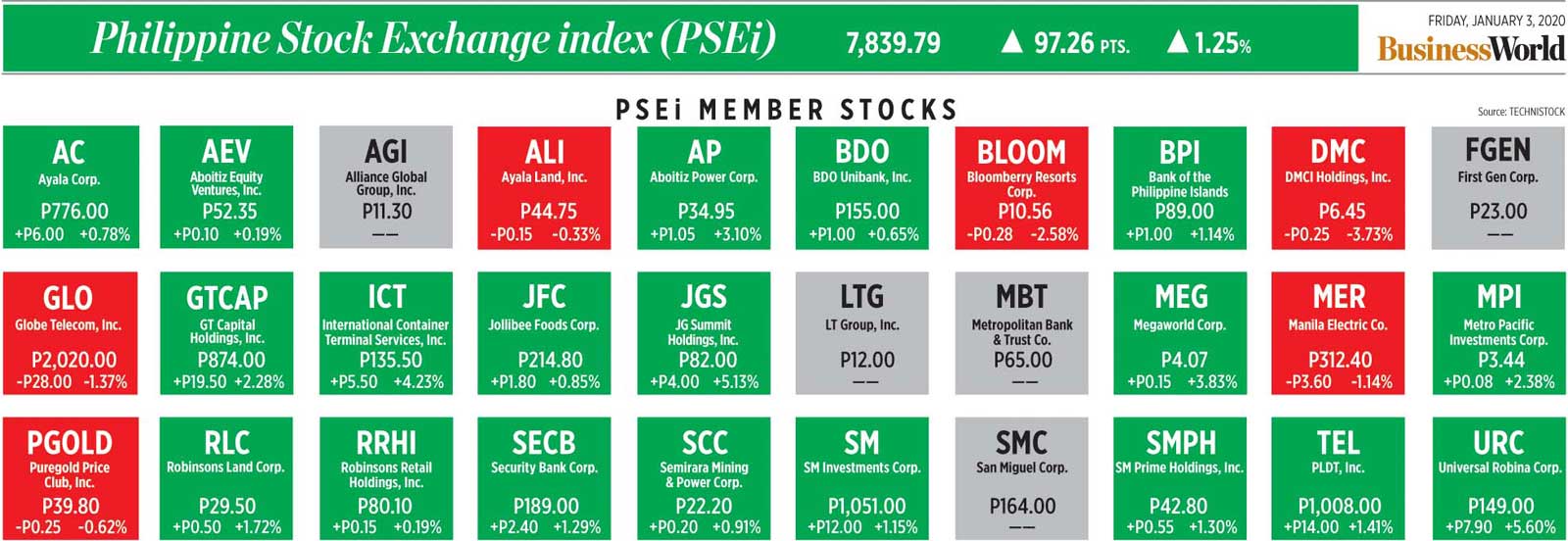
How PSEi member stocks performed — January 3, 2020

Here’s a quick glance at how PSEi stocks fared on Friday, January 3, 2020.